Introduction
Belize is the second smallest country in Central America, occupying 22,963 km2 (Meerman & Sabido, Reference Meerman and Sabido2001). Grass-dominated Neotropical savannah, which covers 12.3% of the country, is the second largest natural biome in Belize after lowland broadleaved forest (Meerman & Sabido, Reference Meerman and Sabido2001). These savannahs host high grass diversity (Bridgewater et al., Reference Bridgewater, Ibáñez, Ratter and Furley2002; Laughlin, Reference Laughlin2002; Bridgewater et al., Reference Bridgewater, Harris, Whitefoord, Monro, Penn, Sutton, Sayer, Adams, Balick, Atha, Solomon and Holst2006; Farruggia et al., Reference Farruggia, Stevens and Vincent2008; Goodwin et al., Reference Goodwin, López, Stuart, Bridgewater, Haston, Cameron, Michelakis, Ratter, Furley, Kay, Whitefoord, Solomon, Lloyd and Harris2013), but grasses are also found in all the varied terrestrial, and some aquatic, habitats across the country, occupying numerous ecological niches (Iremonger & Brokaw, 1999; Meerman & Sabido, Reference Meerman and Sabido2001; Penn et al., Reference Penn, Sutton and Monro2004; Urban et al., Reference Urban, Bridgewater and Harris2006).
Taxonomic work focusing specifically on Belizean grasses began with Standley & Record (Reference Standley and Record1936), who were the first to produce a checklist to the grasses of Belize, although their work was very brief and lacked an identification key. Swallen (Reference Swallen1955) used the work of Hitchcock (Reference Hitchcock1930) as a baseline for his Grasses of Guatemala; this also covered British Honduras (now Belize), which formed part of Guatemala at that time. As part of a long-term commitment to Central America, Missouri Botanical Garden began exploration in Belize in the late 1960s, with Spellman et al. (Reference Spellman, Dwyer and Davidse1975) producing an updated checklist to the monocots of Belize with 241 grass species. Building on this and many other studies, the highly comprehensive Flora Mesoamericana (Davidse et al., Reference Davidse, Mario Sousa and Chater1994; Flora Mesoamericana Online, 1997–) was produced, which is the most recent taxonomic treatment covering Belize that includes detailed species descriptions and a dichotomous key.
The most recent large-scale taxonomic work in the country has been through the Ethnobotany and Floristics of Belize Project (Ethnobotany and Floristics of Belize Project Collaborators, continuously updated), which was designed to catalogue the Belizean flora, and to explore the historical and present-day relationships between the people and plants of Belize. A highlight of the project has been the publication of a checklist to the vascular plants of Belize (Balick et al., Reference Balick, Nee and Atha2000), a work that has long been needed in the country and has formed the basis of this study. In this work, 248 species of grass belonging to 74 genera were recorded, excluding cultivated species, with the Poaceae found to be the third most speciose family of vascular plants in Belize. Subsequently, four additional species were found during a survey done by Bridgewater et al. (Reference Bridgewater, Harris, Whitefoord, Monro, Penn, Sutton, Sayer, Adams, Balick, Atha, Solomon and Holst2006), a further five species were found by Goodwin et al. (Reference Goodwin, López, Stuart, Bridgewater, Haston, Cameron, Michelakis, Ratter, Furley, Kay, Whitefoord, Solomon, Lloyd and Harris2013), and most recently Schizachyrium glaziovii Peichoto, previously known only from South America, was also discovered (Welker & Peichoto, Reference Welker and Peichoto2015). With continuing taxonomic work (Soreng et al., Reference Soreng, Davidse, Peterson, Zuloaga, Judziewicz, Filgueiras, Morrone and Romaschenko2000–), three species previously considered distinct by Balick et al. (Reference Balick, Nee and Atha2000), namely Eragrostis excelsa Griseb., Oryza alta Swallen and Urochloa fasciculata (Sw.) R.D.Webster, have also been placed as synonyms of species already recognised in the checklist (Balick et al., Reference Balick, Nee and Atha2000), thus bringing the total number of wild-growing species known from Belize to 255 (see the list at the end of this paper).
Taxonomic study has also led to certain genera being sunk within others. Hypogynium Nees has been sunk into Andropogon L. (Soreng et al., Reference Soreng, Peterson, Romaschenko, Davidse, Zuloaga, Judziewicz, Filgueiras, Davis and Morrone2015), Paspalidium Stapf into Setaria P.Beauv. (Morrone et al., Reference Morrone, Aliscioni, Veldkamp, Pensiero, Zuloaga and Kellogg2014), Pennisetum Rich. into Cenchrus L. (Chemisquy et al., Reference Chemisquy, Giussani, Scataglini, Kellogg and Morrone2010), Pentarrhaphis Kunth into Bouteloua Lag. (Soreng et al., Reference Soreng, Peterson, Romaschenko, Davidse, Zuloaga, Judziewicz, Filgueiras, Davis and Morrone2015), Rhynchelytrum Nees into Melinis P.Beauv. (Soreng et al., Reference Soreng, Peterson, Romaschenko, Davidse, Zuloaga, Judziewicz, Filgueiras, Davis and Morrone2015) and Spartina Schreb. into Sporobolus R.Br. (Soreng et al., Reference Soreng, Davidse, Peterson, Zuloaga, Judziewicz, Filgueiras, Morrone and Romaschenko2000–; Peterson et al., Reference Peterson, Romaschenko, Herrera Arrieta and Saarela2014; Soreng et al., Reference Soreng, Peterson, Romaschenko, Davidse, Zuloaga, Judziewicz, Filgueiras, Davis and Morrone2015). Other genera have been split, Chloris ciliata Sw. being placed in Stapfochloa H.Scholz (Peterson et al., Reference Peterson, Romaschenko and Herrera Arrieta2015), Aristida megapotamica Spreng. in Jarava Ruiz & Pav. (Peñailillo, Reference Peñailillo2002), and taxa of Leptochloa P.Beauv. in Dinebra Jacq. and Diplachne P.Beauv. (Peterson et al., Reference Peterson, Romaschenko, Snow and Johnson2012). Panicum L., which was once considered the most speciose genus of grasses in Belize (Balick et al., Reference Balick, Nee and Atha2000), has been split into numerous genera. Of the 34 species of Panicum recorded in Belize (Balick et al., Reference Balick, Nee and Atha2000; Goodwin et al., Reference Goodwin, López, Stuart, Bridgewater, Haston, Cameron, Michelakis, Ratter, Furley, Kay, Whitefoord, Solomon, Lloyd and Harris2013), 15 have been placed in nine other genera: Aakia J.R.Grande (1 sp.; Lizarazu et al., Reference Lizarazu, Nicola and Salariato2014), Coleataenia Griseb. (3 spp.; Soreng, Reference Soreng2010; Zuloaga et al., Reference Zuloaga, Scataglini and Morrone2010), Cyphonanthus Zuloaga & Morrone (1 sp.; Morrone et al., Reference Morrone, Scataglini and Zuloaga2007), Louisiella C.E.Hubb. & J.Léonard (1 sp.; Scataglini et al., Reference Scataglini, Lizarazu and Zuloaga2014), Megathyrsus (Pilg.) B.K.Simon & S.W.L.Jacobs (1 sp.; Simon & Jacobs, Reference Simon and Jacobs2003), Morronea Zuloaga & Scataglini (2 spp.; Scataglini & Zuloaga, Reference Scataglini and Zuloaga2013), Ocellochloa Zuloaga & Morrone (2 spp.; Sede et al., Reference Sede, Zuloaga and Morrone2009), Rugoloa Zuloaga (3 spp.; Acosta et al., Reference Acosta, Scataglini, Reinheimer and Zuloaga2014) and Steinchisma Raf. (1 sp.; Aliscioni et al., Reference Aliscioni, Giussani, Zuloaga and Kellogg2003). With these new discoveries and changes in nomenclature, the number of genera known from Belize is currently 81 (see the list).
The taxonomic treatments currently used to identify Belizean grasses cover a much greater number of taxa than are known from Belize (874 spp. in 176 genera in Davidse et al., Reference Davidse, Mario Sousa and Chater1994, and Flora Mesoamericana Online, 1997–; 455 spp. in 120 genera in Swallen, Reference Swallen1955), and as such have often used inconspicuous floral characters not easily seen in the field to key out taxa to genus level. Because 44 of the 81 genera found in Belize are represented by only 1 wild-growing species, and 17 genera represented by only 2 wild-growing species, it is possible to use more species-specific, easily distinguishable characters to differentiate genera. I present an illustrated identification key specific to the grass genera and species currently known from Belize, using, where possible, easily distinguishable characters. An up-to-date list of the grasses known from Belize, following current nomenclature (Soreng et al., Reference Soreng, Davidse, Peterson, Zuloaga, Judziewicz, Filgueiras, Morrone and Romaschenko2000–), is also given. It is hoped that this work will benefit conservation assessments and floristic surveys within Belize, enabling surveyors to identify this key plant family with greater ease.
Taxonomic Key
This key has been created for the 81 genera and 255 species of wild-growing grasses known from Belize (see the list at the end of this paper and Balick et al., Reference Balick, Nee and Atha2000; Bridgewater et al., Reference Bridgewater, Harris, Whitefoord, Monro, Penn, Sutton, Sayer, Adams, Balick, Atha, Solomon and Holst2006; Goodwin et al., Reference Goodwin, López, Stuart, Bridgewater, Haston, Cameron, Michelakis, Ratter, Furley, Kay, Whitefoord, Solomon, Lloyd and Harris2013; and Welker & Peichoto, Reference Welker and Peichoto2015), following current nomenclature (Soreng et al., Reference Soreng, Davidse, Peterson, Zuloaga, Judziewicz, Filgueiras, Morrone and Romaschenko2000–). No cultivated species have been included (see the list for the five species under cultivation). The number in square brackets, for example ‘[1]’, in each couplet refers to the couplet that led to it, so that readers may retrace their progress through the key. The number of species found in Belize appears in parentheses alongside the genus name. Where a number of species of a genus have been keyed out separately, this is noted with an asterisk after the genus name, and the relevant species epithets are found in the footnotes. The list that follows the keys gives the names of all species, including authorities, as well as recent synonyms since the publication of Balick et al. (Reference Balick, Nee and Atha2000), Bridgewater et al. (Reference Bridgewater, Harris, Whitefoord, Monro, Penn, Sutton, Sayer, Adams, Balick, Atha, Solomon and Holst2006) and Goodwin et al. (Reference Goodwin, López, Stuart, Bridgewater, Haston, Cameron, Michelakis, Ratter, Furley, Kay, Whitefoord, Solomon, Lloyd and Harris2013). For genus and species descriptions, and keys to the larger genera, see Flora Mesoamericana Online (Flora Mesoamericana Online, 1997–), GrassBase (Clayton et al., Reference Clayton, Vorontsova, Harman and Williamson2006–), Davidse et al. (Reference Davidse, Mario Sousa and Chater1994) and Swallen (Reference Swallen1955). Illustrations are taken and modified from Görts-van-Rijn & Judziewicz (Reference Görts-Van-Rijn and Judziewicz1990), courtesy of Koeltz Scientific Books, and depict the general characteristics of taxa present in Belize.
Master key
-
1a. Culms hard and woody; plants usually tall, (1–)2–15 m high; leaf blades frequently pseudopetiolate and emerging from clustered branches along the culm_________________________________________________Subkey 1
-
1b. Culms herbaceous and can be crushed between the fingers; plants often short, usually < 2 m tall; leaf blades with or without pseudopetioles, rarely emerging from clustered branches along the main culm (see Isachne)_____2
-
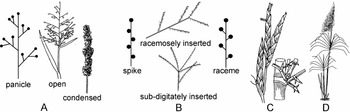
2a. [1] Spikelets inserted in a panicle (at least in the uppermost inflorescence), panicle open, contracted, or condensed and spike-like (NB: spikelets in racemes inserted in secondary branches of the main inflorescence axis, i.e. false panicles, are included here)__________________Subkey 2 (Fig. 1A)
-
2b. Spikelets inserted in a spike or raceme, or spikelets congested in 1-sided raceme-like primary branches (in Steinchisma laxum lower primary branches sometimes with secondary branching), spikes/racemes solitary, digitate/subdigitate or inserted racemosely on the main inflorescence axis (NB: false spikes of single-spikelet follicles sessile on the main inflorescence axis are included here, i.e. Cenchrus)_______________Subkey 3 (Fig. 1B)
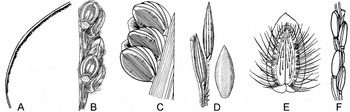
Characters used in the master key and characters of taxa in subkey 1. A, Spikelets held in a panicle, either open or condensed and spike-like; B, spikelets held in spikes or racemes, these inserted racemosely or subdigitately on the central inflorescence axis; C, Guadua , generalised spikelet and culm branch spines; D, Gynerium sagittatum , habit.

Subkey 1
Culms hard and woody; plants usually tall, (1–)2–15 m high; leaf blades frequently pseudopetiolate and emerging from clustered branches along the culm.
-
1a. Spines present on the lower culm branches; spikelets 50–130 mm long____________________________________Guadua longifolia (Fig. 1C)
-
1b. Stems lacking spines; spikelets < 25 mm long_______________________2
-
2a. [1] Culms solid, 30–50 mm diam. at the base; base of leaf blade narrow and merging with the sheath, blades linear; inflorescence a large terminal panicle Gynerium sagittatum (Fig. 1D)
-
2b. Culms hollow, 2–35 mm diam. at the base; base of leaf blade abruptly narrowed into a pseudopetiole before joining the sheath, blades elliptic; inflorescence composed of solitary spikes___________________________3
-
3a. [2] Stem diam. 20–35 mm, nodes with a skirt of white hairs; spikelets 10–15 mm long________________________________Merostachys pauciflora
-
3b. Stem diam. 2–8 mm, nodes without a skirt of white hairs; spikelets 16–25 mm long________________________________Rhipidocladum bartlettii
Subkey 2
Spikelets inserted in a panicle (at least in the uppermost inflorescence), panicle open, contracted, or condensed and spike-like. (NB: spikelets in racemes inserted in secondary branches of the main inflorescence axis, i.e. false panicles, are included here.)
-
1a. Leaf blades with pseudopetioles > 5 mm long________________________2
-
1b. Leaf blades without pseudopetioles or pseudopetioles < 5 mm long_______3
-
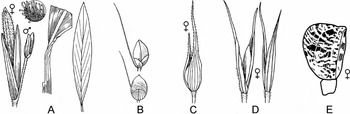
2a. [1] Leaf blade venation pinnate, cross-veins between the obliquely diverging main veins; spikelets paired, of two distinct types differing morphologically, sessile pistillate spikelets larger than pedicellate staminate ones, 12–19 mm long; spikelets never subtended by bristles; floret of sessile pistillate spikelets partly or wholly covered in hooked hairs_________Pharus (3 spp.; Fig. 2A)
-
2b. Leaf blade venation parallel to the midvein, no conspicuous cross-veins between the main veins; spikelets of one type, not differing morphologically, 3–4 mm long; spikelets sometimes subtended by a single bristle; florets not covered in hooked hairs__________________________Setaria Footnote 1 (Fig. 2B)
-
3a. [1] Large pistillate spikelets 8.5–34 mm long; spikelets of two distinct types on the same plant, staminate spikelets smaller and slenderer, reduced to a lemma and palea; leaf blades asymmetrical_________________________4
-
3b. Spikelets usually < 8.5 mm long, if longer then all of one type; leaf blades rarely markedly asymmetrical____________________________________6
-
4a. [3] Inflorescence solely terminal; large pistillate spikelets with the glumes unequal, the lower glume much longer than the upper glume_____________________________________Olyra (2 spp.; Fig. 2C)
-
4b. Inflorescences emerging both terminally and axillary, axillary inflorescences racemose or paniculate; large pistillate spikelets with the glumes equal or subequal_____________________________________________________5
-
5a. [4] Ligule usually conspicuous, 1–5.5 mm long, asymmetrical; pedicels not enlarged towards apex; pistillate floret gradually narrowed to a blunt tip; fruit never triangular or bony white__________Cryptochloa strictiflora (Fig. 2D)
-
5b. Ligule short, 0.5–0.7 mm long, symmetrical; pedicels of pistillate spikelets enlarged towards apex; pistillate floret obtriangular or helmet-shaped; fruit triangular, initially bony white turning mottled brown when mature_______________________________Lithachne pauciflora (Fig. 2E)
-
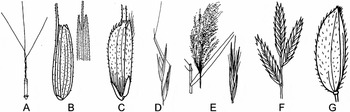
6a. [3] Inflorescence congested into a solitary terminal dense false spike 3–40 cm long, 5–30 mm wide (–60 mm wide in Setaria vulpiseta); spikelets sometimes subtended by long stiff bristles or tufted hairs (NB: Imperata panicles are sometimes diffuse but recognisable by spikelets subtended by tufted hairs that reach past the apex of the spikelet and spikelets falling singly, not in pairs, at maturity)____________________________________________7
-
6b. Inflorescence open to congested but never a solitary terminal false spike; spikelets never subtended by bristles, if spikelets subtended by tufted hairs then panicle more open and often spathulate_______________________14
-
7a. [6] Spikelets subtended by tufted hairs or long stiff bristles and/or glumes covered by long hairs; pedicels sometimes with stiff bristles____________8
-
7b. Spikelets not subtended by tufted hairs or bristles; glumes not covered by long hairs; pedicels lacking bristles_______________________________11
-
8a. [7] Spikelets subtended by, and pedicels sometimes with, long stiff bristles; spikelets lacking long hairs_______________________________________9
-
8b. Spikelets and pedicels without long stiff bristles; spikelets subtended by tufted hairs and/or glumes covered with long hairs________________________10
-
9a. [8] Culms 0.2–2 m tall, rarely thicker than 10 mm; spikelets planoconvex, 1–3(–3.7) mm long; pedicels with long stiff bristles_______Setaria Footnote 2 (Fig. 3A)
-
9b. Culms 2–8 m tall, 10–25 mm thick; spikelets lanceolate, 4.5–7 mm long; pedicels pilose, without long stiff bristles___Pennisetum purpureum (Fig. 3B)
-
10a. [8] Inflorescence hairs golden brown; culm nodes with tufted hairs_______________________________Eriochrysis cayennensis (Fig. 3C)
-
10b. Inflorescence hairs white; culm nodes hairless___Imperata (2 spp.; Fig. 3D)
-
11a. [7] Plants 0.75–3.5 m tall; blades 12–38 mm wide, flat; leaf blade base cordate, amplexicaul and usually more than twice as wide as the sheath; inflorescence spike 10–40 cm long × 1–2 cm wide; plant growing in and around rivers and lakes_____________Hymenachne amplexicaulis (Fig. 3E)
-
11b. Plants 0.05–1.1 m tall; blades 1–5(–8) mm wide, flat or involute; leaf blade base narrow and merging with the sheath; inflorescence spike 4–25 cm long × 0.4–0.8 cm wide (–3 cm wide in Eragrostis ciliaris); plants of generally dry areas_______________________________________________________12
-
12a. [11] Spikelets 6- to 11-flowered, laterally compressed; palea keels conspicuously ciliate________________________Eragrostis ciliaris (Fig. 3F)
-
12b. Spikelets 1- or 2-flowered, dorsally compressed or terete; palea keels not ciliate______________________________________________________13
-
13a. [12] Ligule an inconspicuous membrane, 0.2–0.4 mm long; spikelets 1-flowered; glumes and lemmas membranous, 1-nerved_____________________________________Sporobolus Footnote 3 (Fig. 3G)
-
13b. Ligule a conspicuous membrane, 1–2.5 mm long; spikelets 2-flowered; glumes and lemmas herbaceous, 3- to 7-nerved_________________________________Sacciolepis myuros (Fig. 3H)
-
14a. [6] Inflorescence a pseudopanicle of short racemes of paired spikelets, one sessile on the rachis, the other pedicellate with the pedicel emerging from the base of the sessile spikelet (spikelets can occur in threes at branch apex, i.e. 1 sessile and 2 pedicellate); pedicellate spikelets usually staminate or sterile, sometimes reduced or lost, leaving only the pedicel; spikelet pair with joining pedicel falling as a unit at maturity; pseudopanicles sometimes interrupted by reddish spathes_______________________________________15 (Fig. 4A)
-
14b. Inflorescence a panicle (pseudopanicle in Urochloa fusca and Acroceras zizanioides) with spikelets solitary or in groups, but if paired or in threes, all spikelets pedicellate; spikelets that are inserted in groups rarely reduced or staminate; spikelets falling in groups, solitarily, or breaking up above the glumes at maturity (i.e. with the glumes remaining on the plant after fruiting); panicles never spathulate_______________________________22
-
15a. [14] Inflorescence interrupted by reddish (rarely green) spathes that subtend the short racemes of paired sessile and pedicellate spikelets___________16
-
15b. Inflorescence lacking spathes____________________________________20
-
16a. [15] Spikelets not subtended by hairs; pedicels minutely hairy or glabrous____________________________________________________17
-
16b. Spikelets subtended by tufted hairs and/or pedicels covered with long hairs_______________________________________________________18
-
17a. [16] Short annuals 4–60 cm tall; leaf blades 1–3.5 cm long; inflorescence a simple false panicle_________________________Schizachyrium brevifolium
-
17b. Tall perennials 95–165 cm tall; leaf blades 10–50 cm long; inflorescence a large false panicle_______________________Andropogon virgatus (Fig. 4B)
-
18a. [16] Sessile spikelets with robust awns exserted 15–30 mm, lower part of awns covered in short hairs________________Hyparrhenia (2 spp.; Fig. 4C)
-
18b. Sessile spikelets with filamentous awns or awnless; if awned, awns glabrous or scabrid, exserted 5–17 mm___________________________________19
-
19a. [18] Lower glume of sessile spikelet inwardly concave (or rarely flat), without nerves between the keels; stem internodes cylindrical, usually hollow, rarely solid; sessile spikelets awned or awnless; lower glume apex acute______________________________________Andropogon Footnote 4 (Fig. 4D)
-
19b. Lower glume of sessile spikelet outwardly convex or flat between the keels, never inwardly concave, with 1–9 nerves between the keels (sometimes nerves only apparent towards glume apex); stem internodes markedly to slightly flattened, solid; sessile spikelets always awned; lower glume apex bifid_____________________________________Schizachyrium Footnote 5 (Fig. 4E)
-
20a. [15] Pedicellate spikelets absent, with only the pedicels remaining or reduced to sterile rudiments; stem internodes hollow_______________________________Sorghastrum setosum (Fig. 4F)
-
20b. Pedicellate spikelets well developed, similar to the sessile spikelets but awnless, staminate or sterile; stem internodes solid__________________21
-
21a. [20] Ligule c.1 mm long; blades 2–12 mm wide; sessile spikelets 3–4.5 mm long; pedicellate spikelets 2–3.5 mm long; lower glume sometimes with a glandular pit in its centre, apex rounded to acute; pedicels, and usually upper branch internodes, on upper part of inflorescence with a central groove or membranous area_______________________Bothriochloa bladhii (Fig. 4G)
-
21b. Ligule 3–6 mm long; blades 12–40 mm wide; sessile spikelets 4–6.5 mm long; pedicellate spikelets 4–5.7 mm long; lower glume lacking a glandular pit in its centre, apex 3-dentate; pedicels and upper branch internodes on upper part of inflorescence lacking a central groove or membranous area__________________________________Sorghum halepense (Fig. 4H)
-
22a. [14] Spikelets prominently awned; awns > 1 mm long________________23
-
22b. Spikelets awnless, or mucronate; mucro < 1 mm long________________29
-
23a. [22] Lemmas 3-awned_________________________________________24
-
23b. Lemmas 1-awned_____________________________________________25
-
24a. [23] Glumes acuminate to short awned, awns < 5 mm long____________________________________Aristida (9 spp.)Footnote 6 (Fig. 5A)
-
24b. Glumes long-awned, lower glume with awns > 10 mm long, upper glume with awns c.5 mm long_____________________________Jarava megapotamica
-
25a. [23] Annuals; spikelets (not including awns) < 2.5 mm long____________________________26
-
25b. Perennials; spikelets (not including awns) > 3.5 mm long (NB: some spikelets can appear < 3.5 mm long because the long acuminate tips are misinterpreted as awns)________________________________________27
-
26a. [25] Plants > 60 cm tall; spikelets 2-flowered, with 3 bracts below the fertile floret; glumes unequal, lower glume much shorter than upper glume; plants sticky, with a characteristic strong sweet smell__Melinis minutiflora (Fig. 5B)
-
26b. Plants < 30 cm tall; spikelets 1-flowered, with 2 bracts below the fertile floret; glumes equal in length; plants not sticky or strong-smelling______________________________________Muhlenbergia tenella
-
27a. [25] Spikelets conspicuously laterally compressed; glumes less than half the length of the spikelet; lemmas distinctly ridged, with keel on the midrib_____________________________________Oryza latifolia (Fig. 5C)
-
27b. Spikelets dorsally compressed or terete; glumes more than half the length to exceeding the spikelet; lemma surface smooth and without a keel on the midrib______________________________________________________28
-
28a. [27] Spikelets 3.5–6 mm long; sheaths usually papillose-hispid and/or ciliate; glumes unequal in length, upper glume much longer than lower glume, exceeding the spikelet____________________Arundinella (2 spp.; Fig. 5D)
-
28b. Spikelets 15–23 mm long; sheaths glabrous; glumes equal or subequal in length, shorter than the spikelet______________________Aristida ternipes
-
29a. [22] Spikelets 11–20 mm long, lanceolate; the rachilla between the fertile florets densely covered in long fine silky hairs giving a plumose appearance when flowering; plants of aquatic or wet habitat________________________________Phragmites australis (Fig. 5E)
-
29b. Spikelets usually < 10 mm long, globose to lanceolate, if > 10 mm long the rachilla between the florets never covered in long silky hairs; plants of varying habitat_____________________________________________________30
-
30a. [29] Spikelets with 3 or more florets, laterally compressed (often conspicuously) with midrib of glumes and lemmas usually keeled_______31
-
30b. Spikelets with 1 or 2 florets, laterally or dorsally compressed, if glumes or lemmas with prominent keels then 1- or 2-flowered__________________32
-
31a. [30] Glumes 3- to 7-nerved; lemmas 5- to 11-nerved; plants dioecious________________________________________Distichlis spicata
-
31b. Glumes generally 1-nerved, rarely 3-nerved; lemmas 3-nerved; plants monoecious_____________________________Eragrostis (13 spp.; Fig. 5F)
-
32a. [30] Spikelets inserted in 2 rows on one side of the rachis; spikelets 1-flowered; glumes missing, with only a conspicuously laterally compressed and hardened lemma and palea present_____________Leersia (2 spp.; Fig. 5G)
-
32b. Spikelets inserted on both sides or all around the rachis; spikelets 1- or 2-flowered; glumes or glume-like sterile bracts present, all spikelets having 3 or more bracts, not conspicuously laterally compressed and hardened______33
-
33a. [32] Spikelets globose, 1–2 mm long; glumes equal and slightly shorter than spikelet, enclosing 2 hardened fertile florets both similar in shape; glumes lightly pubescent towards their tips or glabrous____Isachne (3 spp.; Fig. 6A)
-
33b. Combination of characters not as above; spikelets ovoid, ellipsoid, elliptic lanceolate or subglobose, 1–6 mm long (if subglobose, i.e. Lasiacis, > 2.6 mm long with glumes unequal, hardened fertile floret 1, and woolly hairs emerging from the tips of the glumes, lemmas and/or paleas); glumes equal or unequal, as long as the spikelet to much shorter; fertile florets 1 or 2, either hardened or herbaceous, if hardened then only 1 hardened floret present; glumes glabrous to densely pubescent____________________________34
-
34a. [33] Glumes, lemmas and/or paleas with woolly hairs arising from the tips, turning shiny black at maturity; spikelets subglobose and generally large, > 3.5 mm long, rarely as short as 2.6 mm, placed obliquely on the pedicels; lower glumes 5- to 11-nerved; upper glume and lower lemma 7- to 13-nerved; leaf blade base often pseudopetiolate; leaf blades elliptical or obovate; growing in rain forest (NB: the woolly hairs in Lasiacis can sometimes be short and indistinct, so many spikelets should be checked.)________________________________Lasiacis (10 spp.; Fig. 6B)
-
34b. Combination of characters not as above; glumes, lemmas and/or paleas glabrous to pilose but not with woolly hairs arising solely from the tips, green to purple when mature; spikelets globose to lanceolate and generally small, < 3 mm long, rarely longer, erect on the pedicels; lower glumes 0- to 9-nerved or absent; upper glume and lower lemma 1- to 15-nerved; leaf blade base rarely pseudopetiolate, usually rounded abruptly before joining the sheath, or narrow and merging with the sheath; leaf blades elliptical or obovate to linear; growing in a variety of habitats including rain forest______________________________________________________35
-
35a. [34] Lowermost sterile/staminate bracts of spikelet, i.e. glumes and lower lemma, lightly to densely pubescent, at least at the tips (lower glume, if present, often glabrous), enclosing the perfect floret_________________36
-
35b. Lowermost sterile/staminate bracts of spikelet, i.e. glumes (and often lower lemma), scabrous or glabrous, enclosing the perfect floret or much shorter_____________________________________________________41
-
36a. [35] Lowermost sterile/staminate bracts of spikelet, i.e. glumes and lower lemma, densely covered with long hairs; perfect floret herbaceous; spikelets 3–5 mm long________________________________________________37
-
36b. Lowermost sterile/staminate bracts of spikelet, i.e. glumes and lower lemma, sparsely to densely pilose with usually short hairs; perfect floret hardened and often shiny; spikelets 1–3.7 mm long_____________________________38
-
37a. [36] Spikelets elliptic-lanceolate, dorsally compressed, hairs covering spikelets as long as 2 mm, light or dark, never reddish, purple or silver; ligule a minute ciliate membrane c.0.2 mm long____Anthaenantia lanata (Fig. 6C)
-
37b. Spikelets ovoid, laterally compressed; hairs covering spikelets as long as 8.5 mm, reddish, purple or silver; ligule a ring of hairs c.1 mm long_______________________________________Melinis repens (Fig. 6D)
-
38a. [36] Hardened perfect floret distinctly transversely rugose; spikelets 2.8–3.7 mm long; culms 50–300 cm tall; panicles 13–60 cm long; leaf blades linear, 20–85 cm long, 8–35 mm wide__Megathyrsus maximus (see Fig. 8B)
-
38b. Hardened perfect floret smooth to rugulose; spikelets 0.9–3.6 mm long; culms 5–200 cm tall; panicles 1.5–57 cm long; leaf blades linear lanceolate to ovate, or if linear then 0.6–5 mm wide, 2–54 cm long, 0.6–28 mm wide__39
-
39a. [38] Hardened perfect floret with simple papillae all over its surface and long unicellular macrohairs towards the apex; spikelets lanceolate, 2.5–3.6 mm long, acuminate to shortly awned, in pairs on the rachis; lower glume a nerveless rudiment, 1/30–1/5 length of the spikelet, 0.1–1 mm long; upper glume and lower lemma 3- to 5-nerved; leaf blades 16–54(–70) cm long, 10–33 mm wide____________________________________Aakia tuerckheimii
-
39b. Hardened perfect floret smooth or papillose, lacking macrohairs or sparsely puberulent with minute globular trichomes in Panicum hirtum; spikelets ovoid to oblanceolate, sometimes (ob)planoconvex, 1–3.6 mm long, acute to obtuse, solitary or paired on the rachis; lower glume 1- to 3(–5)-nerved, rarely enerved in Dichanthelium, 1/4–2/3(–1/1, i.e. as long as the spikelet, in P. hirtum) the length of the spikelet, 0.4–2.9 mm long; upper glume and lower lemma 3- to 9(–15)-nerved; leaf blades 2–43 cm long, 0.6–28 mm wide (NB: Panicum tricanthum spikelets sometimes sparsely pilose with lower glume enerved but spikelets ellipsoid, 1.2–1.6 mm long)_____________40
-
40a. [39] Upper glume and lower lemma 7- to 9(–15)-nerved (5-nerved in Dichanthelium strigosum); plants frequently forming a basal rosette of short wide leaves different from the longer thinner cauline leaves; only terminal inflorescences flower, spikelets of axillary inflorescences cleistogamous; lower palea present; pseudoligule of hairs 1.5–5.5 mm long sometimes present and conspicuous behind the ligule at the base of the leaf blade__Dichanthelium Footnote 7
-
40b. Upper glume and lower lemma usually 3- to 5-nerved (7- to 9-nerved in Panicum rudgei but recognisable by shortly stipitate hardened fertile floret); plants not forming a basal rosette of short wide leaves, leaves at the base similar to cauline leaves; all spikelets of inflorescence flower at once; lower palea present or absent; pseudoligules absent______Panicum Footnote 8 (Fig. 7A, B)
-
41a. [35] Lower and upper glume equal in length and as long as the spikelet, enclosing 2 herbaceous florets; spikelets elliptic-lanceolate and dorsally compressed, 6–8 mm long________________Homolepis aturensis (Fig. 7C)
-
41b. Glumes unequal in length (subequal in Eragrostis polytricha and some Sporobolus spp., but then much shorter than the spikelet), lower glume shorter than the spikelet (upper glume also shorter than the spikelet in E. polytricha and some Sporobolus); florets 1 or 2, herbaceous, rigid or hardened; spikelets rarely elliptic lanceolate, and if so, combination of characters not as above, dorsally or laterally compressed, 1–6(–7) mm long_______________________________________________________42
-
42a. [41] Both glumes shorter than the spikelet; spikelets disarticulating above the glumes, with glumes remaining in the inflorescence with their pedicel after the grains have fallen; leaf blade base narrow and merging with the sheath; leaves linear_________________________________________________43
-
42b. At least 1 of the 2 lowermost sterile bracts (i.e. glumes, or upper glume and glume-like lower lemma if lower glume lost) as long as the spikelet; spikelets disarticulating below the glumes, with the glumes and grain falling together at maturity; leaf blade base narrow and merging with the sheath, or cordate, pseudopetiolate or rounded abruptly before joining the sheath; leaves linear to elliptical or obovate_________________________________________44
-
43a. [42] Spikelets 2-flowered; glumes subequal, herbaceous; lemmas herbaceous, 3-nerved, scabrous on the keel__________________________________Eragrostis polytricha
-
43b. Spikelets 1-flowered; glumes subequal or unequal with the lower glume shorter than the upper, membranous; lemmas membranous, 1-nerved, glabrous____________________________________Sporobolus Footnote 9 (Fig. 7D)
-
44a. [42] Spikelet midribs keeled either for their entirety or just towards the tips; spikelets laterally compressed (Acroceras spikelets sometimes appear dorsally compressed but have a prominent keel at the tips); perfect floret rigid or hardened, if floret hardened then with a short stipe at base bearing membranous appendages/wings adnate to the base of the lemma (i.e. Ichnanthus); leaf blade base cordate, pseudopetiolate, or rounded abruptly before joining the sheath; leaves lanceolate to ovate_________________45
-
44b. Spikelet midribs lacking keels (rarely slightly apically keeled in some species of Panicum); spikelets dorsally compressed; perfect floret usually hardened, less often rigid, never with a short stipe or membranous appendages at its base; leaf blade base variable, narrow and merging with the sheath, cordate, pseudopetiolate, or rounded abruptly before joining the sheath; leaves variable, linear to ovate________________________________________46
-
45a. [44] Glume apices acuminate to awned; midrib of both glumes with a prominent keel running for the entirety of the glume; perfect floret hardened, with a short stipe at base bearing 2 membranous appendages adnate to the base of the lemma (these appendages can be reduced or indicated only by scars); blade bases usually asymmetrical, cordate, rounded, or often abruptly narrowed into a pseudopetiole______________Ichnanthus (8 spp.; Fig. 7E)
-
45b. Glume apices blunt to acute, never acuminate or awned; upper glume, lower lemma and upper lemma with a keel towards the tip, the lower part rounded; perfect floret rigid, never with a short stipe or membranous appendages; blade bases symmetrical, cordate, never pseudopetiolate________________________Acroceras zizanioides (Fig. 7F)
-
46a. [44] Hardened perfect floret surface rugose/rugulose wrinkled__________47
-
46b. Hardened perfect floret surface never rugulose, smooth and shiny, finely striate, or with simple or compound papillae covering the surface_______49
-
47a. [46] Inflorescence a false panicle of short open racemes; spikelets in pairs, triplets or up to 5 with pedicels emerging from the same point on the rachis, rarely solitary; spikelets obovoid with a short acute apex; upper glume and lower lemma often with reticulate cross-veins on their surface____________________________________Urochloa fusca (Fig. 8A)
-
47b. Inflorescence a true panicle; spikelets solitary, oblong-ellipsoid or obplanoconvex, with an obtuse or subacute apex; upper glume and lower lemma lacking reticulate cross-veins______________________________48
-
48a. [47] Spikelets 2.8–3.7 mm long; hardened upper floret distinctly transversely rugose; herbaceous lower floret staminate; culms 0.5–3 m tall; panicles 13–60 cm long; leaf blades linear, symmetrical, 20–85 cm long, 8–35 mm wide________________________________Megathyrsus maximus (Fig. 8B)
-
48b. Spikelets 1–2.3 mm long; hardened upper floret minutely to clearly rugulose; herbaceous lower floret sterile; culms 0.1–1.5 m tall; panicles 4–28 cm long; leaf blades lanceolate to ovate, asymmetrical, 2–17 cm long, 7–28 mm wide_________________________________________Panicum Footnote 10 (Fig. 8C)
-
49a. [46] Hardened perfect floret pilose at the base and tip or all over_______50
-
49b. Hardened perfect floret glabrous or scabrous (sometimes puberulent towards the tip in Coleataenia rigidula but never at the base)_________________51
-
50a. [49] Hardened perfect floret pilose at the base and tip; spikelets gibbous; upper glume and lower lemma 3-nerved; growing in wet areas____________________________________Cyphonanthus discrepans
-
50b. Hardened perfect floret with conspicuous macrohairs all over its surface (sparsely pilose in Morronea parviglumis); spikelets not gibbous; upper glume and lower lemma 5- to 7-nerved; usually growing in drier areas, forest edges, etc.____________________________________________Morronea (2 spp.)
-
51a. [49] Aquatic perennial, 1–6 m tall; blades 20–50 cm long; panicles 25–50 cm long; spikelets (3.3–)4.5–5.6 mm long, lanceolate; lower palea reduced or absent; lower glume reduced, nerveless and hyaline__Louisiella elephantipes
-
51b. Combination of characters not as above; annuals or perennials, usually not aquatic, usually < 2 m tall (rarely taller, e.g. Panicum altum and P. amarum); blades 2–50 cm long; panicles 1–25(–51) cm long; spikelets 1.2–3.5(–7.7) mm long, usually ovoid; lower palea present or absent; lower glume reduced and hyaline or developed and herbaceous with nerves_________52
-
52a. [51] Upper glume and lower lemma (3–)7- to 9(–15)-nerved, if 3- or 5-nerved then hardened perfect floret with compound papillae present only at the apex of the palea (and apex of lemma in some species), i.e. Panicum, or plants with a basal rosette of short wide leaves different from the longer thinner cauline leaves, i.e. Dichanthelium strigosum; lower palea present or absent______________________________________________________53
-
52b. Upper glume and lower lemma 5-nerved (sometimes 7-nerved in Coleataenia stenodes and Morronea parviglumis); hardened perfect floret either smooth, shiny, without papillae and usually with prickle hairs towards the apex of the lemma (Coleataenia) or covered with simple papillae (Morronea) regularly distributed over the lemma and palea; lower palea present (Coleataenia) or absent (Morronea)____________________________________________54
-
53a. [52] Spikelets 0.9–2.2 mm long; upper glume and lower lemma 7- to 9(–15)-nerved (5-nerved in Dichanthelium strigosum); plants frequently forming a basal rosette of short wide leaves different from the longer thinner cauline leaves; only terminal inflorescences flower, spikelets of axillary inflorescences cleistogamous; lower palea present; hardened perfect floret usually with simple papillae covering the surface of the lemma and palea___________________________________________Dichanthelium Footnote 11
-
53b. Spikelets 1.2–7.7 mm long; spikelets < 2 mm long usually with upper glume and lower lemma (3–)5-nerved (upper glume rarely 7-nerved in Panicum trichidiachne), spikelets > 2 mm usually with upper glume and lower lemma (5–)7- to 9(–13)-nerved (NB: P. hirsutum spikelets 7- to 9-nerved, 1.8–2.2 mm long); plants not forming a basal rosette of short wide leaves, leaves at the base similar to cauline leaves; all spikelets of inflorescence flower at once; lower palea present or absent; hardened perfect floret with compound papillae present only at the apex of the palea (and apex of lemma in some species)______________________________________Panicum Footnote 12 (Fig. 8D)
-
54a. [52] Hardened perfect floret smooth, shiny, without papillae and often with prickle hairs (sometimes puberulent towards the tip in Coleataenia rigidula); sheaths generally glabrous or with a few auricular hairs; lower palea present, 1/3–3/4 length of lower lemma____________________Coleataenia (3 spp.)
-
54b. Hardened perfect floret covered with simple papillae regularly distributed over the lemma and palea, prickle hairs and pubescence absent; sheaths papillose-hispid; lower palea absent_______________________Morronea parviglumis
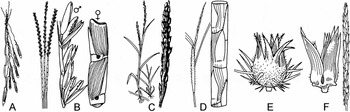
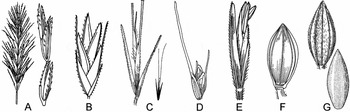
Characters of taxa in subkey 2. A, Pharus , generalised pistillate and staminate spikelet pair, close-up of hooked hairs of the sessile pistillate spikelet, pseudopetiole, and leaf blade with pinnate venation; B, Setaria ,1 spikelet (lateral and dorsal views); C, Olyra , generalised pistillate spikelet; D, Cryptochloa , two views of pistillate spikelet; E, Lithachne pauciflora , pistillate spikelet.

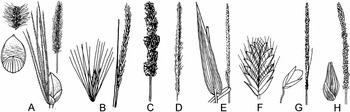
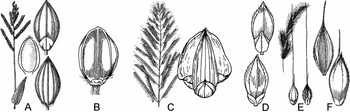
Characters of taxa in subkey 2. A, Setaria ,2 generalised spikelet (dorsal and lateral views) and inflorescence; B, Pennisetum , generalised spikelet and inflorescence; C, Eriochrysis cayennensis , inflorescence; D, Imperata , generalised inflorescence; E, Hymenachne amplexicaulis , leaf blade and inflorescence; F, Eragrostis ciliaris , spikelet; G, Sporobolus ,3 generalised spikelet and inflorescence; H, Sacciolepis myuros , spikelet and inflorescence.

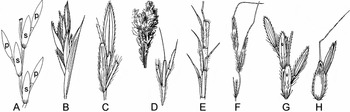
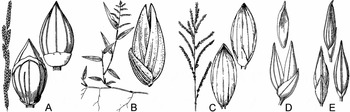
Characters of taxa in subkey 2. A, Generalised andropogonoid spikelet pairing (p, pedicellate spikelet; s, sessile spikelet on rachis); B, Andropogon virgatus , raceme; C, Hyparrhenia , generalised spikelet pair; D, Andropogon , generalised spikelet pair and inflorescence; E, Schizachyrium , generalised portion of raceme; F, Sorghastrum setosum , portion of raceme; G, Bothriochloa bladhii , portion of raceme; H, Sorghum halepense , spikelet pair.

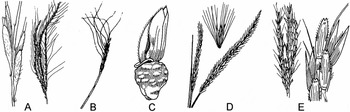
Characters of taxa in subkey 2. A, Aristida , generalised spikelet; B, Melinis minutiflora , spikelet (only showing part of the awn) and apex of lower lemma; C, Oryza latifolia , spikelet (only showing base of the awn); D, Arundinella , generalised spikelet pair; E, Phragmites australis , inflorescence, part of culm and spikelet; F, Eragrostis , generalised spikelets; G, Leersia , generalised spikelet.

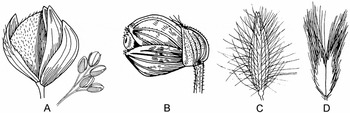
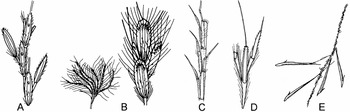
Characters of taxa in subkey 2. A, Isachne , generalised spikelet and portion of inflorescence; B, Lasiacis , generalised spikelet; C, Anthaenantia lanata , spikelet; D, Melinis repens , spikelet.

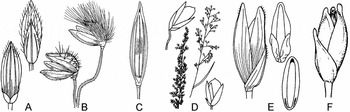
Characters of taxa in subkey 2. A, Panicum rudgei , spikelet (dorsal and ventral views); B, Panicum hirtum , spikelets at different stages of maturity; C, Homolepis aturensis , spikelet (ventral view); D, Sporobolus ,9 generalised spikelets and open to semicontracted panicles; E, Ichnanthus , generalised spikelet and perfect florets with membranous appendages or scars at the base of the lemma; F, Acroceras zizanioides , spikelet.

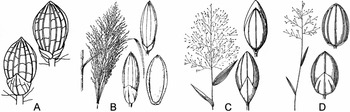
Characters of taxa in subkey 2. A, Urochloa fusca , spikelet (dorsal and ventral views); B, Megathyrsus maximus , inflorescence, culm and leaf, spikelet (dorsal and ventral views) and hardened floret (ventral view); C, Panicum trichoides , portion of plant and spikelet (dorsal and ventral views); D, Panicum parvifolium , portion of plant and spikelet (dorsal and ventral views).

Subkey 3
Spikelets inserted in a spike or raceme, or spikelets congested in 1-sided raceme-like primary branches (in Steinchisma laxum lower primary branches sometimes with secondary branching), spikes/racemes solitary, digitate/subdigitate or inserted racemosely on the main inflorescence axis. (NB: false spikes of single-spikelet follicles sessile on the main inflorescence axis are included here, i.e. Cenchrus.)
-
1a. Leaf blade base abruptly narrowed into a pseudopetiole, blades asymmetrical, 5–9.5 cm wide; inflorescence a single spike 15–32 cm long composed of 40–100 pseudospikelets, each pseudospikelet 13–17 mm long with c.11 rigid bracts subtending a single hermaphroditic floret; awns spirally twisted, 30–40 mm long________________________Streptochaeta sodiroana (Fig. 9A)
-
1b. Leaf blades not pseudopetiolate, symmetrical (sometimes pseudopetiolate and/or asymmetrical in Ichnanthus and Echinolaena), blades < 5 cm wide; floral characters not as above____________________________________2
-
2a. [1] Spikelets (at least the lower) sunk into the swollen rachis of the raceme/spike_________________________________________________3
-
2b. Spikelets all free on the rachis____________________________________5
-
3a. [2] Inflorescence composed of two distinct parts, the lower portion of the raceme with pistillate spikelets sunk into the whitened thickened rachis, whereas the upper portion of the raceme has staminate spikelets free and arranged on one side of the flattened rachis; plants usually 3–6 m tall_____________________________________Tripsacum (3 spp.; Fig. 9B)
-
3b. Inflorescence not composed of distinct parts, with spikelets sunk into the rachis throughout (Rottboellia has spikelet pairs of one sessile spikelet sunken into the rachis and one pedicellate spikelet); plants < 2 m tall___________4
-
4a. [3] Leaf sheaths glabrous, strongly keeled; leaf blades glabrous with a rounded apex; plants stoloniferous; swollen rachis flattened, with spikelets sunken in 2 rows on one or both sides of the swollen rachis___________________________Stenotaphrum secundatum (Fig. 9C)
-
4b. Leaf sheaths strongly papillose-hirsute (hairs irritating to touch), rounded; leaf blades with hairs present and an acute apex; plants tufted; swollen rachis cylindrical, with spikelets sunken all around the swollen rachis___________________________Rottboellia cochinchinensis (Fig. 9D)
-
5a. [2] Spikelets hidden inside a subtending spiny or spineless involucre______6
-
5b. Spikelets free on the rachis and not subtended by an involucre__________7
-
6a. [5] Involucre spiny_____________________________Cenchrus Footnote 13 (Fig. 9E)
-
6b. Involucre not spiny_________________Anthephora hermaphrodita (Fig. 9F)
-
7a. [5] Awns 2.5–12 cm long, prominent, thickened, geniculate and hairy; inflorescence a solitary raceme (rarely 2 racemes)____________________8
-
7b. Awns absent or < 2.5 cm long, filamentous, either scabrid or glabrous (Hyparrhenia [Fig. 4C] has hairy awns to 3 cm long but inflorescence in paired racemes subtended by coloured bracts); inflorescence composed of 1 to many racemes or spikes______________________________________________9
-
8a. [7] Culms and sheaths rounded; ligule a glabrous membrane; spikelet pairs all similar along a slender continuous rachis, short pedicelled spikelet staminate and awnless, long pedicelled spikelet perfect and long-awned______________________________Trachypogon spicatus (Fig. 10A)
-
8b. Culms flattened, sheaths conspicuously keeled; ligule a ciliate membrane; lower few spikelet pairs staminate and awnless, above this the sessile spikelets are perfect and long-awned whereas the pedicellate spikelets are staminate and awnless________________Heteropogon contortus (Fig. 10B)
-
9a. [7] Spikes/racemes solitary or digitate/subdigitate, mostly arising from a central point on the peduncle (NB: Bouteloua scabra, with fascicles comprising a single spikelet and subtending bristles inserted along a central inflorescence axis, included here)____________________________________10 (Fig. 1B)
-
9b. Spikes, racemes or raceme-like primary inflorescence branches arranged racemosely on the central inflorescence axis (NB: sometimes racemes congested on the central axis, so check closely)_____________36 (Fig. 1B)
-
10a. [9] Spikelets inserted on both sides or all around the rachis of the spike or raceme_____________________________________________________11
-
10b. Spikelets inserted on one side of the rachis of the spike or raceme________20
-
11a. [10] Spikelets awnless, or if awned, awns < 1 mm long_______________12
-
11b. Spikelets (at least some) prominently awned, awns > 1 mm long_______14
-
12a. [11] Spikelets of two distinct types in pairs on the raceme, one a rugose ball, the other dorsally compressed, neither subtended by long hairs; sheaths hairy; pedicels glabrous_________________Mnesithea granularis (Fig. 10C)
-
12b. Spikelets all similar, subtended by long hairs; sheaths glabrous; pedicels, if present, covered in long hairs___________________________________13
-
13a. [12] Inflorescence a single congested terminal spike/raceme per peduncle; spikelets solitary or in groups of 2–5, if paired then both pedicellate__________________________________Cenchrus Footnote 14 (Fig. 10D)
-
13b. Inflorescence (1–)2–5 digitate racemes per peduncle; spikelets paired, one sessile on the rachis, the other pedicellate, the pedicel emerging from the base of the sessile spikelet (sometimes the pedicellate spikelet is reduced leaving only the pedicel)______________________Andropogon Footnote 15 (Fig. 4A)
-
14a. [11] Leaf blades broad, ≥ 10 mm wide, base cordate or rounded abruptly before joining the sheath_______________Ischaemum latifolium (Fig. 10E)
-
14b. Leaf blades narrow, 1–5(–7) mm wide, base merging with the sheath, not rounded____________________________________________________15
-
15a. [14] Spikelet subtended by 5 dark bristles, solitary, laterally compressed; spikelet and subtending bristles falling as a unit at maturity; glumes shorter than the spikelet, awned____________________________Bouteloua scabra
-
15b. Spikelets not subtended by bristles, paired, 1 sessile and 1 pedicellate (sometimes the pedicellate spikelet rudimentary with only the pedicel apparent, i.e. Andropogon virginicus), dorsally compressed; spikelet pair with joining pedicel falling as a unit at maturity; lower glume as long as or longer than the spikelet; glumes awnless________________________16 (Fig. 4A)
-
16a. [15] Awns 14–30 mm long; stem nodes often with tufted white hairs____17
-
16b. Awns < 14 mm long (11–17 mm in Andropogon virginicus); stem nodes hairless_____________________________________________________19
-
17a. [16] Racemes paired and subtended by a coloured bract; sessile spikelets with awns exserted 15–30 mm; lower part of awns covered in short hairs__________________________________Hyparrhenia (2 spp.; Fig. 4C)
-
17b. Racemes (1–)2–7, not subtended by bracts; sessile spikelets with awns 14–20 mm long; awns glabrous or scabrid____________________________18
-
18a. [17] Sheaths keeled, usually hairy; lower glume usually with a pitted hole in its centre_____________________________Bothriochloa pertusa (Fig. 11A)
-
18b. Sheaths rounded, glabrous; glumes never with pitted holes_____________________________Dichanthium annulatum (Fig. 11B)
-
19a. [16] Stem internodes markedly to slightly flattened, solid; ligule a short membrane 0.5–1 mm long; racemes 1 per peduncle; lower glume outwardly convex or flat between the keels, but never inwardly concave, with 1–9 nerves between the keels (sometimes nerves only apparent towards apex of glume); lower glume apex bifid; upper lemma of sessile spikelet with ciliate margins________________________________Schizachyrium Footnote 16 (Fig. 11C)
-
19b. Stem internodes cylindrical, usually hollow, rarely solid; ligule a ciliate membrane (0.7–)1–2.5(–8) mm long; racemes 1–6 per peduncle; lower glume inwardly concave or flat and without nerves between the keels; lower glume apex acute; upper lemma of sessile spikelet with entire margins__________________________________Andropogon Footnote 17 (Fig. 11D)
-
20a. [10] Spikelets (at least some) with awns___________________________21
-
20b. Spikelets awnless_____________________________________________25
-
21a. [20] Awns 2–2.5 cm long; stigmas long, persistent, hardened, coiled and tangled at maturity___________________Streptogyna americana (Fig. 11E)
-
21b. Awns short, < 0.6 cm long; stigmas short, deciduous, not hardened or coiled______________________________________________________22
-
22a. [21] Spikes 1–3 cm long, exceptionally longer; spike rachis terminating in a distinct naked green point; upper glume (and sometimes lower lemma) with a stout short flexuose (often crooked) awn emerging from the apex___________________________Dactyloctenium aegyptium (Fig. 12A)
-
22b. Spikes usually > 3 cm long; spike rachis not terminating in a naked point; upper glume with a short awn arising from between 2 lobes in the glume apex (Eustachys), or awnless or with a short filamentous awn arising from the glume apex; lemmas awned (Chloris and Stapfochloa), or unawned or mucronate (Eustachys)________________________________________23
-
23a. [22] Awns 0.3–0.5 mm long, arising from between 2 lobes in the glume apex; lemmas unawned or mucronate; glumes not membranaceous, green throughout; leaf blade apex obtuse__________________Eustachys petraea
-
23b. Awns 0.9–13 mm long, arising from the lemma tips and sometimes the glume tips; glumes with membranaceous margins; leaf blade apex acute to acuminate, rarely appearing obtuse_______________________________24
-
24a. [23] Plants annual; fertile floret lemma awn 4–13 mm long, sterile floret lemma awn 2–7.5 mm long___________________Chloris (2 spp.; Fig. 12B)
-
24b. Plants perennial; fertile floret lemma awn 1–2 mm long, sterile floret lemma awn absent or 0.9–1.4 mm long_____________________Stapfochloa ciliata
-
25a. [20] Spikelets with long tufted white or yellow-brown hairs at their base, these hairs sometimes extending up the back and sides of the glumes___26
-
25b. Spikelets without long tufted hairs at their base______________________________ glumes rarely ciliate, and if so, lacking tufted hairs at their base 27
-
26a. [25] Racemes 2–15; rachis covered with and spikelets subtended by stiff golden yellow-brown hairs; sheaths keeled_____Axonopus aureus (Fig. 12C)
-
26b. Raceme solitary; spikelets with long white hairs covering the base and emerging ciliately from the sides of the glumes (sometimes also covering the back of the glumes); sheaths rounded_______________Mesosetum (2 spp.)
-
27a. [25] Spikelets laterally compressed, midrib of glumes and lemmas prominently keeled____________________________________________28
-
27b. Spikelets dorsally compressed, lacking a prominent keel on the midrib___30
-
28a. [27] Spikelets 1–3 mm long, 1-flowered_______Cynodon (2 spp.; Fig. 12D)
-
28b. Spikelets 4–11 mm long, 2– to many-flowered______________________29
-
29a. [28] Spikes solitary, 2–2.5 cm long; spikelets pustulose hispid; glumes longer than the spikelet, lower glume much longer than the upper; sheaths and adaxial leaf surface papillose hispid; leaf blades 1–4 cm × 3–6 mm, cordate at the base______________________________Echinolaena gracilis (Fig. 12E)
-
29b. Spikes usually 2–6, rarely solitary, usually 3.5–10 cm long, rarely < 2.5 cm; spikelets glabrous; glumes shorter than the spikelet, lower glume shorter than the upper; sheaths glabrous apart from long soft hairs along the margin of upper sheaths and collars, adaxial leaf surface with sparse long soft hairs; leaf blades 5–35 cm × 2–6 mm, base merging with sheath____________________________________Eleusine indica (Fig. 12F)
-
30a. [27] Inflorescence a solitary terminal raceme with spikelets in a single row; rachis of the raceme with well-developed herbaceous wings partly enfolding the spikelets______________________________Thrasya (2 spp.; Fig. 13A)
-
30b. Inflorescence composed of 1 to many racemes with spikelets in > 1 row; rachis of spike rarely with herbaceous wings (see Paspalum)___________31
-
31a. [30] Spikelets paired or in triplets, the pedicels all emerging from the same place on the rachis____________________________________________32
-
31b. Spikelets solitary on the rachis__________________________________33
-
32a. [31] Spikelets circular to elliptic, usually distinctly planoconvex, sometimes biconvex or concave–convex; lowermost bracts (i.e. upper glume and glume-like lower lemma, lower glume absent or a nerveless rudiment, 1-nerved in Paspalum pilosum, Fig. 13B) with an obtuse apex that is either with a short acute tip or apex blunt; perfect floret lemma surface smooth, margins thick or herbaceous, not thinner than the main body of the lemma, inrolled around the palea____________________________________Paspalum Footnote 18 (Fig. 13B, C)
-
32b. Spikelets elliptic-lanceolate, not distinctly planoconvex; lowermost bracts (i.e. upper glume and glume-like lower lemma, lower glume absent or a small nerveless rudiment) narrowed to an acute tip; perfect floret lemma surface gristly, finely wrinkled, margins thin/hyaline, thinner than the main body of the lemma, not inrolled_________________________Digitaria Footnote 19 (Fig. 13D)
-
33a. [31] Inflorescence a single raceme, 2–2.5 cm long; spikelets 5.5–11 mm long, lanceolate; lower glume usually exceeding the spikelet and longer than the upper glume; glume apices acuminate; lemma of upper perfect floret with a thickened scar at its base_______________Echinolaena gracilis (Fig. 12E)
-
33b. Inflorescence with 1 to many racemes, of variable length; spikelets usually < 5 mm long (to 6.7 mm in Paspalum pectinatum), ovoid to lanceolate; lower glume (or lowermost sterile bract) never longer than upper glume (or upper sterile bract); glume apices blunt or acute; lemma of upper perfect floret without scarring at its base_____________________________________34
-
34a. [33] Spikelets 4.5–6.7 mm long; the lowermost bract (upper glume) winged with a cordate base, glabrous; the glume-like lower lemma strongly pustulose ciliate with cilia to 2 mm long____________Paspalum pectinatum (Fig. 13E)
-
34b. Spikelets rarely as long as 4.5 mm, and if so, glumes never winged or with cordate bases; lowermost sterile bracts (i.e. glumes or glume-like lower lemmas) never strongly pustulose ciliate___________________________35
-
35a. [34] Spikelets usually distinctly planoconvex, one side flattened, the other distinctly rounded, sometimes biconvex or concave–convex, ovoid to elliptic, less than twice as long as wide; rounded lemma of perfect floret (i.e. rounded side of the spikelet) facing towards the rachis, flattened side of the spikelet facing away from the rachis; sheaths sometimes keeled_____________________________________Paspalum Footnote 20 (Fig. 13C)
-
35b. Spikelets not distinctly planoconvex, both sides flattened to some degree; spikelets oblong-elliptic to elliptic-lanceolate, more than twice as long as wide; lemma of perfect floret facing away from the rachis; sheaths always keeled_____________________________________Axonopus Footnote 21 (Fig. 13F)
-
36a. [9] Spikelets inserted on both sides or all around the rachis of the primary inflorescence branch; spikelets in pairs or triplets with one spikelet sessile and the other(s) pedicellate; sessile spikelet perfect whereas pedicellate spikelet(s) sterile or staminate___________________________37 (Fig. 4A)
-
36b. Spikelets inserted on one side of the rachis of the primary inflorescence branch (Ichnanthus nemoralis spikelets inserted all around but all spikelets pedicellate; NB: herbarium specimens of certain genera, e.g. Leptochloa and Urochloa, have spikelets that sometimes appear distichously inserted as a result of being pressed); if spikelets in groups on the rachis, then all spikelets pedicellate and fertile__________________________________________39
-
37a. [36] All spikelets laterally compressed with the glume midrib keeled, never subtended by tufted hairs; inflorescence composed of verticillate racemes along the central inflorescence axis; glumes covered in short scabrid spines____________________________Chrysopogon zizanioides (Fig. 14A)
-
37b. Sessile/subsessile spikelets of the spikelet pairs dorsally compressed, lacking prominent keels on the midrib, usually subtended by tufted hairs (rarely glabrous in Bothriochloa pertusa); inflorescence composed of alternate racemes along the central inflorescence axis; glumes lacking spines_____38
-
38a. [37] Pedicellate spikelets awned and laterally compressed; leaf blade base rounded abruptly before joining the sheath; glumes never with pitted holes_______________________________Ischaemum latifolium (Fig. 10E)
-
38b. Pedicellate spikelets awnless and dorsally compressed; leaf blade base either merging with the sheath or rounded abruptly; glumes usually with a pitted hole in their centre_____________________Bothriochloa (2 spp.; Fig. 11A)
-
39a. [36] Spikelets laterally compressed; glumes and lemmas prominently keeled on the midrib (Ichnanthus spikelets sometimes appear dorsally compressed because of the dorsally compressed perfect floret, but glumes and lower lemma are keeled)____________________________________________40
-
39b. Spikelets dorsally compressed; glumes and lemmas lacking a prominent keel on the midrib________________________________________________48
-
40a. [39] Spikelets awned__________________________________________41
-
40b. Spikelets awnless_____________________________________________44
-
41a. [40] Spikes/racemes long and narrow, 5–25 cm long_________________42
-
41b. Spikes/racemes short and broad, < 4 cm long______________________43
-
42a. [41] Leaf blade base merging with the sheath; glumes shorter than the spikelet, acute; lemma awns absent or up to 2.2 mm long__________________________________Leptochloa virgata (Fig. 14B)
-
42b. Leaf blade base subcordate; glumes as long as the spikelet, acuminate; lemma awns 7–25 mm long_____________Gymnopogon spicatus (Fig. 14C)
-
43a. [41] Spikelets 5–9 mm long excluding awns; leaf blades linear, narrow, 1–4 mm wide; awns arising from the tips of the lemmas, lemmas 3-awned__________________________________________Bouteloua repens
-
43b. Spikelets 2–4.5 mm long excluding awns; leaf blades elliptic, broad, 4–20 mm wide; awns arising from the tips of the glumes; glumes 1-awned________________________________Oplismenus (2 spp.; Fig. 14D)
-
44a. [40] Leaf blades elliptic with a subcordate base, usually pseudopetiolate; leaf blades broad, elliptic-ovate lanceolate; blade bases subcordate or rounded, usually abruptly narrowed into a pseudopetiole or less often subpetiolate, often asymmetrical (Ichnanthus)_________________________________45
-
44b. Leaf blades linear; blade bases merging with the sheath, never pseudopetiolate, symmetrical____________________________________46
-
45a. [44] Leaf blade venation with distinct cross-veins; blade bases usually asymmetrical; lower glume shorter than the spikelet; spikelets glabrous or scabrid but never papillose hispid; perfect floret with a short stipe at base bearing 2 membranous appendages 0.5–1.5 mm long adnate to the base of the lemma__________________________________Ichnanthus Footnote 22 (Fig. 7E)
-
45b. Leaf blade venation lacking distinct cross-veins; blade bases symmetrical; both glumes at least as long as the spikelet, with lower glume usually exceeding the spikelet; spikelets usually papillose hispid, rarely glabrous_____________________________Echinolaena standleyi (Fig. 12E)
-
46a. [44] Spikelets 1-flowered; upper glume surpassing the apex of the floret; the floret never reduced, entire spikelet falling at maturity_____________________________Sporobolus spartinus (Fig. 14E)
-
46b. Spikelets 2- to 9-flowered; upper glume rarely reaches apex of the lowermost floret; the uppermost floret reduced to a small rudiment, spikelets breaking up above the glumes at maturity_________________________________47
-
47a. [46] Spikelets 1.8–3 mm long; 2–4 florets per spikelet___________________________Dinebra panicea subsp. mucronata
-
47b. Spikelets 5–9 mm long; 7–10 florets per spikelet_____________________________Diplachne fusca subsp. uninervia
-
48a. [39] Perfect floret subtended by 2 sterile bracts (i.e. upper glume and glume-like lower lemma, lower glume lost) or rarely 1 sterile bract (i.e. lower lemma, glumes lost, as in Paspalum pulchellum); bracts equal in length and enclosing the perfect floret______________________________________________49
-
48b. Perfect floret subtended by 3 sterile/staminate bracts (i.e. lower and upper glume and lower lemma), lower glume shorter than upper glume, upper glume and lower lemma usually equal in length and enclosing the perfect floret (some taxa with upper glume slightly shorter than spikelet; Setaria geminata with upper glume 1/2 to as long as spikelet)________________53
-
49a. [48] Perfect floret much shorter than the bracts (i.e. upper glume and glume-like lower lemma), awned; awn stiff, 1 mm long, arising from the lemma apex (often difficult to see because enclosed by the bracts)____Eriochloa punctata
-
49b. Perfect floret as long as the bracts (i.e. upper glume and glume-like lower lemma), never awned_________________________________________50
-
50a. [49] Spikelets solitary on the rachis_______________________________51
-
50b. Spikelets paired or in groups of 3–5, the pedicels all emerging from the same place on the rachis____________________________________________52
-
51a. [50] Spikelets usually distinctly planoconvex, one side flattened, the other distinctly rounded, rarely concave–convex or biconvex, ovoid to elliptic, less than twice as long as wide, rarely lanceolate (NB: Paspalum pectinatum spikelets lanceolate and not distinctly planoconvex; Fig. 13 E); lowermost bract (i.e. upper glume) and rounded lemma of the perfect floret facing towards the rachis; sheaths sometimes keeled______Paspalum Footnote 23 (Fig. 13C)
-
51b. Spikelets not distinctly planoconvex, both sides flattened to some degree; spikelets oblong-elliptic to elliptic-lanceolate, more than twice as long as wide; lowermost bract (i.e. upper glume) and lemma of the perfect floret facing away from the rachis; sheaths always keeled__Axonopus Footnote 24 (Fig. 13F)
-
52a. [50] Spikelets ovoid to elliptic, usually distinctly planoconvex, one side flattened, the other distinctly rounded, sometimes concave–convex or biconvex; sterile bracts (i.e. upper glume and glume-like lower lemma) either with a short acute tip or apex blunt; perfect floret lemma surface usually smooth; perfect floret lemma margins thick or herbaceous, not thinner than the main body of the lemma, inrolled around the palea__________________________________Paspalum Footnote 25 (Figs 13C, 14F)
-
52b. Spikelets elliptic-lanceolate, not distinctly planoconvex; sterile bracts (i.e. upper glume and glume-like lower lemma) narrowed to an acute tip; perfect floret lemma surface gristly, finely wrinkled; perfect floret lemma margins thin/hyaline, thinner than the main body of the lemma, not inrolled_____________________________________Digitaria Footnote 26 (Fig. 14G)
-
53a. [48] Lower glume reduced to a nerveless rudiment__________________54
-
53b. Lower glume developed, 1- to 5-nerved___________________________56
-
54a. [53] Leaf base cordate; perfect floret lemma surface finely wrinkled; lemma of perfect floret and upper glume facing away from the rachis, the lower glume facing the rachis__________________________Urochloa reptans (Fig. 15A)
-
54b. Leaf base merging smoothly with sheath or rounded, never cordate; perfect floret lemma surface never finely wrinkled; lemma of perfect floret and upper glume facing the rachis, the lower glume facing away from the rachis____55
-
55a. [54] Spikelets elliptic-obovate or elliptic-lanceolate, usually distinctly planoconvex; upper glume and lower lemma with subacute to acuminate apices; perfect floret lemma surface minutely striate or papillose-striate, margins thick, never thin/hyaline, inrolled around the palea______________________________________Paspalum Footnote 27 (Fig. 15B)
-
55b. Spikelets lanceolate, rarely distinctly planoconvex; upper glume and lower lemma with acuminate apices; perfect floret lemma surface gristly with wrinkles, margins thin/hyaline, not inrolled_________Digitaria Footnote 28 (Fig. 13D)
-
56a. [53] Both glumes at least as long as the spikelet, with the lower glume longer than the upper glume and exceeding the spikelet in an acuminate tip; leaf blades pseudopetiolate, pseudopetioles 0.1–15 mm long________________________________Echinolaena standleyi (Fig. 12E)
-
56b. Only the upper glume almost as long to as long as the spikelet (Setaria geminata with upper glume 1/2 to as long as the spikelet), with the lower glume shorter than the upper glume, rounded to acute; leaf blades never pseudopetiolate______________________________________________57
-
57a. [56] Sheaths prominently keeled; spikelets awned or apiculate (Echinochloa colona spikelets sometimes acute; Fig. 15D) or rachis with long dark bristles_____________________________________________________58
-
57b. Sheaths usually rounded, rarely keeled; spikelets never awned, rarely appearing apiculate; rachis without bristles, or if bristles present, then white and filamentous______________________________________________59
-
58a. [57] Rachis of spike with long dark bristles attached; spikelets never awned; lemmas herbaceous, never hardened and shiny; mature spikelets with a papyraceous wing_______________________Ixophorus unisetus (Fig. 15C)
-
58b. Rachis of spike without bristles; spikelets often awned; lemma of perfect floret hardened and shiny; mature spikelets never with a papyraceous wing_______________________________Echinochloa (3 spp.; Fig. 15D–F)
-
59a. [57] Rachis of racemes terminating in a short flattened naked point/bristle (or rarely a reduced sterile spikelet); racemes erect or adpressed to the central inflorescence axis; upper glume 1/2 to almost as long as the spikelet, nerves often anastomosing; hardened perfect floret surface usually rugulose, less often smooth; leaf blades linear; plants of wet areas__________________________________Setaria geminata (Fig. 16A)
-
59b. Rachis of racemes terminating in a fertile spikelet; racemes generally divergent from the central inflorescence axis; upper glume slightly shorter to as long as the spikelet, nerves rarely anastomosing, spikelets sometimes with prominent cross-veins (Urochloa); hardened perfect floret surface rugulose (Urochloa), smooth, papillose, papillose-striate or scaberulous; leaf blades usually linear-lanceolate to lanceolate-ovate, rarely linear; plants of wet or dry areas___________________________________________________60
-
60a. [59] Hardened perfect floret surface smooth; hardened perfect floret shortly stipitate at the base_____________________Ocellochloa (2 spp.; Fig. 16B)
-
60b. Hardened perfect floret papillose and sometimes scaberulous at apex, or surface gristly/rugulose with fine transverse wrinkles; hardened perfect floret not stipitate_________________________________________________61
-
61a. [60] Hardened perfect floret surface gristly/rugulose with fine transverse wrinkles, not scaberulous, papillose or papillose-striate; upper glume and lower lemma sometimes with prominent cross-veins; lower glume 1- to 5-nerved, upper glume and lower lemma 5- to 9-nerved__________________________________Urochloa Footnote 29 (Figs 8A, 16C)
-
61b. Hardened perfect floret papillose or papillose-striate, sometimes minutely to clearly scaberulous at the apex, surface not rugulose; upper glume and lower lemma never with cross-veins; lower glume 1- to 3-nerved, upper glume and lower lemma 3- to 5-nerved_____________________________________62
-
62a. [61] Spikelets usually distinctly planoconvex, almost circular to elliptic-obovate; hardened perfect floret surface minutely papillose or papillose striate, apex not scaberulous____________________________Paspalum Footnote 30
-
62b. Spikelets not distinctly planoconvex, lanceolate to ovoid-lanceolate; hardened perfect floret surface papillose, usually minutely to clearly scaberulous at the apex_______________________________________________________63
-
63a. [62] Hardened perfect floret covered with compound papillae, prickle hairs sometimes present towards apex of lemma; lower palea slightly shorter to slightly longer than the lower lemma; stamens 2; spikelet apex obtuse; glumes and lower lemma usually glabrous, rarely hairy; lower primary branches of inflorescence sometimes with secondary branching__________________________Steinchisma laxum (see Fig. 16D)
-
63b. Hardened perfect floret covered with simple papillae, with prickle hairs towards the apex; lower palea absent or usually to 4/5 length of lower lemma (equalling the lower lemma in Rugoloa hylaeica); stamens 3; spikelet apex obtuse to acute; glumes and lower lemma glabrous, hairy, or scabrous in the middle nerve of the bracts (Panicum stagnatile); lower primary branches of inflorescence lacking secondary branching_________________________64
-
64a. [63] Ligule membrane (not including cilia) 0.6–1.1 mm long___________________________________________ leaf blades (17–)20–37 cm long; glumes and lower lemma glabrous with the middle nerve scabrous; lower lemma 3-nerved; anthers 0.6–1.1 mm long Panicum stagnatile
-
64b. Ligule membrane (not including cilia) absent or to 0.4 mm long; leaf blades 4–16(–25) cm long; glumes and lower lemma glabrous or pubescent, never scabrous; lower lemma 3- to 5-nerved; anthers 0.3–0.8 mm long_____________________________________Rugoloa (3 spp.; Fig. 16E)
Characters of taxa in subkey 3. A, Streptochaeta sodiroana , mature disarticulating spikelets; B, Tripsacum , generalised inflorescence and close-up of portions of pistillate and staminate sections of the inflorescence; C, Stenotaphrum secundatum , habit and inflorescence (dorsal view); D, Rottboellia cochinchinensis , inflorescence and close-up of portion of the spike; E, Cenchrus ,13 generalised spikelet; F, Anthephora hermaphrodita , spikelet and inflorescence.

Characters of taxa in subkey 3. A, Trachypogon spicatus , portion of raceme and inflorescence; B, Heteropogon contortus , inflorescence; C, Mnesithea granularis , spikelet pair; D, Cenchrus ,14 generalised spikelet and inflorescence; E, Ischaemum latifolium , inflorescence and portion of raceme.

Characters of taxa in subkey 3. A, Bothriochloa , generalised portion of raceme; B, Dichanthium annulatum , inflorescence and portion of raceme; C, Schizachyrium , generalised portion of raceme; D, Andropogon , generalised spikelet pair; E, Streptogyna americana , spikelets.

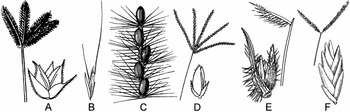
Characters of taxa in subkey 3. A, Dactyloctenium aegyptium , inflorescence and spikelet; B, Chloris , generalised spikelet; C, Axonopus aureus , portion of raceme; D, Cynodon , generalised inflorescence and spikelet; E, Echinolaena , generalised spikelet and raceme; F, Eleusine indica , inflorescence and spikelet.

Characters of taxa in subkey 3. A, Thrasya , generalised raceme; B, Paspalum pilosum , portion of raceme; C, Paspalum , generalised portion of raceme; D, Digitaria ,19 generalised spikelets and perfect floret lemma with gristly surface; E, Paspalum pectinatum , spikelet; F, Axonopus , generalised portion of raceme.

Characters of taxa in subkey 3. A, Chrysopogon zizanioides , inflorescence and portion of raceme; B, Leptochloa virgata , spikelet; C, Gymnopogon spicatus , spikelet (showing only base of the awn) and silhouette of full spikelet; D, Oplismenus , generalised spikelet; E, Sporobolus spartinus , spikelet; F, Paspalum ,25 generalised spikelet; G, Digitaria ,26 generalised spikelet and perfect floret lemma with gristly surface.

Characters of taxa in subkey 3. A, Urochloa reptans , inflorescence and leaf blade, spikelet (dorsal and ventral views) and floret (ventral view) showing wrinkled surface of lemma; B, Paspalum ,27 spikelet (ventral view); C, Ixophorus unisetus , inflorescence and mature spikelet; D, Echinochloa colona , spikelet (dorsal and ventral views); E, Echinochloa crus-pavonis , inflorescence and spikelet (dorsal and ventral views); F, Echinochloa polystachya , spikelet (dorsal and ventral views).

Characters of taxa in subkey 3. A, Setaria geminata , portion of inflorescence and spikelet (dorsal and ventral views); B, Ocellochloa stolonifera , habit and spikelet (lateral view); C, Urochloa mutica , inflorescence and spikelet (dorsal and ventral views); D, Steinchisma laxum , spikelet (lateral view) and perfect floret (ventral view) showing palea almost as long as the lemma; E, Rugoloa polygonata , spikelet (lateral, dorsal and ventral views).

List of the Grasses Currently Known from Belize (Including Cultivated Species)
The information is taken mostly from Balick et al. (Reference Balick, Nee and Atha2000). Genus names, and species epithet if the genus is represented by only a single species, are in bold. New species records found by Bridgewater et al. (Reference Bridgewater, Harris, Whitefoord, Monro, Penn, Sutton, Sayer, Adams, Balick, Atha, Solomon and Holst2006) are marked ‘†’, new records found by Goodwin et al. (Reference Goodwin, López, Stuart, Bridgewater, Haston, Cameron, Michelakis, Ratter, Furley, Kay, Whitefoord, Solomon, Lloyd and Harris2013) are marked ‘‡’, and the new record found by Welker & Peichoto (Reference Welker and Peichoto2015) is marked ‘§’. Cultivated species are marked with an asterisk. Names from the above publications that have since been placed in synonymy (Soreng et al., Reference Soreng, Davidse, Peterson, Zuloaga, Judziewicz, Filgueiras, Morrone and Romaschenko2000–) have been noted as ‘Syn:’.
-
Aakia tuerckheimii (Hack.) J.R.Grande Syn: Panicum tuerckheimii Hack.
-
Andropogon L. (10 spp.) Syn: Hypogynium Nees
-
Andropogon bicornis L.
-
Andropogon bourgeaei Hack.
-
Andropogon gerardi Vitman
-
Andropogon glomeratus (Walter) Britton, Sterns & Poggenb.
-
Andropogon gyrans Ashe
-
Andropogon lateralis Nees
-
Andropogon leucostachyus Kunth
-
Andropogon selloanus (Hack.) Hack.
-
Andropogon virgatus Desv. ex Ham. Syn: Hypogynium virgatum (Desv. ex Ham.) Dandy
-
Andropogon virginicus L.
-
Anthaenantia lanata (Kunth) Benth. Syn: Leptocoryphium lanatum (Kunth) Nees
-
Anthephora hermaphrodita (L.) Kuntze
-
Aristida L. (10 spp.)
-
Aristida appressa Vasey
-
Aristida capillacea Lam.
-
Aristida gibbosa (Nees) Kunth‡
-
Aristida hamulosa Henrard
-
Aristida longifolia Trin.
-
Aristida purpurascens Poir.
-
Aristida recurvata Kunth
-
Aristida setifolia Kunth
-
Aristida ternipes Cav.
-
Aristida torta (Nees) Kunth Syn: Aristida tincta Trin. & Rupr.
-
Arundinella Raddi (2 spp.)
-
Arundinella berteroniana (Schult.) Hitchc. & Chase
-
Arundinella deppeana Nees ex Steud.
-
Axonopus P.Beauv. (6 spp.)
-
Axonopus aureus P.Beauv.
-
Axonopus ciliatifolius Swallen
-
Axonopus compressus (Sw.) P.Beauv.
-
Axonopus fissifolius (Raddi) Kuhlm.
-
Axonopus poiophyllus Chase
-
Axonopus purpusii (Mez) Chase
-
Bothriochloa Kuntze (2 spp.)
-
Bothriochloa bladhii (Retz.) S.T.Blake
-
Bothriochloa pertusa (L.) A.Camus
-
Bouteloua Lag. (2 spp.) Syn: Pentarrhaphis Kunth
-
Bouteloua repens (Kunth) Scribner & Merr.
-
Bouteloua scabra (Kunth) Columbus Syn: Pentarrhaphis scabra Kunth
-
Cenchrus L. (6 spp.) Syn: Pennisetum Rich.
-
Cenchrus brownii Roem. & Schult.
-
Cenchrus echinatus L.
-
Cenchrus incertus M.A.Curtis
-
Cenchrus nervosus (Nees) Kuntze Syn: Pennisetum nervosum (Nees) Trin.
-
Cenchrus polystachios (L.) Morrone Syn: Pennisetum setosum (Sw.) Rich.
-
Cenchrus purpureus (Schumach.) Morrone Syn: Pennisetum purpureum Schumach.
-
Chloris Sw. (2 spp.)
-
Chloris barbata Sw. Syn: Chloris inflata Link
-
Chloris radiata (L.) Sw.
-
Chrysopogon zizanioides (L.) Roberty Syn: Vetiveria zizanioides (L.) Nash
-
Coleataenia Griseb. (3 spp.)
-
Coleataenia rigidula (Bosc ex Nees) LeBlond Syn: Panicum rigidulum Bosc ex Nees
-
Coleataenia stenodes (Griseb.) Soreng Syn: Panicum stenodes Griseb.‡
-
Coleataenia tenera (Beyr. ex Trin.) Soreng Syn: Panicum tenerum Beyr. ex Trin.
-
Cryptochloa strictiflora (E.Fourn.) Swallen
-
* Cymbopogon citratus (DC.) Stapf
-
Cynodon Rich. (2 spp.)
-
Cynodon dactylon (L.) Pers.
-
Cynodon nlemfuensis Vanderyst
-
Cyphonanthus discrepans (Döll) Zuloaga & Morrone Syn: Panicum discrepans Döll
-
Dactyloctenium aegyptium (L.) Willd.
-
Dichanthelium (Hitchc. & Chase) Gould (9 spp.)
-
Dichanthelium aciculare (Desv. ex Poir.) Gould & C.A.Clarke
-
Dichanthelium acuminatum (Sw.) Gould & C.A.Clarke
-
Dichanthelium dichotomum (L.) Gould
-
Dichanthelium ensifolium (Baldwin ex Elliott) Gould
-
Dichanthelium portoricense (Desv. ex Ham.) B.F.Hansen & Wunderlin
-
Dichanthelium sciurotoides (Zuloaga & Morrone) Davidse
-
Dichanthelium sphaerocarpon (Elliott) Gould
-
Dichanthelium strigosum (Muhl. ex Elliott) Freckmann
-
Dichanthelium viscidellum (Scribn.) Gould
-
Dichanthium annulatum (Forssk.) Stapf
-
Digitaria Haller (7 spp.)
-
Digitaria cayoensis Swallen
-
Digitaria ciliaris (Retz.) Koeler
-
Digitaria fuscescens (J. Presl) Henrard
-
Digitaria horizontalis Willd.
-
Digitaria insularis (L.) Fedde
-
Digitaria multiflora Swallen
-
Digitaria setigera Roth
-
Dinebra panicea subsp. mucronata (Michx.) P.M.Peterson & N.Snow Syn: Leptochloa mucronata (Michx.) Kunth
-
Diplachne fusca subsp. uninervia (J.Presl) P.M.Peterson & N.Snow Syn: Leptochloa uninervia (J.Presl) Hitchc. & Chase
-
Distichlis spicata (L.) Greene
-
Echinochloa P.Beauv. (3 spp.)
-
Echinochloa colona (L.) Link
-
Echinochloa crus-pavonis (Kunth) Schult.
-
Echinochloa polystachya (Kunth) Hitchc.
-
Echinolaena Desv. (2 spp.)
-
Echinolaena gracilis Swallen
-
Echinolaena standleyi (Hitchc.) Stieber
-
Eleusine indica (L.) Gaertn.
-
Eragrostis Wolf (14 spp.)
-
Eragrostis acutiflora (Kunth) Nees
-
Eragrostis atrovirens (Desf.) Trin. ex Steud.
-
Eragrostis bahiensis Schrad. ex Schult.‡
-
Eragrostis ciliaris (L.) R.Br.
-
Eragrostis contrerasii R.W.Pohl
-
Eragrostis elliottii S.Watson
-
Eragrostis gangetica (Roxb.) Steud.
-
Eragrostis hirta E.Fourn.
-
Eragrostis hypnoides (Lam.) Britton, Sterns & Poggenb.
-
Eragrostis maypurensis (Kunth) Steud.
-
Eragrostis polytricha Nees
-
Eragrostis prolifera (Sw.) Steud. Syn: Eragrostis excelsa Griseb.
-
Eragrostis rufescens Schrad. ex Schult.
-
Eragrostis unioloides (Retz.) Nees ex Steud. Syn: Eragrostis amabilis (L.) Wight & Arn.
-
Eriochloa punctata (L.) Desv. ex Ham.
-
Eriochrysis cayennensis P.Beauv.
-
Eustachys petraea (Sw.) Desv.
-
Guadua longifolia (E.Fourn.) R.W.Pohl
-
Gymnopogon spicatus (Spreng.) Kuntze
-
Gynerium sagittatum (Aubl.) P.Beauv.
-
Heteropogon contortus (L.) P.Beauv. ex Roem. & Schult.
-
Homolepis aturensis (Kunth) Chase
-
Hymenachne amplexicaulis (Rudge) Nees
-
Hyparrhenia Andersson ex E.Fourn. (2 spp.)
-
Hyparrhenia bracteata (Humb. & Bonpl. ex Willd.) Stapf
-
Hyparrhenia rufa (Nees) Stapf
-
Ichnanthus P.Beauv. (8 spp.)
-
Ichnanthus calvescens (Nees ex Trin.) Döll
-
Ichnanthus dasycoleus Tutin
-
Ichnanthus inconstans (Trin. ex Nees) Döll Syn: Ichnanthus mexicanus E.Fourn.
-
Ichnanthus lanceolatus Scribn. & J.G.Sm.
-
Ichnanthus nemoralis (Schrad.) Hitchc. & Chase
-
Ichnanthus nemorosus (Sw.) Döll
-
Ichnanthus pallens (Sw.) Munro ex Benth.
-
Ichnanthus tenuis (J.Presl & C.Presl) Hitchc. & Chase
-
Imperata Cirillo (2 spp.)
-
Imperata brasiliensis Trin.
-
Imperata contracta (Kunth) Hitchc.
-
Isachne R.Br. (3 spp.)
-
Isachne arundinacea (Sw.) Griseb.
-
Isachne polygonoides (Lam.) Döll
-
Isachne pubescens Swallen
-
Ischaemum latifolium (Spreng.) Kunth
-
Ixophorus unisetus (J.Presl) Schltdl.
-
Jarava megapotamica (Spreng.) Peñail. Syn: Aristida megapotamica Spreng.
-
Lasiacis (Griseb.) Hitchc. (10 spp.)
-
Lasiacis divaricata (L.) Hitchc.
-
Lasiacis grisebachii (Nash) Hitchc.
-
Lasiacis nigra Davidse
-
Lasiacis oaxacensis (Steud.) Hitchc.
-
Lasiacis procerrima (Hack.) Hitchc.
-
Lasiacis rugelii (Griseb.) Hitchc.
-
Lasiacis ruscifolia (Kunth) Hitchc.
-
Lasiacis scabrior Hitchc.
-
Lasiacis sloanei (Griseb.) Hitchc.
-
Lasiacis sorghoidea (Desv. ex Ham.) Hitchc. & Chase
-
Leersia Sw. (2 spp.)
-
Leersia hexandra Sw.
-
Leersia ligularis Trin.
-
Leptochloa virgata (L.) P.Beauv.
-
Lithachne pauciflora (Sw.) P.Beauv.
-
Louisiella elephantipes (Nees ex Trin.) Zuloaga Syn: Panicum elephantipes Nees ex Trin.
-
Megathyrsus maximus (Jacq.) B.K.Simon & S.W.L.Jacobs Syn: Panicum maximum Jacq.
-
Melinis P.Beauv. (2 spp.) Syn: Rhynchelytrum Nees
-
Melinis minutiflora P.Beauv.
-
Melinis repens (Willd.) Zizka Syn: Rhynchelytrum repens (Willd.) C.E.Hubb.
-
Merostachys pauciflora Swallen
-
Mesosetum Steud. (2 spp.)
-
Mesosetum blakei Swallen
-
Mesosetum filifolium F.T.Hubb.
-
Mnesithea granularis (L.) de Koning & Sosef Syn: Hackelochloa granularis (L.) Kuntze
-
Morronea Zuloaga & Scataglini (2 spp.)
-
Morronea cayoensis (Swallen) Zuloaga & Scataglini Syn: Panicum cayoense Swallen
-
Morronea parviglumis (Hack.) Zuloaga & Scataglini Syn: Panicum parviglume Hack.
-
Muhlenbergia tenella (Kunth) Trin.†
-
Ocellochloa Zuloaga & Morrone (2 spp.)
-
Ocellochloa pulchella (Raddi) Zuloaga & Morrone Syn: Panicum pulchellum Raddi
-
Ocellochloa stolonifera (Poir.) Zuloaga & Morrone Syn: Panicum stoloniferum Poir.
-
Olyra L. (2 spp.)
-
Olyra glaberrima Raddi
-
Olyra latifolia L.
-
Oplismenus P.Beauv. (2 spp.)
-
Oplismenus burmannii (Retz.) P.Beauv.
-
Oplismenus hirtellus (L.) P.Beauv.
-
Oryza L. (2 spp.)
-
Oryza latifolia Desv. Syn: Oryza alta Swallen
-
*Oryza sativa L.
-
Panicum L. (19 spp.)
-
Panicum altum Hitchc. & Chase
-
Panicum amarum Elliott
-
Panicum aquaticum Poir.
-
Panicum bartlettii Swallen
-
Panicum caricoides Nees ex Trin.
-
Panicum cayennense Lam.
-
Panicum cyanescens Nees ex Trin.
-
Panicum ghiesbreghtii E.Fourn.
-
Panicum haenkeanum J.Presl
-
Panicum hirsutum Sw.
-
Panicum hirtum Lam.
-
Panicum parvifolium Lam.
-
Panicum repens L.
-
Panicum rudgei Roem. & Schult.
-
Panicum sellowii Nees
-
Panicum stagnatile Hitchc. & Chase
-
Panicum trichanthum Nees
-
Panicum trichidiachne Döll
-
Panicum trichoides Sw.
-
Paspalum L. (36 spp.)
-
Paspalum arundinaceum Poir.
-
Paspalum blodgettii Chapm.
-
Paspalum botterii (E.Fourn.) Chase
-
Paspalum caespitosum Flüggé
-
Paspalum clavuliferum C.Wright
-
Paspalum conjugatum P.J.Bergius
-
Paspalum corcovadense Raddi
-
Paspalum coryphaeum Trin.
-
Paspalum decumbens Sw.
-
Paspalum fasciculatum Willd. Ex Flüggé
-
Paspalum fimbriatum Kunth
-
Paspalum humboldtianum Flüggé
-
Paspalum langei (E.Fourn.) Nash
-
Paspalum laxum Lam.
-
Paspalum ligulare Nees
-
Paspalum lineare Trin.
-
Paspalum microstachyum J.Presl
-
Paspalum millegrana Schrad.
-
Paspalum minus E.Fourn.
-
Paspalum multicaule Poir.
-
Paspalum notatum Flüggé
-
Paspalum nutans Lam.
-
Paspalum orbiculatum Poir.
-
Paspalum paniculatum L.
-
Paspalum peckii F.T.Hubb.
-
Paspalum pectinatum Nees ex Trin.
-
Paspalum pictum Ekman‡
-
Paspalum pilosum Lam.
-
Paspalum plicatulum Michx.
-
Paspalum pulchellum Kunth
-
Paspalum repens P.J.Bergius
-
Paspalum serpentinum Hochst. ex Steud.
-
Paspalum setaceum Michx.‡
-
Paspalum urvillei Steud.
-
Paspalum vaginatum Sw.
-
Paspalum virgatum L.
-
Pharus P.Browne (3 spp.)
-
Pharus latifolius L.
-
Pharus parvifolius Nash
-
Pharus vittatus Lem.
-
Phragmites australis (Cav.) Trin. ex Steud.
-
Rhipidocladum bartlettii (McClure) McClure
-
Rottboellia cochinchinensis (Lour.) Clayton
-
Rugoloa Zuloaga (3 spp.)
-
Rugoloa hylaeica (Mez) Zuloaga Syn: Panicum hylaeicum Mez
-
Rugoloa pilosa (Sw.) Zuloaga Syn: Panicum pilosum Sw.
-
Rugoloa polygonata (Schrad.) Zuloaga Syn: Panicum polygonatum Schrad.
-
* Saccharum officinarum L.
-
Sacciolepis myuros (Lam.) Chase
-
Schizachyrium Nees (5 spp.)
-
Schizachyrium brevifolium (Sw.) Nees ex Buse
-
Schizachyrium glaziovii Peichoto§
-
Schizachyrium microstachyum (Desv. ex Ham.) Roseng., B.R.Arrill. & Izag.
-
Schizachyrium sanguineum (Retz.) Alston
-
Schizachyrium tenerum Nees
-
Setaria P.Beauv. (9 spp.) Syn: Paspalidium Stapf
-
Setaria geminata (Forssk.) Veldkamp Syn: Paspalidium geminatum (Forssk.) Stapf
-
Setaria grisebachii E.Fourn.
-
Setaria palmifolia (J.Koenig) Stapf Syn: Setaria paniculifera (Steud.) E.Fourn. ex Hemsl.
-
Setaria parviflora (Poir.) Kerguélen
-
Setaria scandens Schrad.
-
Setaria sulcata Raddi Syn: Setaria poiretiana (Schult.) Kunth†
-
Setaria tenacissima Schrad. ex Schult.
-
Setaria tenax (Rich.) Desv.
-
Setaria vulpiseta (Lam.) Roem. & Schult.
-
Sorghastrum setosum (Griseb.) Hitchc.
-
Sorghum Moench (2 spp.)
-
*Sorghum bicolor (L.) Moench
-
Sorghum halepense (L.) Pers.
-
Sporobolus R.Br. (8 spp.) Syn: Spartina Schreb.
-
Sporobolus buckleyi Vasey
-
Sporobolus cubensis Hitchc.
-
Sporobolus diandrus (Retz.) P.Beauv.
-
Sporobolus indicus (L.) R.Br.
-
Sporobolus jacquemontii Kunth
-
Sporobolus spartinus (Trin.) P.M. Peterson & Saarela Syn: Spartina spartinae (Trin.) Merr. ex Hitchc.
-
Sporobolus tenuissimus (Mart. ex Schrank) Kuntze
-
Sporobolus virginicus (L.) Kunth
-
Stapfochloa ciliata (Sw.) P.M.Peterson Syn: Chloris ciliata Sw.
-
Steinchisma laxum (Sw.) Zuloaga Syn: Panicum laxum Sw.
-
Stenotaphrum secundatum (Walter) Kuntze
-
Streptochaeta sodiroana Hack.
-
Streptogyna americana C.E.Hubb.
-
Thrasya Kunth (2 spp.)
-
Thrasya campylostachya (Hack.) Chase
-
Thrasya trinitensis Mez
-
Trachypogon spicatus (L.f.) Kuntze
-
Tripsacum L. (3 spp.)
-
Tripsacum andersonii J.R.Gray†
-
Tripsacum dactyloides (L.) L.
-
Tripsacum latifolium Hitchc.
-
Urochloa P.Beauv. (3 spp.)
-
Urochloa fusca (Sw.) B.F.Hansen & Wunderlin† Syn: Urochloa fasciculata (Sw.) R.D.Webster
-
Urochloa mutica (Forssk.) T.Q.Nguyen
-
Urochloa reptans (L.) Stapf
-
* Zea mays L.
Acknowledgements
Thanks to David Harris (E), Tom Cope (K), Gerritt Davidse (MO), Daniel Atha (NY), Jimmy Ratter (E) and Henry Noltie (E), who provided helpful comments on the key, and to the herbarium staff at E, K, MO and NY. Paul Peterson and an anonymous reviewer are thanked for corrections and helpful comments on the manuscript. Koeltz Scientific Books are thanked for providing the illustrations. This research was funded by a NERC MSc scholarship, the Davis Expedition Fund and the SNSF Postdoc mobility grant number P2ZHP3_161988.