Canada thistle [Cirsium arvense (L.) Scop.] is one of several noxious weeds that threatens the sustainability of many remaining natural grasslands (Mullin et al. Reference Mullin, Anderson, Ditomaso, Eplee and Getsinger2000). Canada thistle has a long-standing history as a troublesome weed and was likely introduced to North America in the early 17th century as a hay or crop contaminant (Dewey Reference Dewey1901; Hansen Reference Hansen1918). By 1900, all states on or north of the 37th parallel had reported the weed to be present (Dewey Reference Dewey1901). As of 2003, Canada thistle had infested over 5 million ha of range, pasture, and wildland in the United States (Lym and Duncan Reference Lym and Duncan2005) and currently is considered a noxious weed in 33 states (U.S. Department of Agriculture Natural Resources Conservation Service [USDA-NRCS] 2016).
Management Implications
Canada thistle infestations in crops often cause at least a 50% reduction in yield, and the losses have been assumed to be similar in non-cropland. However, reports on the loss of production from Canada thistle in pasture, rangelands, and wildlands have been inconsistent. In a two-part study, the change in yield of grasses, forbs, and woody plants following Canada thistle control with aminopyralid was evaluated in two prairie sites, while production was also compared in infested versus noninfested sites within wildlife management areas in North Dakota at 20 sites. In general, grass, broadleaf, woody, and total plant yield were similar regardless of the near-complete control of Canada thistle following aminopyralid application. Grass yield increased 365 kg ha−1 the year after treatment at one location, with no change in forb or woody species production. Similarly, there was minimal or no loss of production from Canada thistle in the wildlife management areas located in two separate Major Land Resource Areas (MLRAs) in east-central and central North Dakota. The only exception was an increase in grass production of 425 kg ha−1 at one of the MLRAs, with no change in broadleaf or woody species production in the Canada thistle infested compared with the noninfested sites. Canada thistle does not appear to consistently reduce production of other species in non-cropland. However, Canada thistle control in these areas is still desirable, even if not cost-effective, for the increased hay quality, livestock health benefits, and improved habitat for native species.
Yield reduction due to Canada thistle infestations has been calculated in annual crops such as spring wheat (Triticum aestivum L.) (Hodgson Reference Hodgson1968), barley (Hordeum vulgare L.) (O’Sullivan et al. Reference O’Sullivan, Kossatz, Weiss and Dew1982), and winter wheat (Mamolos and Kalburtji Reference Mamolos and Kalburtji2001). These losses are often greater than 50%, and the economic benefit of controlling Canada thistle can be calculated. However, the benefit associated with Canada thistle control in pasture and rangeland can be difficult to determine (Grekul and Bork Reference Grekul and Bork2004) and has been inconsistent. For instance, in Alberta, Canada, a direct correlation between Canada thistle density and grass yield was only occasionally observed, as an increase in grass yield occurred after removal of Canada thistle in some but not all trials. The lack of response was attributed to variation in moisture availability, disturbance history, and site-specific vegetation composition. Grekul and Bork (Reference Grekul and Bork2004) suggested annual growing conditions and location characteristics may be as or more important than Canada thistle density when predicting herbage yield response. In contrast, grass biomass increased the year after most herbicide treatments in Nebraska, and yields averaged more than 2X the amount produced in the untreated control following 3 yr of annual treatment (Reece and Wilson Reference Reece and Wilson1983).
Estimates of increased forage for grazing animals following Canada thistle control are also difficult to determine. For example, the amount of alfalfa (Medicago sativa L.) available to grazing livestock decreased as Canada thistle density increased during a 4-yr study in Indiana (Schreiber Reference Schreiber1967). Canada thistle became progressively more competitive from the first to the last grazing period in all years of the study, as shown by a steady decrease in alfalfa production. However, even at the highest Canada thistle densities (>22 plants m−2), some alfalfa forage remained available for grazing.
The overall goal of this research was to determine the effect of Canada thistle density on herbage production in the Northern Great Plains region. The change in production following Canada thistle control with aminopyralid was evaluated in the first study, while a second study compared yield of infested with nearby noninfested wildland prairie sites.
Materials and Methods
Treated Prairie Response
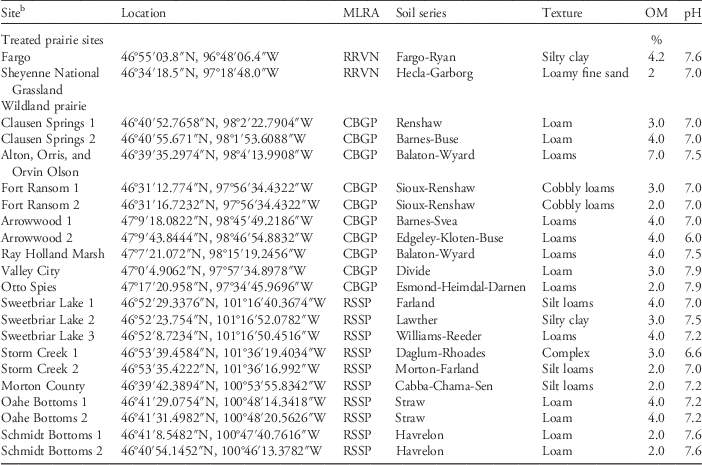
Change in forage yield following herbicide treatment was evaluated at two locations, the Sheyenne National Grassland (SNG) near Leonard, ND, and in Fargo, ND. Both sites were located in the southeast portion of the state but differ in soil type (Table 1) and flora attributes. The SNG site was a former homestead with loamy fine sands (Sandy, mixed, frigid Oxyaquic Hapludolls) (USDA-NRCS 2015). Smooth brome (Bromus inermis Leyss.) and Kentucky bluegrass (Poa pratensis L.) were the most abundant vegetation present, along with foxtail barley (Hordeum jubatum L.), prairie Junegrass [Koeleria macrantha (Ledeb.) Schult.], woolly sedge (Carex lasiocarpa Ehrh. var. americana Fernald), Canadian anemone (Anemone canadensis L.), and stinging nettle (Urtica dioica L.). The Fargo site was located on native prairie with silty clay soil (Fine, smectitic, frigid Typic Epiaquerts). Kentucky bluegrass, porcupinegrass [Hesperostipa spartea (Trin.) Barkworth], and meadow fescue [Schedonorus pratensis (Huds.) P. Beauv.] were the primary grass species found, along with prairie rose (Rosa arkansana Porter), western snowberry (Symphoricarpos occidentalis Hook.), American licorice (Glycyrrhiza lepidota Pursh), common milkweed (Asclepias syriaca L.), and various species of goldenrod (Solidago spp.).
Location, soil series, and classification of treated prairie sites and wildland sites within Major Land Resource Areas (MLRAs) in North Dakota.Footnote a

a Abbreviations: CBGP, Central Black Glaciated Plains; OM, organic matter; RRVN, Red River Valley of the North; RSSP, Rolling Soft Shale Plains.
b Sites located on state or federally operated wildlife management areas not sprayed or grazed.
The experimental design was a randomized complete block with 12 replicates at each location. The whole blocks measured 9 by 6 m (29.5 by 20 ft) and were divided into two subplots measuring 9 by 3 m. Canada thistle density was determined on June 18, 2014, by four stem count samples recorded for each subplot using a 0.25-m2 (2.7 ft−2) quadrat. Mean density was assessed to assure the density of both plots within each block was statistically similar before herbicide application at a 95% confidence level.
The plots within each block were randomly selected as treated or nontreated (control). Aminopyralid at 120 g ai ha−1 (1.7 oz ac−1) plus a nonionic surfactant (NIS; Activator 90, Loveland Products, P.O. Box 1286, Greeley, CO 80632) at 0.25% v/v was applied on June 25, 2014, to control Canada thistle in the bolted to flowering growth stage at both locations. Aminopyralid was chosen because of its high efficacy on Canada thistle and tolerance by many forbs (Almquist and Lym Reference Almquist and Lym2010; Mikkelson and Lym Reference Mikkelson and Lym2013; Samuel and Lym Reference Samuel and Lym2008). As Canada thistle declined following treatment, leafy spurge (Euphorbia esula L.) began to invade the research site. To remove leafy spurge competition, quinclorac at 420 g ai ha−1 plus a methylated seed oil (MSO; Upland MSO, West Central, 2700 Trott Avenue SW, Willmar, MN 56201) at 2.3 L ha−1 (1.8 oz ac−1) was applied to in both treated and control plots at both locations on September 11, 2014. Quinclorac was selected because the herbicide will suppress leafy spurge for at least 12 mo but has little or no efficacy on Canada thistle or many other forbs and perennial grasses (Erickson et al. Reference Erickson, Lym and Kirby2006; Lym et al. Reference Lym, Beck, Becker, Davis, Ferrell, Harris and Masters1997). The herbicides were delivered by a CO2-pressurized handheld boom sprayer with four 8002 flat-fan nozzles (TeeJet®, Spraying Systems, 200 W. North Avenue, Glendale Heights, IL 60139) applied at 160 L ha−1 and 240 kPa (35 psi).
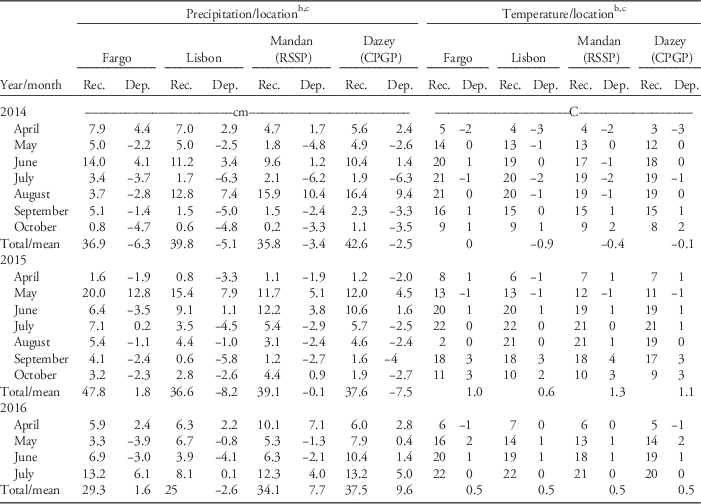
Production was estimated 1 and 13 mo after treatment (MAT) from three 0.25-m2 quadrats harvested in each plot, cut 5 cm above the soil surface with hand clippers. The harvested vegetation was divided into four groups: Canada thistle, grasses, forbs, and woody vegetation. Samples were dried at 55 C (151 F) for 96 h and weighed. Canada thistle stand counts were recorded in mid-June (as a baseline before harvest) and mid-September (after harvest) in 2014 and in mid-September 2015. The precipitation and temperature were recorded during the growing season by nearby automated weather stations at Lisbon (for the SNG) and Fargo (Table 2).
Monthly precipitation and temperature during the growing season with departure from the 30-yr average at four research locations in North Dakota.Footnote a

a Climate data obtained from North Dakota Agricultural Weather Network (NDAWN 2017).
b Abbreviations: Dep., departure; Rec., recorded.
c Major Land Resource Areas (MLRAs) in North Dakota: the Rolling Soft Shale Plains (RSSP) and the Central Black Glaciated Plains (CBGP). Centrally located weather reporting stations were chosen to represent each MLRA.
The variation in biomass of harvested material was analyzed between the treated and nontreated plots across varying Canada thistle densities using the PROC ANOVA procedure of SAS (Statistical Analysis Software, v. 9.3; SAS Institute, 100 SAS Campus Drive, Cary, NC 27513). Location and replicate were considered random effects, and treatment was considered a fixed effect. Fischer’s protected LSD (P=0.05) was used for mean separation. Homogeneity of variance was assessed using error mean squares from each location. Canada thistle density at Fargo was nearly twice that at the SNG, and results are reported separately.
Wildland Response
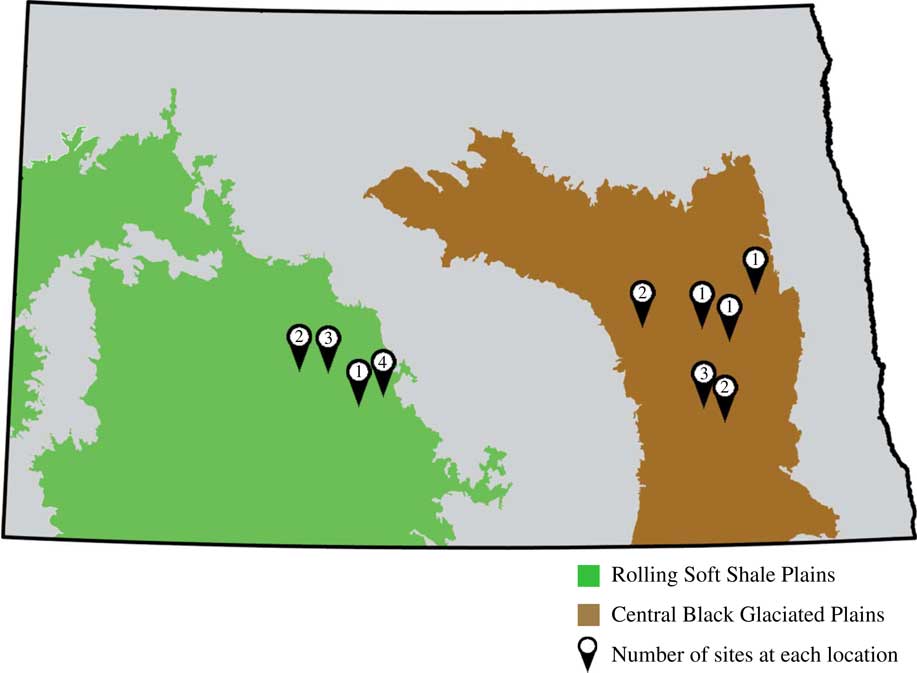
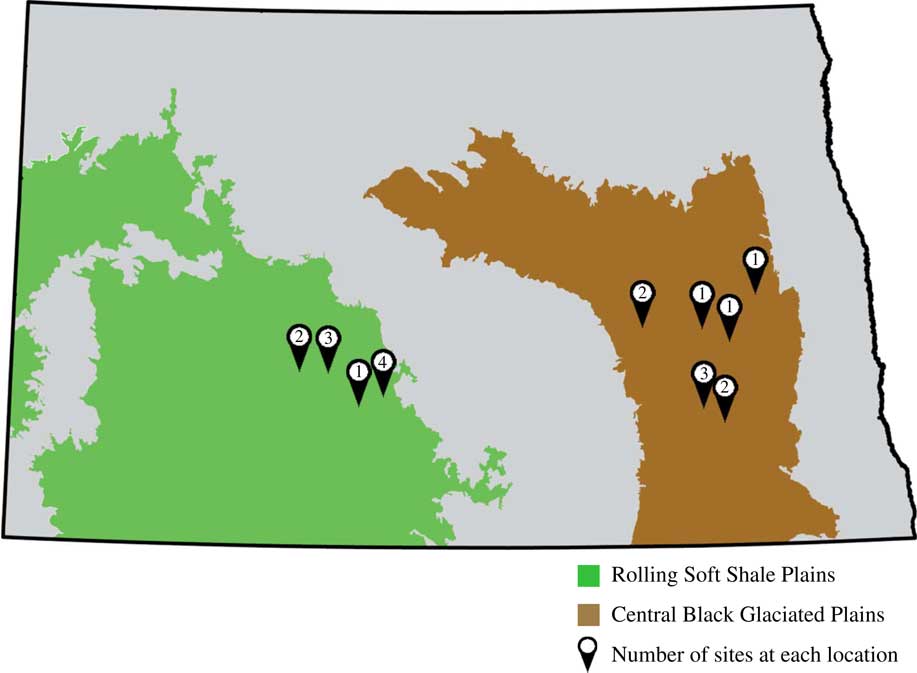
Canada thistle effect on ungrazed wildland forage production was determined at multiple sites within federal and state-operated wildlife management areas in North Dakota. Ten similar sites, not grazed or herbicide treated, were selected within each of the two largest Major Land Resource Areas (MLRAs) in North Dakota, the Rolling Soft Shale Plains (RSSP) and the Central Black Glaciated Plains (CBGP), for a total of 20 sites (Figure 1) (Sedivec and Printz Reference Sedivec and Printz2012). The MLRAs differ in flora, soil composition, and annual precipitation (Tables 1 and 2). The grass community at sites in the RSSP were heavily composed of crested wheatgrass [Agropyron cristatum (L.) Gaertn.] and smooth brome. Many of the forage species found in central North Dakota also are found on the eastern side of the state in the CBGP; however, the grass community in the CBGP is composed mostly of smooth brome and, occasionally, Kentucky bluegrass. The precipitation and temperature near plots in central North Dakota were recorded at Mandan, while in eastern North Dakota, data were recorded at Dazey (Table 2).
Location of Canada thistle–infested and noninfested sites within the two largest Major Land Resource Areas (MLRAs) in North Dakota. Based on USDA-NRCS (2015) MLRAs in North Dakota map.
Two plots were established in close proximity at each of the 20 sites on either June 16 or June 23, 2015 (paired-plot); one in a Canada thistle–infested area and one in a nearby (10 to 20 m), noninfested area. Canada thistle density was determined by counting the number of stems in three 0.25-m2 subplots within each plot. Herbage was harvested on July 20 or July 22, 2015, from the same three 0.25-m2 subplots. The vegetation was clipped, then dried and weighed as described earlier. The study was repeated in 2016 at the same sites, with stem counts and harvested plots moved by 1 m to avoid harvesting in previously clipped areas. Canada thistle stem density and harvest data were collected on July 20 and 21, 2016, in the CBGP and on July 25, 2016, in the RSSP locations.
The paired-plot experimental design consisted of 10 replicated sites in each MLRA. The variation in biomass of harvested material was compared to determine Canada thistle effect on herbage production and differences using the PROC ANOVA procedure of SAS. Density, site, and replicates were considered random effects, while Canada thistle presence or absence and MLRA were considered fixed effects. Fischer’s protected LSD (P=0.05) was used for mean separation. Data were homogeneous and combined over years.
Results and Discussion
Treated Prairie Response
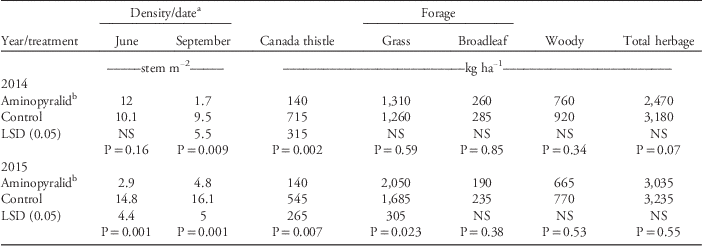
Initial average Canada thistle density at the Fargo location (11 stems m−2) was nearly twice that found at the SNG (6.5 plants m−2) (Tables 3 and 4). Additionally, woody vegetation (e.g., prairie rose and western snowberry) and plant composition were more prominent at the Fargo location. Thus, results from the two locations were analyzed and reported separately.
Aminopyralid efficacy on Canada thistle density 0 to15 mo after treatment (MAT) (June 25, 2014) and herbage response 1 and 13 MAT (June 25, 2014) when harvested in July in Fargo, ND.

a Canada thistle density measured in June 2014 before treatment (0 MAT), September 2014 (2 MAT), June 2015 (12 MAT), and September 2015 (15 MAT).
b Aminopyralid was applied at 120 g ha−1 with Activator 90 at 0.25% v/v.
Aminopyralid efficacy on Canada thistle density 0 to15 mo after treatment (MAT) (June 25, 2014) and herbage response 1 and 13 MAT when harvested in July at the Sheyenne National Grassland near Leonard, ND.

a Canada thistle density measured in June 2014 before treatment (0 MAT), September 2014 (2 MAT), June 2015 (12 MAT), and September 2015 (15 MAT).
b Aminopyralid was applied at 120 g ha−1 with Activator 90 at 0.25% v/v.
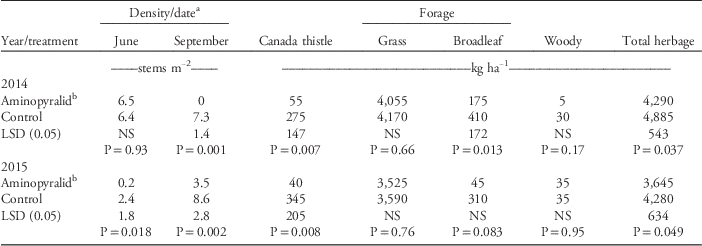
Canada thistle biomass was reduced from 715 to 140 kg ha−1 1 MAT of aminopyralid applied at 120 g ha−1 at Fargo (Table 3). However, grass, broadleaf, and woody vegetation yield were similar regardless of the change in Canada thistle density following aminopyralid application, which may have been due to the relatively short duration between treatment and harvest.
Canada thistle density was reduced 80% by June 2015 (12 MAT) by aminopyralid (2.9 stems m−2, compared with 14.8 stems m−2 in the control at Fargo) (Table 3). Similarly, Canada thistle production at 13 MAT was reduced from 545 to 140 kg ha−1, while grass yield increased by 365 kg ha −1 in the control relative to the treated areas. The increase in grass production following aminopyralid likely was due to decreased competition from Canada thistle, as broadleaf and woody vegetation production was not affected by reduced Canada thistle stem density or biomass. Many forb species commonly found in the study area, such as western snowberry, prairie rose, and common milkweed, are relatively unaffected by aminopyralid (Almquist and Lym Reference Almquist and Lym2010; Samuel and Lym Reference Samuel and Lym2008); therefore no difference was expected. Total herbage production was similar between treatments in both 2014 and 2015 and averaged 2,825 and 3,135 kg ha−1, respectively.
As seen at the Fargo location, Canada thistle yield was reduced from 275 to 55 kg ha−1 at the SNG at less than 1 MAT with aminopyralid compared with the control; however, grass and woody plant production was similar, regardless of treatment (Table 4). Broadleaf plant yield was 410 kg ha−1 in the control, compared with 175 kg ha−1 in the treated area at 1 MAT, likely due to the loss of aminopyralid-susceptible plants such as stinging nettle and Canadian anemone (Almquist and Lym Reference Almquist and Lym2010) that were found at the site. Total herbage production was higher in the control than the treated area, likely due to the short time for competing plant species to replace Canada thistle plants.
Canada thistle stem density at the SNG site numerically was less throughout the study site at 12 MAT and averaged only 0.2 and 2.4 plants m−2 in the treated and control areas, respectively (Table 4). The decrease in Canada thistle density likely was due to increased competition among the plant community, primarily smooth brome. Since the site had been fenced and was not allowed to be grazed as in years past, both smooth brome and the thatch layer increased and likely delayed Canada thistle emergence and competition. In contrast to results from the Fargo site, as Canada thistle biomass declined following aminopyralid application, grass, broadleaf, and woody plant production remained similar to the control the year following treatment. The variation in production supports similar studies of Canada thistle control in grasslands (Bork et al. Reference Bork, Grekul and DeBruijn2007; Reece and Wilson Reference Reece and Wilson1983). Grass production varied considerably by herbicide in a Nebraska study (Reece and Wilson Reference Reece and Wilson1983). Grass production nearly doubled the year after treatment with clopyralid, but even though picloram+2,4-D provided nearly complete Canada thistle control, grass yield was similar to the untreated control. Herbicide treatment increased grass production in Canada, but only in the second year of a 3-yr study (Bork et al. Reference Bork, Grekul and DeBruijn2007). In contrast to Canada thistle suppression, forage production increased by 500 kg ha−1 or more after a single treatment of picloram + 2,4-D to control leafy spurge (Lym and Messersmith Reference Lym and Messersmith1985), which supports the supposition that Canada thistle is much less competitive than other invasive weeds.
Wildland Response
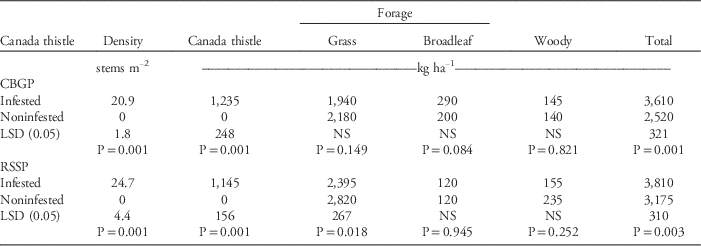
Canada thistle presence generally did not affect grass, broadleaf, or woody plant production in the CBGP or RSSP of North Dakota (Table 5). The only exception was an increase in grass production of 425 kg ha−1 in the RSSP in the Canada thistle–infested sites compared with noninfested sites. Grass production was similar in the CBGP regardless of Canada thistle presence and averaged 2,060 kg ha−1 compared with 2,608 kg ha−1 in the RSSP. These data support the point that Canada thistle density is not directly related to changes in grass/forage production, as the density in the RSSP (24.6 stems m−2) was higher compared with the CBGP (20.9 stems m−2), yet grass production was also higher in the RSSP. Total herbage production was also numerically higher in the RSSP than the CBGP. This finding is supported by McLeod et al. (Reference McLeod, Banerjee, Bork, Hall and Hare2015), who found Canada thistle impacts on herbage yield were not a function of weed density or biomass.
Herbage production of Canada thistle–infested and noninfested wildlands across 10 locations each in the Central Black Glaciated Plains (CBGP) or the Rolling Soft Shale Plains (RSSP) in east-central and central North Dakota, respectively, averaged over 2 yr (2015 and 2016).

Change in grass production following Canada thistle control has varied in previous studies and was attributed to differences in moisture received during the trials (McLeod et al. Reference McLeod, Banerjee, Bork, Hall and Hare2015; Reece and Wilson Reference Reece and Wilson1983). However, the difference in grass production (425 kg ha−1) in noninfested RSSP wildlands compared with Canada thistle–infested (RSSP) wildlands was not likely due to moisture or temperature (Tables 2 and 5) in this study. Average annual precipitation in the RSSP region of central North Dakota is 45.1 cm, approximately 6 cm less than in the CBGP in eastern North Dakota (Table 2). During the first year of the study, precipitation in the RSSP was near normal at 39.1 cm compared with 37.6 cm (7.5 cm below normal) in the CPGP (Table 5). Both MLRAs received above-normal precipitation the second year of the study. The observation that Canada thistle was more competitive in drier environments in Canada (McLeod et al. Reference McLeod, Banerjee, Bork, Hall and Hare2015) was not reflected in this study. Temperatures at both locations were near or slightly above normal at both locations during the study. Thus, Canada thistle density, moisture, or temperature do not seem to be predictive for reduction of herbage when this weed invades an area.
The competitiveness of Canada thistle to reduce grass and forb production in native and grazed sites has generally been assumed to be similar to other aggressive weeds such as leafy spurge and spotted knapweed (Centaurea stoebe L.), but that concept was not supported in this study. These findings are in direct contrast to yield reductions in crops. O’Sullivan et al. (Reference O’Sullivan, Kossatz, Weiss and Dew1982) calculated that Canada thistle densities required to reduce yield in rapeseed (Brassica napus L.), flax (Linum sp.), and wheat were 10.6, 19.8, and 11.2 stems m−2, respectively, approximately 30% less than the stand density found in this study.
Canada thistle control in pasture, rangelands, and wildlands does not necessarily or consistently result in increased herbage production but may be done for other reasons. Hay quality and the health of livestock have increased with decreased Canada thistle density (Gourlay Reference Gourlay2004; Popay and Field Reference Popay and Field1996). Also, biodiversity, habitat, and resilience of native plant species will increase with Canada thistle control (Keane and Crawley Reference Keane and Crawley2002). Land mangers should still manage Canada thistle to reduce stands and limit spread but should not expect these efforts to necessarily increase herbage production, at least in the short term.