Child maltreatment is considered among the most severe childhood adversities and is marked by serious disturbances in the caregiving environment (Cicchetti & Lynch, Reference Cicchetti, Lynch, Cicchetti and Cohen1995; Cicchetti & Toth, Reference Cicchetti, Toth and Cicchetti2016). Children who experience maltreatment are at heightened risk for a number of negative psychological and biological consequences not only in childhood but also throughout the life course (Cicchetti & Toth, Reference Cicchetti, Toth and Lamb2015; Masten & Cicchetti, Reference Masten and Cicchetti2010). Among the myriad negative developmental sequelae, child maltreatment has been associated with emotion dysregulation, difficult peer relations, neuroendocrine dysfunction, internalizing and externalizing symptomatology, and disrupted parent–child relationships (see Cicchetti & Toth, Reference Cicchetti, Toth and Cicchetti2016, for review). In addition, child maltreatment increases risk for the development of substance use problems (e.g., Buckingham & Daniolos, Reference Buckingham and Daniolos2013; Dube et al., Reference Dube, Felitti, Dong, Chapman, Giles and Anda2003; Hamburger, Leeb, & Swahn, Reference Hamburger, Leeb and Swahn2008; Huang et al., Reference Huang, Trapido, Fleming, Arheart, Crandall and French2011; Rogosch, Oshri, & Cicchetti, Reference Rogosch, Oshri and Cicchetti2010; Shin, Hong, & Hazen, Reference Shin, Hong and Hazen2010; Tonmyr, Thornton, Draca, & Wekerle, Reference Tonmyr, Thornton, Draca and Wekerle2010; Wilsnack, Vogeltanz, Klassen, & Harris, Reference Wilsnack, Vogeltanz, Klassen and Harris1997). For instance, over and above other forms of childhood adversities (e.g., parental death, parental incarceration, and parental divorce), child maltreatment uniquely predicted persistent alcohol dependence in adulthood (Elliot et al., Reference Elliott, Stohl, Wall, Keyes, Goodwin, Skodol and Hasin2014). Moreover, adult men with a maltreatment history were found to be 1.74 times as likely to meet criteria for an alcohol disorder compared to men without child maltreatment experience. Elucidating why maltreated children may develop problematic substance use, and which maltreated children may be at greatest risk are important for advancing our understanding of the consequences of child maltreatment and the etiology of substance use disorders, as well as for designing effective preventive interventions for children and families.
Within the broader literature on the development of substance use disorders (SUDs), there is robust support for an externalizing or antisocial pathway (Chassin, Hussong, & Beltran, Reference Chassin, Hussong, Beltran, Lerner and Steinberg2009; Chassin, Sher, Hussong, & Curran, Reference Chassin, Sher, Hussong and Curran2013; Sher, Reference Sher1991; Zucker, Reference Zucker, Cicchetti and Cohen2006; Zucker, Heitzeg, & Nigg, Reference Zucker, Heitzeg and Nigg2011). This pathway to problematic substance use is theorized to begin in infancy with a difficult temperament, and is marked by aggressive and rule-breaking behaviors in childhood, a behaviorally disinhibited or undercontrolled temperamental style, affiliation with deviant and substance using peers, maladaptive parenting practices, and an early onset of substance use (Chassin et al., Reference Chassin, Hussong, Beltran, Lerner and Steinberg2009, Reference Chassin, Sher, Hussong and Curran2013; Costello, Reference Costello2007; Sher, Reference Sher1991; Zucker et al., Reference Zucker, Heitzeg and Nigg2011). Given the vast empirical support for this pathway, it has been described as the “dominant pathway of risk for SUDs” (Hussong, Jones, Stein, Baucom, & Boeding, Reference Hussong, Jones, Stein, Baucom and Boeding2011).
Consistent with this assertion is growing evidence for an externalizing pathway by which maltreated children are at risk for the development of SUDs (Handley, Rogosch, & Cicchetti, Reference Handley, Rogosch and Cicchetti2015; Jones et al., Reference Jones, Lewis, Litrownik, Thompson, Proctor, Isbell and Runyan2013; Mezquita, Ibanez, Moya, Villa, & Ortet, Reference Mezquita, Ibáñez, Moya, Villa and Ortet2014; Oshri, Rogosch, Burnette, & Cicchetti, Reference Oshri, Rogosch, Burnette and Cicchetti2011; Rogosch et al., Reference Rogosch, Oshri and Cicchetti2010). For instance, Oshri et al. (Reference Oshri, Rogosch, Burnette and Cicchetti2011) demonstrated that maltreated children were more likely to display a behaviorally undercontrolled temperament style in childhood, which in turn predicted a higher level of externalizing behaviors during preadolescence, which resulted in more marijuana abuse and dependence symptoms in adolescence. Similarly, Mezquita et al. (Reference Mezquita, Ibáñez, Moya, Villa and Ortet2014) found that childhood physical abuse was associated with young adult disinhibition, which was related to antisocial behavior that prospectively predicted later problem drinking. Therefore, there is accumulating evidence, consistent with the broader developmental psychopathology literature, for an externalizing pathway of risk from child maltreatment to SUDs that is marked by a snowballing of risk including disinhibition, the development of externalizing behaviors, and the further development of problem substance use.
A lesser researched pathway to the development of SUDs is the internalizing pathway that is characterized by stress and negative affect regulation. Individuals traversing this pathway may use substances as a method of coping or self-medication. As with the externalizing pathway, the internalizing pathway to SUDs is best understood with a developmental lens (Zucker, Reference Zucker, Cicchetti and Cohen2006). Individuals who traverse an internalizing pathway may exhibit an inhibited temperament in infancy and internalizing symptoms throughout childhood, adolescence, and beyond. In addition, throughout late childhood and adolescence, individuals following this risk pathway may develop positive beliefs about the effects of substances. These beliefs, often termed substance use expectancies, may include beliefs that substance use can reduce tension and negative affect. Once individuals initiate substance use, their personal experiences with the effects of substances function to shape their motivations for using (see Cooper, Kuntsche, Levitt, Barber, & Wolf, Reference Cooper, Kuntsche, Levitt, Barber, Wolf and Sher2016, for review). Individuals on an internalizing trajectory may develop strong coping motives, or motivations to use substances to cope with distress (Hussong et al., Reference Hussong, Jones, Stein, Baucom and Boeding2011; Sher, Reference Sher1991). It is important to emphasize that the externalizing and internalizing pathways to problematic substance use are not mutually exclusive, and there are individuals for whom elements of both pathways may, at least at certain periods throughout development, contribute to SUDs (Hussong et al., Reference Hussong, Jones, Stein, Baucom and Boeding2011). Given the dominance of the externalizing pathway, to properly isolate the unique effects of the internalizing pathway, it is critical to control for externalizing symptoms.
Although there is some evidence within the broader developmental psychopathology literature for an internalizing pathway to SUD, results are decidedly mixed, especially among studies that controlled for co-occurring externalizing symptoms (Hussong, Ennett, Cox, & Haroon, Reference Hussong, Ennett, Cox and Haroon2017; Leve, Harold, Van Ryzin, Elam, & Chamberlain, Reference Leve, Harold, Van Ryzin, Elam and Chamberlain2012; McCarty et al., Reference McCarty, Wymbs, King, Mason, Stoep, McCauley and Baer2012; O'Neil, Conner, & Kendall, Reference O'Neil, Conner and Kendall2011; Pesola et al., Reference Pesola, Shelton, Heron, Munafò, Maughan, Hickman and van den Bree2015). For example, Menary, Corbin, and Chassin (Reference Menary, Corbin and Chassin2017) showed that, controlling for adolescent externalizing symptoms, greater internalizing symptoms during adolescence predicted an earlier age of first drink and a faster transition from first drink to first alcohol dependence symptom. Moreover, Pesola et al. (Reference Pesola, Shelton, Heron, Munafò, Maughan, Hickman and van den Bree2015) found that depressive symptoms during adolescence were predictive of problematic drinking in emerging adulthood, over and above adolescent conduct problems. However, a number of studies have failed to find evidence for an association between internalizing symptoms during adolescence and later substance use (Chassin, Pitts, DeLucia, & Todd, Reference Chassin, Pitts, DeLucia and Todd1999; King & Chassin, Reference King and Chassin2008), and some have demonstrated a protective effect of internalizing symptoms, particularly anxiety and social withdrawal (Edwards et al., Reference Edwards, Latendresse, Heron, Cho, Hickman, Lewis and Kendler2014; Rogosch et al., Reference Rogosch, Oshri and Cicchetti2010). Hussong et al. (Reference Hussong, Ennett, Cox and Haroon2017) asserted that inconsistencies across studies may be due to variations in the developmental timing of the associations, the particular measure or type of internalizing symptom, and the specific substance type (e.g., alcohol vs. marijuana use).
Within the child maltreatment literature specifically, there is also some emerging support for an internalizing pathway that explains, at least in part, why maltreated children are at risk for SUDs. For example, in a cross-sectional study, retrospectively reported childhood sexual abuse among girls was associated with adolescent problem drinking by way of increased anxiety, but not depressive, symptoms (Hudson et al., Reference Hudson, Wekerle, Goldstein, Ellenbogen, Waechter, Thompson and Stewart2017). Moreover, Mezquita et al. (Reference Mezquita, Ibáñez, Moya, Villa and Ortet2014) found that childhood emotional abuse was associated with higher levels of young adult negative emotionality, which was associated with alcohol coping motives, which prospectively predicted alcohol-related problems. Similarly, Lewis et al. (Reference Lewis, Kotch, Wiley, Litrownik, English, Thompson and Dubowitz2011) showed that adolescent internalizing symptoms at age 14 mediated the effect of child maltreatment prior to age 12 on age 16 smoking. Mirroring the broader developmental psychopathology literature, support for the internalizing pathway from child maltreatment to substance use problems has not been consistent. For instance, Jones et al. (Reference Jones, Lewis, Litrownik, Thompson, Proctor, Isbell and Runyan2013) did not find evidence for an indirect effect of childhood sexual abuse on adolescent drinking via internalizing symptoms. Moreover, although Rogosch et al. (Reference Rogosch, Oshri and Cicchetti2010) found that child maltreatment predicted increased internalizing symptoms in childhood, with continuity throughout early adolescence, higher levels of internalizing symptoms at age 13–15 predicted fewer marijuana disorder symptoms. Differences among the types of substances and specific internalizing symptoms measured by prior studies may contribute to these disparate findings.
As described above, the internalizing pathway is theorized to include tension reduction substance use expectancies and coping motivations for using alcohol and drugs (e.g., Hussong et al., Reference Hussong, Jones, Stein, Baucom and Boeding2011; Sher, Reference Sher1991). There is emerging evidence to suggest that these cognitive components of the risk trajectory may partially explain the developmental progression from child maltreatment to problem substance use. For example, Jester, Steinberg, Heitzeg, and Zucker (Reference Jester, Steinberg, Heitzeg and Zucker2015) demonstrated that childhood exposure to interparental violence predicted distress in early adolescence that was associated with stronger expectances of alcohol use for coping that then predicted problem drinking in emerging adulthood. A similar pattern of results, albeit later in development and with a different form of child maltreatment, was found by Grayson and Nolan-Hoeksema (Reference Grayson and Nolen-Hoeksema2005), who showed that among adult women, retrospectively reported childhood sexual assault was related to adult distress, which was associated with stronger motivations to drink to cope, which were related to alcohol problems. Finally, Goldstein, Flett, and Wekerle (Reference Goldstein, Flett and Wekerle2010) also found evidence for the role of drinking motives in this pathway. Specifically, among college students, the effect of retrospectively reported child maltreatment on current alcohol-related consequences was mediated by coping-depression motives for drinking for women and motives related to enhancing positive mood for men.
Therefore, there is increasing evidence for an internalizing pathway from child maltreatment to problem substance use that may be mediated by negative affect or internalizing symptoms and beliefs about substance use for stress regulation. However, this emerging literature is marked by a number of limitations such as retrospective reporting of child maltreatment or an exclusive focus on a single type of maltreatment (i.e., sexual abuse), cross-sectional methodology, and the lack of the appropriate statistical control of the robust externalizing pathway. Moreover, not all children who experience maltreatment develop problems with substance use. The moderating role of individual factors such as genotypic variation has yet to be adequately investigated within these pathways. It is critical not only to understand why maltreated children may be at risk for substance use problems but also to elucidate which maltreated children may be especially vulnerable.
FKBP5 binding protein 5 gene (FKBP5)
The FKBP5 gene is associated with the stress-response system and therefore has been studied in association with a number of adversities and the development of various forms of psychopathology. FKBP5 is responsive to stress exposure, induced by cortisol, and is an important modulator of the glucocorticoid receptor (GR) activity. More specifically, it is involved in an intracellular, ultra-short negative feedback loop that regulates GR sensitivity. This negative feedback loop is marked by the rapid induction of FKBP5 in response to GR activation and the inhibitory effect of FKBP5 on GR activity and is critical for recovery from stress exposure (Binder, Reference Binder2009; Galat, Reference Galat2013; Zannas & Binder, Reference Zannas and Binder2014).
FKBP5 is located on chromosome 6 (chromosome 6p21.31) and contains a number of single nucleotide polymorphisms (SNPs) that are implicated in the differential ability of FKBP5 to be induced by cortisol and to bind to the GR (for a review, see Zannas & Binder, Reference Zannas and Binder2014). Variants of SNPs spanning the 103 kb of the FKBP5 gene have been linked with functional differences at the GR (e.g., rs3800373, rs9296158, rs1360780, and rs9470080), which during exposure to stress result in prolonged cortisol responses. Minor alleles are associated with greater expression of FKBP5 and increased binding at the GR. Major alleles, in contrast, are associated with weaker induction of cortisol (Binder, Reference Binder2009; Binder et al., Reference Binder, Salyakina, Lichtner, Wochnik, Ising and Pütz2004; Zannas & Binder, Reference Zannas and Binder2014).
A number of studies have demonstrated that variation in FKBP5 SNPs or haplotypes interacts with childhood adversity resulting in various negative outcomes, including limbic system irritability (Dackis, Rogosch, Oshri, & Cicchetti, Reference Dackis, Rogosch, Oshri and Cicchetti2012), poor working memory (Lovallo et al., Reference Lovallo, Enoch, Acheson, Cohoon, Sorocco, Hodgkinson and Goldman2016), heightened amygdala reactivity (White et al., Reference White, Bogdan, Fisher, Munoz, Williamson and Hariri2012), depression (Appel et al., Reference Appel, Schwahn, Mahler, Schulz, Spitzer and Fenske2011; Zimmerman et al., Reference Zimmermann, Brückl, Nocon, Pfister, Binder, Uhr and Ising2011) suicide attempts (Roy, Gorodetsky, Yuan, Goldman, & Enoch, Reference Roy, Gorodetsky, Yuan, Goldman and Enoch2010; Roy, Hodgkinson, DeLuca, Goldman, & Enoch, Reference Roy, Hodgkinson, DeLuca, Goldman and Enoch2012), posttraumatic stress disorder and dissociative symptoms (Xie et al., Reference Xie, Kranzler, Poling, Stein, Anton and Farrer2010; Yaylaci, Cicchetti, Rogosch, Bulut, & Hetzel, Reference Yaylaci, Cicchetti, Rogosch, Bulut and Hetzel2016), and aggressive and violent behaviors (Bevilacqua et al., Reference Bevilacqua, Carli, Sarchiapone, George, Goldman and Roy2012). The majority of these prior studies point to minor alleles or minor haplotypes as interacting with environmental adversity to confer risk; however, a few have found interactive risk from the major alleles or haplotypes (e.g., Roy et al., Reference Roy, Gorodetsky, Yuan, Goldman and Enoch2010, Reference Roy, Hodgkinson, DeLuca, Goldman and Enoch2012; Yaylaci et al., Reference Yaylaci, Cicchetti, Rogosch, Bulut and Hetzel2016). Prior research on FKBP5 and interaction with stress and adversity exposure points to the importance of careful consideration of the developmental timing of the adversity. Specifically, in their review, Zannas and Binder (Reference Zannas and Binder2014) concluded that FKBP5 × Adversity interactions are robust for childhood traumatic experiences, but not for adult traumas.
Researchers have recently begun to examine the role of FKBP5 genotypic variation in the development of problematic substance use. Specifically, Huang et al. (Reference Huang, Schwandt, Chester, Kirchhoff, Kao, Liang and Goldman2014) found FKBP5 genotype and haplotype variation affected the severity of alcohol withdrawal symptoms among adults with alcohol use disorder. Moreover, among a sample of college students, Lieberman et al. (Reference Lieberman, Armeli, Scott, Kranzler, Tennen and Covault2016) demonstrated that FKBP5 interacted with retrospectively reported early life trauma, but not adult trauma or stress, to predict current heavy drinking. Nylander et al. (Reference Nylander, Todkar, Granholm, Vrettou, Bendre, Boon and Comasco2016) also tested the effect of FKBP5 × Environmental Adversity on problem drinking behavior among young adults. Participants retrospectively reported on their childhood relationship with their parents. Results indicated that the effect of a poor parent–child relationship on young adult problem drinking depended on FKBP5 variation. These studies provide promising evidence that FKBP5 interacts with early adversity to affect problem drinking. They are limited however by the reliance on retrospective reports of varying forms of adversity and the lack of investigation of underlying mechanisms.
Among a sample of children with substantiated child maltreatment documented through Child Protective Services records, and demographically matched comparisons, Handley et al. (Reference Handley, Rogosch and Cicchetti2015) found evidence for moderated mediation such that child externalizing behavior mediated the effect of child maltreatment on adolescent marijuana dependence symptoms only for individuals with the FKBP5 CATT haplotype (minor alleles). The authors did not find evidence for FKBP5 moderation of an internalizing pathway to adolescent marijuana dependence, however. To our knowledge, this study provided the first evidence of genetically moderated mediation of the externalizing pathway to SUDs among maltreated children. Although prior studies lay critical groundwork toward the understanding of not only why maltreated children are at risk for SUDs but also which maltreated children may be at greatest risk, many questions remain unanswered.
Current Study
The aim of the present study was to investigate an internalizing pathway from child maltreatment to emerging adult problem drinking, and to determine whether FKBP5 genotypic variation moderates the pathway. Specifically, we sought to prospectively test whether child maltreatment may progress to problematic alcohol use in emerging adulthood by way of internalizing symptoms in childhood and tension-reducing alcohol expectancies in emerging adulthood. To examine the uniqueness of this pathway, over and above the robust externalizing pathway, we included childhood externalizing symptoms in our developmental model. We selected emerging adulthood as a developmental period for investigation of problem alcohol use given that this time period is marked by peak levels of heavy drinking and alcohol dependence (Chassin et al., Reference Chassin, Sher, Hussong and Curran2013; Jackson & Sartor, Reference Jackson, Sartor and Sher2016; Sher, Grekin, & Williams, Reference Sher, Grekin and Williams2005). We hypothesized that children who experienced maltreatment would evidence increased internalizing symptoms during childhood that would affect stronger beliefs about the tension reduction benefits of drinking during emerging adulthood, which would be related to more problematic drinking behavior. We further hypothesized that youth with at least one copy of the FKBP5 CATT haplotype (minor alleles) would be at increased risk to traverse this internalizing pathway.
Method
Participants
Participants (N = 280) were from a longitudinal follow-up study of emerging adults who participated in a research summer camp program as children. The original study (Wave 1) included 680 low-income maltreated (n = 360) and nonmaltreated (n = 320) children aged 10 to 12 (M = 11.28, SD = 0.97). The original sample was racially and ethnically diverse (71.6% African American, 11.8% Caucasian, 12.6% Hispanic, 4.0% biracial/other race) and evenly distributed by gender (50.1% male). The majority of children were from single-parent families (68.7%) with a history of receiving public assistance (96.1%).
Participants for the present investigation consisted of 280 of the original study participants. Of the original 680 participants assessed in childhood, 420 completed the Wave 2 emerging adult assessment. Of these, only the African American participants were included in this current study (N = 280). This was done because genetic variation can differ across ancestral groups, making interpretation of Gene × Environment interactions more difficult. At Wave 2, emerging adults were on average 20.16 years old (SD = 1.37), 46.8% male, and 58.2% with a history of childhood maltreatment.
Analyses (χ2 and t tests) were conducted comparing the 280 included African American youth in the present study to the 207 excluded African American participants on demographic variables and Wave 1 study variables. There were no differences between included and excluded participants on child maltreatment status, family income, maternal marital status at Wave 1, child gender, and age at Wave 1. Moreover, there were no differences between included and excluded participants on self-report of childhood physiological anxiety, depressive symptoms, worry/oversensitivity, or conduct problems.
Informed consent was obtained from parents of maltreated and nonmaltreated children for their child's participation in the summer camp program and for examination of any Department of Human Services (DHS) records pertaining to the family. Children in the maltreated group were recruited through a DHS liaison who examined Child Protective Services reports to identify children who had been maltreated and/or were part of a family with a history of maltreatment. Children living in foster care often experience early and extreme maltreatment. They were not recruited for the current investigation to reduce heterogeneity among the maltreated sample. The DHS liaison contacted eligible families and explained the study. Parents who were interested in having their child participate provided signed permission for their contact information to be shared with project staff. These families were representative of those receiving services through DHS. Comprehensive reviews of all DHS records for each family were conducted. Maltreatment information was coded by trained research staff and a clinical psychologist, using the Barnett, Manly, and Cicchetti (Reference Barnett, Manly, Cicchetti, Cicchetti and Toth1993) nosological system for classifying child maltreatment. Coding is based on all available information and does not rely on DHS determinations.
Because maltreating families primarily have low socioeconomic status (National Incidence Study (Sedlak et al., Reference Sedlak, Mettenburg, Basena, Petta, McPherson and Greene2010), nonmaltreating families were recruited from those receiving Temporary Assistance to Needy Families in order to ensure socioeconomic comparability between maltreated and nonmaltreated families. A DHS liaison contacted eligible nonmaltreating families and described the project. Parents who were interested in participating signed a release allowing their contact information to be given to project staff for recruitment. The families were recruited as nonmaltreated families after comprehensive DHS record searches confirmed the absence of any documented child maltreatment. Families who received preventative DHS services due to concerns over risk for maltreatment were not included within the nonmaltreated comparison group. Mothers of children recruited for both the maltreatment and nonmaltreatment groups were interviewed by trained research assistants using the Maternal Child Maltreatment Interview (Cicchetti, Toth, & Manly, Reference Cicchetti, Toth and Manly2003). This was used to further verify a lack of DHS involvement among the children recruited for the nonmaltreatment group. Moreover, for the nonmaltreatment group, records were reviewed in the year following camp participation to assure that all information had been assessed. Maltreated and nonmaltreated children included in the present study were compared on a number of demographic characteristics. Groups did not differ in terms of maternal marital status, maternal age, child age, and child gender.
A range of strategies were used to relocate and recruit participants at Wave 2. Records of last known addresses, extensive public Internet searches (e.g., LexisNexis), contact information from medical records, and neighborhood canvasing were part of a comprehensive recruitment design. In addition, the DHS liaison was again utilized to locate participants through access to DHS records. The living situation of participants was varied, and the developmental timing (i.e., 18–20 years of age) created unique challenges within this sample. Many participants were in a transitory period, either living with their families of origin or just beginning to live independently, which resulted in fewer participants registering in public databases.
Procedures
At Wave 1, children attended a weeklong day camp from 9:00 a.m. to 4:00 p.m. and participated in both traditional camp activities and research assessments (for detailed descriptions of camp procedures, see Cicchetti & Manly, Reference Cicchetti and Manly1990). At camp, children were assigned to groups of eight (four maltreated and four nonmaltreated children) same-age and same-sex peers. Each group was led by three trained camp counselors who were unaware of the maltreatment status of the children and the hypotheses of the study. The intensive staff to child ratio allowed for counselors to closely interact with children. During the 35 hr of interaction throughout the camp week, counselors got to know children well. In addition to recreational activities, after providing assent, children participated in research assessments. Trained research assistants conducted these individual research sessions in which questionnaires and other research measures were administered.
At Wave 2, emerging adult participants were individually interviewed in private interview rooms by trained research assistants who were unaware of the participant's maltreatment group status and the research hypotheses. The participants completed a variety of assessments including self-report measures and a diagnostic clinical interview.
Measures
Childhood conduct problems
Childhood conduct problems were assessed using the Pittsburgh Youth Survey (Loeber, Farrington, Stouthamer-Loeber, & Van Kammen, Reference Loeber, Farrington, Southamer-Loeber and Van Kammen1998). The Pittsburgh Youth Survey is a self-report measure that examines a range of delinquent behaviors and substance use in childhood. Reporters indicate both the lifetime prevalence of behaviors and the occurrence in the past 6 months. A total of the 25 conduct disorder symptoms (e.g., stealing, cheating on school tests, and damaging property) endorsed in the past 6 months, excluding the six substance use items, was used to determine childhood conduct problems. The mean number of symptoms endorsed was 2.21 (SD = 2.80). Reliability was adequate for the 25 items (α = 0.83).
Childhood internalizing symptoms
Child depressive symptoms were measured using child self-report of the Child Depression Inventory (CDI; Kovacs, Reference Kovacs1982, Reference Kovacs2004). The CDI is 27-item questionnaire measure of depressive symptoms designed for school-age children. Children were asked to select the response option that best describes them within the past 2 weeks. The CDI is a well-established measure of child depressive symptoms with good psychometric properties (Kovacs, Reference Kovacs2004). A summary score of the 27 items was calculated to index self-reported depressive symptoms. Participants in this study reported a mean of 8.01 (SD = 6.76). A total score greater than, or equal to, 19 is indicative of clinical-level depressive symptoms (Kovacs, Reference Kovacs2004). In the current sample, 8.6% of children met this threshold for clinically elevated depressive symptoms.
Child physiological anxiety and child worry/oversensitivity were assessed by child self-report on the Revised Children's Manifest Anxiety Scale (RCMAS; Reynolds & Richmond, Reference Reynolds and Richmond1997). The RCMAS asks children to respond yes or no to a total of 37 items. The RCMAS is a well-validated measure (Muris, Merckelbach, Ollendick, King, & Bogie, Reference Muris, Merckelbach, Ollendick, King and Bogie2002) with good psychometric properties (Reynolds & Richmond, Reference Reynolds and Richmond1997). Scaled scores are calculated based on gender and age. The physiological anxiety subscale includes 10 items, such as “Often I feel sick in my stomach,” “Often I have trouble catching my breath,” and “I have bad dreams.” The mean physiological anxiety scaled score in this study was 8.98 (SD = 3.03). The worry/oversensitivity subscale is composed of 11 items, including “I am nervous,” “I worry when I go to bed at night,” and “I worry about what is going to happen.” Children reported a mean worry/oversensitivity scaled score of 8.46 (SD = 3.07).
As described in detail below, the above three indicators of child internalizing symptomatology (i.e., depressive symptoms, physiological anxiety, and worry/oversensitivity) were subsequently modeled as indicators of a child internalizing latent factor.
Emerging adult alcohol expectancies
At Wave 2, emerging adult participants self-reported their alcohol expectancies using Mann, Chassin, and Sher's (Reference Mann, Chassin and Sher1987) adaptation of the Alcohol Expectancies Questionnaire (Christiansen, Goldman, & Inn, Reference Christiansen, Goldman and Inn1982). Response options ranged from 1 (strongly disagree) to 5 (strongly agree). The three items from the tension reduction subscale were used for the present study. Items included “Drinking alcohol helps me when I'm tense and nervous,” “Drinking alcohol relaxes me,” and “Drinking alcohol helps me forget my worries.” A mean score was calculated such that higher scores indicated stronger tension reduction alcohol expectancies. The mean score for this sample was 3.43 (SD = 1.10). There was adequate reliability among the items in this study (α = 0.78).
Emerging adult problem drinking
Problem drinking in emerging adulthood (Wave 2) was assessed using four alcohol consumption items. Two items asked participants to self-report their quantity and frequency of consumption of hard liquor in the past year. These items were multiplied to index the consumption of hard liquor in the past year. Because this consumption variable was nonnormality distributed, and given that modeling techniques are sensitive to nonnormality, a square root transformation was used to reduce skewness and kurtosis. Participants also self-reported the frequency of their binge drinking of beer, wine, wine coolers, or hard liquor within the past year (defined as three or more drinks for women and five or more drinks for men) and the frequency of getting drunk on alcohol (not just lightheaded) within the past year. As described in detail below, these three variables (i.e., consumption of hard liquor, binge drinking, and drunkenness) were modeled as indicators of an emerging adult problem drinking latent construct in subsequent analyses. In this sample, 68.6% of emerging adult participants indicated drinking alcohol in the past year.
DNA collection, extraction, and genotyping
Using an established protocol, trained research assistants obtained DNA samples from children by collecting buccal cells with the Epicentre Catch-All Collection Swabs. Subsequently, using the conventional method, DNA was extracted with the Epicentre BuccalAmp DNA Extraction Kit, in order to prepare DNA for polymerase chain reaction amplification. Genotyping was conducted following previously published protocols. DNA was whole-genome amplified using the Repli-g kit (Qiagen, Catalog No. 150043, Chatsworth, CA) per the kit instructions to ensure the availability of data over the long term for this valuable sample. Amplified samples were then diluted to a working concentration.
All DNA samples were genotyped in duplicate for quality control. In addition, human DNA from cell lines was purchased from Coriell Cell Respositories for all representative genotypes in duplicate and genotypes confirmed by sequencing using dye terminator cycle sequencing chemistry on an ABI 3130 × 1. These and a no-template control were run alongside study samples representing 9% of the total data output. Any samples that were not able to be genotyped to a 95% or greater confidence level were repeated under the same conditions.
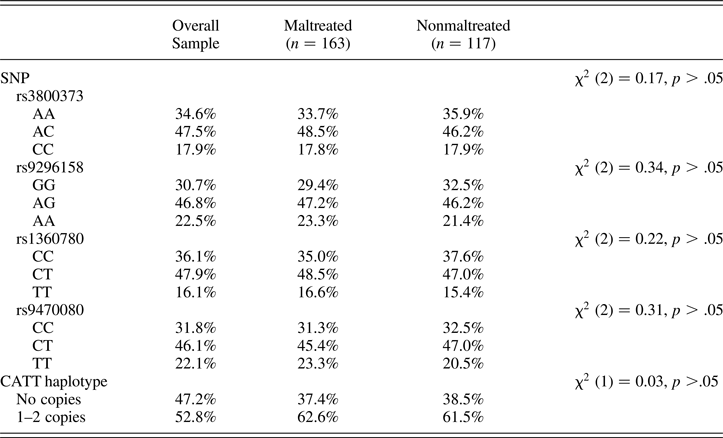
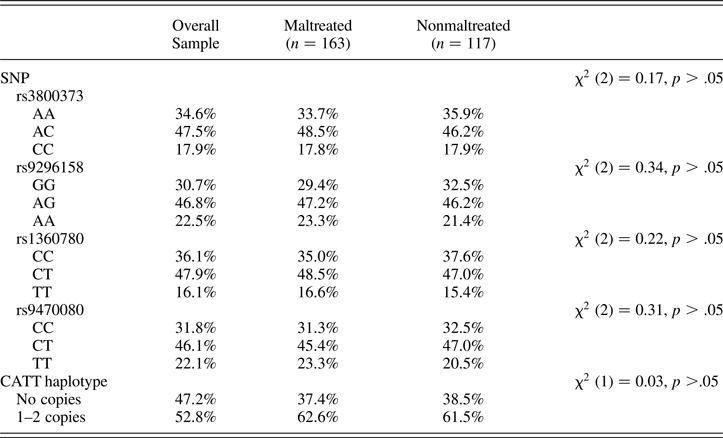
FKBP5 was genotyped using assays for SNPs rs3800373, rs9296158, rs1360780, and rs9470080 purchased from Applied Biosystems, Inc. (Bedford, MA) as C27489960_10, C1256775_10, C8852038_10, and C92160_10, respectively. Individual allele discriminations were made using Taq Man Genotyping Master Mix (ABI Catalog No. 4371357) with amplification in an ABI 9700 thermal cycler and analyzing the endpoint fluorescence using a Tecan M200. If a genotype for either gene or SNP could not be determined after the first run, then it was repeated up to four times. The call rates for the four FKBP5 SNPs ranged from 99.8% to 100%. Genotype distributions were in Hardy–Weinberg equilibrium (all ps > .05). Haplotypes for the four FKBP5 SNPs were determined using Arlequin v3.5.1.3, which employs a pseudo-Bayesian approach to estimate phase (Excoffier & Lischer, Reference Excoffier and Lischer2010). Arlequin was able to estimate haplotypes for every participant with a posterior probability higher than 0.97, which allowed us to assign a score of zero, one, or two copies of the CATT haplotype to participants with a high degree of certainty (see Table 1 for distributions of SNPs and CATT haplotype). Of participants, 37.9% (n = 106) had zero copies of the CATT haplotype, 46.8% (n = 131) had one copy, and 15.4% (n = 43) had two copies of the haplotype. Because of the small number of participants with two copies, individuals with one or two copies of the haplotype were combined. Therefore, for genetic moderation analyses, a binary variable was used such that 37.9% of the sample was coded 0 (no CATT haplotype) and 62.1% were coded 1 (one or two copies of the haplotype).
Description of FKBP5 SNPs and CATT haplotype by maltreatment groups
African ancestry
To validate self-reported race, ancestral proportion testing was conducted. DNA from study participants was subjected to SNP genotyping of the Burchard et al. panel of 106 SNPs (Lai et al., Reference Lai, Tucker, Choudhry, Parnell, Mattei, García-Bailo and Ordovás2009; Yaeger et al., Reference Yaeger, Avila-Bront, Abdul, Nolan, Grann, Birchette and Ziv2008), known to be informative for ancestry from Africa, Europe, and Native America. The SNPs were genotyped using the iPLEX platform from Sequenom Bioscience, Inc., which uses the Sequenom MassArray. Samples are subjected to single base primer extension (SBE) with fluorophore labeled nucleotides from primers designed for SNPs of interest. The samples including the SBE products were placed on the iPLEX platform, and matrix assisted laser diffusion/ionization time of flight was used to identify the allele based on the fluorophore passing the detector at the expected time associated with the mass of the SBE primer. The SNP genotyping results were then recoded and uploaded into STRUCTURE Version 2.3.4, which uses algorithms developed by Falush, Stephens, and Pritchard (Reference Falush, Stephens and Pritchard2003, Reference Falush, Stephens and Pritchard2007) and Hubisz, Falush, Stephens, and Pritchard (Reference Hubisz, Falush, Stephens and Pritchard2009). Three SNP tests were excluded based on high allele call rates of the non-DNA containing wells. The data from remaining 103 loci were uploaded into the software and set to analyze with an Admixture model of ancestry and initialization of the simulation on the GALA cohort (initialize of POPINFO). The simulation was set to run with a burn-in of 10,000, 1,000 Markov chain Monte Carlo repetitions, and assuming three populations within the group. The results of the simulations were subsequently identified as percent association to each ancestry group based on the known ancestry of the GALA cohort. Among this sample of self-identified African American participants, the mean proportion of African Ancestry was 0.90, thus validating the self-report measure of race and supporting genotypic homogeneity.
Data analytic plan
Descriptive data analyses were conducting using SPSS 23, and structural equation models (SEMs) were performed using Mplus Version 7.4 (Muthén & Muthén, Reference Muthen and Muthen1998–2015) with maximum likelihood estimator. Measurement modeling was conducted to confirm the factor structure of the three proposed indicators of child internalizing symptoms (i.e., physiological anxiety, depressive symptoms, and worry/oversensitivity) and the factor structure of the three proposed indicators of problem drinking (i.e., consumption of hard liquor, binge drinking, and drunkenness). Next, measurement invariance testing was done to examine factor loading invariance for both latent factors across FKBP5 CATT haplotype variation. Results of measurement modeling informed model specification in the subsequent SEMs.
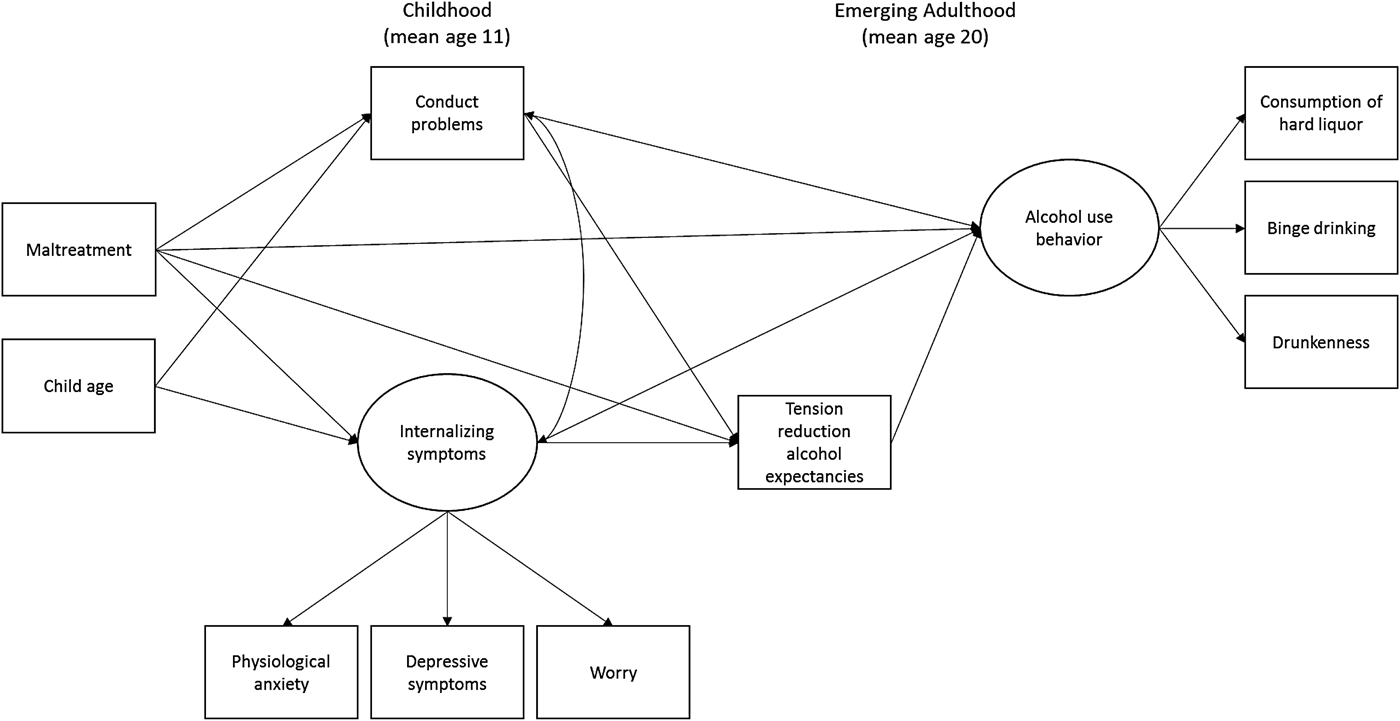
The first SEM was specified as illustrated in Figure 1. Child maltreatment (yes/no) and child age at Wave 1 were included as exogenous variables. Wave 1 childhood conduct problems and the latent child internalizing symptoms factor (indicators: physiological anxiety, depressive symptoms, and worry/oversensitivity) were specified as mediators with correlated residuals. Wave 2 emerging adult tension reduction alcohol expectancies manifest variable was predicted by the childhood internalizing symptoms latent factor, child maltreatment, and childhood conduct problems. Finally, the emerging adult problem drinking latent factor (indicators: consumption of hard liquor, binge drinking, and drunkenness) was modeled as an endogenous variable predicted by emerging adult tension reduction alcohol expectancies, childhood internalizing symptoms latent factor, child maltreatment, and childhood conduct problems.
Conceptual model.

Missing data for endogenous variables were handled using full information maximum likelihood. Model fit for confirmatory factor analyses and SEMs were evaluated using the comparative fit index (CFI), root mean square error of approximation (RMSEA), and the standardized root mean square residual (SRMR). CFI values >0.95, RMSEA values <0.06, SRMR values <0.06, and a nonsignificant χ2 statistic were considered evidence of good model fit (Hu & Bentler, Reference Hu and Bentler1999; Yu & Muthen, Reference Yu and Muthén2002). Mediation was tested using 95% bias-corrected bootstrapped confidence intervals (CIs). CIs that do not include the value zero are considered statistically significant.
Next, genetic moderation was tested using the multiple-group method. Moderation of the internalizing path by FKBP5 CATT haplotype was assessed at the following two paths: (a) child maltreatment → child internalizing latent factor and (b) child internalizing latent factor → emerging adult tension reduction alcohol expectancies. Moderation of the externalizing path by FKBP5 CATT haplotype was assessed at the following two paths: (a) child maltreatment → child conduct problems, and (b) child conduct problems → emerging adult drinking. Moderated mediation was also tested using 95% bias-corrected bootstrapped CIs. CIs that do not include the value zero are considered statistically significant.
Results
Preliminary analyses
Overall, maltreated and nonmaltreated youth did not differ in childhood depressive symptoms, t (276) = –1.37, p > .05, and childhood worry/oversensitivity, t (274) = –1.23, p > .05. Maltreated children reported marginally significantly higher levels of physiological anxiety, t (274) = –1.72, p = .09, and significantly higher levels of conduct problems, t (278) = –2.19, p = .03, at Wave 1. Maltreated and nonmaltreated children did not differ in their self-reported emerging adult alcohol expectancies, t (269) = –0.02, p > .05, hard liquor consumption, t (278) = 0.37, p > .05, binge drinking, t (278) = 0.58, p > .05, or drunkenness, t (278) = 0.71, p > .05.
SNP and haplotype frequencies for the overall sample, and comparing maltreated and nonmaltreated children are presented in Table 1. The groups did not differ on distributions of any of the four FKBP5 SNPs, rs3800373: χ2 (2) = 0.17, p > .05; rs9296158: χ2 (2) = 0.34, p > .05; rs1360780: χ2 (2) = 0.22, p > .05; rs9470080: χ2 (2) = 0.31, p > .05, and groups did not differ on CATT haplotype frequency, χ2 (1) = 0.03, p > .05. Therefore, results do not support gene–environment correlation such that FKBP5 genotype did not affect the likelihood that children would be maltreated.
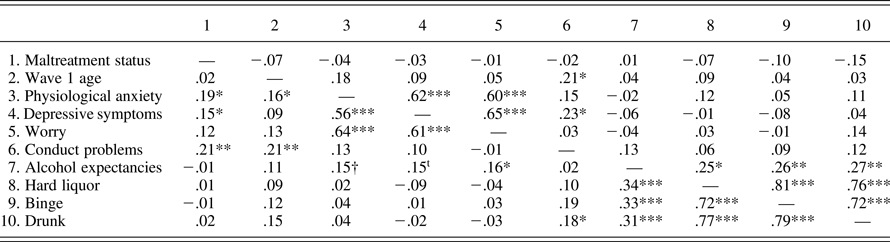
Table 2 provides the zero-order correlations among study variables for both haplotype groups. Child maltreatment was related to higher levels of child physiological anxiety and depressive symptoms for individuals with at least one copy of the FKBP5 CATT haplotype (r = .15–.19, p < .05) but not for individuals with zero copies of the CATT haplotype (r = –.03– –.04, p > .05). Moreover, child internalizing symptom indicators (e.g., physiological anxiety, depressive symptoms, and worry) were related more strongly to emerging adult alcohol expectancies for those individuals with the CATT haplotype (r = .15–.16, ps = .04–.06) than for those with zero copies of the haplotype (r = –.06–.02, ps > .05).
Zero-order correlations among study variables by FKBP5 haplotype group
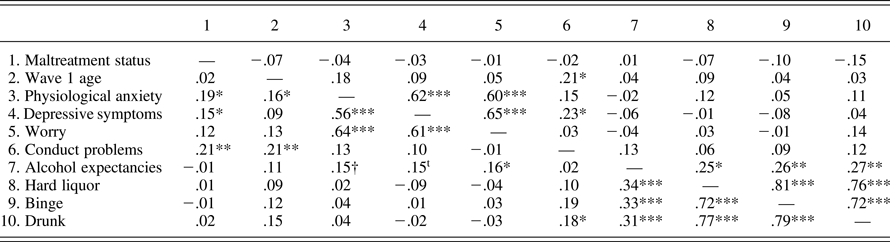
Note: Correlations above the diagonal are for individuals with 0 copies of the FKBP5 CATT haplotype and correlations below the diagonal are for individuals with at least 1 copy of the FKBP5 CATT haplotype. Maltreatment status is coded as 0 = nonmaltreated and 1 = maltreated. All continuous variables are coded such that higher values indicted higher levels of the construct.
†p < .07. *p < .05. **p < .01. ***p < .001.
Measurement modeling
Confirmatory factor analysis was conducted to determine the factor structure of the three childhood internalizing symptomatology measured variables (i.e., physiological anxiety, depressive symptoms, and worry/oversensitivity) and the three emerging adult alcohol use measured variables (i.e., hard liquor, binge drinking, and drunkenness). Results confirmed a two-factor model, χ2 (8, n = 280) = 8.20, p = .41, CFI = 0.99, RMSEA = 0.01, SRMR = 0.03, with statistically significant factor loadings (λ = 0.76–0.82) for the childhood internalizing factor, and (λ = 0.87–0.88) for the emerging adult alcohol use factor. The correlation between the two factors was nonsignificant (β = 0.03, p > .05).
Next, measurement invariance testing was conducting to determine whether the factor loadings varied by FKBP5 variation. The results of a model that constrained factors loadings to equality across groups evidenced good model fit, χ2 (24, n = 280) = 29.02, p = .05, CFI = 0.99, RMSEA = 0.04, SRMR = 0.04. The results of a model that allowed factor loadings to vary across FKBP5 groups was tested next and also evidenced good model fit, χ2 (20, n = 280) = 23.99, p = .24, CFI = 0.99, RMSEA = 0.04, SRMR = 0.04. Because the unconstrained model was not a significantly better fit to the data than the constrained model, Δχ2 (4) = 5.03, p > .05, there was evidence of metric measurement invariance across FKBP5 variation. Therefore, the factor structure and factor loadings for both child internalizing and emerging adult drinking did not vary by FKBP5 variation. These results informed the model specification of the multiple-group SEMs described below.
SEM
An SEM was estimated as depicted in Figure 1. The model evidenced good fit to the data, χ2 (26, n = 280) = 26.69, p = .42, CFI = 0.99, RMSEA = 0.01, SRMR = 0.02. Children who experienced maltreatment self-reported higher levels of conduct problems (β = 0.13, p = .01), as did older children (β = 0.21, p < .001). Child maltreatment was not a significant predictor of child internalizing symptoms latent factor (β = 0.10, p > .05); however, older children self-reported higher levels of internalizing symptoms (β = 0.15, p = .03). Emerging adult alcohol expectancies were not significantly predicted by child conduct problems (β = 0.06, p > .05), maltreatment status (β = –0.02, p > .05), or internalizing symptoms (β = 0.09, p > .05). Finally, higher levels of emerging adult alcohol use was predicted by higher levels of tension reduction alcohol expectancies (β = 0.34, p < .001) and higher levels of childhood conduct problems (β = 0.13, p = .04). Child maltreatment was not a significant unique predictor of emerging adult drinking (β = –0.05, p > .05), nor was child internalizing symptoms (β = –0.01, p > .05). The residual correlation between child internalizing symptoms and child conduct problems was nonsignificant.
The 95% bias-corrected bootstrap method was used to test the significance of the mediated effect of child maltreatment on emerging adult drinking by way of child conduct problems. This method was selected because it has been shown to provide more accurate confidence intervals (MacKinnon, Reference MacKinnon2008) and to be more highly powered for testing mediation effects in samples of this size (Fritz & MacKinnon, Reference Fritz and MacKinnon2007). Confidence intervals that do not include the value zero are considered statistically significant. Results indicated that the effect of child maltreatment on emerging adult alcohol use was significantly mediated by child conduct symptoms, 95% CI [0.005, 0.115], thus supporting an externalizing pathway of child maltreatment to emerging adult alcohol use.
Multiple group SEMs
To examine moderation by FKBP5 genotype variation, two sets of multiple-group SEMs were tested: moderation of the internalizing pathway and moderation of the externalizing pathway. Models were specified as shown in Figure 1 with factor loadings and all structural paths constrained to equality across FKBP5 groups. This fully constrained model fit the data well, χ2 (71, n = 280) = 74.77, p = .36, CFI = 0.99, RMSEA = 0.02, SRMR = 0.06. Next, a partially unconstrained model to test for moderation of the internalizing pathway was estimated that relaxed constraints between FKBP5 CATT haplotype groups for the following two paths of interest: maltreatment → child internalizing latent factor and child internalizing latent factor → emerging adult alcohol expectancies but maintained all other model constraints. This partially unconstrained model evidenced good model fit, χ2 (69, n = 280) = 68.58, p = 0.49, CFI = 0.99, RMSEA = 0.01, SRMR = 0.05, and was a significantly better fit to the data than the fully constrained model, Δχ2 (2) = 6.19, p < .05, supporting moderation by FKBP5.
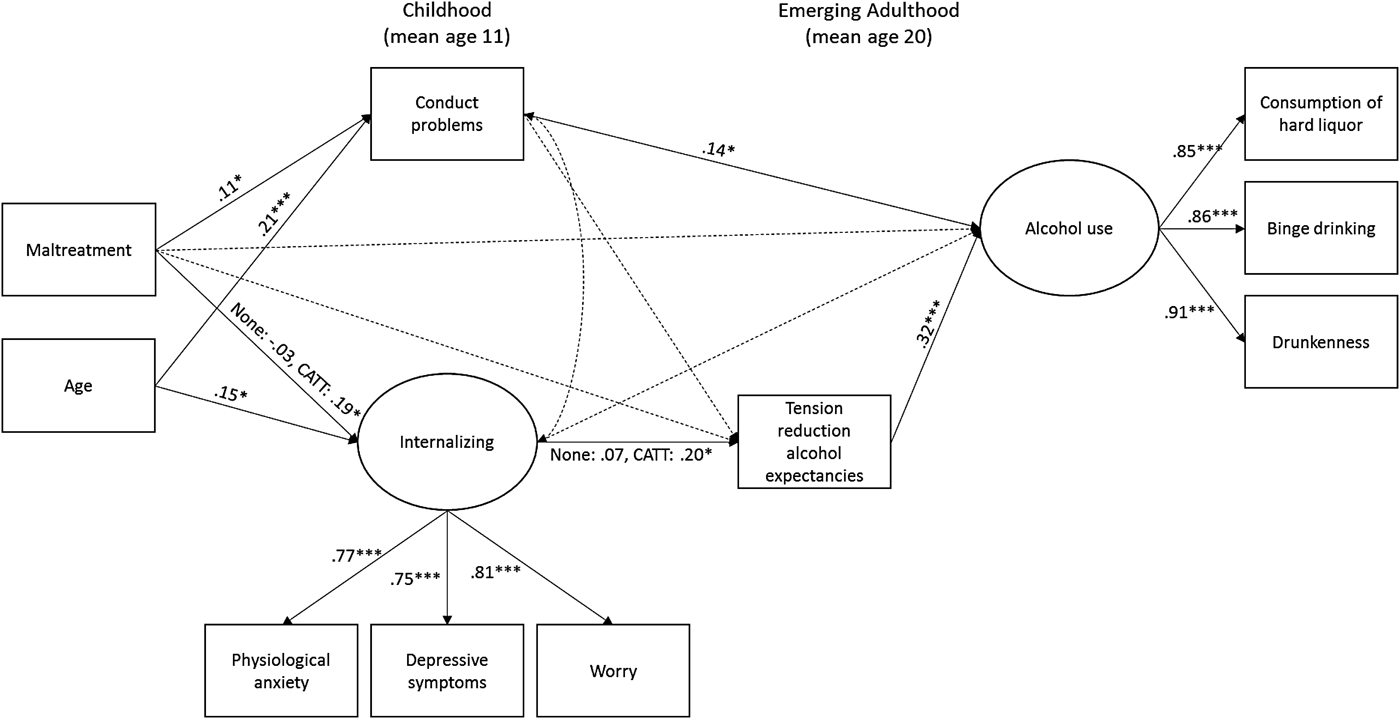
An examination of the unconstrained standardized path coefficients for each group revealed that child maltreatment significantly predicted higher levels of child internalizing symptoms for those children with at least one copy of the FKBP5 CATT haplotype (β = 0.19, p = .02) but not for those children without a copy of the haplotype (β = –0.03, p > .05). Moreover, child internalizing symptoms predicted stronger emerging adult tension reduction alcohol expectancies for those individuals with at least one copy of the FKBP5 haplotype (β = 0.20, p = .03), but not for those without the haplotype (β = –0.07, p >.05). See Figure 2 for results of the partially unconstrained SEM.
The results of moderated mediation model. Standardized factor loadings and path coefficients are presented. None indicates results for the FKBP5 CATT haplotype group without any copies of the haplotype. CATT indicates results for the FKBP5 CATT haplotype group with at least one copy of the haplotype. *p < .05, ***p < .001.

Moderated mediation was also tested using the 95% bias-corrected bootstrap method. The sequential two mediator chain of child maltreatment → child internalizing symptoms → emerging adult alcohol expectancies → emerging adult drinking was also significant for individuals with the FKBP5 CATT haplotype, 95% CI [0.003, 0.095], but not for individuals without the CATT haplotype, 95% CI [–0.015, 0.046]. Thus, results support moderated mediation of the internalizing pathway from child maltreatment to emerging adult drinking. Specifically, for individuals with at least one copy of the FKBP5 CATT haplotype, child maltreatment predicted higher levels of internalizing symptoms in childhood, which in turn predicted stronger tension reduction alcohol expectancies in emerging adulthood, which predicted more emerging adult drinking. This mediational pathway was nonsignificant for individuals without a copy of the FKBP5 CATT haplotype.
Finally, a partially unconstrained model to test for moderation of the externalizing pathway was estimated that relaxed constraints between FKBP5 CATT haplotype groups for the following two paths of interest: maltreatment → child conduct problems and child conduct problems → emerging adult drinking, but maintained all other model constraints. This partially unconstrained model evidenced good model fit, χ2 (69, n = 280) = 71.05, p = .41, CFI = 0.99, RMSEA = 0.02, SRMR = 0.05, but was not a significantly better fit to the data than the fully constrained model, Δχ2 (2) = 3.71, p > .05. Thus, although there was support for the externalizing pathway, there was no evidence for moderation of this pathway by FKBP5.
Discussion
The aim of the present study was to investigate whether internalizing symptoms and tension reduction alcohol expectancies sequentially mediate the effect of child maltreatment on emerging adult problem drinking and to determine whether certain maltreated children may be especially vulnerable to traversing this internalizing pathway of risk based on FKBP5 genotypic variation. In doing so, this is the first study to prospectively test a stress and negative affect regulation pathway of child maltreatment risk for SUDs incorporating two critical consecutive mediators (internalizing symptoms and alcohol expectancies), while controlling for the robust externalizing pathway, and also including genotypic moderation of this progression.
Our results are consistent with a number of prior studies showing that early childhood adversity interacts with FKBP5 variation to affect internalizing symptoms (e.g., Appel et al., Reference Appel, Schwahn, Mahler, Schulz, Spitzer and Fenske2011; Binder et al., Reference Binder, Bradley, Liu, Epstein, Deveau, Mercer and Ressler2008; Zimmerman et al., Reference Zimmermann, Brückl, Nocon, Pfister, Binder, Uhr and Ising2011). Specifically, we found that maltreatment leads to the development of internalizing symptoms during childhood (as measured by child report of physiological anxiety, depressive symptoms, and worry) only for those individuals with at least one copy of the FKBP5 CATT haplotype (minor alleles). Although a prior study failed to find evidence that FKBP5 moderated the effect of child maltreatment on child internalizing symptoms (Handley et al., Reference Handley, Rogosch and Cicchetti2015), the current study differs from that work in terms of our reliance on diverse measures of self-reported internalizing symptoms and our sample of exclusively African American youth. On the contrary, Handley et al. (Reference Handley, Rogosch and Cicchetti2015) employed observer-report measures of various internalizing symptoms with a racially and ethnically diverse sample of children. It is possible that differing perceptions of the child's internalizing symptoms between observers and children themselves, as well as sampling differences, may explain these disparate results.
With regard to the development of alcohol expectancies, our findings indicate that whether child internalizing symptoms prospectively predict stronger tension reduction alcohol expectancies approximately 9 years later, also depends on FKBP5 genotypic variation. We found that higher levels of internalizing symptoms in childhood affect stronger beliefs regarding the stress-reducing properties of alcohol in emerging adulthood only for those individuals with at least one copy of the FKBP5 CATT haplotype. Even before children initiate drinking, they hold beliefs about the effects of alcohol (e.g., Zucker, Kincaid, Fitzgerald, & Bingham, Reference Zucker, Kincaid, Fitzgerald and Bingham1995). Parental drinking behavior and parental alcohol expectancies influence an individual's own alcohol expectancies, as do one's experience with alcohol effects once he or she begins drinking (e.g., Brown, Creamer, & Stetson, Reference Brown, Creamer and Stetson1987; Donovan, Molina, & Kelly, Reference Donovan, Molina and Kelly2009; Handley & Chassin, Reference Handley and Chassin2009; Jester, Wong, et al., Reference Jester, Wong, Cranford, Buu, Fitzgerald and Zucker2015; Sher, Wood, Wood, & Raskin, Reference Sher, Wood, Wood and Raskin1996). Given the consistent and well-documented relation between alcohol expectancies and drinking behavior, a link the current study also supports (e.g., Handley & Chassin, Reference Handley and Chassin2009; Jester, Wong, et al., Reference Jester, Wong, Cranford, Buu, Fitzgerald and Zucker2015; Jones, Corbin, & Fromme, Reference Jones, Corbin and Fromme2001; Mann et al., Reference Mann, Chassin and Sher1987; Montes et al., Reference Montes, Witkiewitz, Andersson, Fossos-Wong, Pace, Berglund and Larimer2017; Sher et al., Reference Sher, Wood, Wood and Raskin1996), understanding how various developmental factors shape alcohol expectancies, and who is at greatest risk for tension-reduction alcohol expectancies, is critical to informing our knowledge of the development of SUDs. We advance the extant literature by showing that for certain vulnerable youth with a specific FKBP5 genotypic profile, childhood internalizing symptoms also shape beliefs regarding the tension reducing benefits of drinking later in development. These results are consistent with developmental theory regarding the internalizing pathway of risk for SUDs by demonstrating that alcohol expectancies, particularly those related to stress and negative affect regulation, are affected by childhood experiences of depression and anxiety for some susceptible individuals (Hussong et al., Reference Hussong, Jones, Stein, Baucom and Boeding2011; Sher, Reference Sher1991).
Taken together, our results provide evidence for an internalizing pathway by which maltreated children are at risk for developing problem drinking that is distinct from an externalizing pathway and is moderated by FKBP5 genotypic variation. More specifically, the central finding of this study is that child maltreatment affects childhood internalizing symptoms, which in turn affects stronger tension reduction alcohol expectancies in emerging adulthood, which results in higher levels of problem drinking behavior. Critically, we found that this is not a universal pathway; rather, FKBP5 genotypic variation is an important moderator of this risk trajectory. These findings are consistent with the growing body of work highlighting FKBP5 as an important gene to study in relation to early adversity (see Zannas & Binder, Reference Zannas and Binder2014, for review). Given its role in the stress response system and as a regulator of the GR (Binder, Reference Binder2009; Galat, Reference Galat2013; Zannas & Binder, Reference Zannas and Binder2014), polymorphisms in FKPB5 warrant continued research attention, especially among studies of early stress exposure. Thus, our results extend prior research on the interactive effects of FKBP5 variation and early adversity by being the first to document its role in an internalizing pathway of risk from child maltreatment to emerging adult problem drinking.
These findings are consistent with the extant literature showing that maltreated children are at risk for developing problems with substances (e.g., Buckingham & Daniolo, Reference Buckingham and Daniolos2013; Dube et al., Reference Dube, Felitti, Dong, Chapman, Giles and Anda2003; Hamburger et al., Reference Hamburger, Leeb and Swahn2008; Handley et al., Reference Handley, Rogosch and Cicchetti2015; Huang et al., Reference Huang, Trapido, Fleming, Arheart, Crandall and French2011; Rogosch et al., Reference Rogosch, Oshri and Cicchetti2010; Shin et al., Reference Shin, Hong and Hazen2010; Tonmyr et al., Reference Tonmyr, Thornton, Draca and Wekerle2010; Wilsnack et al., Reference Wilsnack, Vogeltanz, Klassen and Harris1997). Although we did not find evidence for a direct effect of child maltreatment on emerging adult problem drinking, our results support two distinct mediated pathways of risk. In accordance with the well-documented externalizing pathway to SUD (see Chassin et al., Reference Chassin, Hussong, Beltran, Lerner and Steinberg2009, Reference Chassin, Sher, Hussong and Curran2013; Sher, Reference Sher1991; Zucker Reference Zucker, Cicchetti and Cohen2006; Zucker, et al., Reference Zucker, Heitzeg and Nigg2011, for reviews), we found that maltreated children self-report higher levels of childhood conduct problems, which, over and above childhood internalizing problems, predict higher levels of emerging adult problem drinking. This pathway was not moderated by FKBP5 genotypic variation. Our results show a more nuanced and complex internalizing pathway that is mediated by child internalizing symptoms and emerging adult alcohol expectancies, exists over and above the robust externalizing pathway, and is moderated by FKBP5 genotype. Hussong et al. (Reference Hussong, Jones, Stein, Baucom and Boeding2011) described an internalizing pathway to SUDs marked by an inhibited temperament in infancy, internalizing symptoms throughout development, positive substance use expectancies and interpersonal skills deficits, as well as coping motivations for substance use. Our findings support this stress and negative affect pathway to problem substance use and expand on this model by showing the relevance of FKBP5 to these associations. It is important to highlight that without the inclusion of FKBP5 moderation, results would have pointed only to an externalizing pathway. It was not until we considered FKBP5 genotypic variation that an internalizing pathway emerged.
To date, only one prior study has examined an internalizing and externalizing pathway of child maltreatment risk to substance use while also considering FKBP5. Specifically, among a sample of adolescents, Handley et al. (Reference Handley, Rogosch and Cicchetti2015) found that individuals with the FKBP5 CATT haplotype were more likely to traverse an externalizing pathway from child maltreatment to adolescent marijuana dependence than individuals without the haplotype. Handley et al. (Reference Handley, Rogosch and Cicchetti2015) did not find evidence for an internalizing pathway, nor did they find support for FKBP5 moderation of this pathway. A number of methodological differences between the studies are worth noting when considering the differing findings. First, as described above, the sample for the present study included African American individuals only. This was done to minimize difficulties related to population stratification. The Handley et al. (Reference Handley, Rogosch and Cicchetti2015) sample was racially and ethnically diverse. Second, the two studies differ in their developmental period under investigation. The present study focused on problem drinking behavior among emerging adults, whereas the Handley et al. (Reference Handley, Rogosch and Cicchetti2015) study examined marijuana dependence symptoms among adolescents. In this way, the Handley et al. (Reference Handley, Rogosch and Cicchetti2015) paper investigated pathways from child maltreatment to a more clinical outcome during an earlier period of development. The current study focused exclusively on self-report childhood symptomatology, whereas Handley et al. (Reference Handley, Rogosch and Cicchetti2015) measured childhood symptomatology using camp counselor and peer ratings. Third, we included both internalizing and externalizing pathways within the same model in order to examine the unique effects of each mechanism, compared to testing each model separately as was done in the Handley et al. (Reference Handley, Rogosch and Cicchetti2015) paper. That these notable methodological differences may contribute to disparate findings is consistent with the results of a recent review of the internalizing pathway of risk for SUD, which suggests that the substance under investigation, as well as the developmental period, and the type of internalizing symptom may all contribute to differing findings (Hussong et al., Reference Hussong, Ennett, Cox and Haroon2017).
Although this study makes important new contributions to the literature on child maltreatment, the development of SUDs, and the role of FKBP5 in these associations, limitations are worth noting. We relied on a binary measure of child maltreatment experiences occurring prior to the first wave of assessment. Given accumulating evidence that FKBP5 interacts with early adversity, and not later traumatic experiences, it will be important to further elucidate this interactive effect with more specific measures of the developmental timing of the maltreatment experience throughout childhood. Moreover, although we selected an FKBP5 haplotype with robust empirical support for its role in stress regulation (Zannas & Binder, Reference Zannas and Binder2014), it is only one gene among many involved in this complex process. Polygenic risk scores that incorporate multiple genes related to the stress-response system will be important to incorporate into future research. Finally, we selected a sample of exclusively African American youth for this investigation because genetic variation can differ across ancestral groups and thus challenge interpretations of Gene × Environment interactions. However, this limits the generalizability of our findings and calls for future studies with other samples from other ancestral groups.
In conclusion, the present study sheds light on a lesser studied and complex pathway of risk from child maltreatment to emerging adult drinking that is mediated by internalizing symptoms in childhood and tension-reduction alcohol expectancies in emerging adulthood, and is moderated by FKBP5 genotypic variation. These findings provide important directions for preventive intervention design for maltreated children and their families by showing that for vulnerable youth with the minor alleles of the FKBP5 CATT haplotype, early internalizing symptoms may set the course for problematic beliefs about drinking, which in turn may elevate risk for problem drinking. Thus, several points of intervention are implicated (e.g., depressive and anxiety symptoms in childhood and alcohol expectancies in adolescence/emerging adulthood) that may alter the trajectory of SUD risk for maltreated children.