Introduction
Bird schistosomes draw attention mainly as causative agents of human cercarial dermatitis (swimmer's itch), a hypersensitive skin reaction caused by penetration of the cercariae through the skin (Cort, Reference Cort1928). The disease develops after repeated contact with the cercariae and usually manifests as maculopapular skin eruptions accompanied by intensive itching (Olivier, Reference Olivier1949). Cercarial dermatitis plays an especially important role in recreational areas (e.g. Lake Annecy, France; Caumes et al., Reference Caumes, Felder-Moinet, Couzigou, Darras-Joly, Latour and Léger2003) or agricultural regions (rice fields, e.g. Minsheng et al., Reference Minsheng, Yuefa and Fengjie1977) and it is considered as a disease linked to global climatic changes (de Gentile et al., Reference de Gentile, Picot, Bourdeau, Bardet, Kerjan, Piriou, Le Guennic, Bayssade-Dufour, Chabasse and Mott1996).
However, recent studies have shown that the ability of avian schistosomes to penetrate into mammals is linked to more than just the cercarial dermatitis alone. The parasite can also transform to schistosomula and migrate further through the body of mammals. Larvae of visceral species were found in the lungs and other visceral organs of mice (Haas & Pietsch, Reference Haas and Pietsch1991; Horák & Kolářová, Reference Horák and Kolářová2000), whereas larvae of the nasal species Trichobilharzia regenti were found in the central nervous system of mice (Horák et al., Reference Horák, Dvořák, Kolářová and Trefil1999). There is no information on the importance of particular species of bird schistosomes in the development of organ disorders in humans; however, studies on mammalian models suggest that pulmonary and neurological symptoms might accompany the infection in humans also. All these facts have led to an intensive study of clinical and pathological aspects related to defined species of parasites within the past four decades.
Unlike mammalian schistosomes (including the genus Schistosoma) that occur in tropical and subtropical areas, bird schistosomes are cosmopolitan and can be found even in cold areas of northern Europe (Thune, Reference Thune1994; Thors & Linder, Reference Thors and Linder2001; Voronin et al., Reference Voronin, Beer and Dobrovolskij2002; Larsen et al., Reference Larsen, Bresciani and Buchmann2004). In Iceland, the occurrence of cercarial dermatitis has been reported repeatedly from different localities. In 1995–1997, it occurred in a paddling pond in Family Park, Reykjavík (Kolářová et al., Reference Kolářová, Skírnisson and Horák1999). In 2003 and 2004, cercarial dermatitis was reported from a natural bathing site in the tourist area of Landmannalaugar (Skírnisson & Kolářová, Reference Skírnisson and Kolářová2005). In order to identify the prevalence and causative agents of cercarial dermatitis in Iceland, an intensive examination of intermediate and final hosts of bird schistosomes was carried out during the years 2002–2007. This work resulted in the detection of a nasal and several visceral schistosomes (Skírnisson & Kolářová, Reference Skírnisson and Kolářová2004, Reference Skírnisson and Kolářová2008) and the description of a new bird schistosome genus and species, Allobilharzia visceralis, from Cygnus cygnus (Kolářová et al., Reference Kolářová, Rudolfová, Hampl and Skírnisson2006).
In the present work, we aimed to identify the remaining bird schistosome isolates found in the country. Determination and systematics of bird schistosomes, especially of the largest genus Trichobilharzia, is very complicated for several reasons: gonochorism, two host life-cycles, lack of species-specific characters of cercariae and minute dimensions (for a review see Horák et al., Reference Horák, Kolářová and Adema2002). Therefore, sequencing of the internal transcribed spacer (ITS) region of rDNA (comprising part of 28S and 18S rRNA genes and the whole 5.8S rRNA gene, ITS1 and ITS2) of the samples was performed and the resulting sequences were compared with existing records in the GenBank database.
Material and methods
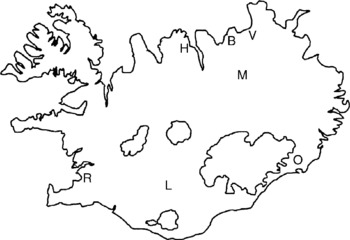
Samples of cercariae or adults were used for DNA extraction. These samples were obtained from seven different localities in Iceland (fig. 1). All samples were fixed in 96% ethanol. Ocellate furcocercariae were collected from individual snails, adults were obtained from individual birds. If more morphological forms of adults in the same bird were found, the fragments were separated according to their morphology. Before DNA extraction all ethanol from the samples was removed by pipetting and speed-vac. Genomic DNA was isolated using Aqua Pure Genomic DNA Isolation Kit (Bio-Rad, Hercules, California, USA) according to manufacturer's instructions. Polymerase chain reactions (PCRs) were performed in reaction volume of 25 μl using specific primers its4Trem and its5Trem (Dvořák et al., Reference Dvořák, Vaňáčová, Hampl, Flegr and Horák2002). The reaction mixture contained 3–5 μl of the DNA template, 0.2 μm of each primer (Generi Biotech, Hradec Králové, Czech Republic), 1 × SAHARA Reaction buffer (Bioline, Luckenwald, Germany), 2 mm MgCl2 (Bioline), 200 μm dNTP (Bioline) and 3.0 units of SAHARA™ DNA polymerase (Bioline). The reaction temperature profile included the initial denaturation step at 95°C for 8 min followed by 30 cycles of denaturation at 95°C for 50 s, annealing at 50°C for 40 s and extension at 68°C for 110 s with a final extension step at 68°C for 10 min.
The study sites on a map of Iceland; Family Park in Reykjavík (R), Hrísatjorn (H), Botnsvatn (B), Víkingavatn (V), Mývatn (M), Osland (O) and Landmannalaugar (L).

The PCR products were purified from the PCR mixture using SureClean (Bioline) or from agarose gel with MinElute Gel Extraction Kit (Qiagen, Hilden, Germany). Purified PCR products were sequenced directly. If necessary, the purified PCR products were cloned using TA Cloning Kit with chemically competent TOP 10 Escherichia coli cells (Invitrogen, Carlsbad, California, USA). Plasmid DNA was prepared with QIAquick Spin Miniprep Kit (Qiagen).
Sequencing reactions were performed using BigDye Terminator v3.1 Cycle Sequencing Kit (Applera, Carlsbad, California, USA) according to the manufacturer's protocol. Two clones from two independent amplification reactions of each DNA isolate were sequenced. In case of a difference between the two clones, a third clone from an independent amplification reaction was sequenced. Sequencing primers M13F and M13R (Invitrogen) annealing to plasmid sites, and specific primers (Generi Biotech) annealing to the DNA insert – its4Trem, its5Trem, its2Trem, its3Trem (Dvořák et al., Reference Dvořák, Vaňáčová, Hampl, Flegr and Horák2002), ITS6-F and ITS6-R (Kolářová et al., Reference Kolářová, Rudolfová, Hampl and Skírnisson2006) – were used for sequencing reactions. The products of sequencing reactions were analysed on ABI PRISM 3100-Avant automated sequencer (Applied Biosystems, Carlsbad, California, USA). The sequences were deposited in GenBank under the accession numbers FJ469784–FJ469799; FJ469803–FJ469822.
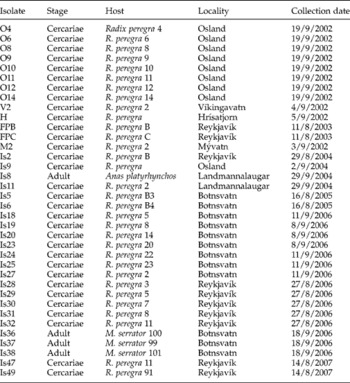
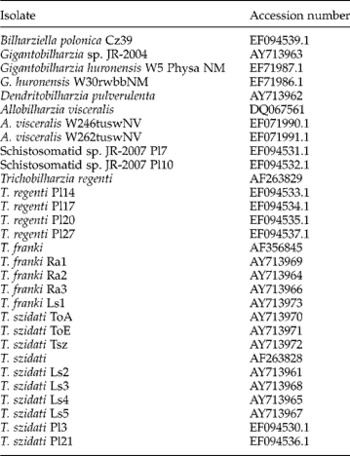
Phylogenetic analyses were performed using the newly obtained sequences (table 1) and sequences of Allobilharzia visceralis, Bilharziella polonica, Dendritobilharzia pulverulenta, Gigantobilharzia huronensis, Gigantobilharzia sp. JR-2004, T. regenti, T. szidati, T. franki and schistosomatids JR-2007 Pl7 and JR-2007 Pl10 downloaded from GenBank (accession numbers AF263828, AF263829, AF356845, AY713961–73, DQ067561, EF094530.1–37.1, EF094539.1, EF71986.1, EF71987.1, EF071990.1 and EF071991.1; see table 2). Sequences of Schistosoma mansoni and S. rodhaini (accession numbers AF531314 and AF531312) were used as outgroups. Sequences were aligned in ClustalX 2.0 (www.clustal.org) and the alignment was manually refined in Bioedit 7.0.9 (www.mbio.ncsu.edu/BioEdit/bioedit.html). The non-repetitive region containing part of 28S rDNA, part of ITS1 and whole 5.8S rDNA and ITS2 (977 positions) was used for tree construction.
Isolates of bird schistosomes used for phylogenetic analysis.

GenBank sequences of bird schistosomes used for phylogenetic analysis.

Maximum likelihood analysis was done using the program Phyml 3.0 (Guindon & Gascuel, Reference Guindon and Gascuel2003) using the GTR+I+Γ model with parameters estimated by the software. Maximum parsimony analyses were carried out in PAUP* v.4.0 (Swofford, Reference Swofford2002). The tree space was searched by ten replicates of heuristic search, with the starting tree being constructed by random taxa addition and TBR swapping. Node support was assessed by bootstrapping (100 replicates). The phylogenetic analyses using the Bayesian method was performed with MrBayes 3.1.2 (Huelsenbeck & Ronquist, Reference Huelsenbeck and Ronquist2001). Four simultaneous Markov Monte Carlo chains (temperature 0.2) were run for 1,000,000 generations under covarion GTR+I+Γ substitution model and sampled every 100 generations. The first 3000 trees were discarded as the ‘burn in’.
Applet software (http://www.vivo.colostate.edu/molkit/dnadot/) for dot plot generation was used for detection of repetitive elements within the sequences. Mismatch limit was set to 0, the number of repetitive elements was counted as N = N d+1, where N means the number of repetitive elements and N d is the number of lateral diagonals on one side of the central diagonal.
Results
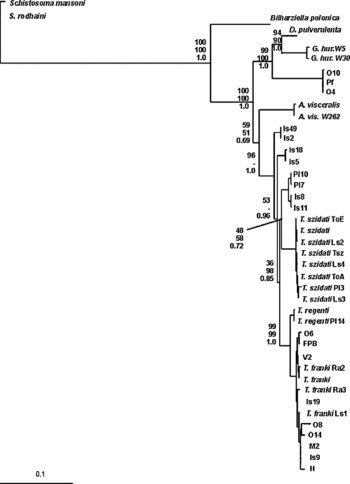
In total, 32 samples of cercariae from Radix peregra snails and four samples of adults from the anatid birds Anas platyrhynchos and Mergus serrator were used for the phylogenetic analyses based on the sequence of the ITS region of rDNA. Due to high sequence diversity and presence of tandem repeats within the repeat region in ITS1, the phylogenetic analysis was based only on the non-repetitive parts of ITS1, 5.8S rDNA, ITS2 and 28S rDNA. The phylogenetic tree made with the new sequences and sequences deposited in GenBank is shown in fig. 2. Schistosoma mansoni and S. rodhaini sequences were used as an outgroup to root the tree.
The phylogenetic tree of isolates of bird schistosomes based on the partial sequence of ITS region. The tree was constructed using maximum likelihood method in Phyml (GTR+I+Γ substitution model). The node support is given in maximum likelihood bootstraps, maximum parsimony bootstraps and Bayesian posterior probability. To save space, the following abbreviations were used in the tree: D. = Dendritobilharzia, G. hur. = Gigantobilharzia huronensis, A. = Allobilharzia, T. = Trichobilharzia. In the case of several isolates with identical sequence in the alignment, only one of them was named in the tree: O4 is identical to O9 and O12; A. visceralis W262 is identical to A. visceralis W246; Is2 is identical to Is28, Is29, Is30, Is31, Is32 and Is47; Is5 is identical to Is6, Is20, Is24, Is27, Is36, Is37 and Is38; T. szidati Tsz is identical to T. szidati Pl3 and Ls5; T. regenti is identical to T. regenti Pl17, Pl20 and Pl27; FPB is identical to FPC; T. franki is identical to T. franki Ra1; Is19 is identical to Is25; and M2 is identical to Is23 and O11.

Bird schistosome samples split into several groups. Bilharziella polonica forms a separate branch basal to the other isolates of bird schistosomes which show division into two clades. The first clade is divided into two branches: (1) D. pulverulenta and G. huronensis and (2) Gigantobilharzia sp. JR-2004 and samples O4, O9, O10 and O12. The second clade includes A. visceralis, all Trichobilharzia sequences from the database and the other Icelandic samples. It can be divided into several branches: (1) A. visceralis; (2) samples Is2, Is28, Is29, Is30, Is31, Is32, Is47 and Is49; (3) samples Is5, Is6, Is18, Is20, Is24, Is27, Is36, Is37 and Is38; (4) schistosomatids sp. JR-2007 Pl7 and JR-2007 Pl10 and samples Is8 and Is11; (5) isolates of T. szidati from database; (6) isolates of T. regenti from database; (7) samples of T. franki from database and samples FPB, FPC, H, M2, O6, O8, O11, O14, Is9, Is19, Is23, Is25 and V2.
Repetitive elements are present in ITS1 of all isolates; in most cases their arrangement is in tandem. According to the number, arrangement and sequence of the repeat units within ITS1, Icelandic isolates can be divided into several groups: (1) samples O4, O9, O10 and O12 with two non-tandem repeat units within ITS1; (2) samples Is2, Is28, Is29, Is30, Is31, Is32, Is47 and Is49 containing a repeat unit present in five tandem copies in Is49 and in four tandem copies in the other isolates; in addition, two non-tandem repetitive elements were found in these samples; (3) samples Is5, Is6, Is18, Is20, Is24, Is27, Is36, Is37 and Is38 with a repeat unit in four tandem copies; (4) samples Is8 and Is11 containing three tandem copies of a repetitive element; and (5) samples FPB, FPC, Is9, Is19, Is23, Is25, O11, O14, H and M2 with four, and isolates O6, O8 and V2 with three, tandem copies of the same type of repetitive element.
Discussion
Bird schistosomes are relatively common parasites in Iceland. The present work represents a continuation of the previous studies (Skírnisson & Kolářová, Reference Skírnisson and Kolářová2004, Reference Skírnisson and Kolářová2008; Kolářová et al., Reference Kolářová, Rudolfová, Hampl and Skírnisson2006) and confirms the high diversity of these parasites. Most of the samples analysed in the present study were cercariae (32 out of 36), which are considered to be of low use for species determination (Rudolfová et al., Reference Rudolfová, Hampl, Bayssade-Dufour, Lockyer, Littlewood and Horák2005). Podhorský et al. (Reference Podhorský, Hůzová, Mikeš and Horák2009) found the pattern of surface sensory papillae (chaetotaxy) to be a suitable character for distinguishing cercariae of Trichobilharzia regenti, T. szidati and T. franki; however, there are still few data for comparison, as for most known bird schistosome species chaetotaxy has not yet been described. Therefore, we decided to use sequencing of the ITS region for determination of our isolates. Results of molecular analysis indicate that they belong to five different species of two genera.
In the phylogenetic tree based on ITS sequences, the samples O4, O9, O10 and O12 group with the isolate of Gigantobilharzia sp. JR-2004 found in Physa fontinalis in the Czech Republic. Their sequences are practically identical (difference approximately 0.1%) and they have the same number and arrangement of repeat units within ITS1. The latter schistosomatid was originally named as Gigantobilharzia sp., however, this determination was based exclusively on its intermediate host specificity and sister position to D. pulverulenta in the phylogenetic tree. Morphological determination of the parasite was not possible, as only cercariae were available. At present, the sequence of G. huronensis obtained from adults is deposited in the GenBank database and it is obvious that schistosomatid species JR-2004 does not belong to Gigantobilharzia sp., as it forms a separate branch in a sister position to Dendritobilharzia and Gigantobilharzia. Therefore, an update was sent to GenBank to suppress the name Gigantobilharzia sp. for this isolate. The sister position of schistosomatid sp. JR-2004 to Gigantobilharzia and Dendritobilharzia corresponds with the position of the avian schistosome W2081 from Kenya (Brant, Reference Brant2007). However, the tree presented by Brant (Reference Brant2007) was based on different DNA regions (18S and 28S rDNA and CO1) and the sequence of the ITS region for isolate W2081 is not available; therefore, comparison of both isolates was not possible. It is probable that, together with the schistosomatid from P. fontinalis, the Icelandic samples belong to a new, as yet undescribed genus.
The samples Is2, Is28, Is29, Is30, Is31, Is32, Is47 and Is49 all originate from the locality Family Park, Reykjavík. They form a separate group within the Trichobilharzia branch and we suppose they belong to the same species. ITS sequences of all these isolates were identical, with the only exception being Is49. In this isolate, five tandem repetitive elements are present, whereas only four copies were found in the other isolates. There are reports on inter- and even intra-specific variation in number of repeat elements in Schistosoma japonicum species complex (van Herwerden et al., Reference van Herwerden, Blair and Agatsuma1998). No such reports exist for Trichobilharzia or other bird schistosome genera; however, this might be caused by the fact that this topic has not been sufficiently studied. The samples Is5, Is6, Is18, Is20, Is24, Is27, Is36, Is37 and Is38 from Lake Botnsvatn also form a separate group within the Trichobilharzia branch. Their sequences are highly similar (difference approximately 0.1%) and we consider them to belong to the same species. For both species mentioned above, no matching record in GenBank was found. Based on their position within the Trichobilharzia branch, the anticipated species were identified as Trichobilharzia sp. 1 and Trichobilharzia sp. 2, respectively.
The samples Is8 and Is11 from the locality Landmannalaugar form a group with the isolates of eggs from the intestinal wall of Anas penelope from northern Poland (schistosomatids sp. JR-2007 Pl7 and Pl10). The isolates in the group are not intermixed, but they are divided into two branches. Sequence difference between the two branches (about 1.7%) is comparable with intraspecific variability within T. szidati and T. regenti and it is lower than in T. franki. The structure and number of repeat units within ITS1 is the same in both groups. This suggests that the Icelandic isolates belong to the same species as the Polish ones. However, the Polish isolates represent visceral species (eggs from the intestinal wall), whereas Is8 belongs to cercariae from R. peregra and Is11 to adults found in the nasal tissue of A. platyrhynchos. The final localization in bird host should be a stable character enabling separation of species, i.e. the visceral species are never conspecific with the nasal ones (Blair & Islam, Reference Blair and Islam1983). This issue, however, was not sufficiently studied. There are several reports that the eggs of bird schistosomes can be disseminated to other organs, and the adults can undergo an atypical migration within their hosts (for review see Horák et al., Reference Horák, Kolářová and Adema2002). Perhaps this could also happen with the eggs found in birds in northern Poland. With regard to these arguments, we think the Polish and the Icelandic isolates belong to the same species, determined as Trichobilharzia sp. 3 based on the position in the tree. Neverthless, morphological study is urgently needed to confirm our assumption.
The samples FPB, FPC, H, M2, O6, O8, O11, O14, Is9, Is15, Is19, Is23, Is25 and V2 represent isolates of cercariae from R. peregra from six different localities (Family Park Reykjavík, Hrísatjorn, Mývatn, Osland, Botnsvatn and Víkingavatn). These isolates group with T. franki from the database. Sequence and length variability in ITS1 is seen among the Icelandic isolates. This is, however, in agreement with the intraspecific variability in T. franki ITS1 region reported by Picard & Jousson (Reference Picard and Jousson2001), and ITS1 regions of different T. franki isolates from GenBank. There is also variability in number of repeat units within ITS1 of the Icelandic isolates – whereas in the samples O6, O8 and V2 three tandem copies were found, ITS1 of the other isolates contains four tandem copies. So far, three tandem repeats within ITS1 have been reported for T. franki (Picard & Jousson, Reference Picard and Jousson2001; Dvořák et al., Reference Dvořák, Vaňáčová, Hampl, Flegr and Horák2002; Rudolfová et al., Reference Rudolfová, Hampl, Bayssade-Dufour, Lockyer, Littlewood and Horák2005); however, no extensive study on intraspecific variability of bird schistosome samples from different localities has been done. In the genus Schistosoma, intraspecific ITS1 variability was observed (Kane & Rollinson, Reference Kane and Rollinson1994; Kane et al., Reference Kane, Ridgers, Johnston and Rollinson1996; van Herwerden et al., Reference van Herwerden, Blair and Agatsuma1998). As repetitive sequences are known to evolve at a high rate, and there are reports on intraspecific variability in repeat unit number for other members of the family Schistosomatidae, we suppose that this variability might also exist within the genus Trichobilharzia. Therefore, we consider the samples mentioned above to represent T. franki.
Usually, Radix auricularia is mentioned as the intermediate host for T. franki (e.g. Müller & Kimmig, Reference Müller and Kimmig1994; Dvořák et al., Reference Dvořák, Vaňáčová, Hampl, Flegr and Horák2002). Similarly to the schistosomatid species JR-2004 reported originally from P. fontinalis, T. franki develops in a different snail species – R. peregra – in Iceland. This corresponds with the findings of Jouet et al. (Reference Jouet, Ferté, Depaquit, Rudolfová, Latour, Zanella, Kaltenbach and Léger2008), who reported R. peregra as an intermediate host of T. franki in natural conditions of Annecy Lake, France. Further, there is even a report on T. franki developing in Lymnaea stagnalis (Rudolfová et al., Reference Rudolfová, Hampl, Bayssade-Dufour, Lockyer, Littlewood and Horák2005). It has been supposed that Trichobilharzia species exhibit a narrow specificity towards their intermediate hosts – they parasitize only one snail species or several closely related species (Blair & Islam, Reference Blair and Islam1983). Narrow intermediate host spectra can be found in the other bird schistosome species as well (Farley, Reference Farley1971). The experiments under laboratory conditions proved that miracidia clearly prefer their natural intermediate host. To some degree, they are also attracted to, and develop in, a closely related snail species; however, the infection rates are lower in such cases – T. franki was able to infect 100% specimens of R. auricularia and 9.8% specimens of R. ovata (probably corresponding to R. peregra sensu Bargues et al., Reference Bargues, Vigo, Horák, Dvořák, Patzner, Pointier, Jackiewicz, Meier-Brook and Mas-Coma2001) (Kock, Reference Kock2001). The findings from Iceland confirmed that, under some circumstances, the already characterized bird schistosomes are able to develop in snail species belonging to a different snail family than originally described. In Iceland, the commonly available snail species – Radix peregra = R. balthica – could serve as the intermediate host for various bird schistosomes (Skírnisson & Kolářová, Reference Skírnisson and Kolářová2008). This confirms the results of Jouet et al. (Reference Jouet, Ferté, Depaquit, Rudolfová, Latour, Zanella, Kaltenbach and Léger2008) who found R. peregra to host four different Trichobilharzia species in a single locality (Annecy Lake, France). Although systematics of the genus Radix is complicated and needs to be revised, recent molecular analyses showed that R. peregra is the only Radix species occurring in Iceland (Bargues et al., Reference Bargues, Vigo, Horák, Dvořák, Patzner, Pointier, Jackiewicz, Meier-Brook and Mas-Coma2001; K. Huňová, unpublished). Radix peregra populations can commonly be found in different localities throughout the island, whereas the other freshwater snails living in Iceland – Gyraulus sp. and Physa acuta – are distributed in a few ponds or lakes. The examination of the latter snails has not revealed any schistosome larvae (Skírnisson & Kolářová, Reference Skírnisson and Kolářová2002, Reference Skírnisson and Kolářová2005; Skírnisson et al., Reference Skírnisson, Aldhoun and Kolářová2009) and, therefore, the main role of R. peregra in schistosome transmission in Iceland was strengthened.
Although the number of suitable intermediate hosts is limited, the diversity of schistosomes in Iceland seems to be high. The species richness could be influenced by bird migrations; some birds overwinter in Iceland, whereas others migrate to western and northern Europe (Skírnisson & Kolářová, Reference Skírnisson and Kolářová2008), and thus both autochthonous and imported species of parasites can be found here. Recently, seven bird schistosome species having different egg morphology were reported from Iceland (Skírnisson & Kolářová, Reference Skírnisson and Kolářová2008). Among them, the nasal Trichobilharzia sp. I from A. platyrhynchos from Landmannalaugar corresponds to Trichobilharzia sp. 3 in the present study, because eggs and adults analysed in both studies are from the same batch and, based on the morphology, they belong to the same species. Also T. franki was found in both studies, and Trichobilharzia sp. 2 from the present study probably corresponds to Trichobilharzia sp. IV or V, as they originated from the same batch; however, it was not possible to decide what types of eggs were produced from the adults analysed in the present study. In addition to the five anticipated bird schistosome species detected in the present study, Trichobilharzia sp. from M. serrator, Dendritobilharzia sp. from Anser anser and Allobilharzia visceralis are mentioned by Skírnisson & Kolářová (Reference Skírnisson and Kolářová2008), and other bird schistosome species were identified recently (L. Kolářová, K. Skírnisson, D. Jouet and H. Ferté, unpublished). These facts led us to conclude that Iceland is very rich in bird schistosome species.
In conclusion, based on the phylogenetic analysis of the ITS region sequences of bird schistosome isolates from Iceland in the present study, we can conclude the following:
(1) Five species/genotypes of bird schistosomes were identified: (i) T. franki from R. peregra from six different localities; (ii) Trichobilharzia sp. 1 from R. peregra from Family Park, Reykjavík; (iii) Trichobilharzia sp. 2 from R. peregra from Lake Botnsvatn; (iv) Trichobilharzia sp. 3 from A. platyrhynchos and R. peregra in Landmannalaugar; and (v) an unknown schistosomatid from R. peregra in Osland.
(2) Trichobilharzia sp. 3 was found to be a nasal species, although originally it had been considered a visceral species, based on its first finding – eggs in the intestinal wall of Anas penelope in northern Poland. This confirms sporadic reports on ectopic dissemination of eggs to unusual organs/tissues within the final host. This phenomenon needs to be studied further.
(3) A single snail species – R. peregra – was found to host at least five different schistosome species/genotypes, including the species originally reported from other snails. It confirms our hypothesis that bird schistosomes are capable of adapting to a new snail host under some circumstances.
(4) In the localities Osland, Botnsvatn and Family Park, Reykjavík several schistosome species/genotypes were found. In general, bird schistosome diversity in Iceland is high, probably due to a frequent migration of birds, and new species are expected to be discovered in the future.
Acknowledgements
This project was supported by the Czech Science Foundation (Grants Nos. 206/07/P092 and 206/06/0777), the Ministry of Education, Youth and Sports of the Czech Republic (Grants Nos. MSM 0021620828 and MSM LC06009) and the Research Fund of the University of Iceland.