


Introduction
The problem of perfectionism
Perfectionism has been defined as the ‘tyranny of the shoulds’ (Horney, Reference Horney1950) in which individuals set high standards and are excessively self-critical in pursuit of these (Frost et al., Reference Frost, Marten, Lahart and Rosenblate1990). Negative consequences associated with striving for perfection have been noted and it is cited as a transdiagnostic issue relevant to the development and maintenance of a number of psychopathologies (Egan et al., Reference Egan, Wade and Shafran2011). Perfectionism correlates with poor self-esteem, heightened sensitivity to criticism (Shafran and Mansell, Reference Shafran and Mansell2001), depression, anxiety disorders and eating disorders (Egan et al., Reference Egan, Wade and Shafran2011), interpersonal difficulties (Ferguson and Rodway, Reference Ferguson and Rodway1994) hopelessness and potentially suicide (Blatt, Reference Blatt1995; Shafran and Mansell, Reference Shafran and Mansell2001). Egan et al. (Reference Egan, Wade and Shafran2011) have suggested that when perfectionist clients present for treatment, where perfectionism is maintaining the presenting disorder, if left untargeted this can limit intervention success, resulting in poorer treatment outcomes (Blatt, Reference Blatt1995; Zuroff et al., Reference Zuroff, Blatt, Sotsky, Krupnick, Martin, Sanislow and Simmens2000; Shahar et al., Sotsky, Reference Shahar, Blatt, Zuroff, Krupnick and Sotsky2004). Conversely, some researchers have acknowledged the potential rewards of being a perfectionist, for example high achievement, leadership ability and approval from others (Hewitt and Flett, Reference Hewitt and Flett1991). However, there is ongoing contention in the literature regarding the possible benefits of perfectionism (see Stoeber and Otto, Reference Stoeber and Otto2006).
Models of perfectionism
A number of models of perfectionism have been proposed, which may be characterized as unidimensional conceptualizations (e.g. Burns, Reference Burns1980) and multidimensional explanations (e.g. Frost et al., Reference Frost, Marten, Lahart and Rosenblate1990). Hewitt and Flett (Reference Hewitt and Flett1991) built upon earlier conceptualizations, criticizing them for including only the intrapersonal and non-social aspects of perfectionism. They propose a model derived of three dimensions. Firstly, ‘Self Oriented Perfectionism’, pertaining to the setting of unrealistically high standards for the self and striving to meet these; secondly, ‘Other Oriented Perfectionism’, relating to the setting of excessively high standards for others; and finally, ‘Socially Prescribed Perfectionism’ which describes the need to be approved of by others in order to avoid negative evaluation or punishment.
Research demonstrating both the positive and negative consequences of perfectionism on psychological functioning (Frost et al., Reference Frost, Heimberg, Holt, Mattia and Neubauer1993; DiBartolo et al., Reference DiBartolo, Yen Li and Frost2008) led to Hill et al. (Reference Hill, Huelsman, Furr, Kibler, Vicente and Kennedy2004) proposing a revised multidimensional model of perfectionism, taking into account both higher order adaptive (‘conscientious’) and maladaptive (‘self-evaluative’) aspects. They propose eight dimensions: ‘Concern Over Mistakes’, ‘High Standards for Others’, ‘Need for Approval’, ‘Organization’, ‘Perceived Parental Pressure’, ‘Planfulness’, ‘Rumination’ and ‘Striving for Excellence’. To measure these dimensions and the higher order components, Hill et al. (Reference Hill, Huelsman, Furr, Kibler, Vicente and Kennedy2004) developed the ‘Perfectionism Inventory’ (PI), a self-report measure of perfectionism.
More recently, Shafran et al. (Reference Shafran, Cooper and Fairburn2002) have proposed a model of ‘clinical perfectionism’. They defined clinical perfectionism as ‘an overdependence of self-evaluation on the determined pursuit and achievement of self-imposed personally demanding standards of performance in at least one domain, despite adverse consequences’ (Shafran et al., Reference Shafran, Cooper and Fairburn2002, p. 778). A cognitive behavioural model is suggested, with direct implications for psychological treatment. Indeed, cognitive behavioural therapy (CBT) treatment for perfectionism has been shown to be effective across a range of psychological disorders (see Lloyd et al., Reference Lloyd, Schmidt, Khondoker and Tchanturia2015).
What about perfectionist therapists?
Research has largely focused on establishing how client perfectionism relates to psychopathology and how it may impede outcomes in CBT, and how it might be understood and treated. Less attention has been given to how therapist perfectionism may impact upon the therapeutic process within CBT treatment. The importance of therapists reflecting upon their own schema has featured little in the CBT literature until recently (Haarhoff, Reference Haarhoff2006), with the emphasis traditionally being on implementing model-driven interventions (Leahy, Reference Leahy2008). Recent work has given more attention to the benefits of therapists reflecting upon the potential impact of their own schema upon their therapeutic work (Leahy, Reference Leahy2001; Young et al., Reference Young, Klosko and Weishaar2003; Haarhoff, Reference Haarhoff2006) and the use of supervision, self-reflection and self-practice is now being more strongly encouraged (Bennet-Levy, Reference Bennet-Levy2006; Pretorius, Reference Pretorius2006).
Perfectionism has been identified as a common therapist schema, with Haarhoff (Reference Haarhoff2006) finding rates of 75-87% amongst trainee CBT therapists utilizing the Therapists’ Schema Questionnaire (Leahy, Reference Leahy2001). Whilst multidimensional explanations of perfectionism acknowledge adaptive components of the construct which may enhance therapist effectiveness (e.g. having the organizational skills to helpfully systematize session materials), the potential detrimental effect of more maladaptive components remains. In applying models of perfectionism to therapists, a number of suppositions could be generated regarding the impact of therapist perfectionism upon client treatment. For example, dimensions such as Other-Oriented Perfectionism (Hewitt and Flett, Reference Hewitt and Flett1991) and High Standards for Others (Hill et al., Reference Hill, Huelsman, Furr, Kibler, Vicente and Kennedy2004) could lead perfectionist therapists to set unrealistically high standards for their clients, perhaps resulting in client apathy or even treatment drop-out. Conversely, dimensions such as Socially Prescribed Perfectionism (Hewitt and Flett, Reference Hewitt and Flett1991) and Need for Approval (Hill et al., Reference Hill, Huelsman, Furr, Kibler, Vicente and Kennedy2004) may encourage therapists to attempt to please clients by colluding with avoidance of emotional discomfort, thereby failing to challenge important maintaining factors of their difficulties. According to the characteristics of perfectionism as described by Shafran et al. (Reference Shafran, Cooper and Fairburn2002), perfectionistic therapists may be rigid, controlling and avoidant of client difficulties they perceive as being beyond their ability to ‘solve’. Leahy (Reference Leahy2001) hypothesized that therapist perfectionism may be related to impatience and of lack of empathy. However, despite these theoretical assertions, to date there has been no empirical exploration of the impact of therapist perfectionism on client outcomes, leaving only conjecture about its consequences.
The ‘Improving Access to Psychological Therapy’ (IAPT) initiative is a £400 million investment to widen availability of psychological treatments for depression and anxiety. CBT is widely offered as part of these services, with treatment outcome data being collected routinely as part of service monitoring protocols. IAPT therefore provides the ‘perfect’ platform for conducting an initial investigation into the relationship between therapist perfectionism and client outcomes and drop-out rates in treatment.
The current study explores two hypotheses:
-
1. That there would be significant relationships between dimensions of CBT therapist perfectionism and clients’ treatment outcome scores for depression and anxiety.
-
2. That there would be significant relationships between dimensions of CBT therapist perfectionism and client drop-out rates in treatment.
Method
Participants
A purposive sample of 36 High Intensity CBT therapists working within a large NHS IAPT Service were recruited. Fifty-three participants were invited to take part, with 37 agreeing to do so; one participant's data was removed as they were a trainee. All participants were qualified to post-graduate diploma level to deliver high intensity cognitive behavioural interventions for depression and anxiety, and were a minimum of one year post-qualification. Eleven participants were male therapists (mean age 39.6 years) and 25 were female therapists (mean age 41 years).
Procedure
Ethical and site approvals were granted by an NHS Research Ethics Committee and the local Research and Development Department. Research packs containing information sheets, consent forms and the Perfectionism Inventory were distributed by team managers to all qualified High Intensity CBT therapists. For each participating therapist, information was collected detailing their clients’ clinical outcomes on the Patient Health Questionnaire (PHQ-9) and the Generalized Anxiety Disorder Questionnaire (GAD-7). In addition, information was collected regarding patient drop-out rates over the preceding 12-month period.
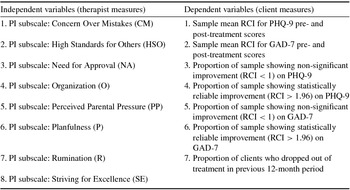
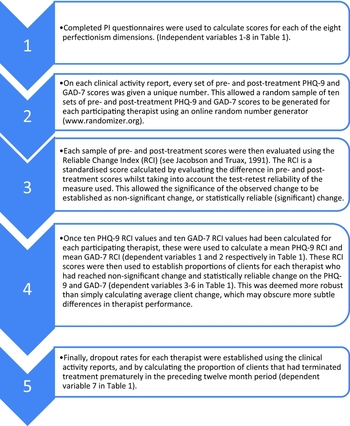
Therapist perfectionism was measured using the PI. Therapists were not given any instruction to relate their questionnaire answers to any specific person or situation; rather they answered the questions in more general terms in order to help us illuminate whether there is any relationship between the person of the therapist and their clients’ outcomes in treatment. Client outcomes were calculated using the standard IAPT outcome measures; these were further evaluated using the Reliable Change Index (RCI) to determine whether observed changes in pre- and post-treatment scores were statistically reliable or not (see Jacobson and Truax, Reference Jacobson and Truax1991). Drop-out rates were also calculated for each participating therapist (see Table 1 for a summary of study variables; Fig. 1 details how each variable was calculated).
Summary of independent and dependent variables

Flow diagram for calculating scores for each study variable

Measures
Perfectionism Inventory
The PI (Hill et al., Reference Hill, Huelsman, Furr, Kibler, Vicente and Kennedy2004) is a 59-item self-report questionnaire that asks respondents to use a 5-point Likert scale to rate how much they agree with each item statement. The questionnaire is less well established as a measure of perfectionism than those devised by Frost et al. (Reference Frost, Marten, Lahart and Rosenblate1990) and Hewitt and Flett (Reference Hewitt and Flett1991). However, the PI was selected due to its multidimensional inclusion of interpersonal factors potentially relevant to the therapeutic relationship (e.g. having high standards for others), as well its categorization of adaptive and maladaptive dimensions of perfectionism; it was anticipated that this would allow for in-depth exploration of the relationship between therapist perfectionism and client outcomes and drop-out rates in treatment. Eight dimensions of perfectionism are measured, which can be summed to yield composite scores for adaptive (‘conscientious’) and maladaptive (‘self-evaluative’) perfectionism, in addition to a singular overall perfectionism score; higher scores infer higher levels of perfectionism. Hill et al. (Reference Hill, Huelsman, Furr, Kibler, Vicente and Kennedy2004) report good internal consistency (alpha = .83) and test-retest correlation; r = .89. They also observed good convergent validity with other measures of perfectionism (see Hill et al., Reference Hill, Huelsman, Furr, Kibler, Vicente and Kennedy2004).
Patient Health Questionnaire
The PHQ-9 (Spitzer et al., Reference Spitzer, Kroenke and Williams1999) was developed to measure levels of depression and is a 9-item self-report questionnaire that requires respondents to indicate how often they have experienced different symptoms of depression in the preceding two week period. A level of depression is calculated by summing all item responses. Kroenke et al. (Reference Kroenke, Spitzer and Williams2001) report excellent internal reliability, test-retest reliability and criterion and construct validity of the PHQ-9.
Generalized Anxiety Disorder Questionnaire
The GAD-7 (Spitzer et al., Reference Spitzer, Kroenke and Williams2006) was designed to measure levels of generalized anxiety. The GAD-7 is a 7-item self-report questionnaire that requires respondents to indicate how often they have experienced symptoms of generalized anxiety disorder in the previous two weeks. A level of anxiety is established by summing all item responses. The GAD-7 has been shown to have excellent internal reliability, test-retest reliability and criterion and construct validity (Spitzer et al., Reference Spitzer, Kroenke and Williams2006).
Results
Estimated proportion of perfectionist therapists
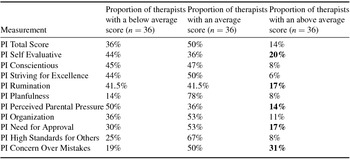
The proportion of perfectionist therapists within the sample group was estimated by calculating the percentage of therapists who scored one standard deviation above the mean on the PI (and its subscales) as defined by the published normative data for the measure (Hill et al., Reference Hill, Huelsman, Furr, Kibler, Vicente and Kennedy2004). Below average scores were defined as those one standard deviation below the mean; average scores were those within one standard deviation either side of the mean. Overall, the proportion of therapists scoring in the ‘problematic perfectionism’ range as measured by the PI was low, with most therapists having average or below average scores on each subscale (see Table 2).
Summary of therapist PI scores

Whilst most scores were average or below, there were areas where more therapists showed elevated perfectionism scores; these were observed within the PI subscales related to maladaptive perfectionism, rather than adaptive perfectionism: six therapists (17%) fell in the above average range on the Rumination subscale and similarly on the Need for Approval subscale. Elevated scores on the Perceived Parental Pressure subscale were reported by five therapists (14%). Most significantly, 11 of the 36 therapists (31%) scored in the above average range on the Concern Over Mistakes subscale.
Is therapist perfectionism associated with client treatment outcomes in CBT?
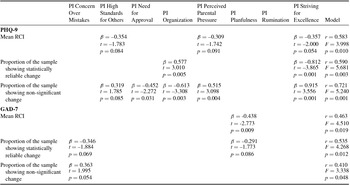
A correlation matrix for the subscales of the PI demonstrated considerable collinearity in the PI subscales of perfectionism. Accordingly, a backwards elimination ordinary least squares regression analysis was conducted for each of the client outcome measures (PHQ-9 and GAD-7) using the categories of change identified by the RCI (non-significant change and statistically reliable change). This analysis allowed the relationship between different dimensions of therapist perfectionism and client outcomes to be assessed. The standardized beta coefficients, t values and associated significant levels are reported in Table 3 for the optimum regression model, illustrating the significant relationships observed.
Observed relationship data between perfectionism subscales and measures of client change

High scores on the PI subscale High Standards for Others were associated with poorer PHQ-9 outcomes, with higher therapist scores on this subscale being associated with lower mean RCI change scores and higher proportions of clients demonstrating non-significant change in depressive symptomology. This suggested that being a therapist who holds others to high standards is associated with poorer outcomes for depressed clients.
The PI subscale Striving for Excellence was negatively associated with outcomes on the PHQ-9, with higher therapist scores on this subscale being related to lower mean RCI change scores and higher proportions of clients reaching non-significant change in treatment; likewise, lower scores on this subscale were associated with higher proportions of clients reaching statistically reliable change on the PHQ-9. This suggested that striving for excellence in therapists is associated with poorer outcomes for depressed clients.
PHQ-9 client outcomes were also associated with the PI subscales Organization and Perceived Parental Pressure. More organized therapists had a greater association with clients reaching statistically reliable change in depressive symptoms, with less organization being associated with more clients evidencing non-significant change. Conversely, therapists who perceived their own parents to have high expectations of them were associated with lower mean RCI change scores and higher proportions of clients within the non-significant change category following their treatment for depression.
There was some evidence of a relationship between PHQ-9 outcomes and therapist scores on the PI Need for Approval subscale. This suggested that need for approval in therapists is associated with fewer clients reaching non-significant change for symptoms of depression. However, this was not supported by any observed relationships between this dimension of perfectionism and the other categories of change.
GAD-7 client outcomes were shown to be negatively associated with the PI subscales Concern Over Mistakes and Planfulness. Therapists indicating more concern about making mistakes and high levels of planfulness had a greater association with lower proportions of clients reaching statistically reliable change in anxiety symptoms. This was further supported by the observation that higher scores on the Concern Over Mistakes subscale were also related to higher proportions of clients reaching non-significant change, and higher scores on the Planfulness subscale were related to lower mean RCI change scores.
Is therapist perfectionism associated with client drop-out rates in CBT?
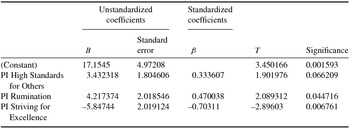
In order to identify the association between therapist perfectionism and numbers of clients prematurely leaving treatment, a backwards elimination ordinary least squares regression analysis was undertaken to identify a minimum set of perfectionism indices that predict client drop-out. Accordingly, the drop-out rate for each therapist was regressed to their eight subscales of the PI. A significant multiple correlation was observed for the final complete regression model (r = 0.474, F 3,32 = 3.08, p = 0.041), indicating that approximately 22% of variation in drop-out rates could be explained in terms of the PI subscales Striving for Excellence, High Standards for Others and Rumination. Having high standards for others and rumination in therapists was associated with a higher client drop-out rate. Conversely, striving for excellence in therapists was associated with less of a drop-out rate. The results of this analysis are summarized in Table 4.
Backward elimination regression model for client drop-out

Discussion
In this study only 14% of therapists had a total PI score in the ‘above average’ range, although 36% of therapists had a score that was above the normative mean. The rates of perfectionism in CBT therapists were shown to be lower than that found in previous research (Haarhoff, Reference Haarhoff2006). This incongruence may be explained by the fact that Haarhoff's sample were trainee therapists (where levels of perfectionism may be amplified due to stage of training) or due to the differing measures of perfectionism utilized. There was a clear rationale for utilizing the PI in the present study, but it is less well established as a measure of perfectionism than the measures by Frost et al. (Reference Frost, Marten, Lahart and Rosenblate1990) and Hewitt and Flett (Reference Hewitt and Flett1991). Alternatively, the results may reflect the self-selecting nature of the sample; perhaps perfectionist therapists did not agree to participate in the study, for example due to concerns about perceived scrutiny or criticism of their outcome data.
In line with the initial hypotheses, significant relationships were observed between dimensions of therapist perfectionism and client outcomes and drop-out rates in treatment. This study suggests that better treatment outcomes for clients with depressive symptoms are associated with a therapist who is organized. Perhaps such therapists aid therapy by having appropriate worksheets or information to hand, or are more able to embed the structure required in session; the precise mechanisms by which organization in therapists might be associated with better outcomes inevitably requires further investigation. This preliminary finding does indicate that perfectionism may have both ‘adaptive’ as well as ‘maladaptive’ consequences for the therapeutic process, although there were a higher number of negative associations observed.
High scores on the PI subscales Striving for Excellence and High Standards for Others were associated with poorer PHQ-9 outcomes. This may suggest that depressed clients have better treatment outcomes with therapists who are not perfectionist in what they do or hold others to high standards. This observation supports Leahy's (Reference Leahy2001) suggestion that the therapeutic relationship would probably be impaired by perfectionistic therapist attitudes, and also Hewitt and Flett (Reference Hewitt and Flett1991) who claim that having high standards for others can cause interpersonal difficulties. It may be that therapists who hold themselves and others to high standards could demotivate clients by creating unrealistic therapeutic standards (e.g. encouraging the setting of unrealistic goals, prescribing homework tasks that are too difficult, rushing through interventions). Tension may then arise in the therapeutic relationship when the client fails to meet the standards expected by the therapist. Conversely, therapists who reported lower perceived parental pressure to succeed also evidenced better clinical outcomes for depression, which may reflect the emulation of a less demanding or critical interpersonal style with their clients. The precise nature of these relationships is beyond the data of the present study and as such requires further empirical investigation.
Interestingly, therapists exhibiting higher need for approval from others were associated with better clinical outcomes in depressive symptoms. Unfortunately, this current study is unable to differentiate between therapeutically endogenous motivations (i.e. the desire to please the client) and therapeutically exogenous motivations (i.e. to please someone external to the therapeutic relationship such as a manager or supervisor) or the tension between these factors. It would be interesting to investigate how therapists with higher need for approval might manage criticism within these relationships; for example, are they more willing to respond to and resolve issues in order to obtain approval? Whilst the present study cannot define the reason for this observation in the data, it would contradict the supposition that need for approval may lead to collusion with client problems (e.g. being unwilling to expose the client to difficult emotions as part of recovery) and suggests instead that the desire to please may result in better treatment outcomes.
In terms of clients with anxiety symptoms, the results suggested that better outcomes are associated with therapists who have less concern about making mistakes and who do not over-plan their therapeutic encounters. Although the present study cannot accurately define these observed relationships, there are a number of hypotheses pertinent to further investigation. For example, planful therapists may arrive at therapy sessions with a preconceived agenda which may reduce collaboration in therapy and may inhibit responsiveness to any other client needs which may arise. This may be perceived by the client as rigid or controlling, in line with the characteristics of perfectionism suggested by Shafran et al. (Reference Shafran, Cooper and Fairburn2002). Additionally, clients presenting with anxiety symptoms may themselves plan excessively as a means of coping with worry and uncertainty. Therefore, therapists who exhibit high levels of planfulness could collude with part of the maintenance of such clients’ problems, thereby limiting treatment success. Conversely, other anxious clients may refuse to plan at all for fear of ‘failing’ and in these circumstances they may find it difficult to work with a planful therapist. This could be exacerbated further by a therapist who also fears making mistakes, and who may collude with any avoidance in this respect, again limiting treatment success.
The results suggested that lower client drop-out rates were associated with therapists who do not hold others to high standards and do not ruminate on their mistakes, and this would support the above conclusions drawn from examining client outcomes. Conversely, lower drop-out rates were also associated with therapists who strive for excellence in what they do. This suggested that such therapists may retain more clients in therapy until treatment completion, but with less significant change in terms of depressive symptomology. Although beyond the data of the present study to explain, it may be that perfectionist therapists actually manage to retain more complex clients in treatment, and that the lesser outcomes observed can be attributed to them persevering with clients with poorer prognosis rather than any negative impact of their schema on client outcomes directly; this hypothesis requires further investigation.
Implications for clinical practice
This exploratory study supports the idea that the interpersonal dimensions of perfectionism are important, and that there may be benefit in therapists identifying their own perfectionist schema and considering how this may be managed in order to maximize client outcomes. It may provide some support for the use of self-reflection, self-CBT and clinical supervision of process issues more recently recommended in the CBT literature (Bennet-Levy, Reference Bennet-Levy2006; Pretorius, Reference Pretorius2006). The results of this study further suggested that such practice should also take into account information about the primary presenting problem of the client and/or their schema, with different dimensions of perfectionism apparently being important to different psychological disorders. It would be useful to investigate further whether implementing specific interventions to target therapist perfectionism in turn improves client outcomes in treatment. Any clinical implications are speculative at this stage and require further, more detailed investigation.
Implications for further research
The sample employed was relatively small and data was drawn solely from self-report measures; this decreases the generalizability of the results and raises some questions about the reliability of the conclusions drawn. Additionally, data gathered about clients failed to eliminate other reasons for non-improvement or termination of treatment. Further research to remedy these factors is warranted and it is important that this captures therapists with a wide range of perfectionistic traits. Additionally, a number of questions have emerged from the present study which warrant further investigation. The present study clearly set out to be an empirical evaluation of the relationship between therapist perfectionism and client outcomes in CBT; however, the quantitative methodology used was not able to illuminate the complexity of the issues being investigated. Certainly, qualitative investigation would help to elucidate how therapists perceive perfectionism to interfere with or enhance their clinical practice, and how their schema might interact with the competing demands of clients, supervisors and service managers. Moreover, such investigations could usefully capture how perfectionist therapists are experienced by their clients, perhaps explaining the associations described in this study. In conclusion, this preliminary investigation demonstrates that therapist perfectionism does appear to be associated with the outcome of CBT intervention. A number of speculations have been made here about the mechanisms underlying these associations; these assertions remain speculative and further research is needed to both validate and elaborate them.
Acknowledgements
We would like to thank the CBT therapists who took part in this study.
Conflicts of interest: The authors have no conflict of interest with respect to this publication.
Financial support: This research received no specific grant from any funding agency, commercial or not-for-profit sectors.
Ethical standards: The authors assert that all procedures contributing to this work comply with the ethical standards of the relevant national and institutional committees on human experimentation within the Helsinki Declaration of 1975, and its most recent revision.



Comments
No Comments have been published for this article.