


Why do some democracies survive for more than a century, whereas others revert to dictatorship after only a brief democratic period? Academic debate and policy recommendations for new democracies frequently look to long-lived democracies such as the United States or Switzerland for clues about which institutional or economic factors may improve the survival of democracies after transition. In fact, a large amount of both theoretical and qualitative empirical research focuses precisely on such long-lived democracies and attempts to explain what distinguishes them from new or failed democracies (see e.g., Huntington Reference Huntington1991; Linz and Stepan Reference Linz and Stepan1996).
The premise underlying this focus on long-lived democracies is that their advanced age is an indicator of the enduring stability of democracy in these countries—that they are consolidated democracies. Although substantial disagreement persists about the exact causes or appropriate measures of democratic consolidation, most research agrees that consolidated democracies face essentially no risk of an authoritarian reversal.Footnote 1 But then even a long-lived democracy may be surviving for two different reasons: it may be either a consolidated democracy whose odds of reverting to dictatorship are essentially zero (e.g., Sweden in 2001), or a democracy that is not consolidated, but survives because of some favorable circumstances (e.g., Thailand in 2001).
However, the influential empirical literature on transitions to democracy treats all existing democracies as a single group: after controlling for various covariates, all democracies are expected to face the same risk of a reversal (see e.g., Przeworski et al. Reference Przeworski, Alvarez, Cheibub and Limongi2000). This failure to account for how the potential heterogeneity among democracies translates into observable data misses an important dynamic in the process of democratic survival. The observed survival of democracy may be the consequence of two distinct causal mechanisms: democratic consolidation, which practically eliminates the risk of an authoritarian reversal, or a separate mechanism that prevents authoritarian reversals in those democracies that are not consolidated.
As a result, the factors that determine whether a democracy will consolidate may differ from those that explain the occurrence and timing of authoritarian reversals in those democracies that are not consolidated. This distinction may seem subtle, but it is crucial to our understanding of democratic survival. A medical analogy may help highlight the importance of this distinction: consider an individual who survived one of the later waves of the Black Death in Europe (e.g., the plague wave of 1383 versus the original 1348 wave). She may have survived because (1) she developed an immunity to the plague during the prior wave(s) of the epidemic or because (2) she practiced careful hygiene and, in turn, minimized her exposure to the contagion.Footnote 2 Although both alternatives explain survival, they are clearly two, distinct causal mechanisms. Similarly, the distinction between the two separate mechanisms that may account for the survival of democracy is lost when we treat all existing democracies as a single, homogenous group. Failure to distinguish between these mechanisms not may only lead to incorrect statistical estimates, but also confounds what is of central interest in the study of democratic survival: the causes of democratic consolidation.
In this paper, I establish a new approach to the empirical study of democratic survival that is designed specifically to addresses the concerns laid out in the above discussion. I assume that the population of existing democracies consists of democracies that are transitional and face a positive risk of an authoritarian reversal, and of democracies that are consolidated and do not face the risk of an authoritarian reversal. As a result, this approach is explicit about the difference between consolidation and the observed survival of democracy: consolidation amounts to being “immune” to the causes of democratic breakdowns, yet democracies that are not consolidated—transitional democracies—may also survive because of some favorable circumstances.
I approach the data on democratic survival realistically and do not assume that we can observe whether an existing democracy is transitional or consolidated. This unobservability implies a departure from the existing empirical literature on democratic transitions in one important way: rather then being a single population, the existing democracies are a mixture of transitional and consolidated democracies, and each group faces very different odds of reverting to dictatorship. All democracies that reverted to dictatorship were, by assumption, transitional. On the other hand, whether an existing democracy is transitional or consolidated must be inferred from the data. Thus this approach neither presumes that consolidation actually occurs nor does it impose an arbitrary criterion on how old a democracy must be in order to be considered consolidated.
I argue that an empirical analysis based on these simple assumptions has several advantages over the existing approach to the study of democratic survival. I find strong evidence that some democracies face qualitatively different odds of survival: a large number of existing democracies are in fact consolidated. By contrast, other democracies are transitional and may revert to dictatorship. Moreover—and quite intuitively—our confidence that an existing democracy is consolidated increases with its age. I also find that studies that do not allow for this unobserved heterogeneity among democracies greatly underestimate the risk of early authoritarian reversals while they overestimate the risk of late reversals.
Importantly, I show that the factors that explain whether a democracy is consolidated differ from those that explain the variation in the hazard of authoritarian reversals in transitional democracies. More specifically, I find that low levels of economic development, a presidential executive, and a military authoritarian past reduce the odds that a democracy consolidates. However, a transitional democracy experiences a reversal primarily as a consequence of an economic recession. My results therefore strongly suggest that in order to explain the survival of democracy, we should build separate theoretical models that account for the onset of authoritarian reversals, on the one hand, and why only some democracies consolidate, on the other. I now turn to a more detailed discussion of my methods and findings.
MAIN FINDINGS AND THEIR CONTRIBUTION TO EXISTING RESEARCH
The results in this paper are obtained using a split-population survival model. In the present context, a key feature of this technique is the assumption that the population of existing democracies is a mixture of those that will ultimately revert to dictatorship and those that do not face the risk of a reversal. In contrast, standard survival models assume that each observation ultimately experiences the event of interest—in this case, an authoritarian reversal.Footnote 3 Although we cannot observe whether an existing democracy is transitional or consolidated, the split-population model exploits the fact that this unobserved heterogeneity implies different expectations about the survival of transitional and consolidated democracies. Importantly, this method does not rule out the possibility that there are no consolidated democracies in the data; whether any among the currently existing democracies are consolidated is assessed using standard statistical tests. As I demonstrate, however, the data on democratic survival strongly indicate that a substantial number of existing democracies are in fact consolidated.
Survival analysis techniques that model this form of unobservable heterogeneity have been developed in biostatistics (Farewell Reference Farewell1977) and are called cure rate models.Footnote 4 In this literature, individuals that are not at risk of experiencing the event of interest are referred to as “cured,” “immune,” or “long-term survivors.” In the social sciences, such models are referred to as split-population models and have been applied to the study of criminal recidivism (Schmidt and Witte Reference Schmidt and Witte1989), addiction (Douglas Reference Douglas1998; Forster and Jones Reference Forster and Jones2001), and long-term unemployment (Yamaguchi Reference Yamaguchi1992). In political science, I am only aware of the use of this technique in the study of campaign financing by Box-Steffensmeier, Radcliffe, and Bartels, (Reference Box-Steffensmeier, Radcliffe and Bartels2005) and civil wars by Findley and Teo (Reference Findley and Teo2006). Here I preserve the social–scientific nomenclature and refer to this class of models as split-population models.
The new empirical approach in this paper allows me to uncover patterns in the data on democratic survival that methods typically employed in the related literature do not reveal. My key substantive findings concern a relationship that is at the heart of a prominent debate in comparative politics: the dynamics of democratic survival and its economic and institutional determinants. Additionally, I argue that the present approach brings the quantitative study of democratic consolidation closer to the qualitative empirical and theoretical research and also provides a better statistical fit to the data on democratic survival. I briefly present these findings before turning to the empirical analysis itself.
A central debate in the literature on transitions to democracy concerns the effect of economic conditions on the survival of new democracies (see e.g., Boix and Stokes Reference Boix and Stokes2003; Przeworski et al. Reference Przeworski, Alvarez, Cheibub and Limongi2000). In a seminal contribution, Przeworski et al. (Przeworski and Limongi Reference Przeworski and Limongi1997; 2000) make the influential claim that the level of economic development affects the survival of democracy but not the transition from dictatorship to democracy. The empirical model in this paper allows me to address the first part of this claim from a new direction: Do we observe a positive association between economic development and democratic survival primarily because (1) wealth improves the odds that a democracy consolidates, (2) a high level of economic development actually lowers the hazard of reversals in transitional democracies, or (3) both effects hold?
The analysis in this paper answers the above question in favor of the first alternative. Specifically, economic development affects consolidation, and therefore whether a democracy faces a risk of a reversal, but it does not help us explain when a reversal might occur in transitional democracies. Instead, I find that the eventual timing of reversals is associated only with economic recessions. Conversely, recessions have no effect on whether a democracy is consolidated. In other words, the level of economic development determines the extent to which a democracy is susceptible to the risk of a reversal, but the eventual timing of reversals is only associated with economic recessions. Although previous research finds that both the level of economic development and the economic growth are positively associated with democratic survival,Footnote 5 my approach allows me to disaggregate the impact of these economic factors on two related yet distinct dynamics: the likelihood of democratic consolidation and the survival of transitional democracies.
How do political institutions affect the survival of new democracies? Another prominent debate in comparative politics concerns the effect of past authoritarian institutions and the type of democratic executive–legislative relations on the survival of democracy (see e.g., Mainwaring and Shugart Reference Mainwaring and Shugart1997; Cheibub Reference Cheibub2007). In particular, the effect of presidentialism on democratic survival remains controversial. In a series of influential arguments, Linz (Reference Linz, Linz and Valenzuela1994) elaborates on the many ways in which presidential systems are more prone to democratic breakdown than parliamentary ones.
Yet existing empirical research is not unanimous regarding the negative effect of presidentialism on democratic survival. Although presidential democracies fail at a higher rate than those with other types of executives (Mainwaring and Shugart Reference Mainwaring and Shugart1997; Przeworski et al. Reference Przeworski, Alvarez, Cheibub and Limongi2000), this correlation may be due to the potentially confounding effect of other economic and institutional factors. Boix (Reference Boix2003, 150–55), for instance, finds that the effect of presidentialism on democratic survival depends on an unfavorable type and distribution of economic assets, but he finds no independent, negative effect of presidentialism. Focusing directly on the relationship between presidentialism and democratic survival, Cheibub (Reference Cheibub2007) revisits the findings in Przeworski et al. (Reference Przeworski, Alvarez, Cheibub and Limongi2000, 128–36) and after a series of new empirical tests concludes that “what kills democracies is not presidentialism but rather their military legacy” (Cheibub Reference Cheibub2007, 140).
The present model allows me to investigate the relationship between political institutions and democratic survival in a novel way: is the effect of political institutions (1) direct, so as to raise the hazard of authoritarian reversals in transitional democracies; (2) indirect, so as to make democracies more or less susceptible to other factors that will eventually lead to a democratic breakdown; or (3) is it both?
I find that both a military past and presidential executive have a large, negative, and independent effect on a democracy's susceptibility to reversals—that is, on a democracy's chances of being consolidated rather than transitional. However, neither a military past nor a presidential executive have any direct effect on the hazard of authoritarian reversals faced by transitional democracies. As mentioned earlier, the primary factor associated with the timing of authoritarian reversals is economic recession. Therefore, if a democracy reverts to dictatorship, its “death certificate” will most likely record an economic recession as the immediate cause of the reversal, despite the fact that political institutions may have had the key, if indirect, effect on its survival.
Building on these results, I address a question that is at the heart of the study of democratic survival: suppose a country has been democratic for T years. Can we conclude that this country is consolidated?Footnote 6 Below, I show that the probability that an existing democracy is consolidated indeed increases with its age. Importantly, however, the economic and institutional history of a democracy considerably moderates the positive effect that age alone has on our confidence that it is consolidated. Both an unfortunate or a lucky combination of economic and institutional factors overwhelms any information conveyed by the continuing survival of a democracy. Thus in contrast to Epstein et al. (Reference Epstein, Bates, Goldstone, Kristensen and O'Halloran2006) and Przeworski et al. (Reference Przeworski, Alvarez, Cheibub and Limongi2000), I find that the age of a democracy is in fact associated with an increase in the odds of its survival. As a result, qualitative studies of long-lived democracies searching for clues that will improve the survival of new democracies are conditionally warranted.
To further illustrate how the model here differs from existing approaches to democratic consolidation, consider the following result of my analysis: an existing democracy that survived an economic recession is more likely to be consolidated than a democracy that survived an expansion. This may seem rather straightforward—if a democracy overcame a crisis, our belief about its enduring stability grows more than if it experienced good times only. But note that existing empirical models imply only that recessions lead to democratic breakdowns (see e.g., Bernhard, Nordstrom, and Reenock Reference Bernhard, Nordstrom and Reenock2001, Gasiorowski Reference Gasiorowski1995) and have nothing to say about what to infer from the fact that a democracy has in fact survived a recession. In contrast, the present approach obtains this intuitive result within a unified empirical model that is explicit about the different odds of survival faced by transitional and consolidated democracies.
Although I have focused on my substantive findings so far, I argue throughout the paper that the empirical approach here provides a notably better statistical fit to the data on democratic survival than do existing models. For instance, I show that new democracies face a risk of an early reversal that is much greater than would be expected using existing methods. At the same time, these methods overestimate the risk of a late reversal. This is because an analysis that ignores the potential but unobservable presence of consolidated democracies assumes that long-lived democracies, such as the United Kingdom, will eventually revert to dictatorship. By contrast, the present model allows for the possibility that some democracies will not revert and therefore leads to a more informative view of the data on democratic survival.
For instance, summary statistics based on this model provide information about the expected lifetime of democracies that actually are at risk of a reversal and allow us to predict which countries belong to that group. Specifically, my analysis indicates that at the median levels of the economic and institutional covariates, about one-half of the transitional democracies will revert to dictatorship by their 14th year. In contrast, for these same democracies, an analysis that does not account for the existence of consolidated democracies predicts a median survival age of approximately 57 years!Footnote 7 Thus existing models exaggerate the longevity of transitional democracies by more than fourfold and are consequently too optimistic about new democracies' odds of survival.
I now turn to a brief summary of the data on democratic survival. Next, I discuss the assumptions underlying split-population models. I then present my empirical analysis and detailed results. I conclude with a review of my central findings and suggestions for future research.
DATA ON DEMOCRATIC SURVIVAL
My data on democratic survival are based on the regime type data compiled by Boix and Rosato (Reference Boix and Rosato2001). Although there are other widely used datasets on regime type (see e.g., Marshall and Jaggers Reference Marshall and Jaggers2003; Przeworski et al. Reference Przeworski, Alvarez, Cheibub and Limongi2000), the Boix and Rosato dataset covers an extensive period (1800–1994) and codes regime type as a binary variable based on explicit institutional criteria.Footnote 8 I extended the temporal coverage of these data backward to 1789 and forward to 2001 in order to cover essentially the entire existence of modern democracy.
In order to study democratic consolidation and authoritarian reversals, I reshaped the data to consist of democratic spells only. That is, the data contain all democracies from the year of their democratic transition to the year of their authoritarian reversal, if one occurred. If no reversal occurred in a country, then the last year in the dataset is the last recorded year for that country.Footnote 9 The resulting data consist of 193 democratic spells in 133 countries.
As I emphasized earlier, an important feature of the data on democratic survival is that we cannot observe whether currently existing democracies are transitional or consolidated. By assumption, spells that have ended in a reversal are transitional. In terms of the vocabulary to be used later, these observations are uncensored. On the other hand, democracies that have not reverted by their last observed year are right-censored observations. These right-censored observations may be either transitional democracies which, if observed long enough, would eventually revert, or consolidated democracies that will never revert to dictatorship.
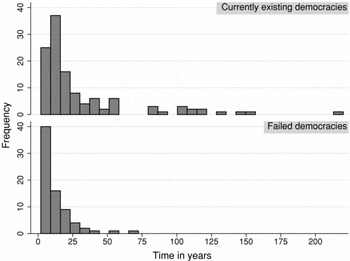
In Figure 1, I separately plot the distribution of survival time of currently existing and failed democracies. Of the 193 democratic spells in the data, a 62% majority are currently existing democracies. Of these, a substantial number remain democratic after more than 30 years. This long-lived group makes up almost one-third of all existing democracies, including many observations that have been democratic for more than a century, such as Canada or New Zealand. In contrast, only three among the 74 failed democracies lasted longer than 32 years. Thus an initial inspection of the pattern of democratic survival reveals that a substantial number of currently existing democracies are surviving for a remarkably long period of time.
Distribution of Survival Time of Currently Existing and Failed Democracies, 1789–2001

A Split-Population Model of Democratic Survival
Before presenting my estimation results, I briefly summarize the key assumptions and derivations underlying split-population models. Maller and Zhou (Reference Maller and Zhou1996) provide a detailed discussion of the large-sample properties of these models.
Denote by C ∈ {0,1} whether a democracy is consolidated or transitional, and let C = 1 whenever a democracy is consolidated, whereas C = 0 whenever a democracy is transitional. Because we do not observe whether the right-censored observations in the data are transitional or consolidated democracies, C is an unobservable variable for the right-censored observations. Denote the probability that a democracy is consolidated by π. Note that π is constant with respect to time. Then Pr(C=1) = π and Pr(C = 0) = 1 − π.
Suppose that the probability that a transitional democracy reverts by year t ≥ 0 follows a cumulative distribution function F(t|C=0). Denote the corresponding density function by f(t|C=0) and the survival function by S(t|C=0)=1−F(t|C=0). Note that F(t|C=0), f(t|C=0), and S(t|C=0) are conditional on C=0, that is, on the democracy being transitional.
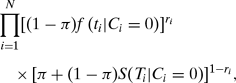
Let T denote the total number of years a democracy is observed in the sample. Let r=1 indicate that a democracy reverts by the last observed year; these observations are uncensored. Otherwise, r=0 and these observations are right-censored. When r=1, a democracy must be transitional and C=0. The likelihood of these observations is Pr(C=0)f(t|C=0), or equivalently, (1−π)f(t|C=0).
On the other hand, when an observation is right-censored, then a democracy may be either transitional or consolidated. The likelihood of these right-censored observations is then a combination of the likelihood that an observation is a consolidated democracy and the likelihood that an observation is a transitional democracy that has not reverted by the last observed year T, Pr(C=1) + Pr(C=0) Pr(t>T|C=0), or equivalently, π + (1−π)S(T|C=0).
Denote observations of democratic spells by i=1,2, . . ., N. The joint likelihood of all N observations in the sample is
and the joint log-likelihood of all N observations in the sample is
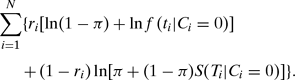
This log-likelihood is maximized numerically. Note that π, the probability that a democracy is consolidated, is estimated jointly with the parameters of the distribution function F(t|C=0).
In order to ensure that my results are not sensitive to the choice of functional form for the survival distribution F(t|C=0), I employ two alternative parameterizations of the survival distribution: the Weibull and the log-logistic. Both the Weibull and the log-logistic distribution are two-parameter distributions; I denote these parameters by λ and α. I refer to λ as the scale parameter because it determines the rate at which reversals occur; I refer to α as the shape parameter because it determines the shape of the hazard rate. The distribution function F(t|C=0) is

for the Weibull and

for the log-logistic parameterization. The key distinction between the two parameterizations is that the log-logistic distribution allows for a nonmonotonic hazard rate, whereas the hazard rate is monotonic in the Weibull parametrization. Later in the paper, I examine the goodness-of-fit of alternative model specifications and find that the log-logistic parameterization provides the best fit to the data. Examples in the remainder of the paper are therefore based on this parameterization, unless otherwise noted.
ESTIMATION AND RESULTS
I begin by estimating a split-population model without covariates. I do this because the key differences between the split-population model used here and the discrete choice and survival models typically employed in the literature on democratic transitions are best understood when we consider the survival of democracy only, without any covariates.Footnote 10 In subsequent sections, I will examine the effects of key economic and institutional covariates on both the timing of authoritarian reversals and the likelihood of democratic consolidation. %All the findings of the preliminary analysis in this section will be confirmed in the analysis that accounts for the effects of covariates.
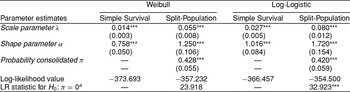
The parameter estimates for the split-population model without covariates are presented in Table 1. The estimates are λ = 0.055 (0.008) and α = 1.250 (0.106) for the Weibull, and λ = 0.080 (0.012) and α = 1.720 (0.154) for the log-logistic model. Robust standard errors are in parentheses. All estimates are significant at the 1% level.
Estimation Results for a Simple and a Split-Population Survival Model without Covariates

Note: 193 observations, 133 countries, 74 reversals. Robust standard errors in parentheses. Significance levels *10%, **5%, ***1%.
a Significance levels are based on the  likelihood ratio test statistic.
What are the implications of the split-population model for the survival of democracies? How do they differ from the implications of a model that ignores the potential unobserved heterogeneity among existing democracies?
The parameter α of the log-logistic model determines the shape of the hazard rate of authoritarian reversals over time. For α > 1, the hazard is first increasing and then decreasing, while the hazard is strictly decreasing for 0 < α ≤ 1. Jointly, the estimates of λ and α imply that in transitional democracies, the hazard rate of an authoritarian reversal is sharply increasing in the first 10 years and declines thereafter. In contrast, the estimate of the shape parameter α is 1.016 for a log-logistic model that ignores the existence of consolidated democracies, and we cannot reject the hypothesis α ≤ 1. For that model, the estimate of α is indistinguishable from 1 at the 95% confidence level, and the estimated hazard rate of an authoritarian reversal is therefore greatest in the first year and declines afterward. The split-population model therefore implies a very different hazard dynamic than a simple survival model.
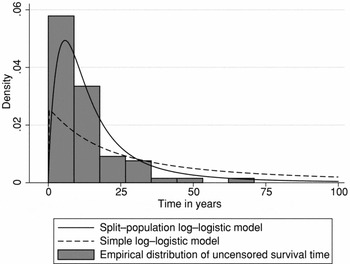
A second notable difference between the two models is that they lead to very different expectations about the survival of new democracies over time. The split-population model implies that about one-half of the transitional democracies will revert to dictatorship by their 13th year. In contrast, a log-logistic model that ignores the existence of consolidated democracies predicts that the median reversal time will instead be about 37 years. In other words, a model that ignores the potential unobserved heterogeneity among existing democracies underestimates the risk of an early reversal while simultaneously overestimating the risk of a late reversal.
Thus the two models differ not only in their implications for hazard dynamics but also in their estimate of the timing of the risk of a reversal faced by new democracies. This difference is evident in Figure 2, which plots the estimated probability density of survival time according to the two models against a histogram of the observed survival time of democracies that reverted to dictatorship.Footnote 11 Clearly, when compared to a simple survival model, the split-population model predicts a distribution of survival time that is much closer the actual distribution of the uncensored survival time of democracies. In other words, estimates based on the split-population model employed here provide a much better fit to the data on democratic survival than do models typically employed in the literature.
Empirical Distribution of Uncensored Survival Time and the Estimated Density of Survival Time of Transitional Democracies According to the Split-Population and the Simple Log-Logistic Models

Now consider the estimate of π, the probability that a democracy is consolidated. The estimates are π = 0.428 (0.055) for the Weibull and π = 0.420 (0.059) for the log-logistic model, with robust standard errors in parentheses. The corresponding 95% confidence intervals are (0.321, 0.535) for the Weibull and (0.305, 0.536) for the log-logistic model.
Can we reject the hypothesis that there are no consolidated democracies among currently existing democracies? In order to do so, I test the hypothesis that π assumes the boundary value of π = 0. The appropriate test statistic for this hypothesis is a 50–50 mixture of  and
 random variables (Maller and Zhou Reference Maller and Zhou1995). The likelihood ratio statistics are 23.918 and 32.923 for the Weibull and the log-logistic models, respectively, whereas the critical value of the test statistic is 5.41 at the 1% significance level. Thus both parameterizations strongly suggest that a substantial number of currently existing democracies are consolidated democracies.
To summarize, this preliminary analysis of the split-population model leads to very different conclusions about both the susceptibility to and the timing of the risk of a reversal faced by new democracies than would be obtained by methods typically employed in the literature on democratic transitions. I find that transitional democracies face a much greater risk of a reversal and a much shorter median survival time than would be estimated by using a simple survival model. At the same time, both the Weibull and the log-logistic parameterizations strongly suggest that a substantial number of currently existing democracies are consolidated democracies, and thus are not at risk of reverting to dictatorship. Finally, when compared to the actual distribution of survival time among democracies that reverted to dictatorship, the split-population model provides a much better fit to the data than does a simple survival model.
The Effects of Covariates
Employing data on the survival of democracy only, the empirical analysis so far strongly suggests that a significant number of currently existing democracies are consolidated. I will now extend the analysis and investigate the effects of covariates on the two related yet distinct mechanisms that I have identified as key to understanding the dynamics of democratic survival: the likelihood that a country becomes a consolidated democracy and the timing of authoritarian reversals in transitional democracies. As I discuss in greater detail below, I examine the effects on democratic survival of two economic and two institutional covariates: level of economic development, economic growth, type of democratic executive, and past authoritarian institutions.
The introduction of covariates implies that the parameters of the survival distribution for transitional democracies are now conditional on these covariates, as is the probability that a democracy is consolidated. In other words, these covariates are a source of additional, observable heterogeneity in the population of democracies. As I have emphasized, only transitional democracies revert to dictatorship, whereas consolidated democracies are not at risk of a reversal. Thus in transitional democracies, covariates affect the occurrence and the timing of reversals. Meanwhile, I estimate how the same covariates may affect the likelihood that a democracy is consolidated rather than transitional.
The inclusion of covariates is also central to addressing the existing research on democratic consolidation. This research associates consolidation with the hypothesis that the risk of an authoritarian reversal declines with the age of a democracy but finds no empirical support for this proposition (Epstein et al. Reference Epstein, Bates, Goldstone, Kristensen and O'Halloran2006; Przeworski et al. Reference Przeworski, Alvarez, Cheibub and Limongi2000). Additionally, that literature emphasizes the need to control for economic and institutional covariates because higher survival rates among older democracies may be confounded with trends in those covariates, such as an increase in the level of economic development (Przeworski et al. Reference Przeworski, Alvarez, Cheibub and Limongi2000, 103).
The present empirical model highlights why the existing approach to the study of democratic consolidation is inadequate: the effect of a covariate on the timing of authoritarian reversals among transitional democracies cannot be separated from the effect of the same covariate on their likelihood of consolidation. But as I emphasized previously, these are two distinct mechanisms by which a democracy may survive. This distinction is key to identifying the determinants of democratic consolidation and cannot be made with models typically employed in the literature on democratic survival.
The main complication arising from the inclusion of covariates is the lack of reliable and comparable covariate data for the entire period 1789–2001. Most economic and institutional covariates are only available for the post-World War II period. However, an analysis based on such historically limited data may not be representative of the relationship between those covariates and democratic survival throughout the entire history of modern democracy. Przeworski et al. (Reference Przeworski, Alvarez, Cheibub and Limongi2000), for instance, do not find that economic development affects transitions to democracy when using data that start in 1950, while Boix and Stokes (Reference Boix and Stokes2003) do detect such an effect when using data that go back to 1850. In order to best ensure that my results are representative of the entire history of modern democracy, I proceed by using the limited economic and institutional covariates available for both the pre- and post-World War II period.
I use two covariates, the level of economic development and annual economic growth, to study the effect of economic conditions on democratic survival. Maddison's Historical Statistics (Reference Maddison2003) is the most extensive source of historical economic data. The two covariates based on Maddison's data are annual GDP per capita and annual GDP growth.
In order to study the effect of political institutions, I employ one measure of the institutional characteristics of the democratic regime and one measure of the institutional characteristics of the authoritarian regime prior to transition to democracy. The dummy variables Presidential, Parliamentary, and Mixed code presidential, parliamentary, and mixed democratic executive, respectively. On the other hand, the dummy variables Military, Civilian, and Monarchy code whether the authoritarian government prior to its transition to democracy was headed by a professional military, civilians, or a hereditary monarch, respectively. When a country was not independent prior to transition, the dummy variable Not independent assumes a value of one. These data are based on Beck et al. (Reference Beck, Clarke, Groff, Keefer and Walsh2001), Cheibub and Gandhi (Reference Cheibub and Gandhi2005), Correlates of War Project (2005), Vanhanen (Reference Vanhanen2003), Svolik and Akcinaroglu (Reference Svolik and Akcinaroglu2006), and on my own data collection. After accounting for missing observations, my data contain 153 democratic spells from 103 countries, which corresponds to a total of 3,402 democracy-year observations between 1848 and 2001.
I now extend the split-population model employed so far and let covariates affect the hazard of authoritarian reversals in transitional democracies as well as the probability that a democracy is consolidated. Covariates affect the timing of reversals in transitional democracies via the scale parameter λ of the Weibull and the log-logistic parameterizations. In order to transform the range (−∞, ∞) of the linear combination of covariates and parameters to the natural domain of λ, which is (0, ∞), I use the exponential link function (McCullagh and Nelder Reference McCullagh and Nelder1983) according to which λ = e X′β and β = (β1. . ., βk) is a parameter vector associated with the covariates X. A positive coefficient βj implies a smaller λ, which in turn implies an increase in the expected duration of democracy for positive changes in the values of the covariates. Alternatively, a negative coefficient implies that a covariate accelerates the onset of an authoritarian reversal.
The covariates X may vary over time, which is the case for both of the economic covariates as well as for the type of the democratic executive. In order to assure their exogeneity with respect to the survival of democracy, I lag each covariate by one year. For the economic covariates, this controls for the possibility that the survival of democracy would affect economic performance in the same year, rather than the other way around. In order to facilitate exposition, I suppress time subscripts for all covariates.
I also let covariates affect the probability that a democracy is consolidated rather than transitional. I use the logistic link function to model the effect of covariates on π, the probability that a democracy is consolidated. Thus we have

where γ = (γ1,. . ., γk) is a parameter vector associated with the covariates X. A positive coefficient γj implies that a democracy is more likely to be consolidated for larger values of covariate j.
However, unlike when I estimate the timing of reversals in transitional democracies, I cannot use time-varying covariates when estimating the probability that a democracy is consolidated. An existing democracy is either transitional or consolidated, although this cannot be observed. Therefore, when estimating the probability that a democracy is consolidated, I only employ covariates that are constant with respect to time throughout the entire democratic spell. In order to estimate the effect of GDP per capita and GDP growth on the probability that a democracy is consolidated, I use a 10-year average of each indicator over the 5 years preceding and the 5 years following transition to democracy.Footnote 12 In order to examine the effect of executive-legislative relations on the likelihood of consolidation, I use the type of executive adopted after transition to democracy. This approach allows me to examine the impact of political institutions and economic conditions at the time of transition to democracy on the likelihood of democratic consolidation.
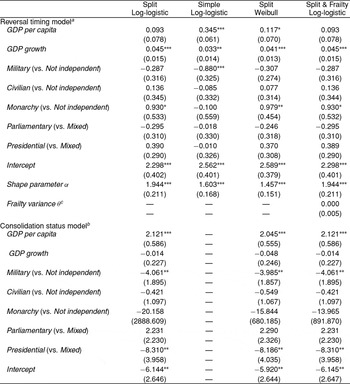
The parameter estimates for the log-logistic and the Weibull parameterizations of the split-population model with covariates are presented in the first and third column of Table 2, respectively. Under the reversal timing model, I list parameter estimates for the effect of covariates on the timing of reversals in transitional democracies. Under the consolidation status model, I list parameter estimates for the effect of covariates on the probability that a democracy is consolidated rather than transitional. I now turn to the interpretation of these estimates.
Estimation Results for Models with Covariates

Note: Standard errors in parentheses. Significance levels *10%, **5%, ***1%.
a Model estimates the timing of reversals among transitional democracies via an exponential link function for the scale parameter λ.
b Model estimates π, the probability that a democracy is consolidated, via a logistic link function.
c Gamma frailty; significance levels are based on the likelihood ratio test statistic.
The Impact of Economic Covariates: Economic Development and Growth
I find that the level of economic development determines the extent to which a democracy is susceptible to the risk of a reversal, but the eventual timing of a reversal is only associated with economic recessions. This can be seen by comparing the statistical significance of the coefficients on GDP per capita and GDP growth in the first and third column of Table 2. Under both parameterizations, the coefficient on GDP per capita is statistically significant at the 1% level in the consolidation status model, but it is not significant in the reversal timing model. The converse is true for the coefficient on GDP growth. This coefficient is statistically significant at the 1% level in the reversal timing model, but it is not significant in the consolidation status model.Footnote 13
The level of economic development strongly affects whether a democracy is transitional or consolidated. The magnitude of this effect is remarkable: a $1,200 increase in GDP per capita raises the probability that a democracy is consolidated from 20% to 80%. As I demonstrate later, whether a democracy is transitional or consolidated is also strongly associated with its type of executive and its past authoritarian institutions. These institutions will therefore determine at which level of GDP per capita the relevant $1,200 interval begins. For a democracy with median levels of all covariates, that critical interval starts at a GDP per capita of $3,900 and ends at $5,100.
How does economic growth affect the timing of authoritarian reversals? Greater growth lowers the hazard of reversals in transitional democracies. Although this effect is nonlinear and exhibits increasing returns, it is almost constant within the range from −7.5% to 9.1% of annual economic growth, which covers 90% of the data: a 1% increase in growth corresponds to a roughly 8-month increase in the median survival time of a transitional democracy. Alternatively, a country with a 0% GDP growth faces the largest reversal hazard in its eighth year. A growth of 10% in the previous year will lower the reversals hazard in the current year by 42%, whereas a 10% recession in the previous year raises the hazard by 43% in the current year.Footnote 14 Finally, recall that consolidated democracies are not at risk of reverting to dictatorship and are thus immune to the negative impact of economic recessions on their odds of survival.
Compare these findings to those based on a model that does not allow for the possibility that some democracies are consolidated. Parameter estimates for a simple log-logistic survival model are displayed in the second column of Table 2. The coefficients of both GDP per capita and GDP growth are statistically significant, yet we are unable to distinguish their effect on the timing of reversals in transitional democracies from their effect on the probability that a democracy is consolidated rather than transitional. In other words, the simple survival model cannot uncover the specific mechanism by which economic conditions promote democratic survival.
The Impact of Past Authoritarian and New Democratic Political Institutions
How do political institutions affect the survival of democracy? I find that a military past and presidential executive both have a large, negative and independent effect on the probability of democratic consolidation, whereas neither institution raises the hazard of authoritarian reversals in transitional democracies. As discussed previously, the latter effect is associated primarily with economic recessions.
First, consider the effect of past authoritarian institutions on the survival of democracy. I find that democracies that were preceded by a military dictatorship face significantly lower chances of becoming consolidated than democracies that were preceded by a civilian dictatorship or a monarchy, or those democracies that were not independent countries prior to transition. (See the coefficient estimates for Military, Civilian, and Monarchy in the consolidation status model in Table 2; I use Not independent as the reference category.) The likelihood ratio test indicates that merging Civilian and Not independent into a single category does not significantly worsen the fit of the model. Therefore, setting aside the four democracies that were preceded by monarchies, the difference in the odds of consolidation is primarily that between those democracies that were preceded by a military dictatorship and those that were not. My estimates suggest that at median levels of the other covariates, only about 1 in 8 democracies that were preceded by a military dictatorship consolidate, while the odds of consolidation are 9 out of 10 for democracies that were preceded by any other type of dictatorship.
However, note that transitional democracies that were preceded by a military dictatorship are not expected to revert to dictatorship any sooner than either democracies that were preceded by a civilian dictatorship or those democracies that were not independent prior to their transition. As the estimates of the reversal timing model indicate, the only institutional factor that affects the risk of authoritarian reversals in transitional democracies is a monarchical past—this type of authoritarian legacy actually lowers the hazard of a reversal. In fact, when they finally reverted to dictatorship, democracies that were preceded by a monarchy lasted 34 years on average, while those democracies that were not preceded by a monarchy lasted less than 10.5 years on average.Footnote 15
Now I consider the effect of the type of executive on democratic survival. As discussed earlier, existing research is not unanimous regarding the negative effect of presidentialism on democratic survival. The present model allows me to take the following, new approach to this issue: is the effect of presidentialism (1) to raise the hazard of authoritarian reversals in transitional democracies, (2) to make democracies more susceptible to other negative factors that will eventually lead to a democratic breakdown, or (3) is it both? The results of my analysis support only the second, indirect relationship between presidentialism and authoritarian reversals: presidential democracies are less likely to become consolidated and are thus more susceptible to other factors that eventually determine the timing of democratic breakdowns.
The magnitude of presidentialism's negative effect on consolidation is remarkable: my results imply that only about 1 in 6,800 presidential democracies will consolidate at median levels of other covariates. Thus the odds that a presidential democracy with median levels of all other covariates will become immune to an authoritarian reversal are practically zero. Compare this to the odds of consolidation for democracies with mixed executives (3 in 8) and for parliamentary democracies (6 in 7). Furthermore, the likelihood ratio test indicates that merging parliamentary and mixed systems into a single category does not significantly worsen the fit of the model. Thus when it comes to the effect of different types of executive on democratic consolidation, the present model suggests a large and important difference between presidential and nonpresidential systems.
As mentioned earlier, however, this large, negative effect of presidentialism on consolidation assumes a democracy with median levels of all remaining covariates. An increase in GDP per capita at the time of transition to democracy from the median $2,858 to $7,831 will compensate for the dismal odds of survival that a presidential executive implies. Nonetheless, several long-lived presidential democracies, and particularly the United States, are outliers in terms of the present model. Furthermore, although this analysis suggests that the type of democratic executive is an important determinant of consolidation, it also suggests that it has no effect on the hazard of authoritarian reversals in transitional democracies. According to the estimates of the reversal model, the median time until a reversal is 14 years for a democracy at median levels of all other covariates, regardless of the type of executive.
Why cannot this strong, negative, and independent effect of presidentialism on democratic consolidation be seen in a simple survival model? Estimates of the log-logistic parameterization of such a model are displayed in the second column of Table 2. As in Cheibub's (Reference Cheibub2007) analysis, a model that ignores the existence of consolidated democracies suggests that a military past has a statistically significant and negative effect on the survival of democracy, but finds no such effect for a presidential executive. In fact, among those democracies that did revert to dictatorship, presidential democracies survive almost equally long as non-presidential ones: the mean survival time is 11.89 and 11.31 years for presidential and nonpresidential democracies, respectively. On the other hand, when only currently existing democracies are considered, nonpresidential democracies have, on average, survived twice as long as presidential ones: the mean survival time is 15.97 and 36.95 years for existing presidential and non-presidential democracies, respectively (see also Przeworski et al. Reference Przeworski, Alvarez, Cheibub and Limongi2000, 129). The present model is able to infer whether we observe this difference in survival between existing presidential and non-presidential democracies because (1) nonpresidential democracies, despite ultimately reverting to dictatorship, tend to survive longer, or because (2) nonpresidential democracies indeed consolidate at higher rates than presidential democracies. In contrast, the simple survival model confounds the two processes and, consequently, does not reveal the important fact that non-presidential democracies indeed consolidate at higher rates than do presidential democracies.
THE DYNAMICS OF DEMOCRATIC CONSOLIDATION
I now use the split-population model to address a question that is at the heart of many studies of democratic consolidation: “Suppose a country has been democratic for T years. Can we conclude that this country is not at risk of reverting to dictatorship?” In order to answer this question, I jointly consider the findings about democratic consolidation so far as well as the additional information of the age of an existing democracy. As in the previous section, I will proceed by first clarifying how the present model addresses the question just raised using age of democracy alone, without economic and institutional covariates. I will then include these covariates in my examination of the effect of age of democracy on consolidation.
Suppose that a democracy has survived for T years and denote by t′ the time at which this democracy reverts. We can use Bayes' rule to compute the probability that an existing democracy is consolidated, given that it has survived for T years,

Using the fact that Pr(T < t′) = Pr(T < t′|C = 1) Pr(C = 1) + Pr(T < t′|C = 0) Pr(C = 0), and the fact that Pr(T < t′|C = 1) = 1 and Pr(T < t′|C = 0) = 1 − F(T|C = 0) = S(T|C = 0), we obtain

where  is the unconditional probability that a democracy is consolidated. Large sample properties of this estimator are discussed in greater detail in Maller and Zhou (Reference Maller and Zhou1996, Chapter 4 and Section 9.3).
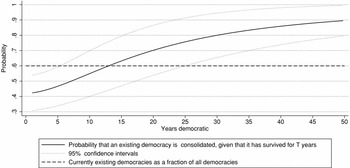
Figure 3 plots this estimator of democratic consolidation based on the parameters of the split-population log-logistic model for the period of the first 50 years after the transition to democracy. The dotted lines plot the associated 95% confidence interval, which measures our statistical confidence in the estimated probability that an existing democracy is consolidated. Intuitively, this probability is increasing in the length of time T that this country remains democratic. We can see in Figure 3 that at time zero, this probability corresponds to the estimate of the fraction of consolidated democracies . As time progresses, our belief that a surviving democracy will never revert to dictatorship is revised upwards.
The Age of an Existing Democracy and the Probability That It Is Consolidated

Using only the age of an existing democracy, any country that has been democratic for 52 or more years as of 2001 is estimated to be consolidated with at least 90% probability. Thus the youngest consolidated democracy would be India, which became a democracy in 1950. We also learn that despite the unprecedented surge in the number of democracies after 1950, no democracy that emerged during that period had by 2001 existed long enough to be considered consolidated with a sufficient degree of confidence.
However, note that with the exception of the first couple of years of a democracy's life, the increase in the probability that an existing democracy is consolidated is greater during the first 20 years after its transition than during any later period. Thus our belief that a democracy is consolidated depends most crucially on its survival during these initial two decades. The substantive relevance of this point is underscored by the fact that 71 out of the 116 currently existing democracies have been democratic for 20 years or less. The survival of democracy in these countries in the next few years will therefore be essential to our belief that these democracies are consolidated.
For expositional purposes, the discussion so far has considered the relationship between democratic consolidation and the age of an existing democracy only, ignoring any covariate effects. Building on the model with covariates, I can now extend this analysis and address the following question: knowing the economic and institutional history of a country and given that it has been democratic for T years, how strong is our belief that this country is not at risk of reverting to dictatorship?
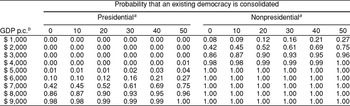
Extending the result in equation (1) to a setting with covariates, I compute the conditional probability that an existing democracy is consolidated, given its age T and its economic and institutional history X t for t = 1, . . ., T. The results are displayed in Table 3. Based on the analysis with covariates, we know that both a higher GDP per capita and a non-presidential executive increase the likelihood that a democracy is consolidated. Table 3 illustrates how the age of an existing democracy leads to an upward revision of that belief. We see that the effect of the age of a democracy can be large, but is restricted to a GDP per capita under $5,000 for nonpresidential democracies, and to a GDP per capita above $5,000 for presidential democracies. Thus depending on its executive type, a democracy may be too poor or too rich for its age to help us infer whether it is consolidated.
Level of Economic Development, Duration of Democracy, Type of Executive, and Democratic Consolidation

Note: Based on a model that distinguishes only between presidential and nonpresidential executive.
a First democratic executive/Age of an existing democracy.
b Average GDP per capita over the 5 years preceding and the 5 years following transition to democracy; the remaining covariates are held at their median/modal values.
Nonetheless, these estimates imply that the survival of democracy for 52 years in India raises our estimate of the odds that India is consolidated from 7% in 1950 to 70% in 2001, despite its low GDP per capita throughout that period. In contrast, models typically employed in the study of democratic survival predict that India should have reverted to dictatorship with a high probability, both in 1950 and in 2001, because of its low GDP per capita.
By jointly considering the age of a democracy and its covariate history within the present model, we also arrive at another notable finding: if a democracy survives an economic recession, our belief that it is consolidated is revised upwards. This is intuitive; given that recessions raise the hazard of reversals when a democracy is transitional, a democracy that survives a recession is more likely to be consolidated than transitional. Formally, this can be seen be conditioning Pr(C = 1|T < t′) in equation (1) on covariate values Xt and considering the effect of a change in Xt on Pr(C = 1|T < t′, Xt). A recession in year T leads to an increase in F(T|C = 0, Xt) and the associated decrease in S(T|C = 0, Xt), which results in an increase in Pr(C = 1|T < t′, Xt). Importantly, however, models that fail to account for the existence of consolidated democracies imply only that recessions raise the hazard of reversals. Those models tell us nothing about what to infer when a democracy has in fact survived a recession.
To summarize, the split-population model can be extended to consider jointly the age of an existing democracy and its economic and institutional history in order to further examine the dynamics of democratic consolidation. Intuitively, the longer a democracy lives, the greater our confidence that it is consolidated. However, I show that the age of a democracy leads to a significant increase in our belief that it is consolidated only for “moderate” values of economic development and depending on its type of executive. The present model also implies that if a democracy survives an economic recession, it is more likely to be consolidated than transitional, a finding that cannot be obtained with models typically employed in the literature on democratic survival. This analysis therefore provides a statistical counterpart to qualitative research that attempts to summarize our belief about the stability of new democracies.
MODEL ROBUSTNESS AND GOODNESS OF FIT
In this section, I demonstrate that the results of my empirical analysis are robust even after accounting for the limited availability of covariate data for the period under study. This lack of data on various potential covariates of interest does not allow me to address several findings in the literature on democratic transitions. For instance, I cannot address the relationship between the survival of democracy and income inequality (Acemoglu and Robinson Reference Acemoglu and Robinson2005; Boix Reference Boix2003), the legal and colonial origin of democracies (La Porta et al. Reference La, Florencio, Silanes, Shleifer and Vishny1999), ethnolinguistic and religious fractionalization (Przeworski et al. Reference Maller and Zhou2000; Fish Reference Fish2002), oil exports (Ross Reference Ross2001), trade openness (Milner and Kubota Reference Milner and Kubota2005), or membership in international organizations (Pevehouse Reference Pevehouse2002). Thus even after employing the available economic and institutional covariates, a significant amount of heterogeneity may remain unaccounted for and bias parameter estimates.
In this section, I account for such spell-specific, unobserved heterogeneity with a frailty extension of the split-population model and confirm the robustness of my findings. The inclusion of a frailty term in the split-population model accounts for the possibility that two transitional democracies with the same covariate values may be subject to different risks because of unobservable, spell-specific risk factors. A frailty term is an unobservable, multiplicative, random effect with unit mean μ = 1 and variance θ that affects the speed of reversals among transitional democracies. Observations with μ > 1 are more frail for reasons unexplained by the covariates and have an increased risk of failure; the converse holds for observations with μ < 1.
I present parameter estimates of a log-logistic split-population model with one commonly used frailty distribution—the Gamma frailty—in column 4 of Table 2. All parameter estimates are now conditional on the frailty variance θ. However, as Table 2 indicates, these estimates are very close to those of the original split-population model. Because research on frailty models indicates that estimates may be sensitive to the specific distribution posited for frailty (see e.g., Heckman and Singer Reference Heckman and Singer1984), I used an alternative, inverse Gaussian frailty distribution to re-estimate the split-population model. Yet the results of that analysis are almost identical to those obtained using the Gamma frailty distribution.Footnote 16 We can therefore be confident that the results in the previous sections are not skewed by spell-specific, unobserved heterogeneity.
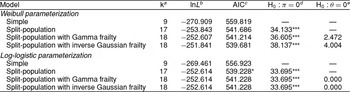
So far, my results do not do not indicate whether the log-logistic or the Weibull parameterization provides a better fit to the data. I therefore consider an additional, information-based criterion for goodness-of-fit, Akaike's information criterion (AIC) (Akaike Reference Akaike1974). This criterion allows me to compare the fit of both non-nested models (the log-logistic versus the Weibull parameterization of the split-population model) and nested models (the Gamma versus the inverse Gaussian frailty within the split-population model) and is a useful indicator of model overfitting. AIC is defined as AIC = −2 ln L + 2k, where L is the model likelihood and k is the number of parameters in the model. The model with the smaller AIC is considered the better-fitting model.
Table 4 displays AIC scores for the alternative parameterizations of the simple survival model and the split-population models with and without frailty. The AIC scores indicate that the log-logistic split-population model without frailty provides the best fit to the data.Footnote 17 In Table 4, I also display the results of a likelihood ratio test of the hypothesis that the frailty variance does not improve the fit of the split-population model (H 0:θ = 0) as well as the hypothesis that there are no consolidated democracies in the sample (H 0:π = 0). The test of the former hypothesis indicates that the inverse Gaussian frailty term improves the fit of the Weibull parameterization at the 5% significance level, but neither frailty parameterization significantly improves the fit of the split-population log-logistic model. Importantly, the latter test clearly indicates that accounting for consolidated democracies improves the fit of the present model regardless of the particular parametric assumptions about the hazard function or the frailty distribution, as I have argued throughout this paper.
Comparison of Goodness of Fit of Alternative Simple and Split-Population Models with Covariates

Note: 3402 observations (democracy-year), 153 democratic spells, 103 countries, 63 reversals.
a Number of parameters, including auxiliary parameters such as the shape parameter α and frailty variance θ.
b Model log-likelihood.
c Lower AIC indicates better fit. The model with the lowest AIC is denoted by *.
d The critical value of the  likelihood ratio test statistic is 18.17 at 1% significance level, *10%, **5%, ***1%.
e The critical value of the likelihood ratio test statistic is 5.41 at 1% significance level, *10%, **5%, ***1%.
CONCLUSION
In this paper, I establish a new approach to the empirical study of democratic survival. A key feature of this approach is the intuitive assumption that some democracies may be consolidated and thus immune to the risk of an authoritarian reversal, while others—transitional democracies—face that risk. Importantly, the difference between the two types of democracy is not directly observable.
I show that a substantial number of existing democracies are indeed consolidated, and that our confidence that an existing democracy is consolidated increases with its age. This is in contrast to the influential quantitative empirical literature on democratic transitions, which finds no statistical evidence that the age of a democracy is associated with greater chances of its survival (see e.g., Epstein et al. Reference Epstein, Bates, Goldstone, Kristensen and O'Halloran2006; Przeworski et al. Reference Przeworski, Alvarez, Cheibub and Limongi2000). The present approach therefore bridges the divide between these existing quantitative findings and the qualitative research on democratic survival, in which the concept of consolidation receives considerable theoretical attention and bears out empirically in qualitative evidence.
I also investigate the effect of prominent economic and institutional factors on democratic survival. Crucially, I identify the factors that explain whether a democracy survives because it is consolidated from those that separately lower the hazard of authoritarian reversals in transitional democracies and thus also promote democratic survival. I find that democracies with low levels of economic development, a presidential executive, and a military authoritarian past are less likely to consolidate. However, these three factors have no effect on the hazard of authoritarian reversals in transitional democracies; that risk is only associated with economic recessions.
At the theoretical level, these results strongly suggest that two separate theories may be needed in order to explain democratic survival: one that accounts for the onset of authoritarian reversals in transitional democracies, and a second one that explains why only some democracies consolidate. In terms of public policies that aim to improve the survival of new democracies, these processes pertain to two related but distinct policy ends: the first is relevant when we want to reduce the immediate risk of authoritarian reversals in transitional democracies, the second when we want to devise policies that will transform a transitional democracy into a consolidated one.
The current approach furthermore allows me to evaluate empirical propositions about democratic consolidation while being realistic about the available data and even without identifying a theoretical consensus about the proper measures of consolidation. Considerable debate persists about the factors that contribute to the consolidation of democracy (see e.g., O'Donnell Reference O'Donnell1996). Still, most research agrees that consolidation greatly improves a democracy's chances of survival. I translate that point of agreement into the statistical assumption that consolidated democracies are markedly more resilient in the face of adverse political or economic conditions than transitional ones. Mine is therefore a “probabilistic” rather than a “substantive” concept of consolidation. The current approach allows me to study consolidation without presuming that it actually occurs and without imposing an arbitrary age threshold that implies that all democracies consolidate by a certain age. In this way, we can advance empirical research on consolidation despite the lack of consensus on its particular determinants or measures.
The empirical approach established here may be a fruitful framework for the study of other political settings with similar unobservable heterogeneity. For instance, Fortna (Reference Fortna2004) studies the effect of cease-fire agreements on the durability of peace, while Diehl and Goertz (Reference Diehl and Goertz2000) study the determinants of enduring international rivalries. In the context of these studies, whether peace or rivalry are truly enduring or merely temporary can only be observed indirectly, via the absence of violence. The approach that I establish highlights the distinction between those factors that lower the hazard of the resumption of violence and those that lead to a permanent peace settlement, and provides a methodology that can identify the potentially different determinants of each trend.



Comments
No Comments have been published for this article.