


Introduction
Anxiety disorders are the most common psychiatric problems in childhood (Essau et al., Reference Essau, Lewinsohn, Lim, Ho and Rohde2018) with as many as 6.5% of pre-adolescent children meeting diagnostic criteria for at least one anxiety disorder at any one time (Polanczyk et al., Reference Polanczyk, Salum, Sugaya, Caye and Rohde2015). This high prevalence is of serious concern given that childhood anxiety disorders have been shown to have an adverse impact on children’s family life, social functioning, and academic development (Essau et al., Reference Essau, Conradt and Petermann2000; Ezpeleta et al., Reference Ezpeleta, Keeler, Erkanli, Costello and Angold2001). These disorders often co-occur with depression and behavioural difficulties (Lewinsohn et al., Reference Lewinsohn, Zinbarg, Seeley, Lewinsohn and Sack1997) or precede the presence of other mental health problems later in life, i.e. depression, suicidal behaviours, and substance abuse (Bittner et al., Reference Bittner, Egger, Erkanli, Jane Costello, Foley and Angold2007; Costello et al., Reference Costello, Egger and Angold2005). Psychological treatments for childhood anxiety disorders have been developed and are broadly effective (James et al., Reference James, James, Cowdrey, Soler and Choke2013; Reynolds et al., Reference Reynolds, Wilson, Austin and Hooper2012); however, although recovery rates vary for specific anxiety disorders (Compton et al., Reference Compton, Peris, Almirall, Birmaher, Sherrill, Kendall and Rynn2014; Knight et al., Reference Knight, McLellan, Jones and Hudson2014; Wergeland et al., Reference Wergeland, Fjermestad, Marin, Bjelland, Haugland, Silverman and Heiervang2016), a significant minority of children with anxiety disorders do not recover following treatment (James et al., Reference James, James, Cowdrey, Soler and Choke2013). In order to better understand these variable outcomes and ultimately improve treatment outcomes, a better understanding of factors that contribute to the development and maintenance of specific childhood anxiety disorders is required.
Theoretical models of anxiety have highlighted that experiencing stressful events is a potential contributing factor to the development and maintenance of anxiety in children (Chorpita and Barlow, Reference Chorpita and Barlow1998; Hudson and Rapee, Reference Hudson, Rapee, Heimberg, Turk and Mennin2004; Rapee, Reference Rapee, Vasey and Dadds2001). For example, Chorpita and Barlow (Reference Chorpita and Barlow1998) propose that the experience of stressful events early in life, in particular uncontrollable events (e.g. chronic abuse, neglect, impoverished environments) increases a child’s vulnerability to interpret future situations as uncontrollable. Consistent with this hypothesis, there is some evidence to suggest that, compared with non-anxious children, children with anxiety disorders experience both more chronic adversities (i.e. enduring stressors, such as neighbourhood problems, and parental relationship dysfunction) and negative life events (i.e. discrete and time-limited events, such as bereavement) (Allen et al., Reference Allen, Rapee and Sandberg2008; Boer et al., Reference Boer, Markus, Maingay, Lindhout, Borst and Hogendijk2002; Gothelf et al., Reference Gothelf, Aharonovsky, Horesh, Carty and Apter2004). In addition, social factors such as living in a dangerous neighbourhood have been implicated as a risk factor for the development of childhood anxiety disorders (Shanahan et al., Reference Shanahan, Copeland, Costello and Angold2008). However, only one study has addressed whether there is specificity in the relationship between types of stressful events in childhood and particular subtypes of anxiety disorders. Tiet et al. (Reference Tiet, Bird, Hoven, Moore, Wu, Wicks and Cohen2001) asked children and adolescents (9–17 years) whether they had experienced 26 negative life events and found a degree of specificity. That is, ‘starting a new school’ and a ‘parent getting a new job’ were significantly associated with separation anxiety disorder (SEP), while ‘a parent going to prison’ and ‘getting a new step parent’ were associated with generalized anxiety disorder (GAD). There was no specificity in relation to events and either social anxiety disorder (SOC) or agoraphobia. Notably, the study was limited to investigating associations between discrete negative life events and particular anxiety disorders and did not examine chronic childhood adversities. This is a notable limitation given that it has been suggested that specific negative life events and chronic adversity may have different associations with different disorders (Phillips et al., Reference Phillips, Hammen, Brennan, Najman and Bor2005). The principal aim of the current study was to examine the relationship between both chronic adversity and negative life events and subtypes of childhood anxiety disorder, in order to identify whether these factors may have a potential role in the development or maintenance of childhood anxiety disorders.
Another factor that has been implicated in the development and maintenance of childhood anxiety disorders is negative parenting behaviours. This includes: (i) over-control (e.g. excessive regulation of children’s activities and routines, overprotection, instruction how to feel and think, and discouragement of independence) (Barber, Reference Barber1996; Steinberg et al., Reference Steinberg, Elmen and Mounts1989); (ii) high expressed anxiety; and (iii) negativity (e.g. parental criticism, rejection, and lack of warmth) (Hudson and Rapee, Reference Hudson and Rapee2001; McLeod et al., Reference McLeod, Weisz and Wood2007; Wood et al., Reference Wood, McLeod, Sigman, Hwang and Chu2003). Such negative parenting behaviours have been found to be associated with anxiety disorders in children and adolescents (McLeod et al., Reference McLeod, Weisz and Wood2007; van der Bruggen et al., Reference van der Bruggen, Stams and Bögels2008). Notably, however, significant associations have not always been found when samples of pre-adolescent children have been studied (Waite and Creswell, Reference Waite and Creswell2015). One explanation for inconsistency in findings across studies may lie in the heterogeneity of the sample studied. Samples commonly include children with a wide range of anxiety disorders, and it is possible that the anxiogenic parenting behaviours apply in different degrees to different forms of child anxiety disorder. Indeed, recent studies suggest that mothers of children with SOC show greater parental overprotection (but not elevated levels of negativity) than mothers of non-anxious children during parent–child interaction tasks (Asbrand et al., Reference Asbrand, Hudson, Schmitz and Tuschen-Caffier2017). Also, higher levels of maternal over-control towards 7-year-old children predict higher rates of SOC in these children when in adolescence (Lewis-Morrarty et al., Reference Lewis-Morrarty, Degnan, Chronis-Tuscano, Rubin, Cheah, Pine and Fox2012). Furthermore, in a small sample of anxious children, Wood (Reference Wood2006) found there to be a significant association between level of parental intrusiveness and level of separation anxiety symptoms. To date, no studies have compared parenting behaviours across different childhood anxiety disorders in a sample of sufficient size to detect whether particular parenting behaviours are associated with specific anxiety disorders. As such, the second aim of this study is to examine whether the different forms of parenting behaviour that have been implicated in the development of childhood anxiety disorders are specifically associated with different types of childhood anxiety disorder.
In summary, the current study constitutes an examination, using a large clinic sample, of whether children with SOC, SEP or GAD differ in terms of: (i) number of chronic childhood adversities; (ii) number of negative life events; and (iii) level of negative parenting behaviours, including (a) over-control, (b) expressed anxiety, and (c) negativity.
There is high comorbidity between different types of childhood anxiety disorders (Kendall et al., Reference Kendall, Compton, Walkup, Birmaher, Albano, Sherrill and Piacentini2010), and selecting groups to study on the basis of having only one disorder would therefore result in small and unrepresentative groups. Therefore, for the current study, from within a clinic sample of children with anxiety disorders, comparisons were made between:
i. Children who met criteria for SOC and those without SOC (SOC vs NO SOC);
ii. Children who met criteria for SEP and those without SEP (SEP vs NO SEP);
iii. Children who met criteria for GAD and those without GAD (GAD vs NO GAD).
Method
Participants
In total, 210 children, aged 7–12 years and their primary caregiving parent (all mothers) were recruited for the study. Potential participants were invited for an initial assessment following a referral by local health and educational services to a specialist UK anxiety clinic and research centre. Children were included if they presented with SOC, SEP or GAD as their primary anxiety diagnosis, or if they presented with other anxiety disorders as their primary problem (i.e. specific phobia, agoraphobia, panic disorder, or anxiety disorder not otherwise specified), as long as SOC, SEP or GAD featured within their diagnostic profile.
Procedure
All procedures received University and National Health Service ethical approval. Participating parents and children completed questionnaire measures and a laboratory-based assessment which included two commonly used parent–child interaction tasks to assess parenting behaviours; i.e. a social anxiety-provoking task, ‘speech task’ (following procedures used by Murray et al., Reference Murray, Lau, Arteche, Creswell, Russ, Della Zoppa and Cooper2012), and a non-social anxiety-provoking task, ‘tangram puzzle’ task (following the procedures of Hudson and Rapee, Reference Hudson and Rapee2001).
Measures
Diagnosis
Children were assigned diagnoses on the basis of the Anxiety Disorders Interviews Schedule for DSM-IV for Children – Child and Parent Versions (ADIS-C/P; Silverman and Albano, Reference Silverman and Albano1996) which has well-established psychometric properties (Silverman and Eisen, Reference Silverman and Eisen1992; Silverman and Rabian, Reference Silverman and Rabian1995; Silverman et al., Reference Silverman, Saavedra and Pina2001). Clinical severity ratings (CSR; 0 = no diagnosis to 8 = severe diagnosis) were assigned according to the higher score derived from parent and child report. A CSR of 4 or above was required to allocate a diagnosis. Assessors (psychology undergraduates) were trained on the standard administration and scoring of the ADIS-C/P through verbal instruction, listening to assessment audio-recordings and participating in diagnostic consensus discussion. Inter-rater reliability statistics for CSRs (α) and diagnoses (for the team were excellent: all 0.97 or above.
Symptom measures
Parent- and child-reported anxiety symptoms were assessed using the 38-item Spence Children’s Anxiety Scale (SCAS-P/C; Spence, Reference Spence1998) in which items are rated on a 5-point Likert scale (0 = never, to 4 = always). The total score and subscale scores relating to SOC, SEP and GAD were used here. The SCAS-P/C has been shown to have satisfactory internal consistency, subscale validity and test–retest reliability (Nauta et al., Reference Nauta, Scholing, Rapee, Abbott, Spence and Waters2004; Spence, Reference Spence1998). Internal consistency in this study was at least adequate for all scales (parent/child Cronbach’s total α = .92/.92; SOC α = .81/.76; SEP α = .76/.72; GAD α = .70/.74). Symptoms of low mood were assessed (to describe participant characteristics and check for potential differences between groups) with parent and child report on the Short Moods and Feelings Questionnaire (SMFQ-P/C; Angold et al., Reference Angold, Costello, Messer, Pickles, Winder and Silver1995) which each have 13 items rated on a 3-point scale (0 = not true in the past 2 weeks, to 2 = always true in the past 2 weeks). The SMFQ has established good psychometric properties with children from 7 years of age (Sharp et al., Reference Sharp, Goodyer and Croudace2006). Internal consistency in this study was high (parent/child Cronbach’s α = .93/.90). A higher score on both symptom measures indicates greater psychopathology.
Chronic childhood adversities
We administered two commonly used measures of social adversity (e.g. Benjet et al., Reference Benjet, Borges and Elena Medina-Mora2010; Dunn et al., Reference Dunn, Crawford, Soare, Button, Raffeld, Smith and Munafò2018; McLaughlin et al., Reference McLaughlin, Breslau, Green, Lakoma, Sampson, Zaslavsky and Kessler2011; Tracy et al., Reference Tracy, Zimmerman, Galea, McCauley and Stoep2008): (i) mothers’ perceptions of neighbourhood adversity (i.e. crime and disorder) and (ii) family environment (i.e. socio-economic status (SES), marital status and family conflict).
Neighbourhood adversity. Mother’s perceptions of neighbourhood adversity were assessed using the modified Community Characteristics Questionnaire – Adult version (CCQ-A; McGuire, Reference McGuire1997; Simchafagan and Schwartz, Reference Simchafagan and Schwartz1986). It consists of two subscales; seven items are scored using a 3-point Likert scale (0 = good to excellent/less dangerous/never, to 2 = very poor to poor/more dangerous/often) relating to perceptions of problems in neighbourhoods (e.g. unemployment, litter); these seven items are summed to produce a ‘total neighbourhood disorder’ score. Twelve items are scored on a 2-point Likert scale (0 = no/false, to 1 = yes/true) relating to negative perceptions regarding danger and crime in the neighbourhood (e.g. physical assaults); these 12 items are summed to produce a ‘total neighbourhood crime’ score. Both subscales have reasonable psychometric properties (McGuire, Reference McGuire1997). Internal consistency in the present study was good (Cronbach’s α = .84 ‘total crime’, α = .74 ‘total disorder’).
Family environment. A demographic questionnaire recorded employment status and occupation types for mothers and fathers (where applicable). Employment and occupations were then used to derive a family SES code using the Office for National Statistics Socio-Economic Classification Guidelines (HMSO, 2005). SES classifications ranged from 1 (including managers and senior official occupations) to 9 (including elementary occupations such as waitressing and cleaning). Where both parents within a family worked, the higher SES code was used. The frequency of the SES scores was non-normally distributed, so these were dichotomized as this was the best fit to the distribution; families were divided into either a ‘High’ SES group (SES codes 1 to 3) or an ‘Other’ SES group (SES codes 4 to 9 and families with unemployed parents). The demographic questionnaire also recorded mothers’ marital status, classified into: ‘single parent’ (i.e. single, divorced or widowed) or ‘in a relationship’ (i.e. married, re-married or living with partner). Finally, the modified Family Conflict Questionnaire-Parent/Child version (FCQ-P/C; Hetherington et al., Reference Hetherington, Clingempeel, Anderson, Deal, Hagan, Hollier and Maccoby1992) measured levels of parental arguments. Both mothers and children (that lived with both parents) completed the questionnaire. The questionnaire has six items, each rated using a 5-point Likert scale (0 = never, to 4 = always). Only responses on a single 5-point item [i.e. ‘How often do you and your partner argue?’ (parent report) and ‘How often do your parents argue?’ (child report)] were used to assess the frequency of parental conflict in this study, as the remaining questions were irrelevant to the study hypotheses.
Negative life events
Mothers and children completed a modified version of the Life Events Checklist-Parent/Child report (LEC-P/C; Brand and Johnson, Reference Brand and Johnson1982; Coddington, Reference Coddington1972; Tiet et al., Reference Tiet, Bird, Hoven, Moore, Wu, Wicks and Cohen2001) to identify which of a series of significant life events had occurred over the preceding 12 months of a child’s life, including: moving home, changing school, gaining a new sibling/step-parent, a sibling leaving home, serious illness to a family member/friend/self, death of family member/friend, disaster event (e.g. fire, flood, burglary), change in household income, parental separation/divorce, parental loss of old/gain of new job, parent/self in trouble with police, parent in prison (mothers reported on 21 items and children reported on 24 items). Previous studies using the LEC-P/C have demonstrated satisfactory reliability (Brand and Johnson, Reference Brand and Johnson1982; Gray et al., Reference Gray, Litz, Hsu and Lombardo2004).
Observed maternal behaviours
Maternal behaviours in the two interaction tasks were rated using observational coding schemes developed by Murray et al. (Reference Murray, Lau, Arteche, Creswell, Russ, Della Zoppa and Cooper2012) and adapted for use with this age range (Cresswell et al., Reference Cresswell, Apetroaia, Murray and Cooper2013) (for coding schemes, see Cresswell et al., Reference Cresswell, Apetroaia, Murray and Cooper2013). Videotapes of the interaction were observed and coded for each minute of the task on a 5-point scale (1 = no behaviour observed, 5 = strong behaviour observed) and a mean score was calculated for specific parental behaviours associated with over-control (overprotection, promotion of avoidance, intrusiveness), positivity/negativity (warmth, engagement, encouragement) and expressed anxiety (e.g. fearful expression, rigid posture, rapid, nervous, or inhibited speech).
Levels of child anxiety (e.g. facial expressions, body movements) were also observed and coded during the presentation and tangram task in order to determine levels of observed child anxiety during the tasks; coded on a 5-point scale (1 = no anxious behaviour, 5 = strong anxiety) for each minute of the task, and a mean score was calculated (see further Cresswell et al., Reference Cresswell, Apetroaia, Murray and Cooper2013).
Coders were all graduate psychologists, blind to child anxiety diagnosis. After thorough training (i.e. reading the schemes, observing expert coding, and receiving feedback on coding) each coder independently coded 25 videotapes in order to check inter-rater reliability against an ‘expert coder’ (postgraduate psychologist with extensive experience in using and training in the coding schemes). All coders reached a satisfactory level of reliability across all codes (range of Cronbach’s α = 0.62–1.00; mean = 0.84).
Data analyses
Prior to analyses, parenting behaviour variables that were infrequently observed were removed (i.e. <10%). Specifically, ‘overprotection’ was removed as it was only observed in 3.8% of mothers during the tangram task and 6.4% during the presentation task. ‘Promotion of avoidance’ was also removed from further analysis of the presentation task, as it was only observed in 3.3% of mothers. Due to high levels of skewness, expressed anxiety and promotion of avoidance during the tangram task were converted to a categorical variable to indicate presence/absence of behaviour as this best reflected the distribution of scores. For other variables analyses were bootstrapped if continuous variables did not adhere to a normal distribution. Correlations between codes that were theoretically similar were examined to facilitate a reduction of the number of variables. Warmth, encouragement and engagement all correlated highly for both tasks (r = .41–.74, d.f. = 242–246, p < 0.01 for all) so were combined by calculating an average score across the three codes to produce a ‘positive behaviours’ code. Similarly, as the neighbourhood crime and neighbourhood disorder variables were highly correlated (r = .66, d.f. = 179, p = .01) they were combined to produce a ‘neighbourhood adversity’ variable. This was done by transposing the total scores from the neighbourhood disorder subscale to make them comparable to the crime subscale.
Prior to hypothesis testing, differences in demographic characteristics (age, gender and ethnicity) and levels of observed child anxiety during the tasks were examined in order to identify potential confounds. As a consequence of high levels of comorbidity between child anxiety disorders, research questions were addressed within three separate sets of binary logistic regression in which the dependent variable was presence/absence of each of the three anxiety disorder diagnoses (i.e., SOC, SEP, GAD) in turn. Separate models were run for neighbourhood problems, parental arguments and maternal behaviour. Given the novelty of the hypotheses, initially forced entry regression analyses were run and reported. If significant differences were found, analyses were repeated with potential confounds entered into the logical regression model first, followed by the main effect predictor variables, using a hierarchical method. In these cases, the results from the hierarchical logistic regression are reported (Field, Reference Field2013). As the anxiety disorder subgroups may not have always been the child’s primary diagnosis, a further set of sensitivity analyses where conducted in which each of the SOC/SEP/GAD groups consisted of only those children who had SOC/SEP/GAD as their primary disorder. Some measures had missing data, and this is reflected in the differing degrees of freedom. If less than or equal to 25% of item values were missing for a particular measure or subscale, these values were replaced with the mean item score for the subscale/measure (calculated from the remaining items on that measure for that individual). If more than 25% of responses on a measure were missing, these cases were excluded from the relevant analysis. Missing data were generally low (i.e. less than 5% of respondents) with the exception of family socio-economic status (11.4%), mother-reported child low mood symptoms (13.3%), and mother-reported life events (36.2%) and neighbourhood adversity (13.3%).
Results
Preliminary analyses – demographics, symptoms and observations of psychopathology
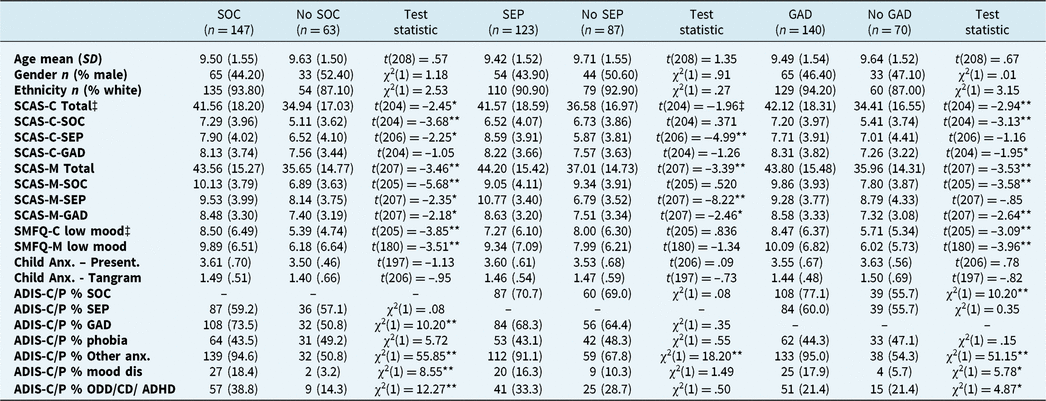
As shown in Table 1, the anxiety disorder subgroups did not differ significantly in terms of child age, gender or ethnicity. As expected, both children and mothers reported significantly higher levels of social anxiety symptoms for children in the SOC compared with the NO SOC group, higher separation anxiety symptoms in the SEP group compared with the NO SEP group, and higher generalized anxiety symptoms in the GAD compared with the no GAD group. However, notably, child and maternal reports on all SCAS subscales were significantly higher in the SOC group compared with the NO SOC group (with the exception of child-reported GAD symptoms). Maternal reported generalized anxiety symptoms were higher for the SEP than the NO SEP group, and both children and mothers in the GAD group reported significantly higher social anxiety symptoms than reported by the NO GAD group.
Demographics, symptoms and observations of psychopathology

Ethnicity, family socio-economic status and marital status data were missing for 4 (1.9%), 21 (10.0%) and 2 (1.0%) participants, respectively. SCAS-C, Spence Children’s Anxiety Scale – Child Report; SCAS-M, Spence Children’s Anxiety Scale – Mother Report; SMFQ-C, Short Moods and Feelings Questionnaire – Child Report; SMFQ-M, Short Moods and Feelings Questionnaire – Mother Report; SOC, social anxiety disorder; SEP, separation anxiety disorder; GAD, generalized anxiety disorder; mood dis, depression/dysthymia; ODD, oppositional defiant disorder; CD, conduct disorder; ADHD, attention deficit and hyperactivity disorder. **p < .01, *p < .05; ‡Pearson’s correlations between child and parent report: SCAS, r = .37, n = 205, p < .01; SMFQ, r = .30, p < .01.
Regarding symptoms of depression, both children and mothers reported significantly lower child mood in the SOC and GAD groups (but not SEP) compared with the NO SOC/GAD groups. There were no significant group differences on levels of observed child anxiety during the presentation and tangram tasks. On the basis of these preliminary analyses, symptoms of additional disorders (i.e. symptoms of GAD, social anxiety and depression) were controlled for in subsequent analyses where these differed between groups.
Main analyses
Chronic childhood adversities
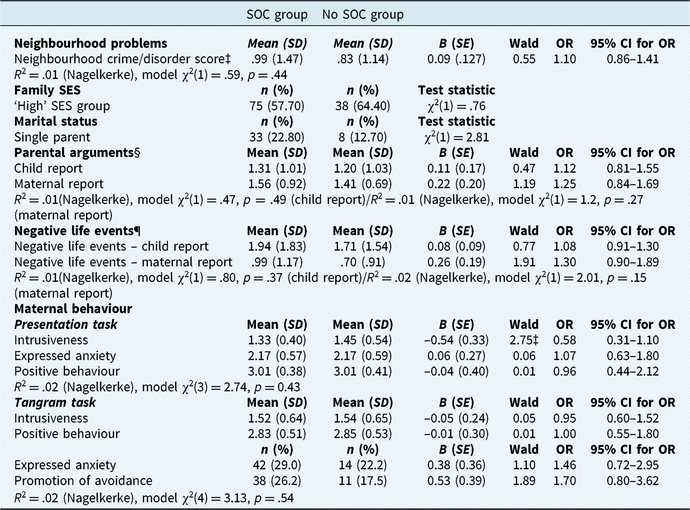
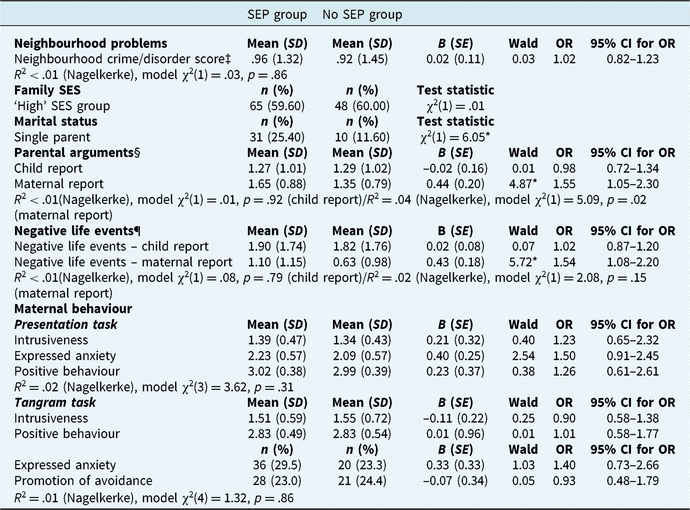
As shown in Tables 2, 3 and 4, there were no significant differences between anxiety disorder subgroups on maternal-reported neighbourhood adversity. For family environment factors, however, while there were no significant group differences in family SES, children with SEP were more likely to have a single parent than children in the NO SEP group. Differences in single parent status remained significant in the sensitivity analysis, where the SEP group consisted only of children who had SEP as their primary disorder (χ2(1) = 5.46, p = .02). In addition, mothers (but not children) in the SEP group reported significantly more frequent parental arguments than mothers of children without SEP (R 2 = .04, OR = 1.55), accounting for 4.3% of the variance in child SEP status. This finding remained significant after controlling for mother report of child anxiety symptoms of generalized anxiety (R 2 = .08, OR = 1.57), but was no longer significant when only examining mothers of children with a primary disorder of SEP compared with children with NO SEP (R 2 = .03, OR = .7).
Associations between chronic childhood adversity, life events, parental behaviours and child SOC

OR, odds ratio; CI, confidence interval. **p < .01, *p < .05. ‡Figures are based on transposed scores. §Only mothers and children (that lived with both parents) completed the questionnaire; n = 163 for child report and n = 155 for maternal report. ¶Pearson’s correlations between child and parent report, r = .32, p < .01.
Associations between chronic childhood adversity, life events, parental behaviours and child SEP

OR, odds ratio; CI, confidence interval. **p < .01, *p < .05. ‡Figures are based on transposed scores. §Only mothers and children (that lived with both parents) completed the questionnaire; n = 163 for child report and n = 155 for maternal report. ¶Pearson’s correlations between child and parent report, r = .57, p < .01.
Associations between chronic childhood adversity, life events, parental behaviours and child GAD

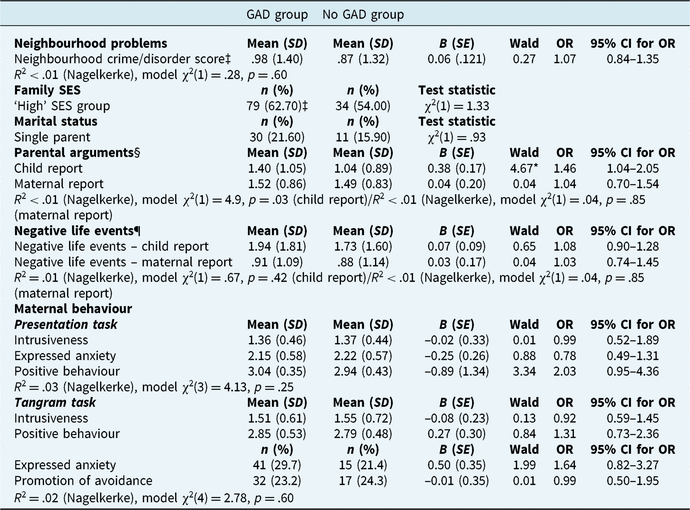
OR, odds ratio; CI, confidence interval. **p < .01, *p < .05. ‡Figures are based on transposed scores. §Only mothers and children (that lived with both parents) completed the questionnaire; n = 163 for child report and n = 155 for maternal report. ¶Pearson’s correlations between child and parent report, r = .32, p < .01.
Finally, children (but not parents) in the GAD group reported significantly higher levels of parental arguments than children in the NO GAD group (R 2 = .04, OR = 1.46), accounting for 4.2% of the variance in the presence or absence of child GAD. However, findings were no longer significant, when child comorbid social anxiety and low mood symptoms were controlled for, or when children with GAD as their primary problem were compared with NO GAD children (R 2 = .15, OR = 1.33 and R 2 = .05, OR = .7, respectively) (see Tables S2–S7 in the online supplementary material for further statistical information for sensitivity analysis).
Negative life events
Mothers of children with SEP reported significantly higher frequency of negative life events than mothers of children without SEP (R 2 = .06, OR = 1.54), accounting for 6.3% of the variance in the presence or absence of child SEP (see Tables 2, 3 and 4). This association was still significant after controlling for child comorbid generalized anxiety symptoms and marital status (R 2 = .10, OR = 1.47), but was no longer significant when the SEP group consisted of children with SEP as their primary problem (R 2 = .04, OR = .718). No other group differences emerged for levels of negative life events.
Exploratory analysis for specific life events indicated limited group differences. Children and mothers in the SOC group were significantly more likely to report that the mother had got a new job than children/mothers in the NO SOC group (χ2(1) = 5.896, p = .02 and χ2(1) = 4.601, p = .03, respectively); and mothers of children (but not children) in the GAD group were significantly more likely than mothers of children in the NO GAD group to report that their child had experienced a ‘family bereavement’ (χ2(1) = 6.592, p = .01). No other significant group differences emerged (p > .05); see online supplementary material (Table S1) for frequency of individual events.
Discussion
The aims of this study were to investigate whether specific associations were obtained between specific types of childhood anxiety disorder – namely SOC, SEP and GAD – and the nature of particular forms of psycho-social risk – namely chronic childhood adversity, negative life events, and particular forms of anxiogenic parenting behaviours. We found little evidence for disorder-specific relationships, except in the case of SEP. The current findings suggest that anxious children with SEP may be more likely than children with other forms of anxiety disorder to live with a single parent, or, where they do not, to experience more frequent parental arguments. In addition, mothers of children with SEP reported that their child had experienced more negative life events over the preceding 12 months compared with mothers of children without SEP. No other associations with specific anxiety disorders were robust when comorbid symptoms of other anxiety disorders were controlled for. Notably none of the significant associations with specific disorders remained significant when we limited our analyses to children who had a primary diagnosis of a particular disorder. This may reflect the reduced sample size as effects sizes were not notably reduced for the primary disorder analyses when compared with the disorder occurring in the context of other anxiety disorders.
There are a number of potential explanations for the specificity findings in relation to SEP that warrant further research attention. Perhaps the experience of negative life events, and in particular challenging family environments, causes children with separation anxiety to view the world as threatening and lead them to seek proximity to their caregiver in an attempt to stay safe (Scheeringa et al., Reference Scheeringa, Zeanah, Myers and Putnam2003). For example, children who live with one parent may feel more vulnerable due to being reliant on just one parent and/or from experience of prior separation from another parent. It is also possible that the absence of a supportive relationship with a partner may make it difficult for parents to manage helping their highly anxious child to separate and develop independence. Furthermore, having a child with SEP may create a risk for strained parental relationships.
Exploratory analyses for specific life events indicated that childhood SOC was specifically associated with the mother getting a new job, and childhood GAD was specifically associated with family bereavement. These findings were not consistent with the one previous study that examined associations between specific negative life events and childhood anxiety disorders in which no significant associations were found between specific negative life events and SOC (Tiet et al., Reference Tiet, Bird, Hoven, Moore, Wu, Wicks and Cohen2001). Indeed, in that study the mother getting a new job (and the child starting a new school) were associated with SEP, while getting a new step-parent and a parent being incarcerated were significantly associated with GAD (neither of which were found in the present study). This discrepancy might be accounted for by differences in study setting (community and clinical) – with those families with more adverse circumstances potentially being less likely to reach traditional mental health services (Saxena et al., Reference Saxena, Thornicroft, Knapp and Whiteford2007). The larger sample size included in Tiet et al. (Reference Tiet, Bird, Hoven, Moore, Wu, Wicks and Cohen2001) study also allowed for greater variability in the occurrence of specific social stressors. Indeed, the mean number of life events reported across all groups was low in the current study.
Regarding negative parenting behaviours, this study is, to our knowledge, the first to directly compare behaviours of parents of children with different anxiety disorders. Our findings did not support the hypothesis that particular forms of parental response are associated with particular types of child anxiety disorders (e.g. Asbrand et al., Reference Asbrand, Hudson, Schmitz and Tuschen-Caffier2017; Wood, Reference Wood2006). It is important to note, however, that patterns of findings have differed in the literature when different observational tasks have been used (see Murray et al., Reference Murray, Creswell and Cooper2009). While we provided a challenging puzzle task, Wood (Reference Wood2006) administered a difficult ‘belt-buckling’ task and an assessment of daily-living tasks that the child engaged in independently (e.g. bathing, dressing). As such, further research is warranted to elucidate this important question.
Strengths of this study include a large clinically representative sample which allowed for the consideration of three specific types of childhood anxiety disorder diagnosed on the basis of systematic and reliable assessments. In addition, this study adds to a very limited literature examining the role of chronic adversity, negative life events, and various family factors in different childhood anxiety disorders. However, our results should be considered preliminary and interpreted in the light of various methodological limitations. Our assessments of chronic childhood adversity and negative life events relied on parent (and in some cases child) report, and, in the case of parental conflict we were limited solely to reports of frequency of parental arguments. While widely used, potential problems with the validity of these measures are highlighted by marked differences between parent and child report (even for events that might be considered to be highly memorable, e.g. family bereavement). It is possible that an interview-based approach (as opposed to relying on questionnaires) may have provided more reliable information (Allen et al., Reference Allen, Rapee and Sandberg2012). Furthermore, the questionnaire data for negative life events (and the exploratory analysis for specific life events) needs to be interpreted with caution given the large amount of missing data on this measure. Due to the novel nature of the research study and restriction to planned comparisons, we did not formally correct for multiple testing; however, the relatively large number of tests should be taken in to account when interpreting the strength of the significant findings.
Regarding parenting behaviours, although we used widely used paradigms for observing and coding parental behaviours, these tasks rarely elicited parental overprotection and promotion of avoidance. The laboratory setting can provide only mildly stressful scenarios which are not likely to elicit extreme parental behaviours (e.g. Hudson et al., Reference Hudson, Comer and Kendall2008), and it is possible that more naturalistic observations of real-life stressors may identify different patterns of parental responding.
Critically, our sample did not include fathers. This is an important omission as there is evidence to suggest that fathers’ and mothers’ behaviours may be differentially associated with child anxiety (Breinholst et al., Reference Breinholst, Tolstrup and Esbjørn2019; van der Bruggen et al., Reference van der Bruggen, Stams and Bögels2008; Verhoeven et al., Reference Verhoeven, Bögels and van der Bruggen2012). Our study was also restricted in the variability of life events experienced, as participating families were largely homogeneous in terms of ethnicity and socio-economic backgrounds. Indeed, they were most unlikely to live in extreme adverse conditions, such as in poor housing or within threatening and dangerous neighbourhoods. As such, these factors limit the generalizability of the current findings, particularly given recent findings that financial means have a moderating effect on the association between parenting behaviours and child anxiety (Cooper-Vince et al., Reference Cooper-Vince, Pincus and Comer2014). The current study also focused on children in mid- to late-childhood (7–12 years) and it is plausible that particular family and environmental factors may be of greater relevance at different developmental stages. For example, Waite and Creswell (Reference Waite and Creswell2015) reported that the association between parental intrusiveness and low warmth and offspring anxiety status was significantly greater among adolescents than children. Furthermore, where we have found disorder-specific associations, the direction of these associations cannot be determined by this cross-sectional study. For example, while the uncertainty caused by a parent starting a new job might precipitate the onset of SEP in a child, equally, having a child with SEP may lead a parent to change jobs in order for them to manage their child’s anxiety differently. Prospective longitudinal studies are clearly required. Finally, and critically, the high level of comorbidity among children with anxiety disorders may have masked potential disorder-specific effects. While we controlled for overlapping symptoms and conducted sensitivity analyses on the basis of ‘primary disorders’, it is still possible that differences may be clearer between ‘pure’ diagnostic groups. In the current study only 26 children met criteria for a single anxiety disorder; not only would these comparisons be limited by small sample sizes but they would also not represent a typical clinical population. The lack of a healthy control group also means that while we can draw conclusions about how different anxiety disorders may differ, we cannot draw conclusions about how these differences relate to the ‘baseline’.
In summary, the current findings suggest that, compared with children with other anxiety disorders, children with SEP are more likely to experience family challenges in the form of more single-parent families, more frequent parental arguments, and more parent-reported negative life events. These findings suggest that family factors may need specific consideration to optimize prevention and treatment of childhood SEP. However, prospective longitudinal studies are required to establish the direction of the association between family factors and SEP in children, in order to ultimately inform improved prevention and treatment. Beyond this we found no clear and consistent evidence of specific associations between family and environmental factors and specific types of childhood anxiety disorders.
Supplementary material
To view supplementary material for this article, please visit: https://doi.org/10.1017/S1352465819000717
Acknowledgements
The authors would like to thank the participating families and staff in the Berkshire Child Anxiety Clinic at the University of Reading and Berkshire Healthcare NHS Foundation Trust, in particular Anna Alkozei, Sarah Cook, Amy Corcoran, Sue Cruddace, Rachel Gitau, Zoe Hughes, Jessica Karalus, Rebecca O’Grady, Ray Percy, Sarah Shildrick, Kerstin Thirlwall and Lucy Willetts.
Financial support
Professor Creswell was funded by a MRC Clinician Scientist award (G0601874). Participants were recruited and assessed within treatment trials funded by the MRC-NIHR partnership (09/800/17) and the MRC (G0802326). Professor Creswell and Dr Halldorsson are currently funded by an NIHR Research Professorship to Professor Creswell (NIHR-RP-2014-04-018).
Conflicts of interest
The authors wish to confirm that there are no known conflicts of interest associated with this publication and there has been no significant financial support for this work that could have influenced its outcome.
Ethical statement
The study followed the Ethical Principles of Psychologists and Code of Conduct as set out by the American Psychological Association.




Comments
No Comments have been published for this article.