


Introduction
The arc of Thai politics and control of government since the end of the absolute monarchy in 1932 has been variously described by scholars, journalists, and other commentators as “a hybrid regime” (Case Reference Case1995; Siripan 2018; Surachart Reference Bamrungsuk and Chachavalpongpun2020), “flawed democracy” (Khidhir Reference Khidhir2020), “failed democracy” (Pithaya Reference Pookaman2020), “electoral authoritarianism” (Case Reference Case2011; Thitinan 2014); “hybrid authoritarianism” (Thitinan 2010), “military dominated” (Prajak and Veerayooth Reference Prajak and Veerayooth2018; Siwach, Draper, and Crumpton Reference Sripokangkul, Draper and Charles D.2019), and “Thai-style democracy” (Hewison and Kengkij Reference Hewison and Kitirianglarp2008; Surin Reference Maisrikrod2007). Regardless of how the nine-decade saga of Thailand's struggle to establish a settled national pattern of politics and governance has been characterised, each analytic lens describes a battle between authoritarian control and democratic aspirations. Surachart (Reference Bamrungsuk and Chachavalpongpun2020) described this saga in terms of five waves of authoritarian/democratic tension, regularly punctuated by military coups, and most recently reflected in the 2019 national “election without democracy” (Levitsky and Way Reference Levitsky and Way2002: 97).
Thailand's general election on 24 March 2019 was the first following the 2014 coup d’état led by General Prayuth Chan-o-cha and the National Council for Peace and Order (NCPO). His junta promoted the 2019 election as a return to a democratic parliamentary system. In this study, the run-up to and conduct and aftermath of the 2019 election is examined to consider a case of what Schedler identified as “the new electoral authoritarianism” (2010: 70):
Rather than suppressing representative institutions altogether, or accepting only some of them, the new electoral authoritarian regimes… have embraced them all. They have set up the full panoply of liberal-democratic institutions—from constitutions to constitutional courts, from legislatures to agencies of accountability, from judicial systems to federal arrangements, from independent media to civic associations. Most important of all, they hold regular multiparty elections at all levels of state power. In their institutional forms, these regimes are virtually undistinguishable from liberal democracies. Yet authoritarian rulers invariably compensate for these formal concessions with substantive controls. While renouncing the suppression of the representative institutions, electoral authoritarian regimes specialize in their manipulation. Operating under the primacy of repression, totalitarian systems occupied one pole on the continuum of authoritarian regimes. Operating under the primacy of institutional manipulation, electoral autocracies occupy the other (Schedler Reference Schedler2010: 70–71).
The current study incorporates what Gandhi and Lust-Okar (Reference Gandhi and Lust-Okar2009) have identified as a need to better understand the micro characteristics of and differences among elections conducted by authoritarian regimes, including the shift to elections that at least offer the appearance of competitiveness compared with prior elections that were blatantly non-competitive (Gandhi Reference Gandhi2015). The study also considers assessments of the way authoritarian regimes manipulate political parties, legislatures, and other nominally democratic institutions (Ezrow and Frantz Reference Ezrow and Erica2011; Gandhi Reference Gandhi2008; Gandhi and Przeworksi Reference Gandhi and Adam2006) to maintain control of the state to co-opt potential opponents, distribute benefits to their supporters, and mitigate elite conflicts. The study also acknowledges Morse's reminder to researchers that,
…studies of electoral authoritarianism need to start engaging in more midrange, case-based research. Research cannot be too distant from actual cases, leading to conceptual ambiguity, nor too close to specific cases, thus failing to generate comparative leverage. Closer engagement with detailed and confined comparisons will generate more conceptual clarity and will in turn form the basis for sounder theory building and comparative analysis (Morse Reference Morse2012: 163).
In a recent contribution to the international discourse on the behaviour of electoral authoritarian regimes, Morgenbesser (Reference Morgenbesser2020) introduced a typology of authoritarian regimes that could be applied in Southeast Asia by integrating the foundational work of Gandhi (Reference Gandhi2008, Reference Gandhi2015), Schedler (Reference Schedler2010) and others. This enabled the description and comparison of the extent to which authoritarian regimes manipulate institutions—including those involved in the conduct of elections—to protect their positions of power and control (Morgenbesser Reference Morgenbesser2020). The current study seeks to apply Morgenbesser's framework to Thailand (not included in his original work) to assess the military-dominated regime's behaviour during the 2019 election cycle.
In its manipulation of state institutions, the Thai junta introduced a new constitution in 2017 that included an electoral approach providing for a non-elected Senate to share responsibility for selecting the prime minister. This meant that control of the prime minister's position could be maintained (McCargo and Saowanee Reference McCargo and Alexander2019; Prajak and Veerayooth Reference Prajak and Veerayooth2018), consistent with the discourse on electoral authoritarianism and the established pattern in Thailand (Brownlee Reference Brownlee2007; Miller Reference Miller2012; Morse Reference Morse2012; Mufti Reference Mufti2018; Schedler Reference Schedler2002; Surachart Reference Bamrungsuk and Chachavalpongpun2020). Prajak and Veerayooth (Reference Prajak and Veerayooth2018: 280) described this constitutional perversion of the democratic process as “military-guided semi-authoritarianism”. The Palang Pracharat Party (PPP) was formed as an electoral platform for junta members to claim votes from the conservative and royalist Democrat Party (DP) (Siripan 2020). The electoral system was perverted by a change of rules for the calculation of party-list seat allocations by the Election Commission (EC), which facilitated a tenuous multi-party coalition centering on the Democrat Party allying with the PPP. A critical element of the regime's manipulation of electoral institutions involved the constitutionally sanctioned mixed-member apportionment (MMA) system. This provided for 350 constituency seats and 150 party list seats. Rather than casting two separate votes—one for a candidate and one for a party list—voters cast a single ballot for a candidate. That vote would count both for the candidate and that candidate's party for the party list seats. The total number of votes received by each party nationwide on the single votes would determine the total share of seats awarded. Party list seats are added to the party constituency seats until their awarded total is reached (Hicken and Bangkok Pundit Reference Hicken and Bangkok2019). The MMA system resulted in political parties facing reduced potential for party-list seat allocation despite capturing large numbers of constituency seats. In response, the previously dominant Pheu Thai Party (PTP) adopted a strategy of focusing on constituencies it was confident of winning. Hoping to win a larger number of party-list seats, it transferred many candidates to run on tickets with the allied Thai Raksa Chart Party (TRCP). However, shortly before the election, responding to the regime's fear of an electoral battle with supporters of the Shinawatras, the Constitutional Court upheld the dissolution of the TRCP ordered by the EC on a technicality (McCargo Reference McCargo2019; McCargo and Saowanee Reference McCargo and Alexander2019).
Thus, during the five-year period between the 2014 coup and the 2019 election, the junta utilised a broad complement of forms of manipulation of institutions associated with elections to stifle aspiration of Thai democracy and to maintain its authoritarian control of politics and government. The result of the constitutional, administrative, and procedural machinations by the junta and its allies and the anti-democratic nature of the formation of the post-2019 election coalition government was the negation of millions of votes and the gain of national and regional electoral majorities by purported anti-regime parties. The behaviour of the Thai authoritarian regime (as reflected in its manipulation of electoral institutions and processes) reflects characteristics described in the international scholarship on electoral authoritarian regimes. The current study seeks to move beyond this standard literature to apply the evidence concerning the lead-up to and the conduct and results of the 2019 Thai elections to assess the Thai authoritarian regime in terms of Morgenbesser's (Reference Morgenbesser2020) typology of Southeast Asian authoritarian regimes. Accordingly, it will be possible to determine whether this demonstrates “retrograde” as “sophisticated” authoritarian behaviour. This addresses a gap in Morgenbesser's analysis, which did not consider Thailand, and also provides regional contextualisation of the Thai authoritarian regime's behaviour.
Literature Review
Conflicting characterisations of Thai politics?
Since Thailand established a constitutional monarchy in 1932, a variety of labels have been applied to describe its politics, each of which is valid. Rather than presenting a conflicting analysis of the political climate, together they describe the emergence and persistence of Thai hybrid regimes and electoral authoritarianism.
The hybrid regime and electoral authoritarianism
Brownlee (Reference Brownlee2009) suggested that hybrid regimes presented a continuum of electoral liberalisation models from a state of closed authoritarianism through intermediate (hegemonic and competitive) states of electoral authoritarianism to a state of open electoral democracy. While multiple political party participants may be allowed in hegemonic authoritarian regimes, they mask the regime's intent to maintain unfettered power and control. Under competitive authoritarianism, formal democratic institutions exist as a means to gain political power and control of government. However, the incumbents abuse state power to gain an advantage over their opponents. Levitsky and Way describe them and the contradictions they represent in the following terms:
Authoritarian governments may coexist indefinitely with meaningful democratic institutions. As long as incumbents avoid egregious (and well-publicized) rights abuses and do not cancel or openly steal elections, the contradictions inherent in competitive authoritarianism may be manageable. Using bribery, co-optation, and various forms of “legal” persecution, governments may limit opposition challenges without provoking massive protest or international repudiation.
Yet the coexistence of democratic rules and autocratic methods aimed at keeping incumbents in power creates an inherent source of instability. (Levitsky and Way Reference Levitsky and Way2002: 58–59)
By considering how post-Cold War electoral authoritarian regimes have utilised democratic institutions to maintain power, Schedler (Reference Schedler2010: 70) operationalised a “menu of institutional manipulation” that can be seen in the history of Thailand's experience with hybrid regimes. As they create state institutions usually associated with liberal democracies, authoritarian regimes offer the pretense of delegating authority to them:
Authoritarian delegation of power… is never meant to sanction the autonomous exercise of power by the designated agent. The institutional creatures that authoritarian regimes breed are not meant to grow and flourish in liberty. Authoritarian rulers cannot tolerate genuine institutional autonomy. They will always strive to constrain and contain their own institutional creations in order to ensure that nominally democratic bodies and procedures remain substantively authoritarian (Schedler Reference Schedler2010: 71).
Schedler goes on to argue that the institutional arenas constructed by authoritarian regimes are deployed to control both the agents of the regime and its adversaries. This is particularly the case with elections, which he describes as the “central arena of struggle” (Reference Schedler2010: 71). Nominally competitive elections involve a variety of strategies for authoritarian regimes to maintain control. Schedler (Reference Schedler2010) describes four sets of tools that electoral authoritarian regimes deploy to reduce the uncertainty of the elections that they promote. Two are of particular interest:
Market restrictions. Rulers can limit the choices available to voters by excluding, subverting, or fragmenting opposition parties (supply restrictions); they can obstruct the formation of voter preferences by denying the opposition fair access to public space (demand restrictions); and they can alter the composition of the electorate through the legal or de facto disenfranchisement of citizens (voter expropriation);
Vote distortions. [O]nce voters have expressed their will at the ballot box, the results may be seriously distorted, either through discriminatory practices (election fraud) or through discriminatory institutions put into place beforehand to incapacitate opposition parties at the polls (such as majoritarian electoral rules that deny them legislative representation) (Schedler Reference Schedler2010: 71–72).
According to Gandhi's (Reference Gandhi2015) consideration of post-Cold War election patterns across authoritarian regimes, the evidence does not present a clear picture of the extent to which purported democratic elections support or hinder the resilience of authoritarian regimes or promote democratic ambitions in subject nations. Rather, she identifies substantial fluidity across nations and their authoritarian regimes and among their actors, institutions, and interest promotion characteristics in the lead up to and conduct of elections. As a result, she argues that more inter-contextual evidence should be produced to better understand the nuances that accrue among particular national settings and authoritarian regimes. The current study seeks to do this in the case of Thailand's 2019 elections. This is achieved by examining the large-scale institutional and micro level manipulations of the structures and processes associated with the conduct of the 2019 Thai election that influenced its conduct and outcome to the advantage of the authoritarian regime.
Manipulation of coalition formation
Coalition-building is a characteristic of electoral politics that is shared among both electoral authoritarian regimes and democratic regimes with parliamentary systems. Just as authoritarian regimes plead commitment to formal electoral processes and products of coalition-building, coalitions provide a political tool that can be manipulated to provide a facade of legitimacy for domestic and international consumption; more importantly, it provides the stability that can contribute to their longevity (Gandhi Reference Gandhi2015). Authoritarian regimes utilise political and economic rewards to purported opposition parties to coalesce with them, preventing their merger with other opposition parties and potentially subverting the incumbent regime's control over government (Gandhi Reference Gandhi2015; Magaloni Reference Magaloni2008; Morse Reference Morse2015). The willingness of purported opposition parties to participate in coalitions is related to their electoral and policy pliability. The less committed to (and more willing to betray) their voters and important policy positions, the more willing they might be to participate in—or be coopted by—the authoritarian regime's coalition-building gambits (Gandhi and Przeworski Reference Gandhi and Adam2006).
Electoral authoritarianism in Southeast Asia
Morgenbesser (Reference Morgenbesser2020) recently introduced a typology to dichotomise authoritarian regimes as “retrograde” or “sophisticated.” By utilising evidence from 1975 to 2015 regarding how Southeast Asia's authoritarian regimes (not including Thailand) demonstrated variation in how they have utilised the toolbox of electoral manipulation over time, he states:
Singapore's court system constrains dissent… Myanmar's constitution preserves military power… Cambodia's elections routinize the… distribution of patronage… Vietnam's legislature co-opts… delegates from different geographic areas and functional backgrounds… and Malaysia's dominant party was an exemplar of coalition building, policy innovation, and money politics… (Morgenbesser Reference Morgenbesser2020: 9)
Morgenbesser goes on to state that one of the determinants of sophisticated authoritative regimes involves apparently competitive elections. Sophisticated regimes conduct multi-party elections intended to mimic the majoritarian characteristics of democracy and convince citizens that the “will of the people” is being expressed in meaningful and competitive ways. This contrasts with retrograde regimes in which elections are so controlled that the outcome is not in doubt. Sophisticated authoritarian regimes “can calibrate electoral manipulation in ways that both improve control and foster credibility” (Moorganbesser Reference Morgenbesser2020: 9). This electoral manipulation extends to the formation of governing coalitions whereby sophisticated regimes prove able to identify and co-opt supposed competing parties into coalitions dominated by the regime and its party.
Morgenbesser further argues that the distinction between sophisticated Southeast Asian authoritarian regimes can be seen in the operation of election administrative agencies. While retrograde regimes may establish supposed independent ECs, they are clearly instruments of the regime and ruling party. In contrast, election administrative bodies established by sophisticated regimes demonstrate patterns that sufficiently combine independent action with adherence to the will of the regime to frustrate the opposition's ability to argue that they are simply puppets of the established regime.
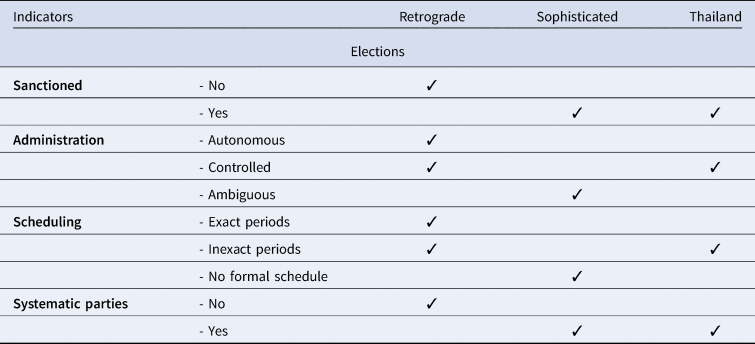
A central purpose of the current study is to frame the conduct and outcome of the 2019 election in terms of Morgenbesser's typology. This will determine whether the Thai regime merits Morgenbesser's designation of a retrograde or sophisticated authoritarian regime, based on the election indicators associated with one of the five dimensions he uses to evaluate whether Southeast Asian nations are retrograde or sophisticated. These dimensions are referred to as “institutional configuration.” Table 1 presents how Morgenbesser (Reference Morgenbesser2020) assesses whether an authoritarian regime is retrograde or sophisticated according to election indicators.
Indicators concerning elections of retrograde and sophisticated authoritarian regimes (Morgenbesser Reference Morgenbesser2020)

The Thai military regime and electoral authoritarianism
In the case of the 2019 election, electoral authoritarianism—representing a blend of retrograde and sophisticated authoritarian behaviour (according to Morgenbesser's framing)—best describes the Thai military-dominated hybrid regime. This contrasts with Brownlee's (Reference Brownlee2009) characterisation of Thailand in 2004, having progressed toward substantive democratisation from a condition of electoral authoritarianism to electoral democracy. Surachart (Reference Bamrungsuk and Chachavalpongpun2020) best described what happened to the regime in terms of five waves of hybridity since becoming a constitutional monarchy in 1932. Each wave has followed at least one military-led coup and involved moves from closed authoritarianism (void of meaningful democratic institutions) to the actual operation of electoral democracy. During each wave, the military has re-exerted a position of political and governing primacy to manipulate the state institutions that most affect democratic aspirations, including the constitution, the courts, the design of the legislature, and electoral administrative processes. This is to assure that its position would survive electoral challenges. The 2019 election offers evidence of this.
Analytic approach of the study
The study examines the run-up to the Thailand 2019 general election, the conduct of the election, and post-election coalition-building through the analytic lens of electoral authoritarianism. This is to determine the extent to which the 2019 Thai case fits the existing discourse, particularly in terms of Morgenbesser's recently introduced retrograde/sophisticated authoritarian regime typology. Accordingly, answers to the following research questions are sought:
1. To what extent do the actions of Thai military regime prior to and during the 2019 election cycle reflect the discourse on electoral authoritarian regimes?
2. Should the Thai regime be classified as “retrograde” or “sophisticated” among Southeast Asian authoritarian regimes according to Morgenbesser's typology?
Methodology
To consider the run-up to the 2019 general election, the election vote count, and the subsequent formation of a governing coalition, the study involved a desk review of a range of sources, including published research, periodic articles and opinion columns, and official Thai government election results, from 1997 to 2021. The official election results were statistically analysed.
Findings and Analysis
Prologue to the 2019election: Authoritarian manipulation of democratic institutions
Consistent with the discourse regarding actions that authoritarian regimes take to protect their positions of power (Brancati Reference Brancati2014; Levitsky and Way Reference Levitsky and Way2002, Reference Levitsky and Lucan A.2010; Magaloni Reference Magaloni2008; Miller Reference Miller2012; Morse Reference Morse2015; Schedler Reference Schedler2002, Reference Schedler2010), the post-2014 Thai junta, led by General then Prime Minister Prayuth, sought international and domestic legitimacy to continue its rule by conducting the 2019 election (Siripan 2020). The junta's leaders were determined to prevent the return of the PTP to power. Despite NCPO efforts to advantage itself and undermine the opposition by manipulating the institutional levers of government from 2014 until the 2019 election, the political parties that refused to align with Prayuth and the NCPO won the most electoral votes.
Immediately following the coup, the NCPO initiated a strategy intended to repress, fragment, and ultimately silence the mainly pro-Shinawatras opposition. These measures included “attitude adjustment,” (i.e., re-education sessions in military camps) and arrest and prosecution under the guise of a variety of constitutional and statutory infractions, including lèse-majesté offenses. Public events sponsored by opposition groups were shut down by the NCPO, and opposition members were harassed by the military. Community and civil society organisations were prevented from peacefully gathering. Although democratic expression was suppressed, Prayuth asserted that the NCPO was wholly democratic (Mudlek 2015; Prachatai 2018).
The limitations that the NCPO imposed on political parties after the coup challenged typical political activities. Large political gatherings and new party offices were banned. NCPO permission was required to organise new political parties and to conduct political fundraising activities. While established parties remained banned, new political parties were allowed to be formed during 2018, with the intent of advantaging the new PPP civil-military party. When the Organic Act on the Election of Members of the House of Representatives was issued on 12 September, 2018, many political observers expected the political climate to ease during the election run-up. However, by ordering those political activities were to be halted until 11 December, 2018, the NCPO sought to ensure that opposition parties would have limited time for their election campaigns prior to the March 2019 election.
The NCPO sought to undermine individual political participation and choice by creating barriers to party membership. Prayuth allowed the existence of previously registered parties but only under the condition that party members confirm their membership and pay a new membership fee, effectively resetting political party membership. Consequently, all established parties saw their memberships decrease; for example, the DP's membership fell from 2,500,000 to 100,000, while the PTP's membership decreased from 134,822 to 13,000. Both parties unsuccessfully appealed the restrictions at the Constitutional Court. Prayuth further diminished individual-party connections by introducing a new ballot design that only showed a candidate's name and number without the party name or logo. This was exacerbated by the EC's action to deny constituency candidates the same number as the party with which they identified—an established practice in previous elections. Furthermore, the NCPO “allowed” the EC to redraw constituency maps without seeking input from constituents or parties (Siripan 2020).
The Prayuth-led regime also constrained group and individual political participation by utilising the organs of state surveillance, psychological warfare, and propaganda. From 2014 to 2019, the NCPO abused instruments of government power, including Thailand's military internal security, Internal Security Operations Command (ISOC) in the Ministry of Defense. ISOC officers descended on villages nationwide to “explain” government policy to villagers, to surveil the activities of local officials and silence those they considered threats to the regime. The agency focused on villagers who supported former Prime Minister Thaksin Shinawatra, using methods similar to those employed to fight communists in the 1970s. During the year after the coup, ISOC created individual village “reconciliation projects”, including an annual large-scale project intended to attract people away from the PTP and other opposition parties and encourage support for the NCPO. These events were also designed to promote the regime's justification for the coup. Appeals to Thai nationalism and identification with the monarchy were used to reinforce the political messaging at these events (Kanittha Reference Thepjorn2018; Strate Reference Strate2015).
ISOC intensified its activities in 2018, holding meetings with local administrative organisations and community and village leaders with the official objective of creating “mutual understanding” about the upcoming election. A widely held assessment by political observers was that these ISOC activities were part of a proactive strategy to mobilise votes for parties supporting Prayuth. ISOC representatives emphasised the successes of the regime that particularly benefited villages. In 2018 alone, ISOC gave presentations in 81,084 villages, reaching four million participants (Dailynews 2018; Matichon 2018, 2019).
ISOC conducted research in 2018 that found that the PTP would not garner sufficient voter support to enable it to lead the formation of a new government. This was because the party had not identified a prime ministerial candidate, complicated by an exodus of leading politicians from the party, particularly in the North and Northeast. This lack of opposition leadership was attributable to ISOC's effort to restrict voters’ choice of candidates. Prayuth built on this initiative by focusing attention on these regions through several campaign-style visits. However, another ISOC poll in late 2018 found that the PTP was still much more popular than the PPP. This likely led Prayuth to postpone the election to March 2019 (Crispin Reference Crispin2019; Kom Chad Luek 2018; McCargo and Saowanee Reference McCargo and Alexander2019).
In addition to intimidation and propaganda, restricting voters’ preferences attained through violations of election law was tantamount to vote buying. Prayuth developed a civil-military state-sponsored political party using the “Pracharat” (‘People's State’) brand to serve as his political vehicle (McCargo and Saowanee Reference McCargo and Alexander2019; Siripan 2020), violating what would normally have been campaign and election law. From 2018 to 2019, Prayuth supported this political machine with a state budget of $14.5 million in grassroots handouts to benefit approximately 17 million people. Those who most benefited were farmers and low-income groups, who also tended to be PTP voters. The government also spent as much as $50 million to increase state employee pensions, disability pensions, first-child benefit payments, and health insurance co-payments (Thaipublica 2019). Shortly before the election, the government handed out money through its Pracharat welfare card scheme and provided eligible beneficiaries with support for electricity and water bills for up to ten months, rent assistance of $13 per month from November 2018 to August 2019, and $32 for traveling costs associated with hospital visits from November 2018 onwards. It also increased the monthly compensation of over one million village health volunteers from $18 to $31, from December 2018 onwards. The government also introduced policies to address the problem of informal debts and provided landless people across the country with land titles (Prachachat 2018a).
From the 2014 coup to shortly before the election, the Prayuth government held nine cabinet sessions in the provinces and allocated over $60 billion for large-scale development projects. During each visit, local politicians were persuaded to attend to welcome Prayuth (Prachachat 2018b). Prayuth was a daily presence on television touting the regime's progress. Despite this, a poll in 2018 found that a majority of respondents perceived Prayuth's efforts to be one-sided election campaigning (Thairath 2018). The blurring of lines between governmental and political campaign activities was in evidence when four members of the regime's economic team (who had been behind the Pracharat scheme) acquired executive positions with the PPP without resigning from their government posts. The November 2018 survey estimated that the PPP would win 8.31 million votes. It was 21.5% of the popular vote, with the DP receiving 7.045 million votes or 18.3%, and the PTP 6.532 million votes or 16.9% (Post Today Reference Post2019). These results apparently persuaded Prayuth to green light the election.
Schedler (Reference Schedler2002) discussed how both the object and consequences of democratic choice can be restricted by the authoritarian regime's manipulation of the roles and responsibilities of elected officials. This can take the form of limitations placed on the scope and jurisdiction of elective officials, preventing elected officers from exercising their constitutional powers, or by going so far as to prevent them from taking office after their election. The 2017 Thai constitution reflects these forms of manipulation (Prajak and Veerayooth Reference Prajak and Veerayooth2018). The MMA system specified that parties capturing large numbers of constituency seats would have the number of their potential party-list seats reduced. The new system fragmented the political landscape among many parties, making it more difficult for a single party to command a majority and disadvantaging large political parties. This revision to the electoral system was designed by the NCPO-appointed Constitution Drafting Committee to prevent the PTP from capturing an electoral majority. It encouraged electoral competition among a large number of parties, not because the authoritarian leaders valued democratic diversity, but because they wanted to thwart large- or medium-sized parties and deflect the threat they might pose to their rule by forcing and potentially leading an opposition coalition of their choosing (McCargo Reference McCargo2019; Ricks Reference Ricks2019; Siripan 2020).
In terms of manipulating other institutions, the junta sought to manipulate the composition of the legislature to strengthen its position by appointing all 250 members of the new Senate (responsible for selecting the prime minister). Through control of positions in supposedly independent bodies (including the EC and the National Anti-Corruption Commission) and the production of a military guided 20-Year National Strategy, the NCPO sought to ensure that its hold on power would last beyond the election. The regime manipulated the EC, eliminating its neutrality by loading it with members of the National Legislative Assembly (NLA), which had been appointed by the NCPO. As a result, regime opponents had little hope that the agency conducting the election would reflect political neutrality and public accountability necessary for clean elections (Mozaffar and Schedler Reference Mozaffar and Schedler2002). Lack of neutrality was evident in multiple election day irregularities, including bat khayong lae khanaen kradod (“tip-toeing ballots and jumping votes”), a term coined by the EC itself. Of most concern in terms of electoral democratic competition, the Commission dissolved the TRCP before the election (McCargo Reference McCargo2019).
Thus, prior to the 2019 election, the Prayuth-led junta deployed most of the anti-democracy deterrents identified by Schedler (Reference Schedler2010) and others in the electoral authoritarian playbook. In terms of Morgenbesser's (Reference Morgenbesser2020) typology, these pre-2019 forms of institutional manipulation by the Prayuth-led Thai regime describe the behaviour of a “retrograde” authoritarian regime. In terms of participation, the regime had constrained the ability of ordinary citizens to participate in politics. This was accomplished by manipulation of the election law, civil society, and direct participation elements of democracy. The regime had thwarted public deliberation. It acted on an anti-egalitarian basis by limiting participation, effective representation, protection of individual political rights, and limiting access to political resources, including party membership.
Conduct of the 2019 election: Authoritarian thwarting of democratic will
While the 2019 elections can be framed as a referendum on the military-dominated regime, the regime's machinations mean that interpreting the election results to determine how many voters were pro- or anti-regime is difficult (Siripan 2020). This is largely a product of the introduction of the MMA system, with its use of a single ballot. This represented a change from the 2001 to 2011 elections, with its separate ballots for constituency candidates and for party-list candidates. This change challenged analytic clarity regarding voter intent vis-à-vis the regime.
In this study, examination of the election results reveals that the number of anti-regime core voters was much larger than the number of pro-regime core voters. Despite the regime's claims to the contrary, it is likely that the majority of voters did not support the Prayuth regime (McCargo and Saowanee Reference McCargo and Alexander2019). Seven parties announced that they would not support the NCPO or General Prayuth. These “anti-regime parties” were, in descending order of votes received: 1) PTP; 2) FFP; 3) Seri Ruam Thai Party; 4) New Economics Party; 5) Pheu Chart Party; 6) Prachachart Party; and 7) Thai People Power Party. Although these parties differed in their policies, they were united in their opposition to the regime. Parties that publicly supported the NCPO and General Prayuth (“pro-regime parties”) were the PPP, Action Coalition for Thailand Party and the People Reform Party. The remaining votes that did not go to any of these ten parties were designated as “other parties”, “spoiled ballots” and “no votes”. This analysis focuses on votes for the pro-regime, anti-regime, and other parties.
Dividing these parties into three groups has at least two limitations. First, careful consideration of pre-election publicly expressed positions of the DP and BJTP makes it clear that they did not support the Prayuth regime. However, in this analysis, votes for these two parties are included as other parties. This is because it can be argued that public statements of the parties’ leaders were political rhetoric and did not reflect their actual positions. Rather, they were primarily positioning themselves to have leverage in the formation of a post-election coalition government that would likely be led by Prayuth. This assessment reduces the total votes of the anti-regime group. On the eve of the election, the DP leader Abhisit expressed explicit rejection of Prayuth; however, along with the BJTP it ultimately joined a coalition with the PPP in exchange for ministerial posts. A second limitation concerns evidence that the candidate list of the PPP was filled with former members of parliament from other parties and locally influential people. Combined with the redesign of the ballot, this may have resulted in voters who did not support Prayuth and the military voting for candidates that would ultimately align with a regime-led coalition.
Voting analysis
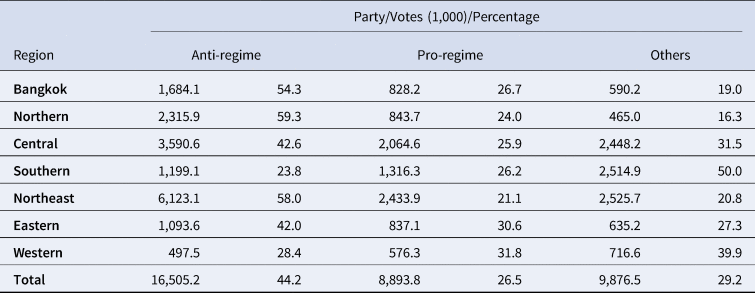
Table 2 presents the national total of votes cast for the three groupings included in this analysis, organised by region, and including the votes and vote percentages received by the anti-regime, pro-regime, and other party groupings. Among the total 35,275,506 votes cast, anti-regime parties garnered a substantial plurality, and only a little more than a quarter chose parties supporting Prayuth and the military-led regime.
Total share of votes for the three groupings of parties (Election Commission of Thailand 2019)

Examination of the results in Bangkok and each of Thailand's seven regions offers additional clarity regarding the distribution of support for the three groups of parties, as follows:
Bangkok: Of the capital's 30 parliamentary constituencies, the PPP captured twelve seats, while the PTP and FFP each won nine seats. Of the 3,102,485 votes cast in Bangkok, over half were for anti-regime parties, and the anti-regime parties receiving majorities in every Bangkok constituency.
North: In the nine provinces of the northern region, a total of 33 constituencies were contested, with the PTP wining 25, the FFP gaining five, and the PPP capturing three. The anti-regime parties gained a majority of votes in each of the nine provinces in this region.
Central provinces (outside Bangkok): Among the 76 constituencies that comprise the central region outside of Bangkok, the PTP won seventeen, the FFP won seven, the PPP won 35, the BJTP won five, the Chart Thai Pattana Party won five, and the DP won two. This means that anti-regime parties captured 24 constituency seats while those in support of the regime won 35 seats. The remaining seventeen constituencies went to other parties. With over 42% of the total votes cast across the region outside of Bangkok, anti-regime parties attracted a plurality of the votes cast, compared with other parties that received over 30% of votes and the pro-regime parties that obtained a quarter of votes cast. Across the region's 21 provinces (excluding Bangkok), anti-regime parties won pluralities in 13 and majorities in five of those. This compares to three pluralities and no majorities for pro-regime parties. Other parties gained pluralities in three provinces and majorities in two.
South: Among the fourteen provinces of the southern region, other parties received half of the votes cast, while pro-regime parties received a little more than one-quarter of the votes, and anti-regime parties received a little less than one-quarter. Among the 50 constituencies contested in the southern region, the Prachachart Party won six, the Palang Pracharat Party won thirteen, Action Coalition for Thailand won a single seat, the DP won 22 and the BJTP won eight. Therefore, anti-regime parties captured six constituency seats while those in support won fourteen. The remaining 30 constituencies went to other parties.
Northeast: In this region, anti-regime parties won a clear majority of the total votes cast—nearly 58%. The pro-regime party and other party groupings each garnered a little more than one-fifth of the votes cast. Of the 116 constituencies contested in this region, the PTP won 84, the PPP won sixteen, the BJTP won eleven, and the Chart Pattana Party, Chart Thai Pattana Party, and FFP each won a single seat. Therefore, anti-regime parties captured 85 constituency seats while those in support of the regime won eleven seats. The remaining 20 constituencies went to other parties.
East: The anti-regime parties won a substantial plurality of votes cast in the eastern region. Of the 26 constituencies contested here, the FFP won nine, the PPP won eleven, and the BJTP and DP each won three. Therefore, anti-regime parties captured nine constituency seats while those in support won eleven seats. The remaining six constituencies went to other parties. Anti-regime parties won pluralities in six of the eight provinces. Pro-regime parties won a majority in one province, while other parties won a plurality of votes in one province.
West: Votes were cast in the western region across a fairly narrow range, with other parties realising a plurality and pro-regime parties gaining the second most votes. Of the nineteen constituencies contested in the western region, the PTP won a single seat, the PPP won twelve, the DP won four, and the BJTP won two. Therefore, anti-regime parties captured one constituency seat while those in support of the regime won twelve seats. The remaining six constituencies went to other parties.
Discussion: After the Election
Aggregating preferences to constrain democratic choice
Schedler (Reference Schedler2002) argued that authoritarian regimes stifle democratic choice through attacks on the integrity of elections to essentially threaten the principle of one person/one vote. This can be perpetrated either through direct electoral fraud (e.g., ballet stuffing) or institutional biases in the electoral framework. There is evidence that electoral fraud took place in the 2019 Thai election via actions such as unusual revisions of vote counts and through institutional bias in the electoral framework, as reflected in the new MMA system (Punchada 2019a; Siripan 2020).
The MMA system was introduced to determine the number of parliamentary seats to which each party was entitled. This was to be accomplished by calculating the number of seats based on the constituency vote, using the total number of votes a party receives as a measure to determine its share of seats, and then deducting the number of captured constituency seats. Some parties that won constituency seats beyond the calculated vote-based allocation were not entitled to receive any additional party-list seats. When only considering the popular vote and not including the seat-allocation system for constituency and party-list seats, the PPP won more votes than any other party. However, the PPP's claim that it won these votes because of the regime's popularity among voters is not supported by the vote-count evidence. Of the 97 seats that the PPP captured through constituency votes, our analysis shows that 37 seats (approximately 1.41 million votes) were won by former members of parliament, and of those, 22 seats were won by candidates who were formerly affiliated with the political network of Thaksin Shinawatra, comprising either the TRTP or PTP. Another 34 candidates who failed to win in the 2011 election fared no better in 2019 by running on a PPP ticket (Viengrat and Cat Reference Viengrat and Cat2020).
The one-ballot system introduced for the 2019 election created the potential for confusion among voters accustomed to the two-ballot approach. Regime assertions—that under the new system no votes were wasted or that every vote had meaning because it was included in the calculation of the party-list seats—were at best exaggerations and more likely disingenuous. In constituencies where a party did not win, even though it captured a large share of the vote, these votes became “wasted” and were not included in the party-list counts. Although the PTP received the second highest tally of votes, despite the regime's five-year campaign to constrain democratic choice, it was found to have a high number of “wasted” votes: 1,603,602, which was approximately 4.5% of all votes cast in the election.
Further evidence of the impact of the manipulation of vote results involving the official organs of the electoral system can be seen in the revision of the party-list electoral threshold by the EC after the election. The electoral threshold represents the minimum share of votes cast that each candidate had to receive in the party-list system (Punchada 2019a; Siripan 2020). To revise the allocation of seats, the EC used a complex formula that enabled eleven candidates from eleven political parties (who were below the previously established threshold of 71,168 votes per seat) to win seats in parliament. All eleven candidates who benefited from the formula joined the regime-led coalition and voted for Prayuth as prime minister. The party most negatively affected by the formula was the anti-regime FFP, which probably lost seven seats.
Other irregularities also benefitted the regime. These included issues with overseas voting, advance voting, and the vote counting process itself, as a few hours after the polls had closed, many PPP votes suddenly appeared (ANFREL 2019).
Assessing the extent of voter betrayal
Nationally, 44.2% of the votes cast were for anti-regime parties, 26.5% for pro-regime parties, and 29.2% for other parties. In the last category, the overwhelming majority of votes were for the DP and BJTP, the former having announced two weeks prior to the election that it would not back Prayuth for prime minister. Siripan (2020) analysed three post-election polls that showed satisfaction with electoral management, despite evidence that the EC was maneuvering to return Prayuth as prime minister at any cost. These polls can be cautiously utilised to shed light on the intentions of voters who voted for other parties. One survey revealed that 80.1% of respondents disapproved of the EC, while 19.9% approved. In the second survey, 20.6% respondents were generally happy with the EC, while in the third, 26.0% respondents thought that the EC had acted with high or very high levels of fairness. This general level of approval (one fifth to one quarter) of the EC is similar to the pro-regime core vote in the election. As the pro-regime vote was around one-quarter of the votes cast, it is likely that some pro-regime supporters also thought the EC had failed in meeting its obligation to the public.
A nationwide Suan Dusit poll conducted from 16 to 21 August 2019 found that of 197,029 people polled, 53.9% agreed with the statement that Prime Minister Prayuth Chan-o-cha should “resign or dissolve parliament” because he had “failed in his administration, causing the country to be plagued with economic problems, corruption and nepotism as he is the perpetrator of dictatorship and lacks the legitimacy to remain in the position” (Bangkok Post 2020). In contrast, 38.4% of those polled disagreed, saying Prayuth was “a good and honest person who has sacrificed for the country and that since he won an election, he should be allowed to complete the four-year term.” Only 7.7% were neutral. This suggests there had likely been a majority national core anti-regime vote (voters for anti-regime parties plus anti-regime voters for “other parties”) of around 54%, with an actual “neutral” vote of around 8%.
The approximate other party ratio of 10:11:8 (or 34% to 38% to 8%) suggests that among a substantial number of other party voters (whose intention in the election was regime change) had been betrayed by the formation of a coalition. This betrayal involves the DP and the BJTP, the two main parties that had campaigned in opposition to Prayuth, switching to support him in the formation of a governing coalition. The DP received 3,947,726 of the votes cast, while the BJTP received 3,732,883 votes, or a combined total of approximately 21.8% of the total votes cast. By applying the approximate other party ratio to these parties’ vote results, the number of voters of each party betrayed by the consequent coalition government formation can be calculated. This is reflected in Table 3. This estimate suggests that the DP and BJTP combined to betray the voting intentions of approximately 2.6 million voters.
Estimating the intended vote distribution among DP and BJTP voters (calculated using data from Election Commission of Thailand 2019)

Post-election implications: A coalition lacking in legitimacy
A core tenet of coalition theory is that political parties that disagree with coalition-formation leading parties on essential matters such as key policies or the legitimacy of the existing regime (as in the case of coalition-formation parties that had come to power via a coup d’état) but that ultimately agree to participate with the coalition-leading party in post-election government are betraying some or most of their voters. The size of the vote received by the betraying parties—the number of voters betrayed—will then impact the stability of the resultant coalition. The larger the vote received by the betraying parties, the more unstable the resultant coalition will be. In addition, the greater the ideological or policy-based differences between the betraying parties and the coalition-leading party, the less stable will be the resultant coalition.
A large percentage of betrayed voters combined with a disregard for major ideological or policy-based differences between betraying parties and coalition-leading parties will likely result in a coalition regime lacking in legitimacy (Axelrod Reference Axelrod1970; Dunphy and Bale Reference Dunphy and Bale2011; Johnson and Middleton Reference Johnson and Middleton2015; Riker Reference Riker1962; Schedler Reference Schedler2002; Sloman Reference Sloman2020). While the 2019 election was not defined by substantial debate regarding ideology or policies, it centred on a matter of perhaps more elemental importance: the legitimacy of the military regime headed by prime minister Prayuth. That the DP and BJTP betrayed millions of voters and ignored the existential issue of the anti-democratic nature of the junta in exchange for junior roles in government augurs badly for the future stability of Thai politics as well as for the future of the betraying parties.
In the 2019 election, the BJTP did not campaign based on an ideology or important policies. It was generally a vehicle for its leader to become a potential compromise prime minister—however, it failed. It was successful in acquiring cabinet positions and patronage opportunities (Ken Reference Ken2020), which included constitutional reform in its campaign platform, for which the DP offered a more substantive focus to the electorate. However, where coalition formation tends to focus on the selection of the prime minister (Duch et al. Reference Duch, Wojtek and Randolph2015), the policies—or lack thereof—of the betraying parties ultimately meant very little in the Thai case. Rather, the betrayers’ ultimate support and acceptance of political payoffs from a regime leader whose legitimacy they had previously challenged could be interpreted at best as opportunism, and at worst, treachery.
The evidence concerning the conduct of the 2019 Thai election and the post-election formation of a governing coalition reinforces the finding that the Prayuth junta made use of the full range of artifices associated with authoritarian regimes to ensure that elections resulted in continued control of government and societal dominance. The extent of voter betrayal exhibited in the post-election coalition formation and the resultant potential for regime instability will likely mean that the authoritarian regime must continue to manipulate the institutions of governance—including those associated with elections—to maintain its position of power for the foreseeable future.
The 2019 Thai election: Applying the Morgenbesser typology
One objective of this study was to use evidence regarding the 2019 Thai election to assess the “election” indicators on the “institutional configuration” dimension of Morgenbesser's (Reference Morgenbesser2020) typology of Southeast Asian authoritarian regimes in relation to Thailand. Table 4 presents the results of this analysis. Based on the evidence considered in this study, particularly in terms of the Thai authoritarian regime's manipulation of the institutional framework of elections (including administrative structures and processes and party participation in the election and post-election coalition formation) we assess that Thailand might be characterised as both a “retrograde” and “sophisticated” authoritarian regime.
Assessing Thailand's 2019 election according to Morgenbesser's (Reference Morgenbesser2020) indicators for elections

The episodic experience of Thailand represented in its 2019 election varies from individual episodic experiences and the temporal arc of experiences among the other nations (Brunei, Cambodia, Laos, Myanmar, Malaysia, Singapore, and Vietnam) considered by Morgenbesser in the application of his typology. However, it is generally reflective of the 30-year experience of the other nations in the region that exhibit combinations of “retrograde” and “sophisticated” behaviours over time in terms of the configuration and manipulation of the institutions of governance to maintain power and control (Morgenbesser Reference Morgenbesser2020).
Epilogue
Since the 2019 Thai election, the Prayuth regime has been challenged by low-level protests. In February 2020, demonstrations began after the dissolution of the Future Forwards Party. On 18 July 2020, protesters demanded the dissolution of parliament, an end to regime intimidation of opponents, and a new constitution (Prachatai 2020). At the time of writing (November 2021), sporadic protests continue, with university students and schoolchildren the most active participants. Beyond questions concerning the legitimacy of the 2019 election, the protests have been fueled by other grievances, including the state of the economy and the regime's response to the COVID-19 emergency (Thammachart 2020). In response to this challenge to his authority, Prayuth has signaled that he would consider a revision to the constitution through parliamentary processes (VOA News 2020). Because of the flimsy basis for the formation of the post-election coalition and the resulting instability, it can be argued that the protests signify a serious challenge to the Prayuth regime. The potential for instability was fueled by a filing on 17 August 2020 (by opposition groups) of a motion to revise Article 256 of the constitution concerning constitutional amendments (Yuda Reference Yuda2020), which was subsequently voted down. The 2020–2021 Thai political crisis appears to be severe with the potential to continue. The heart of the crisis is a broad demand for constitutional reform prior to the next election (Prachatai 2021).
The future of the BJTP and DP appear to be tenuous, perhaps depending on how voters who felt that they were betrayed during the formation of the coalition view the integrity of the PPP and Prayuth. This may be tested by how Prayuth responds to calls for reforms to constitutional, electoral, and other processes and reforms.
Conclusion
The current study has built upon existing evidence concerning the 2019 Thai election and strengthened its connections with the established and emerging discourse concerning the behaviour of electoral authoritarian regimes, focusing on how Thailand fits among the authoritarian regimes of Southeast Asia. The Prayuth regime has deployed almost all the techniques of electoral authoritarian regimes (Brownlee Reference Brownlee2009; Gandhi Reference Gandhi2015; Gandhi and Lust-Okar Reference Gandhi and Lust-Okar2009; Gandhi and Przeworksi Reference Gandhi and Adam2006; Levitsky and Way Reference Levitsky and Way2002; Schedler Reference Schedler2010).
As demonstrated in this study's deconstruction and analysis of the 2019 vote, and per Gandhi and Przeworski (Reference Gandhi and Adam2006), Magaloni (Reference Magaloni2008), and Morse (Reference Morse2015), the Thai case demonstrates that the willingness of purported opposition parties to participate in coalition government is related to their electoral and policy pliability. The less committed they are to (and more willing to betray) their voters, the more willing they will be to participate in the authoritarian regime's coalition-building efforts. Also consistent with the discourse on coalition-building games played by authoritarian regimes, the Prayuth regime continued to manipulate and pervert the institutions and processes intended on the surface to assure the democratic expression of the will of the people to protect its control of government and position of societal dominance.
By re-framing the conversation regarding the ongoing consequences of the 2019 Thai election in terms of pro- and anti-regime change, and by focusing on voter betrayal by the two medium-sized parties—the DP and the BJTP—this study adds to understanding of how—in the five or more years following the military coup—the junta conducted a massive exercise to constrain democratic choice through authoritarian repression. However, despite the junta deploying Cold War-era propaganda, indoctrination, and repression throughout the nation, and utilising strategies to constrain the electoral choice (Schedler Reference Schedler2002), the evidence clearly indicates that Thai voters did not want Prayuth to return as prime minister. To defeat the intent of the electorate, Prayuth was forced to micro-manipulate the electoral process and find pliant coalition partners in the DP and BJTP. By utilising Morgenbesser's (Reference Morgenbesser2020) typology of retrograde and sophisticated authoritarian regimes, the study has also taken first steps in seeking to identify how Thailand compares to other Southeast Asian authoritarian regimes in terms of the manipulation of institutional characteristics of elections. The Thai authoritarian regime's behaviour reflects patterns of alternating and combined characteristics of retrograde and sophisticated authoritarian regimes in its manipulation of the institutional and process characteristics of elections. A fuller comparison would require analysis of five dimensions across 30 years and is clearly a priority for further research.
The potential destabilising consequences of the betrayal of voter intent by the Prayuth regime can be clearly inferred by our analysis of the election results. In the northeast, where the BJTP won the largest number of its votes, and in Bangkok, a former DP stronghold, the evidence of the large anti-regime core vote is important. Based upon the study's analysis of post-election poll returns, it is reasonable to assume that the voters in the Northeast who the BJTP betrayed, and those in Bangkok who the DP betrayed, are unlikely to return to these parties. In interior constituencies with universities such as Khon Kaen, Pathumthani, and Chiang Rai, a large number of student voters supported the FFP, coming out in large numbers to vote for the FFP with the express intent of rejecting the junta (Pitch Reference Pongsawat2020). It is reasonable to assume that the electoral machinations of the junta have further alienated this group of young voters.
While the pro-regime coalition may be tenuous, the position of the military remains strong because of its influence exerted through constitutional bodies that it has managed to manipulate and through the 20-year National Strategy that directly impacts the daily lives of Thais in every region. In support of its aim to permanently depoliticise voters, the military has also strengthened its traditional relationship with the business sector nationally (Prajak and Veerayooth Reference Prajak and Veerayooth2018; Thorn and Weerawat Reference Thorn and Weerawat2019).
Another factor to consider regarding the depoliticisation of the Thai electorate, which may be seen as a limitation to the current study, is the pivotal role of the Thai middle-class, whose growth over the past 40 years has likely made a notable impact on the trajectory of Thai social change (Siwach et al. Reference Sripokangkul, Draper and Charles D.2019). As the middle class has expanded and its economic interests have more closely aligned with national economic policy, it has either grown more politically complacent or become at least quasi-co-opted by the regime and the elite interests with which it networks. The absence of analysis of the voting behaviour of the middle class might be seen as limiting the interpretative value of the current study. If the middle class indeed demonstrated political complacency or indifferent acceptance of the Prayuth regime, this may have influenced the calculus employed by the Prayuth forces in manipulating electoral institutions and processes.
The Thai junta—now the civil-military regime—has created a climate of intimidation that has severely repressed the majority of Thais who have had to pay a high price in terms of their democratic rights and liberties. In addition to seeing the power of their electoral voices stifled in the interest of maintaining the power of the Bangkok “social cage” (Siwach et al. Reference Sripokangkul, Draper and Charles D.2019), the people of Thailand have experienced stunted economic development, among the highest levels of wealth and income inequality in the world, large budgets allocated to the armed forces, the return of an outdated form of bureaucratic governance, and an institutional design that has effectively returned Thailand to Cold War-era/1970's non-politics (Punchada 2019b). This has contributed to an exodus of young talent to other countries (Nanchanok Reference Wongsmuth2016). However, the recent anti-regime protests indicate that thousands of primarily young Thais appear to be willing to risk arrest to force the government's hand through their demands for progressive change. Where our analysis suggests the pro-regime side cannot attract a majority of electoral support in Bangkok, post-COVID protests in the streets of the capital and political instability are likely to continue while the regime persists.