Antimicrobial stewardship programs (ASPs) strive to increase the appropriateness of antimicrobial prescribing, reduce unnecessary antimicrobial use, decrease the emergence of resistant organisms and Clostridium difficile, and improve patient outcomes. Monitoring antimicrobial use is an important tool for identifying potential overprescribing.Reference Solomon, Van Houten and Glynn 1 , Reference Barlam, Cosgrove and Abbo 2
The National Healthcare Safety Network (NHSN) provides an antimicrobial use (AU) option as part of its Antimicrobial Use and Resistance (AUR) Module to assist ASPs with collection and analysis of their antimicrobial use data. 3 The AU option summarizes data as a standardized antimicrobial administration ratio (SAAR).The SAAR is an indirectly standardized summary metric developed by the Centers for Disease Control and Prevention in 2014. Similar to the standardized infection ratio (SIR) generated for hospital-acquired infection data, the SAAR compares observed antimicrobial use to predicted antimicrobial use for a specified group of antimicrobials in a specific patient care location. Because predicted antimicrobial days of therapy are based on nationally aggregated data, SAARs allow ASPs to assess their hospital’s antimicrobial use compared to what would be expected for their facility based on facility bed size, number of intensive care unit (ICU) beds, facility medical school affiliation, location bed size, and location type.
A key question of interest is how SAARs are affected by changes in prescribing following implementation of new stewardship strategies. Here, we describe how SAARs changed following greater involvement of an infectious disease (ID) physician in prospective audit and feedback (PAF) procedures.
METHODS
The Roudebush Veterans Affairs Medical Center is a tertiary-care hospital in Indianapolis, Indiana. The hospital has 41 ICU beds and an additional 109 non-ICU beds with the following designations: medical, surgical, hematology/oncology, rehabilitation, and inpatient psychiatry. During this quality-improvement initiative, each inpatient physician team was assigned a team pharmacist, none of whom had any formal training in ID.
Starting in July 2012, several new ASP processes were implemented, including (1) a pharmacy consult for carbapenems and echinocandins, (2) an automatic ID consult for all Staphylococcus aureus bacteremias, (3) a requirement that the ID service approve the placement of a peripherally inserted central-venous catheter (PICC) for outpatient parenteral antimicrobials, and (4) PAF for targeted broad-spectrum antimicrobials (BSAs). Targeted BSA agents for PAF included all β-lactam/β-lactamase inhibitors, all carbapenems, cephalosporins (third–fifth generations), daptomycin, all fluoroquinolones, linezolid, micafungin, and vancomycin. Only the PAF process data was monitored and analyzed for this initiative.
The PAF team, consisting of team pharmacists and an ID physician, met every Tuesday and Thursday afternoon. At baseline (phase 1, July 2012 through January 2014), all antimicrobial reviews were initiated by the clinical pharmacists. The ID physician would only review cases at the pharmacist’s request. During the phase of greater physician involvement (phase 2, February 2014 through December 2015), all antimicrobial audits were initiated by the ID physician. Feedback from audits was communicated to the primary prescriber by the team pharmacist, and, if questions arose, by the ID physician.
The SAAR, which first became available in May 2015, was used as a tool to retrospectively evaluate antimicrobial use during the 2 study phases. Antimicrobial use data submitted to NHSN were summarized and compared using SAARs for several different groups of antimicrobials: BSAs predominantly used for hospital-onset/multidrug-resistant bacteria, BSAs predominantly used for community-acquired infections, anti-MRSA (methicillin-resistant Staphylococcus aureus) agents, agents predominantly used for surgical site infection (SSI) prophylaxis, and all antibiotic agents. 3 Statistical significance of changes in SAARs from each year to the next was assessed using NHSN’s statistics calculator for comparing 2 standardized infection ratios (exact binomial test and mid-P), as SAARs are analogous to SIRs. 3 – 5
RESULTS
Process data for PAF were collected during 12 months of phase 2 (April 1, 2014, through March 1, 2015). During this time, the ASP made 738 PAF recommendations. The mean number of PAF recommendations per month was 60.5. The most common feedback to prescribers was to de-escalate therapy (32.4%) or to stop antimicrobials altogether (32.0%). Other common categories of feedback included recommending a duration of therapy (12.9%) and recommending an ID consult (5.7%).
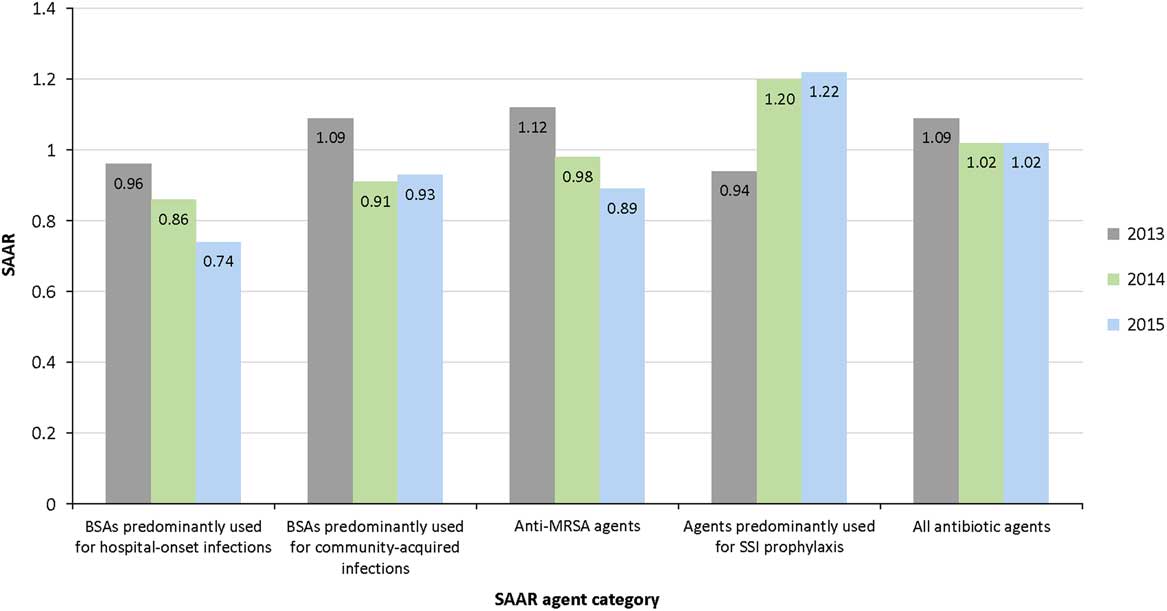
With the exception of surgical site infection prophylaxis agents, SAARs decreased across multiple categories during 2013–2014 and again during 2014–2015 (Figure 1). Declines in SAARs were statistically significant (P<.001) for all non-SSI comparisons, with the exceptions of 2015 versus 2014 changes in SAARs for BSAs used for community-acquired infections (P=.37) and all antibiotic agents (P=.78) (Table 1). These changes in antimicrobial use were not associated with an increase in length-of-stay or mortality.
Facility-level standardized antimicrobial administration ratios (SAARs), 2013–2015.

Change in SAAR by Antimicrobial Category Where Change Is Represented by the Ratio of 2 SAARSFootnote a

NOTE. SAAR, standardized antimicrobial administration ratio; BSA, broad-spectrum antimicrobial; SSI, surgical site infection.
a This ratio is calculated by dividing a more recent year’s SAAR by a previous year’s SAAR.
b All changes in SAAR are statistically significant at the α=0.05 level of significance, with the exception of those marked (b)
c For example, when dividing 2014’s SAAR of 0.89 by 2013’s SAAR of 0.96, we obtain a comparative ratio of 0.93, a 7% decrease from 2013 to 2014.
During 2013–2014, the SAAR for agents predominantly used for SSIs significantly increased (P<.001).
DISCUSSION
SAARs were useful in monitoring ASP activities, and declines in SAARs across multiple categories were consistent with our efforts to encourage providers to prescribe more narrow-spectrum antimicrobials and to stop antimicrobials when they were not indicated.
Our experience suggests that direct involvement of an ID physician in PAF had a measurable impact on antimicrobial prescribing. The ID physician’s more direct involvement in audits may have identified opportunities to improve antimicrobial usage that would have gone unnoticed by the team pharmacists. Our intervention is notable for the limited time commitment required of the ID physician, ie, 5–6 hours per week. Physician involvement has been important to other stewardship interventions as well.Reference Lesprit, Landelle and Brun-Buisson 6 – Reference Aagaard, Gonzales and Camargo 10
In addition to increased ID physician involvement, several other factors may have contributed to the declining SAARs observed in 2014 and 2015. First, team pharmacists may have become more comfortable with antimicrobial stewardship over time and therefore more assertive in making recommendations to the physician teams. Second, as prescribers became accustomed to receiving unsolicited feedback, they may have grown more receptive to ASP recommendations. Third, ongoing lectures to physicians-in-training could have gradually changed the culture of prescribing.
In this study, the only category for which SAARs did not decrease was the SSI prophylaxis agent group. This finding was not surprising because monitoring of these agents was not a major focus of the ASP. Also, for purposes of calculating the SAAR, cefazolin is categorized as an agent used predominantly for SSI prophylaxis. As a result, a shift from anti-MRSA agents to cefazolin to treat suspected S. aureus infections in nonoperative patients could have contributed to an increase in the SAAR for SSI prophylaxis agents.
Our study has several limitations. This study was not a randomized trial, so we cannot exclude the possibility that factors unrelated to the ASP contributed to reductions in antimicrobial usage. Furthermore, we did not track our interventions during phase 1, nor did we collect data on how many of the ASP team’s recommendations were accepted. Thus, we cannot confirm that stewardship feedback changed prescribing decisions, but it seems unlikely that observed antimicrobial usage compared to predicted use would decrease for 2 consecutive years without a systematic intervention. In addition, we have not provided data on days of therapy (DOTs), a common metric for monitoring antimicrobial use. However, we note that (1) DOTs are the numerator for the SAAR and (2) the SAAR represents an improvement over DOTs because it is risk-adjusted for specific hospital characteristics.
In conclusion, we found the SAAR to be a useful tool for monitoring facility-level changes in antimicrobial use over time. At our facility, limited but direct involvement of an ID physician in PAF helped improve prescribing practices and was associated with a decrease in antimicrobial use compared to what would be predicted based on hospital characteristics.
ACKNOWLEDGMENTS
We would like to recognize the pharmacists who participated in our ASP during all 3 years of this study: Rachel Ranz, Shelly Keiser, Ashley Fleck, and Christopher Degenkolb. The findings and conclusions in this report are those of the authors and do not necessarily represent the official position of the Centers for Disease Control and Prevention.
Financial support: No financial support was provided relevant to this article.
Potential conflicts of interest: All authors report no conflicts of interest relevant to this article.