Introduction
In addition to memory problems, behavioral and mood changes are also characteristic of dementia (Cohen-Mansfield and Libin, Reference Cohen-Mansfield and Libin2005; Van der Mussele et al., Reference Van der Museele2013) and can have a detrimental effect not only on the person with dementia (PwD) (Giebel et al., Reference Giebel, Sutcliffe and Challis2014; Reference Giebel2015), but also on their family and informal carers (Miller et al., Reference Miller, Mioshi, Savage, Lah, Hodges and Piguet2013). Depression is a frequent comorbid disorder (Wright and Persad, Reference Wright and Persad2007) and therefore requires specific attention in order to enhance wellbeing as outlined in national documents as part of a more global approach towards dementia (DoH, 2009; ADI, 2012). The recent G8 dementia summit (G8 UK, 2013) raised awareness of the condition and attributed great value to the international collaboration in dementia research.
The more advanced stages of dementia, particularly severe dementia, have been less frequently researched, with attention focused on mild and moderate stages. One possible reason could be the difficulties of PwD in communicating their symptoms at this stage of dementia. In respect of prevalence and factors associated with depression, the literature has similarly focused more on either the earlier or moderate stages of dementia or mixed-stage samples (Rosness et al., Reference Rosness, Barca and Engedal2010; Knapskog et al., Reference Knapskog, Barca and Engedal2011; Reppermund et al., Reference Reppermund2011; Van der Mussele et al., Reference Van der Museele2013; Gaugler et al., Reference Gaugler, Hovater, Roth, Johnston, Kane and Sarsour2014). In studies where PwD obtained an average Mini-Mental State Examination (MMSE) score of between 22 and 28, which is classed as mild dementia (Earnst et al., Reference Earnst2001), prevalence of depression ranged from 25% to 56% (Ballard et al., Reference Ballard, Bannister, Solis, Oyebode and Wilcock1996; Rosness et al., Reference Rosness, Barca and Engedal2010). A review of prevalence studies of depression in severe dementia reported a range varying from 6% to 61% for depression and depressive symptoms, and between 6% and 27% prevalence of major depression (Bielinski and Lawlor, Reference Bielinski and Lawlor2006). However, there is a lack of evidence on the presence of depression in severe dementia and concurrent antidepressant prescription using a cross-national design.
In the literature, several factors have been associated with depression in dementia. Higher levels of pain and neuropsychiatric behavior, poorer QoL and performance on basic ADLs, including bathing, continence, dressing, feeding, toileting, and transfer out of bed (Katz et al., Reference Katz, Ford, Moskowitz, Jackson and Jaffe1963), are all associated with increased levels of depression (Payne et al., Reference Payne1998; Chou, Reference Chou2007; deMedeiros et al., Reference deMedeiros2010; Wetzels et al., Reference Wetzels, Zuidema, De Jonghe, Verhey and Koopmans2010; Knapskog et al., Reference Knapskog, Barca and Engedal2013; Prina et al., Reference Prina2013; Davydow et al., Reference Davydow, Zivin and Langa2014). However, no study to date has explored all these factors in a multi-national sample of people with severe dementia. With depression increasing the risk for care home admission in older adults (Onder et al., Reference Onder, Liperoti, Soldato, Cipriani, Bernabei and Landi2007) and thus associated costs, identifying the factors associated with depression in dementia may facilitate more successful treatment of depression.
The rate of antidepressant prescribing is additionally important in understanding and managing depression in dementia. To date, few studies have compared the concordance between depressive symptomatology, diagnosis of depression, and prescription rates, especially from an international perspective. A study of the use of antidepressants in Dutch nursing home residents found 25% of residents with depressive symptoms and dementia used antidepressants, whilst nearly 60% of residents with a diagnosed depressive disorder and dementia used antidepressants (van Asch et al., Reference van Asch, Nuyen, Verbeek, Frijters, Achterberg and Pot2013). Similarly, Iden and colleagues (Reference Iden, Engedal, Hjorleifsson and Ruths2014) found that 44% of Norwegian nursing home residents received antidepressants, whilst only 31% showed depressive symptomatology based on a Cornell Scale for Depression in Dementia (CSDD) cutoff of eight or above. However, both studies, as examples, provide no information about the proportions of nursing home residents with dementia taking antidepressants, regardless of depressive symptomatology and official diagnosis. It is important to examine antidepressant prescribing in relation to the presence of depressive symptomatology to identify (a) trends of prescription across different countries; (b) potential overuse of antidepressants in PwD without depressive symptoms; and (c) potential underuse of antidepressants in PwD with depressive symptoms.
The aims of this study were threefold. The first was to investigate the prevalence of depressive symptomatology among people with severe dementia across eight European countries. With no previous evidence for this stage and the variety of nationalities, we hypothesized that rates of depressive mood in severe dementia would be similar to those in mild and moderate dementia. The second was to investigate the relationship between prescription of antidepressant medication in severe dementia and depression. Taking into account the limited evidence base, no hypothesis was made. The third was to identify the factors associated with depression. We hypothesized that poor QoL and ADL performance, and higher levels of pain and neuropsychiatric behavior could be related to presence of depressive symptoms. Although some literature has addressed some of these aims, this appears to be the first study to explore all three in a large sample of people with severe dementia across several European countries. With the recent G8 summit on dementia, findings will have implications for country-specific dementia strategies with a focus on comorbid mental health problems, such as depression.
Methods
Participants and recruitment
This study was part of a larger European project (the 7th Framework European RightTimePlaceCare project) undertaken in eight countries (England, Estonia, Finland, France, Germany, Netherlands, Spain, and Sweden), which examined the patterns of transition from community care to residential or nursing home care for PwD. The project collected data at baseline and at three-month follow-up. Further details of the protocol are published elsewhere (Verbeek et al., Reference Verbeek2012).
The sample comprised two groups of older adults 65 years or older: either living at home, receiving community care services, and considered at risk of care home admission within six months; or having moved into a care home in the previous three months. For PwD to be included in the study, they had to have (a) a diagnosis of dementia; (b) a Standardized Mini-Mental State Examination (S-MMSE) score of 24 or below; (c) and an informal carer either living with or visiting the PwD at least fortnightly. In order to provide within-country variation, a minimum of at least three community care providers and ten long-term care facilities were included per country. This study focused solely on a subsample of people presenting with severe dementia. People were defined as having severe dementia if they scored nine or below on the S-MMSE, reflecting previous work (Tombaugh and McIntyre, Reference Tombaugh and Mclntyre1992; NICE, 2006). For this study, baseline data from all eight countries were used. Ethical approval was obtained by each country individually, and participants provided written informed consent prior to their inclusion.
Measures
For this study, six scales were employed, measuring cognition, depressive symptomatology, daily task performance, psychopathology, QoL, and illness comorbidity. The MMSE (Folstein et al., Reference Folstein, Folstein and McHugh1975) measured overall cognition, and the study used the slightly modified S-MMSE (Molloy et al., Reference Molloy, Alemayehu and Roberts1991), which is found to have increased reliability due to stricter administration guidelines (Molloy and Standish, Reference Molloy and Standish1997). The S-MMSE is a brief ten-minute questionnaire addressing memory, repetition, copying, calculation, and orientation to time and place, amongst others. A total score of 30 can be scored, with higher scores indicating improved cognition. Depressive symptomatology was assessed using the CSDD (Alexopoulus et al., Reference Alexopoulus, Abrams, Young and Shamoian1988). Due to feasibility issues, only the subscale for proxy assessment was used in this study, comprising five domains (mood-related signs, behavioral disturbance, physical signs, cyclic functions, and ideational disturbance). Each domain contains four symptoms, apart from physical signs, with three symptoms only. As scoring for each symptom ranged from “0” (absent) to “2” (severe), a maximum score of 38 could be obtained. A cutoff of ten or above was employed, a score indicative of a probable major depression based on previous literature (Alexopoulus, Reference Alexopoulos1988). Daily task performance and independence were measured using the Katz ADL scale (Katz et al., Reference Katz, Ford, Moskowitz, Jackson and Jaffe1963), which assesses the ability to perform tasks of bathing, continence, dressing, feeding, toileting, and transfer. Each activity was scored dichotomously with a score of “0” for “partially dependent” and “fully dependent” and “1” for “independent.” A maximum score of six indicates independence. Neuropsychiatric symptoms were measured using the Neuropsychiatric Inventory Questionnaire (NPI-Q) (Kaufer et al., Reference Kaufer2000), which is a shorter version of the Neuropsychiatric Inventory. The NPI-Q assesses 12 different domains, including delusions, hallucinations, depression, and disinhibition, each of which receives a score for the presence and severity of symptoms from “0” (none) to “3” (severe). The QoL in Alzheimer's Disease (QoL-AD) (Logsdon et al., Reference Logsdon, Gibbons, McCurry and Terri1999), a psychometrically established QoL questionnaire (Thorgrimsen et al., Reference Thorgrimsen2003), was used to assess PwD QoL from the viewpoint of the PwD (QoL-AD-PwD) and from the carer (QoL-AD-C) perspective. With 13 items, each rated from “poor” to “excellent,” a higher score out of a total of 40 indicated better QoL. The Charlson Index of Comorbidity (Charlson et al., Reference Charlson, Pompei, Ales and MacKenzie1987) measured disease comorbidity, with scores ranging from 0 to 37; a higher total score indicating more comorbid conditions. Presence of pain was measured using items from the Minimum Data Set Residents Assessment Instrument (MDS/RAI) (Hawes et al., Reference Hawes, Morris, Phillips, Fries, Murphy and Mor1997) reflecting presence, frequency, and intensity of pain. For this study, presence of pain was defined as having experienced pain in the last seven days. Antidepressant prescription was classified according to the Anatomical Therapeutic Chemical (ATC) classification system, as recommended by the World Health Organization Collaborating Centre for Drugs Statistics Methodology (WHOCC) (WHO, 2013).
In this study, proxy ratings were used in preference to PwD ratings, as the RightTimePlaceCare project primarily employed proxy measures. However, it is acknowledged that proxy ratings have been found to vary between types of proxies (Hoe et al., Reference Hoe, Katona, Roch and Livingston2005; Graeske et al., Reference Graeske, Fischer, Kuhlmey and Wolf-Ostermann2012; Conde-Sala et al., Reference Conde-Sala2014).
Procedure
Face-to-face interviews with PwD and their carers took place at the home of the PwD and lasted approximately two hours. Interviewers in each country were qualified to at least degree level, and received training in administering the interview based on a working manual designed for this purpose. After informed consent was obtained, the S-MMSE and the QoL-AD-PwD were completed. The CSDD, QoL-AD-Proxy, NPI-Q, and the Charlson Index were completed by the informal carer (a family member such as spouse or child) in the community care setting, and by a formal carer or key worker (mostly a nurse or support worker) who knew the PwD well in the care home setting.
Statistical analysis
Demographic characteristics, performance on different measures, depression prevalence, and rates of antidepressant prescription were explored using frequency analysis. Independent t-tests were employed to assess significant differences between those receiving community care and those living in care homes on the variables of PwD and carer age, S-MMSE, ADLTotal, QoL-AD-PwD, QoL-AD-Proxy, NPI-Q, CSDD, and Charlson Index. Analysis of Variance (ANOVA) and post-hoc analysis (Tukey's HSD test) were used to examine significant differences in the mean CSDD score across the eight countries. χ2 test was employed to explore significant differences in number of depression cases across countries, whilst Cramer's V was used to assess the strength of this association. Bivariate correlation analysis was employed to investigate the relationships between clinical caseness of depression (cutoff 10+) and PwD and carer age, PwD gender and marital status, care setting, PwD pain, ADLTotal, QoL-AD-PwD, QoL-AD-Proxy, NPI-Q, and the Charlson Index. Those variables that were found to be significant in the bivariate correlation analysis were then entered into logistic regression models again for the total sample, with scoring 10+ on the CSDD representing the dichotomous dependent variable. All country-specific analyses were exploratory. Multi-level analysis was considered but given the relatively small number of countries involved (Maas and Hox, Reference Maas and Hox2005), logistic regression was regarded as the most suitable option for analysis. Statistical analyses were performed using SPSS version 22.
Results
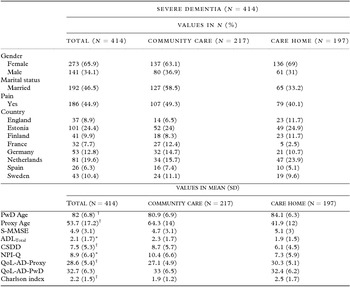
For the project as a whole 2,014 PwD were recruited across all eight participating countries, with 1,223 in the community care setting and 791 in the care home setting. Those included in this study comprised 414 participants with severe dementia as defined previously, including 217 community care and 197 care home participants. Data on 49 PwD were excluded due to missing or incomplete CSDD scores. Table 1 shows the demographic characteristics and performance measures of the sample. The average age of PwD with severe dementia was 82 years, the majority (66%) were female, and almost half (46%) were married. Presence of pain at least weekly was reported in just under half (45%) of cases. PwD had a mean score of 4.9 on the S-MMSE. The number of PwD using either community care or living in a care home was relatively equally distributed. In comparing several attributes between those receiving community care and those living in a care home, PwD age, carer age, ADLTotal, CSDD, NPI-Q, QoL-AD-Proxy, and the Charlson Index varied significantly between both settings.
Demographic characteristics of the European sample

Percentages are in valid percent; * = significant differences between community care and care home participants at p ≤ 0.05 level; †= significant differences between community care and care home participants at p ≤ 0.01 level.
ADLTotal = total score for activities of daily living; CSDD = cornell scale for depression in dementia; NPI-Q = neuropsychiatric inventory questionnaire; PwD = person with dementia; QoL-AD-Proxy = proxy-rated quality of life in Alzheimer's disease; QoL-AD-PwD = self-rated quality of life in Alzheimer's disease; S-MMSE = standardized Mini-Mental State Examination.
Prevalence of depressive mood and prescription of antidepressants
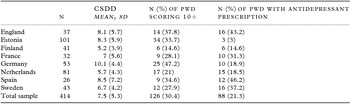
Table 2 shows the mean CSDD score, the prevalence of depressive symptomatology (clinical caseness as indicated with a cutoff of ten and above) and the rate of antidepressant prescription, across the eight countries. Thirty percent of the total sample scored above ten on the CSDD and thus indicated depressive symptomatology. ANOVA showed that the mean CSDD scores varied significantly across the countries (F7,413 = 5.252, p ≤ 0.001). Post-hoc analysis indicated that German PwD had significantly higher scores than PwD in Finland, the Netherlands, and Sweden and that Estonian PwD had significantly higher scores than PwD in Finland and in the Netherlands. Looking at the prevalence of depressive mood, the number of cases with depression varied significantly across countries (χ 2 = 17.1, p ≤ 0.05), whilst the association was low (Cramer's V = 0.203). Germany had the highest proportion of PwD indicating clinical caseness of depression. England and Estonia also showed higher proportions of PwD scoring above the cutoff relative to the total sample. Finland, France, the Netherlands, and Sweden had lower proportions of PwD with scores above the cutoff compared to the total sample, whilst Finland had the lowest prevalence of depressive mood of all eight countries. Moreover, further frequency analysis indicated that a larger proportion of PwD receiving community care (37% of 217) showed depressive caseness than PwD living in care home settings (23% of 197).
CSDD mean scores, depression prevalence and antidepressant prescription rates in each country

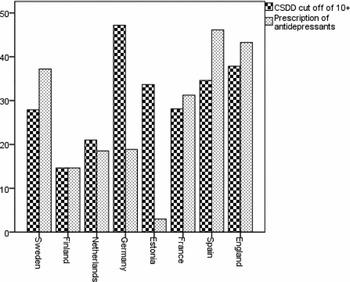
Examining the antidepressant prescription rate, 88 PwD of the total sample (21%) received antidepressants. In comparing the frequency of antidepressant prescription and depression, 33 (26%) of those scoring above the 10+ cut-off received antidepressants. The most frequent type of antidepressant across all eight countries was citalopram (11% of 88 PwD who received antidepressants), followed by mirtazapine (3% of 88 PwD who received antidepressants). Looking at the rates of antidepressant prescription, the largest and smallest proportions of PwD being prescribed antidepressants were from Spain and Estonia, respectively. The largest variations between PwD scoring above the cutoff on the CSDD and antidepressant prescription was reported for Estonia (31%) and Germany (28%), both countries prescribing fewer antidepressants than PwD scoring above the cutoff. In other countries, the rate of prescription was slightly higher than the prevalence of depressive symptomatology (England, France, Spain, and Sweden). The Netherlands and Finland reported similar or the same levels of antidepressant prescription and depression prevalence. This is also depicted in Figure 1.
Association between antidepressant prescription and depression across countries. Key to Figure 1 . The y-axis shows the percentage of PwD in each country scoring above the CSDD cutoff of ten and being prescribed antidepressants, based on the total sample for each country.

Factors associated with depressive symptomatology in severe dementia
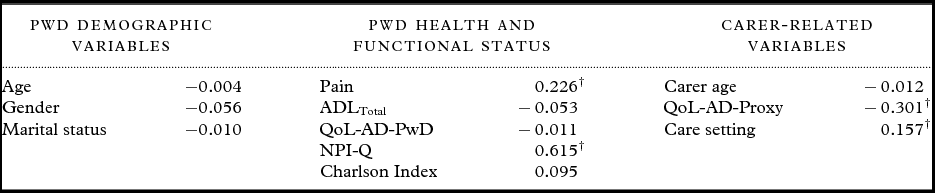
Table 3 shows the bivariate correlations for those with depression, as measured by a 10+ cutoff on the CSDD and PwD and carer demographic characteristics, ADLTotal, QoL-AD-PwD, QoL-AD-Proxy, NPI-Q, and the Charlson Index. Occurrence of pain, community care receipt, higher levels of neuropsychiatric problem behavior, and lower proxy-rated QoL were significantly associated with scoring above the cutoff on the CSDD.
Pearson correlations between individual variables and depression caseness (cutoff 10+)

*= p ≤ 0.05; † = p < 0.01.
Pearson correlations are for the total sample of those scoring 10 or above on the CSDD (N = 126).
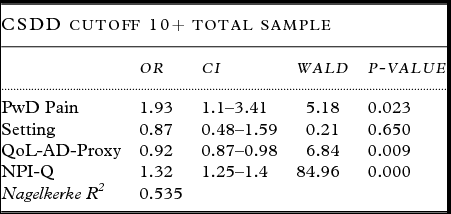
Table 4 shows the factors associated with depressive caseness using logistic regression analyses. QoL-AD-Proxy, pain, and NPI-Q were significant determinants of depressive mood and cumulatively accounted for over 50% of the variation in depression. Differences in mean values between PwD with and without depression (as measured by the CSDD), were apparent for both the QoL-AD-Proxy (26.3 (SD = 5.0); 29.7 (SD = 5.0)) and the NPI-Q (14.9 (SD = 6.0); 6.3 (SD = 4.6)). The presence of pain was proportionally higher in PwD with depression (61.9%) relative to PwD without depression (37.5%).
Logistic regression analysis for factors related to depressive caseness for the total sample and for different settings

CI = confidence interval; OR = odds ratio.
Discussion
Depression frequently occurs alongside dementia and can augment its symptoms. With a paucity of literature on the prevalence of and factors associated with depressive mood in severe dementia, this study aimed to explore these issues in relation to antidepressant prescribing in a European sample.
The prevalence of depressive symptomatology reported in this study varied in relation to care setting and countries. Reflecting previous literature on mixed-stage dementia (Ballard et al., Reference Ballard, Bannister, Solis, Oyebode and Wilcock1996), approximately 30% of people with severe dementia in this study scored above the threshold for depression. Whilst some studies have found rates of over 50% of depressed cases (Bielinski and lawlor, Reference Bielinski and Lawlor2006), the present findings suggest that rates of depression do not necessarily increase with severity of dementia. In this study, depression prevalence was higher in PwD receiving community care relative to those living in care homes. It has to be noted that there may be some variations in the elements of home care provided across the eight participant European countries. Furthermore, some demographic characteristics also varied between PwD in the two settings, which may have contributed to these variations in depression. Further research should address these differences more closely. In one previous study, Nikmat et al. (Reference Nikmat, Hawthorne and Al-Mashoor2013) found no significant differences in depression as measured by the CSDD in a sample of people with severe dementia between the two different settings. However, the authors employed a higher cutoff on the CSDD (12 instead of 10) and examined a much smaller sample of 49 patients, which may have contributed to a reduced likelihood of finding significant differences between the two settings.
In respect of the country-specific distributions of depression prevalences, Germany had the highest mean CSDD score with nearly half of the sample scoring above the cutoff. The lowest levels of depressive symptomatology, as well as the lowest average CSDD scores, were reported in Finland and the Netherlands. In these two countries, the prevalence of 15 and 21 percent, respectively, lay below previous reports across the spectrum of dementia (Ballard et al., Reference Ballard, Bannister, Solis, Oyebode and Wilcock1996; Roseness et al., Reference Rosness, Barca and Engedal2010), whilst all other countries in this study showed prevalence comparable with similarly reported ranges. Interestingly, Finland and the Netherlands also reported lower rates of depressive symptoms in the RightTimePlaceCare study sample as a whole, compared to the other countries (Beerens et al., Reference Beerens2014), and particularly low rates were apparent in the care home setting in both countries. These country differences may suggest that certain factors may influence not only the identification, but also the management, of depression in severe dementia and would be worthy of further investigation.
In order to obtain a more rounded picture of depression in severe dementia, an important factor to consider was the rate of antidepressant prescription. The highest rates of antidepressant prescription were reported in Spain and England although fewer PwD scored above the CSDD cutoff. Due to the study design, it was not possible to determine whether some PwD on antidepressant medication had responded positively and were no longer displaying symptoms of depression but were still receiving a maintenance dose. By contrast, Germany and Estonia showed the largest variations between prevalence and antidepressant prescription, with fewer PwD in both countries receiving antidepressant medication than the number scoring above the threshold for depressive symptomatology. Interestingly, in the overall sample of the RightTimePlaceCare project, Spain had the highest number of antipsychotic medication prescriptions (Soto-Martin et al., Reference Soto-Martin2014). One potential explanation could be the lack of a definitive diagnosis of depression in these countries (at least in this sample of PwD with severe dementia), so that depressive symptoms were only subsequently picked up by the CSDD. However, the cutoff employed on the CSDD may not be sufficiently close to a clinical diagnosis, but without further corroborative evidence on the application of the CSDD in advanced dementia, there is no guidance for an appropriate cutoff. It was not possible to collect information about diagnoses from case notes as part of the RightTimePlaceCare project, so this cannot be further validated here. Moreover, no data were collected on whether PwD received non-pharmacological treatments for depression. Consequently, further research to ascertain the underlying reasons for variations between depression and antidepressant prescription rates across countries is warranted.
Factors associated with depressive mood in PwD with severe dementia included neuropsychiatric symptoms, a lower QoL score identified by the proxy carer and presence of pain. The association between depressive and neuropsychiatric symptoms may be partially attributable due to the overlap of some items on both the NPI-Q and the CSDD. However, this association may also suggest that some neuropsychiatric symptoms tend to present simultaneously with depressive symptoms (Vilalta-Franch et al., Reference Vilalta-Franch2010; van der Linde et al., Reference van der Linde, Dening, Matthews and Brayne2014), and therefore highlight the need to also assess other neuropsychiatric symptoms in PwD presenting with depressive symptoms, and vice versa. Interestingly, no association was found between self-rated QoL and depression, although evidence from other research suggests that depression can explain variation in QoL, particularly in the QoL-AD (50). However, Woods et al. (Reference Woods2014) assessed people with early dementia, as opposed to severe, and used self-rated depression and QoL reports provided by the PwD only. By contrast, the present study collected data on depressive symptoms from two groups of proxies, informal carers, and professional formal carers, depending on the setting, so that any discrepancy between the two may have accounted for the non-significant finding in this study. Furthermore, presence of pain may constitute an integral aspect of depression in severe dementia, as evident in this cross-national sample, and elsewhere (Chou, Reference Chou2007; Kruger et al., Reference Kruger, Abner, Mendiondo, Schmitt, Smith and Jicha2012), which highlights the importance of addressing pain in the management of depression in dementia.
The data indicate that PwD receiving community care had a higher likelihood of scoring above the cutoff for depression than those living in nursing homes. This is supported by the higher prevalence of depressive symptomatology in this sample, and in addition the total sample of the RightTimePlaceCare project, ranging from mild to severe dementia, also indicated that depressive symptoms were greater in community care compared to institutional care settings (Beerens et al., Reference Beerens2014). Considering the severe stage of dementia, carers providing community care, who are often relatives of the PwD, are more likely to be distressed by the augmented symptoms of dementia. Consequently, this may have influenced their ratings of PwD depression, since links between carer burden and patient's depression have been previously reported (Donaldson et al., Reference Donaldson, Tarrier and Burns1998). By contrast, formal carers in nursing or residential homes may be less affected by an individual's behavior, so that their ratings of PwD depression were lower. Therefore, it is important to address both pain management and care setting, the latter involving a specific focus upon informal carers, when considering interventions to address depressive symptomatology in severe dementia.
Contrary to the above factors, ADL performance was not found to be a contributing factor to depressive mood. This reflects previous work by Reppermund (Reppermund et al., Reference Reppermund2011) in older people without a dementia diagnosis. By contrast, Knapskog et al. (Reference Knapskog, Barca and Engedal2013) and Payne et al. (Reference Payne1998) showed ADL disability to be associated with depression in a sample of healthy older adults and PwD and in a mixed-stage dementia sample, respectively. In particular, these results were based on CSDD scores, similar to the present study. Given that Knapskog et al. (Reference Knapskog, Barca and Engedal2013) showed that scoring above three different cutoffs for depression was related to ADL performance, the cutoff employed in this study is unlikely to be an explanation for the lack of association found here. However, ADL performance in the severe stage of dementia as examined in this study has generally shown little variation, as performance on all ADLs is greatly impaired by this stage (Giebel et al., Reference Giebel, Sutcliffe and Challis2014; Reference Giebel2015). This could explain why no association with depression was found. In the absence of supportive evidence, further research is required to explore this.
Limitations
This study has certain limitations. First, data on confirmed diagnoses of depression by professionals were not available. Hence, our findings were solely based on depressive symptomatology ratings by proxies at the time of interview. Second, this study employed predominantly proxy ratings (to address reliability and feasibility issues), which may have potentially resulted in different ratings according to type of carer. For example, formal and informal carers may differ in their perceptions of the PwD’ QoL (Conde-Sala et al., Reference Conde-Sala2014), since formal carers are likely to spend less time with PwD in a care home setting relative to spouses or children in community care settings. Third, the project did not employ random selection of cases (as it was a purposive sample of those marginal to admission to care homes) and thus samples nationally may not be representative, and community and care home settings are expected to vary between countries. Nevertheless each country included at least ten long-term care facilities and three community care organizations to introduce variation within the samples. Lastly, given the fact that this study comprises a secondary data analysis and incorporates some limited sample sizes for individual countries, the comparisons made between countries are necessarily exploratory.
Conclusion
This study indicates that depressive mood is common amongst people at the severe dementia stage, which is associated with presence of pain, lower reported QoL, and behavior problems. Furthermore, prevalence of depressive symptomatology and antidepressant prescription rates vary across countries. With differences apparent between countries, yet with broadly similar samples drawn in relation to setting, dementia stage, and recruitment, it appears that there may be certain factors that influence the identification of depression in PwD with severe dementia in some countries. Further studies should investigate these, potentially culturally or system specific, factors in order to address these differences and diagnose depression symptoms in a group of people who are less able to articulate their feelings due to the nature of their illness. Similarly, it may be beneficial to introduce pain management programmes, whilst neuropsychological symptoms of dementia and symptoms of depression should be addressed and treated based on the best evidence available. Moreover, further research should address country variations in prescription rates and their relationship to depressive caseness.
Conflict of interest
None.
Author roles
CG contributed to the design, analysis, interpretation of the data, and writing the manuscript. CS and ARG contributed to the interpretation of the data and critically to drafts of this manuscript. SA, IRH, MS, AZ, JH, KS, and DC provided feedback to drafts of this manuscript and approved the final version.
Acknowledgments
This work as part of the RightTimePlaceCare project was supported by a grant from the European Commission within the Seventh Framework Programme [Contract number HEALTHF3-2010-242153] funded for 42 months from 1 January 2010 to 30 June 2013.
Appendix 1
The RightTimePlaceCare Consortium partners are as follows:
Coordinator:
University of Witten/Herdecke (DE): Gabriele Meyer PhD, RN, professor (scientific coordinator, WP 1 leader), Astrid Stephan MScN, RN, Anna Renom Guiteras, geriatrician, Dirk Sauerland Dr.rer.pol., professor (WP 4 & 6 leader), Dr Ansgar Wübker, Patrick Bremer dipl. oec.
Consortium Members:
Maastricht University (NL): Jan P.H. Hamers, PhD, RN, professor (WP 3 leader); Basema Afram, MSc; Hanneke C. Beerens, MSc, RN; Michel H.C. Bleijlevens, PhD, PT; Hilde Verbeek, PhD; Sandra M.G. Zwakhalen, PhD, RN; Dirk Ruwaard, MD, PhD, professor.
Lund University (SE): Ingalill Rahm Hallberg, professor (WP 2 leader); Ulla Melin Emilsson, professor; Staffan Karlsson, PhD, Christina Bokberg, MSc, Connie Lethin, MSc.
University of Manchester (UK): David Challis, professor (WP5 leader); Caroline Sutcliffe MSc; Dr David Jolley; Sue Tucker, MSc, RN; Dr Ian Bowns; Brenda Roe, professor; Alistair Burns, professor.
University of Turku (FI): Helena Leino-Kilpi, PhD, RN, professor; Jaana Koskenniemi, MNSc, RN, researcher; Riitta Suhonen, PhD, RN, professor; Matti Viitanen, MD, PhD, professor; Seija Arve, PhD, RN, docent; Minna Stolt, PhD, podiatrist; Maija Hupli, PhD, RN.
University of Tartu (EE): Kai Saks, MD, PhD, professor (WP 5 leader); Ene-Margit Tiit, PhD, professor; Jelena Leibur, MD, MBA; Katrin Raamat, MA; Angelika Armolik, MA; Teija Tuula Marjatta Toivari, MA, RN.
Fundació Privada Clinic per la Recerca Biomedica, Hospital Clinic of Barcelona (ES): Adelaida Zabalegui PhD, RN (WP 5 leader); Montserrat Navarro PhD, RN; Esther Cabrera PhD, RN (Tecnocampus Mataró), Ester Risco MNSc, RN; Carme Alvira MScN, RN; Marta Farre MScN, RN; Susana Miguel MScN, RN.
Gerontôpole, University of Toulouse (FR): Dr Maria Soto; Agathe Milhet; Dr Sandrine Sourdet; Sophie Gillette; Bruno Vellas, professor.