Introduction
CHD is the most common birth defect worldwide, affecting 9 per 1,000 live births.Reference Liu, Chen and Zühlke1 Children with CHD often require surgical intervention, prolonged hospitalisations, and complex medical management and are at increased risk for developmental delays and neurodevelopmental disorders.Reference Gaynor, Stopp and Wypij2,Reference Sood, Newburger and Anixt3 The demands associated with caring for a child with CHD and alterations to the parental role place parents and caregivers at heightened risk for psychological distress, including anxiety, depression, and post-traumatic stress symptoms.Reference Sood, Karpyn and Demianczyk4–Reference Woolf-King, Anger, Arnold, Weiss and Teitel6 Importantly, caregiver psychological wellbeing is associated with child behavioural and developmental outcomes and represents a modifiable target through psychological intervention and community-based supports.Reference Rogers, Obst and Teague7,Reference Wei, Roscigno, Hanson and Swanson8
Peer support, also referred to as peer-to-peer support or peer mentorship, is a form of community-based support with growing evidence for its potential role in mitigating caregiver psychological distress within the context of paediatric CHD.Reference Bruce, Lilja and Sundin9–Reference Gramszlo, Karpyn and Demianczyk12 Peer support has been defined as social, emotional, and informational support provided by individuals with shared lived experience.Reference Watson13 Such support may be delivered through a range of modalities, including in-person and virtual formats (i.e., telephone and online) and may be structured formally (e.g., facilitated by patient/family organisations) or occur informally (e.g., social media).Reference Carlsson and Mattsson11,Reference Klarare, Carlsson and Mattsson14 Peer support has been found to foster caregiver empowerment, resilience, emotional validation, confidence, preparedness for the future, and opportunities for information sharing.Reference Gramszlo, Karpyn and Demianczyk12,Reference Klarare, Carlsson and Mattsson14–Reference Nelson, Abraham, Walters, Pfeiffer and Valenstein17 Further, peer support may be mutually beneficial, fostering meaning-making and personal growth among those providing support.Reference Carlsson and Mattsson11 Peer support has been incorporated into the standards for psychosocial care in neonatal intensive care settings and included in a recent psychosocial care model for families affected by CHD,Reference Hall, Ryan, Beatty and Grubbs15,Reference Driscoll, Christofferson and McWhorter18 reflecting its perceived value.
Despite a growing body of literature highlighting the potential benefits of peer support and caregivers’ expressed interest in this form of support,Reference Bruce, Lilja and Sundin9,Reference Carlsson and Mattsson11,Reference Gramszlo, Karpyn and Demianczyk12,Reference Driscoll, Christofferson and McWhorter18 few studies have explored factors affecting implementation. The literature to date is focused predominantly on the perspectives of those who have received peer support, with substantially less attention to the experiences of those who provide, coordinate, or oversee peer support. Patient/family organisations within the CHD community (sometimes also referred to as patient advocacy organisations or family-led organisations) have extensive experience implementing formal and informal peer support, and yet, the perspectives of those leading these organisations or their local chapters are not typically represented in the literature. Concurrently, there is increasing recognition of the importance of identifying barriers and facilitators affecting implementation of effective interventions in real-world contexts to bridge the gap between research and practice and reduce disparities.Reference Moise, Cené and Tabak19 Leaders of patient/family organisations possess unique insight into the practical, ethical, and logistical challenges of peer support implementation that may differ from those of caregivers or healthcare professionals within the CHD community.
This study used online crowdsourcing to identify barriers and facilitators of peer support implementation, as well as recommendations for optimising peer support, from the perspectives of leaders of patient/family organisations serving the CHD community. These perspectives aim to broaden our understanding of how to improve outcomes for families of children with CHD through community-based support.
Materials and method
This study is part of a larger project informing the development of a family-based psychosocial care model for CHD using online crowdsourcing.Reference Driscoll, Christofferson and McWhorter18 An advisory council consisting of multidisciplinary healthcare professionals and four parents of children with CHD, most of whom also served in a leadership role within a patient/family organisation, was formed at the onset of the larger project. The advisory council convened twice monthly to provide guidance on the study, including methodology, recruitment, data collection, and interpretation of results. Prior to data collection, the study team and advisory council identified potentially important domains relevant to family-based psychosocial care based on literature review, clinical expertise, and lived experience (e.g., education and preparation for CHD, mental health screening, vicarious trauma, father support, sibling support, grief and loss).Reference Driscoll, Christofferson and McWhorter18 These domains informed the questions posed to participants throughout the study. This study was approved by the Nemours Children’s Health Institutional Review Board.
Participants and recruitment
Participants for this study were individuals in a leadership role within a patient/family organisation serving children with CHD and/or their families, including bereaved families. Leaders of national organisations, local organisations, or local chapters of national organisations were eligible. Participants had to be English-speaking and 18 years of age or older, with access to the internet.
Recruitment was conducted through direct contact with leaders of patient/family organisations within the CHD community, word-of-mouth within these organisations, and assistance of the advisory council. Leaders interested in participating were directed to an online survey via REDCap that consisted of an eligibility screener, electronic consent form, and background questionnaire. Eligible individuals who completed the consent form and background questionnaire were instructed to set up a deidentified account on Yammer (Version 7.20, Microsoft Corporation, Redmond, WA), the social networking platform used for qualitative data collection, and then invited to join a private closed Yammer group created for this study.
Procedures
Qualitative data were collected through Yammer using crowdsourcing, a methodology that facilitates collaboration with online groups to identify problems and propose solutions.Reference Brabham20 Crowdsourcing is used in paediatric health research to identify barriers and facilitators to care and opportunities for improvement.Reference Sood, Wysocki and Alderfer21 Thirty-two open-ended questions were posted to participants within the private Yammer group over six months (Supplementary Table S1). Questions were developed by the study team and advisory council through an iterative process whereby participant responses to prior questions informed subsequent questions. Participants responded to these questions through the Yammer app or by email and could view each other’s responses and “like” or comment on these responses (i.e., interact as a “crowd”). In the questions posted to participants and throughout this manuscript, the term “peer mentor” is used when referring to the individuals providing peer support.
Data analysis
Qualitative data were analysed using inductive thematic analysis focusing on participants’ perceptions and lived experiences.Reference Braun and Clarke22 Participant responses were extracted from Yammer and uploaded into Dedoose (Version 8, SocioCultural Research Consultants, LLC, Los Angeles, CA). The qualitative codebook was developed through an iterative process incorporating open coding and discussion between team members regarding code definitions. Three participants’ complete responses were then independently coded by two raters (ES, JC) to establish inter-rater reliability. After achieving acceptable reliability (pooled Cohen’s kappa coefficient > 0.80), remaining responses were divided between the two raters for independent coding. Qualitative data assigned the Not Helpful/Unsupportive (i.e., barriers), Helpful/Supportive (i.e., facilitators), and/or Recommendations/Wishes codes were included in analyses, consistent with the aims of the study. Analyses were conducted in two steps. First, broad themes were constructed from the qualitative data. Next, perceived barriers and facilitators of peer support implementation and recommendations to optimise implementation were identified for each theme.
Results
Participant characteristics
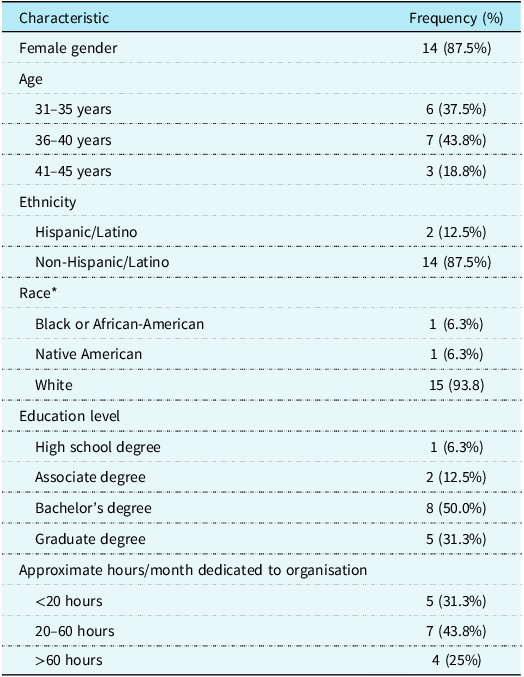
Twenty-five eligible individuals signed the electronic consent form. Four of the 25 did not complete the background questionnaire, three did not set up a deidentified account on Yammer, and two completed all initial steps but did not respond to any open-ended questions, resulting in a final sample size of 16, typically sufficient to achieve thematic saturation in qualitative research with a focused population.Reference Hennink and Kaiser23 Five distinct patient/family organisations were represented, including 8 local chapters from two organisations (AR, CA, IL, NY, OH, TX, VA, WI). All organisations were described as providing peer support for families of children with CHD but varied with the extent to which they also provided peer support for bereaved families. Most participants identified as non-Hispanic White and female, and all identified as the parent of one or more children with CHD. Table 1 displays participant characteristics.
Participant characteristics

Table 1. Long description
A table displaying participant characteristics in a study involving patient/family organizations. The table has two columns: Characteristic and Frequency (percent). It includes 16 rows detailing various characteristics such as gender, age, ethnicity, race, education level, and approximate hours per month dedicated to the organization. Each row provides the frequency percentage for each characteristic. For example, 87.5 percent of participants are female, 43.8 percent are aged 36-40 years, 87.5 percent are non-Hispanic/Latino, 93.8 percent are White, 50.0 percent have a Bachelor’s degree, and 43.8 percent dedicate 20-60 hours per month to the organization.
N = 16; *One participant selected more than one race.
Qualitative themes
Four broad themes were identified from the qualitative data: (1) Training and Expertise, (2) Peer Mentor Wellbeing, (3) Partnerships and Collaboration, and (4) Support for All Families and Family Members. Perceived barriers and facilitators of peer support implementation and recommendations to optimise implementation are described below and presented in Table 2 along with representative quotes. Thematic saturation was achieved, with 94% of participants providing responses that supported all four themes.
Themes and representative quotes

Table 2. Long description
A table with four rows and three columns. The columns are labeled Themes, Training and expertise, Peer mentor well-being, Partnerships and collaboration, Support for all families and family members, and Representative quotes. The table presents barriers, facilitators, and recommendations for each theme. Row 1: Training and expertise, Barriers, Limited formal or specialised training, Limited knowledge in recognising mental health issues, Limited knowledge in bereavement support, Facilitators, Basic training in peer support, Unique training resulting from lived experiences, Guidance on locating mental health support, Recommendations, Structured or tiered support for new peer mentors, Guidance on differences between peer mentorship, counseling, and medical advice, Communication/consultation with professionals, Ongoing on grief, post-traumatic stress, and burnout, Guidance on locating mental health support. Row 2: Peer mentor well-being, Barriers, Risk of reliving traumatic events through the experiences of others, Volunteer nature of peer support: difficulties with boundary setting, balancing roles, Limited formal support for peer mentor well-being, Facilitators, Fostering meaning-making and a sense of purpose, Encouragement to set boundaries, Clear expectations on the peer mentor role, Guidelines around duration and timeline of support for newer peer mentors or those new to the role, Recommendations, Process groups/communication between mentors and leaders on supporting resources, Protocol for offering mentees to professional resources, Families given a list of professional resources to decrease burden on peer mentors. Row 3: Partnerships and collaboration, Barriers, Under-recognition of availability and benefits of peer support, Competing priorities and lack of time/resources, Hospital policies, Facilitators, Building relationships by assisting with hospital initiatives, sharing information on hospital events, and inviting healthcare professionals to serve on medical advisory boards, Requests of individual child life specialists, social workers, and other team members, Recommendations, Stronger partnerships between care centres and organisations, Structured referral systems within care centres. Row 4: Support for all families and family members, Barriers, Difficulty identifying/accessing all families, Limited time/resources for peer support of all family members, Limited knowledge of what fathers and siblings need for peer support and how to best support them, Social expectations around gender roles limit peer support for fathers and other male caregivers, Stigma, discomfort, and burnout on the part of the peer mentor limits peer support for bereaved families, Facilitators, Family-oriented events with specific activities for siblings, collaboration with child life specialists, Requests for fathers to assist with specific activities, offering educational topics and opportunities for information sharing, Recommendations, Sibling-focused support groups/events, Sibling-focused groups to focus on healthy siblings/partner relationships, Educational resources for siblings/families, Encouragement/recruitment of father peer mentors, Father-focused support groups focused on social and educational activities.
CHD = congenital heart disease; *within organisations not specifically focused on support for bereaved families.
Training and expertise
Barriers
Mental health was described as a frequent topic of discussion in the peer-to-peer relationship. However, many participants noted limited formal or specialised training for volunteer peer mentors and a feeling of being unprepared to support families around specific mental health difficulties. Participants reported that, among peer mentors, there is often limited knowledge on how to recognise significant or worsening mental health issues, how or when to suggest professional mental health support, and how to support families in finding and accessing mental health services when needed. Within organisations not specifically focused on support for bereaved families, participants also noted limited knowledge among peer mentors on how best to support bereaved families beyond basic recommendations such as “what not to say,” often resulting in discomfort with providing support to families after a child’s death.
Facilitators
Despite limited specialised training, participants shared that access to basic training in peer mentorship was helpful in navigating conversations with families and understanding the role of the peer mentor. Additionally, many perceived that their lived experiences caring for a child with CHD were invaluable in connecting with and supporting families. Participants reported that these lived experiences provide a form of unique expertise not typically held by healthcare professionals and can foster deep and supportive relationships in which families feel “seen and heard by someone who gets it.”
Recommendations
Participants recommended opportunities for training and consultation by mental health professionals and experts in grief and loss (e.g., organisations dedicated to bereavement support) focused on topics such as recognising mental health issues, initiating conversations about professional mental health support within the peer-to-peer relationship, how people process grief, and how best to support bereaved families. Participants also wanted a list of vetted local resources or guidance on identifying relevant resources beyond peer mentorship.
Mentor well-being
Barriers
Many participants highlighted the impact of burnout, compassion fatigue, and secondary traumatic stress on mentor well-being. They noted that the nature of the peer-to-peer relationship, in which the peer mentor has had similar lived experiences, places peer mentors at risk of re-living difficult or traumatic events through the experiences of others. Burnout was described as particularly high within the context of support for bereaved families by peer mentors who previously experienced the death of their child. Participants also discussed the volunteer nature of peer mentorship and difficulties that can arise in setting boundaries and balancing their role as peer mentor with other roles. Participants noted that peer mentors sometimes neglect their own mental health and needs for support when focusing on the needs of others. Participants reported limited formal support for peer mentor well-being and, specifically the prevention of burnout, compassion fatigue, and secondary traumatic stress.
Facilitators
Many participants also described the benefits of peer support for peer mentors, including its role in fostering meaning-making and a sense of purpose and in strengthening the connection to their child, particularly for peer mentors whose child has died. To facilitate mentor well-being, participants noted that it can be helpful when leaders of patient/family organisations emphasise the importance of boundary setting and help peer mentors work to establish boundaries. Examples included having a protocol or plan for helping families through especially difficult situations and encouraging peer mentors to work together and collaborate with one another in supporting these families, allowing peer mentors to take a step back if needed. Clear expectations for what peer mentorship should and should not be were also described as an important facilitator for mentor well-being. In addition, participants shared that it can be beneficial to establish guidelines around the timeline of support for newer peer mentors or those who are experiencing stressors with their own child (e.g., medical events, hospitalisation, surgery).
Recommendations
Participants suggested that any training or consultation focused on mental health also educate peer mentors about their risk of burnout, compassion fatigue, and secondary traumatic stress and how to recognise symptoms within themselves. Additionally, participants recommended that organisations provide a forum for peer mentors to connect and process what they are experiencing within the peer-to-peer relationship and receive support and guidance from others in similar roles.
Partnerships and collaboration
Barriers
Partnerships and collaboration with care centres were described by many participants as crucial. However, multiple barriers were noted, including under-recognition of the availability and benefits of peer support, competing priorities, lack of time and resources, mistrust, and hospital policies. Some participants noted that relationships with care centres tend to feel “one-sided,” as hospitals typically accept donations from outside organisations while abiding by policies, procedures, and privacy laws that make support of these same organisations more difficult (e.g., limiting access to patients/families and preventing healthcare professionals from distributing information about the organisation). These barriers were described as preventing many patients and family members from learning about patient/family organisations and peer support options.
Facilitators
Some participants noted improvements in partnerships and collaboration with care centres over time. They reported that relationships with care centres are often strengthened when members of patient/family organisations assist with hospital initiatives, such as family advisory councils and hospital improvement projects, or when organisations are willing to share information about hospital events and needs with their members. Some participants also noted that opportunities to table at hospital events and provide care packages for distribution to families or for healthcare professionals to participate in organisations’ medical advisory boards have helped to facilitate awareness of the organisation and build relationships over time. Effective collaboration with individual child life specialists, social workers, and other members of the healthcare team has also led to broader collaborations with care centres.
Recommendations
Recommendations centred around the need for stronger partnerships between care centres and patient/family organisations, including structured referral systems within care centres to peer support options. Some participants emphasised the need to remember that “we are all on the same side” working towards the same overarching goals, with different areas of expertise that can be leveraged for improved outcomes.
Support for all families and family members
Barriers
Many participants noted barriers to identifying and accessing all families in need of support, primarily those related to partnerships and collaboration with care centres, as described above. Many participants also noted that peer support is typically provided by mothers to mothers, with more limited structured support for fathers and healthy siblings. Perceived barriers to providing support for all immediate family members included limited time and resources due to the volunteer nature of most peer support roles, lack of knowledge of what fathers and siblings need from peer support and how to identify and engage them, and societal expectations around gender roles (e.g., fathers and other male caregivers are expected to be “strong,” and seeking help is perceived as “weak”). Within organisations not specifically dedicated to support of bereaved families, many participants noted that bereaved families may be less likely to receive support due to factors such as stigma, superstition, and discomfort on the part of the peer mentor, as well as burnout by those dedicated to bereavement support.
Facilitators
Many participants described using social media to engage families and increase awareness of peer support options within their organisation. Participants also noted some success with offering sibling-specific activities during family-oriented events or sibling care packages during hospitalisations. Some participants also mentioned that collaboration with child life specialists has been helpful in supporting siblings. Participants noted that intentional recruitment of fathers and requests for fathers to assist with or participate in specific activities (e.g., setting up for or participating in a walk/event) have been helpful in increasing their engagement with the patient/family organisation. They also noted that fathers are more likely to engage around educational topics (e.g., informational webinars) and conversations focused on information sharing (e.g., how fathers can support their family during hospitalisation).
Recommendations
Participants expressed the need to work collaboratively with care centres to identify more families and individual family members (including fathers and siblings) who may benefit from peer support. Participants also recommended additional sibling-focused events as an opportunity for healthy siblings to connect to others with shared experiences. They noted that they would appreciate opportunities to learn more about the specific needs of fathers and siblings that could be addressed through peer support.
Discussion
Peer support is consistently identified as important among caregivers of children with CHD and has the potential to improve child and family outcomes.Reference Bruce, Lilja and Sundin9–Reference Gramszlo, Karpyn and Demianczyk12,Reference Klarare, Carlsson and Mattsson14,Reference Driscoll, Christofferson and McWhorter18 The current study examined the perspectives of leaders from patient/family organisations to deepen our understanding of how peer support can be integrated and optimised within hospital- and community-based paediatric cardiac care. Four themes highlighting key barriers and facilitators to effective implementation were identified: Training and Expertise, Peer Mentor Well-being, Partnerships and Collaboration, and Support for All Families and Family Members. Although peer support across stages of care has been recommended in prior work,Reference Gramszlo, Karpyn and Demianczyk12,Reference Driscoll, Christofferson and McWhorter18 few studies have explored how organisational leaders conceptualise needs, challenges, and opportunities for programme development to inform the design and sustainability of peer support.
A central finding is the unique value of lived experience with CHD, aligning with a robust body of literature highlighting this distinct expertise,Reference Carlsson, Klarare and Mattsson10,Reference Watson13,Reference Hall, Ryan, Beatty and Grubbs15 which differentiates peer mentors from medical professionals and other healthcare providers. Prior work has posited that lived experience offers a unique form of emotional validation and fosters mutual exchanges of information, shared social identities, and reassurance.Reference Niela-Vilén, Axelin, Salanterä and Melender24,Reference Shilling, Morris, Thompson-Coon, Ukoumunne, Rogers and Logan16 However, lived experience does not fully prepare peer mentors to identify and address the significant mental health needs of many caregivers of children with CHD. The limited formal or specialised training in mental health support in conjunction with the emotional toll and volunteer nature of the peer mentor role may increase vulnerability to burnout due to fewer structured supports and reliance on intrinsic motivation to sustain their work. These findings are consistent with extensive literature on compassion fatigue,Reference Figley, Figley, Seppälä, mas, Brown, Worline, Cameron and Doty25 which is characterised by dysfunction and exhaustion resulting from prolonged exposure to suffering, stress, and trauma and can often be experienced at an increased rate by individuals in caring professions or caregivers of children diagnosed with a disability.Reference Davenport and Zolnikov26,Reference Meadors and Lamson27 Given the defining feature of shared lived experience, peer mentors may experience increased susceptibility to compassion fatigue as compared to individuals in other helping roles.Reference Sweet, Hennig and Shi28
Importantly, the emotional impact of providing peer support is not uniformly negative. Prior literature has demonstrated shared lived experience can also foster fulfilment, gratitude, enhanced self-esteem, and personal growth for peer mentors, and that engaging in self-compassion and deriving satisfaction from one’s mentoring role promotes resilience.Reference Sweet, Hennig and Shi28,Reference Pistrang, Jay, Gessler and Barker29 These dual outcomes underscore participants’ emphasis on the need for structured programmes that safeguard peer mentors’ well-being. Participants recommended strengthening partnerships with mental health experts, establishing clear referral pathways, and integrating evidence-based training and supervision into peer support infrastructures. A systematic review of peer support for breast cancer survivors similarly highlights the importance of intentional programme design and institutional support to protect peer mentors while optimising impact.Reference Clougher, Ciria-Suarez, Medina, Anastasiadou, Racioppi and Ochoa-Arnedo30
Peer support is embedded within a larger system of partnerships and referral pathways, many of which are inconsistent across hospitals and CHD organisations. Participants described wide variation in how clinical teams connect families to peer support, leading to difficulties accessing all families in need of support. They therefore recommended more systematic collaboration with hospitals, aligning with broader literature which highlights that community-hospital partnerships and deliberate programme infrastructure can help improve access and reduce disparities in paediatric care.Reference Kowitt, Ellis and Carlisle31 A key consideration in implementing peer support is the distinction between institutional support and institutional ownership of peer relationships. While structured training, defined referral pathways, and mechanisms to mitigate peer mentor burnout are critical to ethical and sustainable programme design, excessive formalisation may unintentionally undermine the relational qualities that contribute to peer support effectiveness. Overly prescriptive matching processes or tightly controlled programme structures may result in interactions that are transactional rather than authentic. Implementation efforts should therefore balance the development of supportive infrastructure with preservation of relational autonomy.
Despite the rich diversity of the CHD population, peer mentors tend to be more socio-demographically homogenous (e.g., mothers and non-Hispanic White), which may limit relatability, trust, and uptake of peer support among underrepresented groups.Reference Moore, Coates, Watson, de Heer, McLeod and Prudhomme32,Reference Sokol and Fisher33 Parallel research in healthcare settings suggests that shared racial, ethnic, and cultural identities between patients and providers are associated with improved accessibility, communication, and perceptions of care.Reference Moore, Coates, Watson, de Heer, McLeod and Prudhomme32 For racially or linguistically minoritised families, peer matches that reflect family background may further reduce barriers to engagement. Indeed, in broader health contexts, peer support has been identified as an especially powerful mechanism for reaching groups that traditional health services may poorly engage.Reference Sokol and Fisher33 Addressing this gap, especially for non-English speaking, same-sex, or extended family caregivers, will be vital for building peer support structures that are equitable, accessible, and deeply meaningful to all members of the CHD community.
Participants emphasised that effective peer support must extend beyond the primary caregiver to meaningfully engage the entire family system. Previous research indicates that fathers experience unique stressors related to their child’s CHD but are less likely than mothers to pursue peer support.Reference Sood, Karpyn and Demianczyk4,Reference Driscoll, Christofferson and McWhorter18 Additionally, siblings often experience emotional, behavioural, and family-related impacts of CHD that remain insufficiently addressed in clinical and community settings.Reference Schamong, Liebermann-Jordanidis, Brockmeier, Sticker and Kalbe34,Reference Amaro, Alderfer and Wawrzynski35 Qualitative interviews with siblings of children with CHD reveal concerns about hospitalisation, shifts in parental attention, and feelings of responsibility for protecting their sibling with CHD.Reference Schamong, Seven, Folkerts, Brockmeier and Kalbe36 Taken together, these findings underscore the urgent need to expand peer support programme initiatives to include structured interventions for fathers/male caregivers and siblings, such as supportive peer groups, tailored mentorship, and dedicated sibling-focused resources.
Limitations of the present study may inform future directions for related research. First, participants were a small group of leaders from five CHD patient/family organisations and may not reflect the experiences and perspectives of all leaders or peer mentors, particularly those within small or local organisations. Peer support frequently occurs informally, outside of a structured organisation, and barriers and facilitators to informal peer support may differ. Second, most participants identified as female and non-Hispanic White, and all identified as the parent of one or more children with CHD. While this reflects the demographic characteristics of many leaders of CHD patient/family organisations, the perspectives of leaders from other demographic groups may not be adequately represented within the findings. Third, resources offered through patient/family organisations shift based on organisation priorities, and there have been documented changes in volunteerism related to the COVID-19 pandemic.Reference Cnaan, Unetic and Choi37 Therefore, barriers and facilitators of implementation of peer support may change over time.
This study provides important insights into the key barriers and facilitators of the implementation of peer support and offers recommendations for next steps, including community-hospital partnerships to improve access and intentional programme design to protect peer mentor wellbeing. Further understanding of both caregiver and peer mentor experiences and needs is critical for elucidating ways to develop and implement optimal models of peer support.
Supplementary material
The supplementary material for this article can be found at https://doi.org/10.1017/S1047951126123531.
Acknowledgements
We would like to thank the study participants, members of the advisory council, and Ms Jurni Jackson for their contributions to this work.
Financial support
This work was supported by the National Institute of General Medical Sciences of the National Institutes of Health (Grant #U54-GM104941; P20GM144270).
Competing interests
Carissa Ostrom is Executive Director of Conquering CHD, and Lacie Patterson is President of Sisters by Heart. Conquering CHD and Sisters by Heart are two of the five patient/family organisations represented in this study. The other authors declare none.
Ethical standards
The authors assert that all procedures contributing to this work comply with the Belmont Report and with the Helsinki Declaration of 1975, as revised in 2008, and have been approved by the Nemours Institutional Review Board.