New free walk housing systems including compost-bedded pack barns attract increasing attention due to improved animal welfare, longevity and health (Leso et al., Reference Leso, Barbari, Lopes, Damasceno, Galama, Taraba and Kuipers2020). Astiz et al. (Reference Astiz, Sebastian, Fargas, Fernández and Calvet2014) associated higher milk production and lower somatic cell count in compost with a lower environmental stress level than in conventional cubicle barns. Improved rumination due to a longer lying time in compost was favorably associated with milk production (Schirmann et al., Reference Schirmann, Chapinal, Weary, Heuwieser and von Keyserlingk2012; Leso et al., Reference Leso, Barbari, Lopes, Damasceno, Galama, Taraba and Kuipers2020). However, regarding udder health impact, opinions and practical impressions are quite controversial. On the one hand, compost implies less stress and wellbeing through the implemented free walk area, but on the other hand, the open bedded pack area as a mixture of organic bedding and cattle excreta might increase the risk for bacterial infections (Barberg et al., Reference Barberg, Endres, Salfer and Reneau2007). The combination and amount of pathogens in the compost depends on different factors, such as temperature (Black et al., Reference Black, Taraba, Day, Damasceno and Bewley2013). According to Janni et al. (Reference Janni, Endres, Reneau and Schoper2007), the optimal bedding temperature in a depth of 15 to 30 cm ranges between 43.3 to 65.0°C. However, Barberg et al. (Reference Barberg, Endres, Salfer and Reneau2007) and Black et al. (Reference Black, Taraba, Day, Damasceno and Bewley2013) identified large numbers of temperatures beyond the suggested range. Black et al. (Reference Black, Taraba, Day, Damasceno and Bewley2013) investigated the bacterial flora in compost in relation to the bedding temperature. Coliforms as well as staphylococci and streptococci grew in a wide range of temperatures. Hence, with regard to udder health, Black et al. (Reference Black, Taraba, Day, Damasceno and Bewley2013) identified milking hygiene and the dry lying surface as the most important parameters.
A detailed evaluation of udder health in various farming systems requires proper udder health indicator traits, reflecting the pathogen-specific infection status. Somatic cell count is only moderately associated with impaired udder health or prevalences for clinical mastitis, and genetic correlations depend on the infection status (Riggio et al., Reference Riggio, Portolano, Bovenhuis and Bishop2010). A more accurate evaluation of udder health may be possible on the basis of microscopic cell fraction differentiations of leukocytes in milk or on prevalences for specific mastitis pathogens (Rivas et al., Reference Rivas, Quimby, Blue and Coksaygan2001). Microscopic cell fraction differentiations of leukocytes in milk are proper early indicators for health abnormalities, because specific fractions indicate intramammary infections in early stages (Kehrli and Shuster, Reference Kehrli and Shuster1994; Rivas et al., Reference Rivas, Quimby, Blue and Coksaygan2001). In this regard, lymphocytes, macrophages and polymorphonuclear leukocytes (PMN) represent different immunological functions. High proportions of macrophages indicate earliest defense mechanisms against infections (Paape et al., Reference Paape, Bannerman, Zhao and Lee2003), whereas lymphocytes become dominant in the later course of infection (Sordillo and Streicher, Reference Sordillo and Streicher2002). Regarding infection levels, a very large proportion of PMN (>90%) is an obvious hint for severe clinical mastitis cases (Sordillo and Streicher, Reference Sordillo and Streicher2002). PMN can further be divided into segmented neutrophils (mature neutrophils) and banded neutrophils (immature neutrophils). Banded neutrophils are detectable at the beginning of acute infections (Sellon, Reference Sellon, Reed, Bayly and Sellon2004).
Consideration of specific mastitis pathogens allows a clear differentiation of infections with detailed suggestions for cow treatments, and recommendations for breeding and selection strategies (Schafberg et al., Reference Schafberg, Rosner and Swalve2006). The mastitis pathogens are subdivided into major (e.g. Staphylococcus aureus) and minor pathogens (e.g. Corynebacterium sp.) according to the severity of the inflammatory process triggered in the udder (Ariznabarreta et al., Reference Ariznabarreta, Gonzalo and San Primitivo2002). Pathogen species that infect the udder quarter can vary widely among housing systems (Lobeck et al., Reference Lobeck, Endres, Janni, Godden and Fetrow2012). Comparisons in this regard considering compost systems focused on bulk tank milk (Leso et al., Reference Leso, Barbari, Lopes, Damasceno, Galama, Taraba and Kuipers2020). Astiz et al. (Reference Astiz, Sebastian, Fargas, Fernández and Calvet2014) analyzed the dry period and reported fewer cases of bacteriologically positive udder quarters for cows kept in compost. Consequently, also in lactating cows, we assume udder health differences in compost compared to cubicle systems, due to the positive impact of cow associated well-being parameters. On the other hand, the pathogen burden in the bedding material might be a challenge for cows kept in compost barns.
The aim of the present study was to compare microscopic differential cell counts for lymphocytes, macrophages, PMN, banded and segmented neutrophils, and prevalences for specific mastitis pathogens in compost and cubicle on cow and udder quarter levels during lactation. In this regard, we implemented a specific sampling design in selected herds to inferring the impact of cow associated effects such as production level and lactation stage and of farm characteristics via mixed model applications.
Material and methods
Data for this study comprised milk samples from routine milkings. No additional experiments were conducted. Thus, in concordance with the German animal welfare legislation, no ethical approval was required for this study.
Herds, animals and traits
For milk sample collection, we used six Holstein dairy cow herds. Three herds were kept in compost and the three others in cubicle systems. Interestingly, two farms had both systems compost and cubicle, and they randomly allocated their milking cows to either the compost or the cubicle group. The remaining compost and remaining cubicle herds were selected considering various criteria to make farming system comparisons as objective as possible. Each pair of herds was located in the same region implying identical climatic impact and the same herd size with a similar cow age structure. Cows from the same herd pair were fed the same feed ratio through cooperations in harvesting food. The guidelines for selecting case (i.e. compost) and control (i.e. cubicle) herds were defined by an expert group from the European Freewalk Consortium as stated by Blanco-Penedo et al. (Reference Blanco-Penedo, Ouweltjes, Ofner-Schroek, Brügemann and Emanuelson2020). The six herds were located in the German federal states North Rhine-Westphalia and Hesse.
Milk sampling comprised 2,198 udder quarters from 537 different Holstein dairy cows. The farms were visited on eleven dates between October 2018 and April 2019, implying a repeated measurement data structure within cow. Some 44% of all samples represented the compost and 56% the cubicle system. Some 61% of all samples were taken from cows in first lactation and 39% from cows in second lactation. Diseased cows treated with antibiotics were excluded from all analyses. Before milking, the teats were disinfected with 70% ethanol and the first five squirts of milk were discarded. A 10 ml milk sample per udder quarter was taken following the DVG guidelines (Deutsche Veterinärmedizinische Gesellschaft, 2000) and subsequently examined for specific mastitis pathogens and somatic cell count in the laboratory of Landesbetrieb Hessen. Isolates of specific mastitis pathogens were classified into major pathogens including Aerococcus sp., Aesculin hydrolyzing streptococci, Candida krusei, Enterococcus sp., Escherichia coli, Lactococcus sp., Staphylococcus aureus, Streptococcus dysgalactiae, Streptococcus uberis, mold fungus and Proteus sp. and minor pathogens including Coagulase-negative staphylococci and Corynebacterium sp. In addition, the following pathogens were analyzed individually: Coagulase-negative staphylococci (CNS), Corynebacterium sp. (COR), Aesculin hydrolyzing streptococci and Aerobic bacilli (AER). An udder quarter diagnosis of at least one pathogen within the defined groups major and minor implied the score = 1 for the respective overall group, otherwise the score = 0 was assigned. Also for the individual pathogen analyses for CNS, COR, AER and Aesculin hydrolyzing streptococci scores 1 (pathogen detected) or 0 (no pathogen detected), were used. For the ongoing analyses, bacteriological determinations were available from 2,145 udder quarters.
Differential cell counting was conducted in the laboratory of the Institute of Animal Breeding and Genetics, University of Giessen. In this regard, we followed the protocol of Sarikaya et al. (Reference Sarikaya, Werner-Misof, Atzkern and Bruckmaier2005). Cell counting comprised determination of lymphocytes, macrophages, PMN, segmented and banded neutrophils. The total count comprising all cell fractions was set as 100%. Fractions for differentiated cells within udder quarters were considered as percentages in the ongoing analyses, comprising 2,053 udder quarters with at least 30 counted cells. Descriptive statistics for all udder health traits are given in online Supplementary Table S1.
Statistical analyses
Linear mixed models were applied to infer the effect of the farming system (compost vs. cubicle) on the different cell fractions lymphocytes, macrophages, PMN, segmented and banded neutrophils. From a theoretical perspective for the statistical analyses of count data, generalized linear mixed models with a Poisson link might be more appropriate. However, based on previous experiences in this regard, we found very similar results compared to linear modeling approaches, and partly failed convergence when fitting a large number of effects. In the context of farming system comparisons, special focus addressed interactions with the lactation stage, with cow productivity in milk yield and with the overall infection status as indicated by somatic cell count levels. In analogy, generalized linear mixed models with a logit-link function were used for the analyses of the binary distributed mastitis pathogens (major, minor, CNS, COR, AER, Aesculin hydrolyzing streptococci). For all statistical analyses, the lme4 package R, version 3.6.2, was applied (Bates et al., Reference Bates, Mächler, Bolker and Walker2015). This package was also used to compute least squares means for the different levels of effects. Details for statistical model definitions and corresponding fixed and random effects are specified in the online Supplementary File.
Results
Cell differentiation
The mean values of the cell fractions in udder quarters were 29% (±21%) for macrophages, 60% (±25%) for lymphocytes and 10% (±14%) for PMN, with a maximum of 97% PMN in infected quarters as shown in the online Supplementary Tables S1 and S2. Least squares means for the differential somatic cell fractions from the two production systems depending on lactation stage, cow productivity in milk yield per day and the total somatic cell counts in 1000 ml/l are shown in online Supplementary Table S3.
Impact of lactation stages within housing system on differential cell counts
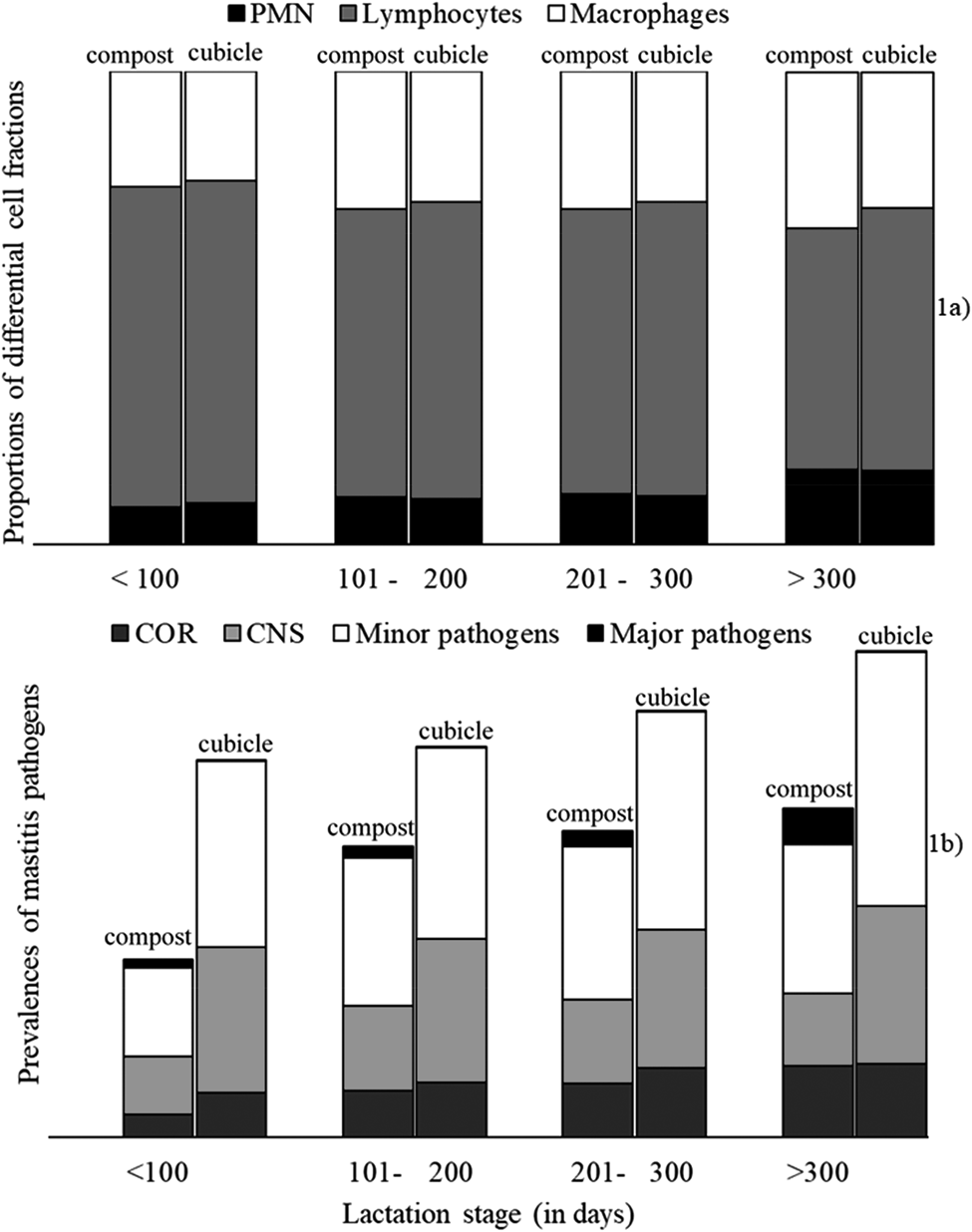
The interaction effect of system and lactation stage was highly significant (P < 0.001) on cell fractions for lymphocytes, macrophages, PMN and the segmented subfraction. The significant interaction indicates that specific cell counts strongly depend on the cow lactation period within the both systems compost and cubicle. Figure 1 shows the least squares means for lymphocytes, macrophages and PMN in response to lactation stage variations in compost and cubicle. The proportion of macrophages increased with increasing days in milk, but the slope differed in compost and cubicle. Regarding the lactation period after 100 d, fractions for macrophages were very similar in cubicle, but steadily increased by lactation stage in compost. Also for PMN, cell fractions increased with increasing lactation stage. In the late lactation beyond 300 d in milk, PMN and the segmented subfraction rapidly increased in both systems. For PMN, the system × lactation stage effect was highly significant (P < 0.001). The segmented subfraction strongly fluctuated by days in milk in both systems. Opposite reactions were observed for lymphocytes, i.e. a decline of cell fractions with increasing lactation stage. The decrease of lymphocytes with increasing days in milk was stronger in compost than in cubicle.
(a) Least squares means for the differential somatic cell fractions lymphocytes, macrophages and polymorphonuclear leukocytes (PMN) from the two production systems compost-bedded pack barns (compost) and conventional cubicle barns (cubicle) depending on lactation stage. (Standard errors for least squares means were in a narrow range from 0.009 to 0.025). (b) Least squares means for prevalences of major pathogens, minor pathogens, Coagulase-negative staphylococci (CNS) and Corynebacterium sp. (COR) from the two production systems compost-bedded pack barns (compost) and conventional cubicle barns (cubicle) depending on lactation stage. (Standard errors for least squares means were in a narrow range from 0.006 to 0.051).

Impact of milk yield level within housing system on differential cell counts
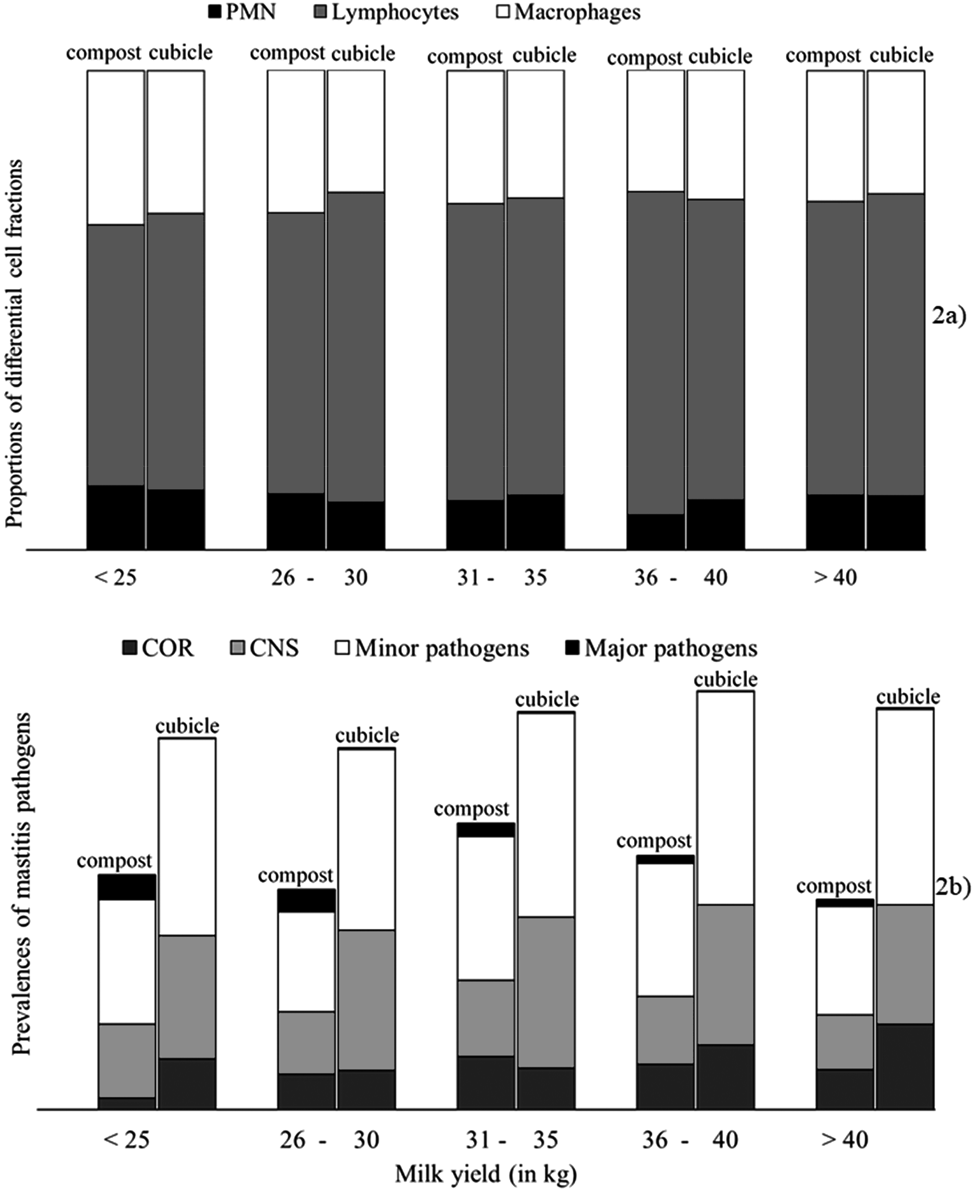
The interaction system × milk yield only was significant for lymphocytes (P < 0.05). The macrophages remained relatively constant in relation to daily milk yield of the cow, in compost between 25.3% (±1.92%) and 32.2% (±1.78%), and in cubicle between 25.5% (±1.55%) and 29.8% (±1.8%) (Fig. 2). The lymphocytes differed slightly between the systems in relation to milk yield. In cubicle, lymphocytes steadily increased up to a milk yield level of 40 kg per day with a maximal value of 68%. In compost, lymphocyte fractions were quite constant with 58% in low yielding cows (<25 kg milk per day) up to 65% in the neighboring milk yield class (25–30 kg milk per day). Percentages for PMN and for the segmented neutrophils varied across milk yield classes and housing systems. Fractions for segmented decreased with increasing milk yield, but increased in the high yielding cows with more than 40 kg milk per day in both systems. The proportions of banded neutrophils varied across all milk yield classes, with different responses in compost and cubicle.
(a) Least squares means for the differential somatic cell fractions lymphocytes, macrophages and polymorphonuclear leukocytes (PMN) from the two production systems compost-bedded pack barns (compost) and conventional cubicle barns (cubicle) depending on cow productivity in milk yield per day. (Standard errors for least squares means were in a narrow range from 0.012 to 0.026). (b) Least squares means for prevalences of major pathogens, minor pathogens, Coagulase-negative staphylococci (CNS) and Corynebacterium sp. (COR) from the two production systems compost-bedded pack barns (compost) and conventional cubicle barns (cubicle) depending on cow productivity in milk yield per day. (Standard errors for least squares means were in a narrow range from 0.01 to 0.045).

Impact of somatic cell count levels within housing system on differential cell counts
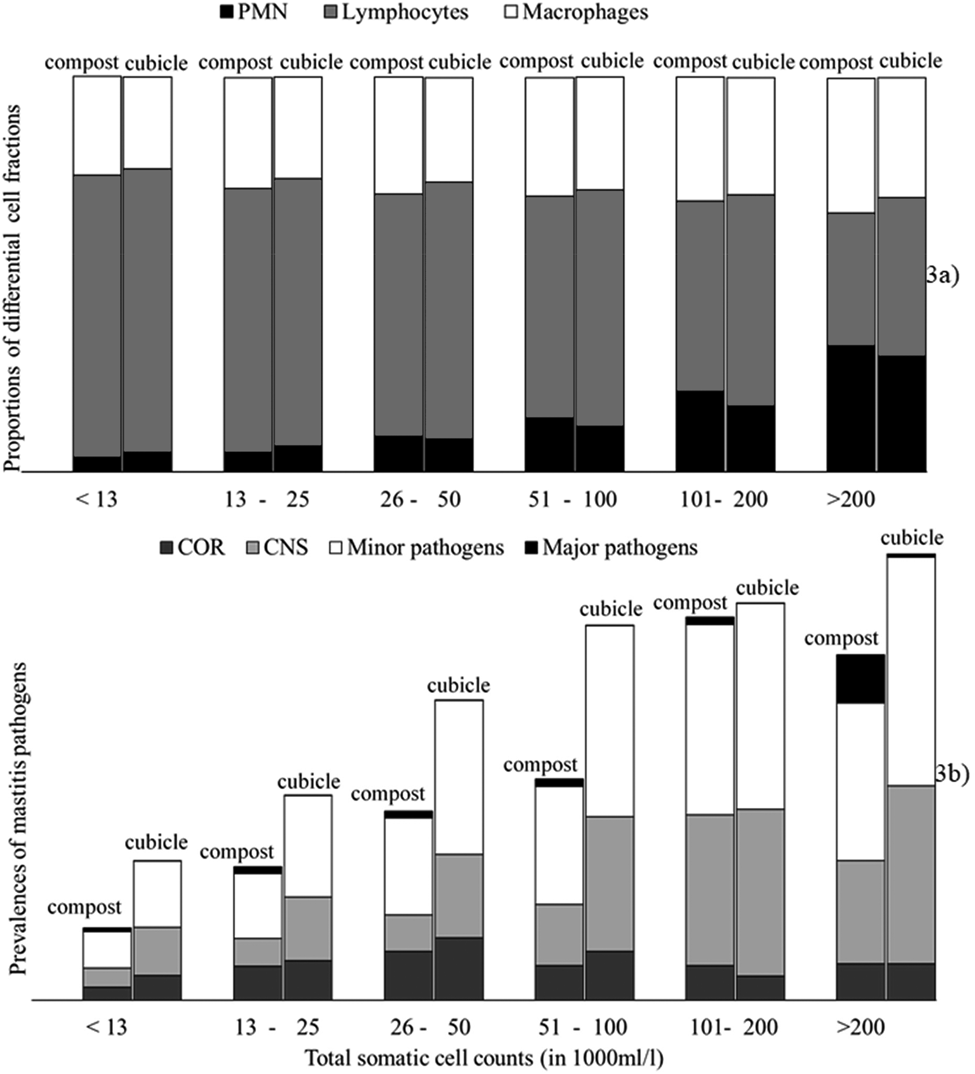
The interaction term, somatic cell count class × system, was highly significant for all cell fractions macrophages, lymphocytes, PMN, segmented and banded neutrophils (P < 0.001). The proportion of lymphocytes decreased with increasing somatic cell count in both systems, in compost from 71.5% (± 1.34%) to 33.7% (±1.97%), and in cubicle from 72% (±1.55%) to 40.2% (±1.83%) (Fig. 3). The proportions of macrophages increased with increasing somatic cell count, with larger percentages (~ plus 2%) of macrophages in compost than in cubicle for all somatic cell count classes. The sub-fractions of PMN (banded and segmented neutrophils) showed a strong increase with increasing somatic cell count, especially when the somatic cell count exceeded 200 000 cells. In most of the somatic cell count classes, proportions for PMN and segmented neutrophils were larger in compost than in cubicle. Fractions for banded neutrophils fluctuated across somatic cell count classes and housing systems.
(a) Least squares means for the differential somatic cell fractions lymphocytes, macrophages and polymorphonuclear leukocytes (PMN) from the two production systems compost-bedded pack barns (compost) and conventional cubicle barns (cubicle) depending on the total somatic cell counts in 1000 ml/l. (Standard errors for least squares means were in a narrow range from 0.008 to 0.021). (b) Least squares means for prevalences of major pathogens, minor pathogens, Coagulase-negative staphylococci (CNS) and Corynebacterium sp. (COR) from the two production systems compost-bedded pack barns (compost) and conventional cubicle barns (cubicle) depending on the total somatic cell counts in 1000 ml/l. (Standard errors for least squares means were in a narrow range from 0.005 to 0.049).

Mastitis pathogens
Least squares means for prevalences of mastitis pathogens in both systems compost and cubicle are given in online Supplementary Table S2 and in Supplementary Table S4 related to lactation stage, cow productivity in milk yield per day and total somatic cell counts in 1000 ml/l. Overall, fewer bacteriologically positive quarters were detected in compost than in cubicle. Among all bacterial species, largest prevalences were identified for CNS (27%) and COR (18%). The system comparison indicated higher prevalences for minor pathogens in cubicle (54.1%) than in compost (35%). Prevalences for CNS were substantially larger in cubicle (36.7%) compared to compost (18.6%). Also, prevalences for COR were larger in cubicle than in compost. Regarding major pathogens, prevalences were generally low with 2.9% in compost and 0.1% in cubicle. We found no significant difference (P > 0.05) between compost and cubicle for AER prevalences, which were on a low level in compost (2.9%) and in cubicle (0.2%). Least squares means for the prevalences of Aesculin hydrolyzing streptococci were 1.13% in compost and 0% in cubicle. The difference was not significant (P > 0.05).
Impact of lactation stages within housing system on mastitis pathogens
The number of bacteriologically negative samples decreased with increasing lactation stage in both systems. The lactation stage had a significant effect on prevalences for COR (P < 0.05) and for minor pathogens (P < 0.01). Least squares means for COR prevalences increased with increasing lactation stage in compost from 5.1% (±1.34%) to 16.2% (±5.1%), and from 10.2% (±2.69%) to 16.5 (±3.87%) in cubicle (Fig. 1). Hence, we observed substantial differences in COR prevalences between both systems during early lactation, but very similar prevalences beyond 300 d in milk, explaining the significant system × lactation stage interaction effect (P < 0.05). Least squares means for CNS only slightly increased by days in milk, from 13.3% (±2.11%) to 16.2% (±3.87%) in compost, and on a much higher prevalence level in cubicle from 32.8% (±4.22%) to 35% (±4.53%). AER and Aesculin hydrolyzing streptococci increased with increasing lactation stage, but their prevalences were quite low. Least squares means for major pathogens increased with increasing lactation stage, in compost from 1.84% (±0.69%) to 8.33% (±0.32%), and in cubicle from 0.14% (±0.23%) to 0.22% (±0.37%).
Impact of milk yield levels within housing system on mastitis pathogens
The interaction term, system × milk yield, did not differ in regard to mastitis pathogens (P > 0.05). The proportion of bacteriologically negative udder quarters was quite constant in compost across milk yield levels, but slightly decreased with increasing milk yield in cubicle. Least squares means for prevalences of minor pathogens and CNS were almost independent from milk yield alterations (Fig. 2), with higher estimates across all milk yield levels in cubicle than in compost. Least squares means for CNS prevalences varied in a narrow range in compost between 13.4% (±3.28%) and 18.5% (±3.38%). In cubicle, CNS prevalences altered between 29.2% (±4.35%) and 36.8% (±4.25%). In both systems compost and cubicle, cows with an average production level in milk yield had the highest CNS prevalences. Least squares means for COR prevalences increased with increasing milk yield in cubicle up to 20.7% (±4.79%), but opposite reactions were observed in compost. Least squares means for AER prevalences substantially increased beyond production levels larger than 40 kg per day in both systems, but displaying higher prevalences in compost. Least squares means for Aesculin hydrolyzing streptococci prevalences were independent from the cow production level, with larger prevalences in compost than in cubicle. Least squares means for prevalences of major pathogens decreased with increasing milk yield in compost from 6.02% (±2.32%) to 1.67% (±1.02%), but were quite constant and close to zero in cubicle.
Impact of somatic cell count levels within housing system on mastitis pathogens
The interaction system × somatic cell count had a significant effect on prevalences for CNS (P < 0.001), COR (P < 0.001), major pathogens (P < 0.001) and minor pathogens (P < 0.001). Least squares means for prevalences of minor pathogens, CNS and major pathogens increased with increasing somatic cell count in both systems compost and cubicle (Fig. 3). Regarding udder quarters with less than 50 000 cells/ml, COR prevalences were higher in cubicle than in compost. Afterward, with increasing somatic cell count, COR prevalences decreased in cubicle, but remained relatively constant (12%) in compost.
Discussion
Cell fractions in housing systems
In our study, the main cell type in both compost and cubicle systems comprised lymphocytes, as previously observed by Dosogne et al. (Reference Dosogne, Vangroenweghe, Mehrzad, Massart-Leën and Burvenich2003) and Schwarz et al. (Reference Schwarz, Diesterbeck, König, Brügemann, Schlez, Zschöck, Wolter and Czerny2011) in conventional farming systems. In contrast, macrophages were the predominant cell fraction in conventional farming systems in the study by Riollet et al. (Reference Riollet, Rainard and Poutrel2001). The proportions of leukocytes in healthy quarters were highly variable in different studies and in different environments (Paudyal et al., Reference Paudyal, Pena, Melendez, Roman-Muniz and Pinedo2018). As reported by Yang et al. (Reference Yang, Ayoub and Rewinski1997) and Paudyal et al. (Reference Paudyal, Pena, Melendez, Roman-Muniz and Pinedo2018), fractions for macrophages and lymphocytes strongly depended on the lactation stage, but as shown in our present study, response pattern can differ between compost and cubicle. Also, the proportion of lymphocytes changed during lactation. In agreement with results by Dosogne et al. (Reference Dosogne, Vangroenweghe, Mehrzad, Massart-Leën and Burvenich2003) and Paudyal et al. (Reference Paudyal, Pena, Melendez, Roman-Muniz and Pinedo2018) in conventional systems, our study indicated a lymphocyte decrease as lactation advanced. In contrast to the previous studies, proportions of macrophages and PMN increased, especially in compost. Fractions for lymphocytes were highest in cows with highest test-day milk yield, confirming results by Paudyal et al. (Reference Paudyal, Pena, Melendez, Roman-Muniz and Pinedo2018), and especially increased with increasing milk yield in compost. The higher bacterial burden in the compost bedding material might trigger immune responses in compost, initiating the circulation of lymphocytes (Derakhshani et al., Reference Derakhshani, Fehr, Sepehri, Francoz, De Buck, Barkema, Plaizier and Khafipour2018). In contrast, fractions for macrophages increased with decreasing productivity. The proportions of PMN were quite constant across milk yield levels in previous studies (see for example Paudyal et al. Reference Paudyal, Pena, Melendez, Roman-Muniz and Pinedo2018), but small PMN fluctuations were observed in the present study, especially in compost. In compost, the bacterial flora showed obvious variations due to the different properties of added materials and cultivation processes (Ferraz et al., Reference Ferraz, Ferraz, Leso, Klopčič, Barbari and Rossi2020). The bedding material can be a primary source of exposure to environmental mastitis pathogens (Ferraz et al., Reference Ferraz, Ferraz, Leso, Klopčič, Barbari and Rossi2020). Ferraz et al. (Reference Ferraz, Ferraz, Leso, Klopčič, Barbari and Rossi2020) reported the highest levels of Klebsiella spp. in flax straw and conifer forest litter, as well as in Miscanthus and spelt husk. However, Klebsiella spp. was not detected in any of our quarter milk samples. Coliforms were detected by Ferraz et al. (Reference Ferraz, Ferraz, Leso, Klopčič, Barbari and Rossi2020) in barley husk, bark mulch, flax straw, wheat husk and barley straw. Black et al. (Reference Black, Taraba, Day, Damasceno and Bewley2013) identified coliforms, Bacillus spp., Staphylococci and Streptococci in the bedding material. However, the occurrence of specific bacteria in the bedding material was unrelated with compost characteristics such as bedding temperature, which complicates the formulation of specific compost management guidelines toward udder health improvements.
Varying bedding materials and the cultivation of the pack may have an impact on PMN fluctuations. The cell fraction PMN has shorter half-life periods than lymphocytes or macrophages, and reacted more sensitive on environmental alterations (Anwer et al., Reference Anwer, Asfour and Gamal2017), possibly explaining the observed differences in PMN fractions between both farming systems compost and cubicle. Independent from the farming system, the count for segmented neutrophils substantially increased with increasing milk production. Such dependencies, i.e. segmented fractions in relation to milk yield, were previously elaborated by Le Maréchal et al. (Reference Le Maréchal, Thiéry, Vautor and Le Loir2011).
Specific mastitis pathogens in housing systems
Overall, cows kept in compost had fewer infected udder quarters (48.9%) compared to cows from cubicle (66.1%). Favorable effects of free access farming systems on bacteriological udder infections were stated by Astiz et al. (Reference Astiz, Sebastian, Fargas, Fernández and Calvet2014) and Eckelkamp et al. (Reference Eckelkamp, Taraba, Akers, Harmon and Bewley2016), and especially in compost, lower incidences for clinical mastitis were observed. Eckelkamp et al. (Reference Eckelkamp, Taraba, Akers, Harmon and Bewley2016) detected different bacteria species in specific housing systems. In the present study, we excluded cows with severe clinical mastitis and antibiotic treatments, causing potential biases in pathogen prevalences. Nevertheless, due to the implementation of mastitis prevention programs in the past two decades, minor pathogens are of greater importance in well-managed farms than major pathogens, as shown in the present study and by Tenhagen et al. (Reference Tenhagen, Köster, Wallmann and Heuwieser2006) and Piessens et al. (Reference Piessens, van Coillie, Verbist, Supré, Braem, van Nuffel, de Vuyst, Heyndrickx and de Vliegher2011). Furthermore, field tests have shown that quarters infected with COR as a minor pathogen were partly resistant against major pathogens due to an intensified stimulation of the immune system (Sordillo et al., Reference Sordillo, Doymaz, Oliver and Dermody1989). Prevalences for CNS differed between compost and cubicle, confirming that the occurrence of CNS positive udder quarters are highly dependent on housing system characteristics and the type of bedding (Supré et al., Reference Supré, Haesebrouck, Zadoks, Vaneechoutte, Piepers and de Vliegher2011; Condas et al., Reference Condas, de Buck, Nobrega, Carson, Naushad, de Vliegher, Zadoks, Middleton, Dufour, Kastelic and Barkema2017). As previously shown by Schukken et al. (Reference Schukken, González, Tikofsky, Schulte, Santisteban, Welcome, Bennett, Zurakowski and Zadoks2009), the number of COR increased with increasing cow lactation stage in both systems compost and cubicle.
Cows producing more than 40 kg milk per displayed the highest prevalence for AER, which invade through the teat canal. Galama et al. (Reference Galama, de Boer, van Dooren, Ouweltjes and Driehuis2015) indicated that heat-resistant compost bacteria may also enter into the udder, complicating ongoing milk processing. Nevertheless, among the different species from Bacillus spp., only Bacillus cereus causes mastitis (Bergmann and Seffner, Reference Bergmann, Seffner, Wendt, Bostedt, Mielke and Fuchs1994). Recently, Giambra et al. (Reference Giambra, Jahan, Yin, Engel, Weimann, Brügemann and König2021) investigated compost and milk samples, but they could not detect Bacillus cereus in bulk tank milk. Interestingly, the number of bacteriologically negative quarters decreased with increasing milk yield in cubicle, but increased in compost. The combination of a good hygiene management and animal welfare in compost has positive impact on the udder health of physiologically (production-related) stressed cows.
Cell fractions and specific mastitis pathogens: possible associations
An exclusion of negative bacteriological results from the dataset implied a small increase of proportions for banded neutrophils, with 1.6% in cubicle and 1.5% in compost. In contrast, proportions of segmented neutrophils were larger in compost than in cubicle, especially for increasing SCC levels. Hence, cell fraction responses in both systems differed in relation to the overall infection status and farming system particularities. Larger levels for banded neutrophils in cubicle than in compost for a somatic cell count exceeding 200 000 cells indicate strong inflammatory reactions due to the pathogens in cubicle systems (Paape et al., Reference Paape, Bannerman, Zhao and Lee2003). Physiologically, an increase of banded neutrophils implies that the number of immature band cells released from the bone marrow is larger than the demand in body and udder tissue (Sellon, Reference Sellon, Reed, Bayly and Sellon2004). The type of pathogen species influences the increase of specific cell fractions and of somatic cell count. In this regard, different CNS species induce different mechanisms within the immune system, with specific impact on somatic cells. Some of the CNS species (e.g. Staphylococcus chromogenes, Staphylococcus simulans) induce an increase in somatic cell count similarly to Staphylococcus aureus and are more pathogenic than other species of the CNS group (Supré et al., Reference Supré, Haesebrouck, Zadoks, Vaneechoutte, Piepers and de Vliegher2011; Condas et al., Reference Condas, de Buck, Nobrega, Carson, Naushad, de Vliegher, Zadoks, Middleton, Dufour, Kastelic and Barkema2017).
In conclusion, different udder health indicator traits depended on specific environmental (farm) characteristics, with different responses in combination with cow associated factors such as lactation stage and milk yield levels. In cubicle, a stronger acute immune response to mastitis pathogens was shown by higher proportions of segmented neutrophils in milk. The number of bacterial positive quarters was lower in compost than in cubicle, as suggested in our hypothesis. Compost was associated with a significantly lower prevalence of minor pathogens. Especially environmentally associated mastitis pathogens depend on milking hygiene and barn management including a dry lying surface and ventilation of the compost material. Based on the results from the present study and according to Lobeck et al. (Reference Lobeck, Endres, Janni, Godden and Fetrow2012) and Leso et al. (Reference Leso, Barbari, Lopes, Damasceno, Galama, Taraba and Kuipers2020), it is imperative to apply specific mastitis prevention strategies adapted to the housing system characteristics and individually to each farm. Ongoing studies associating compost characteristics with cow milk criteria and udder health are imperative in this regard.
Supplementary material
The supplementary material for this article can be found at https://doi.org/10.1017/S0022029921000844.
Acknowledgements
The authors gratefully thank the Federal Ministry of Food and Agriculture for supporting the research project ‘FREEWALK’, part of the European Union's Horizon 2020 Research & Innovation Programme with grant agreement no. 696231.