On February 29, 2020, as the potential severity of the COVID-19 pandemic was coming into focus, the Surgeon General of the United States, Jerome Adams, sent a tweet: “Seriously people—STOP BUYING MASKS! They are NOT effective in preventing general public [sic] from catching #Coronavirus” (Asmelash Reference Asmelash2020). The message was intended to protect the supply of masks for frontline public health workers, but downplaying the benefits of mask wearing was a mistake. By April, the Centers for Disease Control (CDC) was encouraging widespread mask use (Centers for Disease Control 2020) and, by the summer, evidence for the public health benefits was overwhelming. However, adherence to masking protocols was mixed. Republican leaders—most notably President Donald Trump—failed to support masking. Right-wing cable news networks embraced mask skepticism as well; as a result, Republicans in the electorate encountered little information about masking to countervail the partisan cues they received from trusted sources. How much damage might have been avoided with a disciplined and centralized information campaign to explain how masks work to stop viral spread? This article demonstrates that such information might have made a significant difference in Republicans’ understanding of and disposition toward masking.
As of July 2020, Republican officials in Washington, DC, and many state capitals were hostile to masking. Pro-mask information, it was clear, had to come from elsewhere. It is within this context that we began to work with a local television station to produce public service announcements (PSAs) that explain how face masks combat COVID-19 and encourage their use. To inform our approach, we used data from original public opinion surveys that we conducted in April and June. These data revealed that most Americans lacked basic knowledge about how masking worked to slow viral spread. In addition, our survey work identified the groups that were most resistant to mask wearing—namely, Republicans and those skeptical of scientific experts—and the people and institutions they liked best. Armed with this information, we worked with the station’s creative team to devise messaging strategies, choose messengers, and produce content for two 30-second spots.
This article examines whether our PSAs were effective in encouraging people to use face masks. We found that the PSAs successfully pierced political predispositions and induced greater compliance with public health advice. These results illustrate the constructive role that political scientists can play against a backdrop of a politicized crisis: they can apply their theoretical understanding of mass behavior to craft messages that have appeal across lines of political division. Our work provides a roadmap for how scholars can work with governments and media to address pressing public concerns.
Our work provides a roadmap for how scholars can work with governments and media to address pressing public concerns.
THEORETICAL EXPECTATIONS
During the COVID-19 pandemic, masking emerged as a low-cost and easy way to slow the spread of the virus while allowing some in-person activities to occur (Ebbs and Salzman Reference Ebbs and Salzman2020). Many state and local governments across the United States issued masking mandates (ABC11 2020). Yet, compliance was mixed. News stories and social media were filled with accounts of Americans who objected to the practice—sometimes in heated or violent episodes (Hill Reference Hill2020). Politics was at the core of at least some of the resistance. President Trump spoke derisively of masking, and Republican elected officials followed his lead (Berman Reference Berman2020). Predictably, leader behavior affected public opinion (Lenz Reference Lenz2012). According to a late-June survey from the Pew Research Center (2020), 23% of Republicans stated that masks should “rarely” or “never” be worn in public places, compared to only 4% of Democrats. Resistance to masking from those on the political right was not inevitable. For example, European countries experienced relatively high levels of compliance with mask mandates across the political spectrum (Gehrke and Furlong Reference Gehrke and Furlong2020). Therefore, our goal was to determine whether carefully designed PSAs could increase support for mask wearing in the United States.
We designed two PSAs. The first was informed by results from previous survey work suggesting that many Americans lacked knowledge about COVID-19. Therefore, our first PSA used an animated-cartoon whiteboard to inform viewers that masks decrease the amount of infectious particles that a person inhales and exhales. In addition, the PSA informed viewers that wearing a mask would accelerate the reopening of restaurants, movie theaters, and sporting events. This approach—providing information—is the “bread and butter” of public health messaging strategy (Vraga and Bode Reference Vraga and Bode2017). For this reason, we refer to it as the Generic PSA.
The second PSA featured a military source, for two reasons. First, people tend to be most influenced by high-credibility sources (Druckman Reference Druckman2001; Lupia and McCubbins Reference Lupia and McCubbins1998; van der Meer and Jin Reference van der Meer and Jin2020). The US military is reliably one such source. One study spanning three decades of trust measures found that the military regularly receives higher levels of trust than other major political institutions (Gronke and Cook Reference Gronke and Cook2007).Footnote 1 Second, citizens pay particular attention to sources that are unexpected, novel, or counter-stereotypical (Baker and Petty Reference Baker and Petty1994; Maheswaran and Chaiken Reference Maheswaran and Chaiken1991; Rahn Reference Rahn1993). A military source meets this description because public health is not the typical purview of the armed forces. Additionally, the military is associated with the political right and mask wearing met the strongest resistance from Donald Trump and other right-leaning partisans. To create the military PSA, we worked with Hugh Shelton, a retired four-star general and Chairman of the Joint Chiefs of Staff. General Shelton recorded a video in which he characterized masking as a way to “protect our great nation” and then wore a mask himself. We labeled this message the Shelton PSA.
We used the PSAs to ask three research questions. First (RQ1), did our PSAs successfully increase support for masking policies? Second (RQ2), is a message from a novel source especially effective compared to the usual approach to public health information campaigns? Third (RQ3), to what extent does PSA effectiveness depend on attributes of the message recipient?
This article explores four ways in which PSAs might affect subgroups differently. The first way is partisanship. The increasing partisan divide on mask wearing attracted us to this work. Not only was it important to boost lagging Republican attitudes about masks, the fact that Republicans were more skeptical than Democrats also left more room to influence them. A second source of heterogeneity is concern about the virus. People who are more concerned about becoming infected may be more susceptible to messaging about how to prevent infection. A third source of variation is confidence in scientific expertise. People with a low level of confidence in the scientific community are more skeptical about masks, so they may have more room to be influenced, especially by the military messenger who is not a traditional scientific expert. Fourth, people with higher levels of confidence in the US military may be especially influenced by the PSA with a military messenger.
RESEARCH DESIGN
We designed two studies. Study 1 was a field study in collaboration with the Raleigh, NC–based television station WRAL. From July 1 through July 20, 2020, WRAL (and its jointly owned sister station, WRAZ) ran our PSAs more than 400 times during local news, local syndicated programming (e.g., Family Feud and Access Hollywood), and other local advertising blocs, with at least one PSA airing during every local newscast throughout the study period.
To assess the extent to which WRAL messaging increased the willingness to wear a face mask, we contracted with Qualtrics to survey WRAL’s central North Carolina media market. Because the General Shelton PSA was designed to appeal to Republicans, we aimed to limit our data collection to individuals who, in Qualtrics’ panel information, identified as either Republicans or as Independents who lean toward the Republican Party. We successfully collected 1,189 complete responses, of which 978 (82.3%) were Republican identifiers or leaners. All analyses for Study 1 were limited to these Republican identifiers and leaners.Footnote 2 The survey was in the field from July 22 through August 10, 2020. Table SI-1 in the online appendix reports the demographics of our sample.
Respondents were presented with three items that gauged their attitude toward masking protocols: whether masks (1) are important to stop the spread of coronavirus, (2) lower the chance of contracting coronavirus from another person, and (3) lower the chance of spreading coronavirus to another person. These questions—particularly the second and third—measure objective knowledge about masking. However, at the time that we fielded our studies, the underlying facts were contested, and these disputes were the locus of the public debate over masking (Godoy Reference Godoy2020). For this reason, we conceptualized these items jointly as capturing respondents’ attitudes toward masking. Both of our PSAs addressed these matters—for instance, General Shelton stated, “I wear a mask to protect you. You wear a mask to protect me.” Therefore, these items also are indicative of the extent to which respondents accepted (or rejected) arguments to which they were exposed. They loaded onto a single factor (i.e., all loadings above 0.69; Cronbach’s alpha = 0.88). We averaged them, scaled them from 0 to 1, and used the resulting construct as the main dependent measure in Study 1.
Study 1 also included a behavioral measure of mask support. We asked respondents how often they wear a mask outside of the home in situations where they could not be socially distanced, with response options ranging from “never” to “always.” We expected this item to complement those described previously. On the one hand, it was more objective—affirmative responses were less likely to be “mere talk.” On the other hand, behavior can diverge from attitudes. For instance, a person might hate masks and think they are ineffective but still wear one on a daily basis because an employer requires it. As it turns out, the behavioral item was strongly correlated with the summary attitude scale (r=0.63). Moreover, as the following results show, our PSAs influenced both outcomes in similar ways.
We measured exposure to the WRAL PSAs after measuring the outcome—a design choice intended to avoid influencing the outcome measures by bringing public health messaging to mind. First, respondents were asked whether they remembered seeing in the past few weeks any PSAs on television stating that they should wear a face mask. Those who responded “No” skipped the next section of the survey and were coded as having no ad exposure in the subsequent analyses.
Those who responded “Yes” or “Unsure” were presented with images that appeared to be screen captures from four distinct PSAs (presented in random order). Two of the screen captures were genuine captures from the ads that aired on WRAL. The other two were fake screen captures that we created to distinguish genuine recall from false recall and thereby address acquiescence bias. Ad penetration was modest: 11.3% of respondents were certain that they recalled seeing the Shelton PSA and 6.2% recalled seeing the Generic PSA. Respondents also exhibited false memories of the two decoy ads. Specifically, 4.9% were certain they saw the animated decoy and 8.7% recalled seeing the mask-wearer decoy PSA. For all four ads, if respondents reported seeing the ad, we asked them about how many times they saw it, with options ranging from “just once” to “more than 10 times.” From these responses, we constructed an exposure variable for each ad that ranged from 0 (i.e., respondents were certain that they did not see the ad) to 1 (i.e., respondents were certain that they saw the ad more than 10 times). Figure SI-1 in the online appendix reports the distribution of these variables.Footnote 3
Study 2 extended the analysis to a diverse national sample. We recruited 2,400 Americans via Qualtrics, matching US Census benchmarks for age, race, gender, and education. Respondents were recruited as part of Wave 3 of a multi-wave, multi-investigator project focused on political developments related to the COVID-19 pandemic. Of the total respondents, 46% had participated in a prior survey wave. Wave 3 was in the field from September 8 to September 29, 2020, and included unrelated questions that were used for other studies. Study 2 occurred about six weeks after Study 1, by which time arguments for and against masking had promulgated more thoroughly through the general public. Consequently, attitudes and behaviors about masks were likely solidifying as masking became increasingly partisan. This should have made it more difficult for the PSAs to have the intended effect than in Study 1 (Linos and Twist Reference Linos and Twist2018).Footnote 4
Respondents in Study 2 were randomly assigned to one of three conditions: they were shown the Generic PSA, the Shelton PSA, or no video. We asked all respondents the same three attitudinal measures as in Study 1: whether masks (1) are important for stopping the spread of coronavirus, (2) lower the chance of spreading the coronavirus, and (3) lower the chance of contracting the coronavirus. We analyzed these items individually and averaged them into a scale (i.e., ranging from 0 to 1, alpha=0.89).
RESULTS
This section presents results from the two studies.
Study 1
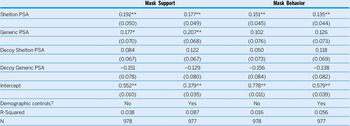
Table 1 reports ordinary least squares models in which measures of support for masking, as well as compliance with masking guidelines, were regressed on measures of exposure to the PSAs. Results in the first two columns suggest that both PSAs increased support for masking protocols, with effects from approximately 15% to 20% of the range of the dependent measure. In other words, our PSAs made Republicans more likely to understand that masks stop the spread of coronavirus and lower the chances of contracting coronavirus from another person and spreading it to another person.
PSA Exposure Predicts Support for Masking Among Republicans (Study 1)

Notes: Robust standard errors are in parentheses. **p<0.01, *p<0.05, two-tailed. Analysis includes self-identified Republicans and Republican leaners. (See the online appendix for analysis of the remaining respondents.) Exposure variables are scaled from 0 (certain did not see an ad) to 1 (certain saw the ad more than 10 times). Dependent variables also are scaled from 0 to 1, with high values representing greater support for masking.
The third and fourth columns of table 1 suggest that the PSAs also increased self-reported masking behavior, with effects ranging from 10 to 15 percentage points on the dependent-variable scale. Yet, it is notable that whereas the effect of the Shelton PSA was statistically significant, the relationship for the Generic PSA was not (at p<0.05) despite its large parameter estimates. The lower-estimate precision is likely attributable to the fact that only about half the number of people (6.2%) reported seeing the Generic PSA as those reported seeing the Shelton PSA (11.3%).
Table 1 results suggest that PSAs increased attitudinal support for masking (RQ1) and for self-reported masking behavior, with the caveat that the relationship between exposure to the Generic PSA and compliance with masking behavior was not statistically significant (at p<0.05). The estimated relationship for the Shelton PSA was larger than for the Generic PSA in three of four models, but the two coefficients were never statistically distinguishable from one another (using Wald tests, all p>0.63). Thus, we did not find strong evidence that a PSA with a novel source was more effective than a more generic message (RQ2).
Study 2
Study 1 examined PSA effects in a naturalistic context. However, PSA reception was not randomly assigned. An unmeasured variable correlated with ad recall could explain the relationships we observed. Additionally, Study 1 focused on Republicans and included limited additional information about the respondents; therefore, we were not well positioned to compare how message effects differ among subgroups. Study 2 addressed both limitations.
Table 2 reports treatment effects. Again, we found strong support for the most important of our hypotheses—namely, that both ads significantly increased respondents’ belief that wearing masks is important and that masks lower the chances of contracting the coronavirus and spreading it to others. This is further evidence that the PSAs increased mask compliance (RQ1). The more traditional approach to PSAs—that is, providing people with straight information—appears to have a more significant effect than the novel messenger General Shelton. The effect size for the Generic PSA was significantly larger than for the Shelton PSA in two of three models (by Wald tests, p=0.53, 0.007, 0.04). This is tentative evidence that—contrary to expectations—a novel PSA was less effective than a generic PSA (RQ2). Regardless, both PSAs boosted pro-masking attitudes by about 4 and 7 percentage points, respectively.
Main Treatment Effects (Study 2)

Notes: Robust standard errors are in parentheses. **p<0.01, *p<0.05, two-tailed. Cell entries are differences in means between each treatment condition and the control condition. Dependent measures are scaled from 0 (low mask support) to 1 (high mask support). All analyses include 2,400 respondents. The Mask Scale is a simple average of the other three items.
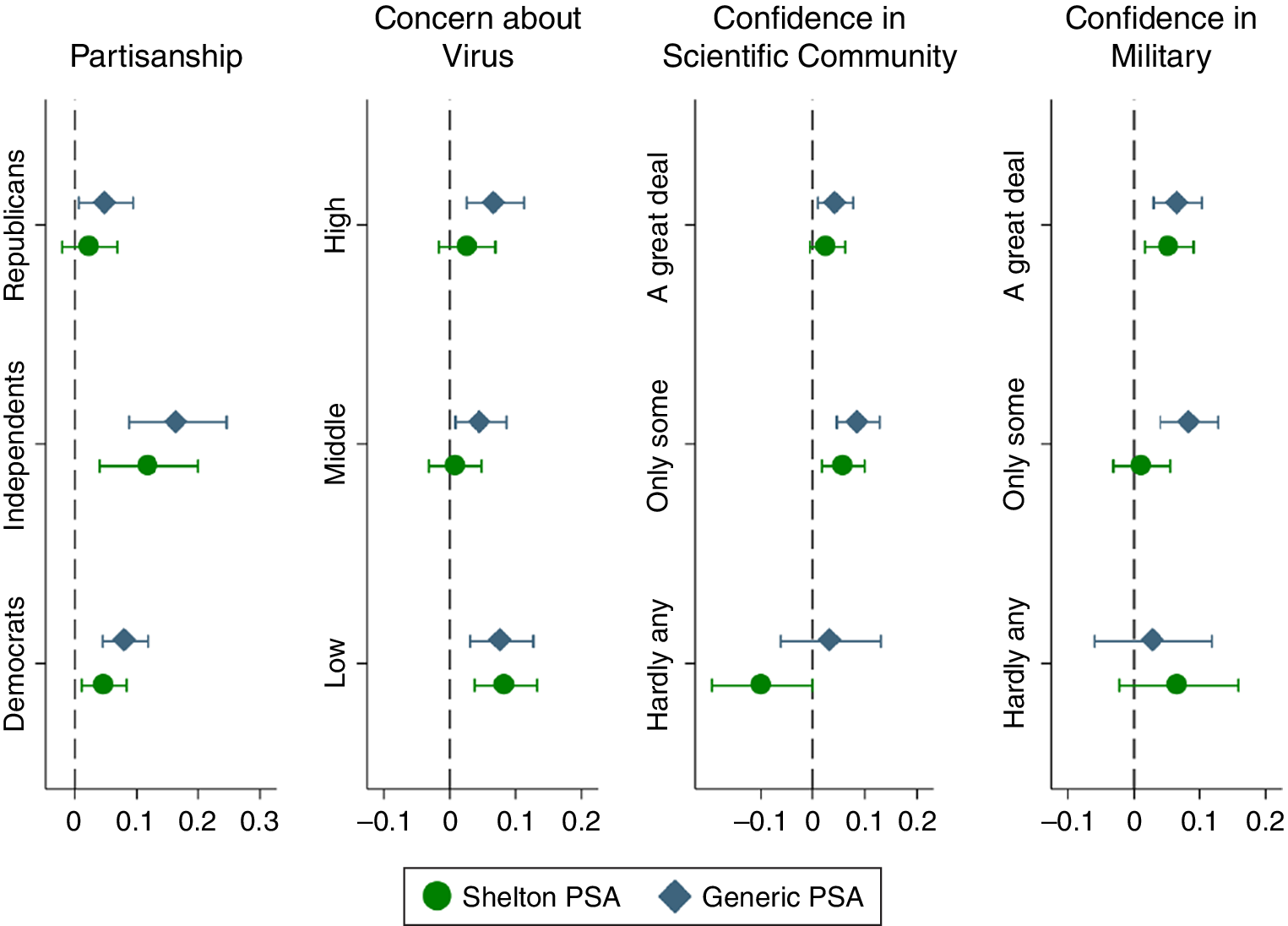
To address RQ3, figure 1 examines four types of potential treatment heterogeneity. Both PSAs appear to have influenced political independents more than partisans, which runs counter to expectations that Republicans would be most susceptible to influence. However, these results could be explained by the increasing partisan divide on masking. Study 2 was fielded in September 2020, when party cues on masking had become very clear: Democrats embracing them and Republicans dubious about them. These clear cues should make it more difficult for new information to move partisans, as opposed to Independents, who are less connected to those cues. In deriving our expectations ex ante, we conflated the importance of persuading Republicans with the ease of doing so.
Treatment Effects in Subgroups (Study 2)
The dependent variable is the summary Mask Scale. Dots represent differences in means between randomly assigned groups and the control condition. Whiskers represent 95% confidence intervals. Independents who stated that they lean toward one party or the other were coded as partisans.

Figure 1 suggests that the PSAs were not more effective among people with high concern about the coronavirus than those with low concern, which is contrary to our expectations. The Generic PSA was equally successful across all concern groups, whereas both PSAs increased mask support among people who expressed less concern about becoming seriously ill from the coronavirus. The positive impact of both PSAs on those with the least concern is substantively useful. It provides tentative evidence that the PSAs can affect the opinion of those who otherwise might be least likely to wear masks. For confidence in science, the PSAs had a positive influence on both those with high and moderate levels but were less effective among people with “hardly any” confidence. Moreover, there is evidence that the Shelton PSA backfired among people with low confidence in science (effect=-0.097, standard error=0.049, p=0.05). However, people with low confidence in the scientific community represented a small proportion of our sample (7.0%).
Finally, we had hoped that the Shelton ad would leverage the very high levels of confidence in the military that exist in the United States. A majority of our respondents (53.2%) professed a “great deal” of confidence in the military, which is higher by far than any other government institution. As expected, the Shelton PSA had a statistically reliable effect on those with high levels of confidence in the military. Yet, the Generic PSA also increased support for masks among those in this group; therefore, we cannot infer that the targeted novel messenger PSA was more effective. Fortunately, both PSAs were effective in this large group of Americans.
DISCUSSION
Using a field study and a randomized experiment, we demonstrate that PSAs are effective for inducing people to follow public health advice. These results highlight promising avenues for successful health communication against a backdrop of profound political polarization. Mask wearing in the United States became so politicized that when a strained relationship developed between an apolitical actor like Dr. Anthony Fauci (i.e., Director of the National Institute of Allergy and Infectious Diseases) and President Trump, conservatives began to dismiss Dr. Fauci’s advice as a result (Collinson Reference Collinson2020). There also has been evidence that CDC recommendations were subjected to political pressure (Mazzetti, Weiland, and LaFraniere Reference Mazzetti, Weiland and LaFraniere2020). Against this dysfunctional backdrop, we show that nonpolitical messages successfully changed the views of Democrats, Republicans, and Independents.
These results highlight promising avenues for successful health communication against a backdrop of profound political polarization.
We did not find evidence that a novel message source (i.e., a retired general) was more effective than a generic message about the benefits of masking. One possible interpretation is that novel message sources (e.g., retired generals) have their greatest effect among specific audiences that are delineated in more detail than we could accomplish in our survey. Another way to interpret our results is that generic messages can be a powerful tool to reach a broad audience. These nuances should be explored in future research.
Broad compliance with public health measures is essential during a pandemic, and our results affirm the importance of PSA campaigns. Our strategy can be replicated and adapted to different communities and to the changing needs of the pandemic. For example, at the time of writing, the willingness to be vaccinated was the next major struggle for compliance with public health measures. Carefully designed PSAs likely would work on that issue as well. Our research makes a strong case for the ongoing use of PSAs—as informed by social science—in combating COVID-19 as well as any future pandemics.
Our strategy can be replicated and adapted to different communities and to the changing needs of the pandemic.
Hopefully, political scientists will follow our lead in offering solutions to future challenges that become mired in politics. A generation ago, it would have seemed unimaginable that partisanship would divide Americans in how best to confront a global health crisis, yet it has emerged as the deepest line of disagreement (Gadarian, Goodman, and Pepinsky Reference Gadarian, Goodman and Pepinskyforthcoming)—a pattern that shows no sign of abating. The unfolding climate-change crisis and mounting threats to democracy are only two other examples of global problems for which our discipline’s collective expertise may prove valuable. Our research for this study makes the case that political science can have a positive impact on real-world problems.
ACKNOWLEDGMENTS
The authors thank Joel Davis, Heather Gray, and John Gilliam at WRAL for working with us to produce and air the PSAs. The PSAs would never have been possible without the cooperation and participation of General Hugh Shelton (Ret.). We also thank Abby Cassario for research assistance. Funding for this project came from the generous support of the North Carolina Policy Collaboratory and the Raymond H. Dawson Bicentennial Chair. Replication files are available by consulting Greene et al. Reference Greene, Hetherington, Maxwell and Ryan2021.
DATA AVAILABILITY STATEMENT
Research documentation and data that support the findings of this study are openly available at the PS: Political Science & Politics Harvard Dataverse at https://doi.org/10.7910/DVN/XDXYPT.
SUPPLEMENTARY MATERIALS
To view supplementary material for this article, please visit http://dx.doi.org/10.1017/S1049096521001086.