Introduction
The period of deviation from a patient's previous experience and behavior that precedes the development of florid psychotic features is commonly referred to as a prodrome (Beiser et al. Reference Beiser, Erickson, Fleming and Iacono1993). During the prodrome, changes in behavior and subjective experience are noticed by the individuals themselves and/or close family and friends. These prodromal symptoms are usually contiguous with the onset of psychosis. Identifying prodromal symptoms can provide an opportunity for early intervention (Yung et al. Reference Yung, McGorry, McFarlane, Jackson, Patton and Rakkar1996). In addition, some patients experience behavioral and emotional changes well before the prodrome. These are not necessarily contiguous with the onset of psychosis and may spontaneously resolve for long periods prior to the onset of similar changes that then progress to psychosis (Gross & Huber, Reference Gross and Huber1996; Yung & McGorry, Reference Yung and McGorry1996; Norman et al. Reference Norman, Scholten, Malla and Ballageer2005). A better understanding of these pre-prodromal and prodromal changes (hereon, collectively referred to as early signs and symptoms) could well advance our knowledge of the etiology, psychopathology, and prognosis of psychotic disorders (Gourzis et al. Reference Gourzis, Katrivanou and Beratis2002; Norman et al. Reference Norman, Scholten, Malla and Ballageer2005).
Early signs and symptoms often include social withdrawal, mood and anxiety disturbances, psychobiological changes (e.g. sleep disturbance), role impairments, and psychotic-like symptoms (Yung & McGorry, Reference Yung and McGorry1996; Hafner, Reference Hafner2000; Tan & Ang, Reference Tan and Ang2001; Meyer et al. Reference Meyer, Bearden, Lux, Gordon, Johnson, O'Brien, Niendam, Loewy, Ventura and Cannon2005; Norman et al. Reference Norman, Scholten, Malla and Ballageer2005; Svirskis et al. Reference Svirskis, Korkeila, Heinimaa, Huttunen, Ilonen, Ristkari, McGlashan and Salokangas2005). Although there is considerable convergence in frequently reported early signs and symptoms across studies, few studies have attempted to examine their underlying factor structure. The association between early signs and symptoms and the later course of psychotic disorders has often been emphasized (Vaglum, Reference Vaglum1996; Yung & McGorry, Reference Yung and McGorry1996; Hafner, Reference Hafner2000; Gourzis et al. Reference Gourzis, Katrivanou and Beratis2002; Norman et al. Reference Norman, Scholten, Malla and Ballageer2005). However, there is still no clear understanding of whether early signs and symptoms are predictive of subsequent diagnostic trajectories.
The points of departure for the present study emerge from two studies that have examined the factor structure of reported early signs and symptoms, one in an ultra-high-risk sample (Hawkins et al. Reference Hawkins, McGlashan, Quinlan, Miller, Perkins, Zipursky, Addington and Woods2004) and another in a first-episode sample (Norman et al. Reference Norman, Scholten, Malla and Ballageer2005). Using the Scale of Prodromal Symptoms, Hawkins et al. (Reference Hawkins, McGlashan, Quinlan, Miller, Perkins, Zipursky, Addington and Woods2004) reported a three-factor structure including positive symptoms, negative symptoms and general distress. As their study sample comprised only individuals at ultra-high risk for psychosis, Hawkins et al. could not investigate associations between these pre-psychotic factors and symptom presentation upon onset of psychosis. Norman et al. (Reference Norman, Scholten, Malla and Ballageer2005) examined early signs and symptoms retrospectively reported by 96 first-episode non-affective psychosis patients. Five factors were identified: dysphoria and odd perceptual and cognitive content, impaired functioning, psychobiological changes, suspiciousness and concentration difficulties, and irritability. Norman et al. found some continuity in content between pre-psychotic factors and symptom factors subsequent to the onset of psychosis. Given the absence of affective psychotic patients in their sample, Norman et al. could not establish whether pre-psychotic factors predicted that the psychosis would be non-affective or affective.
Studies including only schizophrenia-spectrum and mixed schizophrenia-spectrum and affective samples have found similar factor structures (Kitamura et al. Reference Kitamura, Okazaki, Fujinawa, Yoshino and Kasahara1995; Maziade et al. Reference Maziade, Roy, Martinez, Cliche, Fournier, Garneau, Nicole, Montgrain, Dion and Ponton1995; Peralta et al. Reference Peralta, Cuesta and Farre1997). Thus, what appears to distinguish different psychotic illnesses is the relative strength of different factors and not the presence of specific factors themselves. It has been determined that the relative weighting of factors distinguishes diagnostic trajectories in both first-episode (McGorry et al. Reference McGorry, Bell, Dudgeon and Jackson1998; McClellan et al. Reference McClellan, McCurry, Speltz and Jones2002) and later (Maziade et al. Reference Maziade, Roy, Martinez, Cliche, Fournier, Garneau, Nicole, Montgrain, Dion and Ponton1995; Peralta et al. Reference Peralta, Cuesta and Farre1997) stages of psychosis. However, to our knowledge, no study has directly examined whether these differences in severity of factors emerge well before the onset of psychosis, and determine diagnostic trajectories.
There is some support for the general proposition that trajectories of affective and non-affective psychoses develop relatively early. A three-person case study by Thompson et al. (Reference Thompson, Conus, Ward, Phillips, Koutsogiannis, Leicester and McGorry2003) observed that the prodrome in bipolar disorder is marked by depressive symptoms. In an ultra-high-risk sample, Amminger et al. (Reference Amminger, Leicester, Yung, Phillips, Berger, Francey, Yuen and McGorry2006) found that conversion to affective psychosis was associated with depression and negative symptoms at baseline. There are also reports of differences in age of onset and duration of untreated psychosis between non-affective and affective psychoses (Amminger et al. Reference Amminger, Leicester, Yung, Phillips, Berger, Francey, Yuen and McGorry2006; Compton et al. Reference Compton, West and Olfson2006).
To summarize, there is a gap in our understanding of the factor structure underlying early signs and symptoms and its implications for future illness course. The relative strength of factors based on early signs and symptoms may hold part of the key to future diagnostic trajectories. However, this idea has received little attention thus far.
The current study sought to address these gaps. Applying a factor analytic approach to a larger, independent sample of both non-affective and affective psychoses, we built upon the study by Norman et al. (Reference Norman, Scholten, Malla and Ballageer2005). Our main hypothesis was that factor profiles based on early signs and symptoms would distinguish non-affective from affective psychosis. The study also investigated associations between factors characterizing the pre-psychotic phase and key variables reflecting illness trajectory such as duration of untreated illness and substance abuse prior to the onset of psychosis.
Method
Setting
This study was carried out at the Prevention and Early Intervention Program for Psychoses (PEPP) in Montreal, Quebec, Canada. PEPP is a specialized program providing assessment and treatment services to individuals aged between 14 and 30 years presenting with a first episode of psychosis. PEPP serves a defined large urban catchment area of Douglas Hospital (affiliated to McGill University). As there is no other first-episode program serving this catchment and no alternative facilities available privately in the Canadian system of mental health care, our sample is very close to a treated incidence sample.
Criteria for admission
Referrals to PEPP are taken from a range of sources, including hospital emergency service, general practitioners and other primary care services, families/caregivers and young people themselves. Patients are accepted if they meet the following criteria: 14–30 years old, diagnosis of a psychotic disorder (non-affective or affective), and previous antipsychotic therapy for no more than 1 month. Exclusion criteria include IQ below 70, a history of organic mental disorder such as epilepsy, substance-induced psychosis, and an inability to speak either English or French.
Instruments and assessment
All patients provided informed consent prior to participation in any research assessments. Primary and secondary diagnoses were established using the Structured Clinical Interview for DSM-IV (SCID; First et al. Reference First, Spitzer, Gibbon and Williams1997), which was conducted within the first month of entry into PEPP by trained staff and followed by a consensus between two senior psychiatrists (A.M. and R.J.).
Early signs and symptoms were determined by administering the Circumstances of Onset and Relapse Schedule (CORS; Norman et al. Reference Norman, Scholten, Malla and Ballageer2005; Malla et al. Reference Malla, Norman, Schmitz, Manchanda, Bechard-Evans, Takhar and Haricharan2006). The CORS is a semi-structured interview that provides information regarding lifetime history of illness prior to the onset of the presenting psychotic episode.
The CORS was conducted by trained interviewers within 1 or 2 months of entry into the program. Interviews were generally conducted with patients and a family member who had the most contact with the patient. In addition, information was systematically collected from medical records and other sources to estimate the following time points: date of first identifiable psychiatric change (non-psychotic), date of prodrome onset (change contiguous with first psychotic episode), date of first psychotic symptom, date of first psychotic episode, and date of commencement of first adequate treatment. The first psychiatric change was carefully distinguished from lifelong behavior patterns (e.g. always having been withdrawn) and symptoms associated with a long-standing condition beginning in childhood (e.g. those related to attention deficit disorder). Adequate treatment was defined as taking antipsychotic medication for a period of 1 month or until significant response, whichever came first. Data from the patient interview, as well as from other corroborating sources, were used to determine the key dates through consensus between the interviewer and at least two of three senior researchers (psychiatrists A.M. and R.J. and psychologist S.K.). Any marked discrepancy between different sources of information was resolved during the consensus meeting.
The CORS also contains probes for 27 potential early signs and symptoms (identifiable changes in thought, behavior or emotion) that were derived largely from the Instrument for the Retrospective Assessment of Onset of Schizophrenia (Hafner et al. Reference Hafner, Riecher-Rossler, Hambrecht, Maurer, Meissner, Schmidtke, Fatkenheuer, Loffler and van der Heiden1992). The interviewer determined whether each of these 27 potential signs and symptoms had occurred during the period from the first psychiatric change to the onset of the first psychotic episode. As defined in the study, early signs and symptoms included any of the 27 signs and symptoms noted in this period.
Other variables of interest that were estimated using the CORS were duration of untreated illness (DUI) and duration of untreated psychosis (DUP). DUI was defined as the time (in weeks) between the onset of the first psychiatric change and the commencement of adequate treatment. DUP was defined as the time (in weeks) between the onset of the presenting psychotic episode and the commencement of adequate treatment. The presence or absence of drug abuse during the period from the first psychiatric change to the onset of the first psychotic episode was also estimated.
To establish the inter-rater reliability of the CORS, 20 randomly selected cases were rated separately by three trained raters who conducted such interviews regularly. A relatively high degree of agreement was achieved on estimation of DUI and DUP (intra-class correlation coefficients varying from 0.86 to 0.98). Training in administering the CORS spans 1 month and includes orientation, rating videotapes, role-play, and finally conducting the CORS interview with a patient and a family member under supervision. Training is complete when there is perfect agreement between the trainer and the trainee on estimation of pertinent dates on the videotaped and observed cases.
Upon entry into the program, study participants were also rated on a measure of overall functioning, the Social and Occupational Functioning Assessment Scale (SOFAS; Goldman et al. Reference Goldman, Skodol and Lave1992).
Results
Sample characteristics
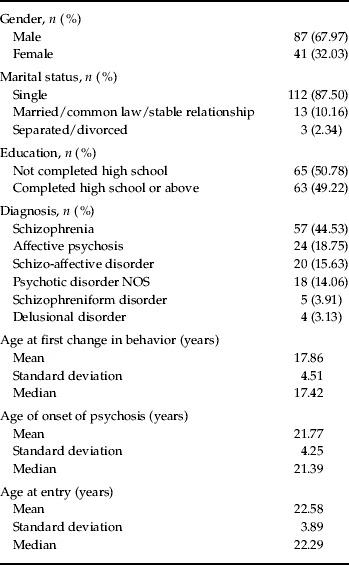
Between January 2003 and September 2006, 160 patients met criteria for the PEPP program and consented to receive treatment and be evaluated. Data were missing for 22 patients who either refused to participate in the treatment program following the initial assessment, or who discharged themselves without completing assessments. For another eight subjects, assessments were pending or in progress at the time of analyses. Thus, data on demographic and clinical ratings were available for 130 patients. However, two subjects had substance-induced psychosis and were excluded from the analysis. Complete data were therefore available on a sample of 128 patients. Table 1 presents detailed sample characteristics including demographics, diagnosis and ages derived from the CORS. Of note, there were no significant differences between the sample for whom data were missing (n=22) and the sample (n=128) included in this study in terms of gender, marital status, education, age at entry, age at onset, and diagnosis.
Characteristics of the sample (n=128)

NOS, Not otherwise specified.
Early signs and symptoms
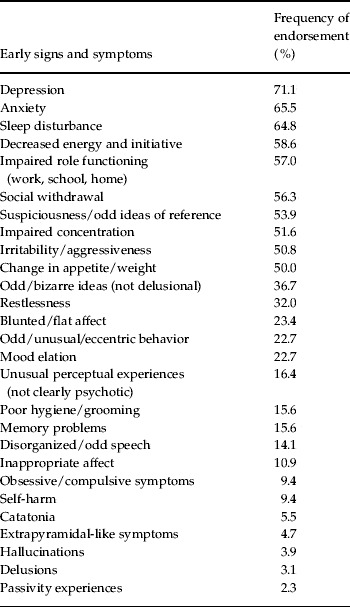
Table 2 presents all 27 early signs and symptoms included in the CORS in decreasing order of frequency of endorsement. Mood changes, such as depression and anxiety, were the most frequently reported early symptoms. Other common signs and symptoms endorsed by at least 50% of patients included sleep disturbance, decreased energy and initiative, impaired role functioning, social withdrawal, suspiciousness/ideas of reference, difficulties with concentration, irritability/aggressiveness and change in appetite/weight. The average number of early signs and symptoms identified retrospectively was 8.3 (s.d.=4.26), with a range from 0 to 21. Only three patients (2.31%) did not endorse any of the 27 early signs and symptoms.
Frequency of early signs and symptoms

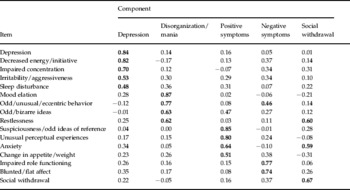
A principal components factor analysis was performed on those early signs and symptoms reported by 16% or more of the sample so as to include only those items that were endorsed by at least 20 patients. As the data were binary, a matrix of tetrachoric correlations was first calculated and the factor analysis was conducted on this matrix (Parry & McArdle, Reference Parry and McArdle1991; McLeod et al. Reference McLeod, Swygert, Thissen, Thissen and Wainer2001). The criterion of an eigenvalue >1 and an examination of the scree plot both suggested that a five-factor solution was appropriate. We examined a four-factor solution but rejected it because of relatively poor interpretability. The five factors were rotated using a varimax rotation procedure. The rotated solution, as shown in Table 3, accounted for 73.84% of the variance. Item loadings of 0.45 or greater were examined to interpret the factors.
Factor loadings based on principal components factor analysis of early signs and symptoms

Values in boldface indicate factor loadings >0.45.
The first factor clearly reflected ‘depression’ with the following items loading onto it: depression, decreased energy and initiative, difficulties with concentration, irritability/aggressiveness, and sleep disturbance. The second factor included mood elation, odd, eccentric and/or reckless behavior, bizarre ideas (including grandiose ideation) and restlessness, and indicated a distinct ‘disorganization/mania’ dimension. The third factor tapped into ‘subthreshold positive symptoms’, with the heaviest loadings from suspiciousness/odd ideas of reference, unusual perceptual experiences and anxiety. Odd/bizarre ideas also loaded onto this factor (0.47), although it loaded more heavily on the second factor (0.63). The fourth factor probably reflects early aspects of ‘negative symptoms’ such as blunted or flat affect and impairments in role functioning. Odd/eccentric behavior also showed a loading slightly greater than 0.45 on this factor, although it loaded higher on the ‘disorganization/mania’ factor. It was more difficult to characterize the fifth factor, which had loadings on social withdrawal, anxiety and restlessness. Social withdrawal uniquely loaded on this fifth factor, suggesting that this factor (referred to here as ‘social withdrawal’) also reflected early negative symptoms. However, the additional symptoms of anxiety and restlessness that loaded on this factor suggest that social withdrawal could be a response to anxiety and fear, often referred to as a phobic response.
Individual patients' scores for each factor were computed by totaling up the occurrence of all of the items with a loading of 0.45 or greater on that factor. Items that loaded on more than one factor were only included in the factor on which they had the highest loading. All further analyses were based on these factor scores.
Early signs and symptoms and associations with diagnostic trajectories
Diagnoses were grouped into two categories: ‘schizophrenia’ and ‘affective psychosis’. The schizophrenia group (n=57) included all subtypes of schizophrenia: paranoid (n=33), disorganized (n=6), catatonic (n=1), residual (n=3), and undifferentiated (n=14). The affective psychosis group (n=24) included bipolar disorder with psychotic features (n=18) and major depression with psychotic features (n=6). Fig. 1 compares the five-factor profiles for the schizophrenia and affective psychosis groups and the factor scores within each diagnostic grouping. The asterisks indicate significant differences from the schizophrenia-spectrum group mean, following the use of independent-samples t tests (α levels were adjusted for multiple comparisons). The two mood-related factors, ‘depression’ and ‘disorganization/mania’, distinguished the affective psychosis and schizophrenia groups [t(79)=2.60 and 2.81 respectively, p<0.01].
Profile of mean factor scores: schizophrenia versus affective psychosis (* p<0.01).  , Depression;
 , disorganization/mania; □, positive symptoms;
 , negative symptoms; ■, social withdrawal.

The next step was to establish whether these two factors predicted the diagnostic group after accounting for gender, DUP and age at onset. The choice of these covariates was based on previous research implicating these as differentiating between non-affective and affective psychosis (Amminger et al. Reference Amminger, Leicester, Yung, Phillips, Berger, Francey, Yuen and McGorry2006; Compton et al. Reference Compton, West and Olfson2006). The schizophrenia and affective psychosis groups were first compared on the covariates. The two groups did not differ by age at onset and gender. As DUP was highly skewed, it was log-transformed. The schizophrenia group had a longer log-transformed DUP (mean=3.15, s.d.=1.41) than the affective psychosis group (mean=1.80, s.d.=1.62) [t(79)=3.49, p<0.01].
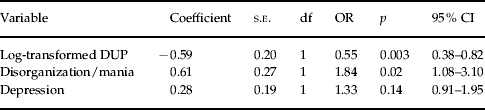
A logistic regression model was run with diagnosis (affective versus schizophrenia) as the dependent variable and DUP, factor 1 ‘depression’ and factor 2 ‘disorganization/mania’ as predictors (see Table 4). The model was statistically significant (χ2=21.47, p<0.01). A shorter DUP and greater ‘disorganization/mania’ were associated with a future diagnosis of affective psychosis. Once these two predictors were controlled for, the depression factor no longer discriminated between the two groups.
Results of logistic regression with diagnosis as dependent variable (schizophrenia versus affective psychosis)
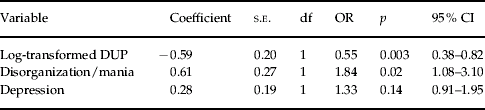
DUP, Duration of untreated psychosis; s.e., standard error; df, degrees of freedom; OR, odds ratio; CI, confidence interval.
We then asked the question: ‘Do mood symptoms differentiate affective psychosis from schizophrenia as far back as the time of the first psychiatric change?’ To answer this question, the first identifiable psychiatric change was categorized as ‘mood-related’ versus ‘other’ (n=59 and 69 respectively). We performed a χ2 test of independence to examine the relationship between diagnostic group (schizophrenia versus affective psychosis) and first psychiatric change (mood-related versus other). The association between these variables was significant [χ2(1)=7.03, p<0.01]. Individuals later diagnosed with affective psychosis were more likely to have a ‘mood-related’ sign and symptom as their first psychiatric change (70.83%, n=17/24) than individuals later diagnosed with schizophrenia (38.60%, n=22/57).
Early signs and symptoms and variables reflecting illness trajectory
We examined the relationship between the five factors and DUI, drug abuse prior to onset of psychosis, gender, and social functioning at baseline. The average DUI was 242.97 weeks (range=0.14–1265.43, median=169.14). Given its skewed distribution, DUI was log-transformed. Log-transformed DUI was significantly correlated with ‘depression’ (factor 1; r=0.22, p<0.01) and ‘social withdrawal’ (factor 5; r=0.22, p<0.01).
Patients who had engaged in drug abuse prior to onset of psychosis reported a greater frequency of early depressive signs and symptoms (factor 1) than did those who did not abuse drugs in the pre-psychotic phase (mean=3.22, s.d.=1.56 and mean=2.47, s.d.=1.68 respectively; t=2.47, p<0.05). Those who had engaged in drug abuse also reported a higher frequency of early negative signs and symptoms (factor 4) than those who did not abuse drugs in the pre-psychotic phase (mean=0.93, s.d.=0.77 and mean=0.56, s.d.=0.67 respectively; t=2.83, p<0.01).
Male and female patients did not differ on the factor scores. Baseline functioning (SOFAS) was inversely correlated with ‘disorganization/mania’ (factor 2) (r=−0.23, p<0.05). A multiple regression was performed with baseline functioning as dependent variable and gender, diagnosis and ‘disorganization/mania’ as independent variables [F(3, 91)=2.80, p<0.05]. Individuals displaying ‘disorganization/mania’-like symptoms in the pre-psychotic phase presented with poorer social functioning at baseline (r=−0.23, p<0.05), after accounting for gender and diagnosis.
Discussion
Early signs and symptoms
The nature and frequency of early signs and symptoms reported by our patients are in general agreement with frequently reported prodromal and early signs of psychosis in other studies (Yung & McGorry, Reference Yung and McGorry1996; Yung et al. Reference Yung, McGorry, McFarlane, Jackson, Patton and Rakkar1996; Hafner, Reference Hafner2000; Tan & Ang, Reference Tan and Ang2001; Gourzis et al. Reference Gourzis, Katrivanou and Beratis2002; Meyer et al. Reference Meyer, Bearden, Lux, Gordon, Johnson, O'Brien, Niendam, Loewy, Ventura and Cannon2005; Norman et al. Reference Norman, Scholten, Malla and Ballageer2005). Our factor analysis resulted in five factors. The first factor strongly reflected mood disturbance and independently accounted for 18.42% of the variance. This ‘mood’ factor may indicate the psychological distress that often precedes and/or accompanies the insidious onset of psychosis (Emsley et al. Reference Emsley, Oosthuizen, Joubert, Roberts and Stein1999, Reference Emsley, Rabinowitz and Torreman2003). The second factor, reflecting disorganization and mania-like symptoms, emerged as an important prognostic indicator of social and occupational functioning. Other factor analytic studies using a broad spectrum of psychosis patients have also reported a factor with loadings reflecting both manic symptoms and disorganization (Kitamura et al. Reference Kitamura, Okazaki, Fujinawa, Yoshino and Kasahara1995; McGorry et al. Reference McGorry, Bell, Dudgeon and Jackson1998). Our third factor tapped into what is described as ‘reality distortion’ after the onset of psychosis. The fourth and fifth factors reflected negative symptoms in the pre-psychotic phase, particularly blunted or flat affect, social withdrawal, and reduced functioning. Fifty-six per cent of our patients reported social withdrawal prior to the onset of psychosis. The prominence of social withdrawal in the early pre-psychotic phase has been reported in previous studies (Yung & McGorry, Reference Yung and McGorry1996; Hambrecht et al. Reference Hambrecht, Lammertink, Klosterkotter, Matuschek and Pukrop2002; Norman et al. Reference Norman, Scholten, Malla and Ballageer2005). The third, fourth and fifth factors are conceptually congruent with positive and negative symptoms seen in established schizophrenia, but have not yet reached the threshold to be clinically significant.
These results point to a continuity in clinical phenomenology between pre-psychotic presentations and established psychotic disorders. Indeed, the factor solution observed in this study and previous similar studies of early signs and symptoms (Hawkins et al. Reference Hawkins, McGlashan, Quinlan, Miller, Perkins, Zipursky, Addington and Woods2004; Norman et al. Reference Norman, Scholten, Malla and Ballageer2005) is reminiscent of factor solutions observed in psychotic patients and community controls. In patients with psychosis, factor analyses of the Brief Psychiatric Rating Scale (BPRS) generally indicate four factors: positive symptoms, negative symptoms, depression-anxiety and mania (Dingemans et al. Reference Dingemans, Linszen, Lenior and Smeets1995; Burger et al. Reference Burger, Calsyn, Morse, Klinkenberg and Trusty1997; Ventura et al. Reference Ventura, Nuechterlein, Subotnik, Gutkind and Gilbert2000). Similarly, analyses of the Positive and Negative Syndrome Scale (PANSS) indicate positive symptoms, negative symptoms, cognitive symptoms, anxiety/depression and excitement as factors (Lindenmayer et al. Reference Lindenmayer, Grochowski and Hyman1995; Lancon et al. Reference Lancon, Aghababian, Llorca and Auquier1998; Lykouras et al. Reference Lykouras, Oulis, Psarros, Daskalopoulou, Botsis, Christodoulou and Stefanis2000; Emsley et al. Reference Emsley, Rabinowitz and Torreman2003; Fresan et al. Reference Fresan, De la Fuente-Sandoval, Loyzaga, Garcia-Anaya, Meyenberg, Nicolini and Apiquian2005). Studies with community samples using the Community Assessment of Psychic Experiences (CAPE; Stefanis et al. Reference Stefanis, Hanssen, Smirnis, Avramopoulos, Evdokimidis, Stefanis, Verdoux and Van Os2002; Verdoux et al. Reference Verdoux, Sorbara, Gindre, Swendsen and Van Os2003; Brenner et al. Reference Brenner, Schmitz, Pawliuk, Fathalli, Joober, Ciampi and King2007) consistently result in three factors: positive, negative, and depressive symptoms (no mania items are included in the CAPE).
Early signs and symptoms and associations with diagnostic trajectories
Consistent with our hypothesis, the affective psychosis group had higher ratings on pre-psychotic depression and mania factors. Of note, individuals later diagnosed with affective psychosis were more likely to display a ‘mood-related’ sign and symptom as early as the first psychiatric change. Our findings throw light on the early stages of affective psychosis, an area that has received little attention so far (Thompson et al. Reference Thompson, Conus, Ward, Phillips, Koutsogiannis, Leicester and McGorry2003; Hauser et al. Reference Hauser, Pfennig, Ozgurdal, Heinz, Bauer and Juckel2007).
Previous early psychosis studies, using factors derived from baseline symptom measures, have also found that mood symptoms distinguish affective psychosis from non-affective psychosis (McGorry et al. Reference McGorry, Bell, Dudgeon and Jackson1998; Amminger et al. Reference Amminger, Leicester, Yung, Phillips, Berger, Francey, Yuen and McGorry2006). Consistent with the findings of McGorry et al. (Reference McGorry, Bell, Dudgeon and Jackson1998), our affective psychosis and schizophrenia groups did not differ on the factors reflecting early negative symptoms. It is possible that negative symptoms become more characteristic of schizophrenia in later stages of the illness. In addition, negative symptoms at the time of first presentation for treatment are most likely to be secondary to other clinical phenomena such as psychotic symptoms and depression (Edwards et al. Reference Edwards, McGorry, Waddell and Harrigan1999; Malla et al. 2002).
Early signs and symptoms and variables reflecting illness trajectory
We found that factors indicating ‘depression’ and ‘social withdrawal’ were associated with a longer DUI. Pre-psychotic depression and social withdrawal may be strongly associated with an insidious onset, characterized by a lengthy course preceding the onset of psychosis. However, it is also likely that depressed and socially withdrawn individuals lack the energy or initiative to seek help, resulting in a long DUI.
In our study, individuals with a history of drug abuse prior to the onset of psychosis scored higher on pre-psychotic ‘depression’ and ‘negative symptoms’. Both substance abuse and schizophrenia generally originate in adolescence and young adulthood. Similar neurobiological changes may be responsible for an increased motivation to abuse drugs and for depression, avolition and anhedonia (van Nimwegen et al. Reference van Nimwegen, de Haan, van Beveren, van den Brink and Linszen2005; Krystal et al. Reference Krystal, D'Souza, Gallinat, Driesen, Abi-Dargham, Petrakis, Heinz and Pearlson2006). However, the abuse of certain substances itself may increase the risk of depression (Durdle et al. Reference Durdle, Lundahl, Johanson and Tancer2007). As we were unable to tease apart the exact onset dates for the depression and the substance use, we cannot rule out the possibility that our results reflect self-medication of depressive symptoms.
Limitations and conclusion
A limitation of the current study is that data on early signs and symptoms were collected retrospectively. This is a commonly adopted and well-established strategy in early psychosis research, with the exception of ultra-high-risk studies that observe symptoms prospectively in samples that may not be representative of all individuals who go on to develop a psychotic disorder (Yung et al. Reference Yung, Phillips, McGorry, McFarlane, Francey, Harrigan, Patton and Jackson1998). Nevertheless, our sample is representative of an incidence sample and is largely treatment naïve. In addition, the data were gathered in a highly structured manner. Another limitation of this study is that the CORS and the SCID were conducted and assessed by the same team, giving rise to the possibility that the SCID diagnosis in itself may be influenced by information gathered during the CORS interview. However, the information from the SCID was reviewed by at least two experienced clinicians/researchers before reaching a consensus diagnosis. Future research could benefit from a larger sample size, particularly in the affective psychosis group.
The current results describe key patterns in the pre-morbid phase of psychotic illness that suggest a clinical continuity between at-risk/pre-psychotic presentations and later stages of the illness. These findings are a step forwards in the process of understanding and characterizing clinically important phenomena to be studied in patients who are identified at high risk for psychosis. Such research also has implications for possible preventive interventions that target pertinent early signs and symptoms and associated phenomena such as substance abuse.
Acknowledgements
Financial support for this work was provided by Valorization de Recherche du Québec through an establishment grant to Douglas Hospital Research Centre and by Canadian Institutes of Health Research grant no. 9951 to the senior author (A.M.).
Declaration of Interest
None.