Neither party has, as a party, any clean-cut principles. … Both have certainly war cries, organizations, interests enlisted in their support. But those interests are in the main the interests of getting or keeping the patronage of the government. Distinctive tenets and policies … have all but vanished. All has been lost, except office or the hope of it.
—James Bryce, 1888Footnote 1In many ways, the Gilded Age closely parallels the polarized politics of the contemporary era. Between the end of Reconstruction in 1877 and the Populist takeover of the Democratic Party in 1896, partisan conflict in Congress was fierce and pervasive, elections were closely fought, divided government was the norm, and there was regular alternation in congressional party majorities. But there is one stark difference between the two eras. Close observers of the early twenty-first-century Congress do not accuse Republicans and Democrats of failing to propose competing national policy programs. By contrast, if one turns to historical accounts of party differences in the Gilded Age, one immediately encounters perspectives like that of James Bryce. The national parties of 1876–1896 were frequently criticized for their failure to offer meaningful policy alternatives.
The conventional portrait of the era depicts the two parties as locked in battles over distributive benefits and patronage, with little, if any, programmatic national policy content.Footnote 2 Prior to the 1896 election's “Battle of the Standards,” in which the two parties finally took opposing stances on the currency issue, both the Democratic and Republican Parties were led by hard-money conservatives. In addition, the prevailing sentiment in both parties favored a very limited role for the federal government. Neither of the major parties proposed policies to deal with the myriad problems arising from rapid industrialization, rising inequality, or the deep depressions of 1873–1879 and 1893–1897.Footnote 3
Between 1877 and 1896, “the parties, closely balanced, hesitated to take clear positions on controversial questions.”Footnote 4 Both parties—cleaved along sectional lines between west and east—managed their internal conflicts by dodging or fudging issues and writing platforms that were “exceedingly vague upon even the leading issues.”Footnote 5 “Patronage, rather than program, became the object of politics.”Footnote 6 One historian compares the two parties to “rival stagecoaches splashing one another with mud as they raced along the same road to the same destination.”Footnote 7 “As party loyalty, regularity, and discipline increased, so did the capacity of parties to evade serious issues,” summarizes Arthur Schlesinger, Jr. “The party, originating as a means to other ends, had become after a while an end in itself.”Footnote 8
Not all historians and political scientists accept this description of Gilded Age politics. Beginning in the 1960s, revisionist accounts challenged the traditional characterization.Footnote 9 Salisbury, for example, argues that “a majority of both Democrats and Republicans maintained a consistent stance throughout this period … [in which] the Republican Party espoused a policy of governmental intervention in both the public and private spheres,” and the Democratic Party stood for “cultural, political, and economic laissez faire.”Footnote 10 Drawing upon analyses of both congressional politics and state party platforms, Bensel offers an alternative interpretation.Footnote 11 He reads party differences in this era as centering around questions of economic development, with the Republican Party serving as the “developmental agent” of the industrializing northern “core,” against a Democratic Party based in the economic periphery of the south and the west.Footnote 12
Revisionist accounts, however, have “not achieved universal acceptance.”Footnote 13 Some scholars contend that the era's intense partisanship rested more on ethnic and religious identities than on any national policy issues.Footnote 14 Others maintain that the period's most significant policy differences were not between the two major parties, but between them together on one side and the minor parties, such as the Greenbackers and the Populists, on the other.Footnote 15 Others continue to emphasize the divisions between east and west within each of the major parties on the most pressing questions of national policy, especially on banking and currency.Footnote 16
The bottom line is that there is scholarly disagreement over whether the Republican and Democratic Parties of the Gilded Age presented distinct positions on questions of national policy. The traditionalist perspective viewed the parties of this period as ideologically similar to one another, in that both envisioned a limited role for government and both favored hard money. But even if one grants the revisionist argument that there were some consistent and meaningful policy differences between the Gilded Age parties, such a position falls far short of a claim that the parties of that era were starkly polarized. Indeed, it is hard to reconcile any historical treatments of this era—either traditional or revisionist—with a view that the major parties of this era diverged sharply on national issues. Nevertheless, according to the most widely used quantitative measures of political polarization, the Gilded Age stands out for some of the most markedly party-polarized Congresses of all time.
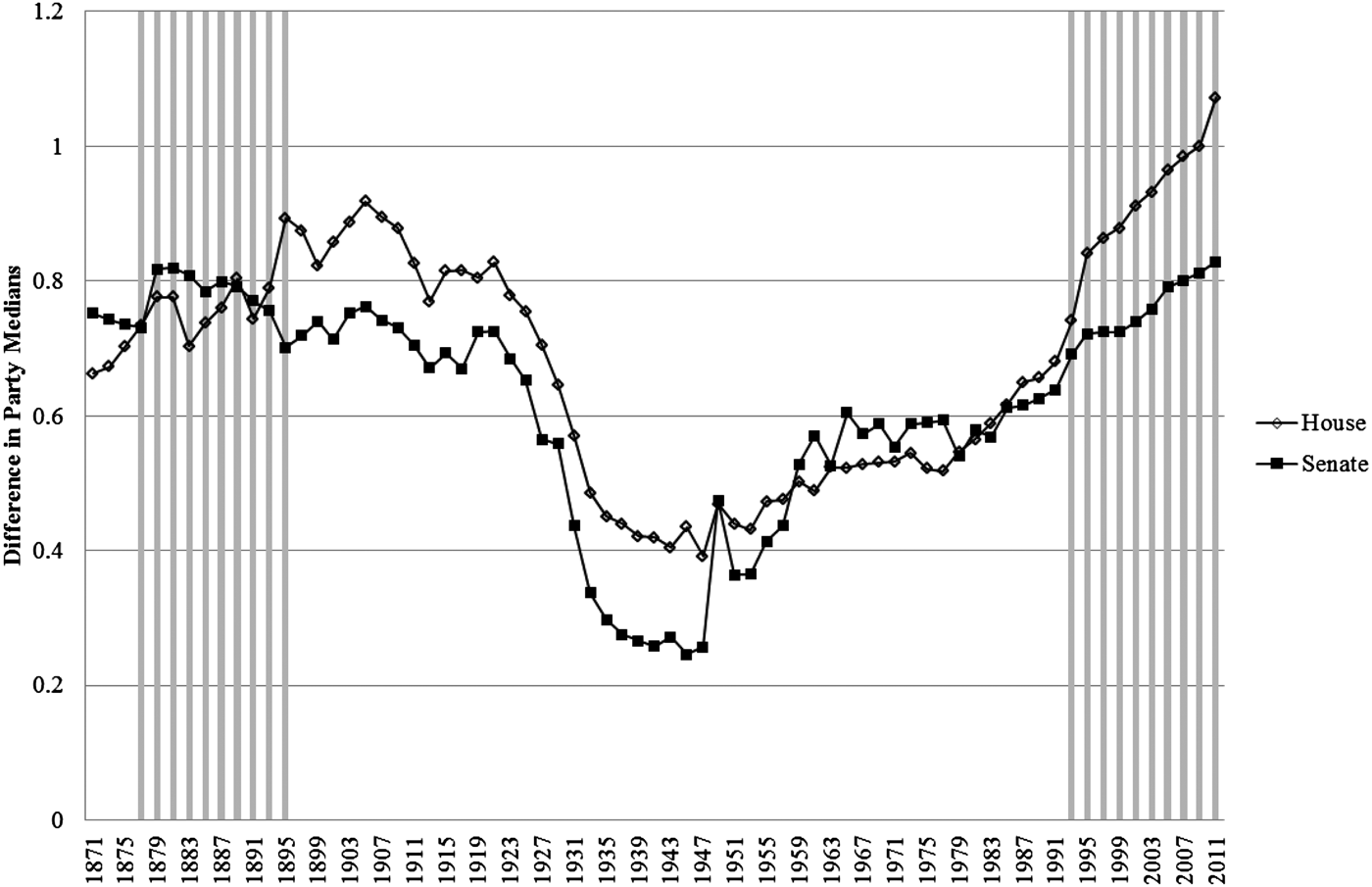
Figure 1 presents the difference between the median members of the Republican and Democratic Parties for every Congress between 1871 and 2013 as measured by Poole and Rosenthal's first dimension DW-NOMINATE scores.Footnote 17 According to DW-NOMINATE's first dimension, the Senate parties of 1877–1897 were on average more polarized than in 93 percent of all the subsequent Congresses between 1897 and 2013; the House parties of 1877–1897 were more polarized than in 67 percent of those subsequent Congresses. Judging by the percentage of all roll call votes setting a majority of one party against the other, the House and Senate of the Gilded Age were both more partisan than the current-day Congress.Footnote 18
Congressional Party Polarization, Difference in Party Medians on First Dimension DW-NOMINATE Scores. The 1876–1896 and 1993–2013 Eras are Shaded for Comparison.

The question, then, is how such quantitative measures ought to be interpreted in light of the substantive issues dividing the parties (or the lack thereof) during the Gilded Age. In the spirit of Lapinski, I aim to bring “substance back in.”Footnote 19 The meanings of NOMINATE coordinates and other measures derived from vote-scaling techniques are ambiguous. To understand the nature of party divisions during any particular era requires one to ascertain how the two parties' positions on policy questions differed. This means mapping quantitative measures of polarization onto historical accounts of the policy debates of the era, as well as the issue content of the votes taken in Congress.
Before I attempt such a mapping, I turn first to briefly discuss the spatial model of policy preferences that undergirds measures of polarization. Not all political issues on which parties can come into conflict make sense in terms of the spatial model. Then I turn to examine the extent to which the parties proposed alternative positions on national policy and the extent to which, instead, the parties' disputes focused on purely partisan matters, such as distributive logrolls and patronage.
First, an examination of the issues on which the Congress of the era took recorded votes reveals that the parties did not take clearly opposing positions on questions involving either federal government regulation of private business or economic redistribution across classes. “Above all,” as one historian warns, “we must not read into this period of American politics the ideas about conservatism and liberalism and the relationship of the government to the economy that have grown up since the Progressive movement.”Footnote 20 The most prominent national issue on which the parties of this time took opposed positions was the tariff. But, even here, the parties' positions were by no means at opposite poles. Party positions on this issue became steadily clearer over the later decades of the nineteenth century, but the Democrats never embraced a policy of free trade. Instead, the parties did battle over competing tariff schedules, with Democrats favoring overall lower tariffs than did Republicans.
At the same time, a large share of the period's contested issues are poorly suited to conceptualization according to a spatial model. Specifically, the era's ubiquitous fights over patronage, control of political office, and the distribution of government benefits make little sense according to a spatial theory in which members vote according to ideal points along an underlying ideological continuum structuring national policy disputes. The political fights of the era were predominantly struggles over power and distributive benefits, where the underlying continuum, if there is one, was instead loyalty to one party and its supportive coalition of interests, as opposed to the other party and its coalition. No other period has seen nearly as many contested elections handled in Congress. Patronage was far more central to the party organizations of the late nineteenth century than was the case at any subsequent point. In sum, the Gilded Age illustrates that political parties are fully capable of waging war over spoils and office, even at times when there are few sharply defined party differences on national policy.
“POLARIZATION” AND THE SPATIAL MODEL
Party polarization is not the same thing as party conflict, even if the two are empirically related. “Polarization” rests upon a theoretical model that envisions (1) a choice space in which policy alternatives can be ranged along a continuum, interpreted generically from left to right or, more specifically, as “conflict over economic redistribution,” and (2) legislators who hold policy preferences along that continuum and who will vote for the alternative closest to their preference.Footnote 21 Parties become polarized when the preferences of the members of the two parties move further away from one another in this choice space. NOMINATE and other methodologies of ideal-point estimation rest upon assumptions that congressional roll call voting conforms to the spatial model. These scores cannot be meaningfully interpreted outside of these assumptions. If there are types of issues that cannot be situated in this choice space or if lawmakers split along party lines for reasons other than their individual policy preferences, the methodology will still generate coordinates, but they will not be valid or accurate as indicators of members' policy preferences or, taken collectively, of the parties' ideological polarization on national issues.Footnote 22
Most important for understanding Gilded Age politics, distributive policy cannot be “represented as spatial or left-right policy dimensions.”Footnote 23 As Cox and McCubbins explain, “[When] Congress must decide how to divide the federal budget pie among members' districts … there simply is no median legislator.”Footnote 24 If members coalesce into parties in order to logroll distributive benefits to their constituencies—as in Aldrich's stylization in Why Parties?—the party conflict that results cannot be attributed to individual members' preferences along an ideological continuum.Footnote 25 Party conflict in those circumstances just results from the simple fact that there is more than one “long coalition” in Congress assembling distributive logrolls.Footnote 26 In fact, the late nineteenth-century Republican Party is typically described in precisely these terms, as a grand distributive coalition: “it offered lands to the West, tariff protection to the East, some sort of controlled inflation to the Midwest, [and] pensions to veterans.”Footnote 27
In addition to distributive policy, another type of political issue poorly suited to interpretation in terms of the spatial model involves legislative action affecting the parties' political interests per se. Such actions include the sheer zero-sum battles over who would control political offices, such as those entailed in clashes over patronage, impeachments, and disputed elections. Along similar lines, partisan conflicts over congressional investigations often stemmed from members' expectations about how the collection or distribution of particular types of information would affect their parties' electoral interests—for example, the protracted 1878 Potter committee investigation of fraud in the Hayes-Tilden presidential election.Footnote 28 In such matters, partisans came into conflict with one another simply because the institutional interests of the two parties in winning and holding office were at odds, not as an artifact of a distribution of individual member preferences along an underlying spatial continuum. As will be discussed below, issues that do not easily fit the spatial model take center stage in the party politics of the Gilded Age.
REGULATION AND REDISTRIBUTION IN THE GILDED AGE
The limited scope and function of the federal government of the Gilded Age complicates any interpretation of its party conflict as polarization along a spatial dimension. Federal policy in the late nineteenth century was predominantly distributive in character. “Distribution [was] the almost exclusive type of national domestic policy from 1789 until virtually 1890,” writes Lowi.Footnote 29 Before the Progressive Era or the New Deal, the federal government engaged in little economic regulation or explicit redistribution across classes—policy domains that are far better suited to conceptualization in terms of the spatial model. Instead, the types of policy disputes that dominated American government during the late nineteenth century were “particularistic decisions of a basically distributive, piecemeal nature.”Footnote 30
Questions of regulation and redistribution were hardly on the congressional agenda between 1876 and 1896. Regulatory issues would become much more prominent on the national policy agenda during the Progressive Era, but during this period, regulation was a priority for neither major party. “By 1876 both major political parties favored pro-industrial policies.”Footnote 31 “By the mid-1870s, Republicans had joined Democrats in abandoning the activist state.”Footnote 32
On the rare occasions when regulatory issues appeared on the congressional agenda in the late nineteenth century—on the regulation of the railroads and trusts—the parties were far from polarized. Instead, sectional divisions cleaved them both.Footnote 33 Agrarian forces were stronger within the Democratic Party than the Republican Party, but both parties struggled to manage issues that divided agricultural interests from the industrial centers. Despite partisan differences along the way, the two most significant federal regulatory laws passed before the Progressive Era were both enacted on a strongly bipartisan basis. The Interstate Commerce Act of 1887 regulating railroads, which knitted together bills passed by a Democratic-controlled House and a Republican-controlled Senate, was adopted with “mid-western Republicans and southern Democrats ma[king] up the largest blocs of votes in favor.”Footnote 34 The Sherman Antitrust Act of 1890, enacted under unified Republican government in the 51st Congress, was passed by the Senate 52–1 and by the House with no opposition.Footnote 35
Questions of economic redistribution were similarly lacking on the policy agenda of the late nineteenth century. The major parties of this era hardly debated a federal responsibility to redistribute wealth or income across classes. Even questions of racial justice and black integration into the national polity had largely been set aside after the settlement of the 1876 contested presidential election.Footnote 36 The only prominent issue on the national agenda with clear implications for redistribution across classes was the currency question, meaning the protracted debates over the relative merits of gold, silver, bimetallism, and paper money, with its obvious implications for creditors and debtors. But rather than dividing the parties from one another, this issue cut across party lines all throughout the late nineteenth century. Members of both parties representing western and southern constituencies tended to favor an expanded money supply and inflation. Meanwhile, members of both parties representing eastern and northern constituencies tended to prefer the gold standard. As Poole and Rosenthal show in an extended analysis, the parties did not take divergent positions on inflation, the money supply, or the gold standard until after 1896.Footnote 37
CONTESTS OVER OFFICE
Rather than debating broad questions of national policy, party politics of the late nineteenth century focused heavily on patronage and the control of offices. American politicians of the Gilded Age were far more concerned with the spoils of office than are their counterparts today. “The historian who explores the papers of late nineteenth century political figures usually discovers that the largest files are those relating to patronage, often far thicker than those having to do with public policy issues.”Footnote 38 The amount of patronage was “enormous—theoretically, before 1883, the whole public service, federal, state and local. … [T]he bulk of the public service was available to stimulate party exertion and to pay party obligations.”Footnote 39 Patronage extended to military pensions, scores of which were distributed via private bills handled in Congress. “The Pension Office dispersed one quarter of all the federal expenditures during the 1880s, and more than one-third of the total during the 1890s.”Footnote 40
Politicians focused so much on patronage because it was central to the organization, management, and mobilization of the era's parties.Footnote 41 Concern about corruption, efficiency, and political machines motivated “mugwump” reformers, a prominent movement of the era. Professional politicians of both parties detested such reformers. Like George Washington Plunkitt, they believed that “you can't keep an organization together without patronage. Men ain't in politics for nothin’.”Footnote 42 One of the most vocal opponents of reform, known to refer to the cause as “snivel service reform,” Roscoe Conkling (R-NY, 1867–1881) declared, “Parties are not built up by deportment, or by ladies' magazines, or gush.”Footnote 43 In contrast to those of the early twenty-first century, congressional parties and politicians of the late nineteenth century trafficked more in “particularized benefits” and less in “position-taking.”Footnote 44
The sheer number of contested elections is another respect in which Gilded Age party politics centered on control of office. The frequency during this era with which Congress itself handled conflicts over the outcomes of individual congressional elections exceeded any previous or subsequent period.Footnote 45 The settlement of these disputes was often achieved “on some basis other than the merits.”Footnote 46 “The decision of election cases,” wrote Speaker Thomas B. Reed (R-ME), “invariably increases the majority of the party which organizes the House. … Probably there is not a single instance on record where the minority was increased by the decision of contested cases.”Footnote 47 Recent scholarship verifies that contested elections in the House of the era were indeed pursued with partisan advantage in mind.Footnote 48 To be sure, Republican outrage over vote fraud, violence, and intimidation in the South also reflected the party's concern for African American civil rights.Footnote 49 But, tellingly, Republicans were far less willing to stand for civil rights when it was less useful to their party's political interests—a pattern evident in the Republican agreement to confine federal troops in the South to federal installations after 1876, President Chester Arthur's pursuit of southern independents at the expense of freedmen, and the decision to prioritize the tariff and the silver issues on the congressional agenda over the Federal Elections bill of 1890.Footnote 50
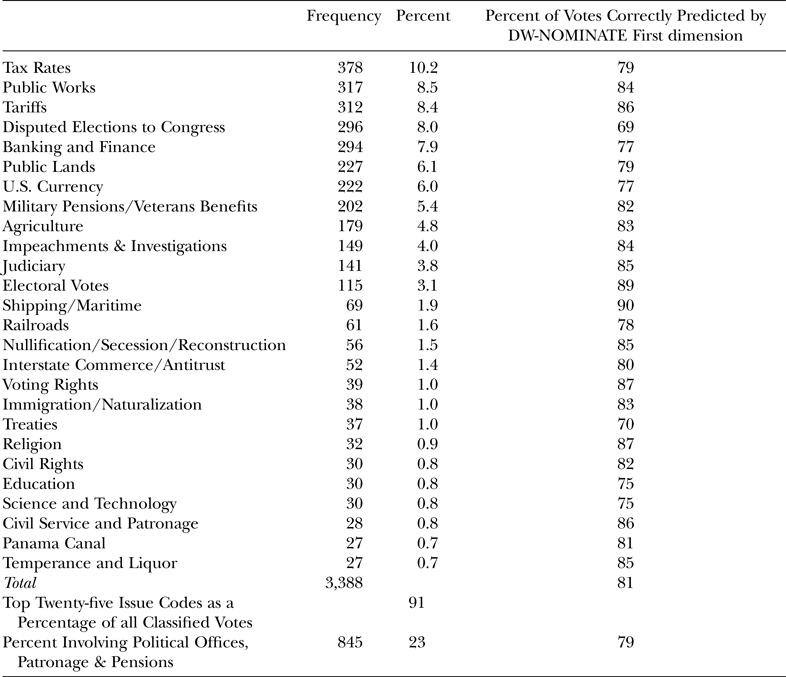
To gain some sense for the prominence of controversies involving patronage and control of office on the congressional agenda of the Gilded Age, Table 1 lists in descending order the top twenty-five issues of the period as measured by the frequency of House and Senate roll call votes.Footnote 51 This is a reasonably comprehensive accounting, in that these twenty-five issues account for fully 91 percent of all the classified votes of the period. Among these, disputed elections to Congress rank as the fourth most frequent issue. Votes on contested elections were nearly as common as votes on the tariff—the most important policy distinction between the parties' national platforms during the period. Roll call votes on disputed elections were more common than votes on banking and finance, public lands, and currency.
Top Twenty-Five Issues by Frequency of House and Senate Roll Call Votes, 44th–54th Congresses

Source: Keith Poole and Howard Rosenthal, “DW-NOMINATE Roll-Call Coordinates and Issue Codes for Houses 1 to 112” and “DW-NOMINATE Roll-Call Coordinates and Issue Codes for Senates 1 to 112,” Voteview.com, http://voteview.com/downloads.asp.
Grouping together all the issue categories that most directly involve patronage and control of political office, they represent almost a quarter (23 percent) of all the votes in the table.Footnote 52 Also displayed here are the percentages of members' votes within each issue category that can be correctly predicted by DW-NOMINATE's first dimension. Votes on patronage and control of office are more or less equally well mapped by the first dimension as the other vote categories.Footnote 53 In short, the major parties of this period were just as distinct from one another in their competition for control of office and patronage as over other issues. This is true, even though the question of civil service reform tended to divide both parties internally. Nevertheless, the parties were still able to coalesce to combat one another on this issue in Congress, with the out-party opportunistically accusing the in-party of corruption. On the question of civil service reform, writes one historian, “if any generalization can be made, it is that the party out of power tended to support reform, the party in power to oppose it.”Footnote 54
DISTRIBUTIVE LOGROLLS AND THE TARIFF
Anyone who spends time examining the questions on which roll call votes of the late nineteenth century were taken will discover that an exceedingly large share of them would run afoul of the 2010 House Republican Conference's ban on earmarks: “No Member shall request a congressional earmark, limited tax benefit, or limited tariff benefit.”Footnote 55 The distribution of these types of particularized benefits was a central preoccupation for the Gilded Age Congress.
As shown in Table 1, roll call votes on public works constituted the second most common type of issue considered on the floor of the period. Public works projects represented a far more significant share of all federal outlays during this era than in the contemporary period. Prominent among these were the omnibus bills funding river and harbor improvements, which were nothing more than “Christmas tree” bills—long lists of project authorizations. The characteristic vote on a rivers and harbors bill was an amendment that proposed “the addition (typically) or deletion (atypically) of a project.”Footnote 56 Beyond these omnibus bills, votes in the “public works” category are almost always proposals to undertake or not undertake some project in a specified location—such as building a courthouse or post office in Peoria, Galveston, Minneapolis, or Omaha; a light house on the Potomac; a bridge in Brooklyn; or the Baltimore and Potomac railroad.
Votes classified in the “tax rates” category—the most common type of issue according to the Poole-Rosenthal classification—are only somewhat more general in their application. There were occasional votes on taxes designed to affect national policy, such as to impose an income tax or to reduce internal revenue overall. But, as in the public works category, the bulk of these votes also dealt with very narrow proposals, such as to eliminate the tax on tobacco; to reduce the tax on spirits; or to preserve the tax on matches, playing cards, or perfumery. The tax on oleomargarine—a cheap substitute for butter and thus the bane of dairy interests—was a source of considerable controversy.
The most important point of policy distinction between the two parties was over the tariff question. The tariff was the source of most federal revenue and, according to Table 1, the third most frequent issue in congressional roll call voting.Footnote 57 On the basis of party platforms and rhetoric, party differences can be easily summarized: Republicans supported a protective tariff providing a competitive advantage to U.S. products and manufacturing, and the Democratic party supported a tariff “for revenue only.” Even this policy distinction only emerged progressively over time, as Democrats stiffened their opposition to the GOP's longstanding policy. Party divisions on the tariff were less clear in the presidential campaigns of 1876, 1880, and 1884 than they became after 1888, which one historian terms “the first tariff campaign.”Footnote 58 In 1884, by contrast, the Democratic tariff plank was “verbosely ambiguous.”Footnote 59
In 1880, the Democrats nominated for president General Winfield Scott Hancock, who described the tariff (in a famous gaffe) as a “local question,” merely a matter of schedules that Congress hashed out on behalf of local interests.Footnote 60 Turning to the votes on the tariff in Congress throughout the late nineteenth century, it is hard to disagree with Hancock. Despite its growing prominence as a party-defining issue in presidential campaigns, the tariff was a classic distributive issue in Congress.Footnote 61 Proposals brought to a vote very rarely dealt with policies of general applicability, such as across-the-board rate reductions or tariff reciprocity. Instead, votes dealt with whether to increase or decrease the duty on specific goods—glass, pig iron, cotton, woolens, tin plate, and fence wire, to name a few. These debates often look like Hofstadter's description of “tariff racketeers” engaging in a free-for-all for government benefits.Footnote 62
Democrats undoubtedly had broad policy aims of reducing the tariff subsidy to northern industry; meanwhile, Republicans sought to sustain a party coalition that had been constructed around the protective tariff. But the whole debate was characterized by relentless particularism. As it was defined in Congress, the tariff controversy in Congress was at least as much about “who gets what?” as about larger questions of the role of government in promoting industrialization. To be sure, the protective tariff “redistributed wealth from the agricultural sector into American industry and thus helped to fund industrialization.”Footnote 63 In pitting the sections against one another, the issue unquestionably had a redistributive dimension.Footnote 64 Despite this, the Democrats of this period never endorsed thorough-going trade liberalization, and Democratic leaders took pains to rebut Republican accusations that they were free traders. Moreover, there remained a critical bloc within the Democratic Party in Congress opposed to any significant reduction in duties at all, headed prominently by Samuel J. Randall (D-PA), who served as Speaker of the House in the 45th and 46th Congresses (1877–1881).
As a consequence, tariff debates in Congress played out as Republicans and Democrats constructed competing coalitions by distributing benefits and costs across different societal interests. Despite Democratic rhetoric, Democratic action in Congress diverged quite sharply from any principled opposition to protectionism. For example, the reform bill pushed by House Ways and Means Chair Roger Q. Mills (D-TX) in 1888 “discriminated outrageously in favor of the South.”Footnote 65 Garraty writes:
Mills slashed the rates on iron and other metal products, and on glass, wool, and many other items made or grown in northern states. Duties on sugar and on rice and on iron ore (mined in increasing amounts in Alabama) were lowered only slightly. Cheap foreign cotton goods, which competed with the products of new southern mills, remained subject to high duties; rates on high quality cotton goods and on woolens were reduced sharply. The defeat of the Mills bill was, therefore, far from being a victory for protectionism as such.Footnote 66
With less industry in the South, it is hardly surprising that the Democratic Party, with its rural southern bastion, would be less friendly to tariffs overall. Nevertheless, southern industry sought and received protective subsidies under Democratic tariffs, as did selected interests outside the South as proved necessary to build Democratic coalitions.
Particularism is even evident in the Democrats' most ambitious drive for tariff reform in 1893–1894, during the one interlude of Democratic unified government of the period. The Democrats' 1892 platform contained their strongest antitariff plank of the era. Under the leadership of William L. Wilson (D-WV), chair of Ways and Means, the House passed a bill that modestly lowered most industrial rates, without threatening steel or heavy industry. At the same time, it put wool, coal, lumber, sugar, sacking, and ores on the free list—concessions to eastern manufacturers seeking cheap raw materials. These changes angered Midwesterners, whose products were thus excluded from the protection they received under the existing McKinley tariff. There was one especially noteworthy element of redistribution in the bill: an income tax levied on personal and corporate incomes above $4,000 per year. Even this was a sectional measure aimed at the Northeast, because relatively few outside that region would be subject to a levy at that threshold. Despite the scale of the changes proposed, radicals remained far from satisfied. Kansas Populist “Sockless Jerry” Simpson called Wilson's reform bill “only a robber tariff in a little less degree than the McKinley bill.”Footnote 67
Subject to the imperatives of coalition building in the Senate, the 1894 House legislation then saw significant modification. Under the leadership of Sen. Arthur P. Gorman (D-MD), Senate Democrats “agreed to whatever was required to hold the protectionist members of their party in line.”Footnote 68 Louisiana Democrats successfully moved raw sugar from the free list to a rate of 40 percent! In the end, the Wilson-Gorman tariff of 1894 slightly lowered rates on average and imposed a 2 percent income tax. But rather than reducing duties across the board, it set tariffs product by product as necessary to hold together the Democratic Party's coalition, including raising some duties higher than under the McKinley tariff. President Grover Cleveland termed the bill an “abandonment” of Democratic pledges, tantamount to “party perfidy and party dishonor.”Footnote 69 He allowed it to become law without his signature, writing to Rep. Wilson, “I have … found myself questioning whether or not our party is a tariff-reform party.”Footnote 70
When one examines the substance of congressional votes on the tariff, the parties do not appear polarized on general principles or on competing visions of the proper role for government. The tariff issue in the Congress of the Gilded Age was simply not organized as a straightforward dispute between protection and free trade. Instead, the vast majority of congressional votes dealt with duties on specific products. Even as the parties became more distinct over time, the Democrats did not frontally assault the tariff with across-the-board reductions; they put together competing tariff schedules of their own.
For their part, rather than staking out positions for steadily higher tariffs, Republican leaders usually attempted to compromise on the tariff, as with the “Mongrel Tariff” of 1883, which reduced rates, if only very slightly.Footnote 71 Even the much-reviled McKinley tariff of 1890 was an effort at compromise. For the first time, tariff protection was extended to a full schedule of agricultural products in an effort to accommodate less industrial areas, especially in the Midwest. Meanwhile, sugar—a household staple and the source of more revenue than any other tariff duty—was put on the free list. In addition, the bill included, also for the first time, provisions for trade reciprocity that would allow the president to sign trade conventions without congressional approval—a hard sell to stalwart Republican protectionists in the House of Representatives.Footnote 72 “No American tariff ever suffered such misrepresentation as the McKinley Act. Most upward revisions were slight and selective.”Footnote 73
Despite internal divisions within the parties over the tariff, especially among Democrats, the issue still tracks extremely well on DW-NOMINATE's first dimension—better, on average, than on most other issues. As shown in Table 1, the first dimension correctly predicts 86 percent of all members' votes on tariffs, as compared to 81 percent of votes on all other issues of the period.
What explains such intense party conflict on the tariff? Beyond Republicans' and Democrats' diverging preferences on “protectionism” as a general principle—on which practice fell far short of rhetoric—late nineteenth-century party divisions on the tariff stemmed from the different economic interests represented in the two parties' coalitions. The interests within these two competing “long coalitions” benefited from different tariff schedules. “Both parties enjoyed dispensing and fighting about policies benefiting particular constituencies,” writes McCormick. “The perennial question of how much tariff protection to place on scores of separate products perfectly fit the major parties of the late nineteenth century.”Footnote 74 Conflicts over the tariff also reflected a basic pattern of the “ins” versus the “outs.” When Democrats were out of power, they were free to oppose Republican tariff policy without clarifying their own party's stance. But when placed in a position where they needed to coalesce around specific tariff reforms in order to govern, they struggled to do so. In sum, party conflict was about far more than “policy preferences” on a national issue. It was also about the maintenance of party coalitions and the pursuit of partisan advantage in exploiting public discontent with the party in power.
PARTY COALITIONS VERSUS “POLARIZATION”
How, then, should one interpret quantitative indicators that identify the Gilded Age between 1876 and 1896 as one of the most starkly party-polarized periods in U.S. history? A measure that denotes the era as extremely party polarized simply does not make sense given what we know about the substantive issues at stake in Congress during that period. Even though there is debate among historians over whether there were meaningful programmatic differences between the parties, neither traditional nor revisionist historians characterize 1876–1896 as an era in which Congress was highly party polarized on national policy questions. Instead, historians disagree over the extent to which the parties during this period offered clear alternatives on national policy, at all. The Gilded Age was highly partisan, but the Republicans and Democrats of this period were not polarized, if by “polarized” one means that the parties presented clear, strongly divergent positions on national policy questions.
During this period, the majority of roll call votes in Congress yielded party blocs of lawmakers on opposite sides. Examination of the issues that generated this pervasive party conflict, however, reveals few of the stark policy differences that have characterized American parties at other periods. There was no party conflict over a war, albeit a fair bit of waving of the “bloody shirt.” Notwithstanding differences on veterans' pensions, there was no party conflict over explicitly redistributive social welfare programs, like Social Security or national health insurance. Regulatory policy had little presence on the congressional agenda during this period, but on the few such bills considered, party differences were not so stark as to prevent passage of strongly bipartisan legislation on both the regulation of railroads and trusts. There were no conflicts over slavery, despite occasional fights over the political rights of African Americans, especially on causes that directly affected the parties' electoral interests. The two parties did not take clear positions on temperance. There was a lot of partisan rhetoric about states' rights versus federal power, but—with the exception of federal supervision of elections—it is hard to identify many actual policy issues in Congress that can be understood under this rubric.
Most congressional votes dealt with particularized benefits doled out to narrow interests. A very substantial share of votes dealt simply with questions of which party would control particular offices or patronage. Meanwhile, Congress took relatively few votes on national policy questions, especially by comparison to later Congresses. Generally speaking, the dominant issues of the late nineteenth-century Congress were distributive in character, pitting one coalition of claimants against another. However the matter of tariff protection figured in campaign rhetoric, in practice it entailed a scramble on behalf of narrow interests. It was an era famously described by Henry Adams as “poor in purpose and barren in results.”Footnote 75
A close examination of this period suggests that scholars should let go of the idea that the level of party conflict in congressional roll call voting is a reliable indicator of the ideological distance between the two parties' positions on national issues.Footnote 76 The relationship between the level of party conflict and the degree of party polarization on national policy is ambiguous. Party polarization on policy issues will undoubtedly result in party conflict. But parties, present and past, can and do come into conflict with one another for many reasons beyond their principled disagreements over national policy.Footnote 77 Congressional party conflict can even approach its high water mark during a period when historians conventionally describe both dominant parties as dodging or straddling many of the major issues of the day.
Remarkably, the overall level of party polarization, as measured by DW-NOMINATE scores, did not increase after 1896, when the two parties began to express much clearer divisions on ideological questions relating to regulation, redistribution, and the proper role of government intervention in the economy. The 1896 election has been described as the “first modern class-struggle political contest of industrial America.”Footnote 78 Following the Populist take-over, the Democratic platform—in a dramatic reversal from President Grover Cleveland's rigid adherence to the gold standard—declared for free and unlimited coinage of silver. The Republican Party platform—despite McKinley's long “straddle-bug” position as a representative from Ohio—contained a plank firmly supporting the gold standard. In addition, the Democratic platform contained a range of positions on other highly controversial national issues, new to major party politics. Among them, it denounced the Supreme Court for declaring the income tax unconstitutional and supported arbitration of labor disputes. Even though this presidential election posed national questions far more starkly than any other since the Civil War, it had no consistent polarizing effect on subsequent congressional roll call voting. As shown in Figure 1, party polarization in the Senate after 1896 actually falls below its levels between 1876 and 1896.
The methodologies scholars use to infer the policy distance between the parties cannot distinguish between partisan and ideological conflict. NOMINATE is a data reduction technique that elegantly summarizes members' voting behavior; it does not explain the reasons for that behavior. Any vote that divides the parties from one another will map onto NOMINATE's first dimension, even if it involves only a dispute over a patronage appointment or a distributive logroll with no larger principles of national policy at stake. When members divide along party lines in their voting behavior, NOMINATE and other vote-scaling methodologies will return estimates in which a single dimension seems to structure members' behavior, regardless of the true dimensionality of the space.Footnote 79 Vote-scaling technologies have proven to be useful for numerous empirical applications, but they do not provide much insight into the reasons why members vote as they do. Indeed, Heckman and Snyder conclude that in predicting members' votes, NOMINATE coordinates do not outperform a simple model that uses only dummy variables indicating members' region and party.Footnote 80
Because NOMINATE and other related methodologies measure both party and ideology simultaneously, they yield ideal-point estimates on congressional votes involving policies that do not make sense in ideological terms. They produce “polarization” scores for eras when the bulk of issues are distributive in nature, even though distributive policy poorly fits the spatial model. Why do vote-scaling methods still “work” on such policies? Because congressional voting is highly structured, not subject to much cycling or instability. Put more simply, members of Congress are members of political parties, and parties are coalitions of societal interests.Footnote 81 These coalitions can wrangle over distributive benefits, even when they do not disagree over ideological questions or even national policy issues more generally. Distributive policy was the mainstay of late nineteenth-century politics. Nevertheless, methodologies grounded in the assumptions of the spatial model still yield extraordinarily high scores for “polarization” during this period because, as Poole and Rosenthal acknowledge, these scores reflect both “loyalty to a political party and loyalty to an ideology.”Footnote 82
Any study of the Gilded Age also highlights a purely institutional dimension of party politics—conflict over power and office per se. Political parties are more than just groups of people with shared policy goals and more than coalitions of societal interests. They are also political organizations with a stake in winning power and controlling offices. In pure organizational terms, the late nineteenth-century parties were arguably the strongest in U.S. history. In a competitive two-party system, the major parties as organizations are locked in a relentless zero-sum struggle. This is a potent source of conflict that endures, even in the absence of meaningful policy stakes. Describing the parties of the Gilded Age, Bryce is drawn to meditate on political parties that live on long after the issues that gave rise to them have since been settled: “The American parties now continue to exist, because they have existed. The mill has been constructed, and its machinery goes on turning, even when there is no grist to grind.”Footnote 83