INTRODUCTION
The bottlenose dolphin (Tursiops truncatus) has a global distribution, only absent from polar waters (Reeves et al., 2006). In the Mediterranean this species has been studied mainly in the western part of the basin (Forcada et al., Reference Forcada, Gazo, Aguilar, Gonzalvo and Fernandez-Contreras2004; Cañadas & Hammond, Reference Cañadas and Hammond2006; Gomez de Segura et al., Reference Gomez de Segura, Crespo, Pedraza, Hammond and Raga2006; Gnone et al., Reference Gnone, Bellingeri, Dhermain, Dupraz, Nuti, Bedocchi, Moulins, Rosso, Alessi, McCrea, Azzellino, Airoldi, Portunato, Laran, David, Di Meglio, Bonelli, Montesi, Trucchi, Fossa and Wurtz2011). There is very little information for the central and eastern parts of the Mediterranean Sea, where studies have been limited to coastal waters (see Bearzi et al., Reference Bearzi, Fortuna and Reeves2009 for a full review). Nevertheless these studies are important in the context of the management of local wildlife and their habitats. They provide long-term reliable data on some aspects of the ecology of the bottlenose dolphin. Due to the self-funded and voluntary nature of most of these studies, many data-sets are inconsistent and contingent on local conditions (Bearzi et al., Reference Bearzi, Fortuna and Reeves2009; Gnone et al., Reference Gnone, Bellingeri, Dhermain, Dupraz, Nuti, Bedocchi, Moulins, Rosso, Alessi, McCrea, Azzellino, Airoldi, Portunato, Laran, David, Di Meglio, Bonelli, Montesi, Trucchi, Fossa and Wurtz2011). As a result, these datasets could have affected the IUCN assessment of the status of the bottlenose dolphin in Mediterranean waters, especially with regard to the emphasis placed on local low densities and fragmentation (Bearzi et al., Reference Bearzi, Fortuna and Reeves2009).
The absence of exhaustive assessments on the distribution and abundance of this species at a meaningful geographical scale is probably one of the main causes of the lack of effective conservation management measures. While a number of existing international legal texts, such as the Convention on the Conservation of Migratory Species of Wild Animals (Bonn, 1979), the Agreement on the Conservation of the Cetaceans of the Black Sea, Mediterranean Sea and Contiguous Atlantic Area (ACCOBAMS, 1996) and the Convention for the Protection of the Mediterranean Sea Against Pollution (Barcelona Convention, 1976), provide the legislative framework for conservation of cetaceans, there is a lack of real enforcement (Notarbartolo di Sciara et al., Reference Notarbartolo di Sciara, Hyrenbach, Scovazzi, Van Klaveren and Agardy2008). Within European waters EU Directives, specifically the Habitats Directive (HD; Council Directive 92/43/EEC, 1992) and Marine Strategy Framework Directive (MSFD; Directive 2008/56/EC) provide more binding commitments for their conservation. The HD has among its main objectives the achievement or maintenance of ‘favourable status’ for all cetacean species, including the bottlenose dolphin and their habitats. In addition it highlights the need to implement transboundary cooperative research and the identification of areas essential to the life, migration and reproduction of aquatic species which range over large areas. Despite these objectives, and the fact that the HD came into force in 1992, bottlenose dolphin conservation status has never been assessed at a regional scale and Italy has not yet established any Special Areas of Conservation (SACs) for this species. Only recently, through the MSFD, EU member States agreed to develop a framework to define and monitor ‘good environmental status’.
This paper represents the first quantitative assessment of the distribution and abundance of the bottlenose dolphins inhabiting the waters around Lampedusa Island (Italy). Eleven years of photo-identification data (from 1996 to 2006), collected by three different research groups, were checked and analysed using mark–recapture techniques. The objectives of these research groups were: (a) to assess the size of this local putative population, evaluate the degree of site fidelity, examine dolphin behaviour in association with trawl fishing and fish farming (Pulcini et al., Reference Pulcini, Triossi and Pace1997, Reference Pulcini, Triossi and Pace2004; Pace et al., Reference Pace, Pulcini and Triossi1999, Reference Pace, Pulcini and Triossi2003, Reference Pace, Pulcini and Triossi2011; Ligi et al., Reference Ligi, Ciappa, Giacoma, Azzolin, Richard and Galante2005; Giacoma et al., Reference Giacoma, Azzolin, Richard and Galante2006); and (b) to assess the potential impacts of boat traffic on their behaviour (Papale et al., Reference Papale, Azzolin and Giacoma2011). All research groups carried out photo-identification surveys.
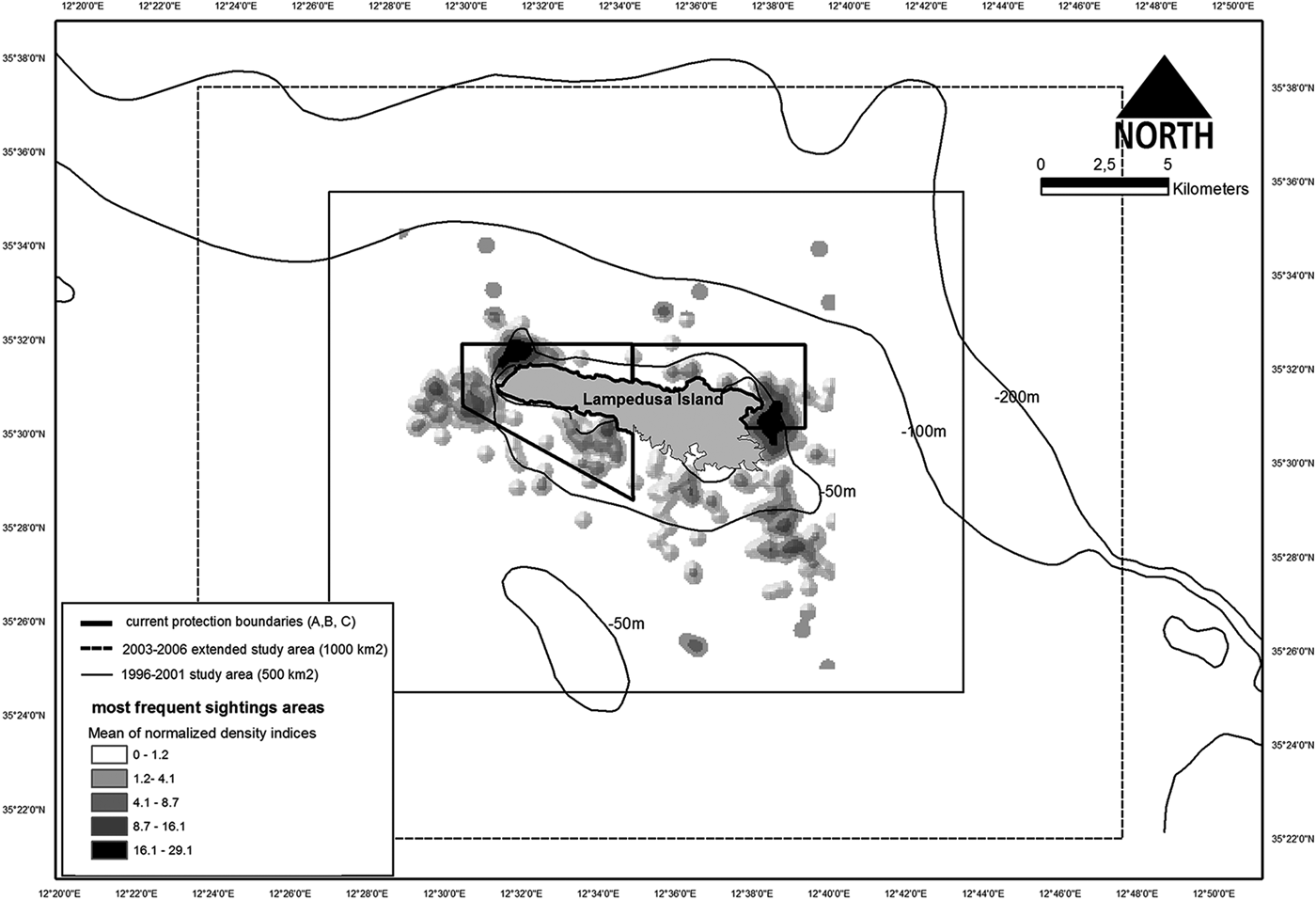
In 2002, Lampedusa, Lampione and Linosa Islands were designated as the ‘Pelagian Islands’ Marine Protected Area (MPA) (Figure 1). This designation did not include data on the presence of cetaceans. Later, as part of a LIFE Nature project (NAT/IT/000163), data collected between 2003 and 2006 provided the scientific basis to draw up the bottlenose dolphin Action Plan for the Pelagian Islands MPA (APt) (Azzolin et al., Reference Azzolin, Celoni, Galante, Giacoma and La Manna2007). This was adopted by the MPA Management Authority in 2008. However, the APt has not yet been implemented, except for a short-term local study on boat traffic and associated noise (La Manna et al., Reference La Manna, Clò, Papale and Sarà2010; Papale et al., Reference Papale, Azzolin and Giacoma2011).
The current Lampedusa MPA zoning. Boundaries of the core study area (1996–2001 study area; 500 km2, plain line) and of the extended study area (2003–2006 study area; 1000 km2, dashed line) are highlighted. The black spots show the most frequent sightings areas.

In the present work analysis of photo-identification data of the bottlenose dolphins living in the waters surrounding Lampedusa Island was used to fulfil the following objectives: (i) to obtain baseline information on abundance and degree of residency of the population; (ii) to review the current MPA Lampedusa boundaries in view of proposing the establishment of a new Special Area of Conservation (SAC); and (iii) to explore the potential and limitation of the analysis of heterogeneous datasets in respect to improving future data collection methods.
MATERIALS AND METHODS
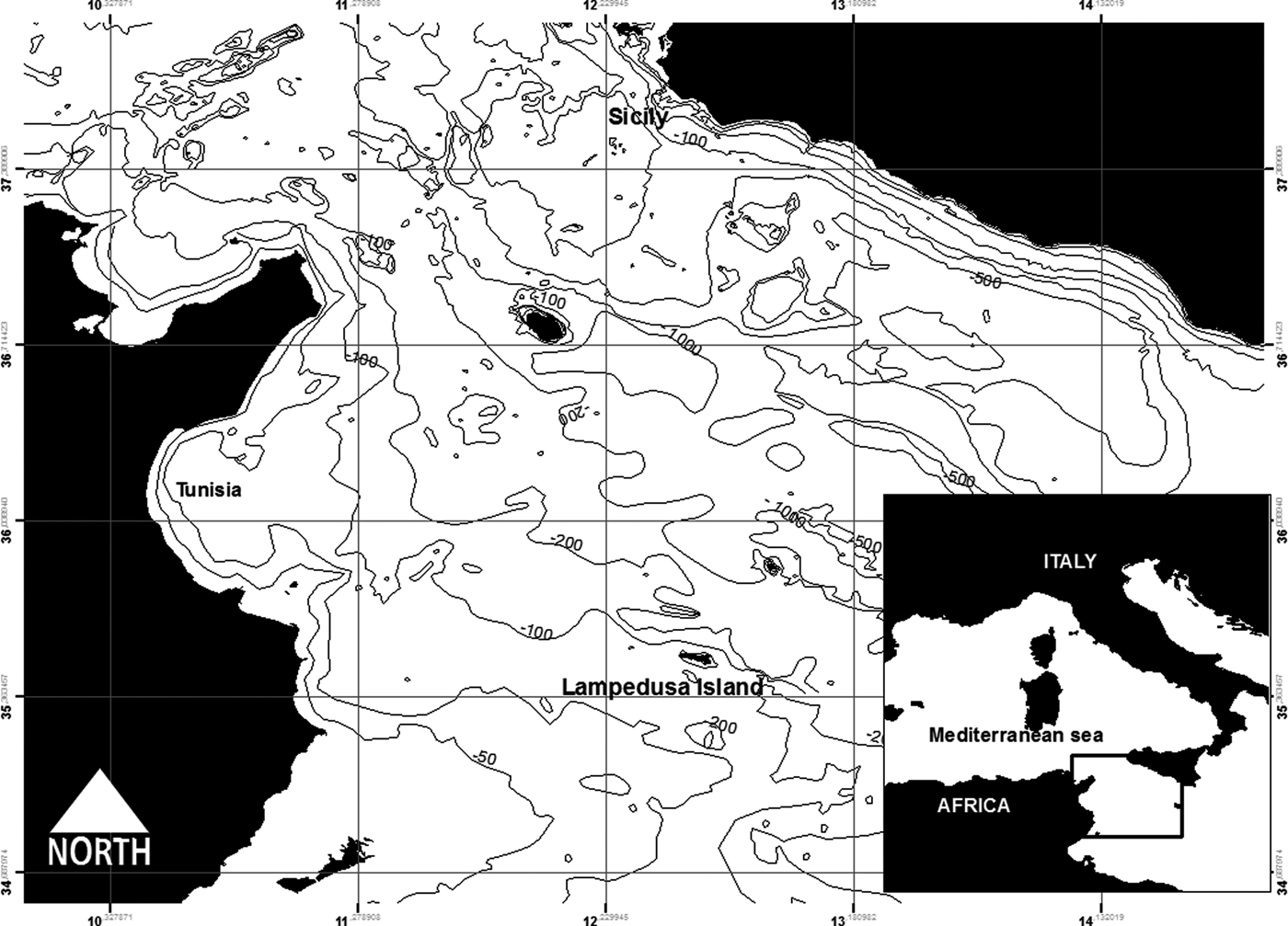
This study was conducted in the waters surrounding Lampedusa Island, the biggest island of the Pelagian Archipelago (Sicily Channel, Italy) (Figure 2). This island is located on the North African continental shelf, about 150 km from the Tunisian coast and 250 km from the Sicilian coast. This region is an exchange area for the water masses of the eastern and western Mediterranean basins, with a complex bathymetry that strongly influences water currents of this region (Pernice, Reference Pernice2002). The Strait of Sicily connects the two main basins of the Mediterranean, the western and the eastern. At its narrowest point, between Cape Bon (Tunisia) and Mazara del Vallo (Sicily), the Strait is about 130 km wide. It is characterized by a two-layer flux model, like the Strait of Gibraltar. The upper layer, called ‘Modified Atlantic Water’ (MAW), is identified by water with a relatively low salinity flowing from the western towards the eastern basin. The lower layer, called ‘Levantine Intermediate Water’ (LIW), is identified by water with a relatively high salinity flowing in the opposite direction, like an undercurrent. The complex bathymetry influences the features of the currents in the region (Fiorentino et al., Reference Fiorentino, Garofalo, Gristina, Gancitano and Norrito2002).
Extended area in which the study area is located.
The Sicily Channel is a very important fishing ground, as witnessed by the important fleets operating there and the associated fish production (Gristina et al., Reference Gristina, Bahri, Fiorentino and Garofalo2006). This is probably one of the most important fishing areas for demersal resources in the Mediterranean Sea (Gristina et al., Reference Gristina, Bahri, Fiorentino and Garofalo2006). Trawling in the Strait of Sicily began in the early 1900s but became intensive after the 1970s. In particular, the Mazara delVallo trawl fishery (south-western Sicilian coast), is one of the most important in the Mediterranean Sea (about 180 trawl vessels). The 21% of the trawl fleet (mean GRT = 76) operates in the Sicilian coastal waters with short fishing trips (1–2 d); the remaining 79% of the trawl fleet is characterized by boats up to 105 GRT that make deep-sea fishing and carry out long trips (21–25 d) in the Strait of Sicily. It has heavily exploited the demersal resources of the Strait of Sicily, causing their slow decline (Levi et al., 1998). Although there is evidence of overfishing for single target stocks (Levi et al., 1998), the impact of fishing on demersal fish communities in this area has hardly been investigated (Gristina et al., Reference Gristina, Bahri, Fiorentino and Garofalo2006).
The demersal fish community of the area surrounding Lampedusa Island shows clear symptoms of stress: the fish community, strongly reduced in standing stock, appears dominated by only two species (Gadiculus argenteus and Merluccins merluccius) that constitute more than 73% of the total catch, whilst elasmobranchs are poorly represented (Gristina et al., Reference Gristina, Bahri, Fiorentino and Garofalo2006).
Cetaceans data collection referring to the first (1996–2001) and the second (2002–2006) period was conducted with different sampling protocols, by three research groups, mostly working opportunistically on a voluntary basis. Surveys between 2003 and 2005, carried out within a LIFE Nature Project NAT/IT/000163, were conducted all year-round on a more structured basis. Throughout the sampling period protocols were strongly affected by the availability of personnel, funds and equipment, as well as weather conditions. Particularly relevant for this paper are the changes that occurred in the: (1) size of the study area; (2) photo-identification equipment; and (3) photo-identification effort, both in terms of duration of the research seasons and frequency of surveys. The size of the study area increased from approximately 500 km2 (‘core study area’) to about 1000 km2 (Comparetto et al., Reference Comparetto, Galante, Poledri, Giacoma, Azzolin, Cimmaruta and Bondanelli2006) (‘extended study area’) in the last triennium (see Figure 1). Some opportunistic observation was made in the waters around Linosa Island.
Between 1996 and 2001, pictures were taken using 100 ISO colour transparency film and a standard SLR Pentax camera equipped with either a 35–80 mm, a 70–210 mm or a 60–300 mm zoom. From 2004, a Nikon D70 digital camera, with either a 28–300 mm or a 70–300 mm zoom lens was used. The research platform also changed. A 4 m inflatable boat was used in 1996 and 1997; two rigid-hulled inflatable boats (4.5 and 5.2 m long) and a 12 m sailing vessel (only in 2001) were used between 1998 and 2001; and three rigid-hulled inflatable boats (4.7, 5.1 and 5.7 m long) and a 12 m sailing vessel were used in 2002–2006. Despite changes to equipment for each encounter the date, time, initial GPS position (or estimated initial position through a triangulation of the landmarks), species, number of individuals and estimated age-class were recorded. Photo-identification was performed following Würsig & Jefferson (Reference Würsig and Jefferson1990), in each of the 11 years of data collection. In order to detect the potential impact caused by changes to the field protocols, the annual and monthly indices of photo-identification success (number of well-marked individuals per successful photo-identification survey) were calculated together with the annual number of recaptured individuals. A ‘successful photo-identification survey’ was a trip in which at least one well-marked dolphin was ‘captured’ (photo-identified).
In order to avoid misidentification, two researchers independently matched the data-sets. Only photographs portraying sharp images of dorsal fins with a minimum relative size of about one-ninth of the frame were used. Only dolphins with distinctive dorsal fin profiles, marked with evident nicks and carrying permanent marks suitable for a long-term identification, were used for mark–recapture analyses. This choice was made to avoid the violation of two of the basic assumptions of mark–recapture theory: (a) markings do not change over the years; and (b) that all the marks upon recapture are correctly reported (Hammond, Reference Hammond1986; Wilson et al., Reference Wilson, Hammond and Thompson1999). Only one expert made the final selection of well-marked dolphins from the catalogue. Sighting data were pooled into ‘monthly capture occasions’ (equivalent to monthly sampling bouts). Sampling occasions between two consecutive monthly sampling bouts were separated by periods ranging between 4 and 31 d (9 d on average). It is difficult to determine whether complete mixing took place between sampling bouts. However, we estimated that four days would guarantee that mix, as theoretically this is a period of time sufficient to allow coherent displacement within and outside the study area.
Annual mark–recapture (MR) analyses on capture histories of well-marked dolphins were made using the MARK software v.4.3 (freely available at http://www.cnr.colostate.edu/~gwhite/mark/m). Only years where a sufficient number of sampling bouts, captured animals and recaptures were available were used for this analysis. In addition when only two ‘sampling bouts’ were available, and in order to explore potential trends of well-marked dolphins in sequential pairs of years, the Chapman's modification of Petersen's two-sample estimator was used (Hammond, Reference Hammond1986). This estimator assumes that all individuals had the same probability of being captured in at least one of the two years and that there was a complete mix of animals between years. The general assumption on demographic closure is undoubtedly violated for dolphins, considered that births and deaths occur. However, the positive bias resulting from this violation is considered only a low percentage (Hammond, Reference Hammond1986). The best model was automatically selected by MARK based on χ2 tests of explained deviance. In addition, when the Chao (Mth) estimator was not selected automatically, it has been also applied for comparison. This model relaxes the assumptions on heterogeneity of captures and their temporal variability, and is generally deemed to be more appropriate for the bottlenose dolphins (e.g. Wilson et al., Reference Wilson, Hammond and Thompson1999; Bearzi et al., Reference Bearzi, Agazzi, Bonizzoni, Costa and Azzellino2008; Gnone et al., Reference Gnone, Bellingeri, Dhermain, Dupraz, Nuti, Bedocchi, Moulins, Rosso, Alessi, McCrea, Azzellino, Airoldi, Portunato, Laran, David, Di Meglio, Bonelli, Montesi, Trucchi, Fossa and Wurtz2011).
The annual abundance estimates were corrected according to the proportion of unmarked dolphins, after Wilson et al. (Reference Wilson, Hammond and Thompson1999). The estimated proportion of animals with long-lasting marks (well-marked animals) in the population was calculated based only on those encounters where all individuals in the school were photographed, regardless of their degree of markings (Wilson et al., Reference Wilson, Hammond and Thompson1999). Log-normal confidence intervals for the total population size were calculated after Thompson et al. (Reference Thompson, White and Gowan1998).
Our final selection for the best abundance estimates was based on the combination of the following three criteria: (i) capture probabilities (cp) > 0.20; (ii) coefficient of variation (CV) < 0.30; and (iii) type of models allowing relaxation of those assumptions typically violated by cetaceans (Mth, Mt and Mh).
To assess the potential effects on the total abundance of changes in the size of the study area, an additional annual abundance estimate based only on the data collected within the ‘core study area’ (500 km2) was calculated. Annual abundance estimates within the ‘core study area’ were compared and tested for their significance, using a log-transformed simple z-test (Thompson et al., Reference Thompson, White and Gowan1998).
Finally as a measure of site fidelity, we considered a dolphin as ‘regular’ when it was present, at least twice, at the beginning (time frame ‘1996–2001’) and at the end (time frame ‘2004–2006’) of the study, as opposed to potential ‘visitors’ seen only once between the first and the second part of this study. It is important to notice that a proportion of visitors seen only at the end of the second part of the study could actually be ‘new’ residents.
RESULTS
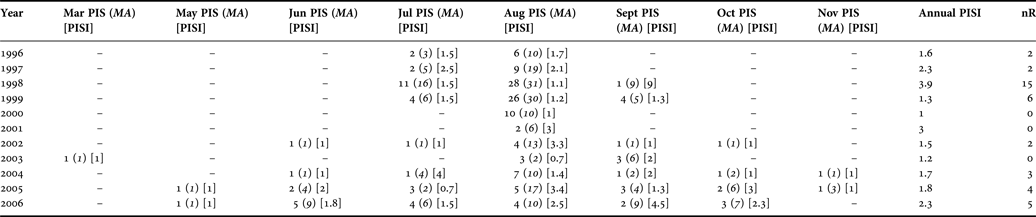
Table 1 gives a summary of the number of successful photo-identification surveys for each month, the number of well-marked photo-identified dolphins, the annual and monthly index of photo-identification success and the number of annual individual recaptures, between 1996 and 2006.
Summary of photo-identification effort and success (1996–2006).
Key: PIS, number of successful photo-identification surveys; PISI, photo-identification success index; MA, number of ‘marked’ animals; nR, annual number of ‘recaptures’.
In terms of distribution, the most resident dolphins were more regularly sighted in various areas around Lampedusa Island, two of which showed very high densities (Figure 1).
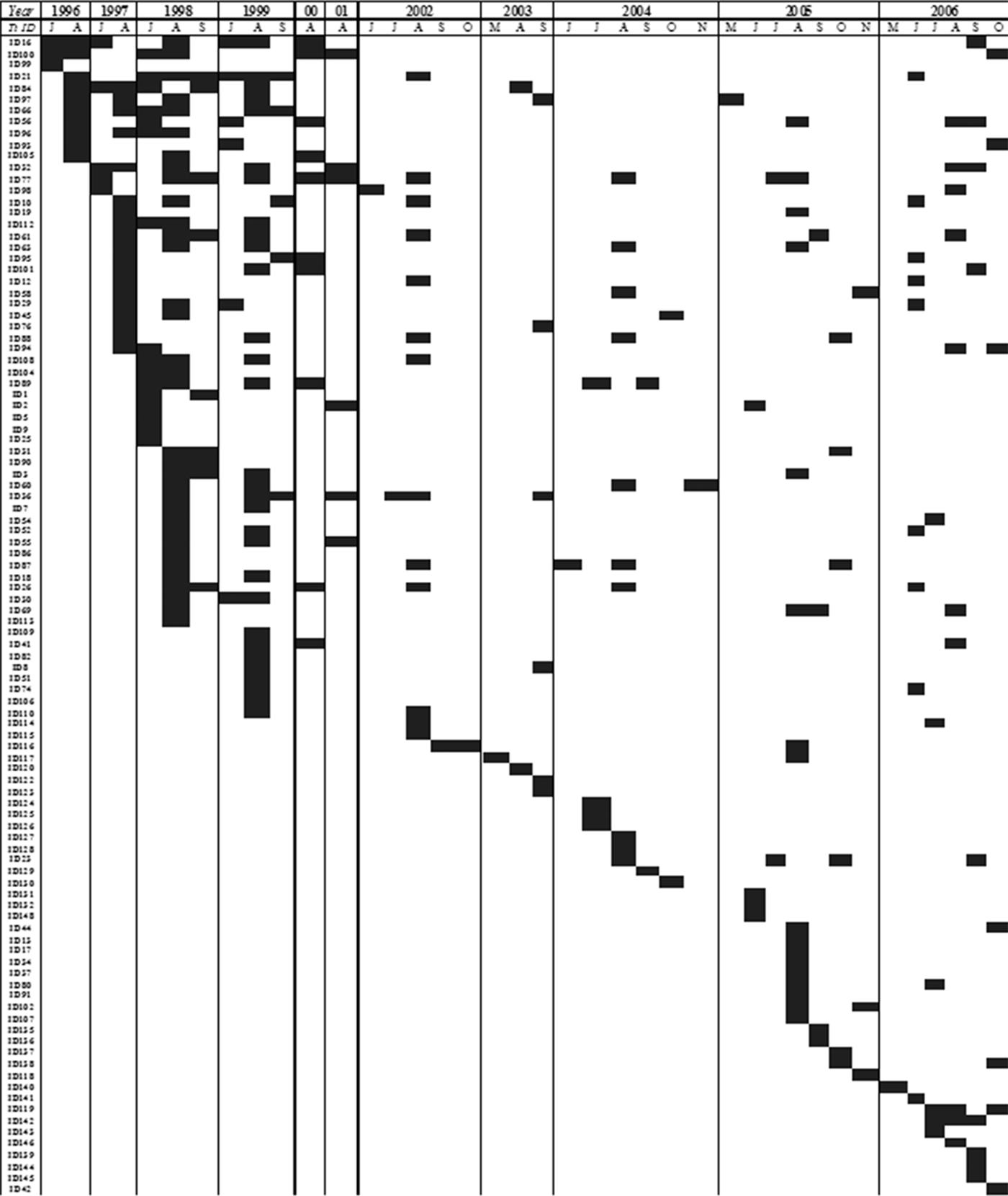
A total of 746 encounters of bottlenose dolphins were recorded throughout the study period. In total 173 encounters were successful in terms of photo-identification of well-marked animals. Out of 148 photo-identified bottlenose dolphins 102 were defined as well-marked (Table 2) and their capture histories were used for MR modelling. Of these 102, sixty individuals were photo-identified between 1996 and 2001 (Figure 3; Table 2). Thirty-four dolphins (33%) were defined as ‘regular’ and 42 dolphins (41%) as ‘potential visitors’. Eighteen dolphins were seen in the first part of the study period (1996–2001), but not in the second part (2002–2006), whereas 42 dolphins were seen only during the second part of the study.
Capture histories of well-marked bottlenose dolphins from Lampedusa Island.
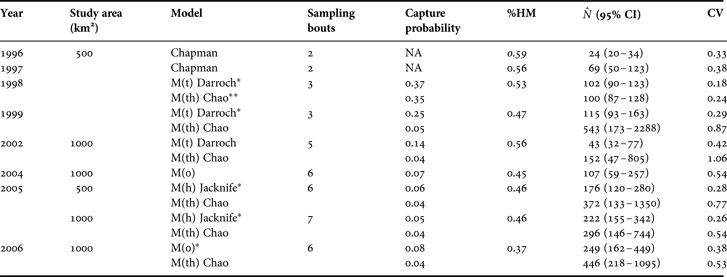
Total annual abundance estimates.
Key:  $\hat {N}$, total abundance estimate corrected for the proportion of unmarked animals; *, statistically selected ‘best model’; **, our ‘best model’ selection; %HM, annual mean percentage of well-marked animals; 95% CI, lower and upper 95% confidence limits; CV, coefficient of variation. Note: in 2000, 2001, 2003 data were insufficient to estimate the abundance.
Bottlenose dolphin group size ranged from 1 to 20 individuals. The mean group size was four individuals (N = 351; SD = 3.14).
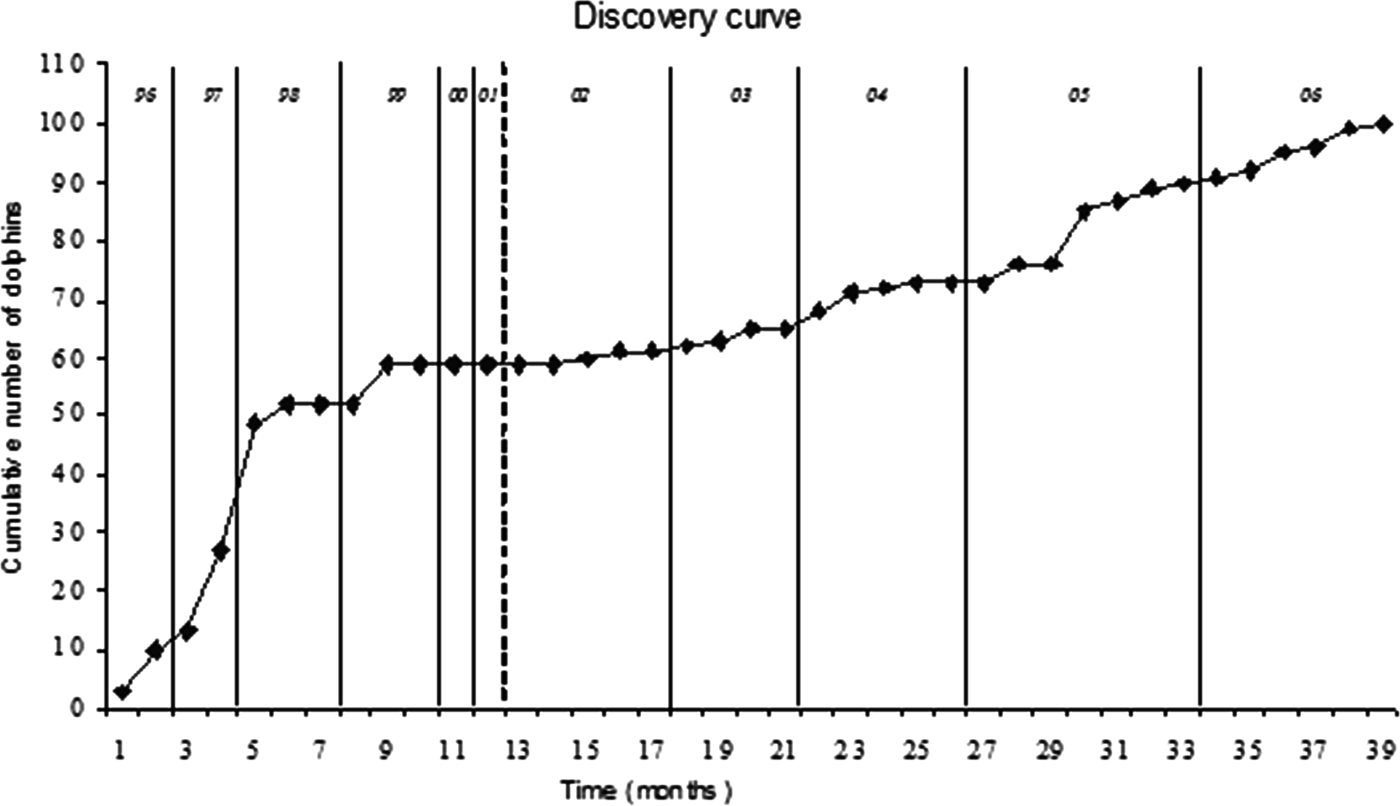
After an initial marked increase, the discovery curve showed an asymptotic trend in 1998, followed by new increase in 1999 and a further asymptotic trend between 1999 and 2003–2004. Afterwards the curve started increasing again (Figure 4).
Bottlenose dolphins' discovery curve (plain bars separate years; dashed bar separates first and second study periods).
From the individual capture histories of the well-marked dolphins (Figure 3), it is clear that the three different research regimes influenced the success of the photo-identification surveys and the annual recapture rate (Table 1). In particular, a lower index of photo-identification success can be seen in the period 2004–2006 when compared to 1996–1999 (1.9 vs 2.3 photo-identified individuals/successful surveys). This provided a lower mean annual recapture rate (4.0 vs 6.3 photo-identified individuals/successful surveys). The intermediate period 2002–2003 was characterized by a mean index of photo-identification success of 2.0 and a mean of annual recaptures of 1.0.
The annual estimates for total abundance are shown. The best estimates from the 1998 data showed capture probabilities (cp) between 0.35–0.37 and CVs in a range 18–24%. For the second period, 2005, capture probabilities were extremely low in the range 0.04–0.06 and CVs in a range 26–54%. This was registered for 2002, 2004 and 2006 as well, with capture probabilities in a range 0.04–0.14 and CVs in a range 38–106%. In 2002, capture probabilities were the highest (cp = 0.14) within the second part of this study, but still relatively low and the CV of abundance estimate was high (42%). The data from 2000, 2001 and 2003 did not allow any estimation, due to low capture success and also single sampling bout in 2000 and 2001 (see Tables 1 & 2). The 2005 ‘extended study area’ annual estimate was significantly higher than that of 1998 (z = 3.093; P < 0.002). This was also the case when using only the ‘core study area’ dataset (z = 2.160; P < 0.05). Moreover, the two 2005 estimates (‘core study area’ vs ‘extended study area’) did not statistically differ (z = 0.720; P > 0.05).
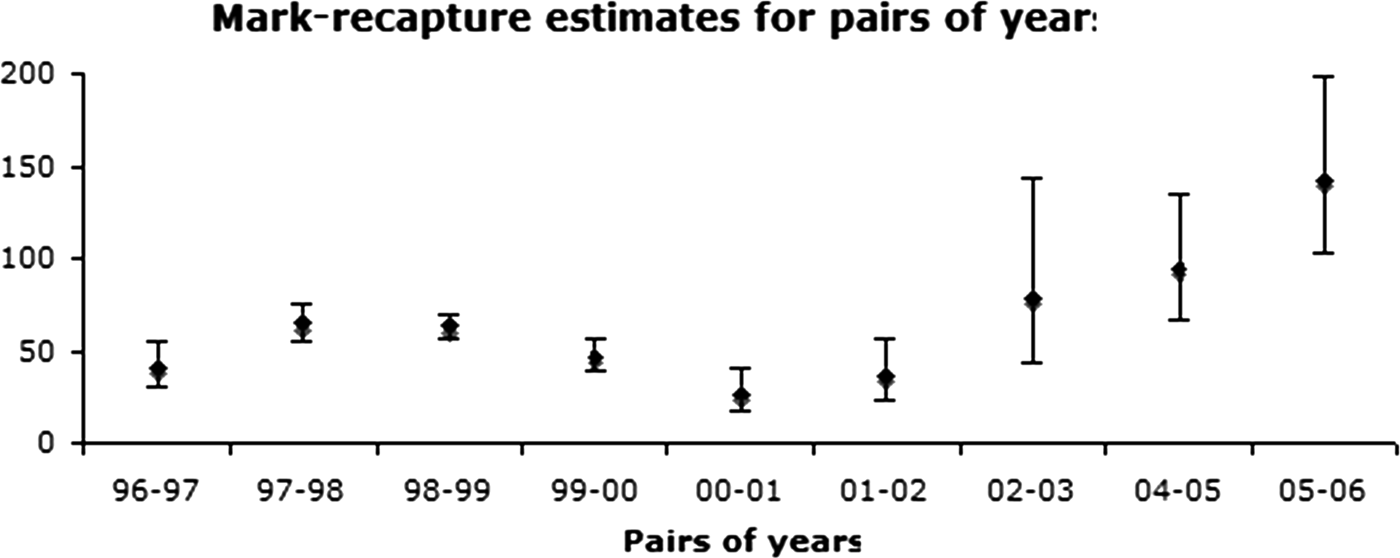
The biennial abundance estimates of well-marked dolphins (uncorrected for the proportion of unmarked animals) obtained for pairs of years are shown in Figure 5. During the first research period, the number and identity of dolphins sighted in consecutive years remained stable (Figure 3). No trend in abundance was detected (Figure 5). In the second part of the study, the number of well-marked dolphins increased in consecutive years, with an extremely low rate of re-sighting (Table 1). The estimates related to the ‘1998–1999’ and ‘2005–2006’ biennial periods, differed significantly (z = −3.387; P < 0.001).
Mark–recapture estimates for pairs of years of well-marked animals only.
DISCUSSION
This study represents the first quantitative assessment of the total abundance of the putative bottlenose dolphin population inhabiting waters surrounding Lampedusa Island (Pelagian Archipelago). Despite some limitations, due to the heterogeneity of data collection protocols, by consolidating distinct data-sets we obtained baseline data on the abundance of bottlenose dolphins using a large portion of the Pelagian MPA. In addition indications on temporal changes and important areas for this species were identified with implications for the definition of spatial management measures.
The individual capture histories and distribution of sightings clearly show that a consistent number of dolphins regularly use the study area. Some of these can be considered as ‘regular’ and others as ‘potential visitor’. The most regular dolphins showed a preference for specific coastal areas around Lampedusa (Figure 1). The preference shown by the bottlenose dolphin for the eastern coast of the island could be an ‘artefact’ due to the presence of an aquaculture cage during the period 1997–1999 (Pace et al., Reference Pace, Pulcini and Triossi2003, Reference Pace, Pulcini and Triossi2011; Pulcini et al., Reference Pulcini, Triossi and Pace2004). Fish-farms are known to attract bottlenose dolphins in this and other Mediterranean areas (e.g. Díaz López, Reference Díaz López2009; Pace et al., Reference Pace, Pulcini and Triossi2011). Conversely, other highly used areas (Figure 1) appear to represent important natural habitats, where feeding (some fishery-related) and social activities regularly occur (Pace et al., Reference Pace, Pulcini and Triossi2003, Reference Pace, Pulcini and Triossi2011; Pulcini et al., Reference Pulcini, Triossi and Pace2004). These observations validate previous suggestions that this bottlenose dolphin population regularly uses this area for feeding, mating and calving (Pace et al., Reference Pace, Pulcini and Triossi1999; Pulcini et al., Reference Pulcini, Triossi and Pace2004).
Between 2002 and 2006, the photo-identification success was unsatisfactory, resulting in a very low re-sighting rate. This is confirmed by the pattern of capture histories (Figure 3) of selected individuals, the annual and monthly capture indices and recapture rates (Tables 1 & 2). It is apparent that the temporal and geographical extensions of the fieldwork and data collection after 2001 do not provide a sufficient level of individual photographic recaptures for obtaining reliable MR estimates. The low rate of re-sighting is unlikely due to the changes in dolphin site fidelity, especially for those considered to be ‘regular’ during the study period. It is more likely caused by a mix of factors related to monthly research effort, experience of fieldworkers and continuous adjustments to new research equipment (e.g. research boats, cameras, etc.). The use of a digital camera after 2003 did not seem to produce any improvement in photo-identification success.
The discovery curve, and both the annual and biennial abundance estimates, suggest that the number of well-marked dolphins using the study area may have increased after 2001. This trend does not appear to be a result of the expansion of the study area. The increase is supported when comparing abundance estimates obtained in 1998 and 2005 for the ‘core study area’ (500 km2). In addition, this increase cannot be explained by the change of research protocols for photo-identification, given that a lower photo-identification success in the second part of the study should have resulted in a reduction in numbers of dolphins rather than an increase.
Pulcini et al. (Reference Pulcini, Triossi and Pace2004) analysing preliminary data from 1996 to 2000 found the discovery curve moving towards asymptotic suggesting a stable local population. In this study we found specific periods in which the discovery curve reached an asymptote (1998, 1999 and 2004). Assuming that in these periods ‘emigration/deaths’ and ‘immigration/births’ had a negligible impact on our estimates (Hammond, Reference Hammond1986), we propose that our 1998 estimate is robust and should be taken as baseline value for management purposes. The two 1998 estimates (Table 2) are very similar and statistically equivalent. The Mth Chao estimator allowing the relaxation of two mark–recapture assumptions typically unmet by cetaceans (individual heterogeneity and temporal variation in capture probability) is usually preferred by cetacean researchers (e.g. Wilson et al., Reference Wilson, Hammond and Thompson1999; Bearzi et al., Reference Bearzi, Agazzi, Bonizzoni, Costa and Azzellino2008; Gnone et al., Reference Gnone, Bellingeri, Dhermain, Dupraz, Nuti, Bedocchi, Moulins, Rosso, Alessi, McCrea, Azzellino, Airoldi, Portunato, Laran, David, Di Meglio, Bonelli, Montesi, Trucchi, Fossa and Wurtz2011). The estimate for 2005 calculated for the core study area alone indicates an increase in the number of dolphins using the region. However, given the low rate of capture probabilities (cp = 0.06) and the increasing trend of the discovery curve, this cannot be considered as sufficiently robust for management purposes. Yet, this increase is supported by the capture histories of well-marked animals (Figure 3). This could be caused by either a strong rate of increase within the Lampedusa putative population during the study period, or by the expansion into the study area of adjacent populations, or both. Considering the geographical location of Lampedusa Island—right in the middle of the Sicily Channel, on the Tunisian continental shelf—the ‘invasion’ by neighbouring populations would not be surprising. Moreover for this species these events have been already described by other authors in other areas (Cañadas & Hammond, Reference Cañadas and Hammond2006). This scenario would obviously complicate the management of this species, requiring further investigations on the structure of the possible meta-population and the abundance of bottlenose dolphins at a wider scale (Figure 6).
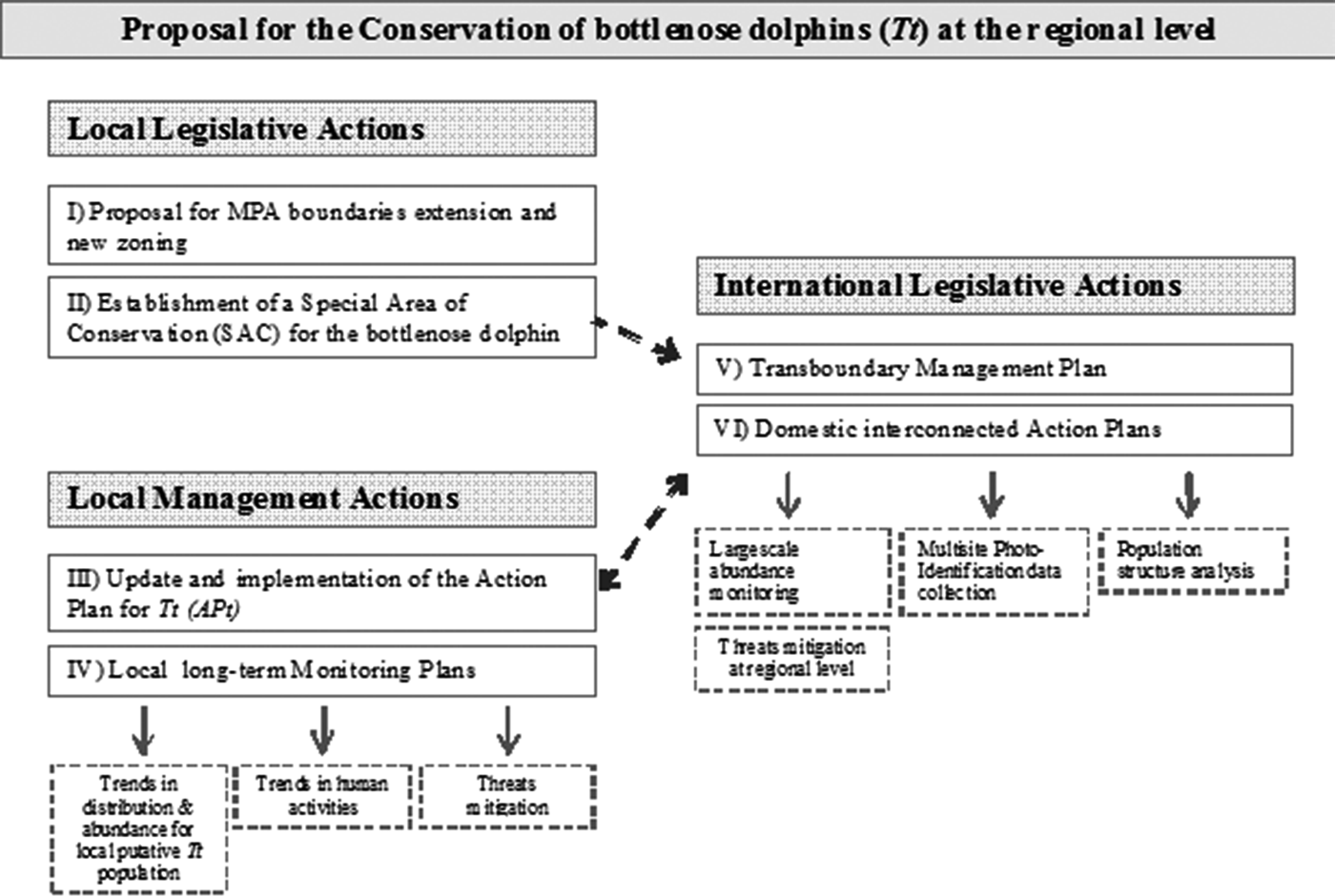
Proposal for a regional Conservation Plan.
The Pelagian Archipelago was declared as an area characterized by relatively low human impact (Azzolin et al., Reference Azzolin, Celoni, Galante, Giacoma and La Manna2007) in the bottlenose dolphin Action Plan for the Pelagian Islands MPA (APt) due to it being geographically isolated. However, its waters are exploited by different kind of fisheries, with a significant impact of trawlers operating principally in the south-eastern and western parts of the island (Pace et al., Reference Pace, Pulcini and Triossi2011). Moreover, an aquaculture inshore cage (containing greater amberjacks Seriola dumerilii) was placed at about 35 m depth off the eastern part of the island, between 1997 and 1999, causing a local temporary ecological change around the island. The fish farm was destroyed by a storm in 1999 and never re-established (Pace et al., Reference Pace, Pulcini and Triossi2011).
As well as the bottlenose dolphin population this archipelago has already been identified as ecologically important for other cetacean species, including short-beaked common dolphins (Delphinus delphis) (Pace et al., Reference Pace, Pulcini and Triossi1999) and fin whales (Balaenoptera physalus) (Canese et al., Reference Canese, Cardinali, Fortuna, Giusti, Lauriano, Salvati and Greco2006). This area is also recognized as critical habitat for one of the Habitats Directive priority species, the loggerhead sea turtle (Caretta caretta) (Margaritoulis et al., Reference Margaritoulis, Argano, Baran, Bentivegna, Bradai, Caminas, Casale, De Metrio, Demetropoulos, Gerosa, Godley, Houghton, Laurent, Lazar, Bolten and Witherington2003; Mingozzi et al., Reference Mingozzi, Masciari, Paolillo, Pisani, Russo and Massolo2007).
Our results suggest that the bottlenose dolphin is locally abundant compared to other Mediterranean areas (Fortuna et al., Reference Fortuna, Wilson, Wiemann, Riva, Gaspari, Matesic, Oehen and Pribanic2000; Lauriano et al., Reference Lauriano, Mackelworth and Fortuna2003; Forcada et al., Reference Forcada, Gazo, Aguilar, Gonzalvo and Fernandez-Contreras2004; Cañadas & Hammond, Reference Cañadas and Hammond2006; Gomez de Segura et al., Reference Gomez de Segura, Crespo, Pedraza, Hammond and Raga2006; Genov et al., Reference Genov, Kotnjek, Lesjak, Hace and Fortuna2008; Gnone et al., Reference Gnone, Bellingeri, Dhermain, Dupraz, Nuti, Bedocchi, Moulins, Rosso, Alessi, McCrea, Azzellino, Airoldi, Portunato, Laran, David, Di Meglio, Bonelli, Montesi, Trucchi, Fossa and Wurtz2011). Densities observed here appear to be similar to those observed in Greece (Bearzi et al., Reference Bearzi, Agazzi, Bonizzoni, Costa and Azzellino2008) and in neighbouring Tunisian waters (Ben Naceur et al., Reference Ben Naceur, Gannier, Bradai, Drouot, Bourreau, Laran, Khalfallah, Mrabet and Bdioui2004). The bottlenose dolphins frequenting Lampedusa waters could well be part of a larger meta-population inhabiting the eastern Mediterranean basin.
Our qualitative and quantitative results help to identify some of the characteristics of the local Pelagian putative population. They give a baseline for the management of this species. On this basis we suggest a number of management, legislative, research and monitoring actions (Figure 6) that expand the existing APt (Azzolin et al., Reference Azzolin, Celoni, Galante, Giacoma and La Manna2007), hopefully facilitating the definition of a transboundary management plan for this species (Figure 6V).
Given the limited size of the survey areas during this study, and the lack of large-scale studies on distribution and abundance of bottlenose dolphins in the Sicily Channel, it is not possible to establish whether this population is open or closed. However, it is clear that the extension of the study area cannot be the cause of the increased numbers of dolphin. As it is difficult to discriminate between the growth of the local population or the periodic external influxes from other putative populations, these aspects should be considered by regional authorities when establishing regional management plans for this species (Figure 6VI). While visiting conspecifics entering in the waters of the MPA would certainly improve the genetic mixing of the population these events would complicate the management, requiring trans-national management plans agreed by Italian and neighbouring competent authorities (Figure 6V). The general uncertainty associated with this population requires a flexible adaptive management approach.
Our results support two legislative actions: first the enlargement of the MPA boundaries (Figure 6I), around Lampedusa Island, with a new zoning taking into account bottlenose dolphins preferred habitats (Figure 1). Secondly the establishment of a SAC for the conservation of bottlenose dolphins in this area (Figure 6II). Both legislative actions would require an update and the implementation of the adopted APt of the ‘Pelagian Archipelago’ MPA (Azzolin et al., Reference Azzolin, Celoni, Galante, Giacoma and La Manna2007) (Figure 6III).
While a SAC would contribute towards the favourable conservation of this species at local level, it should also help stimulate a wider international interest necessary for the effective conservation of the bottlenose dolphin at regional level. This approach should be implemented through a multilateral agreement, involving Italy, Malta and Tunisia. This would entail the development of a Transboundary Management Plan (TMP) for the conservation of the bottlenose dolphins of the Sicily Channel, including Maltese waters, and the Gulf of Gabès (Figure 6V). The TMP should consist of (Figure 6VI): (a) three domestic Action Plans for the Pelagian islands, Malta and Tunisia, including local long-term bottlenose dolphins monitoring schemes; (b) periodical large-scale monitoring actions, aiming at obtaining data on bottlenose dolphin distribution and abundance over the wider continental shelf; (c) a genetic study to assess the regional structure of the bottlenose dolphin population; and (d) a coordinated multi-site photo-identification programme in three agreed locations chosen in the Pelagian Archipelago, Tunisian and Maltese waters.
The quantitative evaluation of trends in distribution and abundance is a fundamental requirement for species listed in Appendices II and IV of the Habitats Directive, such as the bottlenose dolphin. Undertaking an analytical study for the use of heterogeneous data-sets can cause some limitations, due to the different research regimes and protocols, the level of fieldworker experience and the funding restrictions (Gnone et al., Reference Gnone, Bellingeri, Dhermain, Dupraz, Nuti, Bedocchi, Moulins, Rosso, Alessi, McCrea, Azzellino, Airoldi, Portunato, Laran, David, Di Meglio, Bonelli, Montesi, Trucchi, Fossa and Wurtz2011). These limitations can affect the results by increasing the uncertainty around the estimated values and making it difficult to evaluate trends. However, in a field where research has been conducted through self-funded and voluntary studies, any rigorous attempt of pooling and consolidating existing data-sets is necessary to produce baseline information (for example, Gnone et al., Reference Gnone, Bellingeri, Dhermain, Dupraz, Nuti, Bedocchi, Moulins, Rosso, Alessi, McCrea, Azzellino, Airoldi, Portunato, Laran, David, Di Meglio, Bonelli, Montesi, Trucchi, Fossa and Wurtz2011). Based on the lessons learned in this study from the use of data collected by three different research groups, we recommend the following (Figure 6IV, VI):
• the MPA and trans-boundary management authorities should plan a rigorous system for data sharing, based on existing studies. The principal aim should be to use data for practical conservation rather than for purely scientific, educational or promotional interests;
• the MPA and trans-boundary management authorities should request researchers to provide a standard protocol for data collection to be officially adopted and made widely available;
• in terms of fieldwork planning, should funding be a limiting factor, the protocol should clearly support intensive research effort, during favourable weather conditions' months, and require the presence of at least one experienced researcher for the entire fieldwork season.
ACKNOWLEDGEMENTS
Many people helped in the data collection throughout the years coordinated by the CTS and the NGO Oceanomare-Delphis and we are grateful to all of them. We wish to thank the Italian Coastguard and all the volunteers for their assistance in our fieldwork. Special thanks to Simona Clò (CTS Nature Conservation Department) for her support and to Peter Mackelworth for revising content and language of this manuscript.
FINANCIAL SUPPORT
A part of this research was also carried out under the auspices of LIFE Nature Project NAT/IT/000163 (‘Mitigation of anthropogenic activities on loggerhead turtles and bottlenose dolphins and their conservation in Sicily’).