Introduction
It is now clear that recently detoxified alcoholics present cognitive deficits such as episodic memory disorders and executive dysfunctions (Noel et al. Reference Noel, Van der Linden, Schmidt, Sferrazza, Hanak, Le Bon, De Mol, Kornreich, Pelc and Verbanck2001; Pitel et al. Reference Pitel, Beaunieux, Witkowski, Vabret, Guillery-Girard, Quinette, Desgranges and Eustache2007a), which have a harmful impact on new complex learning abilities including new label acquisition (Pitel et al. Reference Pitel, Witkowski, Vabret, Guillery-Girard, Desgranges, Eustache and Beaunieux2007b). The use of rehabilitation methods such as errorless learning (Baddeley & Wilson, Reference Baddeley and Wilson1994) may be relevant when teaching new concepts' labels to alcoholics is considered.
Errorless learning refers to a learning condition that involves the elimination of errors during the learning process (Clare & Jones, Reference Clare and Jones2008). Indeed, according to Baddeley & Wilson (Reference Baddeley and Wilson1994), amnesic patients repeat their errors in the course of the acquisition, learning them instead of the correct answers (Squires et al. Reference Squires, Hunkin and Parkin1997) and leading to learning impairments. Thus, the main goal of errorless learning is to compensate for the deficits of episodic memory, which is assumed to be in charge of error elimination (Baddeley & Wilson, Reference Baddeley and Wilson1994). Even though errorless learning has been used successfully many times (see Clare & Jones, Reference Clare and Jones2008 for review), several questions remain regarding notably the flexibility of the new knowledge and the nature of the memory processes involved.
Flexibility is the capacity of knowledge to be generalized or transferred to other situations. Only single case studies of memory impaired patients (e.g. Clare et al. Reference Clare, Wilson, Breen and Hodges1999; Martins et al. Reference Martins, Guillery-Girard, Jambaque, Dulac and Eustache2006; Pitel et al. Reference Pitel, Beaunieux, Lebaron, Joyeux, Desgranges and Eustache2006) have suggested that information acquired with errorless learning may be flexible. Flexible new knowledge may result from the involvement of explicit memory mechanisms whereas rigid new knowledge may instead reflect implicit memory processes. Thus, two hypotheses are currently the topic of a debate about the memory processes responsible for the errorless learning advantage: the implicit hypothesis developed by Baddeley & Wilson (Reference Baddeley and Wilson1994) and the explicit hypothesis proposed by Hunkin et al. (Reference Hunkin, Squires, Parkin and Tidy1998b). Recent studies addressing this issue did not provide consensual findings, notably because the relationships between errorless learning and implicit/explicit memory have been examined indirectly (e.g. Tailby & Haslam, Reference Tailby and Haslam2003; Anderson & Craik, Reference Anderson and Craik2006; Page et al. Reference Page, Wilson, Shiel, Carter and Norris2006) or an inappropriate measure of implicit memory was used (Hunkin et al. Reference Hunkin, Squires, Parkin and Tidy1998b). The use of an implicit learning task, described as non-episodic incidental learning of complex information without any consciousness of learning (Seger, Reference Seger1994), may be particularly relevant because it has been shown to prevent the intervention of explicit processes.
The present investigation had three main aims: (1) to determine the efficacy of the errorless learning technique on new label acquisition in alcoholics; (2) to specify whether knowledge acquired with errorless learning is flexible; and (3) to test whether errorless learning results rely on explicit or implicit memory processes in alcoholics.
Method
Participants
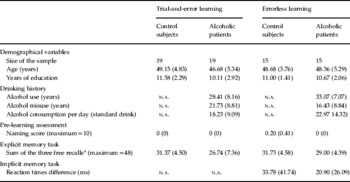
Two groups of subjects (15 controls and 15 alcoholics) in an errorless learning condition were compared with two other groups of subjects in a trial-and-error learning condition (19 controls and 19 alcoholics). The four groups were matched for age and number of years of schooling (Table 1). Trial-and-error learning data have been published previously (Pitel et al. Reference Pitel, Witkowski, Vabret, Guillery-Girard, Desgranges, Eustache and Beaunieux2007b) and were used as the control condition in the present investigation. Alcoholic subjects were recruited by clinicians while they were receiving alcohol treatment as in-patients at Caen University Hospital, according to the DSM-IV criteria of alcohol dependence (APA, 1994). Controls were interviewed to check that they did not meet the criteria for alcohol abuse or dependence. Demographic and clinical data are presented in Table 1. All participants gave their informed consent to the neuropsychological procedure, which was approved by the local ethical committee.
Demographical variables, drinking history, pre-learning assessment and explicit and implicit memory results in the four groups

n.a., Not applicable.
Values given as mean (standard deviation).
a Significant difference between the control groups and the alcoholic groups.
Semantic learning paradigm
Learning design
The semantic learning task, which consists of the acquisition of 10 novel concepts' labels existing in the real world but fairly rare, has been fully described elsewhere (Pitel et al. Reference Pitel, Witkowski, Vabret, Guillery-Girard, Desgranges, Eustache and Beaunieux2007b). In brief, it consisted of five stages: a pre-learning assessment, the presentation of the labels, a learning phase, a learning test and a flexibility task. After the pre-learning assessment and the presentation of the labels on the first day the subjects performed seven daily learning sessions according to the two learning conditions (trial-and-error versus errorless). On the ninth day, a learning test consisting of a naming task with the same photographs as those used during learning was carried out. Finally, on the tenth day and to evaluate the flexibility of the new knowledge, subjects performed another naming task with new photographs of the same concepts. The scores corresponded to the number of correct answers provided.
Learning conditions
In the trial-and-error condition (Pitel et al. Reference Pitel, Witkowski, Vabret, Guillery-Girard, Desgranges, Eustache and Beaunieux2007b), subjects had to provide, for each concept, the label when they were shown the photograph (e.g. a coloured photograph of a ratel) on the screen of a computer. Subjects had to correct their errors themselves from one session to the next, using feedback from the experimenters. In the errorless condition, the modified vanishing cues technique was used (Glisky et al. Reference Glisky, Schacter and Tulving1986; Glisky & Delaney, Reference Glisky and Delaney1996) to teach the concepts' labels to the subjects. During the learning sessions, subjects were asked not to answer if they were unsure, to meet the errorless learning principle (Baddeley & Wilson, Reference Baddeley and Wilson1994).
Explicit memory task
We selected a French version of the Free and Cued Selective Reminding Test (FCSRT) to evaluate episodic memory and more precisely explicit memory processes (Grober & Buschke, Reference Grober and Buschke1987; Grober et al. Reference Grober, Buschke, Crystal, Bang and Dresner1988). We chose to use only the sum of the three free recall trials as the ‘explicit memory score’ because free recalls are assumed to be variables sensitive to deficits in alcoholics (Weingartner et al. Reference Weingartner, Andreason, Hommer, Sirocco, Rio, Ruttimann, Rawlings and Eckardt1996).
Implicit memory task
Subjects in the errorless learning condition carried out an additional computerized (gSRT-Soft; Chambaron et al. Reference Chambaron, Ginhac and Perruchet2008) implicit learning task to evaluate implicit memory capacities. The task was a standard Serial Reaction Time (SRT) task (Nissen & Bullemer, Reference Nissen and Bullemer1987), in which participants had to respond as quickly as possible to a stimulus (blue squares) appearing at one of four locations on the screen by pushing one of four keys. The learning session comprised six blocks of 100 trials. For approximately half of the participants in each group, each trial had an 85% chance of being consistent with sequence A (probable trials) and a 15% chance of being consistent with sequence B (improbable trials). For the remaining participants these were reversed. The ‘implicit memory score’ corresponded to the difference between the mean reaction time for the improbable trials minus the mean reaction time for the probable trials.
Statistical analyses
To examine the effect of errorless learning, we conducted a repeated-measures analysis of variance (ANOVA) with the naming score in the learning test and the flexibility task as repeated variables, and the groups (control versus alcoholic) and learning conditions (trial-and-error versus errorless) as between-subject factors.
We also compared explicit memory results in the four groups using a two-way ANOVA. We then analysed implicit memory results in the two groups in the errorless learning condition by means of an ANOVA on the reaction times collected on the final blocks (blocks 4–6) with the groups (control versus alcoholic) as a between-subject factor and the sequences (probable versus improbable) as a repeated measure.
Finally, we carried out Pearson's correlations between explicit and implicit memory scores on the one hand and the naming score in the learning test on the other.
Results
Pre-learning assessment
The results obtained by the four groups in the pre-learning assessment are summarized in Table 1.
Naming performance in the learning test and in the flexibility task
The repeated-measures ANOVA showed an overall significant effect of group [F(1, 64)=42.09, p<0.001], a significant effect of the learning conditions [F(1, 64)=7.80, p<0.01] and a significant effect of interaction between group and learning conditions [F(1, 64)=6.58, p=0.01]. Post-hoc comparisons revealed that the alcoholic group in the errorless condition differed significantly from the alcoholic group in the trial-and-error condition (p<0.01) but did not differ significantly from the two control groups (p=0.07 for the trial-and-error learning and p=0.06 for the errorless learning condition). There was no significant effect of the repeated variable (learning test versus flexibility task) and no interaction with this factor [F(1, 64) ⩽1 in all cases; Fig. 1].
Results in the learning test and the flexibility task according to the two groups [control (▪) versus alcoholic (○)] and the two learning conditions (trial-and-error versus errorless). * Significant effect of learning conditions (trial-and-error versus errorless). † Significant effect of groups (alcoholic versus control).

Explicit memory task
The two-way ANOVA revealed that there was a significant effect of group [F(1, 64)=7.89, p<0.01] but no significant effect of the learning conditions [F(1, 64)=1.01, p=0.32] or interaction [F(1, 64)=0.52, p=0.47] on the sum of the three free recalls. Post-hoc tests conducted on the significant group effect revealed that, on this task, the alcoholic patients performed significantly worse as a group than the control subjects (p<0.01, Table 1).
Implicit memory task
The ANOVA revealed a main effect of the sequence factor [F(1, 28)=18.50, p<0.001], reflecting the fact that learning had occurred. The effect of groups was also significant [F(1, 28)=19.20, p<0.001], with the mean reaction times being longer for alcoholics than for control participants. However, there was no significant interaction between groups and conditions [F(1, 28)=1.03, p=0.32], indicating that the amount of learning did not differ between control and alcoholic participants. Subsequent planned analyses confirmed that the difference in reaction times between probable and improbable trials (implicit memory score) was significant for both control participants [t(14)=3.13, p=0.007] and alcoholic patients [t(14)=3.10, p=0.008]. There was no significant difference between the alcoholics and the controls regarding the implicit memory score [t(28)=−1.01, p=0.32; Table 1].
Relationships between errorless learning and explicit and implicit memory in the alcoholic group
In the alcoholic group, the naming score in the learning test was correlated with the explicit memory score (r=0.82, p<0.001) but not with the implicit memory score (r=−0.01, p=0.96).
Discussion
Our results show that the alcoholic group in the errorless learning condition performed significantly better than the alcoholic group in the trial-and-error learning condition, confirming the efficacy of the errorless learning in memory-impaired subjects (Wilson et al. Reference Wilson, Baddeley, Evans and Shiel1994; Komatsu et al. Reference Komatsu, Mimura, Kato, Wakamatsu and Kashima2000; Kalla et al. Reference Kalla, Downes and van den Broek2001) even when episodic memory deficits are only mild to moderate. Practical application of the errorless principle to alcohol treatment could be considered when clinicians intend to teach new knowledge and, more particularly, new labels to alcoholic patients with episodic memory disorders.
Moreover, alcoholic patients in the errorless learning condition did not differ significantly from control subjects in the two learning conditions regarding the naming score in session 8. Errorless learning may therefore allow alcoholic patients to normalize the performance of new label acquisition. However, it is worth noting that the comparisons between the alcoholic group in the errorless learning condition and the two control groups revealed tendencies in the p values suggesting that, even when using errorless learning, more learning sessions may be required to allow alcoholic patients to completely normalize learning results.
Our findings also confirm that information acquired by errorless learning is flexible (Hunkin et al. Reference Hunkin, Squires, Aldrich and Parkin1998a; Clare et al. Reference Clare, Wilson, Breen and Hodges1999; Martins et al. Reference Martins, Guillery-Girard, Jambaque, Dulac and Eustache2006) because there was no significant difference between the results in the learning test and the flexibility task in the two groups. The fact that new labels are flexible is in accordance with the correlational results. Indeed, errorless learning performance was significantly correlated with explicit memory results whereas there was no significant relationship with implicit memory results. Taken together, these findings suggest that errorless learning may rely on explicit (Hunkin et al. Reference Hunkin, Squires, Parkin and Tidy1998b) rather than implicit memory processes (Baddeley & Wilson, Reference Baddeley and Wilson1994) in uncomplicated alcoholic patients. However, these results concern mechanisms involved in errorless learning in subjects exhibiting only mild to moderate explicit memory disorders and a different conclusion may be drawn in amnesic patients (Page et al. Reference Page, Wilson, Shiel, Carter and Norris2006; Clare & Jones, Reference Clare and Jones2008). Indeed, errorless learning may be supported by different processes according to the memory profile (Tailby & Haslam, Reference Tailby and Haslam2003). Further studies including explicit and implicit memory assessment in addition to errorless and trial-and-error learning are therefore required in amnesic patients. Such investigations would allow us to determine whether implicit memory processes are involved by default during label learning when explicit memory is severely impaired, resulting in the use of an alternative slow learning route in amnesia (Pitel et al. Reference Pitel, Beaunieux, Guillery-Girard, Witkowski, de la Sayette, Viader, Desgranges and Eustache2009).
Declaration of Interest
None.