Clear conceptualization should be at the core of every comparative study. Gender scholars have a long history of challenging the public/private divide in conventional notions of the political and laying bare the gendered or androcentric character of established concepts such as welfare states (Sainsbury Reference Sainsbury, Goertz and Mazur2008), war (Goldstein Reference Goldstein2001), work (Spierings Reference Spierings2015), or democracy (Paxton Reference Paxton, Goertz and Mazur2008; Walby Reference Walby2009). This criticism often focuses on descriptive and normative meanings (see Goertz Reference Goertz2006, 3). It is descriptive where concepts seek to describe units of analysis such as countries and their levels of democracy and normative because the criticism shows how concepts legitimize androcentric practices. Comparative scholars, however, tend to go one step beyond descriptive comparisons; we seek to explain cross-national variation—for example, why certain countries are democratic, why certain welfare state policies are implemented, or why war occurs. This relates to the relatively new notions of “causal concepts” (Goertz Reference Goertz2006) and the “causal relationship guideline” (Goertz and Mazur Reference Goertz, Mazur, Goertz and Mazur2008).
In this contribution, we develop further the use of causal concepts in comparative gendered analyses by applying it to explanatory concepts or independent variables as well. To do so, we first recapitulate the idea behind causal concepts. Next, we provide two examples where a feminist and gendered lens is applied to the conceptualization of democracy. The first focuses on democracy as a descriptive concept and the theory-building implications of gendering its core definition through Paxton's work (Reference Paxton2000, Reference Paxton, Goertz and Mazur2008). In the second example, we discuss how the notion of causal concepts can be used to gender democracy as an independent variable in the case of democratic peace theory and whether this reflection can help to generate more refined causal theories.
GENDER AND CAUSALITY IN CONCEPTUALIZATION: PRINCIPLES AND GUIDELINES
The recent turn in qualitative-based work on causal concepts and relationships in concept formation, measurement, and theory building (Goertz Reference Goertz2006) provides an opportunity for nonfeminist work on methodology to dialog with gender and politics scholars who seek to gender theories and concepts. Causal concepts provide an opportunity to take into consideration the complexity of the objects we seek to explain, which might lead to a reassessment of old explanations of the phenomenon and to an identification of new ones.
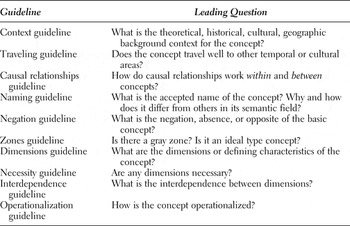
Stated more generally, taking causal issues seriously is an important part of good conceptualization in the process of empirical theory building (Goertz Reference Goertz2006; Goertz and Mazur Reference Goertz, Mazur, Goertz and Mazur2008) because operationalized concepts should reflect causality within concepts as dependent variables and between concepts in terms of how independent variables affect outcomes. Therefore, the causal relationship guideline is one of 10 guidelines identified by Goertz and Mazur (Reference Goertz, Mazur, Goertz and Mazur2008, 15) and applied by the contributors to the volume they coedited on specific concepts used in gender and politics analysis (see Table 1).
List of guidelines for good conceptualization

Source: Goertz and Mazur Reference Goertz, Mazur, Goertz and Mazur2008.
The causal turn in conceptualization in nonfeminist work fits the research agenda for gender and politics quite closely, particularly a “comparative politics of gender,” because the very concept of gender is a causal concept: the way in which men's and women's identities are socially constructed produces varying but persistent gender/sex based inequalities.Footnote 1 Thus, conducting comparative gender and politics research requires careful conceptualization to accurately capture the complexity of gendered processes.
When causal concepts are gendered they often become more complex and arguably more accurate and valid (causality within concepts) and can lead to a set of new hypotheses for explaining why certain gendered processes emerge (causality between concepts). Therefore, if the concept is modified (e.g., gendered), the researcher needs to discuss the implications for the empirical indicators and identify the new independent variables as hypotheses in future empirical studies (Goertz and Mazur Reference Goertz, Mazur, Goertz and Mazur2008, 20–23).Footnote 2
GENDERING AND CAUSALITY BETWEEN CONCEPTS: DEMOCRACY I
Pamela Paxton (Reference Paxton2000, Reference Paxton, Goertz and Mazur2008) parsimoniously yet explosively, adds the requirement of women's full and real universal suffrage to the operational definition of democracy. Although women's suffrage was implied by the procedural definitions of democracy she examines, in the operationalization of the concepts, only manhood suffrage was used. Indeed, many students of democracy argued that women's suffrage was irrelevant in the era of manhood suffrage in western democracies given that it was not on the political agenda (Paxton Reference Paxton, Goertz and Mazur2008, 54).
Changing the transition dates to democracy from when adult men received the right to vote to when adult women were able to fully benefit from voting rights has significant descriptive impacts. Paxton examines four different studies that establish a measure of democracy based on universal manhood suffrage. In those, the transition dates for countries are, on average, 14 to 38 years later when universal female suffrage is included.Footnote 3 Similarly, in another commonly used measure of democracy, polity's “high democracies,” the average difference between when men received suffrage and women were enfranchised, was 40 years (ibid., 57). In two Swiss cantons women did not receive the vote until 1990 (Banaszak Reference Banaszak1996); universal male suffrage was established in 1848.
Using women's suffrage as the transition point also transforms our understanding of the process of the emergence of democracy. Paxton (Reference Paxton2000) shows how Huntington's propositions about the different waves of democracy are incorrect. Including real and full suffrage to women essentially puts many of the 68 countries in later “waves” of democratization. It also shows that the process of democratization was much more gradual from 1893 to 1958; as Paxton (Reference Paxton, Goertz and Mazur2008, 65) asserts, there was actually one “… long continuous democratization period from 1893 to 1958.”
Finally, from the perspective of causal relationships between concepts, making women's enfranchisement a requirement for democratic status raises a new set of explanatory factors, many of which are gender-specific. Among the most salient drivers that need to be assessed for democratization, Paxton argues we should now add (international) feminist and women's movements, individual feminist activists, and women's policy agencies, as well as general public opinion rather than only elite opinion (ibid., 66–67).Footnote 4
GENDERING, CAUSALITY, AND EXPLANATORY CONCEPTS: DEMOCRACY II
So far, applying the gendered causal relationship guideline to democracy has focused on democratization. Here, we take it a step further and apply the guideline to democracy as an explanatory concept. Without being able to do justice to the rich debate on democratic peace theory, which generally posits the deeper the democratic structures of a given country, the more likely it is not to engage in warfare, we focus on the classic Kantian expectation in democratic peace theory. The Kantian approach asserts that democracies will behave more peacefully because of their institutional-electoral characteristics: “democratic leaders are beholden to voters and claim that voters oppose war because of its human and financial costs,” as Tomz and Weeks (Reference Tomz and Weeks2013, 849) summarize the theoretical argument. Our question is to what extent and how the gendered criticism of measuring democracy in terms of male universal suffrage also contributes to theory generation when democracy is an independent variable.
Given the often-used operational definition of war—“armed conflicts with more than 1,000 battle-related deaths in the year” (Gleditsch et al. Reference Gleditsch, Wallensteen, Eriksson, Sollenberg and Strand2002, 616)—the human cost of warfare to the public is the number of body bags returning home. The more battle deaths, the more likely a voter knows someone who has lost a nearest and dearest, and thus the more likely that person will oppose the war and hold elected officials responsible. If this is the core causal mechanism behind the expected relationship, it seems crucial that voters can retrospectively evaluate politicians via elections. Moreover, and crucial here, this theoretical argument is not restricted to women. It can be expected to be at work if only men have the vote as well.
If the causal qualities of democracy are found in the electoral aspect, it could be argued that women's suffrage is irrelevant for the explanatory concept, under the condition that the electoral mechanism is in place for at least a major part of civilians who bear the human costs of warfare (e.g., the lower socioeconomic strata). For testing democratic peace theory, this would legitimize considering Switzerland a full democracy before 1990. An explicit critical gender reflection on this theory of democratic peace-causal mechanism and the independent variable's causal qualities (democracy) is necessary to make this practice valid; a priori exclusion of women's suffrage does not.
A critical gender reflection on democracy as an explanatory causal concept might also lead to a different conclusion: that the genderedness of underlying theoretical mechanisms is not acknowledged. For instance, in explaining war, Caprioli and Boyer (Reference Caprioli and Boyer2001) have argued that in our societies, on average, women are less prone to violence than men. If so, DPT's casual mechanism discussed here might differ in strength between women and men: it can be expected that women are more opposed than men to battle deaths. If so, politicians would be even more reluctant to start a war if women have the right to vote. In other words, male and female suffrage are two different causal qualities or dimensions of the concept “democracy.” Which one has the most impact can be theorized more clearly now and should be tested empirically. However, ignoring that democracy is generally conceptualized in an androcentric way could seriously underestimate the impact of democracy on warfare.
CONCLUSION
The notion of causal concepts more strongly connects the definition and measurement of concepts on the one hand and the causal mechanism in the theory under investigation on the other hand. As such, stipulating the exact causal mechanisms in a theory becomes more important. A critical gender perspective should therefore not only focus on descriptive or normative “stand alone” concepts, but should also assess the causal qualities of a given concept. As illustrated with Paxton's and Walby's efforts to gender measures of democracy, this can draw attention to new explanatory forces of the concept under consideration.
Moreover, considering female suffrage and the causal mechanisms in democratic peace theory (democracy being the independent variable) points to two important contributions to the methodological literature. First, the gender criticism of descriptive concepts cannot be translated a priori to the same concept when it is being used as an independent variable. Valid gender critique on the descriptive concept might be related to a quality (i.e., characteristic, dimension) of the independent variable that is not a causal characteristic in terms of the theoretical mechanism under study. If this is the case, changing the concept in line with the critique might actually lead to a less reliable test of the theory. Second, gendering the independent variable and taking a causal concepts perspective can be seen as part of a theory-generating process that might lead to the stipulation of more refined and gender-sensitive causal mechanisms.
In sum, a critical gender perspective and the notion of causal concepts go together well. They provide multiple ways to go beyond a mere semantic debate about the androcentric nature of concepts by focusing on how gendering concepts leads to finding new causes and refining the causal mechanisms that tie concepts to each other. As such, “gender” and “causal concepts” have important implications for comparative theory building. The next step is to empirically test these new expectations and mechanisms in future comparative studies.