Introduction
Human ritualized behavior is present in different contexts (precautionary behavior, social behavior, and psychopathology). In psychopathology, rituals of obsessive-compulsive disorder (OCD) are described as compulsions. According to the current diagnostic systems,1 compulsions are repetitive behaviors that the individual feels driven to perform in response to an obsession or according to rules that must be applied rigidly. Even though the patient generally perceives them as ego-dystonic (i.e., intrusive and unwanted or clearly absurd), insight over compulsions is actually a continuous phenomenon,Reference Zhu, Nakamura and Farahnik2 with “poor-insight” forms ranging from 15% to 36% of OCD patients.Reference Matsunaga, Kiriike and Matsui3–Reference Barahona-Corrêa, Camacho, Castro-Rodrigues, Costa and Oliveira-Maia5
With regard to the contents, OCD compulsions may be subgrouped into discrete and quite distinct dimensions, built upon ordinary or physiological acts with a high evolutionary significance (such as cleansing or washing, checking the environment, or delimiting space).Reference Fineberg, Apergis-Schoute and Vaghi6 Other symptoms, especially those concerned with ordering and arranging to achieve symmetry, appear to reflect a need to feel the environment “right.”Reference Liénard and Boyer7
In contrast, few clinical studies have specifically focused on the motor structure of compulsive rituals; indeed, in psychopathology, there are not specific criteria of what should be labeled as “ritual” with specific regard to its formal features.Reference Eilam, Zor, Szechtman and Hermesh8
In this connection, adopting an ethological approach in the study of ritual motor profile, previous studiesReference Eilam9–Reference Zor, Keren, Hermesh, Szechtman, Mort and Eilam11 have remarked in OCD compulsions, compared with corresponding physiological actions, an inflated repetition of some acts with the addition of superfluous act types, inscribed into a precise spatiotemporal order. Both the repetition of acts and the intrusion of unnecessary acts heavily affect the functionality of the motor behavior in terms of task completion.Reference Boyer and Liénard12
In a similar vein, Boyer and LiénardReference Krátký, Lang, Shaver, Jerotijević and Xygalatas13 have pointed out the complete detachment from the original pragmatic purpose (“goal-demotion”) and the fragmentation of the action flow into parceled motor units (“action-parsing”). The nonpragmatic redundancy of functional and nonfunctional acts implies the loss of the automatic execution of the action flow with hyperattention to the formal structure of the behavior.Reference Lang, Krátký, Shaver, Jerotijević and Xygalatas14 In other words, the focus of attention is redirected to the basic structural units of the motor pattern, that is, the idiosyncratic “rules” of ritual, such as the number of repetitions, the details, the particular direction of the gestures, and so on.Reference Eilam9, Reference Krátký, Lang, Shaver, Jerotijević and Xygalatas13
Altogether, ritual behavior, including OCD compulsions, invariably presents specific motor characteristics: 1) repetitiveness (recurrent behaviors or utterances); 2) redundancy (superfluous actions that are nonfunctional for the achievement of a goal); and 3) rigidity (emphasis on fidelity and invariance).Reference Tonna, Marchesi and Parmigiani15 Such structural invariance cuts across different fields (ethology, psychopathology, and anthropology) where ritual is expressed, strongly suggesting unique evolutionary proximate and ultimate mechanisms.Reference Tonna, Ponzi, Palanza, Marchesi and Parmigiani16, Reference Graybiel17 Particularly, such a peculiar motor profile is highly conserved across vertebrate phylogeny, underpinned by homologous neural structures (basal ganglia),Reference Wilkes and Lewis18, Reference Szechtman and Woody19 and with the adaptive significance to cope with conditions of potential dangerReference Krátký, Lang, Shaver, Jerotijević and Xygalatas13, Reference Woody and Szechtman20, Reference Eilam, Izhar and Mort21 and/or environmental unpredictability.Reference Eilam9, Reference Graybiel17
Actually, from an evolutionary perspective, Eilam and colleagues suggest that the redundancy of nonfunctional acts is a means to regain a feeling of controllability and predictability over the environment.Reference Blanchard, Blanchard, Rodgers, Olivier, Mos and Slangen22 In both invertebrates and vertebrates, in fact, the repetition of acts serves to interrupt the automaticity of motor performance in case of abrupt ecological changes, in order to align behavioral response to the new environment.Reference Schleyer, Diegelmann, Michels, Saumweber and Gerber23–Reference Hirsh, Mar and Peterson25 In this connection, it has been proposed that human rituals (including OCD) would be performed for reducing a “high-entropy state” (eg, a complex, uncontrollable or unpredictable situation), with the aim of regaining a feeling of control and stability.Reference Lang, Krátký, Shaver, Jerotijević and Xygalatas14, Reference Tonna, Marchesi and Parmigiani15, Reference Eilam26 In other words, at increasing levels of environmental unpredictability, rituals work to compensate the mismatch between changing environment and behavioral response.Reference Tonna, Ponzi, Palanza, Marchesi and Parmigiani16, Reference Graybiel17 In a similar vein, Szechtman and WoodyReference Woody and Szechtman20 hypothesize an overexpression of a “security-motivation system” in OCD, evolved to monitor external signals of particular kinds of potential danger. Particularly, OCD rituals would derive from a failure of security-related activities to deactivate the security motivation system in response to potential threat.Reference Woody and Szechtman20, Reference Eilam, Izhar and Mort21
In the present study, we approached OCD behavior from an ethological perspective, following the model fruitfully adopted by Eilam et al.Reference Zor, Hermesh, Szechtman and Eilam10 and Zor et al.,Reference Zor, Keren, Hermesh, Szechtman, Mort and Eilam11, Reference Boyer and Liénard12 on a larger sample size of OCD patients. Adopting a strictly ethological approach, these authors deconstructed the complex behavioral sequence of rituals of both animals and humans (OCD patients, habitual daily tasks, and cultural rituals) into elementary acts, in order to highlight its internal structure. Elementary action units were then categorized into functional/common acts (i.e., necessary for task completion) and nonfunctional ones (unnecessary or even irrelevant for the task).Reference Zor, Keren, Hermesh, Szechtman, Mort and Eilam11, Reference Boyer and Liénard12, Reference Amitai, Arnon and Shaham27, Reference Lorenz28 Using this approach, it was possible to lump together and assess statistically different kinds of ritual behaviors in humansReference Zor, Keren, Hermesh, Szechtman, Mort and Eilam11, Reference Boyer and Liénard12 and to investigate their formal features compared with the corresponding physiological behaviors.Reference Amitai, Arnon and Shaham27 In this regard, compared with normal performance of the same motor tasks, OCD rituals were longer in duration, comprised a greater repertoire of unnecessary acts and significantly more repetitions of both superfluous and common acts.Reference Amitai, Arnon and Shaham27 From such an analytic method of deconstructing behavior into its elementary units, the authors suggested that common acts guarantee behavioral rigidity and pragmatism, whereas idiosyncratic acts confer a certain degree of flexibility and variability, which are prerequisites for adaptability to ecological changes.Reference Eilam9
The study of ritual compulsions through an ethological analysis may represent a promising field of investigation since the suggested continuity in ritual behavior from animals to humans.Reference Eilam9, Reference Insel29, Reference Tonna, Amerio and Ottoni30 Moreover, a behavioral analysis may represent a proper tool to shed light on the specific formal characteristics of ritual compulsions, which have been partially disregarded in favor of the assessment of OCD contents in classical psychopathology. In this connection, no study to date evaluated whether the motor pattern of OCD compulsive rituals might be associated with OCD psychopathology (eg, OCD severity, level of insight, or concurrent depressive symptoms). Nor has a possible relationship been explored between the formal features of OCD rituals and an underlying schizophrenia vulnerability. This may be an important issue, in light of the complex (both synchronic and diachronic) relationship between obsessive-compulsive dimension and the schizophrenia spectrumReference Rasmussen, Nordgaard and Parnas31; for example, a recent study by Rasmussen et al.Reference Cederlöf, Lichtenstein and Larsson32 found that almost two-thirds of clinically diagnosed OCD patients actually fulfil diagnostic criteria of a schizophrenia-spectrum disorder. Moreover, early-onset OCD often precedes the clinical onset of full-blown psychosis, significantly increasing risk for schizophrenia.Reference Schultze-Lutter and Theodoridou33
In this respect, the concept of prepsychotic subjective disturbances is relevant to the demarcation of a possible schizophrenia vulnerability underneath a more prominent obsessive symptomatology. In fact, prepsychotic symptoms (historically referred as to Basic Symptoms) are subtle, subjectively experienced disturbances in mental processes, including thinking, speech, attention, perception, drive, stress tolerance, and affect, and are regarded as the earliest form of self-experienced symptoms of schizophrenia spectrum.Reference First, Williams, Karg and Spitzer34
Therefore, the first objective of the study was to investigate the specific motor structure of ritual compulsions based on a model of human ethology, that is, on the basis of observations made by the experimenter. For that purpose, we videotaped OCD rituals performed by patients in their own home, and compared these rituals with the behavior of healthy individuals instructed to perform the corresponding physiological act of ritual behavior. In so doing, the videotaped rituals and corresponding ordinary behaviors were deconstructed into their single “action units” (ritual basic components).
The second objective was to explore a possible relationship between the motor pattern of OCD rituals’ psychopathological variables of OCD (OCD severity and insight; concurrent depressive symptoms) and prepsychotic symptoms of schizophrenia.
Methods
Participants
OCD patients
All participants were recruited from the Psychiatric Unit of the University Hospital of Parma from July 2017 to July 2019. Patients were included in the study if 1) they were aged older than 17 years; 2) they received a diagnosis of OCD, according to DSM-5 criteria1; and 3) a written informed consent to study participation was obtained. Patients were excluded if they were affected by 1) a current mental disorder related to a general medical condition or to a drug or alcohol abuse or dependence; and 2) a cognitive disorder (Mini-Mental State Examination score lower than 25), which could impair the compliance with testing procedures.
All patients have been provided a complete and exhaustive description of the study after the exclusion of any condition that could compromise their understanding of the protocol questions.
Control individuals
A matched healthy individual of similar age and gender was asked to perform the same task that formed the OCD ritual. For example, if a patient described his/her ritual as “hand washing,” the respective control was requested to perform the same ordinary action.
The study was approved by the Local Institutional Ethics Committee of “Area Vasta Emilia Nord” (Emilia-Romagna region, approved on October 29, 2018, n. 41109).
Instruments
The Structured Clinical Interview for DSM-5 (SCID-5-CV)Reference Goodman, Price and Rasmussen35 confirmed the diagnosis of OCD.
The severity of OCD was measured with the Yale-Brown Obsessive-Compulsive Scale (YBOCS).Reference Eisen, Phillips, Baer, Beer, Atala and Rasmussen36
The Brown Assessment of Beliefs Scale (BABS)Reference Hamilton37 was adopted to assess the level of insight over obsessive themes. The BABS is a 7-item clinician-administered scale designed to assess degree of insight (“delusionality”) during the past week in a variety of psychiatric disorders. The BABS assesses degree of insight dimensionally.
The severity of depression was assessed through the 17-item Hamilton Rating Scale for Depression (Ham-D).Reference Süllwold38
Prepsychotic symptoms were assessed with the Italian version of the Frankfurt Complaint Questionnaire (FCQ).Reference Rapoport, Swedo, Leonard, Rutter, Taylor and Hersov39 FCQ is a self-report questionnaire, consisting of 98 yes–no questions concerning the experience of subjective, yet not psychotic symptoms. Questions are divided in 10 subscales (loss of control, simple perception, complex perception, language, thought, memory, motility, lack of automatism, anhedonia–anxiety, and sensory overstimulation). For the evaluation, each affirmatively answered item is ascribed to one of the 10 phenomenological subscales; a total score is also calculated. To avoid an excessively large number of variables, in our study, only FCQ total score was taken into account, and not the scores of the 10 subscales.
All assessments (SCID and psychopathological rating scales) were performed by a trained psychiatrist (R.O.). Clinical assessment was carried out in two sessions: the first for the administration of SCID and the second for the administration and scoring of other clinical scales.
Treatment
All patients were treated with serotoninergic medication. Antipsychotic augmentation was added in nonresponders.
Procedure
In the first session, after an accurate description of the research and the approval to participate, patients were asked to provide a videotape of their rituals. Videotape could be registered by the patient himself or by a relative. Patients were requested to display their recent and more frequent rituals. When asked to rate the degree of similarity, patients reported a medium or higher degree of closeness of the videotaped ritual to their off-camera compulsion. Consistent with the patients’ high ratings and in line with previous studies,Reference Zor, Keren, Hermesh, Szechtman, Mort and Eilam11, Reference Boyer and Liénard12 we noticed that once patients started to perform their rituals, performance took over and they paid no further attention to the observer or the camera but only to performing the ritual itself.
Data acquisition and ethological analysis
A ritual was defined as “the set of movements performed to accomplish a task as specified by the patient.”Reference Boyer and Liénard12 The ritual included all the acts displayed within the task. The beginning and end of a ritual were determined by the patient’s activity.
Motor behavior was scored during playback of the video records. We listed the acts that comprised each ritual. Scoring of the videos was done blinded to the OCD status of the subjects. Behavior was scored using “the Observer” (Noldus Information Technology, Wageningen, the Netherlands), a software for ethological descriptions.
Functional and nonfunctional acts
Following Zor and colleagues, for each participant (OCD patients and matched controls), we divided the acts into “functional” (FA), compulsory for task performance, and “nonfunctional” (NFA), unnecessary or even irrelevant for that task.Reference Boyer and Liénard12, Reference Lorenz28 According to such a definition, we chose to label as FA also some kinds of acts that are functional in themselves (eg, regarding the action of washing hands: “rubbing between the fingers” or “rubbing thumb”) but so specific that they were generally not performed by healthy controls.
For each OCD ritual and matched control performance, the following parameters were extracted from the video files: ritual duration (Tot D), incidence of total acts, FA, and NFA (Acts n, FA n, and NFA n); duration of FA and NFA (FA D and NFA D), number of repetition of FA and NFA (FA R and NFA R), chain length of FA and NFA, that is, number of sequences of consecutive FA and NFA (FA L and NFA L), and incidence of switching between FA and NFA (From FA to NFA and From NFA to FA).
Statistical analysis
T-test was adopted to compare OCD compulsions and corresponding behaviors of healthy controls. Pearson’s correlations (two-tailed) were used to investigate the relationship among formal structure of behavior, OCD severity (YBOCS), insight (BABS), depressive symptoms (HAM-D), and prepsychotic symptoms (FCQ).
Results
Participants
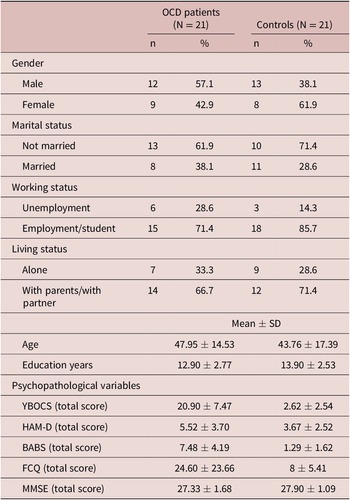
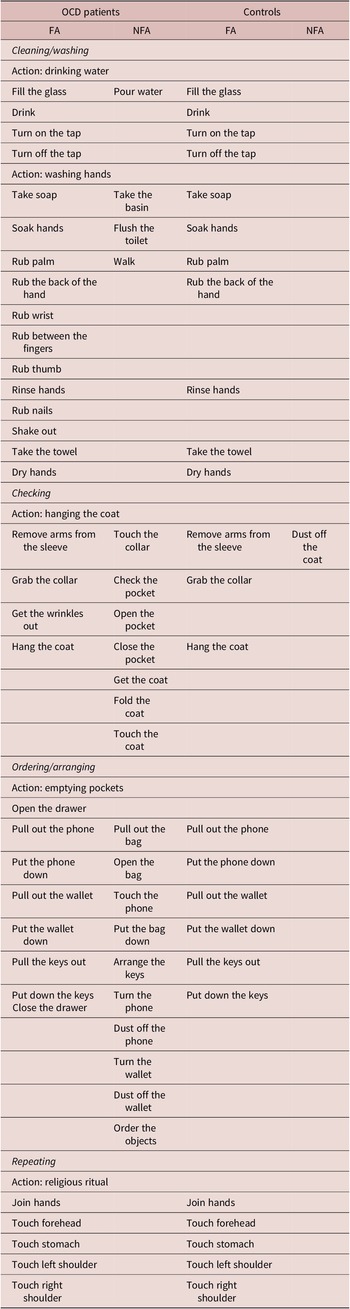
Twenty-one OCD outpatients provided a videotape of their compulsions. An equal number of healthy controls, matched for sex and age, were registered for corresponding physiological acts of OCD rituals. Sociodemographic and clinical features of the whole sample are listed in Table 1. Types of OCD compulsions are reported in Table 2. Table 3 illustrates the single basic motor components analyzed for each type of compulsion and corresponding control behavior.
Sociodemographic and Clinical Features in Patient and Control Groups

Abbreviations: BABS, Brown Assessment of Beliefs Scale; FCQ, Frankfurt Complaint Questionnaire; Ham-D, Hamilton Rating Scale for Depression; OCD, Obsessive-Compulsive Disorder; YBOCS, Yale-Brown Obsessive-Compulsive Scale.
Types of Obsessive-Compulsive Disorder (OCD) Compulsions in the Study Sample

Examples of Motor Acts for Each Type of Obsessive-Compulsive Disorder (OCD) Compulsions and Corresponding Control Behaviors

Comparison between compulsive rituals and corresponding control behaviors
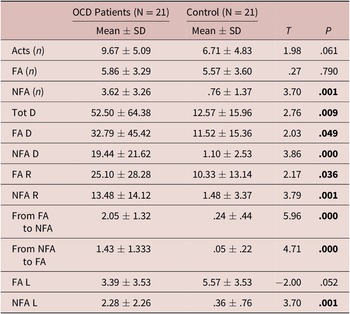
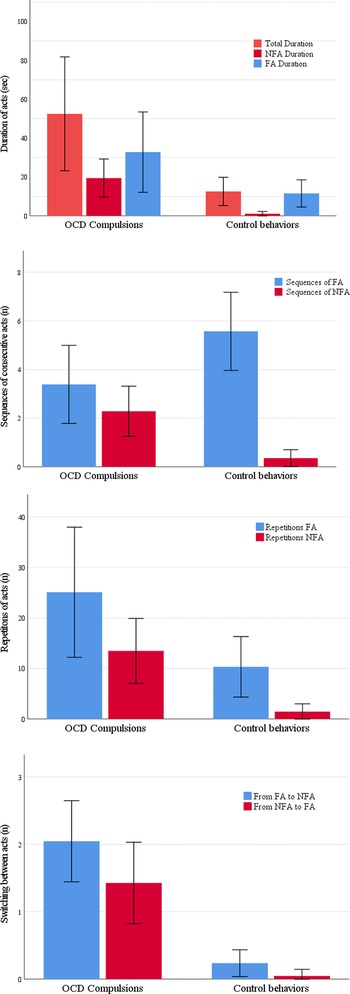
The comparison of the motor pattern between OCD compulsions and corresponding control behaviors is listed in Table 4. OCD compulsions differed from corresponding control behavior with regard to the repetition and duration of FA; the number, repetition, duration, and length of NFA; and the number of transitions from FA to NFA and vice versa (see Figure 2).
Comparison Between Obsessive-Compulsive Disorder (OCD) Compulsions and Control Behaviors in the Motor Pattern

Abbreviations: Acts (n), incidence of all acts; FA (n), incidence of functional acts; FA D, total duration of functional acts; FA L, number of sequences of consecutive functional acts; FA R, repetitions of functional acts; From FA to NFA, incidence of switching between functional acts and nonfunctional acts; From NFA to FA, incidence of switching between nonfunctional acts and functional acts; NFA (n), incidence of nonfunctional acts; NFA D, total duration of nonfunctional acts; NFA L, number of sequences of consecutive nonfunctional acts; NFA R, repetitions of nonfunctional acts; Tot D, total duration of ritual.
Psychopathological variables and formal structure of rituals
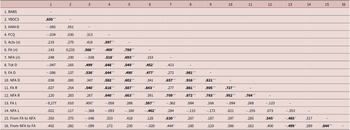
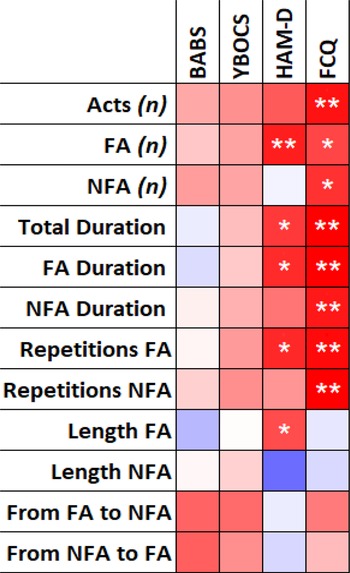
The correlations among psychopathological features and motor structure of rituals in OCD group are reported in Table 5. A correlation heatmap is depicted in Figure 1. No associations were found between formal features of compulsions and psychopathological variables of OCD (BABS and YBOCS). A correlation was found between the severity of depression (HAM-D) and the duration of ritual behavior (total duration; and number, duration, and repetition of FA). Finally, a direct association was found between the severity of prepsychotic symptoms (FCQ) and the overall complexity of ritual (total number, duration, and repetition of both FA and NFA).
Pearson’s Correlation Among Psychopathological Variables and Motor Aspects of Ritual in Obsessive-Compulsive Disorder (OCD) Group

Abbreviations: Acts (n), incidence of all acts; BABS, Brown Assessment of Beliefs Scale; FA (n), incidence of functional acts; FA D, total duration of functional acts; FA L, number of sequences of consecutive functional acts; FA R, repetitions of functional acts; FCQ, Frankfurt Complaint Questionnaire; From FA to NFA, incidence of switching between functional acts and nonfunctional acts; From NFA to FA, incidence of switching between nonfunctional acts and functional acts; HAM-D, Hamilton Depression Rating Scale; NFA (n), incidence of nonfunctional acts; NFA D, total duration of nonfunctional acts; NFA L, number of sequences of consecutive nonfunctional acts; NFA R, repetitions of nonfunctional acts; Tot D, total duration of ritual; YBOCS, Yale-Brown Obsessive-Compulsive Scale.
* P ≤ .05.
** P ≤ .01.
Heatmap of the correlational matrix among the study variables in the obsessive-compulsive disorder group.
Notes. Colored cells are used to represent the correlation coefficient magnitude and positivity/negativity of the correlation. The colors of the spots represent the direction of the correlation (blue for negative; for positive) and the dimension of the correlation magnitude (the stronger the color, the larger the correlation coefficient). The significant associations are indicated with stars (*P < .05; **P < .01).

Comparison between obsessive-compulsive disorder compulsions and control behaviors in the motor pattern.

No correlations were found between psychopathological variables and motor structure of behavior in healthy controls.
Discussion
The first objective of the present study was to replicate the results of Zor et al.Reference Zor, Keren, Hermesh, Szechtman, Mort and Eilam11, Reference Boyer and Liénard12 in order to investigate the formal structure of OCD rituals compared with corresponding ordinary behavior in a larger sample size of OCD patients. The second objective was to assess whether the structure of OCD rituals was associated with specific psychopathological variables and/or prepsychotic symptoms of schizophrenia. To the best of our knowledge, no study to date has explored the motor pattern of ritual compulsions in relation to OCD psychopathology and/or an underlying schizophrenia vulnerability.
First, our findings clearly indicate that compulsive rituals differ from ordinary behavior in their motor pattern. Particularly, in the present study, OCD rituals are distinguished from the corresponding ordinary behaviors with respect to the following features: 1) redundancy of both FA and NFA, confirming that compulsive rituals are built through the repetition of single action unitsReference Zor, Keren, Hermesh, Szechtman, Mort and Eilam11; 2) higher prevalence of NFA (in number, repetition, duration, and length), thus with a detachment from the original pragmatic goalReference Boyer and Liénard12, Reference Krátký, Lang, Shaver, Jerotijević and Xygalatas13; 3) longer duration of both FA and NFA, suggesting a loss of automaticity with redirection of cognitive efforts to the “script” of the performanceReference Zor, Hermesh, Szechtman and Eilam10, Reference Lang, Krátký, Shaver, Jerotijević and Xygalatas14; and 4) higher transition from FA to NFA and vice versa with a continuous fragmentation of the action flow and a further disconnection from environmental contingences.Reference Krátký, Lang, Shaver, Jerotijević and Xygalatas13
Altogether, these results corroborate previous findings of an invariant, “fixed” motor structure of OCD rituals, due to the repetition of single action units (both FA and NFA) with the inflation of NFA. The end result is the fragmentation of the action flow with diversion of the attention to the single building acts and a complete detachment from a pragmatic purpose.Reference Eilam9, Reference Zor, Keren, Hermesh, Szechtman, Mort and Eilam11–Reference Krátký, Lang, Shaver, Jerotijević and Xygalatas13
Second, our study unexpectedly failed to find any association between the motor structure of rituals and OCD psychopathology. In contrast, the motor pattern of OCD rituals was correlated with two symptom dimensions, not strictly inherent to OCD psychopathology: depressive (HAM-D total score) and prepsychotic (FCQ total score) dimensions.
With regard to OCD psychopathology, the formal features of OCD rituals correlated neither with OCD severity (YBOCS total score) nor with the level of the patient’s insight (BABS) over the compulsions. From an evolutionary perspective, OCD compulsions have been defined as innate, preprogrammed behaviors inappropriately or excessively “released” in psychopathological conditions.Reference Monteiro and Feng40 In vertebrates, the neurobiological substrate of rituals (including OCD rituals in humans) lies on the corticostriatothalamocortical circuitry (CSTC), which is focused on the basal ganglia, structures that are highly conserved and implied in daily routines and habits.Reference Wilkes and Lewis18 In nonhuman animal studies, it has been shown that at increasing levels of ecological uncertainty, behavior becomes more repetitive and loses automaticity in favor of major attentional control.Reference Tonna, Marchesi and Parmigiani15, Reference Insel29 Different animal models of OCD-like behavior (eg, quinpirole-induced compulsive checking, marble burying, or nest building behavior models) would confirm the continuity of ritual behavior in vertebrates: 1) construct validity, with shared neural systems (CSTC pathways)Reference Wolmarans, Scheepers, Stein and Harvey41; 2) face validity, with behavioral phenotypes similar to human compulsions (rigid motor repetition, attentional focus on the correctness of acts, and “just right” perceptions)Reference Sobin and Sackeim42; and 3) predictive validity, that is, responsiveness to OCD serotoninergic drugs.Reference Liénard and Boyer7 Altogether, the structural invariance of OCD rituals seems to be “hardwired” in the human brain, and homologous to that of ritual behavior across vertebrate phylogeny.Reference Liénard and Boyer7, Reference Wilkes and Lewis18 Therefore, we suggest that the motor pattern of OCD rituals would say more about the long evolutionary history of ritual behavior than about OCD characteristics of individual patients.
As to depressive dimension, an association was found between the severity of depressive symptoms and duration (total duration and duration of FA) of OCD rituals. In this regard, we suggest that specific psychomotor symptoms of depression (namely psychomotor retardation)Reference Moors and De Houwer43 may increase the duration of ritual, with an overall slowing down of the action flow and a tendency to repetition of FA.
Concerning prepsychotic symptom dimension, in our study, higher score of prepsychotic symptoms was associated with an overall complexity of ritual behavior (total number of single action units; and number, duration, and repetition of both FA and NFA). That is, at increasing levels of subjective prepsychotic self-experiences, the motor pattern is more complex, redundant, and slowed down (thus cognitive demanding), ultimately emphasizing its structural characteristics. Such a process of “complexification” of ritual behavior is independent from OCD severity. We suggest that in OCD patients, the relationship between more severe prepsychotic experiences and highly ritualized compulsive behavior may be explained through the lens of an evolutionary and ethological analysis of the proximal and ultimate causes (mechanisms) of ritual behavior in the life history of a species and their adaptive significance.Reference Tonna, Ponzi, Palanza, Marchesi and Parmigiani16, Reference Graybiel17 That is, the “inflated” motor pattern of OCD rituals would exert a “homeostatic” function to increase predictability and controllability over the psychobiological “high-entropy” stateReference Eilam26 due to prepsychotic symptoms.
Different studies from invertebratesReference Stürzl, Zeil, Boeddeker and Hemmi24, Reference Hirsh, Mar and Peterson25 to mammalsReference Brembs44 have confirmed the “urge” to motor repetition in changing environments across phylogeny. Indeed, across taxa, the repetition of acts, particularly NFA, seem to enhance behavioral plasticity in order to deal with environmental unpredictability.Reference Eilam9, Reference Amitai, Arnon and Shaham27 In fact, at increasing levels of ecological unpredictability, the performance of repetitive acts “forces” the interruption of automatic behavior with an enhanced focalization on the motor pattern itself.Reference Boyer and Liénard12 Ultimately, acts repetition serves to adjust behavioral response to the new environment,Reference Keren, Boyer, Mort and Eilam45 enabling the performer to maintain the control over environmental changes or potential threats.Reference Woody and Szechtman20, Reference Eilam, Izhar and Mort21, Reference Falk46 Behavioral modifications are then incorporated into new adaptive patterns.Reference Schleyer, Diegelmann, Michels, Saumweber and Gerber23, Reference Eilam47 Interestingly, a similar mechanism based on acts repetition seems to be at work also in the development of motor behavior in vertebrates.Reference Anderson and Shivakumar48 For example, the buildup of motor activity of infant rats occurs through the repetition of a single act, to which further new acts are incorporated before the first act is eliminated.Reference Eilam9
In human ritual behavior, both motor and cognitive mechanisms are involved: on the one hand, repetitive and rigid physical actions reduce physiological arousal due to anxiety-related unpredictabilityReference Tonna, Marchesi and Parmigiani15, Reference Karl and Rituals49, Reference Legare and Souza50, but on the other, hyperattention to the reordering sequence of ritual acts (repetition, specific number of procedural steps, and time specificity) leads to the subjective perception of a “reordered” world.Reference Tonna, Ottoni, Paglia, Ossola, De Panfilis and Marchesi51 Altogether, the sensorimotor experience of engaging in sequenced actions that are rigid, formal, and repetitive, coupled with the motor control required to enact these actions, per se satisfies a fundamental need for order and control.
Noteworthy, in schizophrenia patients with low levels of disorganization, mild obsessive-compulsive symptoms are associated with higher levels of functioning.Reference Tonna, Ottoni, Paglia, Ossola, De Panfilis and Marchesi52, Reference Mataix-Cols, Wooderson, Lawrence, Brammer, Speckens and Philips53 Therefore, we suggest that across the entire “schizo-obsessive” continuum (from OCD patients with higher prepsychotic symptoms to schizophrenia patients with OCD),Reference Mataix-Cols, Wooderson, Lawrence, Brammer, Speckens and Philips53 the same counterbalancing mechanism is at work, with a superimposed “ordering” ritual structure over the psychosis-related unpredictability. Of course, this is not to say that OCD is a “voluntary” compensatory mechanism in psychotic patients. Rather, the frequent co-occurrence of OCD and psychotic symptoms, probably underpinned by frontostriatal dysconnectivity,Reference Wilkes and Lewis18, Reference Mataix-Cols, Wooderson, Lawrence, Brammer, Speckens and Philips54 may form more stable syndromic configurations due to the evolutionary role of ritual behavior.
To sum up, OCD compulsive rituals present a specific motor structure compared to their corresponding ordinary actions. The complexity of compulsive motor pattern is independent from OCD psychopathology (YBOCS or BABS), whereas it results specifically associated prepsychotic symptoms (FCQ). We argue that such a specific motor pattern reflects the adaptive significance of ritual behavior across evolution, that is, its homeostatic function in conditions of unpredictability.
The main limitation of our study concerns its cross-sectional design. In fact, the complex relationship between motor parameters of rituals, OCD psychopathology, and prepsychotic symptoms may fluctuate over time. Moreover, a possible relationship between anxiety and ritual motor structure was not specifically assessed; nor was the “rigidity” of ritual behavior (ie, the fidelity of the script) adequately evaluated. Similarly, a potential confounding effect of psychopharmacological therapy over compulsive motor profile was not taken into account. Finally, these results should be viewed with the caveat of the small sample size. Therefore, larger longitudinal studies are needed to confirm our data.
Conclusion
Concluding, in OCD patients with higher prepsychotic symptoms, ritual compulsions tend to be structurally more articulated and demanding, independently from OCD severity or insight. This finding highlights the importance of a careful evaluation of prepsychotic symptoms in OCD patients, whose more prominent compulsive rituals may cover a schizophrenia vulnerability.
Consent to participate
All participants provided a written informed consent for the participation to the study.
Consent for publication
All participants received written information about the purpose of the study with the explanation that data will be analyzed in aggregate form and made available for publication and they provided written consent.
Funding
This research received no specific grant from any funding agency, commercial, or not-for-profit sectors.
Author contributions
Conceptualization: M.T.; Data curation: R.O., L.M., L.G., and A.D.D.; Formal analysis: M.T., R.O., and C.P.; Methodology: M.T. and R.O.; Project administration: M.T.; Resources: L.M., L.G., and A.D.D.; Writing—original draft: M.T.; Writing—review & editing: M.T., S.P., and C.M.
Disclosures
The authors declared no potential conflict of interest with respect to the research, authorship, and/or publication of this article.
Data availability statement
The data that support the findings of this study are available from the corresponding author (M.T.) upon reasonable request.
Ethical standards
All the procedures performed in studies involving human participants were in accordance with the ethical standards of the institutional research committee and with the 1964 Helsinki Declaration and its later amendments or comparable ethical standards.