In February 2019, the government of President Nicolás Maduro in Venezuela launched a propaganda campaign against foreign assistance, playing on long-standing fears about American side-taking in Venezuelan politics. According to reporting in The Washington Post, “Maduro's camp [was] portraying the opposition as puppets attempting to lead a Trojan horse invasion by the United States.”Footnote 1 It is not unusual for foreign economic policy to become politicized as a result of perceptions of foreign meddling. In the 2019 movement against the military government in Sudan, for example, protesters opposed a USD 3 billion pledge of aid from Saudi Arabia and the United Arab Emirates (UAE) because of these countries’ perceived support of the military.Footnote 2
Foreign meddling is common in international politics. Outside powers taking sides in countries’ domestic politics has happened throughout historyFootnote 3 and can shape citizens’ views on maintaining close relations with those side-takers.Footnote 4 We integrate the literature on side-taking with the literature on open economic policy preferences to show how side-taking affects individuals’ foreign economic preferences. When foreign countries take sides, the public views economic relations with them through a partisan lens. This dynamic occurs because people believe that economic engagement with supportive countries will help their personal well-being, party, or country. These responses are sometimes rational since the actual benefits from economic engagement can change depending on whose side a foreign country is on.
To test our argument, we conducted original surveys in Tunisia and the United States. Both countries have experienced partisan foreign interventions, although they differ in their experiences of side-taking and their economic and political characteristics. We find that side-taking clearly shaped support for economic engagement. This finding holds across multiple policies, including aid (in Tunisia), investment (in the US), and trade (in both countries). These findings are important because they suggest that elites could use frames about side-taking to cultivate or depress support for foreign engagement, as the Maduro example shows.
Beyond extending the study of side-taking to the realm of international political economy (IPE), our study makes three contributions. First, we provide new insights about how partner countries shape foreign economic preferences. Previous researchers have also explored how partner countries matter for those preferences.Footnote 5 Other researchers have emphasized citizens’ characteristics, including their economic self-interest,Footnote 6 perceptions of national interest,Footnote 7 and ideology and values.Footnote 8 We combine insights from both traditions, developing a theory about how interventions by partner countries interact with individuals’ partisanship.
Second, we combine evidence from a developed and a developing country. Most studies on IPE preferences focus on developed countries, especially the US.Footnote 9 Yet citizens’ preferences in developing countries may differ because of variation in the nature of economic engagement, individuals’ economic interests, or individuals’ cultural predispositions. We argue and show that side-taking is relevant in both Tunisia and the US. The consistency of our findings supports previous claims that purely economic theories cannot fully explain variation in mass preferences over foreign economic policy.
Finally, we offer a framework for understanding mass preferences in light of the rise of new economic powers. Many non-Western countries are now important aid donors, investors, and trade partners. They have diverse policies about intervening in other countries’ domestic politics. Side-taking and other partner-country characteristics may therefore become increasingly salient variables for understanding international political economy (IPE) preferences in the future.
What Is Side-Taking?
Side-taking occurs when a country meddles in another country's domestic politics in favor of a particular side. It may involve backing a specific candidate during an election or supporting one side in a larger policy debate over many years. Side-takers are often powerful countries—at least relative to their targets. Thus, the classic case of side-taking involves a global or regional power intervening in a developing country.Footnote 10 Yet powerful countries can also be targets, as Russia's side-taking in the 2016 US election illustrates.
Side-taking has many forms. Foreign leaders can make statements in favor of their preferred sides, providing a form of diplomatic recognition. Foreign countries can offer technical advice and material support to help their preferred sides gain political traction.Footnote 11 They can also take more extreme steps, such as supporting armed groups and coups d’état. More often, side-taking involves economic carrots and sticks; the relevant policy tools include aid, loans, investment, preferential trade benefits, and sanctions. Which tools of influence a side-taker chooses depends on a cost–benefit assessment.Footnote 12
Corstange and Marinov estimate that side-taking occurred in more than 120 national elections between 1960 and 2006.Footnote 13 We examine how it shapes citizens’ preferences toward foreign economic policy and outline how the actual and perceived distributions of benefits from economic engagement vary with partner countries’ side-taking. To analyze the hypothesized effects of side-taking on individual preferences, we focus on three policy areas: aid, foreign investment, and trade.
Economic Relations with Side-Takers
Economic relations with a side-taker can create winners and losers that reflect partisan divisions. This dynamic is especially important in contexts such as aid-dependent developing countries. Individuals there may understand the effects of foreign economic relations in sophisticated ways given how important such policies are for their lives.Footnote 14 In other cases, individuals are more uncertain about foreign economic policy.Footnote 15 In such cases, people can use characteristics of the partner country as a heuristic to assess the consequences of such engagement.Footnote 16 Consequently, preferences about economic engagement with specific countries may be more stable than preferences about economic engagement in general.
We explore the economic and non-economic consequences of engagement with a side-taker. Although we argue that economic relations with a side-taker have partisan consequences for all three policies considered in our study, they are clearest for aid and investment. Side-takers can more easily use aid and investment policies to pursue strategic goals because state involvement is greater and the benefits are more easily targeted.
Economic Consequences
Donors often use foreign aid to support governments. When a donor is sympathetic to the recipient government, it may be more likely to tolerate diversions of aid away from poverty relief, such as when leaders skew aid to the regions where their supporters live.Footnote 17 Thus, individuals are more likely to receive economic benefits from a supportive side-taker's aid.
Although the targeting of outward foreign investment is less well-understood, it is plausible that individuals would receive more economic benefits when investment originates from supportive side-takers. Sovereign wealth funds and state-owned multinational corporations may target investments to regions or sectors that support a favored side. Consider Jordan Dubai Capital, an investment fund launched by the sovereign wealth fund of the government of Dubai during a period of close relations between the Emirati and Jordanian governments. According to one study, “Nearly all of these investments deliver[ed] particularistic benefits to coalition members, whether it [was] continued employment …[or] additional capital.”Footnote 18 Within this context, Jordanians have debated the merits of accepting money from the Gulf, including USD 2.5 billion in 2018 designed to promote stability after widespread protests.Footnote 19
Finally, in terms of international trade, standard trade theory suggests that the individual benefits of trade depend on one's factor type or industry. The Stolper–Samuelson theorem posits that the individuals who benefit from trade are the owners of the factors with which their economy is relatively well-endowed. In contrast, the Ricardo–Viner model implies that trade benefits people employed in export-oriented industries. These theories suggest that side-taking does not shape the economic benefits individuals experience from trade. Nevertheless, some people may believe such partisan benefits exist.
Non-economic Consequences
Economic relations with a side-taker also bring many non-economic benefits and costs. Political benefits occur in the short term through electoral victories or policy successes or in the long run through sustained engagement and support.
In the short term, aid is well known to be given by donors to support political allies.Footnote 20 Indeed, donors give more aid in election years to allies to keep friendly incumbents in office.Footnote 21 Outward foreign investment may be similarly targeted. For example, investment may seek to complement the factor of production that is associated with a favored party to support that party's electoral chances.Footnote 22 Furthermore, investment produces benefits that flow back to the side-taker, which can strengthen it and allow it to continue or increase its future support for a favored party.
Trading with supportive partners leads to political benefits over the long term. It deepens ties between countries,Footnote 23 which can lead to greater cooperation and more support in the future. We can see this dynamic with the 2013 Armenian decision to strengthen ties with Russia by joining the Russia-led Eurasian Customs Union instead of signing an already-negotiated trade agreement with the European Union.Footnote 24 In addition, having access to better trade opportunities increases the power of the side-taker, which enhances its ability to intervene. This last point flows from the shared nature of trade's benefits, which improve the economic standing of all countries involved.
Since the debates in which countries intervene often relate to social divisions, the perceived consequences associated with engagement may be quite broad. For example, a key cleavage in the Arab world is between Islamists, who support political Islam, and secularists, who want politics free from religion. Because Qatar is a pro-Islamist side-taker, Qatari aid and investment has provoked backlash. When Qatar gave USD 3 billion in low-interest loans to the Muslim Brotherhood-led Egypt in 2013, protesters burned Qatari flags. Hamdeed Sabahi, a secularist leader, explained, “Egyptians feel that Qatar is not supporting them as a whole but [rather] the Muslim Brotherhood.”Footnote 25 Secularists opposed engagement with Qatar because they believed it would advance Islamism to the detriment of society.
Side-taking and Individual Preferences
Given the consequences of economic relations with a side-taker, we expect side-taking to influence individuals’ preferences. Individuals will prefer economic engagement with supportive side-takers to engagement with opposing side-takers. There are two mechanisms.
First, individuals’ preferences are shaped by their perceived self-interest. Self-interest affects support for free trade in both developedFootnote 26 and developing countries.Footnote 27 Scholars have found similar results with respect to foreign direct investment (FDI)Footnote 28 and aid.Footnote 29Although this literature does not investigate how support for engagement varies with the partner country, it suggests a mechanism through which side-taking might matter. Individuals will support economic engagement with supportive side-takers because they believe it will provide them with economic or political benefits.
Second, the literature has posited that sociotropic concerns shape foreign economic preferences.Footnote 30 Individuals often believe that their party's success is good for the country. Thus, even if people do not believe they will benefit directly from engagement with a supportive side-taker, they may believe that it will help their party or country.
Although this argument builds on the literature on IPE preferences, it also departs from it. Most studies have attempted to explain variation in support for open engagement generally. When they have used questions that measure support for engagement with a specific country, they have assumed the same explanatory variables are relevant. A typical question measuring US trade preferences comes from Mansfield and Mutz.Footnote 31 It asked, “Do you think the government should try to encourage international trade or to discourage international trade?” The same study also used a question about preferences toward NAFTA as an indicator of trade preferences. Yet it is unclear whether support for trade with specific countries such as Canada and Mexico is best explained by the variables that explain support for trade overall. Thus, we examine preferences for engagement with specific countries and detail a theory about how side-taking shapes those preferences. This advance is important since the popular discourse often concerns engagement with specific countries—such as US trade with China or Mexico—rather than the general level of tariffs.
We thus test the following hypothesis:
H1 Individuals will support foreign economic engagement more with supportive side-takers than with opposing side-takers.
Our argument does not make predictions about the size of the side-taking effect that will be associated with different policy instruments. People may use the partner country as a heuristic for assessing the likely benefits of engagement. But if people are knowledgeable about foreign economic policy, they may understand that side-taking is likely to have stronger effects on, for example, the distribution of economic benefits from aid rather than trade. Given that, we examine support for each policy separately.
Finally, we note that our argument builds on previous research about foreign side-taking. Most studies on foreign side-taking focus on elections, examining side-takers’ decision makingFootnote 32 and its effects on election outcomes.Footnote 33 We expand the literature by focusing on how side-taking affects individuals in the targeted countries.
The closest study to our own, by Corstange and Marinov, investigated how knowledge about foreign side-taking in an election affected Lebanese voters’ preferences for maintaining good relations with the outside power.Footnote 34 We build on this important study in three ways. First, we focus on citizens’ preferences for foreign aid, investment, and trade, rather than protecting existing relations. These are substantively important outcomes to explain and generate fresh insights about the partner country's role for the growing literature on IPE preferences. Whereas Corstange and Marinov view the primary mechanism explaining side-taking's effects on voters’ preferences to be their beliefs about future electoral success, our focus on foreign economic policy clarifies the need for a more detailed discussion of a range of possible mechanisms.
Second, we elaborate a theory with different mechanisms to explain variation in support for economic engagement with side-taking countries. As described earlier, we go beyond the primary mechanism in Corstange and Marinov to argue that there are actual and perceived benefits that extend well beyond a party's success in the next election. Specifically, individuals may consider the benefits that accrue to themselves, their country, or their party.
Finally, we test these mechanisms by asking about the perceived personal, national, and party benefits that may come from engaging with a supportive (or opposing) outside power. We do so in two countries: Tunisia and the United States. Since side-taking is arguably more common in developing countries such as Lebanon and Tunisia, citizens there may respond to it differently (e.g., with partisans being more tolerant or even welcoming of it) than in a consolidated democracy. Therefore, establishing the generalizability of our theory beyond the Arab world is an important contribution.
Case Selection and Research Design
To test our theory, we sought to collect detailed experimental data on foreign economic preferences. Necessarily, this approach involved focusing on a few cases. We opted for a diverse pair: Tunisia and the United States. In both cases, the economy was the most important issue according to citizens. Moreover, both countries had experienced side-taking, making them plausible and significant cases for testing the theory.
The cases diverge on several other theoretically relevant characteristics. First, whereas the US is a consolidated democracy that has rarely experienced side-taking, Tunisia is a transitioning democracy that has more frequently experienced it. Thus, the two countries are representative of the broader population of democracies and experiences with side-taking. Second, the US is considerably wealthier than Tunisia. Since individuals’ perceptions of economic interest are related to objective economic conditions, we thus test our theory using evidence from cases that provide variation in those conditions. Choosing diverse cases enhances the generalizability of our study's conclusions.Footnote 35 If we find evidence that side-taking shapes economic preferences in both settings, then there is reason to conclude that side-taking has potentially broad effects on individual attitudes.
We draw on evidence from representative surveys in both countries. Our Tunisia survey took place around the 2014 elections. We worked with a Tunisian survey firm to conduct a two-wave, face-to-face panel survey of 1,107 adult Tunisians, with the first round occurring after the parliamentary election and the second round occurring after the presidential election. Our US survey took place around the 2016 election. We conducted a two-wave, online panel survey of 1,016 adult Americans, with a first round occurring the week before the election and the second round occurring the week following it. The experiment occurred before the election.Footnote 36 Although we pursued a similar research design in both countries, the questions differed in a few ways.
Tunisia
Since the 2011 revolution, the main political cleavage in Tunisia has concerned the role of religion in politics. Although almost all Tunisians are at least nominally Muslim, there is no consensus about the role that Islam should play in politics. The authoritarian government promoted secularism. Since 2011, Ennahda, the country's main Islamist party, has been able to organize freely and played a leading role. At the time of our study (2014), Tunisians were primarily divided between supporters of Ennahda and supporters of Nidaa Tounes, the country's main secular party.
Debates between secularists and Islamists are common throughout the Arab world. Regional and global powers have intervened on both sides of the divide. Side-taking was at the heart of the 2017 crisis in which Saudi Arabia, the UAE, Bahrain, and Egypt cut off relations with Qatar because of its decades-long support for Islamists. In Tunisia, Qatar used its station Al Jazeera to support protesters in 2011 and promote Islamists after the revolution. It also signed economic agreements to support the Ennahda-led transitional government.Footnote 37
Yet many Arab governments view Islamists as a threat to stability. Saudi Arabia and the UAE have thus supported secularists, including in Tunisia prior to the revolution. After the revolution, the UAE halted its investments and cooled bilateral relations with the Ennahda-led Tunisian government, even withdrawing its ambassador in 2013. Meanwhile, Emirati leaders cultivated closer relations with secular Nidaa Tounes while it was in opposition, prompting “figures from or close to Nidaa Tounes [to] often imply that once Ennahda is ousted, Emirati (and other) funds would pour into Tunisia.”Footnote 38
Citizens have perceived powerful Western countries, including the US and France, as supporting secularists in the region because of their long-standing secular traditions. Furthermore, Islamist parties often evince anti-Western sentiments. Jamal argues this dynamic has led the US and France to ally with secular Arab dictators in cases ranging from Algeria in 1992 to authoritarian Tunisia prior to the revolution.Footnote 39
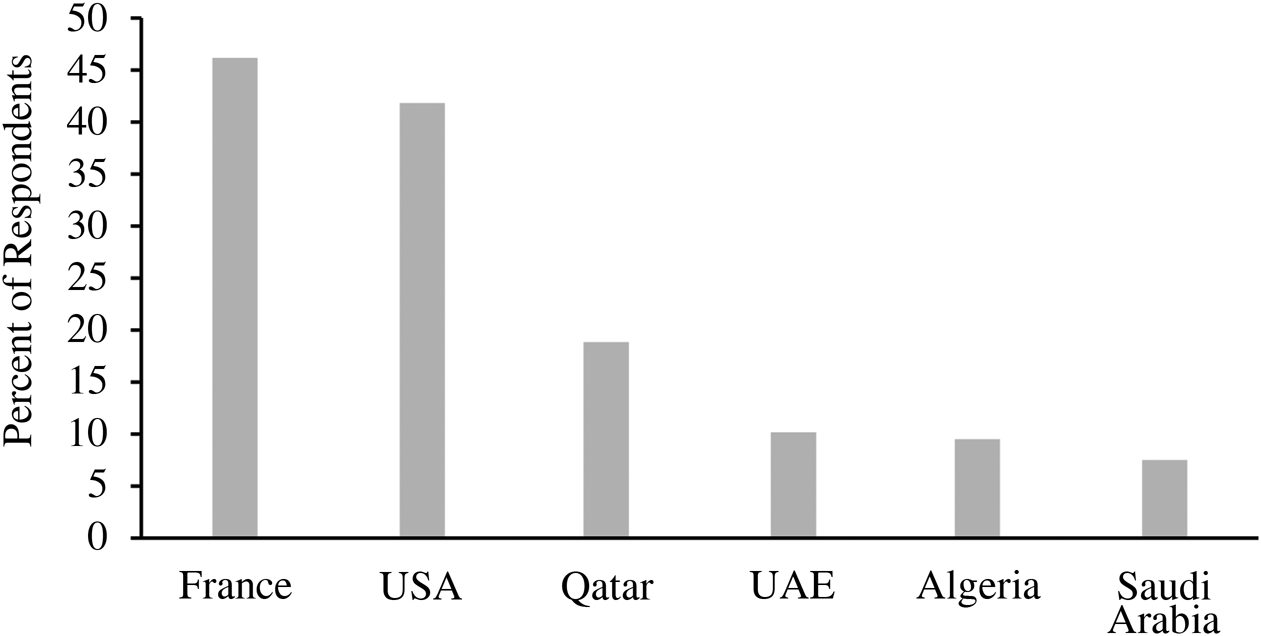
Reflecting these dynamics, Tunisians were attuned to the potential for side-taking. Eighty-six percent of respondents in our survey thought that other countries had influenced the results of the presidential election either “a lot” or “some.” The countries with the most perceived influence were France, the US, and (to a lesser extent) Qatar, as Figure 1 shows. Since the US and France have engaged in democracy promotion in Tunisia, they could be perceived as neutral. Yet many Tunisians viewed US and French influence as having a partisan dimension.Footnote 40 Nidaa Tounes supporters were forty-six percentage points more likely than Ennahda supporters to view US influence as positive (p < 0.001) and twenty-six percentage points more likely to view French influence as positive (p = 0.003).
Most likely influences on the 2014 Tunisian election

To test our theory, we asked respondents whether parliament should encourage aid from and trade with several countries. As discussed earlier, the distributive consequences of engaging with a side-taker are clearer for aid than trade. Thus, we explore how side-taking shapes preferences when the benefits are more and less clear. The questions were also meaningful since Tunisian officials have courted foreign economic engagement since 2011.Footnote 41 Since we asked respondents about both aid and trade, we randomly assigned the partner (France, the United States, or Qatar) to prevent fatigue and save questionnaire space. We chose these countries because they were perceived as having influenced the election and taken diverse sides. Moreover, France and the US were the largest aid donors, and France the largest trade partner. We did not give respondents information about side-taking.
The United States
Side-taking occurred around the 2016 US election as a result of Russian support of Republican presidential candidate Donald Trump, including via hacking the Democratic National Committee and promoting fake news on social media. Some foreign officials engaged in a weak form of side-taking, making negative statements about Trump or positive statements about Clinton. For example, German Economy Minister Sigmar Gabriel described Trump as “not only a threat to peace and social cohesion, but also to economic development,” while Chancellor Angela Merkel praised Clinton, saying, “I value her strategic thinking … Whenever I had the chance to work together with Hillary Clinton, it was a great pleasure.”Footnote 42 Similarly, Mexican politicians were critical of Trump.Footnote 43
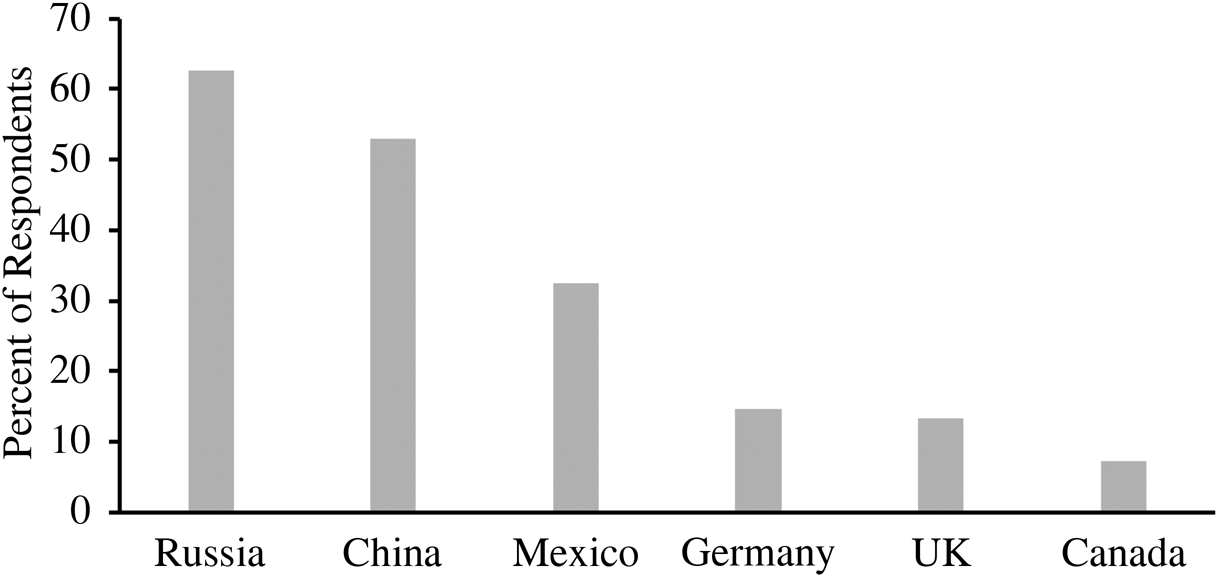
Americans were less aware of side-taking than Tunisians were. When asked to what extent they thought that other countries would influence the election results, around 45 percent anticipated either “a lot” or “some” influence. We asked US respondents who thought that there would be at least “a little” foreign influence to name the three countries that they thought would have the most influence. As Figure 2 shows, people most commonly named Russia, though China and Mexico were also common answers. While some Americans were aware that Russia was attempting to support the election of Donald Trump, a large part of the public was still unaware at the time of our study. Among respondents who did not receive any information about Russia's side-taking in our study, only 51 percent thought Russia supported Trump.
Most likely influences on the 2016 US election

The US survey built on our Tunisia study by replicating it and then by including an experiment that primed side-taking for some respondents.Footnote 44 We presented the following scenario to all respondents, with the italicized text randomly assigned:
• Germany/Russia is considering increasing the amount of goods it trades with/it invests in the United States.
• The size of the increase will be substantial compared to previous levels.
• Germany/Russia is an important economic partner of the United States.
In other words, respondents read a scenario in which a country could increase its investment in or trade with the US. Similar to the Tunisia study, we chose forms of economic engagement that varied in how much side-taking might affect the actual distribution of benefits. Since the US does not receive aid, we asked about preferences for trade and investment.
Those who were randomized into the side-taking prime condition also read about the partner country's side-taking activities. The other respondents were not given such information. This resulted in a 2 × 2 × 2 design: two countries, two types of engagement, and the random assignment of the side-taking prime. The experimental prime enabled us to better identify side-taking's effect. Since we wanted to be truthful, the nature of the side-taking varied by country. For respondents in the side-taking condition, one of the following pieces of text was added to the scenario:
• Germany has opposed Donald Trump's candidacy for US president.
• Russia has supported Donald Trump's candidacy for US president.
We included Russia since it was the most overt side-taker and Germany because it was an important partner that provided variation in side-taking.
Naming countries is common in the experimental literature,Footnote 45 but it introduced the possibility that other country characteristics shaped respondents’ preferences. Thus, we fielded a second US study in 2018 that replicated the 2016 study but did not use country names. Respondents read about “a foreign country” and were told it either supported or opposed Donald Trump in 2016. Our results are similar—and in some cases stronger—when the country name is not mentioned. More information about the replication is available in the appendix.
Results
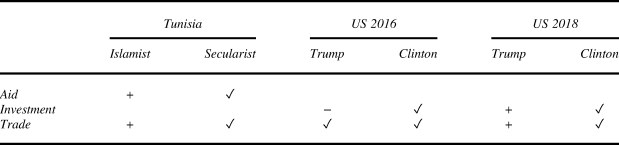
Across the three studies, we find significant support for the theory that side-taking by outside powers affects individual support for economic engagement. Table 1 summarizes the results from the simple difference-in-means tests reported in the tables in the main text. The models with control variables in the appendix improve the precision of the results and increase the number of results that are both consistent with our theory and statistically significant (i.e., more checkmarks in Table 1). As Table 1 shows, our results are consistent with the theory across the two countries and multiple types of economic engagement.
Summary of results

Notes: A ✓means the results are in the expected direction and statistically significant. A + indicates the results are in the expected direction but not significant at traditional levels. A - indicates the results are not in the expected direction. The appendix contains the US 2018 results.
Findings from Tunisia
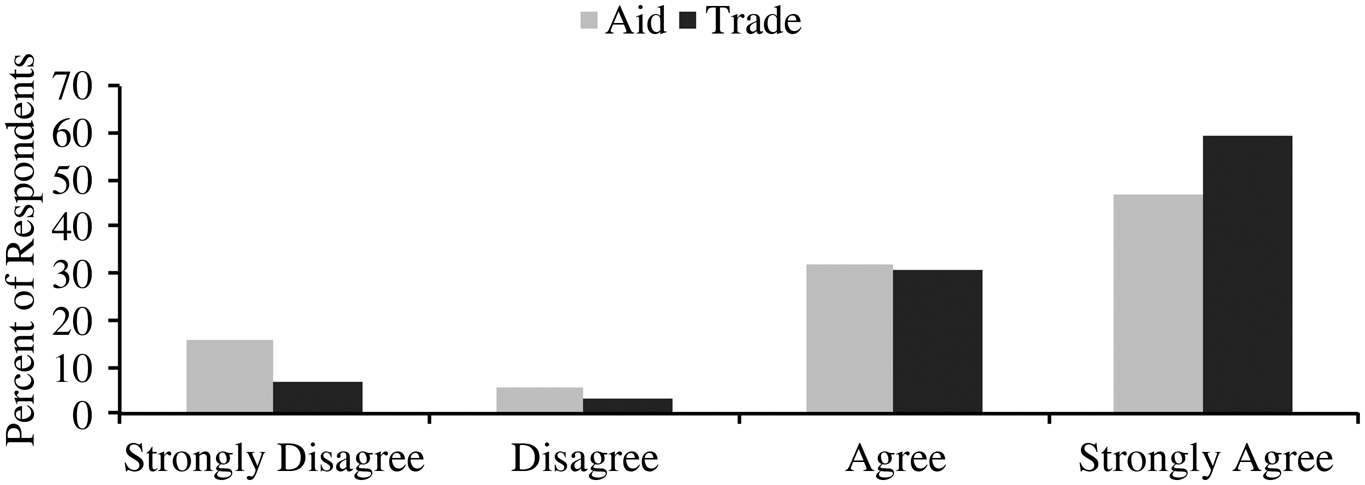
In Tunisia, we asked about support for economic engagement with one randomly assigned partner: France, the US, or Qatar. The first question asked about support for increased aid. The second question asked about support for increased trade. Responses to both questions were answered on four-point scales. Figure 3 plots the distribution of responses, pooled across the countries. Tunisians supported increasing both trade and aid, although there was more support for encouraging trade.
Tunisian support for economic engagement

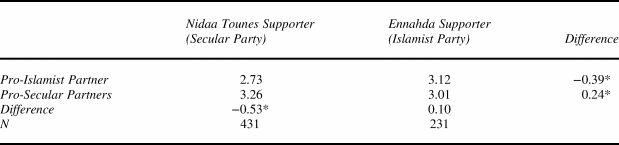
We first compare support for encouraging aid from the pro-secular countries (France and the United States) and the pro-Islamist country (Qatar). Because we are interested in whether individuals prefer to engage with partners that support their side, we examine the conditional effect of the country based on individuals’ placement on the Islamist–secularist divide. Our theory implies that supporters of the leading secular party, Nidaa Tounes, will prefer to engage with pro-secular countries over Qatar, whereas supporters of the Islamist party, Ennahda, will prefer to engage with Qatar over the pro-secular countries. Respondents who supported a minor party (and thus had ambiguous positions in terms of the Islamist–securalist divide) or no party are excluded.
Table 2 shows that for secularists, side-taking is a significant factor in preferences for aid. Nidaa Tounes supporters were more likely to support encouraging aid from France and the US than from Qatar. Islamists slightly preferred to encourage aid from Qatar over the pro-secularist countries, though the difference is smaller than for the secularists and falls below traditional significance levels. To unpack the effect among Islamists, we compare each of the secular countries separately to Qatar. Whereas there is only a small difference between mean support for aid from France versus Qatar (p = 0.60), Islamists seem to prefer Qatari aid over American aid, though because of sample size the difference misses significance at traditional levels (p = 0.14). Although we do not have data on why Islamists reacted more negatively to the US, it may be that American side-taking is perceived as stronger than French side-taking. Thus, awareness and the perceived consequences of American side-taking may be greater. Consistent with this explanation, recall that we observed earlier that the gap between secularists and Islamists in their beliefs that secular outside powers had a positive influence on the election was wider for the United States (46 percentage points) than for France (26 percentage points).
Mean support for aid, Tunisia

Notes: The dependent variable ranges from 1 to 4. * indicates difference is significant at p < .05.
We also look within each partner country at how preferences for aid vary with respondents’ partisanship. For all partners, there were significant differences between Ennahda and Nidaa Tounes supporters in the expected directions. Islamists were significantly less likely to want to engage with the pro-secular countries than secularists were, whereas they were significantly more likely to want to engage with Qatar. These trends are expected given the outside powers’ side-taking.
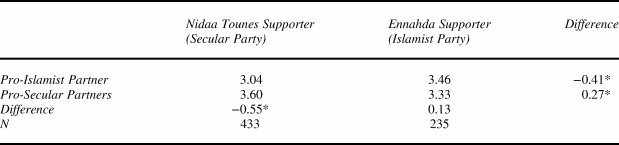
Turning to the results for trade in Table 3, we see a similar pattern. Secularists are significantly more likely to prefer trade with pro-secular partners than a pro-Islamist partner. Conversely, though again not significantly, Islamists prefer trade with a pro-Islamist partner than with pro-secular partners. We also see significant partisan differences in support for engagement when we look within the partner country treatment.
Mean support for trade, Tunisia

Notes: The dependent variable ranges from 1 to 4. * indicates difference is significant at p < .05.
The results are robust to several additional tests shown in the appendix. We highlight two here. First, we show that our results hold when we control for individual-level variables including age, gender, and education. Second, we show that the results are similar when we use an alternative measure of Islamism–secularism that asked respondents whether they agreed or disagreed with this statement: “Religion is private, and we need to separate it from politics.”
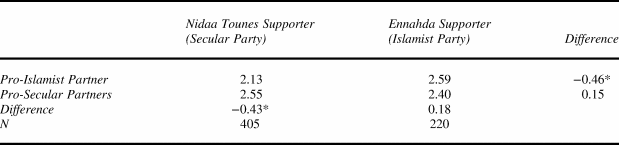
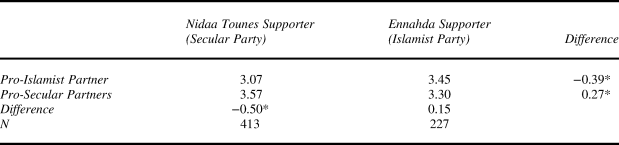
We further theorized that side-taking shapes preferences through the mechanisms of perceived self-interest and sociotropism. We thus asked these questions immediately after measuring the dependent variable: “If France/the United States/Qatar increases the amount of goods it trades with/gives significant amounts of foreign aid to Tunisia…
• How much will you personally benefit?
• How much will the Tunisian economy benefit?
Table 4 holds the mean levels of perceived personal benefits by preferred party and side-taker, and Table 5 holds the results for beliefs about benefits to the economy. There are three interesting findings. First, individuals were on average less likely to believe they would personally benefit from aid or trade than they were to believe that the Tunisian economy would benefit. This result suggests that self-interest is unlikely to explain the high overall levels of support for economic engagement. Second, the strongest effects of side-taking are among Nidaa Tounes supporters, who were significantly more likely to believe they and the economy would benefit from engagement with the secular side-takers vs. Qatar. By contrast, Ennahda supporters were slightly more likely than Nidaa Tounes supporters to believe they and the economy would benefit from engagement with Qatar, though the differences do not reach statistical significance. Third, Nidaa Tounes and Ennahda supporters vary in their beliefs about the benefits from engagement when we look within each partner type, with Nidaa Tounes supporters perceiving greater benefits from engaging with the secular countries than Ennahda supporters, and Ennahda supporters perceiving greater benefits from engaging with Qatar than Nidaa Tounes supporters.Footnote 46
Perceived personal benefits from increased aid and trade, Tunisia

Notes: The dependent variable ranges from 1 to 4. * indicates difference is significant at p < .05.
Perceived benefits to the economy from increased aid and trade, Tunisia

Notes: The dependent variable ranges from 1 to 4. * indicates difference is significant at p < .05.
Taken together, the findings show that side-taking shapes individual support for economic engagement. Given the struggles that the Tunisian economy has faced since the 2011 revolution, one might expect that Tunisians would have welcomed economic engagement from any country. It is therefore striking that support for engagement varied so much. We also see support for both of the hypothesized causal pathways: people perceived both greater personal and sociotropic benefits from engaging with a supportive partner, although people were much less likely to think they would personally benefit.
Findings from the United States
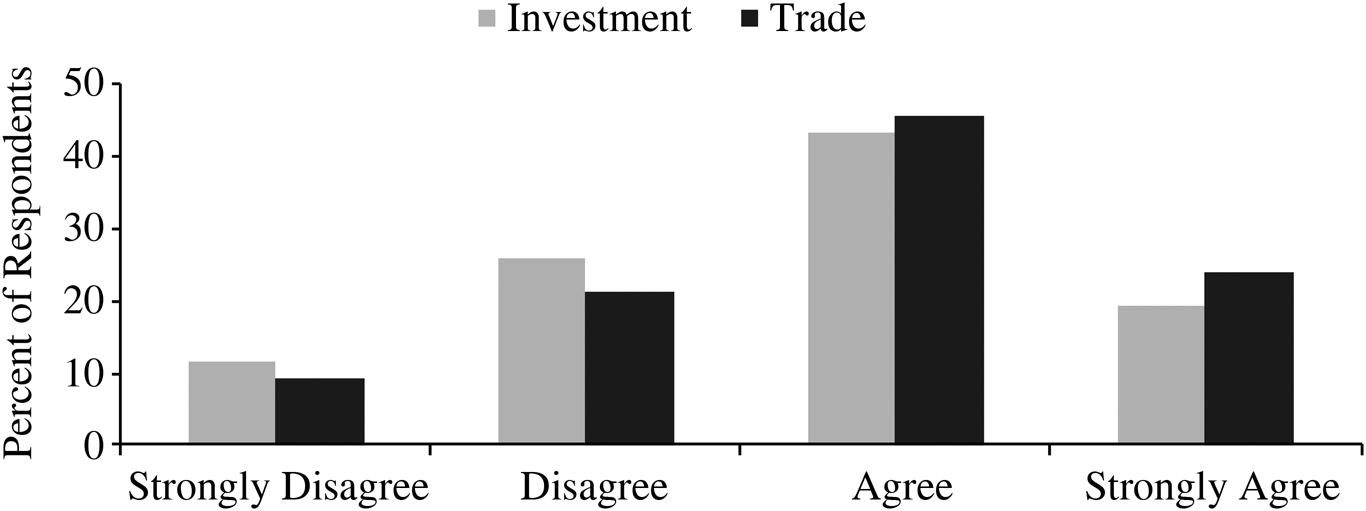
American respondents were randomly assigned to read a scenario about a potential increase in either trade or foreign investment. Our dependent variable is the extent to which respondents agreed that the US government should encourage that increase, measured on a four-point scale. Figure 4 holds the distribution of support for trade and investment, pooling across the partner country and side-taking treatment conditions. As it shows, there was slightly more support for encouraging trade than investment.
American support for economic engagement

We first compare support for investment from Russia (pro-Trump) and Germany (anti-Trump). We compare Clinton and Trump supporters since side-taking around the 2016 US election focused on candidates. We measure support for the candidates using questions that asked respondents who they would vote for. We show in the appendix that the results are generally similar if we use party identification.
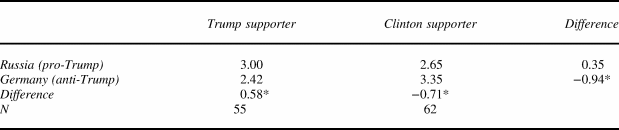
We begin by analyzing support for foreign investment. Table 6 holds the mean support for respondents who received the side-taking prime.Footnote 47 As it shows, Trump supporters were unexpectedly more likely to want to engage with Germany (anti-Trump) than Russia (pro-Trump), though the difference is less than half as large as the effect of the country treatment on Clinton supporters. Trump supporters’ unexpected preference for investment from Germany may relate to the weak side-taking by Germany relative to the electoral intervention by Russia. For Clinton supporters, the difference between support for engaging with Germany and Russia is more than a full point on the four-point scale. Looking within the country treatment, we find that Trump supporters were more likely to want to engage with Russia and less likely to want to engage with Germany compared to Clinton supporters. The latter difference is statistically significant and substantively large at more than half a point.
Mean support for investment, US, side-taking treatment condition

Notes: The dependent variable ranges from 1 to 4. * indicates difference is significant at p < .05.
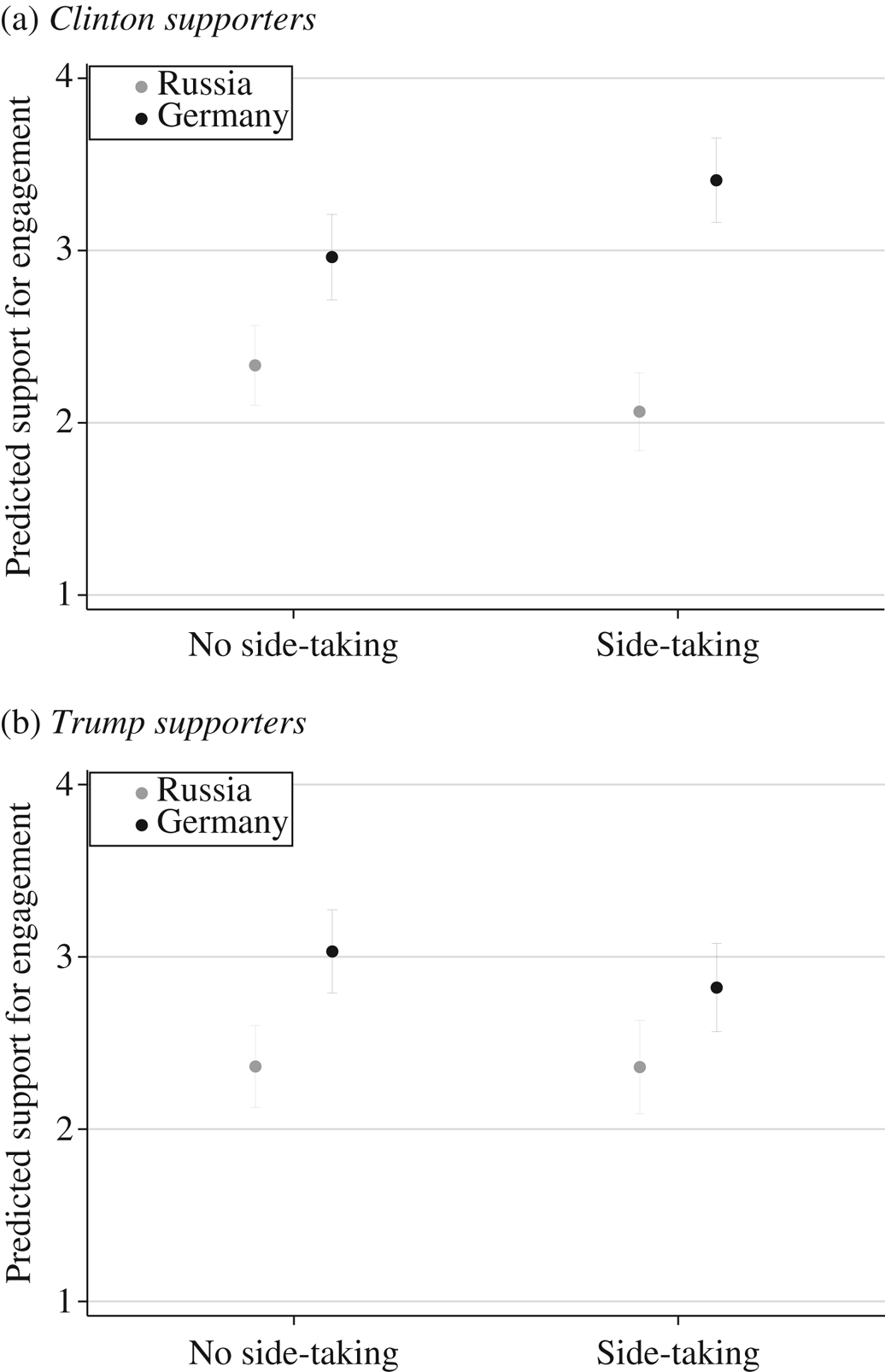
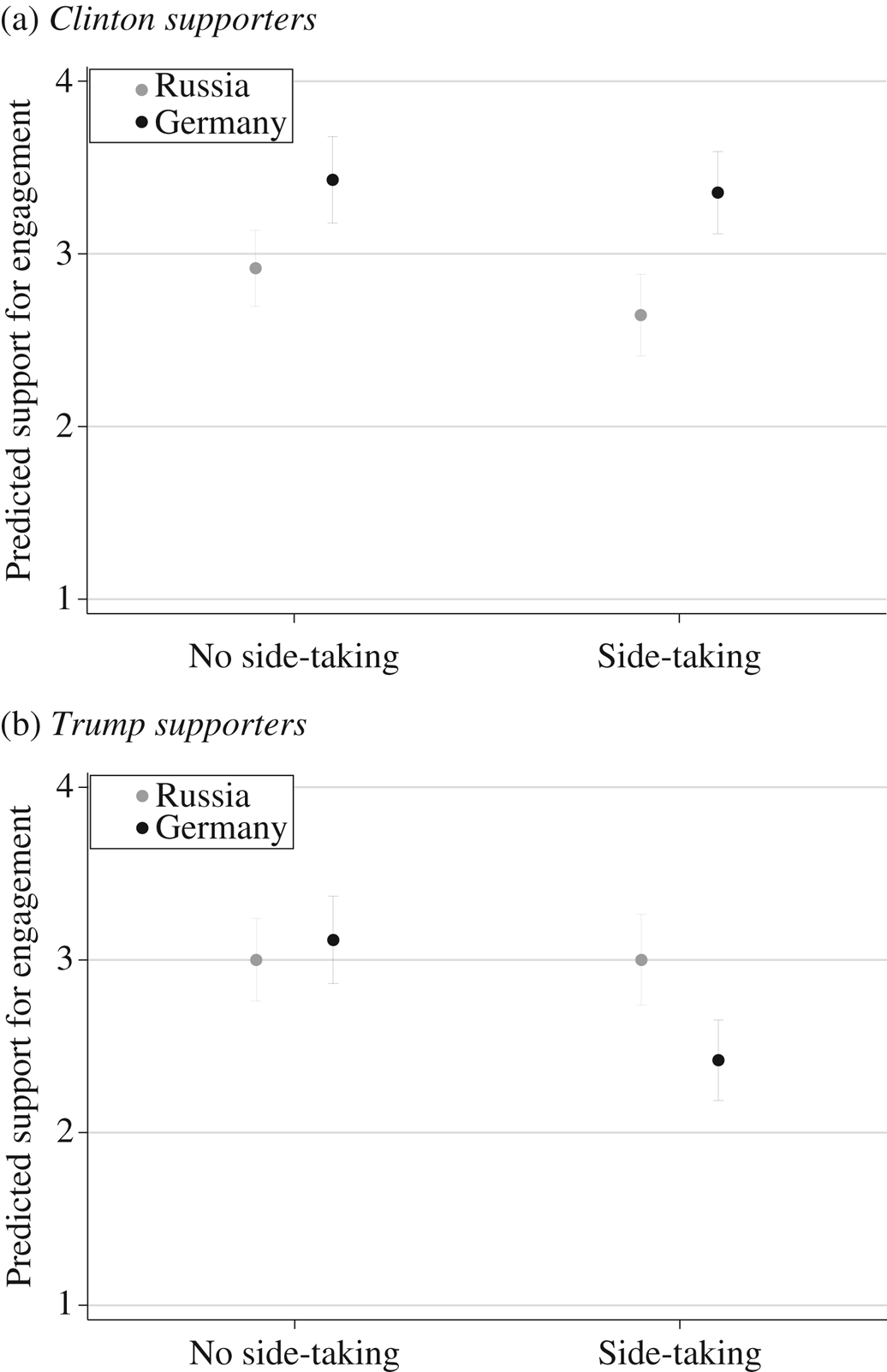
We next examine the effect of the side-taking prime. Figure 5 compares support for investment conditional on respondents’ preferred candidate and assignment to the side-taking prime. As shown in panel (a), the partner country effect increased significantly among Clinton supporters when they were primed with information that Germany took Clinton's side (increasing support for engagement with Germany) or that Russia took Trump's side (decreasing support for engagement with Russia). Similarly, Trump supporters’ initial support for engagement with Germany decreased significantly when they were primed about side-taking. Trump supporters’ support for investment from Russia did not change, however, when primed to think of Russia's pro-Trump stance in the election.
Predicted support for investment, US, by side-taking treatment and partner country

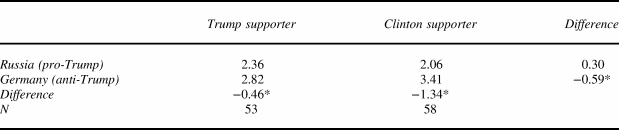
Turning to the results for trade, Table 7 reports the mean level of support when side-taking is primed. Trump supporters were significantly more likely to prefer trade with Russia than with Germany. Conversely, Clinton supporters were more likely to prefer trade with Germany than Russia. Both differences are statistically significant. We also see that Trump supporters were more likely to want to trade with Russia than Clinton supporters, and the partisan effect switches for engagement with Germany.
Mean support for trade, US, side-taking treatment condition

Notes: The dependent variable ranges from 1 to 4. * indicates difference is significant at p < .05.
As Figure 6 reveals, these partisan differences are clearest when side-taking is primed. Interestingly, these analyses suggest that Trump supporters responded more to the side-taking prime for trade than for foreign investment because support for trading with Germany decreased substantially as a consequence of the treatment. Our theory did not predict this pattern. We suspect it may relate to the unusual salience of trade in Trump's campaign rhetoric.Footnote 48 However, the treatment neither increased nor decreased support for trade with Russia among Trump supporters.
Predicted support for trade, US, by side-taking treatment and partner country

These findings support the hypothesis that individuals prefer engagement with supportive partners over opposing partners. Turning to mechanisms, we asked the following questions after measuring the dependent variable: “If Germany/Russia increases the amount of goods it trades with/it invests in the United States…
• How much will you personally benefit?
• How much will the American economy benefit?
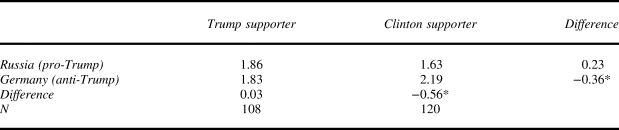
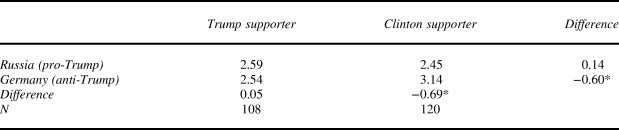
The results are largely consistent with the theory, although individuals on the whole did not believe they would personally benefit from increased trade or investment. Table 8 holds the mean levels of perceived personal benefits by preferred candidate and side-taker, and Table 9 holds the results for beliefs about national benefits. The tables include respondents in only the side-taking treatment. The strongest effects are among Clinton supporters, who were significantly more likely to believe they and the economy would benefit from engagement with Germany over Russia. Trump supporters were only slightly more likely to believe they and the economy would benefit from engagement with Russia.
Perceived personal benefits from increased trade and investment, US

Notes: The dependent variables range from 1–4. * indicates difference is significant at p < .05. Respondents from side-taking condition only.
Perceived benefits to the economy from increased trade and investment, US

Notes: The dependent variables range from 1–4. * indicates difference is significant at p < .05. Respondents from side-taking condition only.
Looking within partner country and across parties, we see that Clinton supporters were always less likely to perceive benefits from engagement with Russia than Trump supporters and more likely to perceive benefits from engagement with Germany than Trump supporters, with the latter differences being larger in magnitude as well as statistically significant. Taken together, these results provide clear evidence that the perceived benefits of engagement—both to oneself and to the country—depend on perceptions of side-taking.Footnote 49
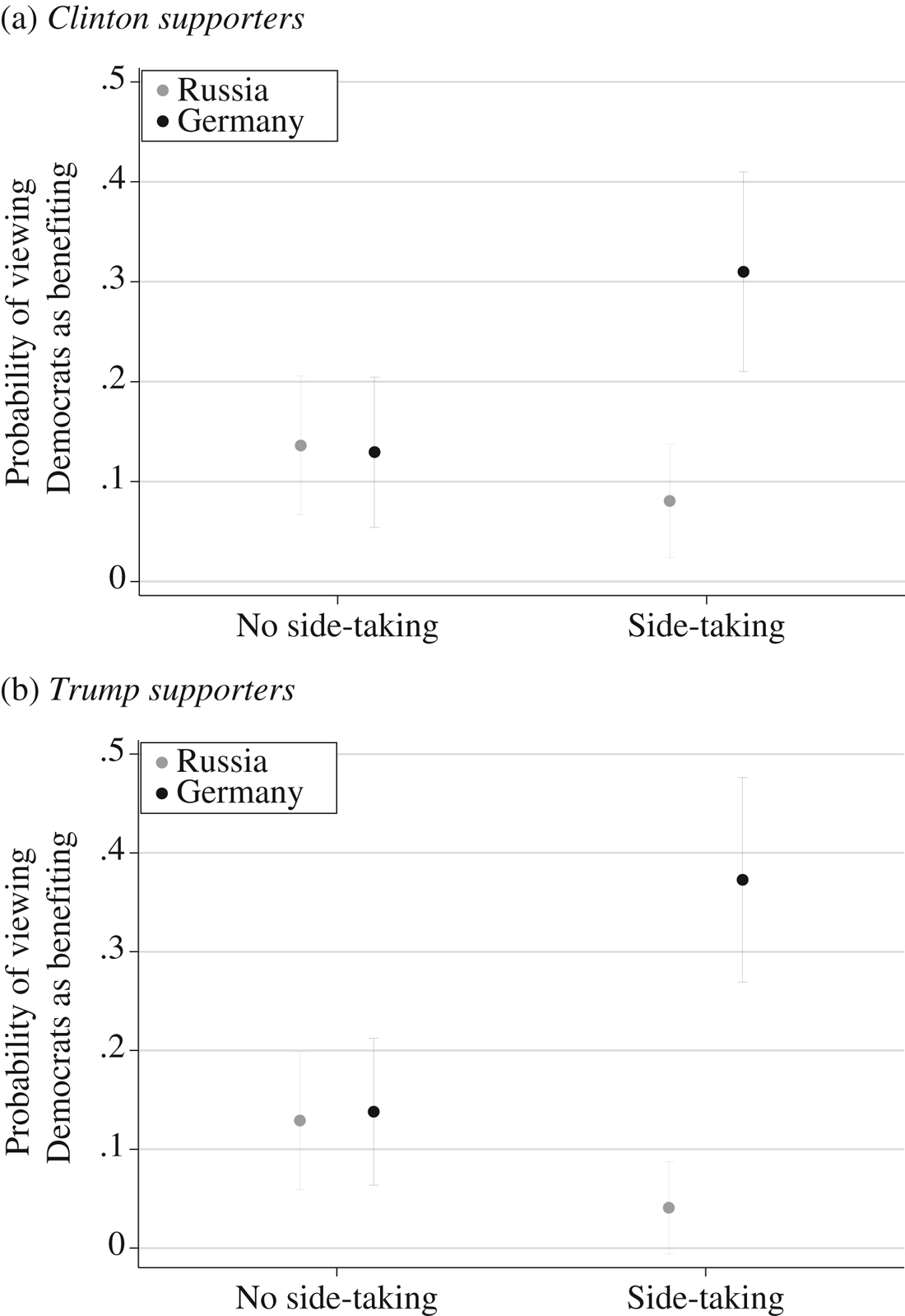
Finally, we asked respondents which political party (or both parties or neither party) they thought would benefit most if Germany/Russia increased trade with or investment in the US. We expected both Clinton and Trump supporters to think that engagement with Germany would benefit Democrats and engagement with Russia would benefit Republicans. We created a binary indicator that is coded 1 if respondents said Democrats benefit from engagement and coded 0 otherwise. Figure 7 shows the effects of the side-taking treatments on beliefs about whether Democrats benefit.Footnote 50 For the sake of simplicity, we pool across investment and trade, though the results are similar if we compare each outcome separately. Whereas both Clinton and Trump supporters viewed the benefits to Democrats similarly without the prime, both groups viewed engagement with Germany as being significantly more likely to benefit Democrats than engagement with Russia with the prime. These results suggest that individuals perceived that the benefits to parties from engagement change with side-taking, which may contribute to their perception of personal and sociotropic benefits.
Predicted probability of viewing Democrats as benefiting, US, by side-taking treatment and partner country

The US findings thus support the hypothesis that side-taking shapes preferences for economic engagement. When individuals were primed with information about side-taking, there was a dramatic difference between Clinton and Trump supporters in their support for engagement with Russia and Germany. We also see support for multiple causal pathways: respondents were more likely to perceive both personal and sociotropic benefits in response to supportive side-taking.
Conclusion
We theorized that partisan meddling by outside countries influences how individuals think about foreign economic relations. We supported the argument with evidence from Tunisia and the United States, finding patterns consistent with our hypothesis. Across both countries and multiple policies, individuals were more likely to support engagement with a supportive partner than with a partner who opposed their side in domestic politics. Our findings support the theorized mechanisms of benefits to oneself, one's party, and one's country.
Although space constraints prevent a detailed discussion of the side-taking effect's substantive size, the appendix takes up this issue directly. As we report there, the effects of side-taking compare favorably to and in some cases are larger than those associated with traditional explanations in the literature such as self-interest and sociotropic concerns. Additionally, the effects of side-taking are robust to subsetting the data based on individuals who are most likely to personally benefit from increases in open economic engagement: low-skilled respondents in Tunisia and high-skilled respondents in the United States. The analysis demonstrates that even among people who are most likely to benefit from economic engagement regardless of its origins, side-taking has a significant effect on their support.
Our findings encourage further research on mass attitudes toward foreign economic engagement that places the identity of partner countries at its center. First, researchers might examine other ways that partner countries affect mass support for economic engagement. In Tunisia, support for engagement with France was generally higher than support for engagement with the United States, even though both countries were perceived as pro-secular. This difference might arise from the fact that France is a more important economic partner for Tunisia, or it might reflect the fact that anti-American attitudes are commonplace in the Arab world.Footnote 51 Although there is an emerging literature on this topic,Footnote 52 future research can investigate how other characteristics of partner countries shape mass attitudes.
Second, because the side-taking effects we identify are large, leaders and activists can use frames that emphasize side-taking to shape debates about foreign economic policy. Thus, studying the effect of elite cues regarding side-taking may be a promising topic for future research.
Finally, scholars should examine whether elite behavior is influenced by side-taking, for example, in terms of voting on trade deals with various economic partners. As Tunisian politicians court aid, foreign investment, and trade, we may see that partisanship shapes their preferences or strategies. Similarly, the side-taking experienced during the 2016 election could affect US foreign economic policy. Episodes of side-taking increase the salience of the partner country, and the public is most likely to affect policy for issues of high salience.Footnote 53 These future studies will become more important to our understanding of economic engagement as we see an increasing number of democracies and economic partners in the world.
Data Availability Statement
Replication files for this research note may be found at <https://doi.org/10.7910/DVN/AD8CKP>.
Supplementary Material
Supplementary material for this research note is available at <https://doi.org/10.1017/S0020818320000156>.
Acknowledgments
We benefited from the suggestions of participants at the following workshops and conferences: the American Political Science Association; the Association for Analytical Learning about Islam and Muslim Societies; the Conference on Public Opinion and Foreign Aid; the International Studies Association; the University of California, Los Angeles International Relations Colloquium; and Virtual IPES. We also thank Michaël Aklin, Chantal Berman, Allison Carnegie, Stephen Chaudoin, Simone Dietrich, Daniela Donno, Mohamed Ikbal Elloumi and Elka Consulting, Julia Gray, Alexandra Guisinger, Ed Mansfield, Helen Milner, Elizabeth Nugent, Christina Schneider, and Matt Winters for feedback and assistance.
Funding
This material is based upon work supported by the National Science Foundation under grant no. 1456505. Any opinions, findings, and conclusions or recommendations expressed in this material are those of the authors and do not necessarily reflect the views of the National Science Foundation.