Introduction
Obesity is recognized widely as a critical health problem. The World Health Organization (WHO; Geneva, Switzerland) has named obesity a 21st century epidemic, stating “obesity’s impact is so diverse and extreme that it should now be regarded as one of the greatest neglected public health problems of our time.”Reference Cienki 1 The prevalence of obesity is drastically increasing. In 2010, the United States had 110 million obese residents, or 35.7% of the population. Time-trend forecasts suggest that by 2030, 42% of the US population will be obese and 11% severely obese. 2
Management and transport of the morbidly obese (MO) pose unique challenges for Emergency Medical Services (EMS) providers. Anecdotal news reports of obese patients requiring special transport and care by EMS are common in the media. Stretchers and ambulances have weight limits that are being exceeded by obese patients requiring transport. Some EMS directors routinely cite increasing numbers of MO patients as a main motivating factor in the purchase of highly specialized and costly equipment designed specifically for bariatric patients.Reference Finkelstein, Khavjou and Thompson 3 However, no hard facts guide these decisions about where to place resources.
Decreased mobility of MO patients may require the presence of additional EMS personnel and the use of other Fire-Rescue resources.Reference Grant and Newcombe 4 Other issues exist aside from transport of the obese. Basic clinical care for MO patients is challenging. Life-saving procedures, such as intubation, are complicated not only by the technical difficulties of inserting the tube, but in maintaining ventilation, oxygenation, and sedation.Reference Boatright 5 Obtaining accurate basic vitals, such as blood pressures and oxygen saturation, is more difficult, can require specialized equipment, and is often less accurate than in non-obese individuals.Reference Dargin and Medzon 6 Establishing vascular access can be hindered by an absence of traditional landmarks and increased soft tissue thickness.Reference Finkelstein, Khavjou and Thompson 3 Pharmacological dosing is of greater concern in the obese, due to altered pharmacokinetics and inability to accurately estimate body weight.Reference Maxwell, Waks, Schroth, Karam and Dornfeld 7
Extensive research has attempted to document the costs associated with rising rates of obesity from patient, hospital, and insurance standpoints.Reference Cheymol 8 There is scant evidence addressing the prehospital setting. In order to help set an agenda for research on resource allocation, the author of this study sought to assess EMS providers’ perspectives on the challenges of transporting MO patients and areas for improvement.
Methods
An anonymous, web-based survey was distributed to all providers of prehospital transport from a large, urban, fire-based EMS system in order to determine provider’s perceptions of the specific challenges of managing MO patients. All EMS providers were asked to participate regardless of level of training. The study site was an urban, inner city, fire-based EMS serving a daytime population of approximately 1,000,000 with an average of 90,000 EMS runs per year. Rescue trucks are all Advanced Life Support-equipped and staffed transport vehicles, with support as needed from a Basic Life Support-equipped engine crew. There were approximately 525 EMS providers at the start time of the survey. However, even in the short time frame, many providers moved internally or left the department.
The survey included 30 questions, including Likert scale, yes/no, and rank order questions (Appendix; available online only). The survey was reviewed and approved by the EMS chiefs prior to distribution. As there was no reliable way to distribute the survey electronically to providers, announcements with a link to the survey were sent to all station chiefs. After these announcements were sent, research assistants visited each of the stations on each of the shifts. The research assistants explained the purpose of the survey as well as the anonymity of the results. A single research assistant made regular visits to the EMS stations to help EMS providers connect to the link.
The survey was posted on SurveyMonkey (Palo Alto, California USA), whose surveys and data are stored on secured servers operated by SunGard (Wayne, Pennsylvania USA). SunGard maintains a comprehensive security interface addressing all physical, network, hardware, and software matters. In addition, Survey Monkey uses Secure Socket Layer encryption for survey data transfer. The EMS providers were assured that the information gathered in the survey would be anonymous, and no respondent would be personally identifiable based on their responses. Additionally, participant IP addresses were not collected as part of the survey process. All data collected from participants were kept private and confidential. Data were collected using SurveyMonkey and simple descriptive statistics were used.
Although the survey used the term “morbidly obese,” the term deliberately was not defined with specific numeric weights or body-mass index (BMI). The EMS provider rarely has the patient’s exact weight provided, and self-reported and estimated weights are often wrong.Reference Dor, Ferguson, Langwith and Tan 9 The EMS scope of practice does not include calculation of BMI. The author therefore left the definition of MO up to the provider.
The study was approved by the Human Subjects Review Office of the University of Miami (Miami, Florida USA). Waiver of an explicit signed consent was granted to providers completing the questionnaire.
Results
Data were collected from April through September 2010. Based upon an estimated population of 525 eligible EMS professionals in the target system, the estimated response rate was 37%. The results were not verified by call records but simply were providers self-reporting. The overwhelming majority of respondents (93.6%) were Emergency Medical Technicians (EMT)-Paramedics with the rest divided between EMT-Basics and EMT-Intermediates. The survey participants tended to be newer hires with 24% under five years of experience, 36% having 5-10 years, 30% having 10-20 years, and only 10% greater than 20 years of service. Distribution of training and years of service of the participants was representative of the entire system. When asked about the increasing size of patient weights during their years of EMS service, 89% thought that patients’ weights were increasing and 87% thought they were becoming a barrier to transport. All had reported transporting a MO patient, yet 78% admitted they could not accurately determine the weight of an obese patient.
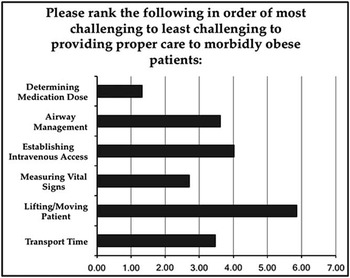
Lifting and moving the patient was considered the most challenging aspect in the transport of the MO (Figure 1). Determining medication dose was reported as the least challenging.
Rank of the Issues in Providing Care to Morbidly Obese Patients.

Participants felt they had difficulty with measuring vital signs in the MO 76% of the time, but 73% related they had achieved intravenous access.
Only 34.4% of survey participants had ever been involved in a resuscitation of an MO patient, and only 12.5% had ever intubated a MO patient. A total of 28.1% reported they had calculated or adjusted appropriate medication dosages for MO patients.
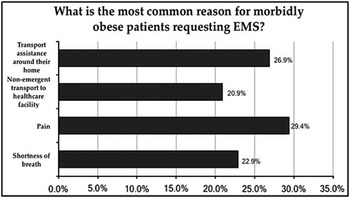
Reasons for calling EMS are described in Figure 2 with respondents reporting 71% of MO transports being Basic Life Support calls.
The Most Common Reasons for Morbidly Obese Patients Requesting EMS. Abbreviation: EMS, Emergency Medical Services.

Almost all participants felt that transport times were delayed in MO (99%), with 87% of respondents feeling it took six to eight providers to transport a MO patient and all responders feeling it required at least five providers.
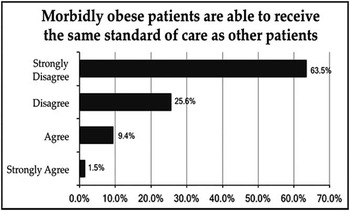
Although most respondents felt they were trained and prepared well enough to transport a MO patient, 87% wanted more specialized training and 86% wanted more specialized equipment. Sixty percent of responders wanted more involved protocols on the transport of the MO. Only 10% of respondents felt MO patients received the same standard of care as the non-obese (Figure 3).
Morbidly Obese Patients Able to Receive the Same Standard of Care as Other Patients.

Discussion
This survey’s intent was to assess paramedic perceptions of challenges of EMS transport of the MO. To the author’s knowledge, this is the first study of its kind. The response rate was lower than anticipated; however, there were 203 responses and responses were frequently in agreement. Almost all agree/disagree questions had at least 80% of responses in agreement.
Emergency Medical Services providers feel the number of obese patients is increasing. This is supported by population data. The fact that all responders had reported transporting a MO patient confirms the extent of this concern.
When listing the reasons for calls from the MO, the respondents perceived that almost 50% were for either transport assistance in the house or non-emergent transport to a health care provider. As more MO people have difficulty fitting into a conventional private vehicle, this could become widespread and represents a possible misuse of 911 providers. This also creates an area to possibly reduce the number of calls to EMS by providing other modes to transport and assist the MO.
Many survey elements focus on EMS perceptions without facts to substantiate these feelings. In terms of transport, the overwhelming majority felt that lifting and moving the patient was the most difficult part of the transport. The number of EMS providers perceived as necessary is considerable, with 87% reporting the need for six or more EMS providers. The potential impact to EMS providers is enormous. In a National Highway Traffic Safety Administration (NHTSA; Washington, DC USA) survey, 32.1% of EMS systems had less than 50 providers, including volunteers. Among rural and wilderness EMS systems, which tend to be smaller systems, over 60% of these systems felt there already was not adequate staffing.Reference Fernandes, Clark, Price and Innes 10 These smaller and rural EMS systems do not have the providers or equipment available at a given time to handle the increased needs of transporting a MO patient. Such calls therefore delay the EMS response to the next 911 caller. The time required and number of providers to transport a MO patient can trigger changes in Unit Hour Utilization that will have impact on staffing and funding for a system. As the number of MO patients increases, the number of EMS personnel required will have to grow.
Worthy of note is that although an overwhelming majority stated they could not estimate the patient’s weight, very few perceived that determining medication doses was a major issue. One-third of responders reported being involved with a cardiac arrest on a MO patient, and one-quarter reported calculating doses for a MO patient. Additionally, although only one-quarter report calculating doses, it was considered the least challenging aspect of transporting a MO patient. The author of this study deliberately avoided asking specific dosing questions in the survey, but this disconnect in the ability to determine weight and calculating weight-based doses might allude to a perception that an adult dose is an adult dose, regardless of adult weight.
Although those who responded felt they were trained in transport, approximately 90% wanted more training and more equipment for transport of the MO. This again shows a disconnect that although EMS providers say they are well-trained, they definitely want more training. Even EMS protocols were requested to make their job easier.
This EMS service also felt overwhelmingly that the MO do not get the same quality of care that non-obese patients receive. This is a serious concern that reflects on the multifaceted challenge of transporting a MO patient. These concerns are addressed in many parts of the questionnaire, but the author did not ask for an explanation of this specific response. Almost all respondents felt the transport time was delayed. Transport time is a key element of quality of out-of-hospital management of critical conditions. However, many factors other than transport time surely come into play. This response alone requires in-depth investigation.
Limitations
This survey was conducted at a single EMS service. The author recognizes the sampling error inherent to this situation and that responses might not be representative of all EMS providers. However, this service provides for a large and diverse population similar to many US cities.
The non-response rate was very high. Despite the response rate of approximately 37%, there were still over 200 responses, and those who responded often selected agree/disagree responses running in over 80% in agreement. The apparent motivation for not responding was the fear that “the administration” would know individuals’ responses. Considering the high percentage of survey responses indicated that the EMS providers were often ill equipped to handle transfer of the MO and requested more resources, training, and protocols, it would be hard to expect the majority of the non-responders answering contrary to those who responded. Even assuming a 50% difference in the response of non-responders, the results would not change the outcome dramatically. The purpose of this survey was not to get specific statistics about transfers but was to gauge EMS provider’s perspectives to direct future more significant research.
Conclusion
Although just a beginning, this survey of EMS providers highlights many challenges involved in the out-of-hospital assessment, treatment, and transport of the MO. The survey participants felt the MO do not get the same quality of care and they felt the need for greater manpower, assistance in lifting and moving patients, and training in specific issues relating to caring for the MO. The responses can provide a framework to the concerns that merit further research as well as a basis to develop EMS and community strategies towards prehospital care for the MO.
Acknowledgements
The author would like to thank Kathleen Schrank, MD and Graham Ingalsbe, MD. Both assisted immensely to the implementation for this study.
Supplementary Material
To view supplementary material for this article, please visit http://dx.doi.org/10.1017/S1049023X16000595