Economists have long argued about the importance of good institutions for economic growth. Rule of law, better enforcement of contracts, and secure property rights are usually associated with better economic outcomes, such as higher investment in physical and human capital and technological progress. Some countries lacking good legal institutions have attempted to import them from abroad with the goal of boosting economic growth. However, the adoption of good foreign institutions does not always lead to positive economic outcomes.
What are the elements of successful institutional transplants? In principle, the effectiveness of transplanted formal institutions hinges on their reception by local communities. Shared values, language, ethnicity, and religion—collectively defined as cultural proximity—play a relevant role for at least three reasons. First, the new institutions, imbued with the values of the exporting country, could be better tolerated inasmuch as their content resembles the customs and social norms of the receiving communities.Footnote 1 Second, irrespective of the content of the new rules, the receiving country may be more accommodating of institutions from closer and more familiar exporting countries. Finally, a given exporter may adopt a friendlier approach, engaging elites and local populations in the reform process and making the new institutions more acceptable, in more culturally similar receiving countries.
We investigate the economic consequences of the interplay between new institutions and cultural proximity by exploiting a well-known historical natural experiment: the Napoleonic invasion of German territories and the consequent imposition of French institutions. Our novel finding is that transplant of these institutions had heterogeneous effects on economic performance across German areas characterized by different degrees of cultural proximity with France. Transplanting French institutions was more effective in areas that were culturally closer to France, while it had virtually no effect in culturally distant territories. This result highlights the relevance of the interplay between culture and institutions for economic development, and it provides the first evidence that cultural proximity plays an essential role in transferring an institution from its original environment to a different context.
To investigate the effects of the interaction between cultural proximity and French institutions, we first zoom in on nineteenth-century Germany with a detailed historical discussion on the modernizing reforms, the differences in their adoption, and their economic effects. Then, we build a novel, hand-collected dataset on pre-Napoleonic principalities, their rulers, and the adoption of progressive reforms and then complement it with rich county-level information from different waves of the Prussian census. We use religious affiliation as our baseline measure of cultural distance to France. Since countries that share a religion are expected to have similar cultures (Guiso, Sapienza, and Zingales Reference Guiso, Sapienza and Zingales2009; Fisman, Paravisini, and Vig Reference Fisman, Paravisini and Vig2017), we exploit the fact that France was predominantly Catholic at that time and use the share of Protestants in the population as an inverse measure of cultural proximity with France. We corroborate our results by constructing two alternative cultural distance measures. First, we focus on a salient dimension of culture, language, and we exploit linguistic heterogeneity to build a measure of linguistic distance from the French language. Second, we construct a proxy based on hand-collected data that exploits pre-Napoleonic linkages by capturing rulers’ familiarity with French culture.
We find evidence that cultural distance is crucial for the long-run economic success of institutional transplants. In particular, the effect of good institutions is positive only in culturally close counties. A one-standard deviation increase in cultural distance, measured as the share of Protestant population in a county, decreases the wages of primary school teachers (our main proxy for economic performance) by approximately 8 percent in counties that received French institutions. Indeed, this is a sizable effect since there is no positive impact of French radical reforms in counties with a Protestant share of approximately 70 percent, and almost half of the subsample of invaded territories has a Protestant share higher than 70 percent. Moreover, in culturally similar areas, the positive effect of good institutions increases with the intensity of French domination and with the number of progressive reforms implemented. In contrast, we find no effect in culturally distant territories, irrespective of the intensity of the institutional treatment. Finally, we find that cultural proximity is at least as important in moderating the long-run economic effects of transplants as the alternative channels proposed in the literature, such as state capacity, institutional proximity, religious and linguistic fractionalization, and Napoleonic war severity.
Our article contributes to the literature investigating the importance of good institutions for economic growth. Starting with the seminal work of North (Reference North1990), many scholars have emphasized that institutions “matter.”Footnote 2 Specifically, our article contributes to the historical debate on the effect of the Napoleonic institutions on the invaded territories during Napoleonic military campaigns. Among these studies, Acemoglu et al. (Reference Acemoglu, Cantoni, Johnson and James2011) is most closely related to this article, as it is the first to exploit variation in institutional reforms during the Napoleonic campaigns in eighteenth- and nineteenth-century Germany to quantify the economic impact of radical reforms.Footnote 3 Kopsidis and Bromley (Reference Kopsidis and Bromley2016) challenge the econometric analysis offered by Acemoglu et al. (Reference Acemoglu, Cantoni, Johnson and James2011), claiming that the institutional reforms have been incorrectly dated and emphasizing the role of coal production as one of the main drivers of economic growth in nineteenth-century Prussia.Footnote 4 In contrast to the existing contributions, our analysis does not focus on the positive effects of adopting good institutions but on the heterogeneity of their reception due to underlying cultural traits and on the resulting differences in long-term economic outcomes. Our article is broadly consistent with both Kopsidis and Bromley (Reference Kopsidis and Bromley2016) and Zweynert (Reference Zweynert2011). These works caution against the easy interpretation that “big-bang” radical institutional change might be the only way to development. Our result that new institutions have different long-term effects depending on the local environment contributes to the debate on shock therapy, offering evidence in favor of Rodrik’s (Reference Rodrik2007) thesis that reform programs must avoid a “one size fits all” strategy but should try to account for the specific conditions of time and space and the participation of local actors.
Our work speaks to the historical literature on the developments spurred by the Napoleonic power in Germany between the French revolution and the first half of the nineteenth century. In particular, Fehrenbach (Reference Fehrenbach2008) discusses how the Napoleonic domination determined the end of the ancien regime in German states and how the new set of laws implemented by Napoleon triggered a wave of reforms in Prussia. Similarly, Clark (Reference Clark2007) remarks on how the Napoleonic shock was the catalyst for extensive social and political reforms in the first decades of the nineteenth century. Tilly (Reference Tilly1966) stresses how the new socio-political context, among other important factors, led to a more favorable governmental attitude toward industrial development when describing the Prussian industrialization process during the nineteenth century. Finally, Koselleck (Reference Koselleck1967) describes the role of the Prussian bureaucracy in promoting economic development and social reforms as a reaction to the Napoleonic domination. We provide evidence on the direct impact of Napoleonic reforms on economic development and provide systematic empirical evidence on the effects of cultural differences on long-term economic performance.
Finally, our work is also connected to two additional strands of research. First, it relates to the literature on the transplantation of legal systems (Berkowitz, Pistor, and Richard Reference Berkowitz, Pistor and Richard2003a, Reference Berkowitz, Pistor and Richard2003b). While these studies focus on the effectiveness of imported legal institutions and attribute differences in their adoption to the process of lawmaking and the demand for law, we test the channel of cultural distance as a moderating factor in the reception of transplanted institutions. Second, our article is related to the emerging literature on the interplay between culture and institutions. While the individual roles of culture and institutions on economic outcomes have been widely investigated (see Alesina and Giuliano (Reference Alesina and Giuliano2015) for a survey), studies on the interaction between these two drivers remain scant. We analyze the long-term economic effects of the interplay between new legal institutions and local cultures, and we empirically show that cultural proximity generates complementarities between local cultures and transplanted institutions, thereby enhancing economic performance.
HISTORICAL OVERVIEW
Napoleonic Military Campaigns
The emergence of revolutionary France as an aggressive and strong military power at the end of the eighteenth century marked the end of the Holy Roman Empire. The first victories of the French army created a power vacuum in the central German territories, which Napoleon exploited to create a cordon sanitaire between France and its traditional Eastern enemies: Austria and Russia. By 1795, Napoleon was in control of the left bank of the Rhine, which was formally annexed by the French Empire in the treaty of Luneville (1801).Footnote 5 When the House of Habsburg ceded some of its German estates to Napoleon’s allies in 1805, the end of the Holy Roman Empire was essentially determined. The following year, central Germany was unified as the Confederation of the Rhine, a formally independent confederation of 16 states whose protector and unofficial ruler was Napoleon.Footnote 6 French expansion continued until Napoleon’s downfall after the Russian campaign in 1812. By that time, the French sphere of influence extended to Poland (with the creation of the Duchy of Warsaw in 1807) and Northern Germany (with the annexation of the Hanseatic cities of Hamburg, Lubeck, and Bremen in 1810). By the first decade of the nineteenth century, Napoleon had taken over the majority of German states.Footnote 7 Napoleon’s expansion of the French Empire was mainly driven by ideological and geopolitical concerns rather than by the economic outlook of the region. In addition to the desire to maintain influence over a buffer region separating France from the two main Eastern powers, the revolutionary rhetoric of France’s natural borders drove his military campaigns.Footnote 8 Accordingly, we will exploit the quasi-natural shock of the Napoleonic invasions to identify the effect of institutional transplants. We will carefully discuss and test the assumption of the economic exogeneity of the French military campaigns in the empirical section.
The Imposition of French Institutions
Despite the marked institutional heterogeneity of the Holy Roman Empire resulting from high territorial fragmentation, some useful general features can be identified. At the dawn of the nineteenth century, the institutions of the ancien regime still pervaded German territories, and feudal privileges were the norm. In rural areas, peasants were subject to several restrictions and burdened by a list of duties and services they had to provide to their lords, even in areas where serfdom had been abolished. In the cities, guilds regulated access to different trades, often limiting the development and growth of the industry they controlled.Footnote 9 Equality before the law was still far from the reality: members of the aristocracy, clergy, and military benefited from particular exemptions, while other groups were discriminated against (e.g., Jews).
The arrival of Napoleon was a disruptive force. His rule over central Europe meant the imposition of a series of radical institutional reforms that aimed at sweeping away old powers and granting him legitimacy.Footnote 10 French rule implied civil equality, religious liberty, the abolition of feudal rights, the sale of Church property, the suppression of corporations, a constitution carrying the right to vote taxes, a more efficient model of administration, and the implementation of fiscal reforms that introduced budgeting and the rationalization of public expenditures. All these reforms were intended to create a framework for a European civilization based on French supremacy that would consolidate the Continent’s political unity. The Civil Code embodied the essentials of this policy, and that is why Napoleon made such vigorous efforts to introduce it everywhere.
While in the annexed territories, the reforms were swiftly and faithfully implemented; in the vassal and allied states, the modernizing reforms were not homogeneously adopted.Footnote 11 For example, Napoleon cared particularly about the newly formed kingdom of Westphalia, and he wished it to become the Napoleonic model state in Germany. Accordingly, the institutional reforms were introduced from the start and thoroughly applied there. In contrast, the modernization process was slower and incomplete in the Grand Duchy of Berg, where many reforms were implemented late (e.g., the Civil Code was introduced only in 1811), and some of them were diluted (e.g., despite the peasant protests, Napoleon conceded the maintenance of land dues to the local aristocracy). In the other states of the Confederation of the Rhine, allied princes adopted at least part of the Napoleonic system. Indeed, the historical circumstances determined by the sudden increase in the area of the largest states—coming from Church possessions, mediatized lands, and former free cities—created the need to merge together a number of differing institutions, privileges, and religious confessions, and French institutions were considered a suitable tool to gain legitimacy. Conversely, in the Grand Duchy of Warsaw, Napoleon had to come to terms with the extremely great power of the nobility. In trying to get the aristocracy on his side, Napoleon only partially implemented the set of reforms: he gave the constitution that had proclaimed civil liberty and abolished serfdom and introduced the Civil Code, but the land continued to belong to the nobles, and feudal rights, land dues, and forced labor continued to exist. Finally, the timing of the implementation of the reforms and the extent of their adoption also depended on the success of the French military campaigns and on the duration of the French rule. In the northern territories annexed in December 1810, although Napoleon swiftly introduced the French regime, annexation was extremely short-lived, and the advantages of the reforms were counterbalanced by the negative effects of the Napoleonic Blockade.
Prussia and the French Institutions
The new rulers and the imposed French institutions also generated a revolution from the outside in the German states that were not under the (direct or indirect) influence of French rule. Zweynert (Reference Zweynert2011) emphasizes how both southwestern Germany and Prussia implemented a “defensive modernization” triggered by external pressure exerted by Napoleon. Similarly, Fehrenbach (Reference Fehrenbach2008) remarks that the Prussian reformers favored a defensive modernization against Napoleon.
The military collapse against Napoleon’s Grande Armée in 1806 left the country in a difficult position but it was crucial for the Prussian political agenda both in terms of foreign policy and internal reforms.Footnote 12 Prussian ministers realized that, in addition to a pervasive military reorganization, social and economic reforms were needed to keep pace with the efficiency of the French state and to regain status as a great power. They tried to pursue enlightened social and economic reforms but encountered the resistance of the elites and managed to accomplish only a form of “conservative modernization,” still oriented toward the old society of estates, the traditional institutions, and corporative liberties under the Holy Roman Empire. Indeed, Dwyer (Reference Dwyer2000) claims that von Hardenberg, Prime Minister of Prussia, realized the importance of the liberal economic and social principles as an essential precondition for Prussia’s economic growth. Consistently, his legislation aimed at abolishing the remnants of aristocratic privileges in Prussia and liberalizing the economy. However, Hardenberg’s attempt to change the traditional social order provoked a series of protests and the strong opposition of social elites, which forced the government to back down from many of its original plans.Footnote 13
The effectiveness of the Prussian social and economic reforms has been questioned by historians. Zweynert (Reference Zweynert2011, p. 135) describes Prussian defensive modernization as a “limited system change in order to prevent a greater upheaval of the political, social and economic power structure.” In the same spirit, Hagemann (Reference Hagemann2015) writes that the immediate effects of most Prussian reforms implemented in the aftermath of the Napoleonic wars were limited or imposed new burdens to the broader population.
The scope of defensive modernization seems to be more limited than the far-reaching reforms introduced in the largest states of the Confederation of the Rhine or in the annexed territories where the entire structure of the state was overhauled. Indeed, it seems that Napoleon’s complete removal of the privileges provided by imperial institutions was a necessary—albeit not sufficient—condition to implement a broad set of reforms that could be potentially growth-enhancing. Consequently, in our analysis, we will consider territories that were not under the (direct or indirect) control of Napoleon as the control group while territories under French domination as treated territories.
CULTURAL PROXIMITY AND HETEROGENEOUS ADOPTION
It is not surprising that each territory under the control of the French Empire had a diverse response to the new imposed institutions, given the different levels of economic, political, and cultural development characterizing German polities.Footnote 14 For example, Broer (Reference Broer1996) underlines that some local communities were less compatible with the new institutions. He classifies territories under the control of Napoleon in the “inner empire” (territories ruled by Napoleon before 1807) and the “outer empire.” In the “inner empire,” Napoleonic rule was most effective in transforming the existing structures and left a profound institutional legacy that remained after Napoleon’s fall. Countries in the “outer empire” were less adaptable to Napoleonic change, and their societies were less amenable to acculturation than were those in the “inner empire”; hence, the implementation of the new institutions was not as successful in those areas.
Although a complex mix of factors is likely responsible for the heterogeneity in the adoption of the new set of rules across German states, our analysis points at cultural distance from France as a key ingredient for the long-term success of the institutional transplant. In the remainder of this section, we discuss and provide anecdotal evidence on three possible explanations whereby culture generates observable differences in the adoption of foreign institutions. We provide a special focus on religious affiliation, an important and easily identifiable cultural trait that influenced the response to the new institutions.
Cultural Proximity and Predisposition of the Invaded Populations
Similar languages, same religion, and analogous social norms are usually associated with social interaction and may induce people to be more accommodating toward “familiar” invaders and the institutions they bring. Indeed, in territories historically more dissimilar to France, as were the ones with a Protestant majority, the imposition of a new set of institutions by a foreign ruler was seen as an act of usurpation, and it encouraged obstructionism. As noted by Crosby (Reference Crosby2008, p. 69), “[the imposition of foreign law] constituted tyranny in German-speaking Europe, and, according to the evangelical legal thought, which had been handed down from the Reformation, Christians not only had the right to resist, but had the obligation to resist according to Lutheran scriptural interpretation.” Conversely, Woolf (Reference Woolf2002) emphasizes how collaboration by Catholic bishops and clergy was successful in forging popular consensus for the French institutions, especially in principalities with an earlier reforming tradition (e.g., Rhineland and Bavaria). For example, parish priests used their influence to boost conscription among peasants and taught the imperial catechism, thereby favoring the legitimacy of the new rules.
In addition, in territories where French customs were more familiar, such as those close to the French border, social and institutional assimilation was somewhat easier. Anecdotal evidence from the Rhineland documents an astonishingly large number of mixed marriages of French speakers and Germans during French rule. According to Rowe (Reference Rowe2003, p. 130), the “examination of 450 marriage certificates from Koblenz, spanning the period September 1798 to September 1802, reveals that one in seven marriages in the city was mixed, with 61 Frenchmen and two French women marrying Rhinelanders.” This unusual number of intermarriages is evidence of both frequent interactions and an absence of extreme animosity against the French, making culturally close territories a more favorable environment for the adoption of new institutions.Footnote 15
Cultural Proximity and Attitudes of the Invader
The second related mechanism is linked to the different attitudes of the French during the Napoleonic campaigns. The process of state formation in the annexed territories and that of Frenchification in the satellite states entailed the imposition of French norms and practices. Frenchification, however, was not carried out homogeneously across territories. In the early occupied Catholic areas, for example, French representatives were especially cautious in the application of revolutionary decrees. Woolf (Reference Woolf2002) notices that in the Rhineland, the days chosen for the revolutionary public holidays were those of popular religious holidays. This careful approach surely favored the compliance of the local population with the new rules.
To facilitate the creation of a more homogeneous national identity, the invaders also used a friendlier approach in the implementation of reforms in territories they considered to be more similar. Again, in the case of the Rhineland, the neighboring Alsatian bilingual Frenchmen were favored in several public appointments to create a natural bridge between French and German culture and to facilitate the integration of the new region into the French Empire. However, the French did not implement this gentle approach in the annexed Italian territories since they considered Italian elites and nobles to be lazy and soft and the common Italians to be uncivilized.Footnote 16 To facilitate the adoption of the institutions, French rule was often more flexible in the Rhineland, a land that was culturally closer to France.Footnote 17 In addition to engaging local elites, Paris promoted policies to actively favor the assimilation process. One of these policies set aside six million francs of nationalized land for five veterans’ camps in the Rhineland and north Italy (law of 1 Floreal XII, 20 April 1804), where French veterans were required to farm their own land and form a home guard in times of crisis and were encouraged to marry local girls (Rowe Reference Rowe2003).
Another distinguishing aspect of the French cultural homogenization was the emphasis on social interaction and sociability in general. One prominent example of sociability intentionally diffused by the French regime was Freemasonry. This formal association was populated by relevant French administrators and local notables, providing a fertile ground for the interaction between the invaders and local elites. French Freemasonry often followed the path of the victorious military campaign, and army officers created new lodges in French-controlled Europe jointly with local people. In the Rhineland, the number of lodges rose from three to 17, with 170 French and 345 local members. In the Grand Duchy of Warsaw, where Freemasonry was historically an important institution, this association played a remarkable role in guaranteeing the collaboration of the Catholic clergy with the new administration. However, the diffusion of Freemasonry was not uniform across all territories under Napoleonic control: in Bavaria, for example, Freemasonry was strictly forbidden.Footnote 18
The anecdotal evidence suggests how the French adopted different behaviors in different territories, being more lenient and inclusive towards the populations they deemed more similar. A higher level of engagement of the locals could then translate into higher acceptance of the new institutions.
Cultural Proximity and the Content of the New Institutions
The final explanation relates to a possible clash generated by the difference between the norms embedded in the new French institutions and the pre-existing local social norms and values. “Napoleon’s attempt to oblige ordinary Germans to live according to an Alltagsleben (everyday life) reorganized by French private law, in the form of the Code civil, probably did as much as anything else to encourage the determination of Germans to take up arms and push the French back across the Rhine” (Crosby Reference Crosby2008, p. 69). Along the same lines, Ellis (Reference Ellis2003) recognizes that the Napoleonic Civil Code conflicted with local customs and vested interests of pre-revolutionary elites. This is especially true in the rural areas, where the local nobles benefited from a strong traditional status and the seigneurial system was deeply rooted.Footnote 19 In the case of Hesse in the Kingdom of Westphalia (and other old Prussian provinces), the peasantry had the most to gain from the new principles imposed by the French government, but in these men, strong ties with a feudal system and the sentiment of loyalty to the ancient regime outweighed the abolition of labor services and generated a sense of discontent.Footnote 20 The French recognized the complexity of exporting an entire system, “[They] acknowledged that the imposition of so comprehensive a new set of rules would inevitably clash with many established practices, which had emerged from and expressed often long-accepted values” (Woolf Reference Woolf2002, p. 185).
A clear instance of a clash between the content of the new rules and well-established norms is provided by the different reactions of Catholic and Reformed churches to the reform of the structure of authority within religious institutions. In line with the rationalization of the civil society, Napoleon sought to simplify the organization of the Churches, reducing the number of parishes and bishops according to the size of the population of the departments and imposing a hierarchical structure to their organization. While Catholics yielded to this simplifying reform, for Protestants this reorganization “fundamentally contradicted the proud insistence on independence of each community and the egalitarian participation of clerics and faithful which lay at the core of the maintenance of their identity in hostile environments” (Woolf Reference Woolf2002, p. 209).
Cultural proximity with France may also have played a role since some of the norms in the Civil Code were entrenched in traditional French values. Smithers (Reference Smithers1901) argues that substantial elements of the Civil Code were drawn from the Civil Law, Feudal Customs, Canon Law, Royal Ordinances, and Laws of the Revolutionary Assemblies, showing how firmly traditional values were entrenched in the new set of laws despite the annihilating processes of the Revolution. According to Ellis (Reference Ellis2003), on several points of the code, the legislative reforms of the Revolution were diluted or abandoned. Several other sources stress the bond between some parts of the code (e.g., the articles regulating family) and French traditional values.Footnote 21 It is likely then that the similarities between local and French norms that pervaded the new codes facilitated the assimilation of the new set of institutions.
DATA AND VARIABLES
To investigate how cultural proximity influences the effects of institutional transplants on long-term economic outcomes, we collect and digitize detailed information from historical sources on pre-Napoleonic principalities. We complement this dataset with cross-sectional census data on 447 Prussian counties immediately after German unification (1871) from the Ifo Prussian Economic History Database (iPEHD).Footnote 22 In particular, we map all the counties surveyed in the census into 36 eighteenth-century states, henceforth principalities: this allows us to build pre-Napoleonic, principality- or region-level variables that will serve as measures of cultural and institutional proximity. The list of pre-Napoleonic principalities is reported in the Online Data Appendix.Footnote 23
Following an established literature (Allen Reference Allen2001; Galloway, Hammel, and Lee Reference Galloway, Hammel and Lee1994; Becker and Woessmann Reference Becker and Woessmann2009), we use wages to proxy for economic performance. Our main measure of county-level income is the average annual wage of male elementary school teachers from the 1886 Education Census. This is the earliest direct measure of income available for all counties. Teacher salaries, albeit representative of a single occupational group, reflect the development of the county, as its main determinants are local contributions.Footnote 24 One drawback of this proxy is that it may be influenced both by the value that the local community attaches to education and by other benefits provided to teachers (e.g., free housing). In our empirical analysis, we address these issues by controlling for factors that affect both the demand for teachers (e.g., the number of pupils and the demographic structure of the population) and the supply of teachers (e.g., free housing and the total number of teachers). By exploiting later waves of the Prussian census, we assess the robustness of our results using the wages of (unskilled) day laborers in 1892 and income tax revenue per capita, an additional income proxy used by Galloway, Hammel, and Lee (Reference Galloway, Hammel and Lee1994) and Becker and Woessmann (Reference Becker and Woessmann2009).
Our main measure of institutional transplantation is a binary variable, which takes the value 1 if the county is either in a province annexed by the French Empire (e.g., the Rhineland) or in a satellite state (e.g., the Kingdom of Westphalia). This variable reflects the presence of formal French institutions since, in our sample, all territories under direct or indirect control of Napoleon were subject to the Civil Code and, at least partially, the set of modernizing reforms.Footnote 25 Although exposure to the new institutions was not homogeneous across principalities, we prefer a dichotomous variable as our baseline measure to prevent our results from being driven by the controversial dating of the modernizing reforms (Kopsidis and Bromley Reference Kopsidis and Bromley2016). However, in Section A we employ alternative proxies for institutions that account for the varying intensity of institutional treatment.
Following the existing literature (Guiso, Sapienza, and Zingales Reference Guiso, Sapienza and Zingales2009; Spolaore and Wacziarg Reference Spolaore and Wacziarg2009; Fisman, Paravisini, and Vig Reference Fisman, Paravisini and Vig2017), we use religious affiliation as our main proxy for cultural similarity to France. Religious affiliation synthesizes various cultural aspects beyond the mere spiritual dimension. As previously mentioned, religion was of paramount importance in shaping the politics of the Holy Roman Empire, determining alliances, wars, marriage, and lineages. The anecdotal evidence reported later suggests that the reaction to the French rule was different between Catholics and Protestants, and that Catholic territories were closer to the identity of the French authority and to the content of the new set of rules, which were imbued with centuries of French culture. Accordingly, we use the share of Protestants in the county as an inverse proxy for cultural similarity. We draw this information from the 1871 Prussian census. Because religious affiliation is highly persistent across centuries, cross-county variation in this measure is mostly driven by long-run differences in cultural traits, which likely existed prior to the French invasion.Footnote 26
In our analysis, we use a rich set of controls, including historical, geographic, and contemporaneous controls. Historical controls are meant to capture pre-existing differences across counties. We construct a dummy variable indicating the presence of Hanseatic or free imperial cities in the sixteenth century, since they benefited from particular economic and diplomatic privileges.
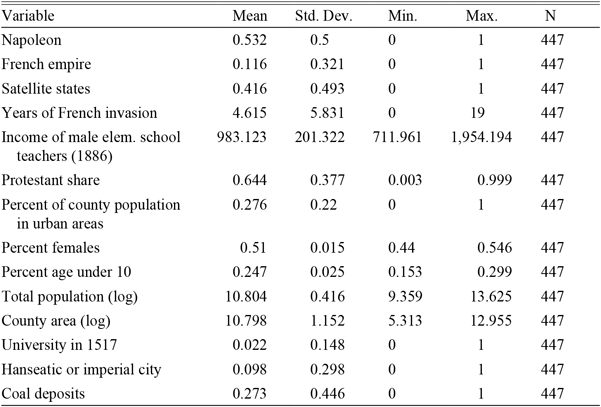
We also control for pre-Napoleonic economic development using the urban population in 1500 from Becker and Woessmann (Reference Becker and Woessmann2009). Geographic controls include the latitude (in radians), the log of total area of the county and a dummy variable for Polish-speaking provinces (which are mainly located in the east and underdeveloped).Footnote 27 In addition, we always include a dummy variable to control for counties with coal deposits since access to natural resources could affect western German industrialization and differential regional development.Footnote 28 Following Donges, Meier, and Silva (Reference Donges, Meier and Silva2017), we collect the location of the deposits from map BI (coal mining) in Pfohl and Friedrich (Reference Pfohl and Friedrich1928). Using information from the 1871 and 1886 censuses, we control for the demographic and social characteristics of the population and the industrial features of the county, as well as other aspects that may affect the wages of teachers (Socioeconomic and Education Controls).Footnote 29 Table 1 reports summary statistics for our main variables.Footnote 30 The table shows that approximately one-half of the sample was under the direct (11.6 percent) or indirect (41.6 percent) control of Napoleon. Moreover, we observe significant variability in the annual wages of male elementary school teachers, which range from 712 to 1954 gold marks. Table 1 also reveals quite a high variability in the linguistic distance measure. Moreover, while eighteenth-century Prussia was mainly Protestant (the average Protestant share is 64.4 percent), we observe sizable differences in counties’ religious affiliation.
SUMMARY STATISTICS

Source: Ifo Prussian Economic History Dataset (Becker et al. Reference Becker, Cinnirella, Hornung and Woessmann2014) combined with multiple data sources.
EMPIRICAL STRATEGY
This section presents the empirical model we use to test our central hypothesis, namely, that institutional transfer was more effective—and hence induced better economic performance—in places that were more culturally similar to France.
Our baseline specification is as follows:
 \begin{array}{l}{y_i} = \alpha + \;{\beta _1}Cultural\;dis{t_i} + {\beta _2}Napoleo{n_i} + {\beta _3}Cultural\;dis{t_i}\\ \quad \times Napoleo{n_i} + {{\bf{H}}_{\bf{i}}}{\beta _4} + {{\bf{G}}_{\bf{i}}}{\beta _5} + {{\bf{E}}_{\bf{i}}}{\beta _6} + {{\bf{X}}_{\bf{i}}}\;{\beta _7} + {\rm{\;}}{{\bf{H}}_{\bf{i}}}\;\\ \quad \quad \times {\rm{\;}}Napoleoni\;{\beta _8}{\rm{\;}} + {\rm{\;}}{{\bf{G}}_{\bf{i}}}\; \times {\rm{\;}}Napoleoni\;{\beta _9}{\rm{\;}} + {\rm{\;}}{\varepsilon _i},\end{array}
(1)
where y i is the log of the average income of male elementary school teachers in county i; Cultural dist i is one of our measures of cultural distance; Napoleon i is a binary variable indicating French influence; Hi, Gi, Ei, and Xi are vectors of historical, geographical, educational, and socioeconomic controls, respectively; and ε i is an error term. Throughout the article, all standard errors are robust to allow for heteroscedasticity in the variance-covariance matrix.Footnote 31 To account for the differential effects of the institutions depending on pre-existing characteristics that are not related to culture, the specification also includes interactions between the institutional dummy, Napoleon i, and pre-Napoleonic and geographic variables. We interact only controls that were already determined at the time of the Napoleonic invasion.
Our aim is to identify the differential impacts of French institutions on economic outcomes across levels of cultural similarity. The coefficient of interest is therefore β 3, which captures the differential effects of institutions on economic outcomes across counties with different degrees of cultural proximity to France. The identification of β 3 requires that other characteristics correlated with prosperity did not influence Napoleon’s invasion across areas with different degrees of cultural proximity to France. As previously discussed, the French invasions had primarily geopolitical, military, and ideological motives. Anecdotal evidence reported by Donges, Meier, and Silva (Reference Donges, Meier and Silva2017) shows how occupied regions, like Rhineland-Westphalia, were not economically more promising ex ante than those not invaded, like Saxony. This makes it unlikely that Napoleon systematically selected territories based on their cultural traits, cherry-picking rich culturally close regions and poor culturally distant ones.Footnote 32
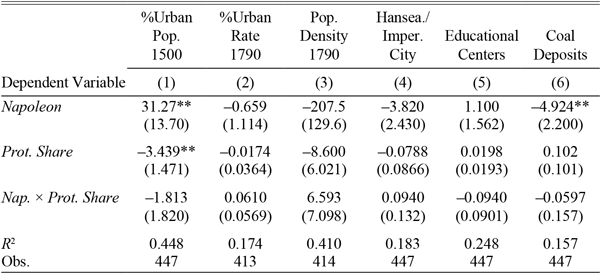
We test the exogeneity assumption with a battery of regressions estimating our baseline specification using as dependent variables the pre-Napoleonic variables available in our dataset. Significant coefficients on the Napoleon × Prot. Share may be symptomatic of the presence of pre-existing characteristics that simultaneously influence culture, institutions, and economic performance. The results are reported in Table 2. In Column (1), we implement the baseline specification using the urbanization rate in 1500.Footnote 33 In Columns (2) and (3), we use urbanization rate and population density in 1790 as the dependent variable, respectively. We have constructed these measures by exploiting the HYDE database and summing the grid-level information on population and urbanization in our county-level data. In Column (4), we run a linear probability model using the dummy variable capturing the presence of Hanseatic and Free Imperial Cities, while in Column (5), we use a dummy that indicates the presence of educational centers, either universities in the Holy Roman Empire or the presence of primary educational centers (schools and monasteries), in 1517. Finally, in Column (6), we exploit a dummy variable capturing the presence of coal deposits. The results show that the coefficients on the interaction term Napoleon × Prot. Share are never significant. These findings can be interpreted as evidence that pre-Napoleonic observables are balanced both across treatment and across cultural distance, which supports our identification assumption.
EXOGENEITY TEST — NAPOLEONIC INVASION AND PROTESTANT SHARE
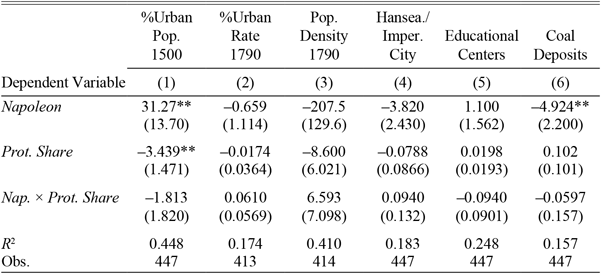
Notes: The dependent variable is in the column heading. Poisson regressions in Column (1). All specifications include Geographic Controls, Historical Controls (when not in the dependent variable), distance from the imperial capital (Berlin), distance from the district capital, Hist & Geo Interactions and the interactions of distance from the imperial capital (Berlin), and distance from the district capital with the dummy Napoleon. See also the notes to Table 3. Robust standard errors in parentheses. ***p<0.01, **p<0.05, *p<0.1
Source: Ifo Prussian Economic History Dataset (Becker et al. Reference Becker, Cinnirella, Hornung and Woessmann2014) combined with multiple data sources.
RESULTS
Baseline Estimates
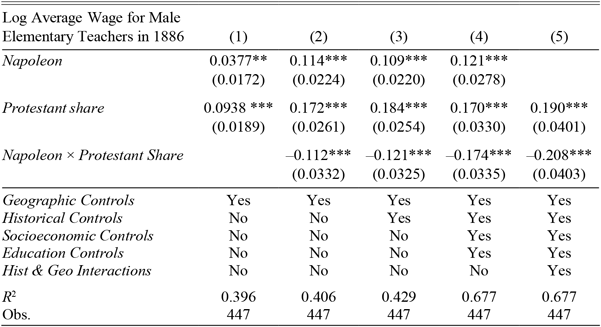
This section reports the results of our baseline analysis. Column (1) of Table 3 shows the estimates of a specification that includes only the institutional dummy, Napoleon, the cultural distance measure, Prot. Share, and geographical controls. In the following columns, we progressively enrich the specification until we estimate our baseline model in Column (5). Column (2) introduces the interaction term Napoleon × Prot. Share, while Column (3) adds historical variables that take into account counties’ pre-Napoleonic observable differences. Column (4) adds socioeconomic and education controls. These variables not only capture the economic and social outlook of the county after the Congress of Vienna, but also are meant to account for elements that influence the demand for and/or supply of teachers, thereby directly affecting our preferred proxy for economic performance. Unlike previous controls, these can be considered “bad” controls (Angrist and Pischke Reference Angrist and Pischke2009) since they are themselves potential outcomes of institutional transplants. However, our results are robust, and neither the magnitudes nor the statistical significance of our coefficients of interest are extremely affected. Finally, to eliminate the possibility that the estimate of our coefficient of interest is spuriously driven by the interplay of transplanted institutions with pre-existing county-level characteristics, Column (5) implements our baseline model and includes interactions between Napoleonic institutions and historical and geographic controls, thereby obtaining our baseline model. Table A3 in the Online Appendix reports all the coefficients of this specification, while Table A8 in the Online Appendix repeats the analysis on the subsample of invaded territories.
INSTITUTIONS AND RELIGIOUS AFFILIATION
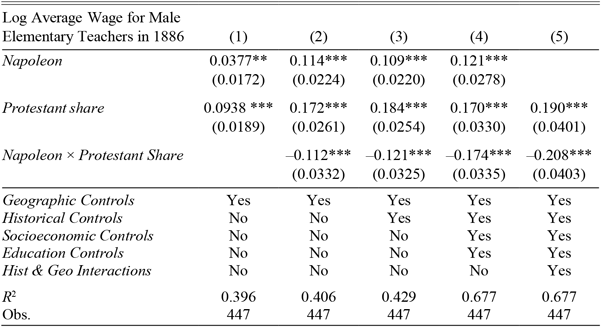
Notes: The dependent variable is the logarithm of the average annual wage of an elementary school teacher in 1886. Napoleon is a dummy variable indicating the presence of French institutions. Protestant Share is measured in 1871. Geographic Controls: latitude, area of the county (log) and dummy variables for Polish-speaking areas and coal deposits. Historical Controls: population in 1500 and Hanseatic or Imperial cities. Socioeconomic Controls: total population size (log), percentage of county population in urban areas in 1871, percentage of Jews, percentage of labor force in mining in 1882, number of farms in 1882 (log), distance from the imperial capital (Berlin), distance from the district capital, and year of annexation by Prussia. Education Controls: percentage of pupils traveling more than 3 km to school, total number of pupils in 1886 (log), total number of teachers in 1886 (log), and number of free apartments for male teachers in 1886. Hist & Geo Interactions: interaction between Napoleon and both Geographic Controls and Historical Controls. Robust standard errors in parentheses. ***p<0.01, **p<0.05, *p<0.1
Source: Ifo Prussian Economic History Dataset (Becker et al. Reference Becker, Cinnirella, Hornung and Woessmann2014) combined with multiple data sources.
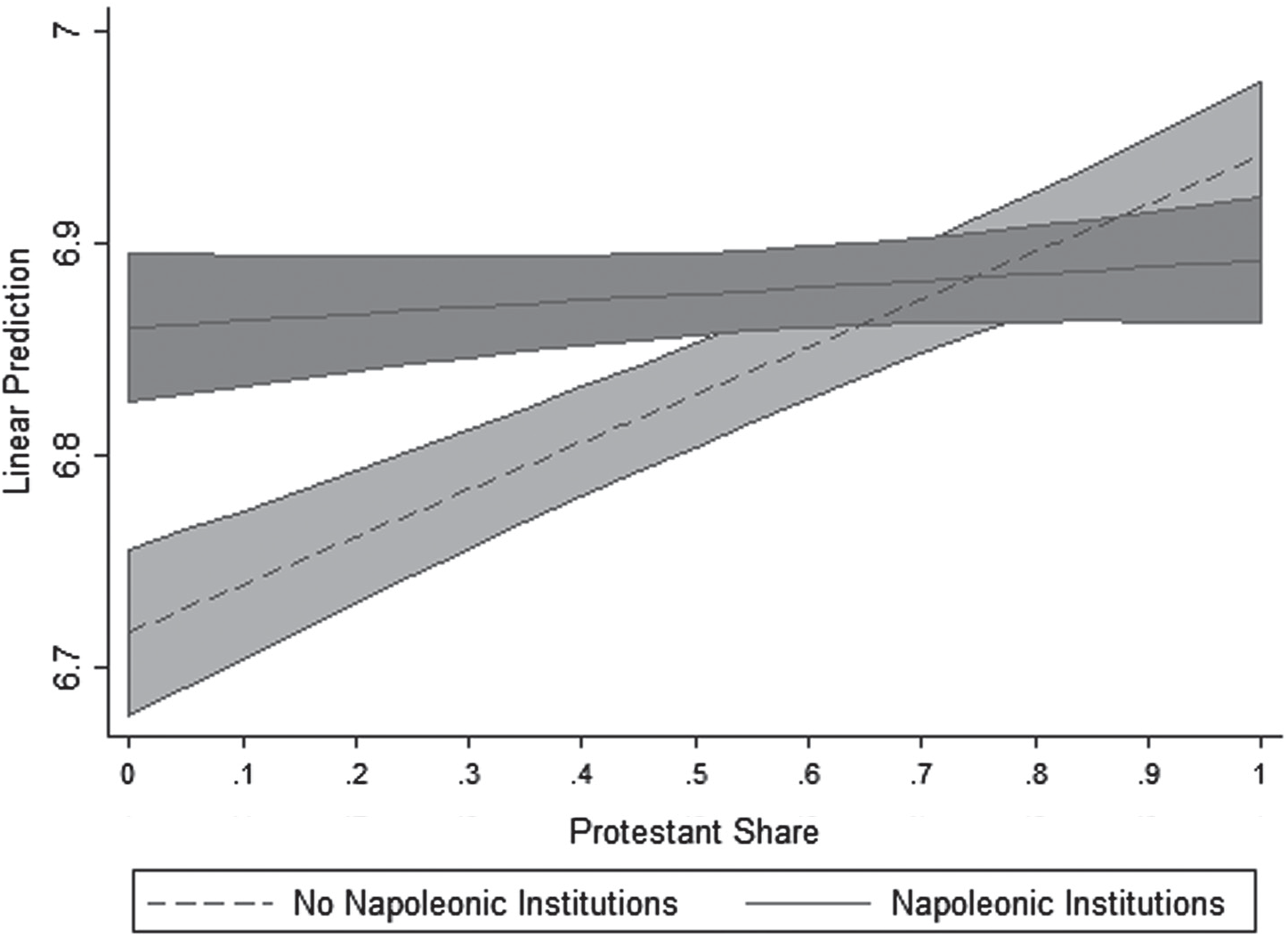
Consistent with the existing literature, the linear effects of good institutions (Napoleon) on our measure of economic performance is positive and statistically significant across all specifications, suggesting that transplanting progressive institutions can indeed improve economic outcomes.Footnote 34 Moreover, Protestant affiliation (Prot. Share) is always positively associated with better economic outcomes, consistent with Becker and Woessmann (Reference Becker and Woessmann2009). Notably, our coefficient of interest (β 3) is always negative, significant, and remarkably stable across specifications, indicating that Napoleonic institutions had virtually no impact on economic performance in culturally distant areas. To be more precise, the positive effect of institutions vanishes for a county whose Protestant share of the population equals 70 percent (Prot. Share mean is 64 percent). This result is also illustrated in Figure 1 which contrasts the predicted values of the income measure at different levels of the Protestant share for counties that did and did not receive the Napoleonic institutions. Furthermore, the magnitude of β 3 suggests that the moderating effect of cultural distance is sizable. Indeed, in counties that receive the French institutions, a one-standard-deviation increase in the Protestant share corresponds to a reduction in the county income of approximately 8 percent. Comparatively, the presence of a coal deposit in a county invaded by Napoleon increases the local income by approximately 6 percent.
PREDICTED EFFECT OF NAPOLEONIC INSTITUTIONS

In Table A4 in Online Appendix A, we perform an extensive sensitivity analysis addressing possible measurement and specification issues. First, we show that the results are robust to the use of alternative measures of economic prosperity. In particular, we estimate our main specification using average income of male elementary school teachers in levels, log wage of a daily laborer in 1892, income tax revenue per capita, and urban population in 1871. Second, we use alternative measures of religious affiliation. Specifically, we use a dummy variable capturing Protestant (absolute) majority, Protestant share in the first available wave of the Prussian census (1816), a historical measure of the Protestant majority in the seventeenth century and the distance from Wittenberg (IV specification).
Third, we introduce additional controls that may affect our results. Specifically, we introduce population densities and urbanization in 1790, a county-level price index, measures for locally born population, literacy rate, educational quality measures, and a dummy variable capturing the presence of ore deposits. To allow for potential correlation in the error term, we cluster standard errors at pre-Napoleonic-principality level, at the pre-Napoleonic-ruler level, at the preunitary-state level after the Napoleonic German mediatization, and at the Prussian political district level in 1871. Then, we show that our evidence is not driven by influential observations. We trim and winsorize the extreme 1 percent of observations of our dependent variable and consider alternative subsamples. The results of all these different specifications show that the association between French institutions and religious affiliation is always statistically significant, negative and remarkably stable.
In Table A5 in Online Appendix A, we repeat the analysis conditioning on different sets of fixed effects to address the concern that the presence of unobserved characteristics may influence both economic outcomes and cultural traits. Specifically, we add to the baseline specification ruler fixed effects, and three groups of geographic dummies (dummies for quintiles of distance from Berlin, Paris, and the French border). The results are confirmed even when exploiting for identification only within region variation.
Table A6 in Online Appendix A investigates how the moderating effect of cultural distance changes with the length of exposure to the new institutions. We use three measures that capture different facets of the intensity of the institutional treatment: (i) dummy variables that distinguish between territories that were annexed by the French Empire and those belonging to the Confederation of the Rhine (satellite states), (ii) the number of years of French influence, and (iii) an index proposed by Acemoglu et al. (Reference Acemoglu, Cantoni, Johnson and James2011) that summarizes different reforms. We find that cultural distance plays a significant role even when the intensity of the institutional treatment increases.
Finally, Table A7 in Online Appendix A reports the results of different specifications testing alternative explanations for our findings. We focus on factors, other than culture, that may interact with the new institutions, thereby affecting long-run economic outcomes. In particular, we analyze the impact of (i) state capacity, (ii) institutional proximity, (iii) legitimacy of the pre-Napoleonic ruler, (iv) education policies, (v) previous French invasions, (vi) severity of the Napoleonic conflict, and (vii) religious and linguistic fragmentation. Our results are not affected by the inclusion of this additional set of variables confirming that despite complex interactions among institutions and historical and socioeconomic factors, cultural similarity does play a role in institutional transplants and long-term economic outcomes.
Difference-in-Differences Specification
Our second strategy is to test our hypothesis using a different dataset, which allows us to implement a difference-in-differences (DID) specification. We use the data compiled by Acemoglu et al. (Reference Acemoglu, Cantoni, Johnson and James2011), which contain information on urbanization and religious affiliation for a panel of 19 independent German states (or provinces of larger states) for the years 1750, 1800, 1850, 1875, and 1900. Even though these data are available at a higher level of aggregation (19 states vs. more than 440 counties), they allow us to test our hypothesis using within-region variation over time. Accordingly, our baseline DID specification reads as follows:
 $$\eqalign{urb\;rat{e_{it}} & = {\alpha _1}Pos{t_t} + {\alpha _2}Pos{t_t} \times Napoleo{n_i} + {\alpha _3}Pos{t_t}\; \times \;Pro{t_i} + {\alpha _4}Pos{t_t} \cr & \quad \times Napoleo{n_i}\; \times Pro{t_i}\; + \;{\mu _i}\; + \;{\varepsilon _{it}},}$$
(2)
where urb rate it is the urbanization rate of state i in year t (the proxy for economic outcomes in this dataset), Post is a dummy variable that equals one in the years after the Napoleonic invasion (in other words, in the second half of the nineteenth century), Napoleon is a time-invariant dummy variable that captures the French presence (treatment) in the state, Prot i is the share of Protestants around 1800 (constant over time), and µ i are state fixed effects.
As already mentioned, to avoid distortions due to errors in the recording of the timing of the reforms, we prefer to use a dummy variable capturing the presence of French rule rather than the reform index, proposed by Acemoglu et al. (Reference Acemoglu, Cantoni, Johnson and James2011), based on the duration of each reform. Moreover, using a dummy variable that indicates French presence allows us to reduce concerns about potential endogeneity in the duration and the intensity of French reforms. Indeed, whether a state retains the set of reforms after the Congress of Vienna is a choice variable that may well depend on the success of the institutional transplant itself.
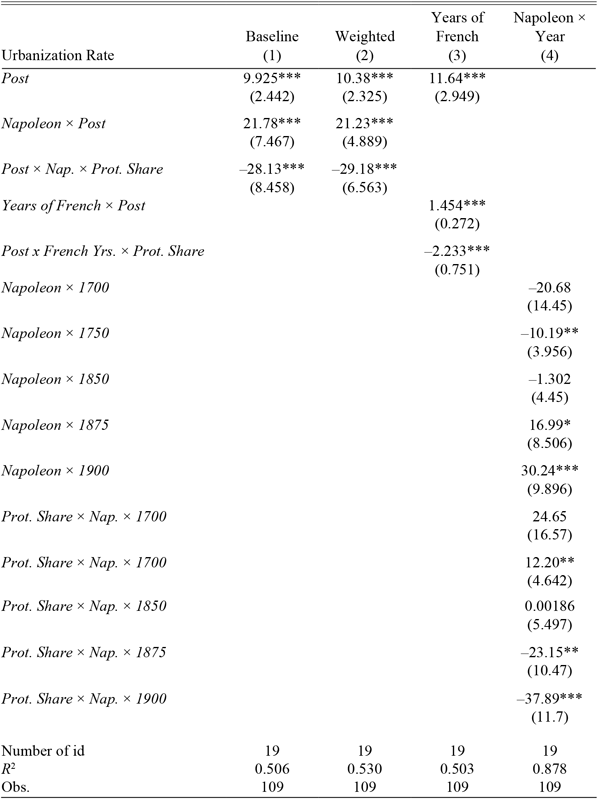
The results are reported in Table 4. Column (1) shows the baseline DID estimates. The coefficient on the Post dummy indicates that German areas grew in the second half of the nineteenth century. The positive coefficient on Napoleon × Post suggests that growth was higher in places that received French institutions. The negative coefficient on the interaction between French institutions and Protestant share after institutional transplant confirms that the positive effect of French reforms was not homogeneous across different levels of cultural proximity. Indeed, the estimates suggest that the positive effect of good institutions vanishes for a share of Protestants of approximately 85 percent (the median Protestant share in this sample is 80 percent). In Column (2), we show that the results are robust to weighting the regression by total population in 1750, as in Acemoglu et al. (Reference Acemoglu, Cantoni, Johnson and James2011). In Column (3), we reach the same conclusion using a different measure of French institutions, that is, the number of years of French presence. Finally, in Column (4), we replace the Post indicator with a full set of year dummies (we take 1800 as the reference year). The positive average effect of the Napoleonic reform appears only in the long term (around 1875, in other words, 60 years after the Congress of Vienna) and, perhaps more interestingly, only in states characterized by a Catholic majority.Footnote 35
DIFFERENCE-IN-DIFFERENCES ESTIMATION

Notes: The dependent variable is the urbanization rate of the German territories. All regressions have territory fixed effects that subsume the linear effects of Napoleon, Prot. Share, and Napoleon Prot. Share (all of which are constant over time). Column (4) includes year fixed effects. The reference year is 1800. All specifications include interactions between post (or year) and the Protestant share. The results are not reported for the sake of readability. Regressions are weighted by territories’ total population in 1750. Robust standard errors are clustered by territory. ***p<0.01, **p<0.05, *p<0.1.
Source: Acemoglu et al. (Reference Acemoglu, Cantoni, Johnson and James2011).
Using a different dataset and a different empirical strategy, the results of this section confirm that cultural distance from France played a role in the success of the institutional transplantation process. However, we find that the positive effect of radical reforms unfolds only in the long term and only in places that were more amenable to the French reforms. We discuss two possible explanations for the existence of a time lag between the imposition of the institutions and the emergence of their positive economic effect even in culturally close territories: (i) the negative heritage of the military conflicts and the effect of French foreign policies and (ii) the gradual interaction of the Prussian policies with French heritage.
Obviously, the arrival of the French army placed heavy burdens upon local communities: their villages were invaded, and their towns and cities were besieged and occupied. French soldiers often supported themselves through requisitions and plundering, but the forces of the German states also often required local inhabitants to provide them with supplies and transport. The stationing of troops also brought with it both diseases that often spread to livestock and inflationary pressures especially on the prices of foodstuff (Leighton Reference Leighton2013). Moreover, war had left counties with high debts and reconstruction burdens. However, perhaps the highest toll was paid in terms of human capital depletion. The total war dead among all the European armies during the Napoleonic campaign was estimated to be approximately three million, with additional civilian losses of nearly one million, mainly concentrated among young men. In addition to immediately depriving the productive sectors of a labor force, the loss of so many men upset the population balance between the sexes and had long-term consequences on population growth. Finally, in non-annexed territories, the manufacturing sector was damaged by French protectionist policies that deprived the sector from cheap imports from Britain and at the same time made it hard to export to France. In addition, capital was inadequate to create new enterprises to compensate for the lack of British manufactured goods. Coastal cities and their merchants were heavily affected, and industries related to naval trade, such as ship-building and rope-making, declined, as did many other industries that relied on overseas markets, such as the linen industries. All in all, the Napoleonic wars left central Europe severely battered, and the positive heritage of progressive reforms took time to manifest itself.
After the congress of Vienna, Prussia experienced a periphery-center conflict characterized by tension between western reformers and Berlin conservatives, which slowed the reform process. It was not until the 1840s that the heritage of the French institutions could interact with Prussian virtuous reforms, favoring the Prussian industrial take off. For example, in the aftermath of Napoleon’s downfall, Rhenish infant industries—deeply integrated into Napoleon’s Continental System—suffered greatly both from the imposition of Dutch and French tariffs and from international competition with Britain. The progressive creation of the German customs union benefited Rhenish industry by facilitating the formation of a German-wide national market for goods and especially by fostering East-West commerce, increasing fiscal efficiency and providing both mild protection of nascent industry and the access to duty free raw materials.Footnote 36 Furthermore, the 1840s witnessed a turn to a more favorable governmental attitude toward industrial development, which is well illustrated by the new policies that boosted railroad building, monetary integration, and the reform of the banking system (Tilly Reference Tilly1966). All these institutional changes spurred private investments in productive industrial activities, allowing for a boost in the industrialization process. Our results suggest that the positive effect of German reforms, which took off only in the second half of the nineteenth century, interacted with Napoleonic institutions and that this fruitful interaction was relatively stronger in the culturally closer territories.
Additional Cultural Dimensions
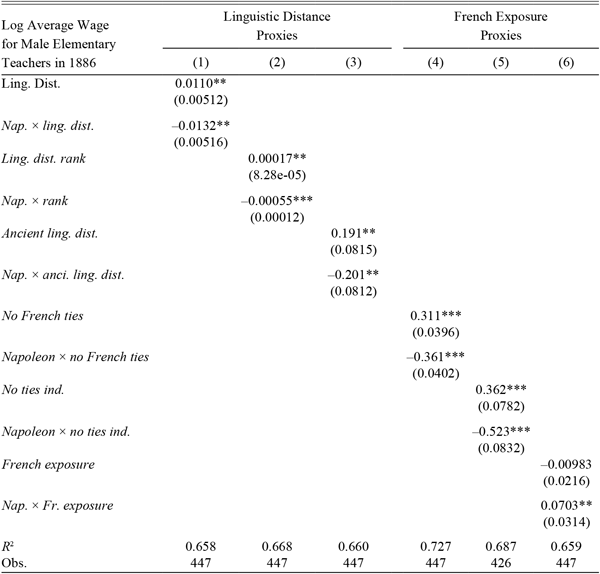
Religious affiliation captures persistent cultural similarities across counties, but there might be other important cultural aspects that interact with the adoption of transplanted institutions. In this section, we study distinct aspects of cultural similarities occurring either among members of the lower class or among the elites. As a proxy for cultural distance among lower class members we use linguistic distance, while to measure cultural distance among elites we build a variable based on the affinity between the eighteenth-century rulers and French culture.Footnote 37 The results are reported in Table 5 using the same specification as in Column (5) of Table 3.
ALTERNATIVE CULTURAL MEASURES
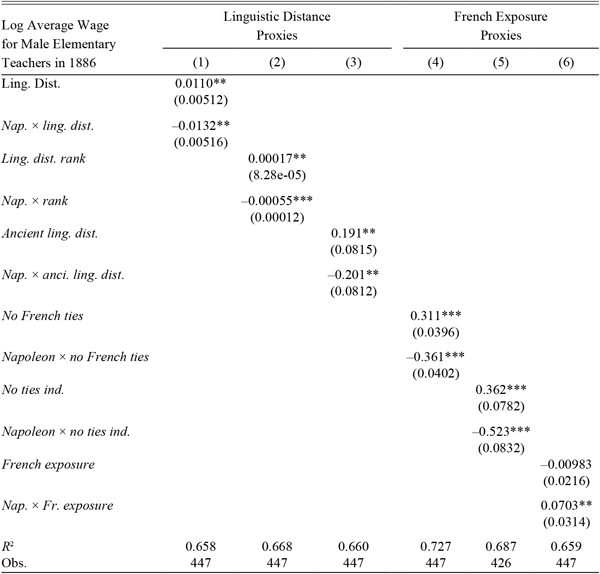
Notes: The column headings indicate the cultural-distance-proxy groups used in the specification. The dependent variable is the logarithm of the average annual wage of an elementary school teacher in 1886. The specifications include Geographic Controls, Historical Controls, Socioeconomic Controls, Education Controls, and the interactions between the new measure of institutional intensity with historical and geographical controls. See also the notes to Table 3. Robust standard errors in parentheses. ***p<0.01, **p<0.05, *p<0.1.
Source: Ifo Prussian Economic History Dataset (Becker et al. Reference Becker, Cinnirella, Hornung and Woessmann2014) combined with the Ethnologue database (Simons and Fenning Reference Simons and Fennig2018) and multiple data sources.
We begin by discussing linguistic distance. Consistent with the existing literature, we interpret language as a reflection of persistent cultural traits (Galor, Özak, and Sarid Reference Galor, Özak and Sarid2017; Falck et al. Reference Falck, Heblich, Lameli and Südekum2012) and as a vehicle of social interaction and social influence (Spolaore and Wacziarg Reference Spolaore, Wacziarg, Ginsburgh and Weber2016, Reference Spolaore and Wacziarg2019). Hence, linguistic distance is likely to serve as an inverse proxy for the diffusion of social norms. We exploit linguistic heterogeneity within Prussia to build a measure of linguistic distance between French and the languages spoken in each county. To this purpose, we leverage the linguistic information reported in the Ethnologue database (Simons and Fenning Reference Simons and Fennig2018), which describes the languages that are currently spoken in each NUTS2 region.Footnote 38 As shown in Column (1) of Table 5, the coefficient of interest, β 3, is negative and precisely estimated, and its magnitude suggests that the moderating effect of cultural distance is sizable. Indeed, in counties that received the French institutions, a one-standard-deviation increase in the measure of linguistic distance from the French language (approximately an increase of two nodes in the linguistic distance) corresponds to a reduction in the county income of approximately 8 percent, an effect that is remarkably similar to our estimated baseline effect. Then, to prevent our results from being driven by minor differences in the linguistic distance variable, we use counties’ ranking in terms of the linguistic distance. The results are reported in Column (2), and they are consistent with the baseline result. Since the Ethnologue database reports currently spoken languages, a possible concern is that linguistic areas may have been affected by the Napoleonic treatment (e.g., through migrations). To ensure that our results are not exclusively driven by the assignment of counties to modern linguistic regions, we redefine the linguistic regions exploiting the information contained in an ancestral language map.Footnote 39 Column (3) shows that the results are unaffected by this sensitivity test.
The second set of alternative cultural distance measures relies on the existence of different attitudes of eighteenth-century rulers toward both Enlightenment ideals and French culture. Indeed, the degree of acceptance of a foreign institution may crucially hinge on the mediation of the ruling class, whose inclinations and attitudes toward the new rules could facilitate their implementation. Using essays, biographies, and books, we investigate whether local rulers during the period 1701–1790 (i) had a direct French relative (mother, father, or spouse) and, thus, an explicit link to the French aristocracy; (ii) displayed a positive disposition toward the customs and traditions of the French court;Footnote 40(iii) embraced French Enlightenment ideals;Footnote 41 or (iv) had a long-standing relationship with the French Royal House.Footnote 42 Our first proxy of cultural distance, No French Ties, is a dummy that equals one if none of the previously noted conditions is satisfied.Footnote 43 The results are reported in Column (4), and the estimated impact of No French Ties is considerably large. This pronounced impact is not surprising because having a dummy that equals one means that no ruler in the century before the Napoleonic invasions had any ties with France, indicating a significant lack of exposure to French culture that translates into a 36 percent decrease in the average income of the county in the invaded territories.
Then, to obtain a more precise measure of the potential exposure to French culture through the ruler’s attitude, we weight our dummy by the fraction of years a ruler was in power during the period 1701–1790 (Column 5). For example, if a ruler with no French ties was in power for 46 years, his or her contribution to our index is 0.51 (in other words, 46 over 90 years). Finally, to alleviate the concern that the variable is distorted by the availability of historical information (as it is likely that large principalities and active rulers are more covered), we redefine the measure to reflect only objective historical exposure to French culture. Specifically, in addition to information on rulers’ kinship relations with the French aristocracy, we exploit the presence of Huguenot migrants during the seventeenth century using county-level data collected by Hornung (Reference Hornung2014) and complemented by Poole (Reference Poole1880). It is likely that fruitful interaction with elites and local populations generated a favorable image of these Frenchmen and a positive inclination toward French culture. We then construct a dummy variable, French Exposure, that equals one if local rulers during the period 1701–1790 had a direct French relative (mother, father, or spouse) or if the county registered the presence of Huguenot colonies. The results in Column (6) show that transplants were more effective if the local population had previous exposure to French culture.
In this section, we highlight different cultural aspects that may have influenced the reception of the French rule. In particular, the linguistic proxies are meant to capture the slow-moving components of culture reflected by ancient linguistic similarities and reflect features of the local population. Instead, the rulers’ attitude variables capture the cultural affinities of the ruling class with the values contained in the new transplanted institutions. Overall, the results confirm that cultural proximity plays a significant role in the acceptance of the French institutions. Consistently with the potential mechanisms discussed in the previous section, the results also suggest that various aspects of cultural distance might be relevant for a positive adoption of the transplanted institution.Footnote 44
CONCLUSION
In this work, we measure how the economic impact of transplanted institutions depends on cultural proximity between the exporting and the receiving countries. Our historical context is well suited to exploiting both the quasi-natural experiment generated by the Napoleonic military campaign and cultural heterogeneity across Prussian counties. Our results show how the economic development spurred by the Napoleonic rule in Germany between the French revolution and the first half of the nineteenth century depends on culture. Specifically, we present evidence that cultural distance, measured as religious affiliation in our baseline specification, interacts with the adoption of transplanted institutions, thereby diluting the positive long-term economic effect of progressive institutions.
Drawing on novel data on pre-Napoleonic principalities combined with waves of the Prussian census we are able to conduct a comparative analysis of the economic impact of institutional transplants across areas characterized by different degrees of cultural proximity. We provide evidence that Napoleonic institutions had heterogeneous effects on economic performance across German areas characterized by different degrees of cultural proximity with France. Our results suggest that a one-standard-deviation increase in the Protestant share corresponds to a reduction in the county income of approximately 8 percent. The magnitude of the effect is sizable and comparable to that of other significant drivers of Prussian economic growth (e.g., presence of coal deposits). Overall, our findings largely support the idea that cultural proximity facilitates the adoption of new institutions through a mix of a better disposition toward the French invader and toward the content of the institutions in the receiving communities, and of a friendlier approach of the exporter in imposing the same formal institutions in culturally similar areas.
On a more general perspective, our results contribute to the existing debate on the so-called “Washington Consensus.” Indeed, the imposition of seemingly “sound” reforms was not always beneficial for the receiving country and the reforms did not always work out the way they were intended. Although we analyze a very specific historical environment, and extrapolation to other contexts might be hazardous, our findings suggest that the new institutions are growth enhancing if designed to fit the circumstances of individual countries. In particular, reforms need to be compatible with local social norms: the transplant may fail if it conflicts with local culture, and the population may be reluctant to accept a new set of institutions that is perceived as alien or that is imposed by a culturally distant entity.
Supplementary material
To view Supplementary material for this article, Please visit https://doi.org/10.1017/S0022050719000366