WTO Director-General Pascal Lamy, in announcing failure of the WTO's July 2008 ministerial meetings, reported that out of a to-do list of 20 topics, 18 had seen positions converge. But the gap did not narrow on the 19th – the special safeguard mechanism for agriculture (SSM). The difference was the traditional one: importers' concern that the parameters on the table would allow too little flexibility to deal with unforeseen problems; exporters' concern that safeguard actions might undo what they had gained through tariff reductions.
Safeguard or flexibility mechanisms have long been a part of the GATT/WTO system, and on the whole have managed to strike a reasonable balance between these concerns. My objectives in this paper are to review the experience of the international community with other GATT/WTO safeguard or flexibility provisions, to examine how this experience might be applied to the design of a useful safeguard for agriculture.
As to where this investigation leads me, I conclude that the effectiveness of traditional safeguard instruments to sustain long-run liberalization programs stems from their requiring objective, transparent and participatory decisions on the application of new/exceptional import restrictions. Their usefulness stems from these process requirements, not from the ‘criteria’ they have imposed, e.g. injury or injurious dumping.
The proposed SSM includes no procedural requirements, but defines by arithmetic formula when a Member may impose a new import restriction. The proposed formulae would – as they intend – expand Members' scope for unilaterally imposing restrictions. Simulations indicate however that the formulas would frequently allow an import restriction when it would not have the positive effect SSM proponents allege, and frequently fail to prescribe SSM action when it would have such effect.
As to how the discussion proceeds, Sections 1, 2, and 3 look into how GATT/WTO safeguard or flexibility provisions have functioned and evolved – the characteristics that made them supportive management tools. I examine in Section 4 the special safeguard provisions (SSG) of the Uruguay Round Agreement on Agriculture. It and the proposed SSM have similar structures, hence how the SSG has operated will help us to understand how the SSM might operate. Sections 5 and 6 examine the proposed SSM. I pay particular attention to the mechanism as a decision mechanism: will the proposed ‘triggers’ allow import restrictions when they are appropriate, disallow them when they are not? Section 7 looks briefly at interactions between the SSM and the current state of negotiations on tariff reductions; Section 8 offers conclusions and comments.
1. Safeguards in international trade agreements: principles
The longer-run benefits of commitment to a program of liberalization through negotiation and bound commitments are familiar. The mercantilist quid pro quo for domestic reforms – improved access to foreign markets – will help to provide alternative uses for displaced domestic resources. Moreover, binding reforms through international agreement will buttress resistance to backsliding.
The reality of trade politics is that to win acceptance of liberalization a government will often have to assure industry that ‘exceptional circumstances’ will be dealt with. Thus international commitments to long-term reform usually include ‘safeguard’ provisions that provide flexibility to deal with exceptional events. Such provisions allow new trade restrictions, but at the same time attempt to discipline against their overuse so that a longer-run momentum toward liberalization is maintained.
Dimensions of a safeguard/flexibility provision
Membership in the WTO commits a government to use only approved instruments of trade control, principally tariffs, to apply them in a generally non-discriminatory manner and to subject them to a long-term process of binding and reduction through negotiation.Footnote 1 Flexibility in this context does not refer to the freedom a government would maintain by remaining outside the agreement or by not binding its tariff rates through the agreement. It refers to disciplined or guided flexibility intended to keep its application by each Member in line with the overall and long-run objectives implicit in membership. Being a part of the overall agreement, safeguards presume each Member's long-term commitment to liberalization.
I will review safeguard mechanisms from the perspectives of three characteristics: flexibility, discipline, and guidance toward good policy choices.
Flexibility
Trade liberalization is not rocket science. There will be uncertainty as to the economic impact reforms will have and as to the intensity of the resistance these impacts might provoke. In the face of reaction that might disrupt the entire liberalization program, good policy becomes the pragmatic matter of managing pressures for exceptions so as to maintain a general momentum for liberalization and to strengthen the politics of avoiding rather than of imposing such restrictions in the future. The correct choice will sometimes be to impose an import restriction.
Discipline
At the same time, a safeguard provision should provide discipline against overuse; discipline so that the possibility of introducing new trade restrictions is not so attractive that it overcomes the government's intention to maintain a long-run momentum toward liberalization. There should remain a general pressure toward not applying the measures that in special circumstances the safeguard provision allow. The occasional step back should not only preserve previous steps forward, it should strengthen the politics of taking more steps forward in the future.
Policy guidance
Finally, a safeguard provision might be expected to do more than make pragmatic political sense. Beyond the matter of taking one step back in order to preserve two steps forward, economic science does recognize situations in which an import restriction might itself advance the national economic interest. The rhetoric of antidumping, for example, suggests that an antidumping action follows more or less the same economic logic as an anti-trust action. Interventions that neutralize ‘distortions’ (situations in which the market price of a product differs from its true economic cost) will serve the national economic interest in the long run as well as in the short run.
The meaning in practice of each of these criteria will be elaborated in the review of experience with GATT/WTO safeguard provisions. One of the lessons of that review is that rhetoric often dominates analysis – interventions occur more frequently than the economic distortions that might render them good economics.
2. GATT provisions that allow new import restrictions
The General Agreement on Tariffs and Trade (GATT) is an agreement and the World Trade Organization an organization intended to promote the expansion of international trade. Even so, the GATT/WTO explicitly provides for Member countries to impose new trade restrictions or to replace old ones. This section reviews use of such provisions.
One of my conclusions here is that usage is perhaps the only guide to the functions of these provisions; e.g., antidumping functions as a ‘safeguard’ rather than a discipline on anti-competitive business practices. Another is that though the criteria for use of the various flexibility provisions appear to differ – safeguard, antidumping, balance of payments provisions – they are in practice quite fungible. Why one measure is used has been more a matter of political and administrative convenience than the economics of the particular situation. Analysis also shows that the administrative disciplines the GATT/WTO imposes – recognition of and participation of interested parties, public availability of information, publication of decisions and reasons for decisions – have been an important support for good policy management – perhaps more so than the economic criteria these provisions impose.
Renegotiations and emergency actions
In GATT's first decade, the most prominent of the provisions that sanction new restrictions was Article XXVIII, providing for renegotiation of any tariff reduction a participating country had made.Footnote 2 The 1947 GATT gave each country an automatic right to renegotiate any of its reductions after three years (Article XXVII) and, under ‘sympathetic consideration’ procedures, reductions could be renegotiated more quickly. As to discipline on the use of renegotiation, the process carries with it the requirement to compensate – in undoing a previous tariff reduction, a country would be expected to offer exporters something equivalent on other tariff lines.Footnote 3
Article XIX, titled ‘Emergency Actions on Imports of Particular Products’ but often referred to as the ‘Escape Clause’ or the ‘Safeguards Clause’, provides a country quicker access to much the same renegotiation process. In instances of particularly troublesome increases of imports – that cause or threaten serious injury to domestic producersFootnote 4 – a country could introduce a new restriction, then afterwards negotiate a compensating agreement with its trading partners.Footnote 5
Reciprocity as discipline
GATT negotiators were aware that these mechanisms offered the potential to overcome the principal purpose of the agreement: a general reduction of trade barriers. There are consequently certain disciplines built into each mechanism, the basic discipline on new restrictions through renegotiation being reciprocity. A country seeking to increase a restriction was expected to offer compensating reductions on other products. If supplier countries did not consider these to be satisfactory, they could retaliate, i.e. increase their restrictions in a parallel manner.Footnote 6
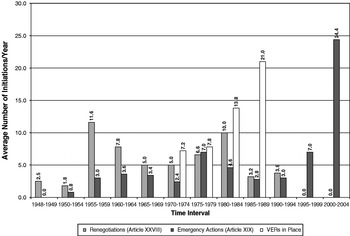
Figure 1 traces early usage of the different provisions. Within 15 years after the GATT first came into effect, every one of the 29 participating countries who had bound tariff reductions had undertaken at least one renegotiation – in total, 110 renegotiations, on average almost four per country. These actions were in large part renegotiations under Article XXVIII, supplemented by emergency actions (restrict first, then negotiate compensation) under the procedures of Article XIX.Footnote 7
Renegotiations (GATT Article XXVIII), emergency actions (GATT Article XIX), and voluntary export restraint agreements (VERS), 1948–2004

Over time, the mix shifted toward a larger proportion of emergency actions. In use, Article XIX emergency actions and Article XXVIII renegotiations complemented each other. Nine of the 15 pre-1962 Article XIX actions that were significant enough that the exporter insisted on compensation (or threatened retaliation) were eventually resolved as Article XXVIII renegotiations. Article XXVIII renegotiations, in turn, were often folded into regular tariff negotiations.Footnote 8
Protection contingent on circumstances as discipline
In addition to the obligation to compensate and the ultimate threat of retaliation, Article XIX introduces a second source of discipline: conditions. Article XIX provides legal clearance only in instances where imports cause or threaten serious injury to domestic producers.
Some negotiators argued that the ‘injury’ criterion would provide little discipline. Import restrictions had been put in place to increase domestic production, removing them was indeed likely to displace it. Allowing new import restrictions when removal of old ones led to displacement of domestic production had the potential to undo a large part of the reductions. Negotiators consequently added the condition ‘as a result of unforeseen developments’,Footnote 9 so that the normal or expected results of a tariff reduction would not justify an increase.
As economics, the ‘unforeseen developments’ requirement is an admission that injury is not a good criterion, but it does not provide a criterion that identifies import restrictions that will have net economic benefit.
Negotiated export restraints – reciprocity outside legal bounds
By the mid 1970s, formal use of Article XIX and of the renegotiation process began to wane. Actions taken under the escape clause tended to involve negligible amounts of world trade in relatively minor product categories.Footnote 10 Big problems such as textile and apparel imports were handled another way, through the negotiation of ‘voluntary’ export restraint agreements (VERs). The various textile agreements, beginning in 1962, provided GATT sanction to VERs on textiles and apparel. The same method, ‘negotiated’ export restraints or VERs, was used by the developed economies to control troublesome imports into several other important sectors, such as steel and automobiles.
Except for those especially sanctioned by the textile arrangements, VERs were GATT-illegal.Footnote 11 However, while VERs violated GATT legalisms, they accorded well with its ethic of reciprocity and their negotiation controlled for the possibility of a chain reaction of import restrictions from one country to another, as had been disastrous in the 1930s.
The reality of power politics was at play, but compensation was involved. Reduced export volumes were compensated for by higher prices, the result often being a net gain for exporters.Footnote 12 Sometimes the quid pro quo was foreign aid or some other non-trade consideration.
Though VERs were GATT-illegal, they prevailed through the 1970s and the 1980s as the predominant mechanism for managing troublesome imports (Figure 1). Their use came to an end with the Uruguay Round Agreement on Safeguards. Its Article 11 includes an explicit prohibition and a procedure for notification and phasing out of those in place. One might speculate that the reasons behind this elimination included:
• the increasing weight of developing countries in world trade and their increasingly active role in the GATT system;
• the growing realization in developed economies that a VER was a costly form of protection;Footnote 13
• the long-term legal pressure of the GATT rules; and
• the availability of an attractive, GATT-legal alternative, antidumping.
Antidumping ascends
Antidumping was a minor instrument when the GATT was negotiated, and provision for allowing antidumping measures was included with little controversy. In 1958, when the GATT Contracting Parties first canvassed themselves about the use of antidumping measures, the resulting tally showed only 37 antidumping decrees in force across all GATT countries, 21 of those in South Africa.Footnote 14
Since 1995, when the Uruguay Round agreements came into force, use of antidumping has dominated use of other provisions that sanction import restrictions: 2,049 antidumping measures as compared with 83 safeguard measures, 119 countervailing duty measures and no renegotiations reported by the WTO Secretariat.Footnote 15
While in GATT's early decades renegotiation of previously agreed tariff bindings was the most frequently used flexibility provision, the ascendance of antidumping demonstrates that as the GATT/WTO system became more juridical, adjustments previously treated as negotiations were increasingly taken up as evaluations against specified criteria.
These evaluations are unilateral in that they are conducted by national authorities, but they retain significant collective or international dimensions. Evaluation is against a collectively agreed ‘just cause’ (e.g., injurious dumping) and it follows collectively agreed procedures. National investigations must recognize exporters and governments of exporting countries as interested parties and these investigations are under continuous international scrutiny. Antidumping measures have been the subject of 60 of the 368 casesFootnote 16 taken up in the WTO dispute settlement process.
Discipline
Though the number of antidumping measures applied has increased, the record indicates that there is a good deal of discipline in the GATT/WTO system. Finger et al. (Reference Finger, Keith Hall and R. Nelson1982) found that over 1975–79, only 2% of US imports were covered by either affirmative antidumping or countervailing duty cases; 4% by affirmative safeguard (Article XIX) cases. Gallaway et al. (Reference Gallaway, Blonigen and Flynn1999) found that in the mid 1990s the percentage for the total of all three of these trade remedies was still about 5%. Egger and Nelson (Reference Egger and Nelson2007) looked at the impact of antidumping worldwide, and estimated that over the 40 years 1960–2000 antidumping had reduced world export volume by no more than 2%.
One discipline on antidumping is cost; the cost to an industry of legal representation and of supplying the information needed to support a petition along with the cost to a government of conducting an investigation.Footnote 17 Another discipline is reciprocity. Though WTO rules do not require compensation when an antidumping duty is imposed, the threat of reciprocal antidumping action has become an effective discipline. There was a surge of antidumping users and actions soon after the Uruguay Round, but the number of cases subsequently declined. Several studies have found that the threat of retaliation provides considerable discipline, hence the decline in the number of antidumping actions once a large number of WTO Members had armed themselves. Blonigen and Bown (Reference Blonigen and Bown2003) summarize these arguments and evidence. Eichengreen and Van der Ven (Reference Eichengreen and Ven1985) document how threatened retaliation by the EEC caused the US government to pull back from taking antidumping action against imports of automobiles from Europe.
An effective pressure valve
Antidumping has proven to be an effective pressure valve. It allows domestic interests to complain about the unfairness of foreign competition and provides a detailed process for investigation of such concerns. At the same time, antidumping measures have been minor in comparison with the liberalization the global economy has witnessed.
Guidance for good policy
Antidumping is perhaps the classic example of a pragmatically successful flexibility instrument with pretensions – but no more than pretensions – to a real economic rational. Functionally speaking however, antidumping's contribution is that it has provided needed political flexibility. The increasing technical complexity of its criteria have not improved the economics, but the cost of accommodating it has probably deterred usage.
Developing country usage of GATT balance of payments provisions
The GATT system imposes no restrictions on unilateral increases of unbound tariff rates, and until the Uruguay Round developing countries had notified bindings on few of their tariff lines.Footnote 18 They therefore did not need the legalities of renegotiations, safeguards, or antidumping in order to adjust tariff rates.
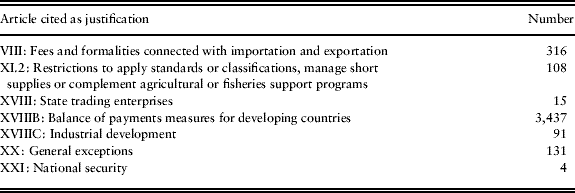
GATT Article XI provides a general prohibition against quantitative restrictions, hence any application of such a restriction must find legal sanction in other provisions of the agreement. Article XII allows quantitative restrictions as measures to guard the balance of payments, and in GATT's earlier decades was frequently cited by developed countries. More relevant for developing countries however is Article XVIII. Provisions under Article XVIIIB allow developing countries to impose quantitative restrictions to address balance of payments disequilibria and to maintain reserves adequate for development. Section C of the same article allows protection to infant industries, or in GATT language, measures to promote the establishment of particular industries in the context of a development program. In practice, the balance-of-payments exception has been invoked far more often than the infant industry exception: almost 3,500 restrictions under the balance of payments exception compared with less than 100 under the infant industry exception (Table 1).
Number of CCCN items notified under each GATT article by developing countries 1974–87

Source: OECD (1992: 100).
The paucity of actions notified under the infant industry provision should not be taken as an indication that developing country governments did not apply trade restrictions for this purpose. Anjaria (1987: 671) concludes that the explanation for the larger number of measures notified under the balance of payments provision is its easier procedural requirements. Infant industry measures (Article XVIIIC) require prior notification to the GATT, and compensation for affected exporters. Article XVIIIC also provides that the GATT Contracting Parties can disapprove such an action and can authorize retaliation if a not-approved action in taken. Balance of payments measures (Article XVIIIB) are not subject to these restraints, nor are there time limits on how long they may be in place. The facts of usage suggest that measures notified under Article XVIIIB were often intended to support particular industries rather than to restrict imports generally. Anjaria reports (1987: 680) that for each country the aggregate of measures notified under XVIIIB was made up of many different applications, and that for three-quarters of the developing countries who notified measures the aggregate covered less than half of import categories.
Rationale
When the GATT was adopted, the widely believed Prebisch thesis cautioned that commodity earnings would inexorably decline and industrialization would require vast imports of capital goods. Thus, developing countries would continuously suffer balance of payments problems.Footnote 19 Reflecting this thinking, GATT soon evolved a tolerance for developing country trade restrictions.Footnote 20
Discipline
Again we find reciprocity to be the effective discipline. By the 1970s, a number of developing countries had become important in world trade, both as potential export markets and as suppliers of imports that increasingly prompted developed country industries to call for protection. The intensified commercial presence of developing countries provoked industrial countries to press for market-opening actions by developing countries. Pressure was applied both through the GATT Balance of Payments Committee and the Trade Committee of the OECD. One of the focal points of this pressure was reduced use by developing countries of Article XVIIIB restrictions.
The Uruguay Round agreements include an understanding on balance of payments provisions intended to reduce overall use as well as to shift usage to tariffs instead of quantitative restrictions. Under pressure of this agreement, developing countries have drastically reduced the number of measures justified under GATT's balance of payments provision. WTO Balance of Payments Committee Reports (WT/BOP/R/10 and WT/BOP/R/19) for 1995 and 1996 report balance of payments measures in place in 18 Members. Subsequent Reports (through 2007) indicate that all such measures have been removed. Rather, antidumping is now the instrument of choice of developing countries as well as of developed. It accounts for 1,358 out of 1,454 antidumping, safeguard, and countervailing actions notified to the WTO by developing country members between 1995 and 2007 inclusive, and 2,049 out of 2,251 for all Members.
3. Lessons from liberalization
A recent group of studies looked particularly at how developing country policy managers used safeguards and antidumping as part of their countries' liberalization and reform programs. The studies, covering Argentina, Brazil, Chili, Columbia, Costa Rica, Mexico, and Peru, are summarized in Finger and Nogués (Reference Finger and Nogués2008).Footnote 21 Rather than repeating that summary here, I will report only conclusions/lessons from the study; these to be applied below to the analysis of the proposed SSM.Footnote 22
The GATT/WTO system of bindings and rules was critical to the success of the liberalization programs
In their economic histories, these countries had passed through several cycles of protection and openness. Many different import control instruments were in use, among them tariffs, surcharges, benchmark customs values, enterprise-specific limits on foreign purchases, and import prohibitions. Application of restrictions was undertaken through processes that allowed wide discretion to government officials, with decisions often made at the sub-ministerial level. Safeguards and antidumping – as GATT and WTO rules define them – were rarely used. With almost all tariff lines unbound through the GATT/WTO, the legal sanction that use of such instruments would have provided was not needed.
The binding of tariff rates in the Uruguay Round meant that only GATT/WTO mechanisms could be used to apply new restrictions. This provided the basis in domestic politics for governments to eliminate the previous mechanisms and to maintain control over the management of new pressures for protection in agencies with economy-wide responsibilities and accountabilities.
The motivation for reform was each government's perception that reform and liberalization would benefit the people of the country
The mercantilist idea that liberalization was the ‘cost’ of advancing a county's export interests played a minimal role. The Asian example – growth and productivity through integration into the global economy – had considerable influence. The officials who led the reforms saw the objective as achieving world levels of productivity by becoming a part of the global economy rather than by simply boosting their exports. To them, GATT/WTO mechanisms were more about helping to manage reform than about forcing it.Footnote 23
Creating safeguard and antidumping mechanisms was often part of the bargain to gain industry acceptance of reform
Acceptance by industry of the idea that they could not only survive but prosper under the stimulus of international competition was paired with the promise that they would be protected from abnormal or unfair competition. This was a political bargain, expressed in speeches and other such statements, often with reference to GATT/WTO rules and mechanisms as the standard for distinguishing what industry would and would not be expected to face up to.
The administrative dimensions of GATT/WTO rules for trade remedies supported valuable managerial reforms
One of the objectives of the officials who led the reforms was to change the culture of policy management, from one based on relationships to one based of the facts of economic potential. This relates particularly to such GATT/WTO rules as those on the recognition of and participation by interested parties, for open procedures according to previously announced processes, for publication of decisions, and of reasons for decisions. Notification requirements also proved valuable, they proved the basis for establishing an archive that allowed for continuing analysis of the impact of measures put in place. The collection of the data and the keeping of such records was a matter of changing management culture as well as of allocating the necessary resources.
The economics of the GATT/WTO flexibility provisions proved an unconstructive guide to managing the national economic interest
Particularly in creating safeguard mechanisms, these governments attempted to create decision mechanisms that balanced the various domestic interests at play. Injury, the interests of displaced domestic production, was a basic element. At the same time, the new safeguard mechanisms asked protection seekers to submit a recovery plan that would demonstrate that the industry asking relief would, over the long term, pull its own weight – not be a long-term burden on the rest of the economy. Several of the governments provided also for a government agency to prepare a quantitative analysis of the impact of the requested protection on users of imported products, and made that information a part of the information base for a decision.Footnote 24 Peru required the petitioner to provide such analysis. Chile and Costa Rica paid particular attention to how restricting imports would affect the competitiveness of the local industry.
The managerial logic of including such factors in the decision process was, first, that it made economic sense to do so, and, second, that having such information on the record would provide political support in those cases when the government concluded that a restrictive action would not be wise.
The fact that the WTO rules did not mandate consideration of such factors eventually provided leverage against reform. Petitioners who were turned down on the basis of long-run viability or cost to user industries complained that the government was being more rigorous than the GATT/WTO required, that they were being subjected to a higher standard than was applied in the industrial countries who were the inventors of safeguards and antidumping. Given that governments, in winning industry's acceptance of reform programs, had referred to GATT/WTO rules as the relevant criteria, these complaints had considerable political bite.
The Mexican government was subject to similar criticism when it attempted to base dumping investigations on operational techniques to determine the prevailing international price in competitive markets. WTO rules sanction constructed cost formulas that allow generous overstatement of what normal business accounting practices would determine. Under criticism from protection seekers and from international antidumping professionals, the Mexican government was forced to abandon a disciplined measure of competitive price that it had concluded would better serve the Mexican national economic interest. The generous ‘space’ provided by GATT/WTO safeguard and antidumping rules proved to support resistance for reform rather than to support the policy leaders' case for it.
GATT/WTO rules earn a high mark on support for good process, a lower mark on support for good criteria.
Liberalization at times involved considerable short-term use of flexibilities
Chile for one year notified more countervailing duty investigations than any other country. Mexico and Argentina, for short periods, initiated large numbers of antidumping investigations. These high rates of usage took place in years of extraordinary economic stress, often involving overvalued exchange rates. When crises had passed and the exchange rate adjusted, usage of the flexibility provisions fell back to levels comparable with those of other WTO Members.
Build all of the interests that are relevant into the decision process
This is perhaps the overall lesson from the study. Adopting a technical approach to safeguard decisions was a key part of changing the decision culture, and GATT/WTO procedural rules were strongly supportive of adopting that approach. As noted above, when the GATT/WTO rules mandated a technical consideration only of the arguments for protection, they tended to support resistance to reform. Moreover, they compromised the reformers' confidence in a technical approach and thus their resolve to move trade policy decision-making away from ‘politics as usual’. GATT/WTO guidelines should do more than allow good economics, they should support it.
4. Special agricultural safeguards (SSG)
The Uruguay Round agreements Agreement on Agriculture (AoA) provide for a ‘special safeguard’Footnote 25 (SSG) that allows the imposition of an additional import duty in case of an import surge (volume trigger) or when the price of an import shipment falls markedly below historical prices (price trigger).
The SSG is intended nominally to deal with the problems liberalization of agriculture might create. The SSG provisions are to ‘remain in force for the duration of the reform process’,Footnote 26 but the agreement provides no end date for that process. Legally speaking, the SSG mechanism is in place until members, by formal agreement, eliminate it.Footnote 27
The provisions were agreed in conjunction with tariffication, and recourse to SSG is limited to those countries that undertook tariffication in line with Uruguay Round modalities and who, in their schedules, marked tariff lines on which each reserved the right to apply SSG measures. Thirty-nine Members, nine developed (counting the EC-15 as one), 24 developing, and six transition economies, reserved that right.Footnote 28 (The six transition economies have since become Member States of the EC-27.) The share of agricultural tariff lines so reserved ranged from 66% for Poland to 1% for Indonesia.Footnote 29
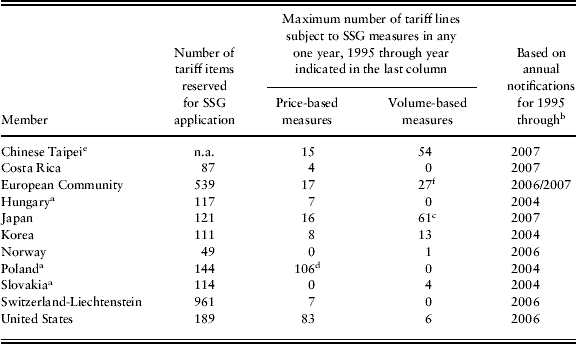
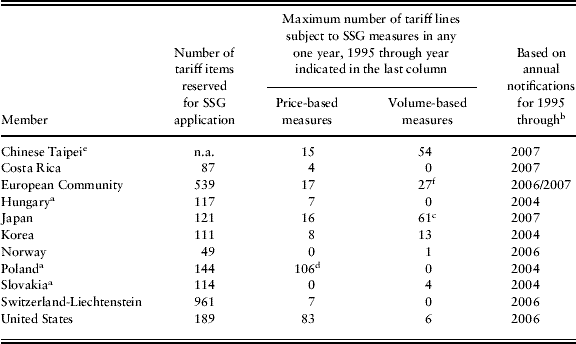
Many developing Members tariffied by adopting ceiling bindings and are thus not eligible to apply SSG measures; some who did designate products as SSG-eligible complain that the complexity of the formulas and the data requirements make the SSG system difficult to use. For whatever reason, few developing Members are in the list of major users provided in Table 2.
Notifications of SSG Measures by selected users
Notes:
n.a.=not available.
a Acceded to the EU in May 2004.
b Available on the WTO ‘Documents Online’ as of 9 January 2009.
c Second largest number is 10.
d Second largest number is 7.
e Acceded to the WTO 1 April 2002; first annual notification is for 2002.
f The number of tariff lines for which EC notifications indicate that the volume-based system was ‘made operational’. EC notifications also state each year that no volume-based measure was ‘applied’. There is no parallel notification for the EC price-based system.
Source: WTO (2002) (covers 1995–2001) and country annual notifications available on the WTO Documents online website.
Properties of the SSG
The price trigger allows every import shipment to be screened against previously determined and posted trigger prices. Major users of the system (e.g., the EEC, the Rep. of Korea, the United States) posted trigger prices in 1995, when the Uruguay Round agreements came into effect.Footnote 30 Because the trigger prices are averages for 1986–88, they need not be revised year by year. Any exporter, aware that an additional duty will be added if her price is below that posted price, has therefore the incentive to price at that level. The price-trigger system can function thus as a minimum price system.
As to inference that might be drawn from research on similar economic instruments, the behavior of exporters whose products are under antidumping order provides insight into what the effect of the published trigger prices might be. (They face the similar choice between pricing at the ‘no dumping’ level or having an antidumping duty increase their delivered price by the same amount.) Blonigen and Park (Reference Blonigen and Park2004) found that exporters under antidumping order do typically raise prices so as to avoid paying antidumping duties.Footnote 31
The volume trigger functions as a second stage tariff-rate quota (TRQ). The volume trigger allows a Member to screen each year's imports against the average of imports over the previous three years. Once the trigger is reached (a certain percentage over the three-year average) the Member is clear to add an additional duty – above the bound duty rate. The stages of tariff application are thus the following. (1) Up to the TRQ volume, imports would enter at a low or zero rate. (2) Once the TRQ volume of imports is reached, the ordinary duty may be applied. (3) Once the volume trigger is reached, the ordinary duty plus the SSG additional duty may be applied.
Procedural requirements are minimal. The AoA obligates Members to operate SSG ‘in a transparent manner’ and to ‘afford any interested Members the opportunity to consult with it in respect of the conditions of application of such action’.Footnote 32 It provides however no specifications on recognition of interested parties nor on procedure. Notification requirements provide minimal information on impact. The period over which a product was subject to SSG action must be notified, but Members are not required to notify the amounts of imports on which additional duties were levied nor the amounts of these additional duties.
The disciplines on application of SSG measures are entirely technical: only on tariff lines previously marked, only if the invoice price of a shipment is below the calculated trigger price or the volume in a year exceeds the trigger level based on previous years' imports. Multilateral oversight is the same as oversight for observance of bound rates: did the rate applied fall within the country's bindings, i.e. those bindings appropriately calculated to take into account the trigger formulas? In comparison with the other safeguard provisions in the GATT/WTO and their tradition of use, the SSG is a complicated detail of tariff bindings rather than a safeguard or flexibility provision.
Application of measures
Judging from notifications to the WTO, Members have applied SSG measures to few of the tariff lines on which they reserved the right to do so, and even on these tariff lines to a small percentage of shipments (Table 2). Usage has tended to be for extended periods of time; many of the products protected by SSG measures have been under such protection for almost all of the years the mechanism has been in place. All in all, the SSG has functioned more as an expansion of the limits Members have accepted through their tariff bindings than as an allowance for occasional response to short-term situations.Footnote 33
5. Special safeguard mechanism – the proposals
Several factors lie behind the Doha Round's consideration of a new special safeguard mechanism. One of these was developed countries pressure for increased access to developing country markets as quid pro quo for developed country concessions on agriculture and on manufactures. Significant reductions of developing country bound rates would be required, developed countries insisted, because developing countries' bound rates were on average higher than those of developed countries, and much higher than their applied rates (Table 3). Developing countries, on the other hand, had experienced significant increases of agricultural imports over the 1990s and into the twenty-first century.Footnote 34 They insisted that they would need a safeguard mechanism to help with the adjustment to lower tariff rates.
Average post Uruguay Round applied and bound tariff rates on agricultural products; ad valorem equivalents

Source: Martin and Mattoo (Reference Martin and Mattoo2008: 5).
A possible alternative to creating a second agricultural safeguard was that developing countries obtain access to the SSG by, say, allowing a new period for notification of the tariff lines on which Members reserve SSG application. This alternative however attracted little support. There were complaints that the SSG's complex formulas were difficult to apply and that the 1986–88 base for price triggers was increasingly out of date. Furthermore, a sense of fairness suggested that while the developed countries had had more or less exclusive access to the SSG during their period of adjustment, developing countries should likewise have an exclusive instrument during theirs.
The proposals
The major proposals tabled have been those of the Draft Agricultural Modalities working documents for the July 2008 WTO meetings, and for the December 2008 high-level WTO meeting that did not take placeFootnote 35 (‘Draft Modalities’) and of the G-33.Footnote 36 The G-33 proposal accepts more or less the structure of the Draft Modalities; differences are mainly over the parameters. While application of additional duties under the SSG is limited to tariff lines that were tariffied and marked in a Member's schedule, the SSM could be applied to any agricultural tariff line.Footnote 37 A basic limitation is that pre Doha Round rates will be a ceiling; the normal duty plus the SSM duty cannot exceed the pre Doha Round bound rate.Footnote 38 The major remaining differences on parameters are on those that define the extent of exceptions to this limit.
Volume and price triggers
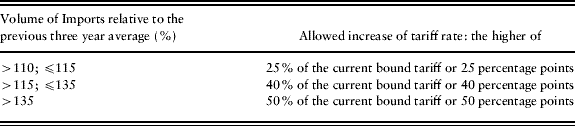
The SSM volume trigger would authorize an additional duty if in any year the volume of imports exceeds (by a certain percentage) the average volume over the previous three years.Footnote 39 The schedule shown in Table 4 gives the amounts of the additional duty.

At any time in a year that the volume quota was reached, the SSM duty could be applied for the remainder of the year.
Draft Modalities and G-33 do not differ on these parameters. However, a notable difference is that Draft Modalities would limit the volume calculation to MFN imports, the application of the remedy to MFN imports.Footnote 40 G-33 would include preferential trade in both.
Draft Modalities propose that volume-based measure be limited in duration to a maximum of 12 months, or for a seasonal product the length of the marketing season (maximum six months). Reapplication would require a new trigger calculation, but Draft Modalities add the limit ‘no product shall be subject to the volume-based SSM consecutively for more than two periods and where such consecutive application has occurred this may not be resorted to again before the elapse of a further two consecutive periods’ (paragraph 140). G-33 would not impose the two-year limit. Determining the trigger level for a year immediately after one in which an SSM measure was applied follows the standard formula, i.e. the average over the three previous years, including the one in which the SSM measure was in place. However, where this would have the effect of lowering the three-year rolling average below the level which triggered the SSM in the initial period, the trigger level for the initial period would apply.Footnote 41
A price-based SSM measure may be applied to any import shipment where the price is below a trigger price. The trigger price will be equal to 85% of the reference price, the reference ‘price’ being the average of monthly MFN-sourced import unit values for that product for the most recent three-year period for which data are available (WTO, 2008b: paragraph 135).
Draft Modalities propose that the SSM duty be limited to 85% of the difference between the c.i.f. import price (the price of the shipment in question) and the trigger price. If, for example, the reference price=100, the trigger price is then 85. If the c.i.f. price of a shipment was 75, the additional duty would be 0.85×(85−75)=8.5.
The G-33 statement proposes that the trigger price be 90% of the reference price, the allowed additional duty be ‘100% compensation of the price difference’.Footnote 42 Following the nomenclature of the Draft Modalities document, this would mean 100% of the difference between the trigger price and the shipment price.
Pre-Doha bound rates as limits
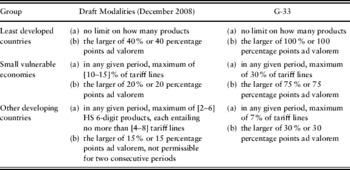
The Draft Modalities would impose pre-Doha Round Agreement bound rates as an upper limit on duties that might be applied – on the sum of the post-Doha bound rate and the SSM additional duty. Exceptions would be allowed, but Members have expressed significant disagreements on the parameters. Proposals on the table have two basic parameters: (a) the number of products on which the pre-Doha Agreement bound rate could be exceeded by the ordinary duty plus the SSM additional duty and (b) the size of the SSM duty, based on the then current (i.e. post Doha Agreement) bound rate (see Table 5).

Procedure and notification
Procedural and notification requirements parallel those of the SSG. Draft Modalities require that ‘[t]he trigger price shall be publicly disclosed and available to the extent necessary to allow other Members to assess the additional duty that may be levied’.Footnote 43 They do not specify how far in advance of application trigger prices must be publicly disclosed, nor do they require that they be notified to the WTO. A country might however post up-front trigger prices, as did several Members under the SSG, and operate in effect a minimum price system. As to what SSG experience has been, other than the up-front postings of SSG trigger prices described in the previous section, the first notification to the WTO of SSG trigger prices has been as part of after-the-fact notification of SSG measures applied. The applying member must also provide interested Members ‘the opportunity to consult with it in respect of the conditions of application of such action’.Footnote 44 There are no provisions for participation of interested parties in the decision process.
6. Special safeguards as policy decision rules
From the perspective of developing countries' interests, an SSM or any other trade policy mechanism should not be judged by the frequency with which it would allow import restrictions. It should be judged by how effectively it distinguished instances in which restriction was the better choice from instances in which to not restrict was the choice that better advanced the developing country's interests.Footnote 45
The first paragraphs of this paper reminded the reader that imposing an import restriction sometimes can be the correct choice. To not restrict might force an unnecessary burden on resources whose long-run comparative advantage does lie in agriculture, or force other resources out of agriculture more rapidly than alternative income-earning possibilities develop.
On the side of not acting is the need to maintain constructive pressure on the sector to modernize. In developing countries as well as in developed countries, the cost of agricultural support is considerable. For example, the 2008 WTO Trade Policy Review for Korea reports that: ‘Korea's net agricultural support exceeds the sector's GDP contribution (3.3% versus 3.2% in 2006).’Footnote 46
Also on this side of the issue are the interests of the food consumers. An increase of food prices is a significant reduction in real income, mistakes on the side of restricting can be costly. For example, the WTO's 2007 Trade Policy Review for Indonesia reports that ‘[t]he two thirds of farming households in Indonesia who are net consumers of rice were adversely affected when the Government announced a seasonal import restriction on rice from January 2004, which has been extended repeatedly and effectively become permanent’.Footnote 47
In the following subsections, I present the results of two simulations that look at the SSM from the perspective of a guideline for when an import restriction would or would not be the correct policy choice.
Identifying incidents of price undercutting
Raul Q. Montemayor (Reference Montemayor2008) has conducted a sophisticated simulation exercise to better understand how the proposed SSM would perform. Though his primary objective is different from determining when the mechanism would make the correct choice between imposing versus not imposing an import restriction, his results do provide considerable insight on that issue.
Montemayor applied the proposed SSM rules to historical data; his data base included monthly imports mostly from 2000 to 2005 of six countries: China, Ecuador, Fiji, Indonesia, the Philippines, and Senegal.
To understand Montemayor's results is is useful to keep in mind that he distinguishes between:
• the criterion under which an import restriction is justified, and
• the instances in which the SSM formula would allow an import restriction.
His criterion is ‘serious price undercutting’ – ‘problematic months’ in which the price of imports, including the full bound duty, was 10% or more below the domestic price of the product.Footnote 48 The SSM formulae include only import prices and volumes, so it is possible that the criterion is satisfied but the SSM formula does not allow an import restriction, or vice versa.
Montemayor's simulations covered potentially 432 ‘months’ – six countries times six years times 12 months/year of historical data, though there were months in which one country or another recorded no imports for some products. He does not report the numbers of ‘months’ in any category, only the percentages of the totals, hence the tables below employ that metric.
I summarize his findings below, focusing on two types of error associated with managerial decision rules:
• Type A: not to act when action is the correct decision, or
• Type B: to act when not acting is the correct decision.
Judged by either managerial standard, the trigger mechanisms perform poorly.
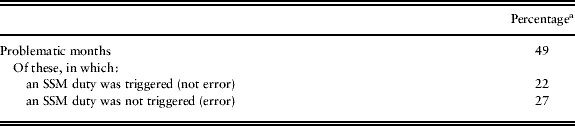
• In more than half of the instances in which there was a problem, action was not triggered (Table 6).
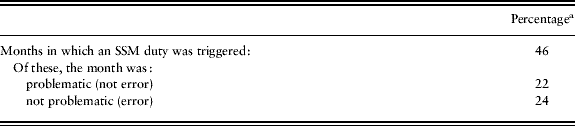
• More than half the time an action was triggered, there was no need for it (Table 7).Footnote 49
Type A error: instances of serious price undercutting (problematic months) in which the SSM triggered action versus when it did not

Note: a Percentage of the total number of country-months in the historical period over which the SSM was simulated.
Source: Tabulated from Montemayor (Reference Montemayor2008).
Type B error: instances in which action was prescribed when it was correct (problematic months) versus when it was not
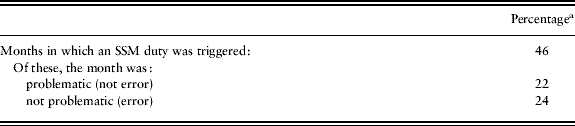
Note: a Percentage of the total number of country months in the historical period over which the SSM was simulated.
Source: Tabulated from Montemayor (Reference Montemayor2008).
Related findings from the past Footnote 50
This finding – that rules to ‘fill in’ with policy remedies in ‘exceptional’ years are likely to be inaccurate – is not an isolated one. Studies sparked by an earlier, 1970s, concern to deal with the instability of receipts from primary products produced similar results. Considerable research was done to simulate the behavior of buffer stocks that would stabilize prices by selling when the price was above the long-run trend line, buying when it was below. These studies likewise found that workable decision rules to identify when to buy or when to sell were difficult to devise. Even when predictions of future prices (on which buy/sell decisions depended) were based on sophisticated regressions – over many or few past years – the buffer stock turned out in retrospect to be on the wrong side of the market as often as on the correct.
Analysis of a more ‘macro’ instrument, the IMF's Compensatory Finance Facility, produced a similar conclusion. The intent of the CFF is to lend to countries when their export receipts are below trend, the countries repay in above-trend years. Over the long term, export receipts net of borrowings and repayments should then be more stable than ‘raw’ receipts. Analysis revealed that net receipts were in fact less stable. The problem again was the difficulty of deciding in any year (necessarily on the basis of estimates/projections of that and future years' receipts) if that was an above-trend or a below-trend year. More than half of borrowings had been in years in which export receipts had been above trend, repayments were likewise ill-timed.
Another problem these studies identified – more political perhaps than economic – was that price cycles tended to be longer than the politics behind the support for policy instruments seemed to presume. Commodity agreements had a life of five years, then were renegotiated. Analysis indicated that an agreement would sometimes have to stay on the same side of the market (always buying or always selling) for longer than that. The possibility that international politics would be strong enough to support such action was unlikely.
Valdés and Foster (Reference Valdés and Foster2005: 16), in their extended study of a possible SSM, also caution (p. 2 and p. 14) that the politics of the SSG presumed shorter departures from trend than world markets tend to produce. They recognize also the difficulty of separating instability from trend, but see more danger in the complexity of such determinations creating political opportunities for mis-use (Type B error, above, acting when inaction is correct) than in overlooking instances in which action is appropriate. On this basis, they suggest a rule-of-thumb limit on the number of years a measure might remain in place.
Differences by provenance of unit values: another source of mistaken signals Footnote 51
The SSM price trigger takes unit values aggregated over imports from all sources as the trigger or reference price. In real-world commerce, unit values differ considerably from one source to another, so this amounts to using the average over all sources as the standard applied to imports from each source. Even though the price from all sources may be constant over time, the price trigger will allow SSG duties on imports from some sources.Footnote 52
Because unit values of imports from developing countries are often lower than those of imports from developed countries, using as triggers unit values calculated from imports from all sources will introduce a bias against developing country exporters. To develop an indication of how large this bias might be, we compared for a sample of developing country importers (Brazil, China, India, Indonesia, Malaysia, and Mexico) the unit values of imports from different countries. The experiment covers these six importing countries and the six-digit product lines in the HS sub-sectors: 02 (meats), 04 (dairy products), 10 (grains), 11 (flour), 12 (oil seeds), 17 (sugar), and 18 (cocoa).Footnote 53 All of the data were for calendar year 2006 – we were comparing unit values from one source with unit values from other sources, not unit values in one year with unit values in previous years. The ‘restrictions’ that this experiment will trigger result entirely from differences in prices from one source to another, not from declines of prices over time.
The exercise then is about identifying unintended consequences of the proposed trigger mechanism, particularly that:
• even if prices are unchanging over time, the price trigger as proposed will authorize a considerable number of restrictions, and
• most of these restrictions will be on imports from developing countries.
For each of these countries as importers we calculated for each HS six-digit line in agriculture, the following:
• the unit value of imports from all sources combined,
• the unit value of imports from each source (e.g., China imported soya beans from Argentina, Brazil, Canada, Japan, Korea Republic, Taiwan China, the United States, and Uruguay).
We then screened imports, by country of origin, to identify those where unit values were less than 85% of the unit value from all sources.Footnote 54
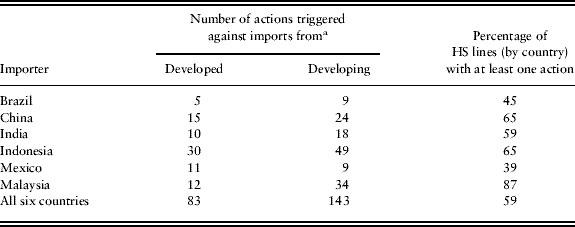
Table 8 provides the results of our simulation, the numbers of actions against imports triggered when the unit value of imports is 15% or more below the unit value of imports from all sources.
Simulation of numbers of SSM actions that would be allowed by differences of import unit values from one import source to another

Note: a An action is an additional duty on imports from one country of origin on an individual tariff line.
The preponderance of the restrictions this simulation identifies – 143 out of 226 – would be on imports from developing countries. The trigger would allow a restriction on imports from at least one country of origin on at least 39% of tariff lines – on average over the six countries on 59% of the tariff lines for which these countries had positive amounts of imports in 2006.Footnote 55 These would be penalties imposed on exporters who charge lower prices than other exporters. They are neither responses to surges of import volume nor to decline of import price.
This is a flexibility larger than that provided for ‘Special Products’ and ‘Sensitive Products’ in the tariff negotiations. The tariff modalities allow for special treatment by developing Members of up to one-third of tariff lines as Sensitive Products, up to 12% as Special Products.Footnote 56
Another comparison, the Draft Modalities suggest that the SSM be limited to breaching current bound rates on no more than 6% of tariff lines, the G-33 proposal would set this limit at 7% of tariff lines.
The experiment thus shows that there is a lot of ‘noise’ in trade data, sufficient noise to swamp the analytics of neutralizing departures from trend or of the impacts of unanticipated economic events.
7. SSM as part of the market access issue
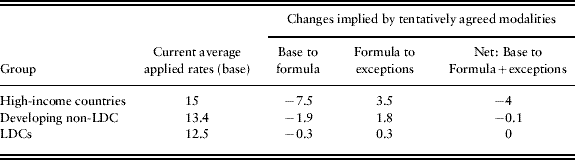
Though Director-General Pascal Lamy singled out the SSM as the issue on which the July 2008 WTO meetings foundered, it is difficult to separate the SSM from the other parts of the agricultural negotiations. Tentative agreement on modalities for tariff reduction formulas and exceptions may have been more a matter of shifting problems to the SSM discussions than of resolving them. Allowances for Special Products and Sensitive Products already take back a large part of the liberalization the formula would provide – 1.8 percentage points of the 1.9 percentage points reduction the formula would mean for developing Members (Table 9, below).
Summary of the impact on applied rates of the December 2008 Draft Agricultural Modalities – concessions given by groups of Members

Note: The base rates are ad valorem equivalents of rates applied in 2004, with adjustments for internationally binding commitments to reform, e.g. Ukraine's accession commitments. The figures for changes are for percentage points reduction, e.g. from 15% ad valorem to 9% ad valorem would be −6.0, a reduction of 6 percentage points.
Source: Calculated from Martin and Mattoo (Reference Martin and Mattoo2008: Table 1).
Agreed formulas and other modalities state political commitment but not legal obligation. In the end, a Member's legal obligation will be specified not by these modalities but by the schedule of tariff rates the Member submits. There is neither provision in the modalities for a neutral reviewing of schedules for compliance with the tariff-cutting formulas nor with the modalities' standards for and limits on excepting products from the formula cuts. To the extent this screening is done, it will be done by individual Members. Determinations about whose or which parts of schedules comply with agreed modalities will be political determinations, part of the negotiations.
There is indeed a possibility that because of their generous flexibilities the modalities do not advance the market access negotiations for agricultural products, that they instead transfer it to a yet-to-come negotiation focused on the schedules that each Member in the end will notify as its legal obligation. In turn, it may not be possible to complete the SSM negotiations until Members have a more precise idea of the tariff schedules from which the SSM will allow exceptions.
8. Conclusions, comments
The strength of traditional GATT/WTO flexibility provisions is that they have allowed adjustment within a system that provides for general pressure toward liberalization – flexibility to take restrictive action within a system that provides general discipline not to do so. The effectiveness of GATT/WTO safeguard or flexibility provisions to sustain long-run liberalization programs stems from their requiring objective, transparent and participatory national decisions on the application of new/exceptional import restrictions. Their usefulness does not stem from the ‘formulas’ they have provided, e.g. injury or injurious dumping.
The proposed SSM (like the existing SSG) includes no procedural requirements and defines by arithmetic formula when a Member may impose a new import restriction. Results reported here suggest that the principal impact of the formulas is to expand Members' scope for imposing restrictions but that they provide a poor guide as to when it makes sense to do so. Simulations indicate that the formulas frequently prescribe action when it is not needed, frequently fail to prescribe action when it is appropriate. Moreover, the formula would allow restrictions against imports from other developing countries disproportional to the share of imports coming from them. To the extent that the proposed SSM is more than a defense of Members' latitude to unilaterally increase their tariff rates, it is bad guidance on when to do so – or not to do so.
Even without the proposed SSM, the tentatively agreed flexibilities to name special and sensitive products provide great scope to avoid the tariff reductions the agricultural formula would otherwise imply. Such modalities suggest lack of agreement rather than agreement on what liberalization Members will undertake. Failure to agree on the additional flexibilities the SSM would provide is part of this broader lack of agreement.
The current pause in the Doha Round negotiations provides an opportunity to think farther about what the negotiations are about. In the spirit of general commitment to policies that will support development, I offer two comments.
The first is to remind all of us, analysts and negotiators, that the objective of a safeguard provision is to support good choices over bad rather than to support restriction over liberalization, or vice versa. In the mercantilist environment of a trade negotiation, it is easy to slip into a mercantilist perspective. While I have used Montemayor's (Reference Montemayor2008) results to gauge how well the SSM triggers would separate appropriate action from inappropriate, the criterion he himself applies is how often developing countries would be allowed to impose additional duties, e.g. ‘slightly higher volume and price thresholds … would not seriously compromise access rates’ (p. 11). By this standard, the ideal parameters are those without limit on magnitude of remedy or on when remedy can be applied. The criterion of accuracy – how often the SSM as a decision rule would indicate the correct versus the incorrect decision – slips out of consideration.
The exchange of SSM proposals in Geneva has been captured by the same mentality: exporters submitting proposals that would allow fewer SSM restrictions; importers submitting proposals than would allow more. Functionally speaking, this is part of the market access negotiations – agreeing the limits beyond which each government reserves the right to unilateral action – rather than an attempt to design a policy decision mechanism.
If the SSM discussion is about creating an effective safeguard mechanism, then it should be about creating a good management tool. That management tool should help a government to reach a correct decision and to sustain that decision among its various constituencies. This suggests that the discussion should be about process, particularly about finding a role for interested parties so that they have a sense of ownership/acceptance of whatever decision is reached.
If procedural requirements are out – developing Members insist on a ‘usable’ safeguard – then a simple coin toss would be a better decision rule than the proposed SSM formulae. (The formula errs more than half the time.) To maintain a degree of discipline, there might be a limit on the number of SSM actions that could be in place at any time, e.g. ‘bound rates may be exceeded for a maximum of [x] tariff lines at any one time’. What this comes to, in substance, is that each Member would have the flexibility to name its lists of Special Products and Sensitive Products year by year, there being a limit on the number of products on the list at any one time.