INTRODUCTION
In Ethiopia, rural households practice mainly rainfed, small-scale farming with a diversity of crops for both subsistence and for sale (Sibhatu and Qaim, Reference Sibhatu and Qaim2017). Yet, due to extensive soil degradation and inefficient water use, the country is unable to support enough cereal production to feed its population (Tsegaye et al., Reference Tsegaye, LaRovere, Mwabu and Kassie2017). Traditional farming practices (i.e. use of the mahresha plow and draught animals) involve heavy soil tillage (15–20 cm depth) that demands large amounts of labour and time. Soil degradation is thus very high due to frequent tillage and erosion of the vulnerable steep topography (Araya et al., Reference Araya, Cornelis, Nyssen, Govaerts, Bauer, Gebreegziabher, Oicha, Raes, Sayre, Haile and Deckers2011, Reference Araya, Nyssen, Govaerts, Baudron, Carpentier, Bauer, Lanckriet, Deckers and Cornelis2016a). Moreover, as in many semi-arid regions that practice rainfed agriculture, water availability is a major constraint to crop production. Rainfall in the area is erratic and insufficient during the growing season (Meze-Hausken, Reference Meze-Hausken2004), and even during normal rainfall seasons, dry spells are common (Tsegay et al., Reference Tsegay, Vanuytrecht, Abrha, Deckers, Gebrehiwot and Raes2015).
In the northern Tigray region of Ethiopia, crop production is highly affected by the erratic rainfall, soil degradation and low soil moisture coupled with poor agricultural management practices (Gebreegziabher et al., Reference Gebreegziabher, Nyssen, Govaerts, Getnet, Behailu, Haile and Deckers2009). These conditions have led to low average cereal grain yields (<2 Mg ha−1) in the region (Nyssen et al., Reference Nyssen, Clymans, Descheemaeker, Poesen, Vandecasteele, Vanmaercke, Zenebe, Van Camp, Haile, Haregeweyn, Moeyersons, Martens, Gebreyohannes, Deckers and Walraevens2010). In addition, crops are often weedy and nitrogen deficient, growing on soils with poor structure and prone to erosion (Nyssen et al., Reference Nyssen, Naudts, De Geyndt, Haile, Poesen, Moeyersons and Deckers2008). Yet, there have been increases in cereal production since the late 1990s in Ethiopia due to adoption of soil and water conservation practices, fertilizer and improved seed use (Nyssen et al., Reference Nyssen, Frankl, Zenebe, Deckers and Poesen2015).
Conservation agriculture (CA) is a technique that holds great promise for sufficient food production and is an important contribution for sustainable development because of its benefits to the environment, the economy and society. CA achieves this through application of three key principles: (i) minimum soil disturbance, (ii) permanent soil cover and (iii) crop rotations together with other good agronomic practices such as timely planting, effective weed control and integrated disease and pest management (FAO, 2015).
Since its introduction in 1998, 3047 small-scale farmers in central Ethiopia were recorded in 2011 to have adopted CA practices (Tsegaye et al., Reference Tsegaye, LaRovere, Mwabu and Kassie2017). In the Tigray region of northern Ethiopia, long-term studies revealed that CA practices led to significantly less soil loss and higher yield compared to conventional tilling (CT) practices (Araya et al., Reference Araya, Cornelis, Nyssen, Govaerts, Bauer, Gebreegziabher, Oicha, Raes, Sayre, Haile and Deckers2011, Reference Araya, Cornelis, Nyssen, Govaerts, Getnet, Bauer, Amare, Raes, Haile and Deckers2012; Gebreegziabher et al., Reference Gebreegziabher, Nyssen, Govaerts, Getnet, Behailu, Haile and Deckers2009; Oicha et al., Reference Oicha, Cornelis, Verplancke, Nyssen, Deckers, Behailu and Haile2010). The authors reported higher soil loss in the CT than the CA treatments due to frequent tillage and immediate complete removal of crop residues post-harvest. Another CA field study (9 years) in Tigray showed increased crop and straw yield over time for most grains except teff (Eragrostis tef) (Araya et al., Reference Araya, Nyssen, Govaerts, Baudron, Carpentier, Bauer, Lanckriet, Deckers and Cornelis2016a; Oicha et al., Reference Oicha, Cornelis, Verplancke, Nyssen, Deckers, Behailu and Haile2010). CA-based practices are capable of improving yield and soil health in a stable, consistent manner (Govaerts et al., Reference Govaerts, Sayre and Deckers2005). Yet, CA adoption in Ethiopia continues to be low due to livestock free grazing, lack of appropriate CA equipment for small-scale farmers, and low knowledge transfer and support (Araya et al., Reference Araya, Nyssen, Govaerts, Baudron, Carpentier, Bauer, Lanckriet, Deckers and Cornelis2016a). Maintaining permanent crop residue cover is difficult as farmers completely remove crop residue to feed their animals and stubble is overgrazed by livestock due to shortage of animal feed. This practice deprives the soil of essential elements such as nitrogen (Kassam et al., Reference Kassam, Basch, Friedrich, Shaxson, Goddard, Lal and Stewart2013).
It is clear that since the majority of the population relies on an agriculture-based livelihood, urgent measures are needed to boost and sustain productivity while reducing negative climate change impacts. Currently, several studies evaluating various CA interventions in northern Ethiopia have been carried out to find ways to reverse declining agricultural productivity (e.g. Araya et al., Reference Araya, Cornelis, Nyssen, Govaerts, Bauer, Gebreegziabher, Oicha, Raes, Sayre, Haile and Deckers2011, Reference Araya, Nyssen, Govaerts, Deckers and Cornelis2015, Reference Araya, Nyssen, Govaerts, Baudron, Carpentier, Bauer, Lanckriet, Deckers and Cornelis2016a, b, Gebreegziabher et al., Reference Gebreegziabher, Nyssen, Govaerts, Getnet, Behailu, Haile and Deckers2009; Oicha et al., Reference Oicha, Cornelis, Verplancke, Nyssen, Deckers, Behailu and Haile2010). Nevertheless, the transfer to more sustainable practices over current, traditional agricultural practices remains difficult. Moreover, the variation in soil and climate in the region makes further studies necessary. The objective of this research was to evaluate the impact of CA-based practices on crop yield and economic performance in the arid northeastern part of Tigray. This study included the use of semi-permanent beds (SPB), which are good options for farmers transitioning to CA technology, as it combines familiar, local farming practices with CA practices. In addition, an economic benefit analysis was included comparing the technologies.
MATERIALS AND METHODS
Study site
The study site was located at a farmers’ training center in the Maymesanu village (14o19′2.035′′N, 39o26′56.032′′E), near the town of Adigrat within the semi-arid region of northeastern Tigray, Ethiopia (Supplementary Figure S1, available online at https://doi.org/10.1017/S001447971800039X). Soils in the region are mainly Vertisols (Araya et al., Reference Araya, Cornelis, Nyssen, Govaerts, Bauer, Gebreegziabher, Oicha, Raes, Sayre, Haile and Deckers2011). The soil texture was determined through the hydrometer method (Kettler et al., Reference Kettler, Doran and Gilbert2001) and identified as a clay-loam soil (37% sand, 32% silt, 31% clay). The mean annual rainfall of the study area over the last two decades was 620 mm (NMA, 2013). The traditional tillage system used in the Tigray region, as in the rest of the country, is the mahrasha plowing system with paired oxen. The most common crops grown in the area are wheat (Triticum aestivum L.), barley (Hordeum vulgare L.), ‘hanfets’ (Triticum aestivum + Hordeum vulgare), maize (Zea mays L.), teff (Eragrostis tef), horse bean (Vicia faba) and field pea (Pisum sativum).
Field experiment
A long-term CA field experiment was established in 2010. Data collected and presented in this study are from 2010 to 2016 excluding 2015 due to crop failure caused by drought (El Nino phenomenon). Plots (4.4 m × 25 m) were laid out in a randomized complete block design with three treatments replicated three times for a total of nine plots. The treatments were (i) CT consisting of plowing three times and complete crop residue removal similar to the farmers’ traditional practices; (ii) SPB with furrows at 30 cm intervals, where 30% of the crop residue was left on the field, tilled once to incorporate the residue and again during sowing and glyphosate applied to control weeds at a rate of 2 kg active ingredient ha−1 and (iii) permanently raised beds (PRB) with furrows at 30 cm intervals, where 30% of the crop residue was also retained, one refreshment tillage was done on the furrows, and glyphosate was applied at a rate of 2 kg active ingredient ha−1 4 days before sowing. In 2011, as the field was infested by broad-leaf weeds after 56 days of sowing, it received an additional application of 2, 4-D selective herbicide. Two weeks of drought (mid-season dry spell) after the selective herbicide application resulted in the wilting of wheat leaves. In both 2010 and 2011, supplementary irrigation was carried out manually applying water from two plastic barrels (240 L) to each plot. The watering was performed 50 days after planting in 2010 and 90 days after planting in 2011.
The experimental plots were sown with barley (Hordeum vulgare L.) commonly used by farmers in the area on August 31, 2010 at a rate of 110 kg ha−1and fertilized with urea (64 kg N ha−1) and diammonium phosphate (DAP) (46 kg P ha−1); half of the N was applied at sowing time and the remaining half after 20 days. Wheat (HAR 1685 variety) was sown on July 11, 2011 at a rate of 150 kg ha−1, fertilized with urea (96 kg N ha−1) and DAP (69 kg P ha−1). Half of the N (48 kg) was applied at sowing and the remaining 48 kg N, 40 days later. Barley was repeated on July 11, 2012; wheat on July 5, 2013; barley on July 12, 2014 and wheat on July 21, 2016 with similar agronomic management practices as in 2010 and 2011, respectively.
Agronomic parameters
The following agronomic parameters were measured each year except 2015: grain yield in Mg ha−1 (GY), dry biomass yield in Mg ha−1 (BY), and straw yield in Mg ha−1 (SY). GY, BY and SY were determined at harvest from three 1 m2 (1 m × 1 m) quadrants from CT and three 0.9 m2 (1 m × 0.9 m) quadrants from PRB and SPB treatments each, the three sample areas averaged per plot. SY was calculated as the difference between the BY and GY.
Partial budget analysis
The economic potential of the treatments was tested through partial budget analysis (PBA), following the procedure by Upton (Reference Upton1979). In the first 3 years, input and grain price data were collected on site. Circumstances prevented data collection from taking place in the other years. For the other 3 years, grain price data were obtained from the Tigray Agricultural Marketing Promotion Agency and the District Agricultural and Rural Development Office of Adigrat and input prices were considered constant. Yield together with straw value constituted gross farm gate benefit and the variable input costs included were hand weeding, glyphosate herbicide, labour for herbicide and fertilizer application, 30% residue retained and ploughing costs. Here, the negotiated prices for a pair of oxen, which plow 0.25 ha in 1 day were US$16.44, 18.27 and 18.27 (1US$ = 27.36 Ethiopian Birr), respectively, in 2010, 2011 and 2012 and subsequent years. A pair of oxen can plow approximately 0.25 ha (one tsimad) in a day if there is a gentle slope and the soil is not stony (Nyssen et al., Reference Nyssen, Clymans, Descheemaeker, Poesen, Vandecasteele, Vanmaercke, Zenebe, Van Camp, Haile, Haregeweyn, Moeyersons, Martens, Gebreyohannes, Deckers and Walraevens2010). Cost of hand weeding was noted based on the practice in the local area and 10 day workers were assigned to weed 0.25 ha, at a cost of US$1.2, 2.2 and 2.6 in 2010, 2011 and 2012 and subsequent years per person per day in each year. The amount of herbicide used per ha was 2 L ha−1 and its cost was US$6.1, 8.0 and 8.8 L−1 in 2010, 2011, 2012 and subsequent years. Labour required to spray was one worker per 0.25 ha at a cost of US$1.8, 2.2 and 2.6 in each year. The price of barely, wheat grain and straw was determined by taking the average of one month local market price (town of Adigrat) during the harvest season. For the purpose of this research, only 90% of the grain and straw yield was considered in the economic analysis to minimize error (i.e. yield was adjusted by 10% to determine the yield farmers would realistically achieve under their own conditions).
Statistical analysis
The effect of PRB, CRB and CT treatments on agronomic parameters were analysed for barley and wheat by analysis of variance (ANOVA) using the SAS statistical software (JMP version 5.0; SAS Institute., Cary, NC, USA). Significant differences between the treatments for each parameter and crop were determined using Tukey's post-hoc test (P < 0.05). As 2010 and 2011 crops received manual irrigation and additional herbicides, GY, BY and SY were not statistically compared for those years, but yields between 2012–2014 and 2016 were analysed by ANOVA.
RESULTS
Crop yield components
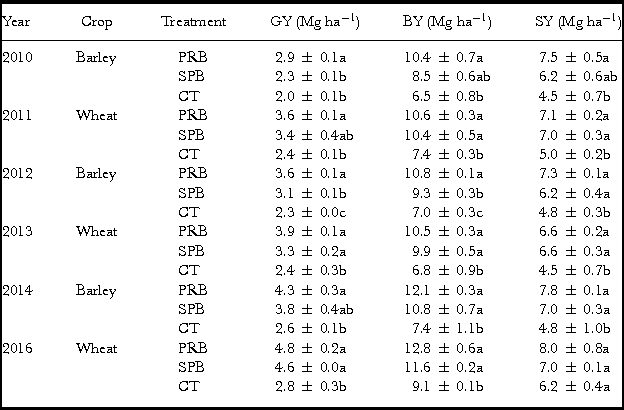
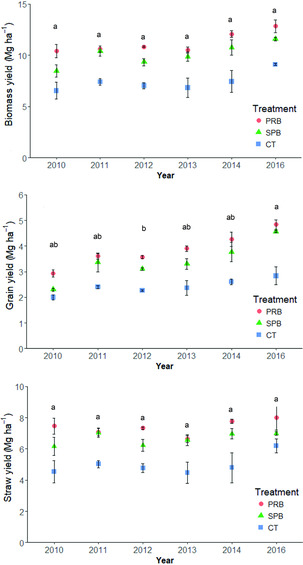
GY, BY and SY from PRB treatments were significantly higher than from CT treatments in all recorded years (2010–2014, 2016). Yields from SPB treatments were often similar to those of PRB and for the most part significantly greater than CT (Table 1). Only grain yield in 2016 was significantly (P < 0.05) greater than grain yield in 2012 (Figure 1).
Crop yield components of barley and wheat under different treatments over 6 years. Letters indicate significant differences between treatments for each crop in a year (Tukey test, P < 0.05).

GY = Grain yield; BY = Biomass yield; SY = Straw yield.
Barley and wheat yields per treatment per year in 6 years. Lowercase letters indicate significant differences between the years (Tukey test, P < 0.05).

Economic performance
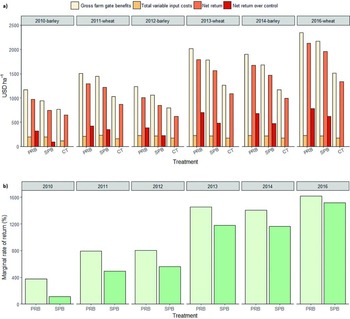
PBA showed that net returns (Figure 2a) and the marginal rate of return (MRR) (Figure 2b) were higher using CA in all six years (2010–2014, 2016). More specifically, MRR was 354% under PRB and 107% under SPB in 2010, 874% under PRB and 531% under SPB in 2011, 904% under PRB and 634% under SPB in 2012, 1454% under PRB and 1179% under SPB in 2013, 1407% under PRB and 1164% under SPB in 2014, and 1619% under PRB and 1519% under SPB in 2016.
Partial budget analysis (PBA) for 2010–2016. (a) Gross farm gate benefits, total variable input costs, net return and net return over control (US$ ha−1). (b) Marginal rate of return (%).

DISCUSSION
Yield and yield components
This 6-year assessment of crop yield in the eastern Tigray region found that barley and wheat yield components of CA-based management practices (PRB and SPB) were consistently higher compared to conventional farming practices (CT) (Table 1). These results are similar to those of Araya et al. (Reference Araya, Nyssen, Govaerts, Baudron, Carpentier, Bauer, Lanckriet, Deckers and Cornelis2016a, b)’s studies in northern Ethiopia where higher crop yields were recorded under the resource-conserving practices of furrows (TER+) and PRB with furrows (DER+) compared to CT. Yields from all treatments remained relatively similar over the years, though the higher mean grain yields in PRB and SPB treatments in 2016 compared to previous years suggest there is potential for increased yields under continued CA over time (Figure 1).
A yield increment was noticeable from the first experimental year of this study for both barley and wheat under PRB, but more importantly, it continued from the third to last year (2012–2016). Araya et al. (Reference Araya, Cornelis, Nyssen, Govaerts, Bauer, Gebreegziabher, Oicha, Raes, Sayre, Haile and Deckers2011) similarly observed wheat yield increments only after 3 years of CA implementation (PRB with 30% residue retention). With all crop residue retained, Govaerts et al. (Reference Govaerts, Sayre and Deckers2005) saw maize yield improvement in CA treatments compared to CT from the first year, positively affected by the wheat–maize rotation. This suggests that the crops used in rotation, and hence the residue they produce, play an important role in determining CA's effectiveness. A meta-regression analysis of maize yields under CA-based systems in tropical and sub-tropical climates showed that CA outperforms CT systems in drought and heat stress environments (Steward et al., Reference Steward, Dougill, Thierfelder, Pittelkow, Stringer, Kudzala and Shackelford2018). This improvement has been attributed to the residue cover on the surface, which can improve soil moisture retention, reduce evaporation, and moderate temperature fluctuations during the day (Govaerts et al., Reference Govaerts, Sayre and Deckers2005; Steward et al., Reference Steward, Dougill, Thierfelder, Pittelkow, Stringer, Kudzala and Shackelford2018). Thus, in the present study, both barley and wheat residues on the surface in PRB and SPB treatments appeared to be more beneficial compared to complete residue removal in the CT treatment. In addition, the glyphosate applications in these treatments were likely essential in ensuring their success since in other cases where herbicide was not applied; crop yield was lower in CA systems than in the CT system due to uncontrolled weeds (Araya et al., Reference Araya, Nyssen, Govaerts, Baudron, Carpentier, Bauer, Lanckriet, Deckers and Cornelis2016a; Oicha et al., Reference Oicha, Cornelis, Verplancke, Nyssen, Deckers, Behailu and Haile2010). In agreement with other research (e.g. Gebreegziabher et al., Reference Gebreegziabher, Nyssen, Govaerts, Getnet, Behailu, Haile and Deckers2009; Tsegaye et al., Reference Tsegaye, LaRovere, Mwabu and Kassie2017), the use of PRB and/or SPB with surface residue and crop rotation, combined with herbicide application, can be a step closer to implementing CA practices in the Tigray.
Economic performance of CA
The PBA for barley and wheat in all years showed that the net return of CA treatments was superior to CT (Figure 2a). Araya et al. (Reference Araya, Nyssen, Govaerts, Baudron, Carpentier, Bauer, Lanckriet, Deckers and Cornelis2016a) similarly observed higher mean gross margin in the PBR with furrows (DER+) treatment compared to furrows (TER+) and CT treatments. This implies that adopting PRB may be more economically advantageous than SPB and CT practices in areas characterized by limited rainfall and poor soil fertility, such as Tigray. In our study, the income increment perceived in both PRB and SPB treatments compared to CT was due to less hours of labour and increased yield and straw harvests, suggesting that farmers may save time and energy by using CA-based crop management practices instead of conventional practices. These findings are in line with those of Ngwira et al. (Reference Ngwira, Aune and Mkwinda2012, Reference Ngwira, Thierfelder and Lambert2013) who observed increased maize yields and labour savings, leading to higher net returns, in CA systems compared to conventional practices in Malawian small-scale farms.
Nevertheless, costs were slightly higher in CA-based practices compared to CT practices (Figure 2a) in the present study mainly due to herbicide and labour expenses. This can be a significant constraint to CA adoption by small-scale farmers, who often cannot afford increased labour and herbicide costs. These costs, however, usually decline with the reduction of weeds under CA in the long term (Thierfelder et al., Reference Thierfelder, Chivenge, Mupangwa, Rosenstock, Lamanna and Eyre2017). CA that practices minimum tillage and residue retention can reduce weeds by affecting weed germination so that less use of chemicals is required (Farooq et al., Reference Farooq, Flower, Jabran, Wahid and Siddique2011). Based on their results, Ngwira et al. (Reference Ngwira, Thierfelder and Lambert2013) also suggest that higher costs of herbicides and their application can be offset by the increased net returns in CA systems.
In the first year of this experiment (2010), a group of 35 farmers, technical experts and political leaders from the Maymesanu village participated in a ‘farmers’ day’ where they learned about the study and the CA treatments. The participants were convinced by the performance of CA, but they remained wary of the yield improvements since they were unfamiliar with CA management compared to traditional, conventional practices (A. Gebru, personal observation, 2010). As Araya et al. (Reference Araya, Nyssen, Govaerts, Baudron, Carpentier, Bauer, Lanckriet, Deckers and Cornelis2016a) noted, despite government policies to encourage zero grazing, small-scale farmers in Tigray have been reluctant to abandon free grazing to leave sufficient crop residue cover. For that reason, feed shortage and weed control have been major obstacles to CA adoption (Araya et al., 2016). In this experiment, the above ground biomass (straw/hay) was higher in CA than CT treatments in each of the 6 years. As a result, the MRR was almost double in the PRB treatment, higher even than for the SPB each year (Figure 2b). In Tigray where there is a mixed crop-livestock farming culture, results such as this that lead to higher residue production make it feasible for farmers to remove part of the residue for animal fodder and still retain enough on the field to ensure soil health. As Nyssen et al. (Reference Nyssen, Frankl, Zenebe, Deckers and Poesen2015) state, ‘it is now a matter of scaling [CA] up’, which would require more farmer-to-farmer extension and empowerment.
CONCLUSIONS
In this 6-year field study, barley and wheat biomass, grain and straw yields were significantly greater in CA treatments than in the CT treatment in the first 3 years and after. Greater MRR in these systems suggest potential for higher revenue (based on price data collected in the first 3 years), while excess straw produced can be removed for animal feed and still leave at least 30% on the soil surface. Although adopting CA practices over traditional, conventional practices may be the key in ensuring food security in the Tigray region, it is clear that this will require a cultural shift. In this study, an experimental approach including farmer participation in the initial stages was used to test and modify different strategies; keeping knowledge and technology transfer a priority. Converting gradually to CA by starting with SPB, rather than directly with PRB is likely a better strategy in regards to the local community's culture and traditions. As seen, the adoption of SPB and the eventual evolution to PRB can contribute to improved crop yield, increasing farmers’ income and potentially reversing the circumstances of low productivity in the area. Still, initial high expenses related to the purchase of herbicides and/or increased labour costs need to be addressed, perhaps through greater government support. Lessons learned from this study will be included in extension packages offered to farmers in the area.
Acknowledgements
This work was supported by Adigrat Diocesan Catholic Secretariat – Food Security Project and Adigrat Wereda Office of Agriculture and Rural Development, which provided access to the research site. The authors are grateful for participation of the Mekelle University of Ethiopia, the Ethiopian Catholic Church Adigrat Diocesan Catholic Secretariat (ECC–ADCS) and the International Maize and Wheat Improvement Center (CIMMYT–Mexico).
SUPPLEMENTARY MATERIAL
To view supplementary material for this article, please visit https://doi.org/10.1017/S001447971800039X