Introduction
Murraya koenigii (L.) Spreng, commonly known as curry leaf (CL), is a popular aromatic plant, leafy spice, and a familiar medicinal plant belonging to the family Rutaceae (Prakash and Natarajan, Reference Prakash and Natarajan1974). It is native to India and is geographically distributed throughout the tropical and subtropical regions of the Indian subcontinent (Joseph and Peter, Reference Joseph and Peter1985; Raghu, Reference Raghu2020). It is a good source of essential oil (EO); the leaves, fruits, and seeds yield EO on hydro-distillation (Rao et al., Reference Rao, Rajput and Mallavarapu2011a). CL is also rich in several nutrients and bioactive compounds such as β-carotene, calcium, iron, vitamin C, and carbazole alkaloids (Philip et al., Reference Philip, Peter and Gopalakrishnan1981; Khatoon et al., Reference Khatoon, Verma, Chacko and Sheikh2011; Vyas et al., Reference Vyas, Kandoliya, Vidhani, Parmar, Bhalani and Golakiya2015; Raghu et al., Reference Raghu, Aghora and Dhananjaya2020; Raghu, Reference Raghu, Dubey and Singh2023). Aside from its regular culinary usage as a spice (Verghese, Reference Verghese1989), it is also widely used in medical and nutraceutical applications (Igara et al., Reference Igara, Omoboyowa, Ahuchaogu, Orji and Ndukwe2016; Poornima et al., Reference Poornima, Nandini and Raghu2022; Raghu et al., Reference Raghu, Aghora and Dhananjaya2022). Due to its anti-inflammatory, anti-diuretic, memory enhancing, antimicrobial, anti-diabetic, antioxidant, anti-tumour, and wound healing properties, CL is used in the treatment of various diseases and disorders such as piles, inflammation, itching, poison bites, fresh cuts, dysentery, diarrhoea, vomiting, and dropsy (Dastur, Reference Dastur1970; Drury, Reference Drury1978; Ganesan et al., Reference Ganesan, Phaiphan, Murugan and Baharin2013; Igara et al., Reference Igara, Omoboyowa, Ahuchaogu, Orji and Ndukwe2016). In recent times, it has become increasingly popular as a profitable commercial crop, especially in various regions of southern India, owing to its low input requirements, perennial nature, and steady market demand around the year (Mohan, Reference Mohan2012). Consequently, there is an escalating demand for CL genotypes that possess genetic superiority for commercial farming.
Essential oils (EOs) are the secondary metabolites produced by aromatic plants to protect themselves against several biotic and abiotic stresses (Sahoo et al., Reference Sahoo, Champati, Dash, Jena, Ray, Panda, Nayak and Sahoo2022). EOs possess several bioactive properties, such as antimicrobial, anti-inflammatory, antioxidant, etc., which make them valuable commercial products in the pharmaceutical, cosmetic, food, and beverage industries (Ray et al., Reference Ray, Jena, Dash, Kar, Halder, Chatterjee, Ghosh, Panda, Nayak and Mahapatra2018; Kamila et al., Reference Kamila, Ray, Jena, Sahoo, Kar, Nayak and Panda2021). The chemical composition of essential oils (EOs) directly influences their biological activity (Zhang et al., Reference Zhang, Yao, Duan, Wei, Wu and Li2015). For example, the EO derived from CL, which was high in α-Pinene (49.3% of the total volume), demonstrated significant antibacterial effects against five strains of gram-positive and five strains of gram-negative bacteria (Senthilkumar et al., Reference Senthilkumar, Gopalakrishnan, Jayaraman and Venkatesalu2014). Likewise, the EO containing a high proportion of oxygenated monoterpenes (72.15%), including linalool (32.83%), displayed both antibacterial and antioxidant properties (Priya et al., Reference Priya, Blessed and Nija2013). Moreover, previous studies have indicated that the EOs extracted from the leaves of the CL plant possess antimicrobial (Goutam and Purohit, Reference Goutam and Purohit1974), antifungal (Deshmukh et al., Reference Deshmukh, Jain and Agarwal1986), and pesticidal (Pathak et al., Reference Pathak, Yadav, Jha, Vasudevan and Pathak1997) activities. Therefore, it is very much essential to identify and characterise the existing CL germplasm into different chemotypes for better industrial applications. Similar to other aromatic species (Masotti et al., Reference Masotti, Juteau, Bessière and Viano2003; Angioni et al., Reference Angioni, Barra, Coroneo, Dessi and Cabras2006; Sahoo et al., Reference Sahoo, Kar, Jena, Dash, Ray, Sahoo and Nayak2019), the yield and composition of EO in CL are influenced by its genetic makeup and the age of the plant (Raina et al., Reference Raina, Lal, Tripathi, Khan, Syamasundar and Srivastava2002; Rao et al., Reference Rao, Rajput and Mallavarapu2011a). Other factors, such as agronomic practices, climate, soil type and composition, and genotype X environment interactions, also influence the EO composition and yield (Ram et al., Reference Ram, Kumar, Naqvi, Verma and Patra2005; Verma et al., Reference Verma, Verma, Chauhan and Yadav2009, Reference Verma, Rahman, Verma, Chanotiya, Chauhan, Yadav, Yadav and Singh2010). Prevailing edaphic and abiotic factors exert selection pressure on underlying genetic differences for the biosynthetic pathway for volatile compounds, thereby leading to the development of different chemotypes in a single species across various regions (Morshedloo et al., Reference Morshedloo, Ebadi, Maggi, Fattahi, Yazdani and Jafari2015). Hence, a proper understanding of the variations in the EO yield and composition is a prerequisite to exploring superior chemotypes.
In situ evaluation (on-site evaluation or evaluation in its natural habitat) of CL for its EO yield and composition has been extensively studied at different locations in India, and several chemotypes have been reported so far (Mallavarapu et al., Reference Mallavarapu, Ramesh, Syamasundar and Chandrasekhara1999, Reference Mallavarapu, Rao and Ramesh2000; Raina et al., Reference Raina, Lal, Tripathi, Khan, Syamasundar and Srivastava2002; Rao et al., Reference Rao, Rajput and Mallavarapu2011a, Reference Rao, Rajput and Mallavarapu2011b; Syamasundar et al., Reference Syamasundar, Srinivasulu, Ananda, Ramesh and Rao2012; Verma et al., Reference Verma, Chauhan, Padalia, Jat, Thul and Sundaresan2013). Whereas evaluation of diverse germplasm with proper experimental design under common growing conditions (ex-situ evaluation) would accurately estimate genetic differences between tested genotypes and precisely characterise exploitable chemotypes. However, such efforts have yet to be made so far in CL for EO yield and composition. Therefore, it is necessary to evaluate CL germplasm ex-situ to quantify genetic variance for EO composition and yield. With this background, diverse sets of CL germplasm and elite genotypes were collected from different parts of the Indian subcontinent, covering the north, south, east, and western regions. A total of 125 accessions were collected and conserved in a field gene bank established at the ICAR- Indian Institute of Horticultural Research (ICAR-IIHR), Bengaluru (Raghu and Nandini, Reference Raghu and Nandini2021). The present investigation was carried out on selected diverse germplasm accessions with the objective of studying the genetic diversity of EO yield and composition in CL and identifying different chemotypes.
Materials and method
Plant materials
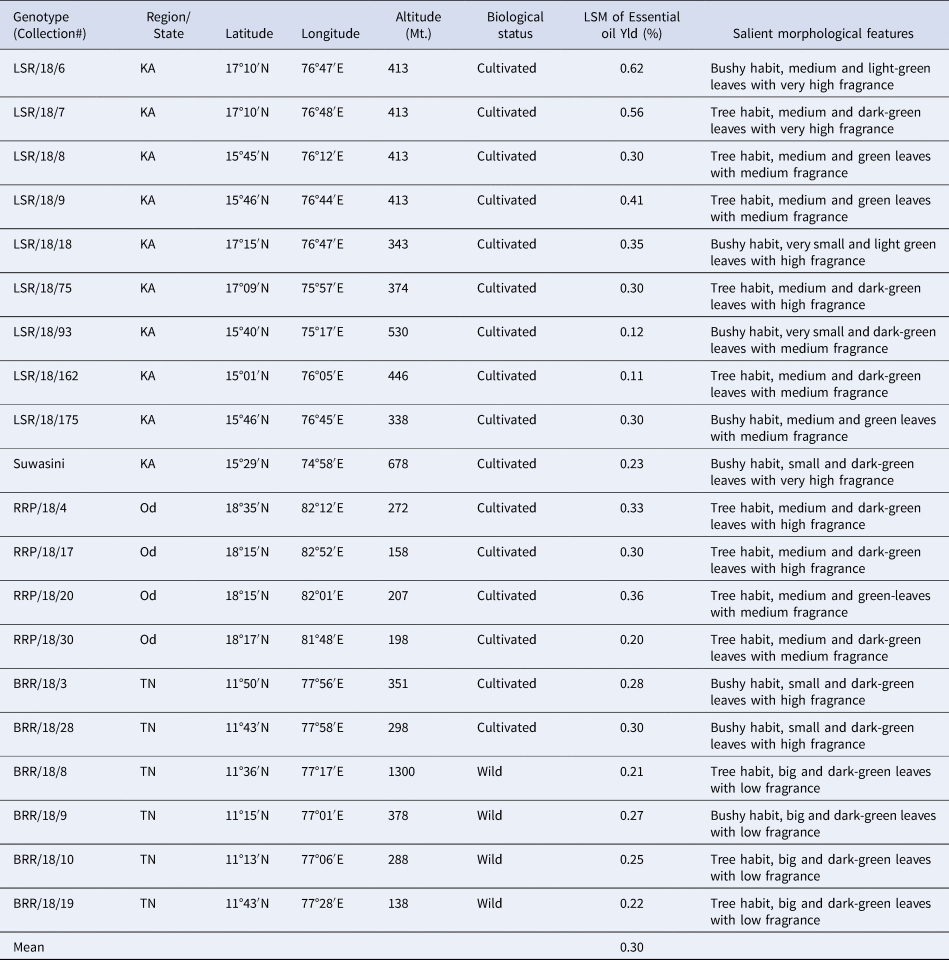
Twenty diverse accessions of CL were utilised in the present study (Table 1). They comprise 15 accessions of cultivated types and 4 wild type genotypes collected from three Indian states and Suwasini, a commercially available improved variety (Fig. 1). The present experiment was carried out in RBD design by planting all 20 selected genotypes in three replications with a plant density of 10 plants per 23 square meters. All the recommended agronomic practices were followed, and plants were maintained by pruning one year after planting at regular intervals of three months.
Details of curry leaf germplasm used in the present study

KA, Karnataka; Od, Odisha; TN, Tamil Nadu.
Map showing collection sites of CL germplasm in three Indian states.

Sample preparation and extraction of EO
Leaf samples were collected from 3-month-old shoots during June 2022. Matured and pest-free leaves were selected. Fresh leaflets were retained by removing the leaf stalks. Finely chopped leaflet samples (500 g) were hydro-distilled in a Clevenger-type glass apparatus (Clevenger, Reference Clevenger1928) for 5 h (Syamasundar et al., Reference Syamasundar, Srinivasulu, Ananda, Ramesh and Rao2012). The EO was collected and dried over anhydrous sodium sulphate and stored in the dark at 5°C until further analysis (Syamasundar et al., Reference Syamasundar, Srinivasulu, Ananda, Ramesh and Rao2012). The content of EOs (v/w) in the leaves of CL was expressed as a percentage. The experiment was repeated in June 2023.
Analysis of the chemical composition of EOs in Gas chromatography-mass spectrometry (GC-MS)
GC-MS analyses of the EOs were performed using a Varian-3800 Gas Chromatograph equipped with a Varian-4000 Ion-Trap MS detector. The ion trap, transfer line and ion source temperatures were maintained at 190, 240 and 200°C, respectively. A fused-silica capillary column VF-5 ms from Varian, USA, with 30 m × 0.25 mm id, 0.25 mm film thickness, was used for the analysis. The injector temperature was set at 260°C and all injections were made in split mode (1:5). Samples were injected under the following conditions: helium was used as a carrier gas at approximately 1 ml/min, pulsed in split mode (20:1), the solvent delay was 3 min, and the injection volume was 1.0 μl. The mass spectrometric detector was operated in the external electron ionisation mode operating at 70 eV, with a full mass scan- range of 45–450 amu. The detector temperature was maintained at 270°C and the temperature programme used for the column was as follows: 50°C for 5 min, followed by an increment of 4°C/min till 170°C, held for 2 min; subsequently, increased by 5°C/min till it reached 250°C and then, a constant temperature of 250°C was maintained for 7 min. The total run time was 60 min. Total volatile production was estimated by a sum of all peak areas in the chromatogram, and individual compounds were quantified as relative per cent area. Individual volatile compounds were identified by comparing their retention index (RI), which was determined using a homologous series of n-alkanes (C5 to C32, procured from Sigma-Aldrich) as Standard (Kovats, Reference Kovats1965) and comparing mass spectra with the available two spectral libraries, using Wiley and NIST-2007 (Adams, Reference Adams1995).
Statistical analysis
Replicated data derived from two years (2022 and 2023) on the EO yield were arcsine square root-transformed, and the combined analysis of variance was carried out according to the Duncan multiple comparison test at the probability level of P < 0.05 using web-based free statistical software SAS (SAS On Demand for Academics, ‘https://welcome.oda.sas.com’). Adjusted mean values or least squares mean (LS-means) were derived for EO yield. Similarly, combined ANOVA for EO components was performed, and adjusted mean values for individual volatile compounds were derived for each genotype. Two sample T tests were also performed using SAS software. The adjusted mean values for volatile components were auto-scaled and logarithmically transformed and further subjected to the chemometric analysis through the free statistical software MetaboAnalyst 5.0 (Pang et al., Reference Pang, Chong, Zhou, de Lima Morais, Chang, Barrette, Gauthier, Jacques, Li and Xia2021). The chemometric analysis consisted of significance analysis of metabolomics (SAM) based on F statistics, pattern analysis based on Spearman rank correlation, principal component analysis (PCA), partial least squares discriminant analysis (PLS-DA), and variable of importance in prediction (VIP score), and hierarchical cluster analysis (HCA) and heatmap with the Euclidean distance between the genotypes given by the Ward algorithm.
Results
EO yield and composition
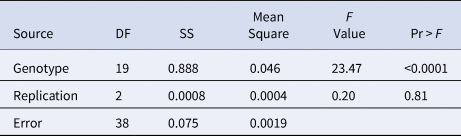
Analysis of variance among CL genotypes revealed a significant (P < 0.05) variability for EO yield (Table 2). The EO yield in the present study ranged from 0.11–0.62% (v/w), with a mean yield of 0.3%. The highest EO yield was recorded in LSR/18/06 (0.62%), followed by LSR/18/07 (0.56%). The lowest EO yield was observed in LSR/18/162 (0.11%). Cultivated types of CL showed significantly (P < 0.05) higher EO yield as compared to wild types (online Supplementary Table S1).
Analysis of variance of essential oil yield among curry leaf germplasm

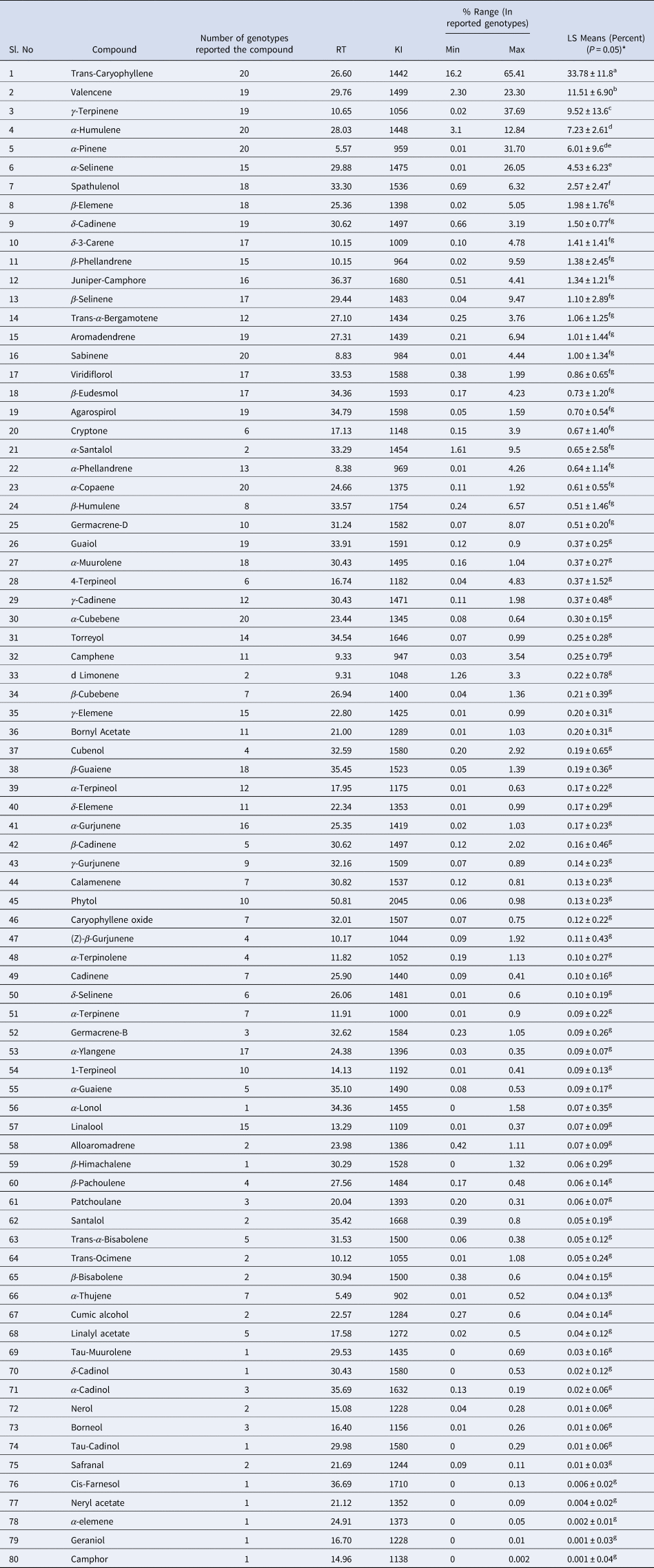
Eighty distinct compounds were detected in the EOs of 20 different genotypes of CL. Table 3 summarises the identified compounds in terms of their occurrences across the tested genotypes, along with the range and mean values. Each genotype contained between 27 (BRR/18/10) and 45 (RPP/18/4) compounds, contributing to approximately 98.1% (LSR/18/75) to 99.9% (BRR/18/10) of the EOs (Fig. 2). Among the 80 compounds identified, 13 compounds – β-cadinene, agarospirol, δ-selinene, patchoulene, santalol, trans-α-bisabolene, safranal, cumic alcohol, δ-cadinol, α-santalol, α-lonol, β-pachoulene, and β-himachalene – are reported for the first time in this study (Table 3). Additional details about the volatile compounds found in each genotype are provided in online Supplementary Table S2.
Components of leaf essential oils of curry leaf germplasm

RT, Retention Time; KI, Kovate Index; *Data are expressed as Mean ± Standard Deviation; Mean values followed by different letters (a–g) at superscript are significantly different at the probability level of P < 0.05 according to the Duncan test.
Number and total volume of volatile compounds present in essential oils of CL germplasm.

Occurrence and distribution of EO components
Univariate analysis of EO components indicated a statistically significant variability among tested genotypes (Table 3). Trans-caryophyllene was the most abundant (mean; 33.78 ± 11.8%) and widely distributed compound (range; 16.2%–65.4%) detected in all 20 tested genotypes.
Similarly, compounds valencene (mean; 11.51 ± 6.90%), γ-terpinene (mean; 9.52 ± 13.6%), α-humulene (mean; 7.23 ± 2.61%), α-pinene (mean; 6.01 ± 9.6%), and α-selinene (mean; 4.53 ± 6.23%), were also present in significantly (P < 0.05) higher quantities. Wherein α-humulene and α-pinene were present in all the tested genotypes, whereas valencene, γ-terpinene, and α-selinene were detected in >90 and 75% of tested genotypes, respectively. All these top six compounds that we found in the present study as major compounds are listed in Table 3, along with their range of distribution.
Whereas spathulenol, along with 73 remaining compounds (Sl. No. 8-80 in Table 3), were detected in small but varying quantities, with the mean values ranging from <0.5 to 2.67%. This set of compounds comprised compounds restricted to a few genotypes as well as compounds found in the majority of the tested genotypes with varying low concentrations. Thus, we have listed all these 74 compounds (Sl. No. 7-80 in Table 3) as minor compounds.
Further, SAM analysis of EO components between wild and cultivated types was performed to understand the differential distribution of EO components among wild and cultivated types (Fig. 3). The results indicated that concentrations of α-pinene, bornyl acetate, and camphene were significantly high (P < 0.05) in wild types. In contrast, trans-α-bergamotene and 1-terpineol were significantly high in cultivated types (online Supplementary Table S3). Although α-pinene was detected in all 20 tested genotypes, its concentration was higher in wild types (mean of 23.8%) compared to cultivated types (mean of 1.6%). Besides, pattern analysis based on Spearman's rank correlation confirmed the SAM results. It showed α-pinene, bornyl acetate, and camphene had an increasing concentration in wild types and a decreasing concentration in cultivated types (Fig. 4). In contrast, compound trans-caryophyllene and 21 other minor compounds were in increasing concentrations in cultivated types and decreasing concentrations in wild types.
Significant compounds identified between wild and cultivated curry leaves by SAM (Significance Analysis of Microarray) (Delta = 0.9). The green-coloured dots indicated compounds with significant differences between the two groups. Compounds with positive d.valvues are placed at the top, indicating higher concentration in wild types (i.e., mean concentration in wild types > mean concentration in cultivated curry leaves), and compounds with negative d.valvues placed at the bottom, indicating higher concentration in cultivated types (i.e., mean concentration in cultivated types > mean concentration in wild curry leaves).

Pattern analysis among the top 25 correlated compounds with wild and cultivated curry leaves based on Spearman rank correlation. ‘1’ denotes Cultivated, and ‘2’ denotes wild types. The top 3 compounds show a positive correlation with wild types and a negative correlation with cultivated types, showing upward expression among wild types and downward expression for cultivated types. The bottom 22 compounds have a positive correlation with cultivated types and a negative correlation with wild types, showing upward expression among cultivated types and downward expression for cultivated types.

Population variance for EO components
PCA was performed to understand the population variance of EO components in CL germplasm. It is an unsupervised estimation of a given population. To better understand the dispersion of genotypes, we presented the graph of the PCA vectors (Fig. 5), the loadings of the variables (compounds) (online Supplementary Table S4), and the scores of the samples (genotypes) (online Supplementary Table S5).
Principal component analysis for EO components in CL germplasm. 3D Score plot of essential compounds of wild and cultivated curry leaf germplasm collected from 3 Indian states: KA, Karnataka; O, Odisha, and TN, Tamil Nadu.

The 3D principal component analysis (Fig. 5) retained the first three main principal components (PCs), which explained 49.7% of data variability. Results demonstrated a greater genetic divergence both within and between different geographical regions of India. Wild CL genotypes were clustered at the top-left of the score plot, with the highest positive values for PC2 and the highest negative values for PC1, indicating a similar chemical profile among them. Whereas cultivated types were dispersed at the bottom of the score plot with negative values for PC2, indicating their clear chemical distinctness from wild CL genotypes. Further, these cultivated CL genotypes were dispersed in a divergent direction due to positive/or negative values for PC1 and PC3, indicating a greater genetic divergence among cultivated CL genotypes than wild CL genotypes. There was a clear intermixing of cultivated CL genotypes from different regions, indicating the existence of genotypes with similar chemical compositions across the regions.
Further, PCA indicated that among 80 compounds, 17 compounds had the highest loadings (±values) for the first 3 PCs (online Supplementary Table S4). This indicated their greater contribution to the overall population variance. Amongst these 17 compounds, 3 were major (α-pinene, γ-terpinene, and α-selinene), and the remaining 14 were minor (sabinene, α-phellandrene, β-phellandrene, cryptone, β-elemene, trans-α-bergamotenecamphene, bornyl acetate, α-terpinene, α-terpineol, 1-terpineol, δ-selinene, δ-elemene, γ-cadinene). These findings further confirmed that major and minor compounds together play an important role in the formation of different chemotypes in CL.
Meanwhile, the compounds with almost null loading values (≤ |0.09|) for all three PCs were placed near the origin in the score plot and had a limited role in imparting population variance. A total of 34 compounds had null values (≤ |0.09|) (online Supplementary Table S4). Among them, 3 major compounds (trans-caryophyllene, α-humulene, and valencene) and 12 minor compounds (spathulenol, δ-cadinene, agarospirol, viridiflorol, α-copaene, and aromadendreneα-gurjunene, α-muurolene, linalool, α-cubebene, α-ylangene, and guaiol) were important due to their wider occurrence across genotypes (present in more than 75% of the tested genotypes). These compounds might play a fixative role in EOs and be responsible for constituting the basic characteristic aroma of CL across various chemotypes.
Influence of origin on genetic divergence of EO components
In order to identify the compound(s) with significant region-specific expression, a supervised multivariant discriminant analysis was performed. We used the presented variable of importance (VIP) in the prediction score for EO components (Fig. 6) following Sahoo et al. (Reference Sahoo, Champati, Dash, Jena, Ray, Panda, Nayak and Sahoo2022). The compounds with >1.0 VIP scores are reported to have more influence on population discrimination. Accordingly, we identified 22 compounds with >1.0 VIP scores (Fig. 6). Major compound valencene along with minor compounds such as sabinene, α-guaiene, β-elemene, δ-elemene, agarospirol, β-guaiene, β-eudesmol, juniper camphor, linalool, and β-selinene were present in significantly higher concentrations in the genotypes from Tamil Nadu. Whereas the major compound γ-terpinene, along with minor compounds such as β-cubebene and α-phellandrene, were present in significantly higher concentrations in the genotypes of Odisha. No major compounds; however, only a few minor compounds such as torreyol, 1-terpineol, γ-cadinene, camphene, α-terpineol, caryophyllene oxide, cryptone, and β-humulene were present in significantly higher concentrations in the genotypes from Karnataka.
Important volatile compounds identified by partial least squares-discriminant analysis (PLS-DA) among cultivated curry leaves from 3 Indian states. Twenty-five top compounds according to the VIP (variable importance in projection) score in Karnataka, Odisha and Tamil Nadu are shown. Coloured boxes indicated the relative concentrations of the corresponding compound between groups (red, higher concentration; green, lowest concentration; grey, moderate concentration).

Association among EO components
Analysis of hierarchical clustering between volatile compounds and CL genotypes was performed with the objective of identifying genotypes with similar chemical profiles (Fig. 7). Results indicated that CL germplasm was grouped into two major genetically distinct populations, A and B. Population-A consisted of 8 cultivated genotypes, of which 6 were from Karnataka and 2 from Odisha. Population A had significantly higher concentrations of α-selinene and γ-terpinene as major compounds, and α-phellandrene, crypton, α-terpineol, 1-terpineol, trans-α-bisabolene, calamenene, α-cubebene, and α-copaene as minor compounds. Further, population-A was sub-grouped into A1 and A2 based on the relative concentrations of α-selinene, γ-terpinene, crypton, α-phellandrene, α-cubebene, and α-copaene.
Heatmap of EO components according to different chemotypes in CL germplasm. Clusters of highly similar chemical profiles were highlighted in the box.

Population B had higher concentrations of valencene and was comprised of both cultivated (n = 8) and wild CL genotypes (n = 4). Based on the chemical profile of other major and minor compounds, it was further divided into 3 sub-populations, namely, B1, B2, and B3. Subpopulations B1 (LSR/18/8, LSR/18/9, LSR/18/175, and RPP/18/30) and B2 (BRR/18/3, BRR/18/28, Suwasini, and RPP/18/4) were comprised of only cultivated CL genotypes and had higher concentrations of trans-caryophyllene and α-humulene as major compounds. These two subpopulations, B1 and B2, differed with respect to the composition of minor compounds. Sub-population B3 (BRR/18/8, BRR/18/9, BRR/18/10, BRR/18/19) was comprised of only wild CL genotypes. It was predominantly composed of α-pinene as the major compound and bornyl acetate, camphene, agarospirol, δ-selinene, cadinene, δ-elemene, and (Z-)-β-ocimene as the minor compounds.
Chemotype classification in CL
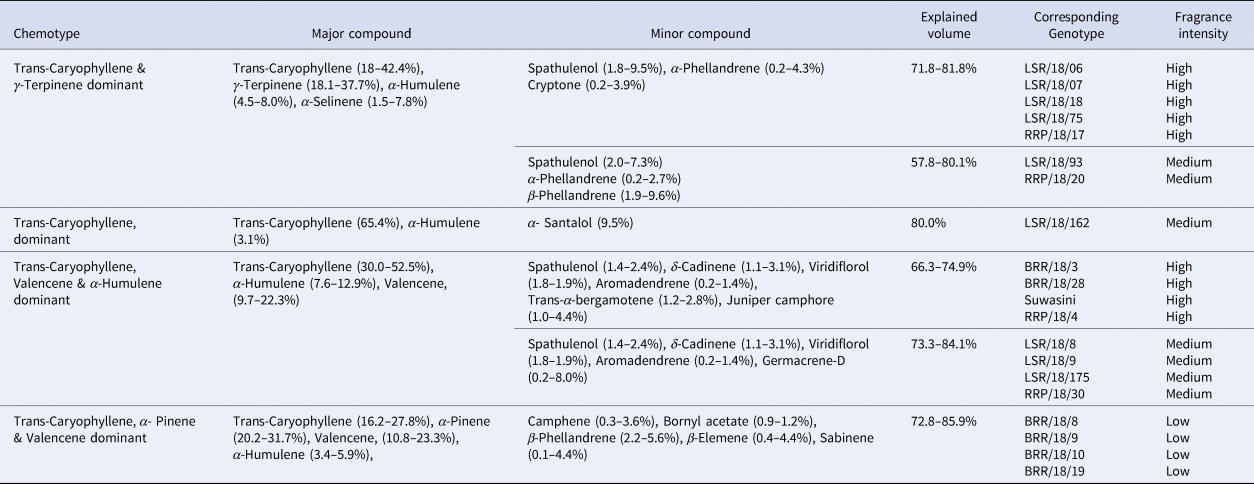
Based on the significant distribution of major compounds and minor compounds in the EOs, the tested genotypes were grouped into four major chemotypes, namely, (i) trans-caryophyllene and γ-terpinene dominant, (ii) trans-caryophyllene dominant, (iii) trans-caryophyllene, valencene, and α-humulene dominant, and (iv) trans-caryophyllene, α-pinene, and valencene dominant chemotypes (Table 4). The chemotype characterisation of CL germplasm was in line with the results of PCA, PLS-DA and HCA. α-pinene dominant chemotypes were limited to wild types, and γ-terpinene dominant chemotypes were confined to cultivated types. The valencene dominant chemotypes were found both in wild and cultivated types of CL genotypes; however, all were collected from the Tamil Nadu region. The trans-caryophyllene was present in all chemotypes, indicating the predominant occurrence of trans-caryophyllene dominant chemotypes in CL.
Chemotype classification of curry leaf germplasm

Discussion
The present research has made significant efforts to explore the biochemical diversity and richness that are inherent in this aromatic plant. The germplasm selected for this study was sourced from a diverse array of geographical areas (three Indian states), ensuring an ample number of accessions from each state to examine any possible inter- and intra-regional differences (Fig. 1). A thorough understanding of the genetic variations in CL is essential for developing an effective strategy for future germplasm exploration initiatives and conservation efforts, as well as for breeding traits related to important essential oils (Salgotra and Chauhan, Reference Salgotra and Chauhan2023). This study represents a fundamental step toward fully utilising native species, like CL, for pharmaceutical applications (Raghu, Reference Raghu2020).
The essential oil (EO) yield observed in this study ranged considerably (0.11 to 0.62%) with a mean value of 0.3%, suggesting substantial genetic variation for EO yield in CL, which could be further utilised through breeding strategies. We identified two CL genotypes (LSR/18/06 and LSR/18/07) that exhibited particularly high EO yields (>0.5%). Both genotypes are cultivated types showcasing an intense fragrance and were collected from a nearby geographical area (Table 1). The EO yield in CL appears to have a significant correlation with geographical origin (Mallavarapu et al., Reference Mallavarapu, Ramesh, Syamasundar and Chandrasekhara1999; Raina et al., Reference Raina, Lal, Tripathi, Khan, Syamasundar and Srivastava2002; Syamasundar et al., Reference Syamasundar, Srinivasulu, Ananda, Ramesh and Rao2012), altitude (Verma et al., Reference Verma, Chauhan, Padalia, Jat, Thul and Sundaresan2013), and the domestication process influenced by human selection (Rao et al., Reference Rao, Rajput and Mallavarapu2011b), which likely has had a continuous modifying effect on the underlying biosynthetic pathways of EOs (Shamsheer et al., Reference Shamsheer, Riaz, Yousaf, Hyder, Aftab, Iqbal, Rahman, Al-Ashkar, Almutairi and El Sabagh2022). This was further supported by the notably lower EO yield found in wild types compared to cultivated types, as all wild genotypes consistently displayed reduced fragrance (Table 1). Hence, it is suggested that the variations in fragrance intensity among CL are positively correlated with leaf EO content.
The chemical diversity of the CL is substantial in terms of EO composition (Rao et al., Reference Rao, Rajput and Mallavarapu2011a). Besides inherent genetic differences (Raina et al., Reference Raina, Lal, Tripathi, Khan, Syamasundar and Srivastava2002), various elements like location (Mallavarapu et al., Reference Mallavarapu, Ramesh, Syamasundar and Chandrasekhara1999, Reference Mallavarapu, Rao and Ramesh2000), seasonal changes (Verma et al., Reference Verma, Padalia, Arya and Chauhan2012), habitat (Rana et al., Reference Rana, Juyal, Rashmi and Blazquez2004; Syamasundar et al., Reference Syamasundar, Srinivasulu, Ananda, Ramesh and Rao2012; Verma et al., Reference Verma, Chauhan, Padalia, Jat, Thul and Sundaresan2013), and cultivation practices (Rao et al., Reference Rao, Rajput and Mallavarapu2011b) notably influence the biochemical properties of CL. Nevertheless, there is currently no research available that directly compares the components of EO by categorising them into major or minor compounds within CL. To enable meaningful direct comparisons, CL oils must be extracted under identical conditions while maintaining all other variables constant. This method would accurately delineate the chemotypes and genuine heritable variation (Rao et al., Reference Rao, Rajput and Mallavarapu2011a). Consequently, in this research, we conducted a statistical analysis of the EO profiles from 20 CL genotypes, all extracted under uniform conditions.
A total of 80 compounds were found across 20 CL accessions, with each genotype having between 27 and 48 compounds, which together constituted more than 98% of the total EO volume. Out of the 80 compounds, only six were identified to be in significantly higher concentrations among the different genotypes; these six compounds – trans-caryophyllene, valencene, γ-terpinene, α-humulene, α-pinene, and α-selenine – were categorised as major volatile compounds. The remaining 74 compounds (Sl. No. 7-80 in Table 3) were detected in substantially lower concentrations and were thus labelled as minor compounds. This classification of EO components into major and minor categories based on statistical differences is being reported in CL for the first time. However, earlier research has identified higher concentrations of α-pinene, sabinene, β-pinene, δ-3-carene, limonene, β-phellandrene, (Z)-β-ocimene, lavandulol, terpinen-4-ol, geraniol, α-copaene, isocaryophyllene, and γ-elemene in EOs of CL (MacLeod and Pieris, Reference Macleod and Pieris1982; Onayade and Adebajo, Reference Onayade and Adebajo2000; Rao et al., Reference Rao, Rajput and Mallavarapu2011a; Sukkaew et al., Reference Sukkaew, Pripdeevech, Thongpoon, Machan and Wongchuphan2014; Santhanakrishnan et al., Reference Santhanakrishnan, Shoba, Varun, Mohankumar and Raveendran2023).
Additionally, this study represents the first attempt to examine the differences in EO yield and composition between wild and cultivated types to examine the degree and direction of genetic divergence in CL during the domestication process. Generally, trans-caryophyllene emerged as the primary component in cultivated types, while other significant compounds like γ-terpinene, α-humulene, and α-selenine showed quantitative variation among the cultivated genotypes. Conversely, wild types primarily contained α-pinene as the main constituent of their EOs. This chemical composition variation underscores the essential connection between the culinary and medicinal preference for trans-caryophyllene and the genetic alterations resulting from human selection during the domestication of CL. Therefore, trans-caryophyllene could explain the enduring aroma found in CL plant leaves and their popularity as a spice (Onayade and Adebajo, Reference Onayade and Adebajo2000).
In the current study, multivariate analysis such as PCA was employed to describe population variance for EO composition with a few key compounds (Fig. 4). PCA is a powerful dimension-reduction technique that is frequently employed in large amounts of biochemical data to describe overall variation with the smallest possible number of components. In curry leaf (Santhanakrishnan et al., Reference Santhanakrishnan, Shoba, Varun, Mohankumar and Raveendran2023) and other aromatic crops (Ray et al., Reference Ray, Jena, Haldar, Sahoo, Kar, Patnaik, Ghosh, Panda, Mahapatra and Nayak2019; Kamila et al., Reference Kamila, Ray, Jena, Sahoo, Kar, Nayak and Panda2021; Sahoo et al., Reference Sahoo, Champati, Dash, Jena, Ray, Panda, Nayak and Sahoo2022), the chemical diversity and chemotype characterisation have been reported based on PCA. In the present study, the PCA indicated that α-pinene, γ-terpinene, and α-selinene were contributing the most to population variance due to the highest variable loadings (online Supplementary Table S4). Santhanakrishnan et al. (Reference Santhanakrishnan, Shoba, Varun, Mohankumar and Raveendran2023) reported that α-pinene, α-fenchene, β-pinene, chloral hydrate, and α-caryophyllene are distributed distinctly. They were found to be prominent components for the distribution of the 11 curry leaf accessions they examined. Although trans-caryophyllene and α-humulene were detected as the major components of EOs, they contribute less to population variance due to null variable loading values (online Supplementary Table S4), and thus, they were the most widely distributed and commonly available volatile compounds in EOs of CL. In other studies, trans-caryophyllene was reported to be the main component of EOs in CL genotypes from Sri Lanka, Nigeria, and Thailand (Onayade and Adebajo, Reference Onayade and Adebajo2000; Rao et al., Reference Rao, Rajput and Mallavarapu2011b).
In the current study, hierarchical clustering was performed to classify the genotypes based on similar chemical profiles and identify the chemotypes (Fig. 6). The HCA classification was in line with the PCA results. The whole population was divided into two major genetically distinct populations, A and B, which were further sub-grouped into 5 sub-populations (Fig. 6). Grouping of genotypes was not in accordance with their origin, indicating the existence of similar chemotypes across locations. The α-selinene and γ-terpinene major cluster consisted only of cultivated types (Fig. 6). In contrast, a predominance of valencene, trans-caryophyllene, and α-humulene formed the second major cluster, which consisted of both wild and cultivated types. Variety Suwasini grouped in the second cluster and had higher concentrations of valencene, trans-caryophyllene, and α-humulene and a lower concentration of α-pinene. Interestingly, Santhanakrishnan et al. (Reference Santhanakrishnan, Shoba, Varun, Mohankumar and Raveendran2023) reported a higher concentration of α-pinene in the leaf volatiles of Suwasini based on thermal desorption gas chromatography-mass spectroscopy.
Rao et al. (Reference Rao, Rajput and Mallavarapu2011b) summarised several previous studies in CL. They described 14 chemotypes under three major categories (monoterpenoid, sesquiterpenoid, and mono- and sesquiterpenoid predominant oils) based on leaf EO chemical profiles. However, these studies were characterised by the in situ evaluation of a few genotypes, and the identification of chemotypes was simply based on predominant compounds rather than the significant contribution of the compounds based on statistical differences (Rao et al., Reference Rao, Rajput and Mallavarapu2011a). The present CL germplasm was classified into four major chemotypes based on HCA results (Table 4). Notably, trans-caryophyllene was present in all the chemotypes, indicating its predominance in the EOs of CL. Previously, β-caryophyllene dominant (Onayade and Adebajo, Reference Onayade and Adebajo2000; Raina et al., Reference Raina, Lal, Tripathi, Khan, Syamasundar and Srivastava2002) and β-caryophyllene and α-pinene dominant chemotypes (Syamasundar et al., Reference Syamasundar, Srinivasulu, Ananda, Ramesh and Rao2012) were reported in CL. In the present study, three new chemotypes have been identified: trans-caryophyllene and γ-terpinene dominant; trans-caryophyllene, valencene, and α-humulene dominant; and trans-caryophyllene, α-pinene, and valencene dominant. Two superior CL genotypes, LSR/18/06 and LSR/18/07 that have been identified in the current study for the higher EO continent belong to the newly reported chemotype, i.e., trans-caryophyllene and γ-terpinene dominant chemotype.
This research highlights the heredity aspects of biochemical variation observed in the EOs of CL. It sets a benchmark for the future management of plant genetic resources and targeted breeding programs in CL. This lays the groundwork for more comprehensive research in the future to uncover the biochemical mechanisms involved and to identify the key genes that improve EO yield and quality in CL, which can also be applied to other aromatic plants. Additionally, two newly identified superior genotypes of CL (LSR/18/06 and LSR/18/07) from this study have immediate relevance in both the agriculture and essential oil sectors.
Conclusion
In the current study, we made pioneer efforts to establish an ex-situ field bank and then to understand the genetic diversity of EO composition in cultivated and wild types of CL germplasm. We employed statistically robust techniques, such as cluster analysis, PCA, PLS-DA, SAM, and pattern analysis, for chemotype characterisation in CL for the first time. A greater degree of genetic divergence was observed for EO yield and composition among tested genotypes, indicating the extent of chemical divergence that is inherent in CL. The current study has identified and classified a large number of volatile compounds of EOs as major and minor compounds for the first time in CL. Cultivated types yielded substantially higher amounts of EO as compared to wild types, and their chemical profile was genetically distinct from wild types.
Further, a greater degree of chemical divergence was observed in cultivated types as compared to wild types, reflecting the impact of human selection and domestication in CL for a variety of leaf fragrances. In addition, the study has unravelled three new chemotypes in CL. The information generated from the present study will be useful for the pharmaceutical and EO industries and also for planning future exploration trips and subsequent conservation programs in CL. This will support breeding initiatives focused on improving both EO yield and quality in upcoming cultivars, such as the two superior genotypes (LSR/18/06 and LSR/18/07) mentioned in this study.
Supplementary material
The supplementary material for this article can be found at https://doi.org/10.1017/S1479262124000662
Acknowledgements
The authors are thankful to Dr M R Dinesh, former Director of ICAR – Indian Institute of Horticultural Research and current Director – for providing basic infrastructure and necessary support.
Author contributions
B.R. Raghu: Conceptualization, Methodology, Writing- Original draft preparation; K.S. Shivashankara: Supervision, Manuscript editing; Priyanka Mahadappa: Software-data analysis, Manuscript editing; A.N. Lokesha: Methodology-GCMS analysis; K. S. Nandini: Methodology-Essential oils extraction; V. K. Rao: Methodology-Essential oils extraction; H.C. Prasanna: Manuscript editing; Sudip Kumar Dutta: Manuscript editing.
Competing interests
The authors declare that they have no known competing financial interests or personal relationships that could have appeared to influence the work reported in this paper.