Introduction
The recruitment and retention of skilled workers to provide direct care to older people is a long-standing international concern (Department of Health and Department for Education and Skills 2006; Howe Reference Howe2009; Korczyk Reference Korczyk2004; Stone Reference Stone2004). Migrant workers are often recruited as a means of relieving staff shortages (Cangiano et al. Reference Cangiano, Shutes, Spencer and Leeson2009; Howe Reference Howe2009; Hussein, Manthorpe and Stevens Reference Hussein, Manthorpe and Stevens2010). Within this context, growing attention has been placed on the recruitment and retention of social care staff in England. Concurrently, improving the quality of care is one of the ways in which governments have striven to achieve personalisation within social care, part of which is to give those receiving support greater choice and control over the services that they receive (Department of Health 2009a, 2010). However, this pursuit of quality services in domiciliary and care home provision in England has been an enduring theme in national policy guidance (Cm 849 1989; Cm 4169 1998; Cm 6737 2006; Cm 7432 2008). Central government has sought to realise this goal by using the commissioning and contracting process for domiciliary care and care home provision as a lever to improve the skills and competencies of the workforce, including improved recruitment and retention practices and the provision of training. The latter has included training specific to the care of people with dementia since care workers caring for older people in most settings may be involved in supporting those with the condition (Department of Health 2000, 2009a, 2009b, 2009c; 2011a, 2011b, 2011c; Department of Health, Skills for Care and Skills for Health 2010a, 2010b, 2011; House of Commons All-Party Parliamentary Group on Dementia 2011). However, although data are being collected on the nature of the social care workforce (Skills for Care 2008a), less is known about the degree of influence that local authorities can have on this through their commissioning and contracting processes.
The community care reforms initiated by the 1989 White Paper Caring for People (Cm 849 1989) introduced a changed role for local authorities from that of main provider of social care, to that of a purchaser of care from a variety of providers, including the voluntary and private sectors. Local authorities were subsequently required to choose provision based on considerations of quality and cost, keystones of the concept of ‘Best Value’. They were, however, particularly encouraged to promote the development of independent-sector services through their commissioning and contracting processes (Cm 4169 1998). Thus, there has been a substantial increase in the independent-sector share of both care home (Forder and Netten Reference Forder and Netten2000) and domiciliary care services (Ware et al. Reference Ware, Matosevic, Forder, Hardy, Kendall, Knapp and Wistow2001), with over two-thirds of the social care workforce employed by this sector (Department of Health 2009a). There were estimated to be over half a million (569,000) care workers employed in the independent sector in England, with most working in either residential (355,000), or domiciliary care services (212,000) (Skills for Care 2008a). They perform an important role in meeting both the short and long-term social care needs of the older population. Increasingly, local authorities are encouraged to jointly commission and contract with commissioners of health services for domiciliary care and care home provision for older people (Cm 4818-1 2000; Cm 7881 2010; Department of Health 2007, 2008, 2009d, 2009e, 2009f). Commissioners have discretion to tailor the way in which they do this according to local circumstances, which may influence the quality of services. Block contracts (where payment is agreed in advance for a fixed quantity of service) spanning a number of years offered more security and stability to providers, but the promotion of more personalised adult social care services has prompted commissioners to adopt more flexible forms of contract in terms of volume and time frame. An example of this is spot contracting (where payment is made for services used by individual clients) (Forder et al. Reference Forder, Knapp, Hardy, Kendall, Matosevic and Ware2004). Increasingly, services are jointly commissioned by health and social care agencies. As a result, commissioning and contracting arrangements vary across the country (Chester, Hughes and Challis Reference Chester, Hughes and Challis2010).
In this article, the concept of continuity of care, defined as the same worker or group of workers providing direct care, is presented as a hallmark of a quality care service and we summarise our rationale for this as follows. The benefits of health and social care tasks being undertaken by a single care worker were noted in an early study of case management. This reduced the number of persons assisting the older person and facilitated monitoring of their wellbeing (Challis et al. Reference Challis, Darton, Johnson, Stone and Traske1995). Continuity of care for older people with dementia with the same care workers caring for the same service users over time has been noted as a feature of domiciliary care services specially developed for this group. This enables staff to identify any change in circumstance or preference, and to respond accordingly (Challis et al. Reference Challis, Sutcliffe, Hughes, von Abendorff, Brown and Chesterman2009; Rothera et al. Reference Rothera, Jones, Harwood, Avery, Fisher, James, Shaw and Waite2008). Moreover, research has suggested that continuity of care in terms of the home care worker being the same each time was particularly valued by carers of older people with dementia (Challis et al. Reference Challis, Clarkson, Hughes, Chester, Davies, Sutcliffe, Xie, Abendstern, Jasper, Jolley, Roe, Tucker and Wilberforce2011; Department of Health 2011c). Furthermore, around four-fifths of care workers have reported that the ability to care for the same person over a long period of time would be helpful in supporting them to remain at home (Alzheimer's Society 2011). It is not unreasonable to assume that the likelihood of the same worker providing direct care in domiciliary care and care home settings will be reduced where providers experience problems with recruitment and retention, thereby diminishing service quality. Other research has indicated that staff turnover is indeed associated with the quality of a service. In a study of nursing aides in care homes, Castle and Engberg (Reference Castle and Engberg2005) reported that high levels of turnover were associated with lower quality care. Moreover, Netten, Jones and Sandhu (Reference Netten, Jones and Sandhu2007) linked higher-quality domiciliary care services with the absence of problems relating to staff recruitment and retention. Staff turnover was also thought to be one of the most critical influences on service user experience of service quality.
This paper has two aims. First, to describe local authority commissioning and contracting arrangements for domiciliary and care home provision for older people. Second, to explore the influence of these and other factors on the recruitment and retention of staff providing direct care in these services. By direct care we mean support to vulnerable older people to perform activities of daily living (such as bathing or toileting) and if they are living in their own home, instrumental activities of daily living (such as shopping or housework) (Katz et al. Reference Katz, Ford, Moskowitz, Jackson and Jaffe1963). Subsequently, the implications of these findings for the pursuit of quality in the provision of care for vulnerable older people are explored.
Method
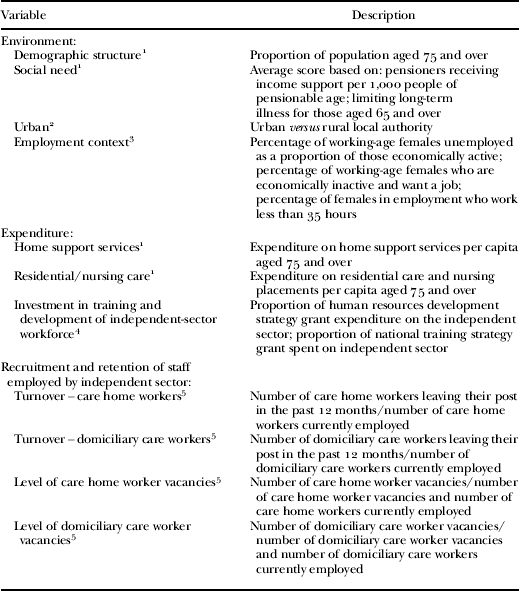
Data are presented from both primary and secondary sources. Findings from a postal survey undertaken by the authors in 2008 relating to joint commissioning between health and social care and contractual arrangements with independent-sector social care providers are described. The unit of analysis was local authorities with social services responsibilities in England. A response rate of 74 per cent was achieved, with the sample attained broadly representative of different types of local authority as measured by a classification used by central government to distinguish them in terms of divisions of responsibilities and balance of power, which in turn, are likely to be indicative of differences in terms of size of population and geographical area (Department of Health 2008; Office for National Statistics 2012). In this respect, there was not believed to have been a bias in terms of the nature of local authorities responding to the survey. Three strategies were adopted to ensure a high response rate. First, the contents of the questionnaire were informed by a purposive review of literature and policy, together with meetings with senior local authority managers. Second, the initial mail out was deliberately scheduled for early rather than later in the calendar year. Third, following the initial distribution of the questionnaire, non-respondents were contacted twice by telephone and replacement questionnaires were sent. Subsequently, measures created from routinely collected data were linked to this national dataset. As shown in Table 1, three broad sets of indicators were produced. Those within the first set we describe as environment variables, such as measures of need. These were created from a number of data sources to provide information about factors within the geographical environment. They, together with the second set measuring local authority expenditure on social care and the independent-sector workforce, provide a context for the information from our dataset and our next set of indicators. These are measures of turnover and vacancies of care staff in domiciliary care organisations and care homes. They were constructed using a subset of data from the National Minimum Dataset for Social Care (NMDS-SC) which contained a range of information about social care providers and their employees in England. This was collected by Skills for Care, an organisation in England whose purpose is to ensure that the adult social care workforce has the skills and qualifications to deliver high-quality care (Skills for Care 2008a). Two subsets of this data were extracted for the purpose of this paper, one containing data relating to independent-sector care homes and the other, domiciliary care organisations. Both datasets contained only those organisations providing care to older people and employing care workers or senior care workers. They were aggregated to local authority level to provide details of the total number of senior care workers or care workers leaving their employment in the past 12 months, number of vacancies, and employees in permanent or temporary roles in each of these localities. These measures were used to compute local authority-level measures of turnover and vacancy levels, as detailed in Table 1, which were linked to our national data.
Details of routinely available data used in the analysis

Source: 1. Key Indicators Geographical System 2006–07 (Dr Foster Intelligence 2008). 2. DEFRA Classification of Local Authority Districts and Unitary Authorities in England 2005 (Department for Environment, Food and Rural Affairs 2005). 3. Labour Force Survey 2006–07 (National Online Manpower Information Service 2008). 4. Self-assessment Survey 2007–08 (Commission for Social Care Inspection 2008). 5. National Minimum Dataset for Social Care 2007 (Skills for Care 2008b; Skills for Care, personal communication, 14 December 2007).
The first aim of this paper is addressed by tabulations of findings from the national survey. Subsequently, the second aim is explored by means of Ordinary Least Squares (OLS) regression analysis. In this, the four measures relating to the recruitment and retention of staff (detailed in Table 1) provide the response variables. Two types of model were estimated for each of these outcomes and thus eight models were produced in total. The first of the two types contained a subset of commissioning and contracting variables from Tables 2–4. A selection was necessary as the number of variables that could be included in the analysis was limited due to the sample size. This was guided by the capacity of variables to discriminate between different local authorities as well as the presence of missing information. For example, a measure of block contracting was included in the model as most respondents had provided this information and this varied between authorities. However, contract specifications relating to care homes were excluded as details were only provided by a subset of respondents. To produce the second type of model, measures of environment and expenditure from Table 1 were also included. Backward elimination was used as the basis of model selection. A threshold of 10 rather than 5 per cent was chosen as the level of significance due to the small sample size, to increase the probability of identifying effects (Kennedy Reference Kennedy2003). A range of diagnostic tests were used prior to, during and subsequent to the analysis. For example, a correlation matrix of all explanatory variables and collinearity diagnostics from the models were examined to identity any potential sources of multicollinearity, and no significant problems were found (Field Reference Field2009). Moreover, the distribution of the response variables was explored prior to the analysis and diagnostic checks were undertaken to identify any cases having any undue influence on the model. As a result of these investigations, one outlier was removed from the models relating to the turnover of domiciliary care workers. Furthermore, examinations of the size and variance of residuals from the models as well as the correlation between them were conducted to check that the assumptions of OLS were met and these revealed no significant cause for concern (Field Reference Field2009).
Findings
The findings are in two parts. First, data from the national survey are presented. Second, the findings from the models are discussed.
Service arrangements
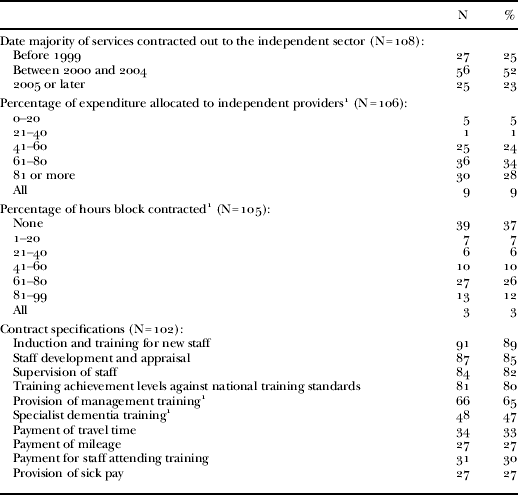
Information relating to four aspects of local authority arrangements for contracting with the independent sector for domiciliary care services are detailed in Table 2. First, just over half of local authorities contracted out the majority of this provision to independent-sector providers between 2000 and 2004, a quarter did this before 1999, and a similar number in 2005 or later. Second, a total of nine local authorities reported that they no longer had in-house domiciliary care provision, as such, all of their expenditure relating to this was allocated to independent providers. The remainder retained some in-house domiciliary care services. In total, nearly three-quarters of authorities allocated over 60 per cent of their expenditure on domiciliary care to independent providers. Third, nearly two-fifths reported having no block contracts, although a small number of local authorities also reported that all of their domiciliary care hours were purchased by this method. Finally, in contracting for domiciliary care, items most likely to be specified were: induction and training for new staff and staff development and appraisal. Least likely to be specified were provision of sick pay and payment for staff attending training. With regard to the latter, achievement levels against national training standards was reported to be specified in contracts by four-fifths of authorities. However, provision of management training and specialist training for the care of older people with dementia were less likely to be contractual requirements. It was surmised that the inclusion of these items in contracts may increase the likelihood of providers having effective arrangements in place for the training of their staff, particularly where this is overseen within the local authority contract-monitoring processes.
Contractual arrangements with the independent sector for domiciliary care
Note: 1. Variable selected for subsequent regression analysis.
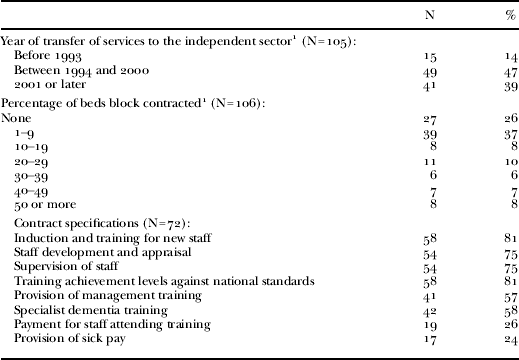
Table 3 reports data regarding three aspects of contractual arrangements for independent-sector care home provision. First, it indicates that around a tenth of authorities had transferred the majority of their establishments into the independent sector before 1993, just under half had done this between 1994 and 2000 and just under two-fifths had done this in 2001 or later. Second, block purchasing was found to form only a small part of contracting arrangements for care home provision. Just over a quarter of local authorities reported that they had no such arrangements and almost two-thirds reported that they purchased less than 10 per cent of beds provided by the independent sector by this method. Third, in contracting documentation, items most likely to be specified were induction and training for new staff and staff development and appraisal. Least likely again to be included were provision of sick pay and payment for staff attending training. The specification in contracts of achievement levels against national training standards was reported by around four-fifths of authorities. However, specification of management training and specialist training for the care of older people with dementia were less likely.
Contractual arrangements with the independent sector for care homes
Note: 1. Variable selected for subsequent regression analysis.
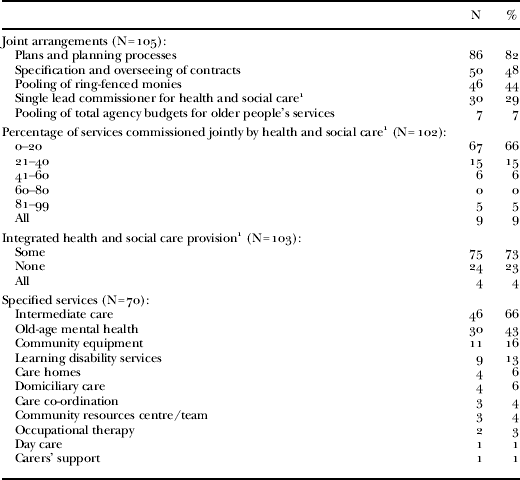
Table 4 presents data relating to three aspects of local authority arrangements for the joint commissioning and provision of older people's social care services. First, with regard to commissioning, the most common joint arrangements in place were joint plans and planning processes, with four-fifths of authorities utilising these. Just under half of authorities undertook joint specification and overseeing of contracts. A similar number reported pooling ring-fenced monies, with a small number of authorities stating that they pooled total agency budgets for older people's services. Second, in respect of the extent to which social care services were commissioned jointly with health commissioners, two-thirds of local authorities reported that they commissioned 20 per cent or less in this way. However, a small minority reported that they jointly commissioned all of their older people's services. Third, with regard to the joint provision of services, only 4 per cent of authorities had an integrated provider for services for older people for all provision. However, nearly three-quarters had an integrated provider for some services. Where local authorities provided details of these, these were most likely to be intermediate care and old age mental health services.
Joint commissioning and provision
Note: 1. Variable selected for subsequent regression analysis.
Factors influencing staff turnover in the independent sector
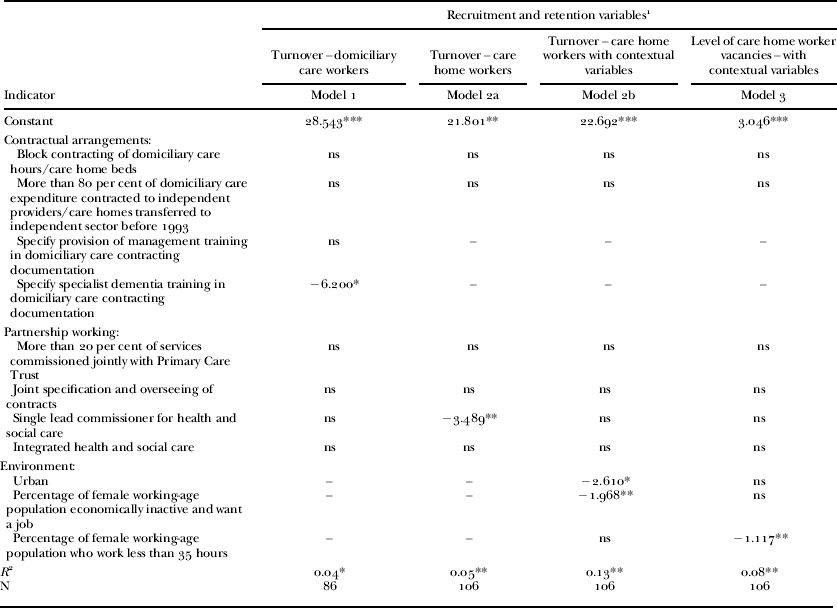
The regression analysis revealed that commissioning and contracting variables were not significantly related to domiciliary care or care home worker vacancies. Specifically in relation to domiciliary care, it was noteworthy that measures of environment and expenditure detailed in Table 1 were not associated with the level of domiciliary care worker vacancies, or the turnover of domiciliary care workers. It is also relevant to note that variables relating to expenditure were not relevant in any of the models. Thus only four regression models are presented in Table 5. Three relate to staff turnover and one to the level of staff vacancies. Significant findings relating to the provision of specialist training in the care of older people with dementia, characteristics of the workforce and urbanisation are discussed below.
Factors influencing the recruitment and retention of independent-sector care workers
Note: 1. Definitions of these variables are in Table 1.
Significance levels: * p < 0.10, ** p <0.05, *** p <0.001. ns denotes term that was tested in the model and dropped because p ⩾0.10.
Two commissioning and contracting variables were significantly associated with the turnover of staff providing direct care. For care home workers, ‘single lead commissioner for health and social care’ was significant in model 2a, however, as indicated in model 2b, this was insignificant once contextual variables were included in the analysis. More importantly, model 1 demonstrates that where local authorities had made specialist training for the care of older people with dementia a contractual requirement, there was a lower turnover of domiciliary care workers, suggesting that lower numbers of care workers were leaving their employment where they received this training. Specialist training for the care of older people with dementia has been noted to be a feature of specialist dementia home care services (Rothera et al. Reference Rothera, Jones, Harwood, Avery, Fisher, James, Shaw and Waite2008). Chilvers (Reference Chilvers2003) has argued that the recruitment of care workers may be easier for specialist dementia compared to generic home care services. Interestingly, Ryan et al. (Reference Ryan, Nolan, Enderby and Reid2004) noted opportunities for personal development and training as a reason why support workers working within specialist dementia services have a high level of job satisfaction. Other studies have reported that care workers within these services have the ability to undertake a greater variety of tasks and develop long-term relationships with service users, which may also explain why working in these specialised settings may be more attractive compared to generic home care services (Challis et al. Reference Challis, Sutcliffe, Hughes, von Abendorff, Brown and Chesterman2009; Rothera et al. Reference Rothera, Jones, Harwood, Avery, Fisher, James, Shaw and Waite2008). It has also been reported that specialist home care services are perceived to be of greater quality by care workers and others have noted the link between the quality of a service and the recruitment and retention of care staff (Castle and Engberg Reference Castle and Engberg2005; O'Kell Reference O'Kell2002).
With regard to the characteristics of the workforce, the analysis revealed that two variables indicative of the local employment situation were found to be significantly associated with the recruitment and retention of staff. First, in model 2b a measure of the percentage of the female working-age population who are economically inactive and want a job was associated with lower turnover of care home workers. Second, in model 3 the proportion of the female working-age population who work less than 35 hours was related to a lower level of vacancies. One possible explanation for the first finding is that this variable may indicate a greater supply of female workers available for work, and as such, signify a more competitive local employment market, where staff are discouraged from leaving their current employment. With regard to the second finding, it may be that this measure is indicative of areas with a greater supply of female workers for part-time work, and thus vacancies which are easier to fill. Similar types of indicators have been found to be important in turnover of related staff groups. For example, Banaszak-Holl and Hines (Reference Banaszak-Holl and Hines1996) explored the influence of several factors on turnover of nursing aides working in care homes. They found environment factors significantly influenced turnover of staff, with local economic conditions such as the unemployment rate and per capita income rate reported to have the strongest effects on turnover. More specifically, lower turnover of nursing aides was reported to be associated with higher unemployment rates in the locality, suggesting that turnover was higher in areas with more employment opportunities. Moreover, O'Kell (Reference O'Kell2002) has noted that managers of care homes in areas where there are high levels of unemployment have less difficulty in recruiting staff.
As indicated in model 2b, turnover of care home staff was lower in urban areas. This suggests that care homes in urban areas may have less difficulty in retaining their workforce compared to those in rural areas. This supports findings by O'Kell (Reference O'Kell2002) who reported that homes located in rural and isolated areas tend to experience more problems with the recruitment of care workers. Whilst no evidence for the effect of urbanity was found in the models relating to domiciliary care workers in the current study, other research has also noted difficulties in rural communities with the recruitment and retention of this staff group (Bainbridge and Ricketts Reference Bainbridge and Ricketts2003; Commission for Rural Communities 2008; Department of Health, Social Services and Public Safety 2011; Manthorpe and Stevens Reference Manthorpe and Stevens2010). Poorer local public transport links, higher travel costs and a potentially smaller working-age population in rural compared to urban areas may offer potential explanations for why care homes or care agencies in rural localities may experience greater difficulties recruiting and retaining care staff (Manthorpe et al. Reference Manthorpe, Iliffe, Clough, Cornes, Bright and Moriarty2008; O'Kell Reference O'Kell2002).
Discussion
This paper has presented data from a national survey relating to local authority arrangements for the commissioning and contracting of domiciliary and care home services. Its principal limitations relate to the available data and, more generally, understanding of the complexities and significance of measurement of staff turnover. The data represent a snapshot of arrangements at one point in time and these evolve in response to changes in policy and practice guidance. Indeed, the subsequent requirement to deliver more personalised care services is evident in both policy and practice guidance, confirming a move away from block contracting to more flexible arrangements (Department of Health 2008, 2009c). Longitudinal data are required to fully explore the factors influencing recruitment and retention, and direction of causality, such as, for example, the relationship between the quality of a service and the turnover of staff (Castle and Engberg Reference Castle and Engberg2005; Evans and Huxley Reference Evans and Huxley2009). With regard to the data obtained from the NMDS-SC, no details were available of inter- and intra-local authority variation in response rates.Footnote 1 In interpreting data relating to recruitment and retention of staff, it has been argued that sometimes staff turnover is not undesirable if this relates to the involuntary turnover of underperforming staff, leading to a gradual up-skilling of the workforce. Thus a distinction should be drawn between very low and very high turnover (Brannon et al. Reference Brannon, Zinn, Mor and Davis2002). However, it is difficult to establish at what point levels of staff turnover become problematic, rather than desirable, from the perspective of organisations and service users. It was also not possible to control for many other factors that may influence turnover and vacancy rates such as wage levels within a locality. These limitations may be reflected in the low proportion of the variation in turnover and vacancy rates explained by the variables included in the models, as indicated by the low values of R 2 (see Table 5). Notwithstanding these limitations, this study has permitted exploration of some of the factors influencing staff turnover in care homes and domiciliary care organisations. In the remainder of this article, the implications of these findings are discussed in the context of the importance of promoting continuity of care – our hallmark for a quality care service – for older service users.
Our study suggested two influences on the recruitment and retention of staff providing direct care in care home and domiciliary care organisations: staff training and a range of factors we describe as environment variables. These comprise: variables indicative of the local employment context and urbanisation. Both influences may be conceived of as potential determinants of continuity of care which we construe as a proxy for a high quality of care. The current study reported an association between specifying specialist training for the care of older people with dementia as a contractual requirement and lower turnover amongst domiciliary care staff. Other studies have explored the links between training, staff retention and the quality of care provided to older people. Training care home staff to manage behaviour associated with dementia has been identified as a means to promote continuity of care over time (Mozley et al. Reference Mozley, Sutcliffe, Bagley, Cordingley, Challis, Huxley and Burns2004). O'Kell (Reference O'Kell2002) described how staff retention may be more likely in care homes that assist staff to take up education and training opportunities. Moreover, a more highly trained domiciliary care workforce, in terms of the number of hours of training received, has been reported to promote higher service quality (Netten, Jones and Sandhu Reference Netten, Jones and Sandhu2007). There is also evidence to suggest that training can influence care home staff confidence in caring for people with dementia and has the potential to directly influence the quality of care (Hughes et al. Reference Hughes, Bagley, Reilly, Burns and Challis2008). Although the findings of the current study relate to specialist dementia training, similar benefits may well apply to generic home care training or training relating to other aspects of care such as, for example, care for people with Parkinson's disease or those who have suffered a stroke.
In our analysis, the influence of what we have called environment variables (see Table 1) was found to be of greater importance than commissioning and contracting arrangements in influencing the recruitment and retention of care home staff. Similar findings regarding the relative importance of the local economic or social context have been noted by others. Banaszak-Holl and Hines (Reference Banaszak-Holl and Hines1996) reported how local economic conditions such as unemployment rate and per capita income rate had the strongest effects on staff turnover, with contextual variables of greater importance than factors within the control of care homes such as job design and facility characteristics. More recently, Brand, Hughes and Challis (Reference Brand, Hughes and Challis2012) explored the influence of care management arrangements on service-level outcomes, such as the proportion of older people admitted to residential or nursing care, and reported that structural factors, such as the level of rurality, were of greater importance in determining this. These findings, in effect, support the conclusion which can be drawn from our analysis, namely that local environment factors, such as the levels of local employment or level of urbanisation, are likely to influence the quality of care vulnerable older people receive from those providing direct care.
Effective strategies to recruit and retain care workers may thus contribute to continuity of care for vulnerable older people and, more generally, quality provision. Nevertheless, it must also be acknowledged that quality services may be more likely to recruit and retain care workers, indicating a reciprocal relationship between quality services and staff turnover. Therefore, strategies to improve recruitment and retention of care workers must be pursued as part of wider goals of promoting continuity of care for care home residents or older people in receipt of domiciliary care, and improving the quality of care services.
Conclusion
To what extent, therefore, can the commissioning and contracting process influence the quality of care provided to older service users within care homes and domiciliary care organisations? This study has described these arrangements and explored their impact on the recruitment and retention of care workers, considered to be a prerequisite of continuity of care and a driver of quality services. The findings suggest that commissioning and contracting arrangements had little influence on continuity of care, our proxy measure of a quality service. Nevertheless, this study identified that there may be a potentially important role for staff training. As noted above, training has many benefits, not only in improving the quality of care provided to older people, but also in improving staff confidence and increasing job satisfaction (Hughes et al. Reference Hughes, Bagley, Reilly, Burns and Challis2008; Ryan et al. Reference Ryan, Nolan, Enderby and Reid2004). This study suggests that by making training, such as that relating to the care of older people with dementia, a contractual requirement, care workers may be less likely to leave their employment, and thus, local authorities can potentially, through their commissioning and contracting processes, help providers to retain their staff, promote continuity of care and thus obtain higher-quality social care for older people living within their locality. However, these findings also demonstrate that for those charged with commissioning social care in England, many key factors are not susceptible to their influence. Thus, after more than 20 years of policy focus on commissioning and improving commissioners' competence in this process, there may be a limit to the control commissioners have through these arrangements. Outcomes such as improving the recruitment and retention of care workers who provide direct care to older people may be influenced by factors beyond their influence.
Acknowledgements
We are most grateful to the local authorities and their staff for their participation in the research and the organisation Skills for Care for the use of their data, access to which was facilitated by Professor Jill Rubery at Manchester Business School. Approval for the study was received from the Association of Directors of Adult Social Services Research Group and a university research ethics committee. This work was undertaken by the Personal Social Services Research Unit and funded by the Department of Health for England. Responsibility for this paper is the authors' alone. The views expressed are those of the authors and do not necessarily represent those of the Department of Health. All authors made a substantial contribution to the conception and design, analysis and interpretation of data; the drafting or revision of the article; and approved the version to be published.