1. Introduction
English, in the course of its progressive evolution and global spread, has had contacts with different languages (Hogg & Denison, Reference Hogg, Denison, Denison and Hogg2006) which have led to the emergence of native and non-native varieties spoken in different countries of the world. This, in part, has resulted in variable pronunciations of English lexical items, such as anti- pronounced as /ænti/ or /æntaɪ/ at the segmental level and adult as /'ædʌlt/ or /ə'dʌlt/ at the suprasegmental level of stress (Hogg & Denison, Reference Hogg, Denison, Denison and Hogg2006). In addition to this, phonological free variation in English has been motivated by phonetic processes, phonological changes and sociolinguistic factors, among others (Shitara, Reference Shitara1993; Mompean, Reference Mompean and Henderson2010).
A few studies (Shitara, Reference Shitara1993; Wells, Reference Wells, Elenius and Branderus1995, Reference Wells1999, Reference Wells2003; Henderson, Reference Henderson2010; Mompean, Reference Mompean and Henderson2010) have been carried out on phonemic and stress free variation in native English varieties which have contributed immensely to our understanding of this phenomenon and to the successive reviews of Wells’ (Reference Wells2000, Reference Wells2008) Longman Pronunciation Dictionary (LPD). Conversely, such empirical studies are very scarce in Nigerian English (NigE, henceforth) even though it is common knowledge that English words are prone to variable pronunciations in the NigE accent, owing to the influences of the British and American varieties on the one hand (Awonusi, Reference Awonusi1994; Ogbulogo, Reference Ogbulogo2005; Obasi, Reference Obasi2019) and cross-linguistic influence from indigenous languages on the other (Jowitt, Reference Jowitt2019). This, therefore, limits our understanding of the concept of phonological free variation in a non-native English setting. Yet, as shall be established in this study, this phenomenon is germane for the standardisation of NigE.
In filling this gap, therefore, this study attempts a corpus-based investigation of word-stress free variation in NigE with a view to identifying NigE speakers’ preferences. It is believed that the findings would serve as a resource material required for a review of a revised edition of the existing Dictionaries of Nigerian English (Igboanusi, Reference Igboanusi2002; Adegbite, Udofot & Ayoola, Reference Adegbite, Udofot and Ayoola2014). The objectives of this study are as follows:
(i) to ascertain the variability of word-stress patterns in NigE
(ii) to identify the preferred stress free variants
(iii) to establish the influences on the NigE speakers’ preferences
This section has provided a background for this study. Section 2 examines the concept of free variation in English while section 3 discusses word stress in NigE. In Section 4 the methodological approach to the study is described. The results of the analysis are presented in section 5 and discussed in Section 6, and the paper finally concludes with recommendations in section 7.
2. Free variation in English
The concept of free variation in phonology accounts for the occurrence of two or more different sounds in the same environment without constituting a meaning change and without being considered incorrect by the native speakers. The phenomenon may also be explained as a case of instability or free fluctuation in sounds (Hughes, Trudgill & Watt, Reference Hughes, Trudgill and Watt2005) as a result of which a particular sound may be variably pronounced at different times by the same speaker or differently by two speakers (Fatunsin, Reference Fatunsin2007). Free variation may occur at the segmental (e.g. schedule as /ʃeʤu:l/ or / ʃkeʤu:l/, dilemma as /dɪlemə/ or /daɪlemə/) and supra-segmental (e.g. detail as /'di:teɪl/ or /dɪ'teɪl/, finance as /'faɪnænts/ or /fə'nænts/) levels.
At the segmental domain, free variation may manifest in phonetic or phonemic form. It may occur as an instance of phonetic realisations of a phoneme, for example, the pronunciation of the initial voiceless alveolar plosive in team as aspirated [thi:m] or unaspirated [toi:m], or a situation where certain sounds are realised as different phones from one native accents to another (e. g., RP /ɒ/ as /ɑː/ in GA). In its phonemic form, free variation may occur due to differentiation in the number of phonemes in a language (McCully, Reference McCully2009; Roach, Reference Roach2009), thereby allowing a set of phonemes in a particular language to be used interchangeably. For example, both long /e:/ and diphthong /eɪ/ are present in some northern British English accents, while the same long /e:/ is realised as/eɪ/ in BBC pronunciation.
At the suprasegmental domain, free variation may occur in the stress pattern of a particular word in isolation with no change in grammatical category (e.g. vaccine /'væksi:n/ or /væk'si:n/; complex /'kɒmpleks/ or /ֽkɑːm 'pleks/) or in connected speech (e.g. a shift in stress placement in eco'nomic, as in think about the 'economic 'value they have), yet without a meaning difference. Lastly, free variation may also manifest through the processes of assimilation, coalescence and reduction in connected speech. These may result in phonological alternations such as this shop as /ðɪs ∫ɒp/ or /ðɪ∫∫ɒp/; God bless you as /gɒd bles ju:/ or /gɒd ble∫ʊ/ and would you as /wʊd ju:/ or /wʊʤu/.
This study focuses on free variation in lexical stress patterns. Essentially, this phenomenon explains the possibility of more than one stress pattern on a particular word in its citation form (e.g. ciga'rette or 'cigarette, ap'plicable or 'applicable, 'distribute or di'stribute, 'communal or co'mmunal) without a change in meaning or grammatical category (Mompean, Reference Mompean and Henderson2010; Cruttenden, Reference Cruttenden2014). This, therefore, precludes stress variation that is due to stress shift (e.g., su'ccess versus 'success 'power) or leads to a change in grammatical class such as au'gust (adjective) and 'August (noun), 'present (adjective/noun) or pre'sent (verb).
The occurrence of lexical-stress free variation may be due, largely, to accent differences (Shitara, Reference Shitara1993; Katalin & Szilárd, Reference Katalin and Szilárd2006; Henderson, Reference Henderson2010) or what Simo Bobda (Reference Simo Bobda2010) refers to as stress variation in space. Variability in the accents of the two major native English varieties (RP and GA), globally considered as models for teaching and learning English in the second language setting, has considerably yielded lexical-stress free variation in various English varieties. Examples are advertisement pronounced as /əd'vɜ:tɪsmənt/ (RP) and /ædvə'taɪzmənt/ (GA); formidable as /fɔ:'mɪdəbəl/ (RP) and /'fɔ:rmɪdəbəl/ (GA); harass as /'hærəs/ (RP) and /hə'ræs/ (GA); and so on (Shitara, Reference Shitara1993; Simo Bobda, Reference Simo Bobda2010).
Word-stress free variation has also been shown to be conditioned by social factors, such as age, level of education and gender, among others. For example, preferences for certain word stress variants (e.g., harass, formidable, justifiable) are found to be influenced by age, gender or level of education of speakers in both British and American English varieties (Shitara, Reference Shitara1993; Wells, Reference Wells, Elenius and Branderus1995).
Another explanation for lexical-stress-free variation, according to Simo Bobda (Reference Simo Bobda2010), is variability in time. Evidence abounds of diachronic stress shift on English words over time which has yielded several competing stress patterns. For example, the lexical items ´illustrate, ´revenue, and ´abdomen with stress preference on the initial syllable in present-day British English were, prior to the 18th century, stressed on the penultimate syllable as i´llustrate, re´venue, ab´domen. Today, both the traditional and newer forms are in free variation (Wells. Reference Wells2008, Simo Bobda, Reference Simo Bobda2010).
Generally, the concept of free variation has not received detailed attention in phonological theory, possibly due to the traditional assumption that it was insignificant to the linguistic field (Mompean, Reference Mompean and Henderson2010). Nevertheless, a few studies in the native English varieties have paid attention to the phenomenon, whose findings have improved our understanding of the concept (Henderson, Reference Henderson2010; Mompean, Reference Mompean and Henderson2010) and have provided support for the revised editions of the English Dictionaries (Shitara, Reference Shitara1993; Wells, Reference Wells1999, Reference Wells2003).
On the other hand, research into lexical-stress free variation in a second language setting such as Nigeria is yet to be seen, despite that the accent is replete with variable pronunciations under the influences of native Englishes and substrate languages. The present study, therefore, is an attempt to extend the study of free variation in word stress to a non-native variety.
3. Word stress in Nigerian English
English, in Nigeria, has graduated from just being the language of trade and of teaching the Christian ethos to that of government, diplomacy, literature, the mass media, and of inter-ethnic and international communication (Oyeleye, Reference Oyeleye2016). It is the nation's official language and, unarguably, the most influential and dominant language (Gut, Reference Gut, Kortmann, Schneider, Burridge, Mesthrie and Upton2004). The contact of English with the over 500 indigenous languages (Ebenhard, Simons & Fennig, Reference Ebenhard, Simons and Fennig2019) has, however, exposed it to substratum influence which has resulted in a domesticated variety known as Nigerian English. The existence of NigE is no longer in doubt (see Gut, Reference Gut, Kortmann, Schneider, Burridge, Mesthrie and Upton2004; Jowitt, Reference Jowitt2019). Rather, commendable efforts are geared towards its codification and standardisation (Gut, Reference Gut2012; Adegbite et al., Reference Adegbite, Udofot and Ayoola2014) which have yielded series of studies at different linguistic levels.
At the suprasegmental level of phonology, several studies have posited that NigE differs remarkably from British English (BrE) in stress assignment. These studies are agreed that, in view of the serious challenge which stress poses to most users of English as a second language, NigE speakers have developed nativised stress-placement strategies which have yielded peculiar but definable stress patterns. Some of these include backward and forward stress shift in contrast to the native-English stress patterns (Atoye, Reference Atoye1991; Simo Bobda, Reference Simo Bobda2010; Atoye et al., Reference Atoye, Soneye, Adejuwon, Faleye and Fajobi2018; Jowitt, Reference Jowitt2019) and replacement of English stress with tone (Amayo, Reference Amayo1980; Gut, Reference Gut, Bisang, Hock and Winter2007; Udofot, Reference Udofot2007; Gussenhoven & Udofot, Reference Gussenhoven and Udofot2010; Fajobi, Reference Fajobi2014).
In addition to these, however, users of English in Nigeria are also exposed to the American and British English stress patterns, which are often in free variation (Atoye et al., Reference Atoye, Soneye, Adejuwon, Faleye and Fajobi2018; Obasi, Reference Obasi2019), in view of the initial contact with the British and the subsequent political, economic and educational interactions with the United States of America (Awonusi, Reference Awonusi1994; Jowitt Reference Jowitt2019). This presupposes that NigE speakers are beneficiaries of different linguistic influences with different variants of English word stress in their repertoire.
It is against this backdrop that the study of word-stress free variation in NigE is worthwhile. The present study goes beyond mere identification and description of NigE word stress patterns which was the preoccupation of earlier studies. It is intended, as a first step, to empirically establish the pronunciation preferences of NigE speakers amongst competing word stress patterns through corpus analytical methods.
4. Methodology
The data for this study were sourced from the International Corpus of English (ICE) – Nigeria, which contains 1,010,382 words of spoken (609,586) and written (400,796) NigE usage. The ICE–Nig was compiled between 2007 and 2014 at the Universities of Augsburg and Münster (Gut, Reference Gut2014) as part of the International Corpus of English project founded by Greenbaum and associates in 1990 (Unuabonah & Gut, Reference Unuabonah and Gut2018). The text samples were supplied by male and female Nigerians with a wide range of age groups who have been educated in Nigeria through the medium of English to at least the end of secondary school. These include media practitioners, politicians, university lecturers and students, medical doctors, sport analysts and commentators, lawyers, judges, technocrats and clergy. The choice of these categories of informants as the population sample for this study is premised on their recognition as suitable candidates for the codification of NigE (Gut, Reference Gut2012).
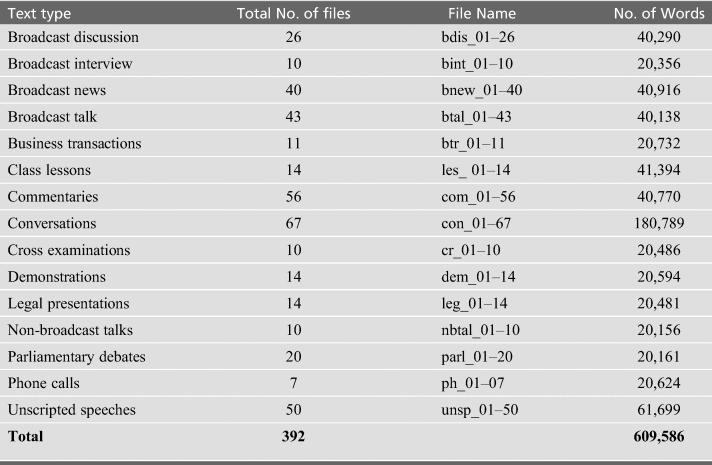
Specifically, the study concentrates on the spoken categories of the corpus which contain formal, semi-formal and informal texts, such as conversations, unscripted speeches, broadcast interviews, classroom lessons, broadcast talks, non-broadcast talks, broadcast news, and so on. Table 1 shows the data types in the spoken part of the corpus and the total number of files and words contained in each of the texts.

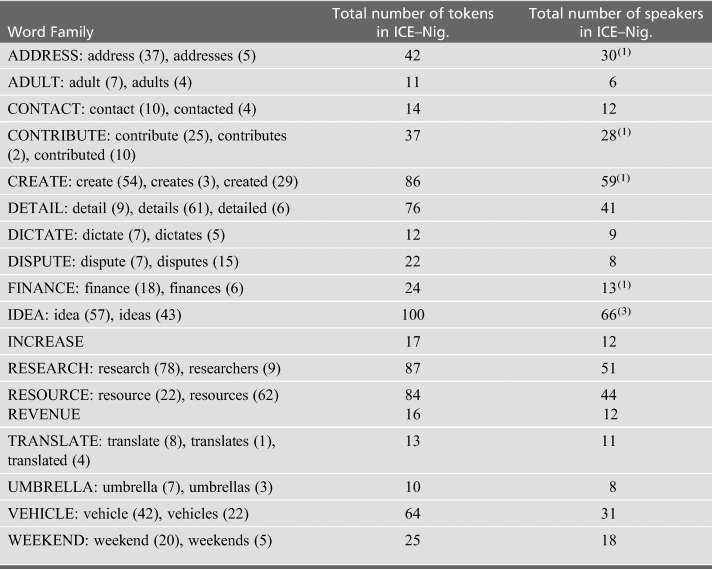
Forty-four lexical items that are prone to stress variation in native Englishes were compiled from Shitara (Reference Shitara1993), Mompean (Reference Mompean and Henderson2010) and Wells’ (Reference Wells2008) Longman Pronunciation Dictionary (LPD). The words, in their inflectional forms (plural, present tense and past tense), were searched in ICE–Nig using AntConc corpus analysis toolkit version 3.4.4 (Anthony, Reference Anthony2014); the search returned 31 words with various rates of occurrences. In order to ensure a well balanced representation of each word, therefore, 18 items which occurred ten times and more were eventually chosen for the analysis. Table 2 contains the lexical items analysed in this study.
Tokens, number of occurrences and speakers

The analysis involved listening to the relevant audio files of each word in ICE–Nig by the authors to determine the particular variants produced. Both raters are Nigerian L2 speakers of English and trained phonologists. Each listened to the audio clips independently and noted the variants produced, after which their findings were compared. Cases of disagreement were resolved by jointly listening to the disputed audio clips; and where it was difficult to reach a consensus, the opinion of another trained phonologist was sought and then a decision was made. The data were subsequently analysed quantitatively by counting the tokens of occurrence of each variant and speaker and converting them to percentages. The variants with higher percentages of tokens of occurrence and higher number of speakers were taken as the preferred variants. In a situation of intra-speaker variation, where the same speaker pronounces the two variants of a lexical item, the number of times such variation occurs is indicated as a superscript above the total number of speakers (see Table 2). Wells’ (Reference Wells2008) LPD model was adopted for the transcription of native English pronunciation variants while Adegbite et al.'s (2014) phonemic model of NigE was adopted for the NigE phonemic representations.
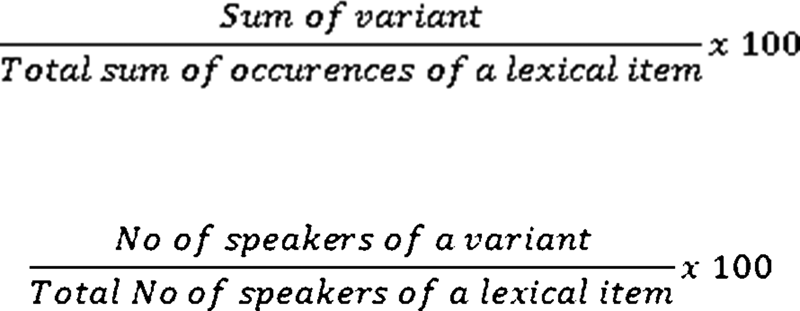
To establish the preferred stress variant of a particular lexical item, two levels of analysis were carried out. First, the sum of each variant was calculated as a percentage of the total sum of occurrences of the lexical item in the corpus; and second, the number of speakers who produced each variant was also calculated as a percentage of the total number of speakers who produced the word. Therefore, the variants with the higher (or highest) percentage of occurrence and the higher (or highest) rate of speakers were regarded as the preferred. This is statistically represented as shown in (Figure 1):
Statistical representation of preferred variants

5. Findings
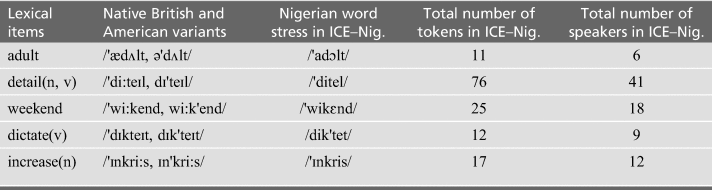
A total of 18 lexical items that typically exhibit stress variation in the native English varieties were analysed in this paper. Each word appears in different inflectional forms grouped as a word family (e.g. CREATE: create, creates and created). The lexical items were grouped into three categories: disyllabic items with invariant word stress in the corpus, disyllabic items with variant word stress and trisyllabic words whose stress alternates between the initial and penultimate syllable in native Englishes. The native British and American English pronunciation forms, as well as the NigE speakers’ pronunciation variants and preferences, are tabulated and discussed accordingly. Since the inflectional forms of each item do not show stress differences, only the base form is shown on the tables as representing each word family. For example, CREATE stands for create, creates and created (see Table 3).
Words with invariant words stress in Nigerian English

Table 3 shows that no stress variation was exhibited in five disyllabic words: adult, detail(n,v), weekend, dictate(v) and increase(n) in the corpus. In all instances of occurrence of the lexical items, all the speakers demonstrated total preference for stress on the initial syllable of 'adult (11 tokens produced by six speakers), 'detail (76 cases produced by 41 speakers), 'weekend (25 instances produced by 18 speakers) and 'increase(n) (17 tokens produced by 12 speakers), and on the final syllable of dic'tate(v) (12 tokens produced by nine speakers). The result for 'adult in this study is similar to that of Wells’ (Reference Wells2008) LPD which indicates that 84% of BrE speakers preferred stress on the initial syllable, but different from Shitara's (Reference Shitara1993) finding which reveals that 88% of AmE respondents showed a preference for stress on the final syllable of a'dult. The score for 'detail tallies with Mompean's (Reference Mompean and Henderson2010) and Wells’ (Reference Wells2008) LPD findings respectively which show the BrE (85.5%) and AmE (75%) speakers’ predilection for stress on the initial syllable of the same word. Wells’ (Reference Wells2008) LPD entry for 'weekend shows that NigE speakers’ preference for stress on the initial syllable of the item is in tandem with the AmE prereference, as against the BrE primary variant: wee'kend. Stress on the final syllable of dic'tate(v) agrees with the BrE preferences but differs from the word-initial stress variant favoured in AmE as LPD (Wells, Reference Wells2008) reports.
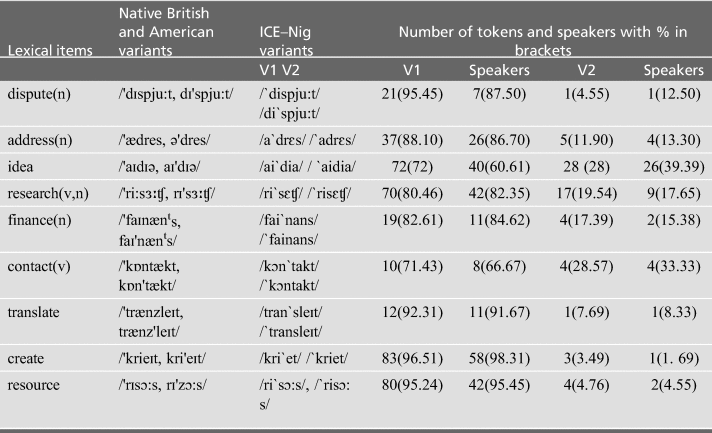
The lexical items in the second category are disyllabic words that take stress either on the initial or final syllable. Table 4 shows that NigE speakers preferred stress on the initial syllable of 'dispute(n) while a'ddress(n), i'dea, re'search(v,n), fi'nance(n), con'tact(v), tran'slate, cre'ate and re'source were predominatly stressed on the final syllable. Seven (87.50%) out of eight speakers exhibited a preference for stress on the initial syllable in 21 (95.45%) of the 22 cases of 'dispute(n) found in the corpus. This differs from Mompean's (Reference Mompean and Henderson2010) and Wells’ (Reference Wells2008) LPD findings which reveal a predilection for stress on the final syllable of the same word in both BrE and AmE, which is an exception to the English noun-verb alternation stress rule and further confirms the notion that English stress is unpredictable (Simo Bobda, Reference Simo Bobda2010; Jowitt, Reference Jowitt2019).
Disyllabic words with variant word stress in ICE–Nig.

V1- Variant 1 (NigE main/prefered variant); V2- Variant 2 (NigE alternative variant)
In a'ddress(n), the final syllable was predominantly stressed in 37 (88.10%) out of 42 tokens by 26 (86.70%) speakers. This includes an incidence of intra-speaker variation within the same discourse by a female speaker (btr_11) who produced address with final stress twice and with initial stress once. The result compares with Wells’ (Reference Wells2008) LPD entry for the same word, which reveals that 58% of AmE speakers showed preference for stress on the final syllable and that the variant is the primary pronunciation in BrE. Table 4 also reveals that 40 (60.61%) speakers in 72 (72%) cases preferred stress on the final syllable of i'dea. This finding is similar to the LPD data (Wells, Reference Wells2008) which shows the stress variant as the BrE speakers’ only pronunciation form and the preferred variant for 86% of AmE respondents based on a preference poll. Again, a number of speakers in the corpus varied their pronunciation of idea, shifting between initial and final stress. For example, in (bdis_12), a male discussant produced /'aidia/ once and /ai'dia/ thrice, while a female lecturer (btr_07) and a male lecturer (les_01) each pronounced both variants of idea in two different instances.
Final stress was also adopted in 70 (80.46%), out of 87 cases of re'search (both the verbal and the nominal forms) by 42 (82.35%) speakers. The poll results for the same word in LPD (Wells, Reference Wells2008) reveal that 80% of BrE speakers also preferred stress on the same syllable, while 78% of AmE respondents placed stress on the initial syllable ('research). The finding also supports the possibility of distinguishing between the verb (re'search) and the noun ('research), which LPD (Wells, Reference Wells2008) reports for the native speakers, as the two tokens of the verb form in the corpus were accented on the final syllable, whereas the noun received stress on the intial syllable in majority of the cases.
Preference for final stress was also observed by 11 (84.62%) speakers in 19 (82.61%) of the 23 tokens of fi'nance(n) and by eight speakers (66.67%) in ten instances of the total cases of con'tact(v), representing 71.43%. This includes a case of intra-speaker variation which occurred in the pronunciation of 'finance and fi'nance by a news reporter in (bnews_31). However, both findings are at variance with Wells’ (Reference Wells2008) LPD entries which indicate that the initial syllable is the preferred stress position for both words in the American and British English varieties. Final stress was again favoured in 12 (92.31%) of the 13 tokens of tran'slate by 11 (91.67%) speakers and in 80 (95.24) of the 84 cases of re'source by 42 (95.45%) spearkers. In both cases, NigE speakers aligned with the BrE final stress preference against the initial stress pattern in AmE. Finally, in this category, 58 speakers (98.31%) overwhelmingly placed stress word-finally on cre'ate in 83 (96.31%) of the 86 tokens found in the corpus. A presenter also varied his pronunciation of 'creates and cre'ated with stress on the first and the second syllable respectively. The finding agrees with LPD (Wells, Reference Wells2008) which shows that 87% of American respondents preferred final stress on the same lexical item and that it is the primary pronunciation in BrE.
The third category of lexical items considered in this study comprises trisyllabic words: contribute, umbrella, revenue and vehicle which are typically stressed on the initial or penultimate syllable in native Englishes. As shown in Table 5, contribute was stressed on the intial, penultimate and final syllables by NigE speakers; however, it was final stress, contri'bute, that was overwhelmingly favoured by 25 (89.29%) of the 28 speakers in 31 (83.78%) cases of all the total incidence of the lexical item. A female lecturer (unsp_05) also exhibited internal variation in her pronunciation of the lexical item; toggling between initial stress on 'contribute and penultimate stress on contri'buted. The result is different to Mompean's (Reference Mompean and Henderson2010) finding and the LPD (Wells, Reference Wells2008) poll results which show that 78% and 73% of British respondents respectively preferred stress on the penultimate syllable (con'tribute), which is also the case in AmE.
Trisyllabic words with variant word stress in ICE–Nig.

Table 5 further shows that 7 (87.5%) out of 8 speakers preferred stress on the initial syllable in 7 (70%) of the 10 cases of umbrella found in the data; whereas LPD (Wells, Reference Wells2008) reveals that both American respondents (86%) and British speakers favour penultimate stress. Revenue was pronounced with intial stress in 15 (93.75%) of 16 cases by 11 (91.67%) speakers, which agrees with the main variant in British and American English (Wells, Reference Wells2008). Finally, out of the 64 tokens of vehicle found in the corpus, stress was placed on the first syllable ('vehicle) in 63 (98.44%) instances by 30 (96.77%) speakers. This trend agrees with Wells’ (Reference Wells2008) findings in LPD which marks the same stress position as the norm in BrE and the preferred for 95% of AmE speakers.
6. Discussion
In this paper, an attempt is made to investigate variations in the patterns of word stress in NigE, through a corpus analytical approach, in order to establish the NigE speakers' word stress preferences. The results show varied stress patterns on some of the lexical items examined. Out of the 18 words that were eventually considered for analysis in ICE–Nig, 13 were found to have exhibited stress free variation, with NigE speakers preferring one variant to another. For example, most speakers preferred stress on the initial syllable of 'dispute, 'vehicle, 'umbrella and 'revenue but favoured word-final stress on a'ddress(n), i'dea, re'search(v,n), fi'nance(n), con'tact, tran'slate, cre'ate, re'source and contri'bute. On the other hand, stress assignment on 'adult, 'detail(n,v), 'weekend, dic'tate(v), 'increase(n) and re'source did not show variation. This, however, does not suggest that stress is not variable on these words in NigE; analysis of controlled elicited speech is likely to yield a different result. Even then, the patterns of stress on those words reveal the NigE speakers’ preferences: word-initial stress was preferred in 'adult, 'detail, 'weekend and 'increase while word-final stress was favoured in dic'tate.
The study further reveals patterns of word stress that are characteristic of the NigE variety. Essentially, it confirms the scholarly position that the stress patterns of many traditional native English words have been subjected to ‘radical redistribution’ in the ESL setting (Simo Bobda, Reference Simo Bobda2010: 64), yielding forms that differ markedly from the established native English norms (Jowitt, Reference Jowitt2019). NigE speakers’ stress preferences in the data show that, although stress assignment was similar to the native English patterns in some cases (e.g. 'increase, 'detail, cre'ate and 'revenue), a few lexical items had the traditional order of stress on them reversed. In the first instance, stress on some words was reassigned to an earlier syllable; for example, 'dispute and 'umbrella were stressed on the initial syllable as against the final dis'pute and penultimate um'brella positions preferred in British and American English. This tendency, referred to as regressive stress shift (Atoye, Reference Atoye1991) or backward stress (Simo Bobda, Reference Simo Bobda2010), has been established as an important process of stress assignment in NigE that is characteristic of such words as 'estate, 'success, 'assault, 'cassette, 'contempt, 'adjacent and 'opponent typically stressed on a later syllable in native Englishes (Atoye, Reference Atoye1991; Simo Bobda, Reference Simo Bobda2010).
Secondly, some lexical items had the stress on them shifted forward from their typical position in native Englishes. This was demonstrated in con'tact, fi'nance(n) and contri'bute whose stress was predominantly moved forward from the initial or penultimate position preferred in the British and American English varieties. This trend, known in NigE as progressive stress shift (Atoye, Reference Atoye1991) or forward stress (Simo Bobda, Reference Simo Bobda2010), is considered the most significant influence on NigE stress evidenced by the following pronunciation: pe'trol, co'vet, soli'cit, inter'pret and manipu'late amongst others (Atoye, Reference Atoye1991; Simo Bobda, Reference Simo Bobda2010; Jowitt, Reference Jowitt2019).
A deeper examination of the data further reveals some underlying strategies that possibly account for the NigE speakers’ patterns of stress preferences identified above. These include generalised application of syllable weight and noun-verb alternation constraints (Simo Bobda, Reference Simo Bobda2010). The weight of the syllable as an important factor of stress assignment in English determines stress placement on the strong final (heavy) syllable of a disyllabic word. It is only when that position is weak that the penult is then considered (Hayes, Reference Hayes1981; Simo Bobda, Reference Simo Bobda2010). A strong syllable, in this regard, contains a short vowel followed by a consonant cluster or a long vowel or diphthong followed by any number of consonants (Jowitt, Reference Jowitt2019).
This appears to be the dominant rule that accounts for the NigE speakers’ preferences in the data. Stress was generally placed on the strong final syllable of all disyllabic verbs (except ‘detail’[v]Footnote 1). These include re'search(v) Footnote 2, con'tact, tran'slate, cre'ate, and dic'tate ). It was also applied to disyllabic nouns: fi'nance(n), ad'dress(n), i'dea, re'search(n), and re'source) and extended to a multi-syllabic word (contri'bute) without regard to exceptions in native Englishes. Also in keeping with the rule, primary stress was moved from weak final and penultimate syllables of some multisyllabic words to a strong (heavy) intial syllable (e.g. 'vehicle /'vi:ɪkəl/, 'umbrella). This tendency has also been reported as a significant factor that is responsible for the prevalence of forward stress in NigE as seen in multi'ply, exer'cise, sur'vey, an'cestor, ca'lendar and cha'llenge, amongs many other lexical items (Simo Bobda, Reference Simo Bobda2010; Jowitt, Reference Jowitt2019).
The other native English stress rule which appears to influence NigE speakers’ stress preference in the data is the noun-verb alternation constraint, which guides stress placement on the initial and final syllables of disyllabic words that can function as a noun and as a verb respectively (e.g. 'export(n) versus ex'port(v)). This was attested in their preference for stress on the initial syllable of 'increase(n) and 'detail(n) which were stressed following the native English rule. In some cases, however, NigE speakers tend to observe this rule without paying attention to its large number of exceptions. Instances in the data include 'dispute(n) (where final-syllable stress di'spute(n) is preferred in British and American Englishes) and con'tact(v) (with preference for stress on the initial syllable 'contact(v) in British and American Englishes). Similar lexical items in this category as attested by Simo Bobda (Reference Simo Bobda2010) include such nominal forms as a'dvice and as'sault (stressed as 'advice, 'assault in NigE) and verbal forms as 'purchase and 'kidnap (stressed as pur'chase and kid'nap in NigE).
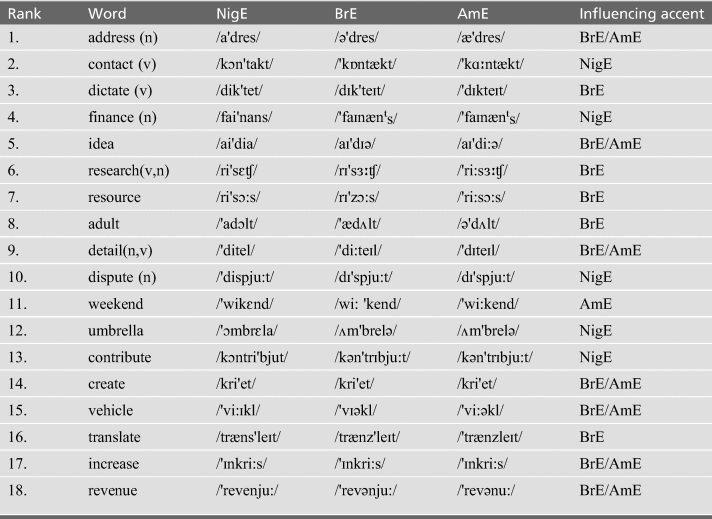
It follows from the above that word stress preferences in NigE are underlyingly influenced by the speakers’ knowledge of the native English stress rules (Simo Bobda, Reference Simo Bobda2010), which they rightly apply in some cases but generalised in others. Besides, in view of their contact with and exposure to the standard native varieties through education and non-enculturation sources, such as the media (Jowitt, Reference Jowitt1991; Akinjobi, Reference Akinjobi2013), NigE speakers seem to have absorbed the native English pronunciation of some of the lexical items. This is evident in their overwhelming preferences for stress on the initial syllables of 'adult (as in BrE), 'weekend (as in AmE) and 'revenue (as in BrE and AmE), where the syllable weight rule was not applied (see Table 6). This also explains the native-like stress on some lexical items, for example, fi'nance(n), 'contact and con'tribute, produced as alternative variants (V2) by very few speakers.
NigE stress free variants in comparison with AmE and BrE varieties

It should also be noted that, in some cases, stress preferences in NigE were subject to a combination of factors. For instance, final-syllable stress on con'tact(v) can be explained as a combined influence of the generalised application of syllable weight rule (which pushes stress to the strong final syllable) and noun-verb alternation constraint (whereby nouns and verbs are stressed on the initial and final syllables respectively).
7. Conclusion
This paper set out to investigate variations in the word stress patterns of NigE speakers, using the spoken part of ICE–Nigeria as a database. The goal was to determine their word stress preferences. The findings have demonstrated the variability of word stress in NigE as obtained in native Englishes (Wells, Reference Wells2008), which justifies the claim that language is inherently variable (Foulkes & Docherty, Reference Foulkes and Docherty2006). As this study has shown, peculiar word stress patterns of NigE speakers can be accounted for by the generalised application of the native English stress rules (syllable weight and noun-verb alternation constraints) as well as speakers’ exposure to standard native English pronunciation. This suggests that NigE speakers’ word stress preferences are subject to ‘two standardising forces’ which interact with one another; on the one hand is peculiarly Nigerian standard and, on the other, exonormative British and American Standard (Jowitt, Reference Jowitt2019: 32). Both of them exact influences on NigE speakers' word stress preferences. This position is further strengthened by the cases of intra-speaker variations attested in a number of lexical items in the study. This suggests that, although NigE takes its root from native Englishes, especially British and American English varieties, it has definable features that stand it out as a variety of World Englishes. This is the type of variety that Achebe (Reference Achebe1966: 22) refers to as ‘a new English, still in full communion with its ancestral home but altered to suit its new African surroundings’.
It is in view of this realisation that the present study seeks to echo the call for the codification and standardisation of NigE. These findings, therefore, provide useful resource materials for the revision of existing dictionaries of NigE usage (e.g., Igboanusi, Reference Igboanusi2002; Adegbite et al. Reference Adegbite, Udofot and Ayoola2014), which is a sine qua non for endonormative standardisation (Bamgbose, Reference Bamgbose1998; Jowitt, Reference Jowitt2019). As Bamgbose (Reference Bamgbose1998: 4) puts it:
One of the major factors militating against the emergence of endomormative standards in non-native Englishes is precisely the dearth of codification. Obviously, once a usage or innovation enters the dictionary as correct and acceptable usage, its status as a regular form is assured.
The proposed revision will be patterned after Wells’ (Reference Wells2008) Longman Pronunciation Dictionary which was influenced by Shitara's (Reference Shitara1993) survey of American pronunciation preferences, amongst other polls. In addition to the existing entries in the dictionaries, the edition would contain the NigE speakers’ pronunciation preference charts. A demonstration of the proposed dictionatry entry is hereby provided below, using two of the lexical items examined in this study: weekend and contribute.
Existing Entries:
Igboanusi (Reference Igboanusi2002)
weekend the sense of weekend in Nigeria differs slightly from the sense in which it is used in BE. In Nigeria, weekend starts from Friday (after working period) to Sunday, but in Britain, it is Saturday and Sunday.
Adegbite et al (Reference Adegbite, Udofot and Ayoola2014)
weekend /wikɛnd/HL, n., a typical weekend in Nigeria starts from after work on Friday and ends on Sunday night: “The ‘bachelor's eve’ takes place on Friday, next weekend.”
The proposed revised edition will include:
Weekend
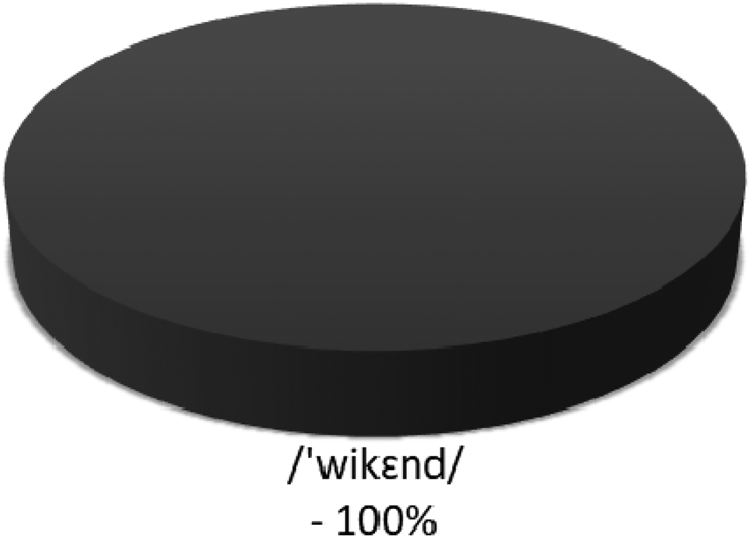
– Preference poll: /′wikɛnd/ - 100% (Figure 2)
The preference poll for weekend

Contribute
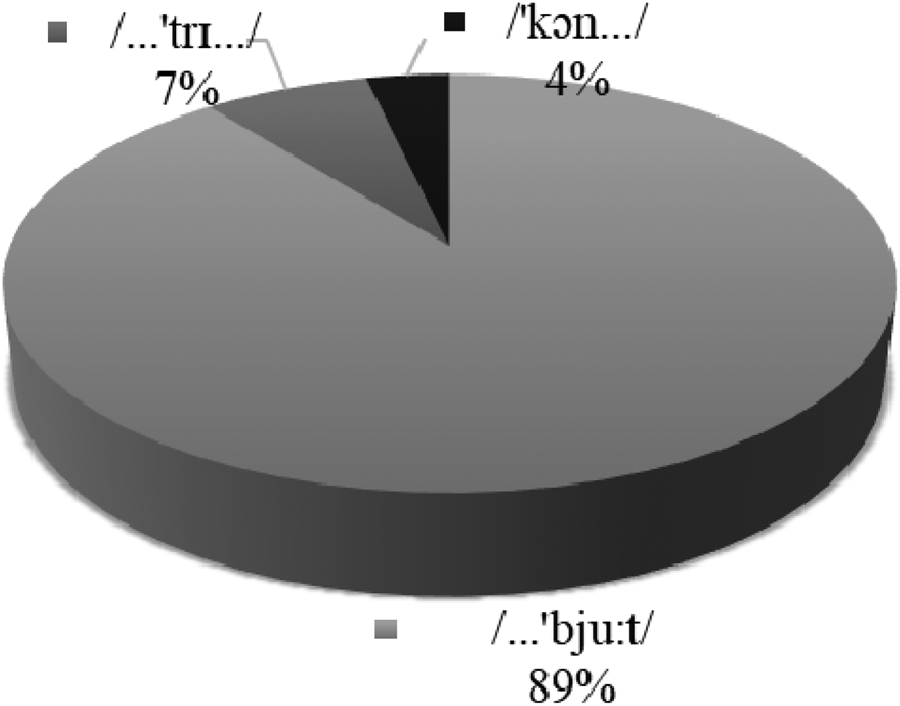
– Preference poll: /kɔntrɪ′bju:t/ - 83.78%; kɔn′tri… - 8.11%; /′kɔn…/ - 8.11%,. (Figure 3)
The preference poll for contribute

This paper provides a first-step attempt at investigating word stress preferences in Nigerian English which will serve as a catalyst for future studies. We, however, acknowledge its limitations and shortcomings; one of which is the small size of ICE–Nig which resulted in the examination of only a few lexical items. So many words that typically exhibit free variation in native Englishes and which could have made the analysis and discussion more robust and extensive were not found in the corpus, while some with less occurrences were excluded. It will be more enterprising, therefore, to see a field-based study that would advance this study, address the constraints and, possibly, examine the sociophonetic variation of word stress preferences in NigE.
 ADERONKE AKINOLA is a doctoral student in the Department of English, Redeemer's University, Ede, Osun State, Nigeria. Her areas of interest are phonetics and phonology of English and Corpus linguistics. She is a member of the English Scholars’ Association of Nigeria (ESAN), Association of Phoneticians and Phonologists in Nigeria (APPN) and a Fellow of Ife Institute of Advanced Studies (IIAS). Email: aderonke197@gmail.com
 ROTIMI OLADIPUPO teaches English at Redeemer's University, Ede, Nigeria. His research interests include the phonetics and phonology of English, sociophonetics, language contact and corpus linguistics. He has published articles in English Today, Sage Open, Journal of Pragmatics and World Englishes. Email: olarotimi2002@yahoo.com