Introduction
Studies report that nursing home residents with dementia spend the majority of their daily life doing little or nothing and remain most of the time in their rooms sitting alone (Harper Ice, Reference Harper Ice2002; den Ouden et al., Reference Den Ouden2015). Having something to do, however, is important for residents of nursing homes because it allows them to connect with other people and to experience feelings of pleasure during activities (Vernooij-Dassen, Reference Vernooij-Dassen2007). Participation in activities is an important indicator of nursing home quality and one of the basic human needs (Hancock et al., Reference Hancock, Woods, Challis and Orrell2006). Furthermore, being engaged in activities allows people to express themselves (Vernooij-Dassen, Reference Vernooij-Dassen2007), and is associated with a higher quality of life of nursing home residents with dementia (Edvardsson et al., Reference Edvardsson, Petersson, Sjogren, Lindkvist and Sandman2014).
Daily life is a dynamic and multidimensional concept, and constitutes more than activities alone. The physical and social environments of nursing homes are also important for the daily lives of their residents because they can influence a person's capacity to act in the world, which is referred to as “agency.” For example, moderate levels of sound or the presence of a small group of people can act as facilitators for engagement in activities (Cohen-Mansfield et al., Reference Cohen-Mansfield, Thein, Dakheel-Ali and Marx2010). Furthermore, the provision of outdoor areas can also accommodate activities and may have an effect on agitation or the physical effort of residents (Whear et al., Reference Whear, Coon, Bethel, Abbott, Stein and Garside2014).
In both clinical practice and research, the concept of person-centered care is being advocated as a way to provide high quality of care (Edvardsson et al., Reference Edvardsson, Winblad and Sandman2008). In order to provide this person-centered care, insight is needed into the needs, possibilities, and environmental aspects that are important for individual nursing home residents. Often, research suggests that a “one size fits all” approach is not suitable for interventions targeted at nursing home residents with dementia due to differences in cognitive and functional dependency among residents (Zarit and Femia, Reference Zarit and Femia2008). Gaining insight into the daily lives of residents allows nursing home staff and researchers to tailor interventions for individuals by targeting the relevant aspects of daily life.
How can daily life situations of nursing home residents with dementia be measured?
Observing nursing home residents with dementia in their daily lives allows researchers to consider multiple aspects of daily life at once. Observations offer, in contrast to other measurement methods such as questionnaires, the opportunity to present the activities of residents with dementia in real time in relation to contextual factors. Furthermore, observing experiences or behaviors within the context they naturally occur for multiple momentary assessments provides a more representative assessment than a single static snapshot of time (Shiffman et al., Reference Shiffman, Stone and Hufford2008). This principle is based on ecological momentary assessment (EMA) which allow investigators to examine sequences of events and experiences and enable them to describe and analyze interactions between events that shape behavior over periods of minutes, hours, or days (Shiffman et al., Reference Shiffman, Stone and Hufford2008). The use of electronic devices such as handheld computers or tablets allows researchers to do more observations within the same time period than using pen and paper. In addition, it allows them to process the observation data more efficiently (Casey et al., Reference Casey, Low, Goodenough, Fletcher and Brodaty2014).
Few electronic observation tools have been reported that aim to study daily life in long-term care. A review conducted by Curyto et al. (Reference Curyto, Van Haitsma and Vriesman2008) examined direct observation methods of behavior in people with dementia. They discuss over 35 observation tools, however, all of these tools focus on only one or two aspects of daily life and fail to incorporate multiple aspects in order to describe daily life completely (Curyto et al., Reference Curyto, Van Haitsma and Vriesman2008). Currently, a freely accessible, easy to use, electronic observation tool to assess the daily lives of nursing home residents with dementia is lacking. Observation tools that have been reported show limitations to assess aspects of daily life for nursing home residents with dementia (Kitwood and Bredin, Reference Kitwood and Bredin1992; Brooker, Reference Brooker2005; Cohen-Mansfield et al., Reference Cohen-Mansfield, Thein, Dakheel-Ali and Marx2010). First, most existing tools do not cover the observation of a variety of aspects of daily life together (e.g. activities, social aspects, psychological aspects, environmental aspects). As a result, they fail to provide a comprehensive insight into all complex facets of daily life. Second, most tools are used to only observe residents within the communal living room or only during certain parts of the day and therefore miss important data. Third, existing tools require extensive training, separate licenses, and are designed to do observations using pen and paper. This makes data analyses time consuming and expensive.
The aim of the current study was to develop a freely accessible, easy to use, electronic observation tool to give a full and extensive description of the daily lives of nursing home resident with dementia. The goals were that the tool (1) allows researchers to assess multiple aspects of daily life simultaneously, (2) can be used in multiple nursing home areas easily, and (3) provides an efficient way of data processing by using electronic devices to carry out the observations. The current paper describes the development process of the MEDLO-tool, including reliability and feasibility testing.
Methods
To develop the MEDLO-tool, three steps were taken. (1) determining relevant aspects of daily life for nursing home residents with dementia; (2) determining observation procedure and operationalization of the aspects of daily life; and (3) testing the final version of the MEDLO-tool. Steps were based on the development of other observation tools (Casey et al., Reference Casey, Low, Goodenough, Fletcher and Brodaty2014). The study protocol was reviewed by the medical ethics committee of the Maastricht University Medical Center. They declared that the study was non-invasive for nursing home residents with dementia according to the Medical Research Involving Human Subjects Act. The participating nursing homes provided informed consent for participation. All data were collected anonymously.
Determining relevant aspects of daily life for nursing home residents with dementia
To take face- and content validity into account, the relevant aspects of daily life were determined based on multiple sources. First, a literature search was conducted to determine relevant aspects of daily life. Pubmed, Web of Science, PsycINFO, and Google Scholar were searched. Search words included “daily life,” “meaningful activity,” “observation,” “nursing home care,” “dementia,” and “aspects of daily life.” To find additional relevant literature, snowballing techniques were used and grey literature was studied. The literature search revealed a list of important aspects of daily life. Next, experts were consulted individually and in groups to discuss relevant aspects of daily life, they were free to suggest as many aspects of daily life as they wanted. The participants included experts in the field of research (n = 10; background in psychology, architecture, nursing home care, nursing science, and occupational science) and professionals in dementia care (n = 8; nursing staff, managers of Dutch nursing home wards/living facilities for people with dementia). All had at least a bachelor's degree. When they had no further suggestions, they were told which aspects were found based on the literature and were then asked whether they agreed that these are indeed important and whether something was missing.
Pilot testing observation procedures and operationalizations of the aspects of daily life
To determine the observation procedure using the MEDLO-tool, the following factors were taken into account: the number of people that can be observed at the same time using the MEDLO-tool, the amount of time needed to do an observation, the areas in which the residents are going to be observed, observer fatigue, the sampling method to use (instantaneous or continuous), and the software and hardware needed for observations (e.g. whether observations could be carried out on standard tablets). Decisions regarding these factors were made based on literature and testing preliminary versions of the tool in practice. Completeness and feasibility of the tool were the main criteria guiding the decision process.
To determine the operationalization of the relevant aspects of daily life, existing observation tools were reviewed. Several operationalization methods and procedures were tested and adapted in practice. Every adaptation was tested and if necessary adjusted again. Following earlier observation research (Doherty-King et al., Reference Doherty-King, Yoon, Pecanac, Brown and Mahoney2014), several steps were taken in deciding which operationalization and procedures to use. First, one researcher (BB) tested different observation procedures (e.g. 10, 20, or 30 minute observation periods, instantaneous vs. continuous sampling) and operationalization (e.g. using a 6- or a 7-point scale for mood) for approximately 8 hours. Second, two researchers (BB and HB) tested preliminary versions of the tool in two different types of nursing homes (small-scale, homelike, and large-scale traditional) for 8 hours in total. This was done in order to check if there was agreement between observers and to see whether the tool could be used in a variety of nursing home settings. If there was disagreement between the observers on how to score certain situations, discussions were held with a third researcher (HV) until agreement was reached. After five alterations, the MEDLO-tool was finalized. Parallel to making the alterations a manual was made with descriptions of the full observation procedure and operationalization of all aspects of daily life.
Testing the final version of the MEDLO-tool
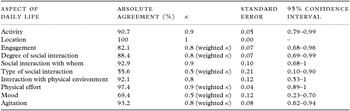
Reliability of the MEDLO-tool was tested by carrying out anonymous observations in a convenience sample at a nursing home ward providing care for 16 residents. To assess inter-rater reliability, two researchers simultaneously observed a random selection of eight residents independently for 56 observations in total (seven observations per resident). Agreement was assessed by calculating absolute agreement percentages and (weighted) κ values. For some aspects of daily life (activity, location, social interaction with whom, and interaction with the physical environment) we calculated the “standard” κ, as these aspects do not have a hierarchical structure but are strictly categorical (the difference between activity 1 and 3 is the same as the difference between activity 1 and 22). However, for other aspects of daily life (engagement, degree of social interaction, type of social interaction, physical effort, mood, and agitation) there is a hierarchical structure in the scoring options. For example, the difference between mood scores 1 and 5 is larger (4) than the difference between mood scores 1 and 2 (1). The relative distance between two successive scoring options for all these aspects was always equal to 1. This means that for example scoring options “1” and “3” had a relative distance of 2. Therefore, weighted κ values were calculated to take the relative distances between scoring options into account. Absolute agreement should achieve at least 80% (Bradford Dementia Group, 2005). For κ, it was determined whether there was slight (0.01–0.20), fair (0.21–0.40), moderate (0.41–0.60), substantial (0.61–0.80), or almost perfect (0.81–0.99) agreement (Viera and Garrett, Reference Viera and Garrett2005). Resident characteristics and information on cognition and independence in activities of daily living (ADL) were gathered on ward level via the nursing staff. This means that data were gathered anonymously and reported on an aggregated level instead of on an individual level. Cognition of the residents was assessed with the Cognitive Performance Scale (CPS) (Morris et al., Reference Morris1994). The total score of the CPS ranges from 0 to 6, with lower scores indicating better cognition. ADL was measured with the Activities of Daily Living – Hierarchy scale (ADL-H) (Morris et al., Reference Morris, Fries and Morris1999). The total score of the ADL-H ranges from 0 to 6, with lower scores indicating more independence in ADL.
Feasibility of the MEDLO-tool was assessed by a short questionnaire, filled out by three research assistants who were trained to use the MEDLO-tool. Training observers to use the MEDLO-tool in the current study required the following effort. The research assistants studied the observation manual and the app for approximately 2 hours. Next, they joined the main researcher for three observation periods of four hours in which they practiced the observations. After each of these three observation periods the observations were evaluated for 2 hours each.
The questionnaire addressed several feasibility aspects such as (1) the use of the hardware and software; (2) the practical use of the MEDLO-tool (e.g. operationalization, observer fatigue); (3) the completeness of the tool; and (4) grading the overall feasibility of the MEDLO-tool with a score between 1 and 10, with 10 being the highest (completely feasible). In addition, respondents had the opportunity to add any other comments.
Results
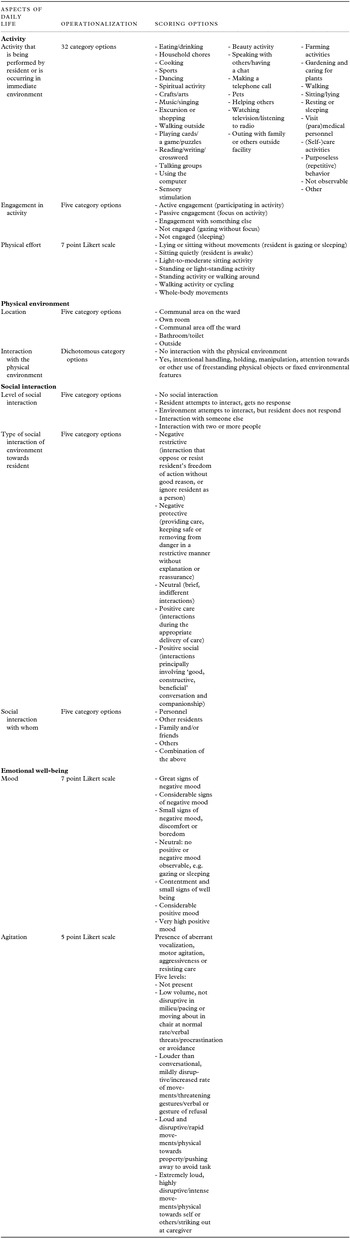
Table 1 gives an overview of the aspects of daily life that are included in the MEDLO-tool, their operationalization, and the literature they were based on.

Determining relevant aspects of daily life for nursing home residents with dementia
Based on findings from the literature and consultations with the experts (n = 18), the following aspects of daily life were selected to be included in the MEDLO-tool:
-
1. Activity: the activity performed by or occurring in the immediate environment of the resident (e.g. eating, household chores, playing a game), the engagement in this activity (e.g. active engagement in activity, no engagement in activity), and the degree of physical effort (e.g. lying, sitting, standing, walking, etc.).
-
2. Physical environment: the location of the resident (e.g. communal area, own room, outside, etc.), and whether they had interaction with the physical environment (Wood, Reference Wood2005).
-
3. Social interaction: the level of social interaction (e.g. talking with one, two, or more persons), the type of social interaction (Dean et al., Reference Dean, Proudfoot and Lindesay1993), and with whom this social interaction takes place (e.g. other residents, family, etc.).
-
4. Emotional well-being: mood, including both positive and negative signs, and agitation were considered most relevant aspects of emotional well-being in daily life. Mood is based on Kitwood's model of person-centered care (Kitwood and Bredin, Reference Kitwood and Bredin1992), and Dementia Care Mapping (Bradford Dementia Group, 2005). Agitation (e.g. no, small, or extreme signs of agitation) is based on the Pittsburgh Agitation Scale (Rosen et al., Reference Rosen1995).
In case events occurred that could not be covered by the aspects of daily life from the MEDLO-tool, the possibility to make field notes was added to the MEDLO-tool based on experts’ advice. No other aspects were suggested by the experts.
Pilot testing observation procedures and operationalizations of the aspects of daily life
OBSERVATION PROCEDURE
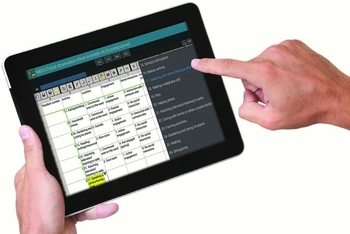
The MEDLO-tool is a tablet-based observation tool, using the app e-Droid-cell Pro, which is able to run Microsoft Excel (.xls) files. It runs observation schemes consisting of drop down boxes for each of the observed aspects of daily life. In addition, an observer has the possibility to make field notes in case events occurred that cannot be covered by the aspects of daily life from the MEDLO-tool. Furthermore, there is room for questions and remarks that have to be discussed with fellow colleagues. Figure 1 shows what the observation scheme on the tablet looks like.
MEDLO-tool observations on tablet.

An instantaneous sampling procedure was chosen to obtain insight into the daily lives. With instantaneous sampling, observations are performed systematically at preselected moments in time, so each resident should be observed once per observation period. Instantaneous sampling can give a good approximation to the proportion of time spent in certain behaviors if an observation day consists of multiple observation periods (Martin and Bateson, Reference Martin and Bateson2007).
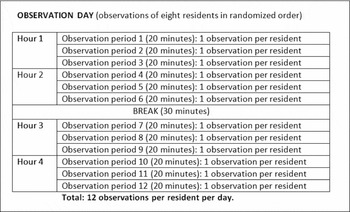
Pilot testing showed that it often was not possible to observe eight residents (the number of residents living together in a small-scale facility) within a 10 minute observation period while 30 minutes was too was long. Based on this it was decided 20 minutes is an appropriate amount of time for an observation period to observe eight residents. In an observation period, the observer looks at an individual resident for 1 minute and based on this minute the observer scores all aspects of daily life and continues to the next resident. To prevent bias due to order-effect, the order of observations of residents within an observation period is randomized in advance. Entering the scores on the tablet takes approximately 1 minute per resident. In addition, time is reserved for the observer to find the next resident. As the MEDLO-tool is designed to follow residents around, observers do not only observe in communal areas, but follow residents outside these areas as well. As a result, walking outside and arranged activities outside the communal area are captured. Privacy of residents is taken into account: when the door of their bedroom or bathroom is closed, people are not observed.
Figure 2 provides an overview of what one observation period looks like. To prevent observer fatigue, researchers should not observe longer than 4 hours in one day. Observation days should also include breaks: after two hours, a half hour break is recommended. In order to increase reliability of measurements, the observations and interpretations of situations should be discussed with other observers weekly.
Overview of one observation period of the MEDLO-tool.

OPERATIONALIZATION OF THE ASPECTS OF DAILY LIFE
Based on pilot testing by two researchers adjustments in operationalization were made in order to increase agreement. As can be seen in Table 1, the aspects of daily life are scored on lists of categories (activity performed by resident, engagement, location, interaction with the physical environment, level and type of social interaction, interaction with whom) or on Likert scales (physical effort, mood, agitation). Finally, the following operationalization was determined. First, the activity that the resident is performing or that occurs in the immediate environment of the resident is scored. There are 31 options to choose from (see Table 1). In addition the option “other” can be chosen if the activity that is observed is not covered by the pre-defined activity options. The observer always chooses one activity based on operational rules described below:
-
1. Some activities have priority over others based on how meaningful they can be (e.g. “having a chat” has priority over “sitting/lying”).
-
2. If two meaningful activities take place, the one with the longest duration is chosen.
-
3. If both have the same duration, the one which had the most influence on the residents’ well-being is chosen).
-
4. If it is still unclear which activity to choose, field notes are made describing the situation and a decision is made based on discussing it within the research team.
Second, engagement is scored by choosing one of five categories ranging from not engaged (sleeping) to active engagement. Third, the observer scores where the resident is located. The options are communal area on the ward, own room, communal area off the ward, bathroom/toilet, and outside. Fourth, the level of social interaction is scored by choosing from five categories ranging from no social interaction to interaction with two or more people. Next, it is scored with whom the interaction takes place and which type of social interaction it is (based on the quality of interactions schedule (Dean et al., Reference Dean, Proudfoot and Lindesay1993)), the type of social interaction ranges from negative restrictive to positive social.
Furthermore, interaction with the physical environment is defined as whether residents perform any form of intentional handling, holding, manipulation, attention towards or other use of freestanding physical objects or fixed environmental features (Wood, Reference Wood2005). The answer options are yes and no.
The degree of physical effort of the residents is scored next. The observer chooses between seven categories ranging from “lying or sitting without movement” to “whole body movements.”
The operationalization of mood is based on Dementia Care Mapping (Bradford Dementia Group, 2005). Mood is operationalized using a 7-point Likert scale. At first, only six scoring options were used, ranging from extremely negative to extremely positive. However, there often was disagreement between the researchers due to the lack of a neutral scoring option. Residents displaying a neutral mood were often scored slightly negative or slightly positive by observers while both thought of it as being “neutral.” Following recommendations of Sloane et al. (Reference Sloane2007), a “true” neutral scoring option was added. Rosen et al. (Reference Rosen1995) identified four types of agitation: aberrant vocalization, motor agitation, aggressiveness, or resisting care. By incorporating the different types of agitation, agitation is scored on a 5-point scale ranging from “not present” to “extremely present.”
Finally, the observer has the option to make field notes during the observations. This is done in case events occurred that could not be covered by the aspects of daily life from the MEDLO-tool. These field notes can be about organizational, social, or physical environmental factors as well as any prominent differences with the “normal” situation. Furthermore, there is room for questions and remarks that needed to be discussed with fellow colleagues.
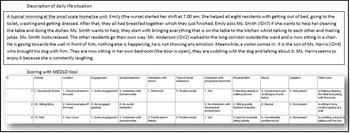
Figure 3 shows a description of an example of a certain daily life situation and the way residents should be scored using the MEDLO-tool. The manual of the MEDLO-tool is available upon request.
Description of daily life situation and the way they were scored with the MEDLO-tool.

Testing the final version of the MEDLO-tool
The final version of the MEDLO-tool was tested on a nursing home ward in the Netherlands. The residents (n = 16) had mean age of 77 and 56% were women. They had a mean ADL-H score of 3.8 (range 0–6) and a mean CPS score of 3.5 (range 0–6), indicating extensive functional dependence and moderate to severe cognitive impairment. Table 2 provides information regarding the inter-rater reliability of the MEDLO-tool. Agreement levels on the aspects of the MEDLO-tool are positive with an average absolute agreement of 86%. The investigation of inter-rater reliability shows low κ values for “type of social interaction” and “mood.” For “type of social interaction,” this can be attributed to the fact that there was very few data for this aspect of daily life. Often no social interaction at all was scored (63%) and thus also no type of social interaction. For “mood,” one option (contentment and small signs of well-being) was scored in the majority of cases (70%). Disagreement in only a few cases causes a large decline in κ. Further investigation of the data showed that disagreement between observers of two or more scoring categories only occurred in 5.5% of the cases.
MEDLO-tool inter-rater reliability

FEASIBILITY
The respondents of the questionnaire (n = 3) all had at least a Master's degree. They were trained by the main researcher (BdB) to conduct observations using the MEDLO tool. No difficulties with regard to the use of the hardware and software were experienced. In addition, the practical use of the tool and its operationalization were clear. One user indicated that the observations and weekly discussions are quite time consuming. The users suggested that when the tool was intensively used during multiple mornings, afternoons, and evenings for a longer period of time, this might lead to observer fatigue. With respect to the completeness of the tool, the respondents indicated that the activity “smoking” was missing as an activity option. In addition, the presence of visitors (family, friends) could be added to the MEDLO-tool. Two users graded the overall feasibility of the MEDLO-tool with an eight, one with a seven.
Overall, the observers were positive about the feasibility of the MEDLO-tool to assess the daily lives of nursing home residents with dementia. One user answered: “I think the observation method is a thorough method to gather detailed information about the daily lives of people with dementia. It seems very reliable because it—in contradiction to questionnaires—does not rely on retrospective assessments but on real time occurrences.” Another user considered the MEDLO-tool “a good instrument which I would recommend other researchers to use.”
Discussion
The current study described the development and pilot testing of the MEDLO-tool, an electronic, freely accessible tool, to provide insight in the daily life context for nursing home residents with dementia. First, results indicate that the MEDLO-tool is a reliable and feasible tool to simultaneously assess multiple aspects of daily life related to activity, physical environment, social interaction, and emotional well-being. By using tablets, observers are flexible to assess nursing home residents in the entire nursing home environment easily. This gives a more complete view of the daily lives than only observing them in the communal living room. Furthermore, the MEDLO-tool has an efficient data processing system by using apps and tablets, which are compatible with statistical software. This prevents the time-consuming process of transferring the observation data for statistical analyses.
Some study limitations have to be acknowledged. First, this study focused on the development of the tool and first testing of reliability and validity. Therefore, some important aspects of the validity remain unknown, such as the construct validity. This requires further investigation. Second, the feasibility questionnaire was filled out by three assistants working in the same research team as the main researcher. Although they were able to freely answer in detail and clarify their responses, social desirability of their answers cannot be ruled out. Therefore, and for the further development of the tool we advise other (independent) researchers to use the tool and investigate feasibility as well.
Evidence indicates that residents with dementia perceive activities as meaningful if they experience feelings of pleasure during the activities, and if there is a sense of connection with other people (Phinney et al., Reference Phinney, Chaudhury and O'Connor2007; Vernooij-Dassen, Reference Vernooij-Dassen2007; Harmer and Orrell, Reference Harmer and Orrell2008). Research suggests that these aspects are also related to quality of life (e.g. Edvardsson et al., Reference Edvardsson, Petersson, Sjogren, Lindkvist and Sandman2014). The MEDLO-tool can be used to investigate whether activities are accompanied by active engagement, positive mood, and social interaction, as it assesses all these aspects simultaneously in the context of everyday life. For example, the activity “watching television” can be meaningful for nursing home residents with dementia when it matches their personal identity or when it is accompanied by feelings of pleasure and social interaction (Phinney et al., Reference Phinney, Chaudhury and O'Connor2007; Harmer and Orrell, Reference Harmer and Orrell2008). However, it can also be accompanied by sleeping. The MEDLO addresses all these various aspects of daily life (i.e. activities, engagement, emotional well-being) simultaneously. This provides insight in possible associations between aspects of resident's daily life and their quality of life (Beerens et al., Reference Beerens2016).
A range of innovative nursing home initiatives has been developed, focusing on providing person-centered care in a small-scale and homelike environment (Verbeek et al., Reference Verbeek, van Rossum, Zwakhalen, Kempen and Hamers2009). They aim to provide more meaningful activities for residents in comparison with traditional nursing homes (Smit et al., Reference Smit, de Lange, Willemse and Pot2012). The MEDLO-tool could be a valuable tool to evaluate the nursing home environment and compare the daily lives of residents with dementia cross different settings. The MEDLO-tool considers contextual factors (both physical and social) and can therefore be used to investigate which aspects of daily life are affected by innovative nursing home care facilities. In order to gain such a detailed insight into the daily lives of nursing home residents with dementia, it is important to use multiple observation periods preferably divided over weekdays/weekends and over mornings, afternoons and evenings over a longer period of time.
Conclusion
This study suggests that the MEDLO-tool is a reliable and feasible method to achieve detailed, in-depth insight into the daily lives of nursing home residents with dementia. It is a tool that provides researchers with repeated real time measures of multiple aspects of daily life simultaneously.
Conflict of interest
None.
Description of author's roles
B. de Boer designed the study, collected data, and wrote the paper. H.C. Beerens designed the study, collected data, and wrote the paper. S.M.G. Zwakhalen supervised the data collection and wrote the paper. F.E.S. Tan assisted in data analyses and wrote the paper. J.P.H. Hamers supervised the data collection and wrote the paper. H. Verbeek designed the study, supervised the data collection and wrote the paper. All authors have approved the final version of the manuscript.
Acknowledgments
The research project was funded by the Netherlands Organization for Health Research and Development (ZonMw, project number: 728010002). They had no role in the design of the study, data collection, data analysis, interpretation of the data, writing of the report, or the decision to submit the paper for publication.
Supplementary Material
To view supplementary material for this paper, please visit http://dx.doi.org/10.1017/S1041610216000478.
Appendix
Appendix with additional references is added.