











1 Introduction
Let
 ${\mathbb F}_q$
denote a finite field of order q and characteristic p, and let
 $M_2({\mathbb F}_q)$
be the set of two-by-two matrices with entries in
 ${\mathbb F}_q$
. We write
 $X\ll Y$
to mean
 $X\leq CY$
for some absolute constant
 $C>0$
and use
 $X\sim Y$
if
 $Y\ll X\ll Y$
.
Given subsets
 $A, B\subseteq M_2({\mathbb F}_q)$
, we define the sum set
 $A+B$
to be the set
 $\{a+b: (a, b)\in A\times B\}$
and similarly define the product set
 $AB$
. In this paper, we study various questions closely related to the sum-product problem over
 $M_2({\mathbb F}_q)$
, which is to determine nontrivial lower bounds on the quantity
 $\max \{\,|A+A|,\, |AA|\,\}$
, under natural conditions on sets
 $A\subseteq M_2({\mathbb F}_q)$
.
A result in this direction was proved by Karabulut et al. in [Reference Karabulut, Koh, Pham, Shen and Vinh4, Theorem 1.12], showing that if
 $A\subseteq M_2({\mathbb F}_q)$
satisfies
 $|A|\gg q^3$
then
 $$ \begin{align} \max\{\,|A+A|,\, |AA|\,\}\gg \min\left\{\,\frac{|A|^2}{q^{7/2}},\, q^{2}|A|^{1/2}\,\right\}. \end{align} $$
A closely related quantity is the additive energy
 $E_+(A, B)$
defined as the number of quadruples
 $(a, a^{\prime }, b, b^{\prime })\in A^2\times B^2$
such that
 $a + b = a^{\prime } + b^{\prime }$
. The multiplicative energy
 $E_{\times }(A, B)$
is defined in a similar manner. We also use, for example,
 $E_+(A) = E_+(A, A)$
. For
 $\lambda \in M_2({\mathbb F}_q)$
, we define the representation function
 $r_{A B}(\lambda ) = |\{\,(a, b)\in A\times B: a b = \lambda \,\}|$
. Note that
 $r_{A B}$
is supported on the set
 $AB$
and so we have the identities
 $$ \begin{align} \sum_{\lambda\in A B}r_{A B}(\lambda) = |A||B|\quad \text{and}\quad \sum_{\lambda\in A B}r_{A B}(\lambda)^2= E_{\times}(A, B). \end{align} $$
A standard application of the Cauchy–Schwarz inequality gives
 $$ \begin{align} |A+B|\ge \frac{|A|^2|B|^2}{E_+(A, B)},\; |AB|\ge \frac{|A|^2|B|^2}{E_{\times}(A, B)}. \end{align} $$
Thus, if either
 $E_+(A, B)$
or
 $E_{\times }(A, B)$
is small, then
 $\max (|A+B|, |AB|)$
is big. This motivates the study of energy estimates.
Balog and Wooley [Reference Balog and Wooley2] initiated the investigation into a type of energy variant of the sum-product problem by proving that given a finite set
 $A\subset \mathbb {R}$
, one may write
 $A= B \sqcup C$
such that
 $\max \{E_+(B), E_{\times }(C)\}\ll |A|^{3-\delta }(\log |A|)^{1-\delta }$
for
 $\delta =2/33$
. In the prime field setting, they also provided similar results, namely:
-
(1) If
 $|A|\le p^{\frac {101}{161}}(\log p)^{\frac {71}{161}}$
, then
$$\begin{align*}\max\{E_+(B), E_{\times}(C)\}\ll |A|^{3-\delta}(\log |A|)^{1-\delta/2}, ~~\delta=4/101.\end{align*}$$
-
(2) If
$|A|> p^{\frac {101}{161}}(\log p)^{\frac {71}{161}}$
, then
$$\begin{align*}\max\{E_+(B), E_{\times}(C)\}\ll |A|^{3}(|A|/p)^{1/15}(\log |A|)^{14/15}.\end{align*}$$


These results have been improved by Rudnev, Shkredov, and Stevens in [Reference Rudnev, Shkredov and Stevens10]. In particular, they increased
 $\delta $
from
 $2/33$
to
 $1/4$
over the reals, and from
 $4/101$
to
 $1/5$
over prime fields. We note that this type of result has many applications in different areas, for instance, bounding exponential sums [Reference Mohammadi and Stevens5, Reference Roche-Newton, Shparlinski and Winterhof8, Reference Shkredov12–Reference Swaenepoel and Winterhof15] or studying structures in Heisenberg groups [Reference Anh, Ham, Koh, Pham and Vinh1, Reference Hegyvári and Hennecart3].
The main goals of this paper are to study energy variants of the sum-product problem, and to obtain new exponents on two moderate expanding functions in the matrix ring
 $M_2({\mathbb F}_q)$
. While the results in [Reference Balog and Wooley2, Reference Rudnev, Shkredov and Stevens10] mainly relies on a number of earlier results on the sum-product problem or Rudnev’s point–plane incidence bound [Reference Rudnev9], our proofs rely on graph theoretic methods. It follows from our results in the next section that there exists a different phenomenon between problems over finite fields and over the matrix ring
 $M_2(\mathbb {F}_q)$
.
2 Main results
Our first theorem is on an energy decomposition of a set of matrices in
 $M_2(\mathbb {F}_q)$
.
Theorem 2.1 Given
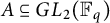
 $A\subseteq GL_2({\mathbb F}_q)$
, there exist disjoint subsets
 $B, C\subseteq A$
such that
 $A = B \sqcup C$
and
 $$\begin{align*}\max\{E_{+}(B), E_{\times}(C)\}\ll \frac{|A|^3}{M(|A|)}, \end{align*}$$
where
 $$ \begin{align} M(|A|) = \min\Bigg\{\,\frac{q^{4/3}}{|A|^{1/3}(\log|A|)^{2/3}},\, \frac{|A|^{4/5}}{q^{13/5}(\log|A|)^{27/10}}\,\Bigg\}. \end{align} $$
It follows from this theorem that for any set A of matrices in
 $M_2(\mathbb {F}_q)$
, we always can find a subset with either small additive energy or small multiplicative energy. By the Cauchy–Schwarz inequality, we have the following direct consequence on a sum-product estimate, namely, for
 $A\subseteq GL_2(\mathbb {F}_q)$
, we have
 $$ \begin{align} \max \left\lbrace |A+A|, |AA| \right\rbrace \gg |A|\cdot M(|A|). \end{align} $$
By a direct computation, one can check that this is better than the estimate (1.1) in the range
 $|A|\ll q^{3+5/8}/(\log |A|)^{1/2}$
.
In the next theorem, we show that the lower bound of (2.2) can be improved by a direct energy estimate.
Theorem 2.2 Let
 $A, B\subseteq M_2({\mathbb F}_q)$
and
 $C\subseteq GL_2({\mathbb F}_q)$
. Then
 $$\begin{align*}E_+(A, B) \ll \frac{|A|^2|BC|^2}{q^4} + q^{13/2}\frac{|A||BC|}{|C|}. \end{align*}$$
Corollary 2.3 For
 $A\subseteq M_2({\mathbb F}_q)$
, with
 $|A|\gg q^{3}$
, we have
 $$ \begin{align} \max\{\,|A+A|,\, |AA|\,\}\gg \min\left\{\,\frac{|A|^2}{q^{13/4}},\, q^{4/3}|A|^{2/3}\,\right\}. \end{align} $$
In addition, if
 $|AA|\ll |A|$
and
 $|A|\gg q^{3+1/2}$
, then
 $$ \begin{align} |A+A|\gg q^4. \end{align} $$
If
 $|AA|\ll |A|$
and
 $|A|\gg q^{3+2/5}$
, then
 $$ \begin{align} |A+A+A|\gg q^4. \end{align} $$
We point out that the arguments of the proof of Corollary 2.3 could be used iteratively to give stronger results for expansion of k-fold sum sets
 $A + \cdots + A$
of sets
 $A\subseteq M_2(F_q)$
with
 $|AA|\ll |A|$
, as k gets larger.
We remark that the estimate (2.3) improves (1.1) in the range
 $|A|\ll q^{3+5/8}$
and is stronger than (2.2) in the range of
 $|A|\gg q^{13/4}$
. We also note that our assumption to get the estimate (2.4) is reasonable. For instance, let G be a subgroup of
 $\mathbb {F}_q^*$
, and let A be the set of matrices with determinants in G, then we have
 $|A|\sim q^3\cdot |G|$
and
 $|AA|=|A|$
.
It has been proved in [Reference Karabulut, Koh, Pham, Shen and Vinh4, Theorems 1.8 and 1.9] that for
 $A, B, C\subseteq M_2(\mathbb {F}_q)$
, if
 $|A||B||C|\ge q^{11}$
, then we have
 $$\begin{align*}|AB+C|, ~|(A+B)C|\gg q^4.\end{align*}$$
In the following theorem, we provide improvements of these results.
Theorem 2.4 Let
 $A, B, C \subseteq M_2({\mathbb F}_q)$
, we have
 $$\begin{align*}|AB+C|\gg \min \left\lbrace\, q^4,\, \frac{|A||B||C|}{q^{13/2}} \,\right\rbrace. \end{align*}$$
If
 $C\subseteq GL_2(\mathbb {F}_q)$
, the same conclusion holds for
 $(A+B)C$
, i.e.,
 $$\begin{align*}|(A+B)C|\gg \min \left\lbrace\, q^4,\, \frac{|A||B||C|}{q^{13/2}} \,\right\rbrace. \end{align*}$$
In particular:
-
(1) If
$|A||B||C|\gg q^{10 + 1/2}$
, then
$|AB + C|\gg q^4.$
-
(2) If
$|A||B||C|\gg q^{10 + 1/2}$
and
$C\subseteq GL_2(\mathbb {F}_q)$
, then
$|(A+B)C|\gg q^4.$


The condition
 $C\subseteq GL_2(\mathbb {F}_q)$
is necessary, since, for instance, one can take C being the set of matrices with zero determinant and
 $A=B=M_2(\mathbb {F}_q)$
, then
 $|(A+B)C|\sim q^3$
and
 $|A||B||C|\sim q^{11}$
.
We expect that the exponent
 $q^{10 + 1/2}$
, in the final conclusions of the above theorem, could be further improved to
 $q^{10}$
, which, as we shall demonstrate, is sharp. For
 $AB+C$
, let A and B be the set of lower triangular matrices in
 $M_2({\mathbb F}_q)$
and for arbitrary
 $0<\delta <1$
, let
 $X\subseteq {\mathbb F}_q$
be any set with
 $|X|= q^{1-\delta }$
, and let
 $$\begin{align*}C = \left\{\,\begin{pmatrix} c_1 & c_2 \\ c_3 & c_4 \end{pmatrix}:c_1, c_3, c_4\in {\mathbb F}_q, c_2\in X\,\right\}. \end{align*}$$
Then
 $|A||B||C| = q^{10-\delta }$
and
 $|AB+C| = |C| = q^{4-\delta }$
.
For
 $(A+B)C$
, the construction is as follows: For arbitrary k, let
 $q=p^k$
, and let V be the set of elements corresponding to a
 $(k-1)$
-dimensional vector space over
 ${\mathbb F}_p$
in
 ${\mathbb F}_q$
. Thus, we have
 $|V| = p^{k-1} = q^{1-1/k}$
. Now, let
 $$\begin{align*}A = B = \left\{\,\begin{pmatrix} x_1 & x_2 \\ x_3 & x_4 \end{pmatrix}:x_1, x_2\in V, x_3, x_4\in {\mathbb F}_q\,\right\}, \end{align*}$$
and
 $$\begin{align*}C = \left\{\,\begin{pmatrix} c_1 & c_2 \\ c_3 & c_4 \end{pmatrix}:c_1, c_3\in {\mathbb F}_q, c_2, c_4\in {\mathbb F}_p\,\right\}. \end{align*}$$
Note that
 $A+B = A=B$
and so
 $$\begin{align*}(A+B)C = AC = \left\{\,\begin{pmatrix} y_1 & y_2 \\ y_3 & y_4 \end{pmatrix}:y_1, y_3, y_4\in {\mathbb F}_q, y_2\in V\,\right\}, \end{align*}$$
where we have used that
 $V\cdot {\mathbb F}_p + V\cdot {\mathbb F}_p = V+V = V.$
Thus,
 $|A||B||C| = (q^2\cdot q^{2-2/k})^2 \cdot (q^2\cdot q^{2/k}) = q^{10-2/k}$
while
 $|(A+B)C| = q^{4-1/k}$
.
Also, we remark here that in the setting of finite fields, our approach and that of Karabulut et al. in [Reference Karabulut, Koh, Pham, Shen and Vinh4] imply the same result. Namely, for
 $A,B,C \subseteq \mathbb {F}_q$
, we have
 $|(A+B)C|, |AB+C| \gg q$
whenever
 $|A||B||C| \gg q^2$
. However, this is not true in the matrix ring. Let us briefly sketch the proof. For
 $\lambda \in AB +C$
, write
 $$\begin{align*}t(\lambda) = |\{\,(a, b, c)\in A\times B \times C: a b + c = \lambda\,\}|. \end{align*}$$
By the Cauchy–Schwarz inequality, we have
 $$\begin{align*}(|A||B||C|)^2 = \left(\sum_{\lambda\in AB+C} t(\lambda)\right)^2 \leq |AB +C|\sum_{\lambda\in AB+C} t(\lambda)^2. \end{align*}$$
Thus, the main task is to bound
 $\sum _{\lambda }t(\lambda )^2$
, i.e., the number of tuples
 $(a, b, c, a', b', c')\in (A\times B\times C)^2$
such that
 $ab+c=a'b'+c'$
. In [Reference Karabulut, Koh, Pham, Shen and Vinh4], instead of bounding
 $\sum _{\lambda }t(\lambda )^2$
, they bounded the number of quadruples
 $(a, b, c, \lambda )\in A\times B\times C\times (AB+C)$
such that
 $ab+c=\lambda $
. These two approaches imply the same lower bounds for
 $(A+B)C$
and
 $AB+C$
when
 $A, B, C\subset \mathbb {F}_q$
, but in the matrix rings, bounding
 $\sum _{\lambda }t(\lambda )^2$
is more effective. In other words, there exists a different phenomenon between problems over finite fields and over the matrix ring
 $M_2(\mathbb {F}_q)$
.
We now state a corollary of the above theorem with
 $C=AA$
which might be of independent interest.
Corollary 2.5 Let
 $A\subset M_2({\mathbb F}_q)$
with
 $|A|\gg q^{3+ 7/16}$
, then
 $$\begin{align*}\max\{|AA(A+A)|, |AA+A+A|\}\gg q^4. \end{align*}$$
Let
 $A, B, C, D\subseteq M_2({\mathbb F}_q)$
, our last theorem is devoted for the solvability of the equation
 $$ \begin{align} x+y=zt,\quad (x, y, z, t)\in A\times B\times C\times D. \end{align} $$
Let
 $\mathcal {J}(A,B,C,D)$
denote the number of solutions to this equation.
One can check that by using Lemma 4.1 and Theorem 4.2 from [Reference Karabulut, Koh, Pham, Shen and Vinh4], one has
 $$ \begin{align} \left\vert \mathcal{J}(A,B,C,D)-\frac{|A||B||C||D|}{q^4} \right\vert\ll q^{7/2}(|A||B||C||D|)^{1/2}. \end{align} $$
Thus, when
 $|A||B||C||D|\gg q^{15}$
, then
 $\mathcal {J}(A,B,C,D)\sim \frac {|A||B||C||D|}{q^4}$
. We refer the interested reader to [Reference Sárközy11] for a result on this problem over finite fields. In our last theorem, we are interested in bounding
 $\mathcal {J}(A,B,C,D)$
from above when
 $|A||B||C||D|$
is smaller.
Theorem 2.6 Let
 $A, B, C, D\subseteq M_2({\mathbb F}_q)$
, and let
 $\mathcal {J}(A,B,C,D)$
denote the number of solutions to equation (2.6). Then, we have
 $$ \begin{align*} \mathcal{J}(A,B,C,D) \ll \frac{|A||B|^{1/2}|C||D|}{q^2} + q^{13/4} (|A||B||C||D|)^{1/2}. \end{align*} $$
Assume
 $|A|=|B|=|C|=|D|$
, the upper bound of this theorem is stronger than that of (2.7) when
 $|A|\ll q^{11/3}$
.
2.1 Structure
The rest of this paper is structured as follows: In Section 3, we prove a preliminary lemma, which is one of the key ingredients in the proof of our energy decomposition theorem. Section 4 is devoted to proving Theorem 2.1. The proofs of Theorem 2.2 and Corollary 2.3 will be presented in Section 5. Section 6 contains proofs of Theorem 2.4, Corollary 2.5, and Theorem 2.6.
3 A preliminary lemma
Given sets
 $A, B, C, D, E, F\subseteq M_2({\mathbb F}_q)$
, let
 $\mathcal {I}(A, B, C, D, E, F)$
be the number of solutions
 $$\begin{align*}(a, e, c, b, f, d)\in A\times B\times C\times D\times E\times F: \quad ab+ ef = c + d. \end{align*}$$
The main purpose of this section is to prove an estimate for
 $\mathcal {I}(A, B, C, D, E, F)$
, which is one of the key ingredients in the proof of Theorem 2.1.
Proposition 3.1 We have
 $$\begin{align*}\bigg|\mathcal{I}(A, B, C, D, E, F) - \frac{|A||B||C||D||E||F|}{q^4}\bigg| \ll q^{13/2}\sqrt{|A||B||C||D||E||F|}\,. \end{align*}$$
To prove Proposition 3.1, we define the sum-product digraph
 $G=(V, E)$
with the vertex set
 $V=M_2(\mathbb {F}_q)\times M_2(\mathbb {F}_q)\times M_2(\mathbb {F}_q)$
, and there is a directed edge going from
 $(a, e, c)$
to
 $(b, f, d)$
if and only if
 $ab+ ef = c+d$
. The setting of this digraph is a generalization of that in [Reference Karabulut, Koh, Pham, Shen and Vinh4, Section 4.1]
Let G be a digraph on n vertices. Suppose that G is regular of degree d, i.e., the in-degree and out-degree of each vertex are equal to d. Let
 $m_G$
be the adjacency matrix of G, where
 $(m_G)_{ij}=1$
if and only if there is a directed edge from i to j. Let
 $\mu _1=d, \mu _2, \ldots , \mu _n$
be the eigenvalues of
 $m_G$
. Notice that these eigenvalues can be complex numbers, and for all
 $2\le i\le n$
, we have
 $|\mu _i|\le d$
. Define
 $\mu (G):=\max _{|\mu _i|\ne d}|\mu _i|$
. This value is referred to as the second largest eigenvalue of
 $m_G$
.
A digraph G is called an
 $(n, d, \mu )$
-digraph if G is a d-regular digraph of n vertices, and the second largest eigenvalue of
 $m_G$
is at most
 $\mu $
.
We recall the following lemma from [Reference Vu16] on the distribution of edges between two vertex sets on an
 $(n, d, \mu )$
-digraph.
Lemma 3.2 Let
 $G = (V, E)$
be an
 $(n, d, \mu )$
-digraph. For any two sets
 $B, C \subseteq V$
, the number of directed edges from B to C, denoted by
 $e(B, C)$
satisfies
 $$\begin{align*}\left| e(B, C) - \frac{d}{n}|B | |C| \right| \leq \mu \sqrt{|B| |C|}\,.\end{align*}$$
With Lemma 3.2 in hand, to prove Proposition 3.1, it is enough to study properties of the sum-product digraph G.
Definition 3.1 Let
 $a, b \in M_2(\mathbb {F}_q)$
. We say they are equivalent, if whenever the ith row of a is not all-zero, neither is the ith row of b and vice versa, for
 $1\leq i \leq 2$
.
Proposition 3.3 The sum product graph G is a
 $(q^{12},\, q^8,\, c\cdot q^{13/2})$
-digraph, for some positive constant c.
Proof The number of vertices is
 $|M_2(\mathbb {F}_q)|^3 = q^{12}$
. Moreover, for each vertex
 $(a, e, c)$
, with each choice of
 $(b, f)$
, d is determined uniquely from
 $d = ab + ef - c$
. Thus, there are
 $|M_2(\mathbb {F}_q)|^2 = q^8$
directed edges going out of each vertex. The number of incoming directed edges can be argued in the same way. To conclude, the digraph G is
 $q^8$
-regular. Let
 $m_G$
denote the adjacency matrix of G. It remains to bound the magnitude of the second largest eigenvalue of the adjacency matrix of G, i.e.,
 $\mu (m_G)$
.
In the next step, we are going to show that
 $m_G$
is a normal matrix, i.e.,
 $m_G^Tm_G=m_Gm_G^T$
, where
 $m_G^T$
is the conjugate transpose of
 $m_G$
. For a normal matrix m, we know that if
 $\lambda $
is an eigenvalue of m, then
 $|\lambda |^2$
is an eigenvalue of
 $mm^T$
and
 $m^Tm$
. Thus, for a normal matrix m, it is enough to give an upper bound for the second largest eigenvalue of
 $mm^T$
or
 $m^Tm$
.
There is a simple way to check whenever G is normal. For any two vertices u and v, let
 $\mathcal {N}^+(u,v)$
be the set of vertices w such that
 $\overrightarrow {uw}, \overrightarrow {vw}$
are directed edges, and
 $\mathcal {N}^-(u, v)$
be the set of vertices
 $w'$
such that
 $\overrightarrow {w'u}, \overrightarrow {w'v}$
are directed edges. It is not hard to check that
 $m_G$
is normal if and only if
 $|\mathcal {N}^+(u,v)| = |\mathcal {N}^-(u,v)|$
for any two vertices u and v.
Given two vertices
 $(a, e, c)$
and
 $(a^{\prime }, e^{\prime }, c^{\prime })$
, where
 $(a, e, c) \neq (a^{\prime }, e^{\prime }, c^{\prime })$
, the number of
 $(x,y,z)$
that lies in the common outgoing neighborhood of both vertices is characterized by

For each pair
 $(x, y)$
satisfying this equation, z is determined uniquely. Thus, the problem is reduced to computing the number of such pairs
 $(x, y)$
.
For convenience, let
 $\bar {a} = a - a^{\prime }$
,
 $\bar {c} = c - c^{\prime }$
, and
 $\bar {e} = e - e^{\prime }$
. Also, let
 $t = \begin {pmatrix} \bar {a} & \bar {e}\end {pmatrix}_{2\times 4}$
. Then, the above relation is equivalent to
 $$ \begin{align} \begin{pmatrix} \bar{a} & \bar{e}\end{pmatrix} \begin{pmatrix} x \\ y\end{pmatrix} = t \begin{pmatrix} x \\ y\end{pmatrix}_{4\times 2}= \bar{c}\,. \end{align} $$
We now have the following cases:
-
• (Case 1:
$\operatorname {\mathrm {rank}}(t) = 0$
) Note that in this case, we need
$a = a^{\prime }$
,
$c = c^{\prime }$
, and
$e = e^{\prime }$
, which is a contradiction to our assumption that
$(a, e, c) \neq (a^{\prime }, e^{\prime }, c^{\prime })$
. Thus, we simply exclude this case. -
• (Case 2:
$\operatorname {\mathrm {rank}}(t) = 1$
) As t is not an all-zero matrix, there is at least one nonzero row. Without loss of generality, assume it is the first row. Then,
${t = \begin {pmatrix} a_1 & a_2 & e_1 & e_2 \\ \alpha a_1 & \alpha a_2 & \alpha e_1 & \alpha e_2\end {pmatrix}}$
, where
$(a_1, a_2, e_1, e_2) \neq \textbf {0}$
and
$\alpha \in \mathbb {F}_q$
.-
– (Case 2.1:
$\operatorname {\mathrm {rank}}(\bar {c}) = 2$
) In this case, there is no solution, as
$\operatorname {\mathrm {rank}}\left (t \begin {pmatrix} x \\ y\end {pmatrix}\right ) \leq \operatorname {\mathrm {rank}}(t) = 1$
but
$\operatorname {\mathrm {rank}}(\bar {c}) = 2$
. -
– (Case 2.2:
$\operatorname {\mathrm {rank}}(\bar {c}) = 1$
) Let
$x = \begin {pmatrix} x_1 & x_2 \\ x_3 & x_4 \end {pmatrix}$
,
$y = \begin {pmatrix} y_1 & y_2 \\ y_3 & y_4 \end {pmatrix}$
. We discuss two sub-cases:(a)
$\bar {c} = \begin {pmatrix} c_1 & c_2 \\ \alpha c_1 & \alpha c_2 \end {pmatrix}$
with the same factor
$\alpha $
, where
$(c_1, c_2) \neq (0, 0)$
.In this case, we have the following set of equations:
Since we assume
$$ \begin{align*} \begin{cases} a_1 x_1 + a_2 x_3 + e_1 y_1 + e_2 y_3 = c_1, \\ a_1 x_2 + a_2 x_4 + e_1 y_2 + e_2 y_4 = c_2. \end{cases} \, \end{align*} $$
$(a_1, a_2, e_1, e_2) \neq \textbf {0}$
, without loss of generality, let
$a_1 \neq 0$
. Then, which means that for each
$$ \begin{align*} \begin{cases} x_1 = (a_1)^{-1}(c_1 -a_2 x_3 -e_1 y_1 - e_2 y_3), \\ x_2 = (a_1)^{-1}(c_2 - a_2 x_4 - e_1 y_2 - e_2 y_4), \end{cases} \end{align*} $$
$(x_3, y_1, y_3)$
there is a unique
$x_1$
and for each
$(x_4, y_2, y_4)$
there is a unique
$x_2$
. Thus, there are
$q^6$
different
$(x,y,z)$
solutions.
(b) In all other sub-cases, there is no solution. If
$\bar {c} = \begin {pmatrix} c_1 & c_2 \\ \beta c_1 & \beta c_2 \end {pmatrix}$
, where
$\beta \neq \alpha $
and
$(c_1, c_2) \neq (0, 0)$
, then we get the following two equations: which obviously do not have any solution.
$$ \begin{align*} \begin{cases} a_1 x_1 + a_2 x_3 + e_1 y_1 + e_2 y_3 = c_1, \\ \alpha a_1 x_1 + \alpha a_2 x_3 + \alpha e_1 y_1 + \alpha e_2 y_3 = \beta c_1, \end{cases}\, \end{align*} $$
Otherwise,
$\bar {c} = \begin {pmatrix} \beta c_1 & \beta c_2 \\ c_1 & c_2 \end {pmatrix}$
, where
$(c_1, c_2) \neq (0, 0)$
. Note that if
$\alpha \neq 0$
, then
$\beta \neq \alpha ^{-1}$
, because this case is covered in Case 2.2(a) implicitly. We get the following equations. which obviously do not have any solution. Notice that
$$ \begin{align*} \begin{cases} a_1 x_1 + a_2 x_3 + e_1 y_1 + e_2 y_3 = \beta c_1, \\ \alpha a_1 x_1 + \alpha a_2 x_3 + \alpha e_1 y_1 + \alpha e_2 y_3 = c_1, \end{cases}\, \end{align*} $$
$\alpha = 0$
or
$\beta = 0$
corresponds to t and
$\bar {c}$
not being equivalent.
-
– (Case 2.3:
$\operatorname {\mathrm {rank}}(\bar {c}) = 0$
) This case is similar to the Case 2.2(a), except
$c_1 = c_2 = 0$
. We have the following two equations: Following the same analysis, we conclude there are
$$ \begin{align*} \begin{cases} a_1 x_1 + a_2 x_3 + e_1 y_1 + e_2 y_3 = 0, \\ a_1 x_2 + a_2 x_4 + e_1 y_2 + e_2 y_4 =0. \end{cases}\, \end{align*} $$
$q^6$
solutions.
-
-
• (Case 3:
$\operatorname {\mathrm {rank}}(t) = 2$
) In this case, we always have solutions, for any
$\bar {c}$
.-
– (Case 3.1:
$\operatorname {\mathrm {rank}}(\bar {a}) = 2$
or
$\operatorname {\mathrm {rank}}(\bar {e}) = 2$
) In this case, let us look back on equation (3.1). If
$\operatorname {\mathrm {rank}}(\bar {a}) = 2$
, then we can rewrite (3.1) as
$\bar {a}x = \bar {c} - \bar {e} y$
. Observe that, for any
$y\in M_2(\mathbb {F}_q)$
, there is a unique x. Thus, the number of solutions is
$q^4$
. The case where
$\operatorname {\mathrm {rank}}(\bar {e}) = 2$
is similar. -
– (Case 3.2:
$\operatorname {\mathrm {rank}}(\bar {a}) \leq 1$
and
$\operatorname {\mathrm {rank}}(\bar {e}) \leq 1$
) In this case, it is not hard to observe that t must be one of the following four types:-
(i)
$\begin {pmatrix} a_1 & a_2 & e_1 & e_2 \\ \alpha a_1 & \alpha a_2 &\beta e_1 &\beta e_2\end {pmatrix}$
, where
$(a_1, a_2), (e_1, e_2)\neq (0,0)$
,
$\alpha \neq \beta $
,
$(\alpha , \beta ) \neq (0,0)$
. -
(ii)
$\begin {pmatrix} \alpha a_1 & \alpha a_2 &\beta e_1 &\beta e_2 \\ a_1 & a_2 & e_1 & e_2 \end {pmatrix}$
, where
$(a_1, a_2), (e_1, e_2) \neq (0,0)$
,
$\alpha \neq \beta $
,
$(\alpha , \beta ) \neq (0,0)$
. -
(iii)
$\begin {pmatrix} a_1 & a_2 &0 &0 \\ 0& 0 & e_1 & e_2 \end {pmatrix}$
, where
$(a_1, a_2),(e_1, e_2) \neq (0,0)$
. -
(iv)
$\begin {pmatrix} 0 & 0 & e_1 & e_2 \\ a_1& a_2 & 0 & 0 \end {pmatrix}$
, where
$(a_1, a_2), (e_1, e_2)\neq (0,0)$
.
Since
$(i)$
and
$(ii)$
are symmetric and so is
$(iii)$
and
$(iv)$
, we only argue for
$(i)$
and
$(iii)$
. For
$(iii)$
, reusing notations from Case 2.2(a), we have
$$ \begin{align*} \begin{cases} a_1 x_1 + a_2 x_3 = c_1, \\ a_1 x_2 + a_2 x_4 = c_2, \\ e_1 y_1 + e_2 y_3 = c_3, \\ e_1 y_2 + e_2 y_4 = c_4. \end{cases} \end{align*} $$
As
$(a_1, a_2) \neq (0,0)$
and
$(e_1, e_2) \neq (0,0)$
, without loss of generality, we assume
$a_1 \neq 0$
and
$e_1 \neq 0$
. Then, it means for each
$(x_3, x_4, y_3, y_4)$
there is a unique
$(x_1, x_2, y_1, y_2)$
. Thus, the system has
$q^4$
solutions.For
$(i)$
, we have Again, assume
$a_1 \neq 0$
and
$e_1 \neq 0$
. Now, take
, we get
$(\alpha - \beta )(e_1 y_1 + e_2 y_3) = \alpha c_1 - c_3 $
. As
$\alpha \neq \beta $
, this means
$e_1 y_1 + e_2 y_3 = (\alpha - \beta )^{-1}(\alpha c_1 - c_3)$
. Thus, for each
$y_3$
, there is a unique
$y_1$
. Similarly, compute
, and we get
$ a_1 x_1 + a_2 x_3 = (\beta - \alpha )^{-1}(\beta c_1 - c_3)$
, which means that for each
$x_3$
, we get a unique
$x_1$
. We can do the same for
and
and conclude that there are
$q^4$
solutions.
-
-


Observe that all cases are disjoint and they together enumerate all possible relations between vertices
 $(a, e, c)$
and
 $(a^{\prime }, e^{\prime }, c^{\prime })$
. We computed
 $\mathcal {N}^+((a, e, c), (a^{\prime }, e^{\prime }, c^{\prime }))$
above and the computation for
 $\mathcal {N}^-((a, e, c), (a^{\prime }, e^{\prime }, c^{\prime }))$
is the same. Thus, we know
 $m_G$
is normal. Note that each entry of
 $m_Gm_G^T$
can be interpreted as counting the number of common outgoing neighbors between two vertices. We can write
 $m_Gm_G^T$
as
 $$ \begin{align*} \begin{aligned} m_Gm_G^T &= q^8 I + 0 E_{21} + q^6 E_{22a} + 0 E_{22b} + q^6 E_{23} + q^4 E_{31} + q^4 E_{32} \\ &=(q^8 - q^4)I + q^4 J - q^4 E_{21} + (q^6 - q^4)E_{22a}\\ &\qquad\qquad -q^4 E_{22b} + (q^6 - q^4) E_{23} + (q^4 - q^4) E_{31} + (q^4 - q^4) E_{32} \\ &= (q^8 - q^4)I + q^4 J - q^4 E_{21} + (q^6 - q^4)E_{22a}- q^4 E_{22b} + (q^6 - q^4) E_{23}\,, \end{aligned} \end{align*} $$
where I is the identity matrix, J is the all one matrix and
 $E_{ij}$
s are adjacency matrices, specifying which entries are involved. For example, for Case 2.3, all pairs
 $(a,e,c), (a^{\prime }, e^{\prime }, c^{\prime })$
with
 $c = c^{\prime }$
and
 $\operatorname {\mathrm {rank}}(t) = 1$
are involved. Thus, the
 $E_{23}$
is an adjacency matrix of size
 $q^{12}\times q^{12}$
(containing all triples
 $(a,e,c)$
), with pairs of vertices satisfying this property marked 1 and all others marked 0.
Finally, observe that each subgraph defined by the corresponding adjacency matrix
 $E_{ij}$
is regular. This is due to the fact that the condition does not depend on specific value of
 $(a,e,c)$
. Starting from any vertex
 $(a,e,c)$
, we can get to all possible
 $\bar {a}, \bar {e},\bar {c}$
by subtracting the correct
 $(a^{\prime }, e^{\prime }, c^{\prime })$
. Thus, for each case, we get the same number of
 $(a^{\prime }, e^{\prime }, c^{\prime })$
that satisfies the condition.
Let
 $\kappa _{ij}$
be the maximum number of 1s in a row in
 $E_{ij}$
. Obviously,
 $\kappa _{ij}$
is an upper bound on the largest eigenvalue of
 $E_{ij}$
. It is not difficult to see that
 $\kappa _{21} \ll q^9$
,
 $\kappa _{22a} \ll q^7$
,
 $\kappa _{22b} \ll q^8$
and
 $\kappa _{23}\ll q^5$
. For example, in Case 2.1, we have
 $\operatorname {\mathrm {rank}}(t) = 1$
and
 $\operatorname {\mathrm {rank}}(\bar {c}) = 2$
. For a fixed
 $(a, e,c)$
, the former implies that there are
 $O(q^5)$
possibilities for
 $a^{\prime }$
and
 $e^{\prime }$
while the latter implies there are
 $O(q^4)$
possibilities for
 $c^{\prime }$
. Altogether, there are
 $O(q^9)$
possibilities for
 $(a^{\prime }, e^{\prime }, c^{\prime })$
in Case 2.1. Because the graph induced by
 $E_{21}$
is regular, we have
 $\kappa _{21}\ll q^9$
. Other cases can be deduced accordingly.
The rest follows from a routine computation: let
 $v_2$
be an eigenvector corresponding to
 $\mu (G)$
. Then, because G is regular and connected (easy to see, there is no isolated vertex),
 $v_2$
is orthogonal to the all 1 vector, which means
 $J\cdot v_2 = \mathbf {0}$
. We now have
 $$ \begin{align*} \begin{aligned} \mu(m_G)^2 v_2 = m_Gm_G^T \cdot v_2 &= (q^8-q^4)I\cdot v_2 + (- q^4 E_{21} + (q^6 - q^4)E_{22a} - q^4 E_{22b} + (q^6 - q^4) E_{23}) \cdot v_2 \\ &= ((q^8 - q^4)- q^4 \kappa_{21} + (q^6 - q^4) \kappa_{22a} - q^4 \kappa_{22b} + (q^6 - q^4)\kappa_{23})\cdot v_2\\ &\ll q^{13} \cdot v_2 \,. \end{aligned} \end{align*} $$
Thus,
 $\mu (m_G)\ll q^{13/2}$
.

4 Proof of Theorem 2.1
To prove Theorem 2.1, we will also need several technical results. A proof of the following inequality may be found in [Reference Roche-Newton, Shparlinski and Winterhof8, Lemma 2.4].
Lemma 4.1 Let
 $V_1, \dots , V_k$
be subsets of an abelian group. Then
 $$ \begin{align*} E_{+}\bigg(\bigsqcup_{i=1}^{k}V_i\bigg) \leq \bigg(\sum_{i=1}^k E_{+}(V_i)^{1/4}\bigg)^4. \end{align*} $$
The following lemma is taken from [Reference Mohammadi and Stevens5] and may also be extracted from [Reference Roche-Newton, Shparlinski and Winterhof8, Reference Rudnev, Shkredov and Stevens10]. Lemma 4.2 is slightly different to its analogs over commutative rings as highlighted by the duality of the inequalities (4.5) and (4.6).
Lemma 4.2 Let
 $X \subseteq GL_2(\mathbb {F}_q)$
. There exist sets
 $X_*\subset X$
,
 $D \subset XX$
, as well as numbers
 $\tau $
and
 $\kappa $
satisfying
 $$ \begin{align} \frac{E_{\times}(X)}{2|X|^2}\leq \tau \leq |X|, \end{align} $$
 $$ \begin{align} \frac{E_{\times}(X)}{\tau^2\cdot \log |X|}\ll |D| \ll (\log|X|)^6 \frac{|X_*|^4}{E_{\times}(X)}, \end{align} $$
 $$ \begin{align} |X_*|^2 \gg \frac{E_{\times}(X)}{|X| (\log|X|)^{7/2}}, \end{align} $$
 $$ \begin{align} \kappa \gg \frac{|D|\tau}{|X_*|(\log|X|)^2}, \end{align} $$
such that either
 $$ \begin{align} r_{DX^{-1}}(x) \geq \kappa \quad \text{for all} \quad x\in X_*, \end{align} $$
or
 $$ \begin{align} r_{X^{-1}D}(x) \geq \kappa \quad \text{for all} \quad x\in X_*. \end{align} $$
We need a dyadic pigeonhole argument, which can be found in [Reference Murphy and Petridis6, Lemma 18].
Lemma 4.3 For
 $\Omega \subseteq M_2(\mathbb {F}_q)$
, let
 $w,f: \Omega \rightarrow \mathbb {R}^+$
with
 $f(x) \leq M, \;\forall x\in \Omega $
. Let
 $W = \sum _{x\in \Omega } w(x)$
. If
 $\sum _{x\in \Omega } f(x) w(x) \geq K,$
then there exists a subset
 $D \subset \Omega $
and a number
 $\tau $
such that
 $\tau \leq f(x) < 2\tau $
for all
 $x\in D$
and
 $K/(2W) \leq \tau \leq M\,.$
Moreover,
 $$ \begin{align*} \frac{K}{2 + 2\log_2M} \leq \sum_{x\in D} f(x)w(x) \leq 2\tau \sum_{x\in D}w(x) \leq \min\{2\tau W,\, 4\tau^2 |D|\}\,. \end{align*} $$
Proof of Lemma 4.2
We use the identities in (1.2) and apply Lemma 4.3, by taking
 $\Omega = X X, \, f = w = r_{XX},\, M = |X|,\, K = E_{\times }(X)$
, and
 $W = |X|^2$
, to find a set
 $D \subset XX$
and a number
 $\tau $
, satisfying (4.1), such that
 $D = \{\, \lambda \in XX: \tau \leq r_{XX}(\lambda ) < 2\tau \,\}\,$
and
 $$ \begin{align} \tau^2 |D| \gg E_{\times}(X) / \log |X|\,. \end{align} $$
Define
 $P_1 = \{\,(x,y)\in X\times X: xy \in D\,\}$
and
 $A_x = \{\,y: (x,y)\in P_1\,\}$
for
 $x \in X$
. By the definition of D, we know that
 $\tau |D| \leq |P_1| < 2\tau |D|$
. We can use Lemma 4.3 again with
 $\Omega = X, f(x) = |A_x|, w = 1, M = W = |X|$
, and
 $K = |P_1|$
to find a set
 $V\subset X$
and a number
 $\kappa _1$
such that
 $V = \{\,x\in X: \kappa _1 \leq |A_x| < 2\kappa _1\,\}\,$
and
 $$ \begin{align} |V|\kappa_1 \gg |P_1|/\log|X| \gg \tau |D| / \log |X|\,. \end{align} $$
Now, we split the analysis into two cases based on
 $|V|$
:
Case 1 (
 $|V| \geq \kappa _1 (\log |X|)^{-1/2}$
): In this case, we simply set
 $X_* = V$
and
 $\kappa = \kappa _1$
. For each
 $x\in V$
, there are at least
 $\kappa _1$
different y such that
 $x y \in D$
. Therefore,
 $r_{DX^{-1}}(x) \geq \kappa \;\forall x \in X_*$
.
Case 2 (
 $|V| < \kappa _1 (\log |X|)^{-1/2}$
): In this case, we find another pair
 $U, \kappa _2$
that satisfies
 $|U| \gg \kappa _2 (\log |X|)^{-1/2}$
and set
 $X_* = U$
and
 $\kappa = \kappa _2$
. Let
 $P_2 = \{\,(x,y)\in P_1: x\in V\,\}$
and
 $B_y = \{\,x: (x,y)\in P_2\,\}$
. By definition, we have
 $|P_2| \geq |V|\kappa _1$
. We apply Lemma 4.3 again, with
 $\Omega = X, f(y) = |B_y|, w = 1, K = |P_2|$
and
 $W = M =|X|$
to get
 $U \subset X$
and a number
 $\kappa _2$
such that
 $U = \{\,y\in X: \kappa _2 \leq |B_y| < 2\kappa _2\,\}\,$
and
 $$ \begin{align} |U|\kappa_2 \gg |P_2|/\log|X| \geq \kappa_1 |V| /\log|X| \,. \end{align} $$
Combining this inequality with the assumption of this case (
 $\kappa _1 \geq |V|(\log |X|)^{1/2}$
) and
 $|V| \geq \kappa _2$
, we conclude
 $|U| \gg \kappa _2 (\log |X|)^{-1/2}$
. We can then argue similarly as in Case 1 to conclude
 $r_{X^{-1}D}(x) \geq \kappa \;\forall x \in X_*$
.
Now, (4.4) follows from either of (4.8) or (4.9). To prove (4.3), we first note that in either of the cases above we have
 $|X_*|\gg \kappa (\log |X|)^{-1/2}$
. Then using the lower bound on
 $\kappa $
, (4.7) and (4.1), we have
 $|X_*|^2\gg |D|\tau (\log |X|)^{-5/2}\gg E_{\times }(X)/(|X|\log |X|)^{7/2}$
as required. Finally, to deduce the required upper bound on
 $|D|$
in (4.2) note that, as shown above,
 $|D|\tau \ll |X_*|^2(\log |X|)^{5/2}$
, which with (4.7) implies
 $|D|E_{\times }(X)(\log |X|)^{-1}\ll (|D|\tau )^2\ll |X_*|^4(\log |X|)^5$
.
Lemma 4.4 Let
 $X\subseteq GL_2({\mathbb F}_q)$
. Then there exists
 $X_*\subseteq X$
, with
 $$\begin{align*}|X_*| \gg \frac{E_{\times}(X)^{1/2}}{|X|^{1/2}(\log |X|)^{7/4}}, \end{align*}$$
such that
 $$ \begin{align} E_{+}(X_*) \ll \frac{|X_*|^4|X|^6(\log|X|)^2}{q^4 E_{\times}(X)^2} + \frac{q^{13/2}|X_*|^3|X|(\log|X|)^5}{E_{\times}(X)}. \end{align} $$
Proof We apply Lemma 4.2 to the set X and henceforth assume its full statement, keeping the same notation. Without loss of generality, assume
 $r_{X^{-1}D}(x) \geq \kappa \;\forall x\in X_*$
. Thus,
 $$ \begin{align*} E_{+}(X_*) &= |\{(x_1, x_2, x_3, x_4)\in X_*^4: x_1 + x_2 = x_3 + x_4\}|\\ &\leq \kappa^{-2}|\{(d_1, d_2, x_1, x_2, y_1, y_2)\in D^2\times X_*^2 \times X^2: x_1 + y_1^{-1} d_1 = x_2 + y_2^{-1} d_2 \}|\\ &= \kappa^{-2} \mathcal{I}(X^{-1}, D, -X_*, -X^{-1}, D, X_*). \end{align*} $$
Then applying Proposition 3.1 and (4.4), we obtain
 $$ \begin{align*} E_{+}(X_*) &\ll \kappa^{-2}\cdot\bigg( \frac{(|D||X||X_*|)^{2}}{q^4} + q^{13/2}|D||X||X_*|\bigg)\\ &\ll\frac{|X_*|^4|X|^2(\log|X|)^2}{q^4\tau^2} + \frac{q^{13/2}|X_*|^3|X|(\log|X|)^4}{|D|\tau^2}\,. \end{align*} $$
Finally, applying (4.1) and (4.2), we obtain the required bound in (4.10) for
 $E_{+}(X_*)$
.
We are now ready to prove Theorem 2.1.
Proof of Theorem 2.1
We begin by describing an algorithm, which constructs two sequences of sets
 $A = S_1 \supseteq S_2 \supseteq \cdots \supseteq S_{k+1}$
and
 $\emptyset = T_0 \subseteq T_1 \subseteq \cdots \subseteq T_{k}$
such that
 $ S_{i} \sqcup T_{i-1} = A$
, for
 $i = 1, \dots , k+1$
.
Let
 $1\leq M\leq |A|$
be a parameter. At any step
 $i\geq 1$
, if
 $E_{\times }(S_i)\leq |A|^3/M$
the algorithm halts. Otherwise if
 $$ \begin{align} E_{\times}(S_i)> \frac{|A|^{3}}{M}, \end{align} $$
through a use of Lemma 4.4, with
 $X=S_i$
, we identify a set
 $V_i:= X_* \subseteq S_i$
, with
 $$ \begin{align} |V_i| \gg \frac{E_{\times}(S_i)^{1/2}}{|S_i|^{1/2}(\log|A|)^{7/4}}> \frac{|A|}{M^{1/2}(\log|A|)^{7/4}} \end{align} $$
and
 $$ \begin{align} E_{+}(V_i)\ll \frac{|V_i|^4|S_i|^6(\log|S_i|)^2}{q^4 E_{\times}(S_i)^2} + \frac{q^{13/2}|V_i|^3|S_i|(\log|S_i|)^5}{E_{\times}(S_i)}. \end{align} $$
We then set
 $S_{i+1} = S_i \setminus V_i$
,
 $T_{i+1} = T_i \sqcup V_i$
and repeat this process for the step
 $i+1$
. From (4.12), we deduce
 $|V_i|\gg |A|^{1/2}(\log |A|)^{-7/4}$
and so the cardinality of each
 $S_i$
monotonically decreases. This in turn implies that this process indeed terminates after a finite number of iterations k. We set
 $B = S_{k+1}$
and
 $C = T_k$
, noting that
 $A = B\sqcup C$
and that
 $$ \begin{align} E_{\times}(B) \leq \frac{|A|^{3}}{M}. \end{align} $$
We apply the inequalities (4.11), (4.12) and
 $|S_i| \leq |A|$
, to (4.13), to get
 $$ \begin{align*} E_{+}(V_i) &\ll M^2|V_i|^4q^{-4}(\log|A|)^2 + M|A|^{-2}|V_i|^3 q^{13/2} (\log|A|)^5 \\ &\ll \big(M^2 q^{-4}(\log|A|)^2 + M^{3/2}|A|^{-3}q^{13/2}(\log|A|)^{27/4}\big)\cdot|V_i|^4. \end{align*} $$
Then, observing that
 $$ \begin{align*} C = T_k = \bigsqcup_{i=1}^{k} V_i \subseteq A, \end{align*} $$
we use Lemma 4.1 to obtain
 $$ \begin{align*} E_{+}(C) &\ll (M^2q^{-4}(\log|A|)^2 + M^{3/2}|A|^{-3}q^{13/2}(\log|A|)^{27/4}) \bigg(\sum_{i=1}^k|V_i|\bigg)^4 \\ &\leq M^{2}|A|^4q^{-4}(\log|A|)^{2} + M^{3/2}|A|q^{13/2}(\log|A|)^{27/4}. \end{align*} $$
Note that Lemma 4.1 is applicable because
 $M_2({\mathbb F}_q)$
is an abelian group under addition. Comparing this with (4.14), we see the choice
 $M = M(|A|)$
, given by (2.1) is optimal.
5 Proofs of Theorem 2.2 and Corollary 2.3
Proof of Theorem 2.2
We proceed similarly to the proof of [Reference Roche-Newton, Rudnev and Shkredov7, Theorem 6]. Note that
 $$ \begin{align*} E_+(A, B) &= |C|^{-2}|\{\,(a, a^{\prime}, b, b^{\prime}, c, c^{\prime})\in A^2\times B^2\times C^2: a + b c c^{-1} = a^{\prime} + b^{\prime} c^{\prime} (c^{\prime})^{-1}\,\}|\\ &\leq |C|^{-2}|\{\,(a, a^{\prime}, s, s^{\prime}, c, c^{\prime})\in A^2\times (BC)^2\times (C^{-1})^2: a + s c = a^{\prime} + s^{\prime} c^{\prime}\,\}|. \end{align*} $$
The required result then follows by applying Proposition 3.1.
Proof of Corollary 2.3
Since
 $|A|\gg q^3$
, we may assume
 $A\subseteq GL_2({\mathbb F}_q)$
. We use Theorem 2.2, with
 $A=B=C$
and apply the lower bound on
 $E_+(A)$
given by (1.3) to obtain (2.3). To prove (2.4), we follow the same process and apply the assumption
 $|AA|\ll |A|$
, to obtain
 $$ \begin{align} |A+A| \gg \min\{\,q^4,\, |A|^3/q^{13/2}\,\}, \end{align} $$
which gives the required result.
To prove (2.5), we use Theorem 2.2, to get
 $$\begin{align*}\frac{|A+A|^2|A|^2}{|A+A+A|}\leq E_{+}(A+A, A) \ll \frac{|A+A|^2|A|^2}{q^4} + q^{13/2}|A+A|. \end{align*}$$
Recalling (5.1), this rearranges to
 $$\begin{align*}|A+A+A|\gg \min\left\{q^4, \frac{|A+A||A|^2}{q^{13/2}}\right\}\gg \min\left\{q^4, \frac{|A|^2}{q^{5/2}}, \frac{|A|^5}{q^{13}}\right\}. \end{align*}$$
The required result then easily follows.
6 Proofs of Theorem 2.4, Corollary 2.5, and Theorem 2.6
Proof of Theorem 2.4
For
 $\lambda \in AB +C$
, write
 $$\begin{align*}t(\lambda) = |\{\,(a, b, c)\in A\times B \times C: a b + c = \lambda\,\}|. \end{align*}$$
By the Cauchy–Schwarz inequality, we have
 $$\begin{align*}(|A||B||C|)^2 = \left(\sum_{\lambda\in AB+C} t(\lambda)\right)^2 \leq |AB +C|\sum_{\lambda\in AB+C} t(\lambda)^2. \end{align*}$$
Further noting that
 $$\begin{align*}\sum_{\lambda\in AB+C} t(\lambda)^2 = \mathcal{I}(A, B, -C, -A, B, C). \end{align*}$$
We apply Proposition 3.1 to obtain
 $$\begin{align*}|AB + C|\gg \min\left\{\,q^4,\, \frac{|A||B||C|}{q^{13/2}}\,\right\}. \end{align*}$$
This immediately implies the required result.
For the set
 $(A+B)C$
, as above we have
 $$\begin{align*}|(A+B)C|\ge \frac{|A|^2|B|^2|C|^2}{|\{\,(a, b, c, a', b', c')\in (A\times B\times C)^2\colon (a+b)c=(a'+b')c'\,\}|}. \end{align*}$$
To estimate the denominator, we follow the argument in the proof of Proposition 3.1. In particular, we first define a graph G with the vertex set
 $V=M_2(\mathbb {F}_q)\times M_2(\mathbb {F}_q)\times M_2(\mathbb {F}_q)$
, and there is a direct edge going from
 $(a, e, c)$
to
 $(b, f, d)$
if
 $b a+e f=c+d$
. The only difference here compared to that graph in Section 3 is that we switch between
 $b a$
and
 $a b$
. By using a similar argument as in Section 3, we have this graph is a
 $(q^{12}, q^8,c q^{13/2})$
-digraph, where c is a positive constant.
To bound the denominator, we observe that the equation
 $$ \begin{align*} (a+b)c=(a'+b')c' \end{align*} $$
gives us a direct edge from
 $(c, -b', -ac )$
to
 $(b, c', a'c')$
. So, let
 $U:=\{(c, -b', -ac)\colon a\in A, c\in C, b'\in B\}$
and
 $W=\{(b, c', a'c')\colon b\in B, c'\in C, a'\in A\}$
. Since
 $C\subseteq GL_2(\mathbb {F}_q)$
, we have
 $|U|=|W|=|A||B||C|$
. So applying Lemma 3.2, the number of edges from U to W is at most
 $$\begin{align*}\frac{|A|^2|B|^2|C|^2}{q^4}+q^{13/2}|A||B||C|. \end{align*}$$
In other words,
 $$\begin{align*}|\{\,(a, b, c, a', b', c')\in (A\times B\times C)^2\colon (a+b)c=(a'+b')c'\,\}|\ll \frac{|A|^2|B|^2|C|^2}{q^4}+q^{13/2}|A||B||C|, \end{align*}$$
and we get the desired estimate.
Proof of Corollary 2.5
It follows from Theorem 2.4 that
 $$ \begin{align} |AA + A + A| \gg q^4 \quad \text{if} \quad |A|^2 |A+A|\gg q^{10+1/2} \end{align} $$
and
 $$ \begin{align} |AA(A+A)| \gg q^4 \quad \text{if} \quad |A|^2 |AA|\gg q^{10+1/2}. \end{align} $$
Note that by Corollary 2.3, if
 $|A|\gg q^{3+7/16}$
, we have
 $$\begin{align*}|A|^2\cdot \max\{\,|A+A|,\, |AA|\,\}\gg q^{4/3}|A|^{8/3} \gg q^{10 + 1/2}. \end{align*}$$
Hence, one of the conditions in (6.1) or (6.2) is satisfied, which in turn gives the required estimate.
Proof of Theorem 2.6
By the Cauchy–Schwarz inequality and Proposition 3.1, we have
 $$ \begin{align*} \mathcal{J}(A,B,C,D) &= |\{\,(a, b, c, d)\in A\times B \times C\times D: a+b = c d\,\}|\\ &\leq |B|^{1/2}|\{\,(a, a^{\prime}, c, c^{\prime}, d, d^{\prime}) \in A^2 \times C^2 \times D^2: c d - a = c^{\prime} d^{\prime} - a^{\prime}\,\}|^{1/2}\\ &\ll \frac{|A||B|^{1/2}|C||D|}{q^2} + q^{13/4} (|A||B||C||D|)^{1/2}.\\[-42pt] \end{align*} $$



