INTRODUCTION
The annual incidence of cancer has risen steadily during the past decade, but the development of early detection techniques and improved treatment options have led to an increased survival rate among cancer patients (Korean Central Cancer Registry, 2012). However, cancer stills remains the second leading cause of death in the majority of Organisation for Economic Co-operation and Development member nations (OECD, 2013).
In addition to physical decline, terminally ill cancer patients experience such psychological stressors as depression, anxiety, interpersonal difficulties, and existential concerns (Kim, Reference Kim2012). Family caregivers of terminally ill cancer patients can also experience stress and psychological problems associated with the burden of care in addition to financial difficulties (Braun et al., Reference Braun, Mikulincer and Rydall2007; Grunfeld et al., Reference Grunfeld, Coyle and Whelan2004). The family is a central component of palliative care, providing a tangible source of emotional support; therefore, family caregiver stress is closely related to patient distress and quality of life (Williams & McCorkle, Reference Williams and McCorkle2011; Hodges et al., Reference Hodges, Humphris and Macfarlane2005). Indeed, the palliative approach refers to the family as a “unit of care” (Kristjanson & Aoun, Reference Kristjanson and Aoun2004).
Caregiver burden can be categorized as either objective or subjective (Jones, Reference Jones1996). Subjective caregiver burden refers to such psychological factors as grief, guilt, anxiety, and depression. The degree of subjective burden experienced by caregivers is affected by patient-related factors, including the presence of multiple symptoms, decline in functional status, short projected lifespan following diagnosis, and onset of the terminal period (Grunfeld et al., Reference Grunfeld, Coyle and Whelan2004; Given et al., Reference Given, Wyatt and Given2004). Furthermore, many caregiver characteristics can contribute to increased caregiver burden, namely: unmarried status, younger age, female sex, shorter duration of education, non-spouse or adult child status, longer time spent providing care, fewer visits from other family members, poor family functioning, low self-esteem, low monthly income, low level of social support, physical health problems, anxiety, and depression (Given et al., Reference Given, Wyatt and Given2004; Grov et al., Reference Grov, Fossa and Tonnessen2006; Teixeira & Pereira, Reference Teixeira and Pereira2013; Goldstein et al., Reference Goldstein, Concato and Fried2004; Park et al., Reference Park, Shin and Choi2012; Andrews, Reference Andrews2001).
Personality traits are key determinants of an individual's response to different stressors and situations (Groves & Muskin, Reference Groves, Muskin and Levenson2011). Therefore, caregiver burden in the context of terminally ill patients would be expected to be modulated by the caregiver's personality. A previous report pertaining to personality and caregiver burden in the context of cancer patients found that self-esteem and coping strategy were significantly related (Adejumo, Reference Adejumo2009; John & Srivastata, Reference John, Srivastata, Pervin and John1999). However, these factors do not fully encompass the various dimensions of personality. In dimensional models, the following five factors are widely accepted as the fundamental units of personality (i.e., the “Big Five” personality traits): extroversion, agreeableness, conscientiousness, neuroticism, and openness (John & Srivastata, Reference John, Srivastata, Pervin and John1999).
For caregivers of patients with dementia and chronic obstructive pulmonary disease (COPD), neuroticism and extroversion are predictors of burden (González-Abraldes et al., Reference González-Abraldes, Millán-Calenti and Lorenzo-López2013; Nordtug et al., Reference Nordtug, Krokstad and Holen2011). However, to the best of our knowledge, only one article has been published on the influence of the Big Five personality dimensions on burden among caregivers of cancer patients at various stages of disease progression, and in that study, neuroticism was indirectly associated with caregiver burden, but only two of the Big Five dimensions (extroversion and neuroticism) were investigated (Kim et al., Reference Kim, Kim and Yoo2010).
We aimed in the present study to determine the influence of the Big Five personality dimensions on caregiver burden in the particular context of a palliative care setting. We also investigated other factors potentially related to caregiver burden, including the sociodemographic, psychological, and clinical characteristics of the patient–family caregiver dyad, using well-validated measures.
METHODS
Study Design and Recruitment
Family caregivers of cancer patients admitted to the palliative care unit (PCU) of Chonnam National University Hwasun Hospital (Hwasun, South Korea) were consecutively enrolled in the main study between March of 2009 and August of 2011. The following inclusion criteria were applied: diagnosis of terminal cancer by an oncologist, estimated survival time of a few months, and admission to the PCU for palliative care. Patients admitted to the PCU prior to commencement of the study and those who were hospitalized in the PCU for less than three days were excluded. Eligible caregivers were family members (spouse, son, son-in-law, daughter, daughter-in-law, parent, brother, sister, or other relative who provided direct assistance to the patient) of at least 18 years of age who served as the primary caregiver for the patient, and who completed the personality assessment questionnaires. Caregivers who were unable to understand the informed consent procedure or the study objective were excluded. In the present study, we employed the data on subjects recruited between February of 2010 and August of 2011 because investigation of the Big Five personality dimensions was begun after February of 2010, when the Korean version of the 10-item Big Five Inventory (BFI–10) had been validated (Kim et al., Reference Kim, Kim and Yoo2010). Following explanation of the study's purpose and methodology, informed consent was provided by all patients (or their familial surrogate, according to the patient's mental status) and caregivers. The study was approved by the institutional review board at Chonnam National University Hwasun Hospital.
Caregiver Burden
The dependent variable, subjective caregiver burden, was measured using the seven-item short form of the Zarit Burden Interview (ZBI-7), developed specifically to assess the burden associated with palliative care (Gort et al., Reference Gort, March and Gomez2005). Overall burden was indexed by total scores on the ZBI-7, with higher scores indicating greater caregiver burden. The ZBI-7 has been validated in a Korean population (Kim et al., Reference Kim, Kim and Stewart2006).
Caregiver Personality
Caregiver personality was assessed using the 10-item short version of the BFI–10 (Rammstedt & John, Reference Rammstedt and John2007), which measures the Big Five dimensions of personality: extroversion (talkative, assertive, and energetic); agreeableness (good-natured, cooperative, altruistic, and empathic); conscientiousness (orderly, responsible, and dependable); neuroticism (neurotic, easily upset, and lacking in self-confidence); and openness (open to experience, intellectual, imaginative, and independent minded). Scores for each trait on the BFI–10 range between 1 and 5. Higher scores correspond to higher levels of each personality trait (John & Srivastata, Reference John, Srivastata, Pervin and John1999). The BFI–10 has been translated into Korean and subsequently validated (Kim et al., Reference Kim, Kim and Yoo2010).
Factors Potentially Associated with Caregiver Burden
Sociodemographic, psychological, and clinical factors potentially associated with caregiver burden were the independent variables, selected on the basis of previous research (Given et al., Reference Given, Wyatt and Given2004; Grov et al., Reference Grov, Fossa and Tonnessen2006; Goldstein et al., Reference Goldstein, Concato and Fried2004; Park et al., Reference Park, Shin and Choi2012; Andrews, Reference Andrews2001). Patients were interviewed and assessed by a psychiatrist within 4 to 7 days of admission to the PCU; family caregivers were assessed by a clinical research coordinator on the same day. The research coordinator encouraged caregivers to complete the assessment to minimize instances of incomplete data.
Patient-Related Factors
Data pertaining to age, sex, years of formal education, marital status, primary cancer site, time since cancer diagnosis, recurrent cancer status, current palliative radiotherapy, and detected metastasis were collected from each patient's clinical chart. We restricted our investigation of metastasis to the two most common sites (i.e., liver and lung), because otherwise there would have been too many individual sites to include in the analysis. We used the Richmond Agitation–Sedation Scale (RASS) to determine patients' mental status. The RASS is a 10-point scale ranging between −5 (unarousable) and 4 (combative), with a midpoint of 0 (calm). The RASS is a reliable and valid measure of level of consciousness (Sessler et al., Reference Sessler, Gosnell and Grap2002). We divided patients into the following three groups, according to RASS scores: drowsy to unarousable (−1 to −5), calm (0), and restless to combative (1 to 4). Physical functioning was measured using the Eastern Cooperative Oncology Group Performance Status (ECOG–PS) instrument, on which scores range between 0 (fully active) and 4 (completely disabled) (Oken et al., Reference Oken, Creech and Tormey1982). Subjective pain was measured using a numerical rating scale (NRS) ranging between 0 and 10, with higher scores indicating greater pain intensity (de Conno et al., Reference de Conno, Caraceni and Gamba1994). Depressive symptoms in patients were measured using the Montgomery–Åsberg Depression Rating Scale (MADRS) (Montgomery & Åsberg, Reference Montgomery and Åsberg1979; Ahn et al., Reference Ahn, Lee and Yi2005). The MADRS is an objective 10-item questionnaire assessing symptoms experienced during the past week; scores for each item range between 1 and 6, yielding a maximum possible score of 60. Higher scores indicate more severe depressive symptoms.
Caregiver-Related Factors
Data regarding age, sex, years of formal education, marital status, relationship to patient, whether the caregiver had lived with the patient prior to admission, employment status, religion, medical illnesses, and caregiving situation were obtained during a face-to-face interview. The caregiver's depressive symptoms were measured using the MADRS (Montgomery & Åsberg, Reference Montgomery and Åsberg1979; Ahn et al., Reference Ahn, Lee and Yi2005).
Statistical Analysis
A univariate analysis was performed on the independent variables to identify factors associated with caregiver burden. We analyzed nonnormally distributed data using the Mann–Whitney U test or the Kruskal–Wallis test for categorical variables and Spearman's rank correlation for continuous variables. Factors significantly associated with each dependent variable in the univariate analysis (p < 0.05) were then entered into linear regression models to identify which were associated with caregiver burden. Skewed continuous variables were normalized using log transformation. Categorical variables were entered into the model as dummy variables. A value of p < 0.05 was taken to indicate statistical significance. All statistical tests were performed using the SPSS for Windows software package (v. 13.0; SPSS Inc., Chicago).
RESULTS
Recruitment
A total of 521 patients were admitted to the PCU during the recruitment period, of whom 370 (71.0%) satisfied the patient inclusion criteria, with 327 (88.4%) of those consenting to participate. A total of 305 caregivers for these 327 patients consented to participate; of those, 227 (74.7%) were enrolled subsequent to February of 2010, following which they completed the BFI–10 personality questionnaire. Therefore, 227 patient–family caregiver dyads were included in the present analysis. Of the 78 patient–family caregiver dyads not included in the final analysis, a greater proportion of patients had PS scores of 0 (p = 0.046), and more caregivers answered “no” to the question of whether the caregiver lived with the patient prior to admission (p = 0.028). No significant group differences were observed for any other variable (all p > 0.05).
Univariate Associations Between Patient Characteristics and Caregiver Burden
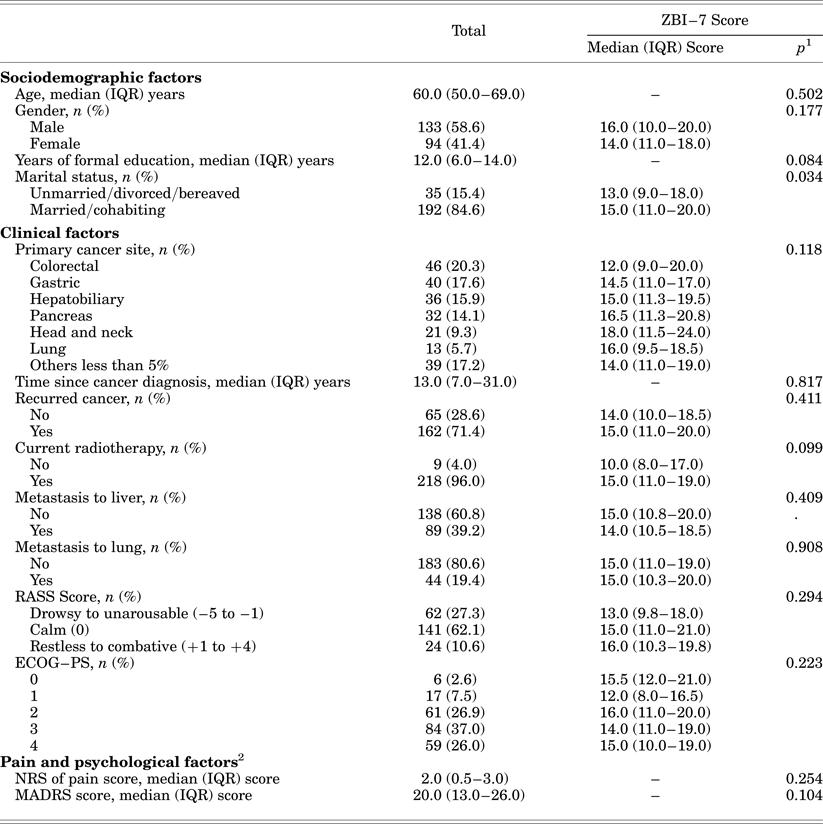
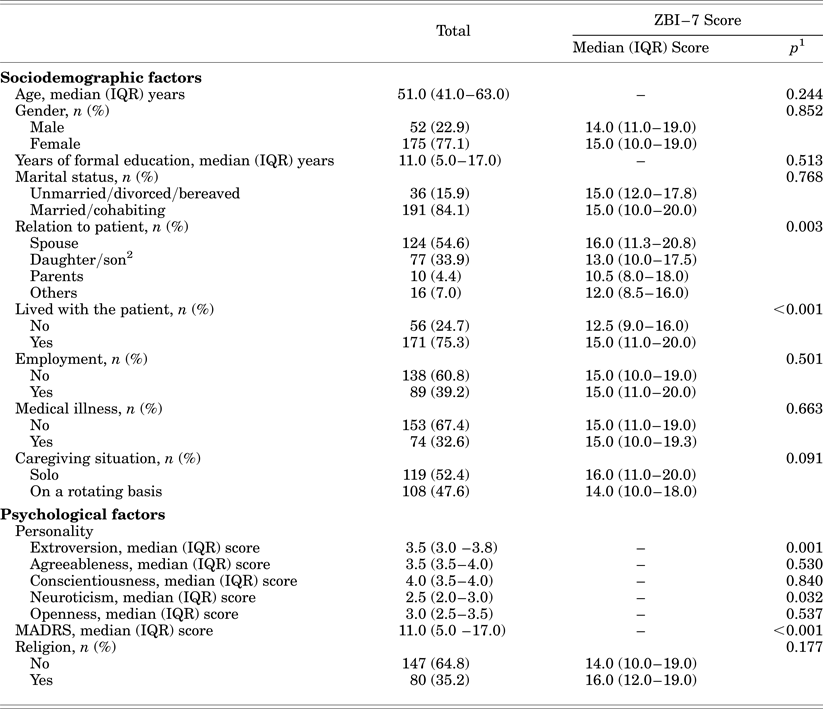
The median (interquartile range [IQR]) patient age was 60 years (50–69 years); 133 (58.6%) of patients were male. The median (IQR) caregiver age was 51 years (41–63 years), of whom 52 (22.9%) were male. The median (IQR) caregiver burden score was 15 (11–19). In the univariate analysis, patient marital status was significantly associated with caregiver burden. No other patient characteristics were significantly associated with caregiver burden. Regarding caregiver characteristics, being a spousal caregiver and living with the patient prior to admission were associated with a higher degree of burden. Caregivers who were more extroverted reported lower burden; caregivers with higher neuroticism levels reported higher burden. Furthermore, caregiver MADRS scores were positively associated with caregiver burden. Patient and caregiver characteristics and their univariate associations with caregiver burden in the analyzed subjects are presented in Tables 1 and 2, respectively.
Patient-related factors and their association with caregiver burden (n = 227)

ECOG–PS = Eastern Cooperative Oncology Group Performance Status; IQR = interquartile range; MADRS = Montgomery–Åsberg Depression Rating Scale; NRS = numeric rating scale; RASS = Richmond Agitation–Sedation Scale; ZBI–7 = seven-item short version of the Zarit Burden Interview.
1p by Mann–Whitney U test, Kruskal–Wallis test, or Spearman's rank correlation test, as appropriate.
2 Those factors could not be investigated on mentally incapacitated patients (n = 30) to interview.
Caregiver-related factors and their association with caregiver burden (n = 227)
IQR = interquartile range; MADRS = Montgomery–Åsberg Depression Rating Scale; ZBI–7 = seven-item short version of the Zarit Burden Interview.
1p by Mann–Whitney U test, Kruskal–Wallis test, or Spearman's rank correlation test, as appropriate.
2 Including daughter-in-law and son-in-law.
Multivariate Linear Regression Analysis of Caregiver Burden
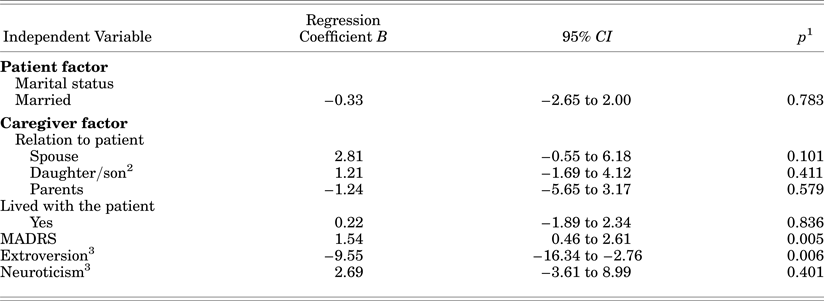
Adjusted associations between caregiver burden and simultaneously entered independent variables were analyzed using multivariate linear regression. The analysis revealed that only caregiver extroversion and MADRS scores were significantly associated with caregiver burden. The influence of neuroticism on caregiver burden was nonsignificant following adjustment (Table 3).
Multivariate linear regression analysis for caregiver burden (n = 227)
CI=confidence interval; MADRS = Montgomery–Åsberg Depression Rating Scale.
1 Adjusted for patient marital status and caregiver factors (i.e., relation to patient, lived with patient, and MADRS and BFI–10 Extroversion and Neuroticism scores).
2 Including daughter-in-law and son-in-law.
3 Data normalized using log transformation.
DISCUSSION
The key finding of our present study was that caregivers' personality and depressive symptoms were both associated with their degree of subjective burden. Patient-related factors were not significantly associated with caregiver burden following adjustment for other independent variables. To the best of our knowledge, this is the first report on the influence of the Big Five personality dimensions on degree of burden among family caregivers of cancer patients in a palliative care setting.
Personality influences an individual's response to stressful situations. Extroverts have been characterized as assertive, energetic, outgoing, sociable, talkative, and “spunky” (John & Srivastata, Reference John, Srivastata, Pervin and John1999). In stressful situations, extroverted individuals tend to choose support-seeking coping styles and to maintain optimism (Amirkhan et al., Reference Amirkhan, Risinger and Swickert1995). Optimism is important in reducing the burden on family caregivers (Contador et al., Reference Contador, Fernandez-Calvo and Palenzuela2012). Social support also influences caregiver burden and mediates psychological morbidity (Teixeira & Pereira, Reference Teixeira and Pereira2013). Particularly in Asia, social support is an important factor in care burden within palliative care contexts (Wang et al., Reference Wang, Chen and Chang2011). Accordingly, extroverted individuals may experience less burden because they tend to cope by seeking support and maintaining their optimism.
In previous studies, extroversion and neuroticism were both predictors of burden in caregivers of dementia and COPD patients (González-Abraldes et al., Reference González-Abraldes, Millán-Calenti and Lorenzo-López2013; Nordtug et al., Reference Nordtug, Krokstad and Holen2011). This accords with our results, though the influence of neuroticism was attenuated following adjustment for caregiver MADRS scores. Meanwhile, in a previous investigation conducted in the United States, neuroticism, but not extroversion, was associated with burden (Kim et al., Reference Kim, Duberstein and Sorensen2005). This discrepancy may result from either cultural or methodological differences; the previous study employed a small sample size, and was concerned with a homogeneous group of predominantly Caucasian spouses. Because our sample consisted entirely of Koreans, it is reasonable to suggest that cultural differences could underlie the discrepancy between these studies' results.
In a previous study, the influence of neuroticism on caregiver burden was indirect, but neuroticism directly influenced caregiver depression (Kim et al., Reference Kim, Duberstein and Sorensen2005). Caregiver depression has also been reported to be directly related to caregiver burden (Grov et al., Reference Grov, Fossa and Tonnessen2006). These previous reports contribute to our understanding of the relationship between neuroticism and caregiver burden, which was found not to be significant following adjustment for caregiver depression.
Depression is prevalent in caregivers of patients with advanced cancer (Han et al., Reference Han, Yuan and Luo2013). A previous study that employed path analysis to identify variables associated with caregiver burden reported that caregiver depression was the only variable directly and significantly associated with caregiver burden (Grov et al., Reference Grov, Fossa and Tonnessen2006). In our present study, greater caregiver depression was significantly associated with higher burden, consistent with earlier reports. It may be that the dysfunctional thoughts and cognitions associated with depression influence caregivers' perceived subjective burden (Vázquez-Sánchez et al., Reference Vázquez-Sánchez, Aguilar-Trujillo and Estébanez-Carvajal2012). Because depression can be treated, it is important that screening and therapeutic programs be available for caregivers of patients with terminal cancer.
Our finding that patient-related factors are not associated with caregiver burden is consistent with one previous study (Park et al., Reference Park, Shin and Choi2012), although other studies have reported associations between patient health status and caregiver burden (Grunfeld et al., Reference Grunfeld, Coyle and Whelan2004; Given et al., Reference Given, Wyatt and Given2004; Yoon et al., Reference Yoon, Kim and Jung2014). Methodological differences may account for these discrepancies. Our study design, which used dyads that included PCU inpatients, may have influenced the results because caregivers are probably more likely to report that patient symptoms are controlled in a PCU than in a community hospital admission (Addington-Hall & O'Callaghan, Reference Addington-Hall and O'Callaghan2009). Previous studies have tended to include only a limited number of patient-related variables, such as sociodemographic factors, performance status, and cancer sites (Park et al., Reference Park, Shin and Choi2012; Yoon et al., Reference Yoon, Kim and Jung2014). Our study therefore represents the most comprehensive investigation of the patient–caregiver dyad-related factors independently associated with caregiver burden in a palliative care setting in Korea. We included patient sociodemographic, clinical, and psychological variables, including depressive symptoms and mental status, in our analyses. A further strength of our study design was that the patient and caregiver data were obtained on the same day, and that the interviews were conducted independently by a psychiatrist and a research coordinator, respectively. This reduced the potential for type I errors that might result from interviewer bias.
Our study has several limitations. First, the cross-sectional design did not allow us to make inferences regarding causality. Therefore, further longitudinal studies are required to establish causal relationships. Second, our study sample was limited to terminally ill cancer patients in the PCU of a single hospital and their caregivers, which may limit the generalizability of our findings. Third, approximately one quarter of the enrolled dyads were excluded from the analysis because personality was not assessed. Therefore, the results may not be representative of the wider population of terminally ill cancer patients and their caregivers. Fourth, though we investigated symptoms indicative of patient distress, including mental outlook, pain, and depression, these symptoms do not encompass all of the symptoms experienced by terminally ill cancer patients. However, pain reportedly has the greatest negative impact on the well-being of terminal cancer patients (Kwon et al. Reference Kwon, Yun and Lee2006).
In conclusion, caregiver personality traits, particularly extroversion and depressive symptoms, are independently associated with care burden. Therefore, evaluating caregiver personality traits is important to detect caregivers who may be more vulnerable to increased subjective burden. Furthermore, depression screening and treatment programs for the caregivers of terminally ill cancer patients are also required.
ACKNOWLEDGMENTS
This study was supported by a grant from the Korean Health Technology R&D Project, Ministry of Health and Welfare, Republic of Korea (A120004).