Introduction
There have been occasional examples of violent behavior by individuals with serious mental illness for as long as there have been people with serious mental illness. In England in 1800, James Hadfield, responding to God’s commands to bring about the Second Coming, fired a pistol but narrowly missed King George III. In the United States in 1835, Richard Lawrence, believing that he was the King of England, attempted to assassinate President Andrew Jackson but his gun misfired. In 1881, President James Garfield was shot to death by Charles Guiteau, who many claimed was insane. Throughout the 19th and first half of the 20th centuries, there continued to be sporadic examples of violent behavior by individuals who today would be diagnosed with schizophrenia, bipolar disorder with psychotic features, or major depression with psychotic features.
A major reason why such episodes were relatively uncommon at this time is that most of the individuals with the most severe forms of serious mental illness were confined to psychiatric hospitals for much of their adult lives. In 1850, the number of such individuals who were hospitalized in the United States was less than 5,000; by 1903 this number had increased to 150,151 and by 1955 to 558,922. It is believed by some that these sharply increased numbers reflected a real increase in the number of individuals affected by serious mental illness.Reference Torrey and Miller 1 Whether this is true or not, the fact remains that during this period the majority of individuals with serious mental illness who had the potential to commit violent acts were confined to asylums.
The Emptying of State Mental Hospitals
The mass exodus of patients from state mental hospitals, known as deinstitutionalization, began in the 1960s. It was driven by 4 major factors. The first was public revelations following World War II that most state mental hospitals were grossly overcrowded and that patients were living in squalid conditions. Second was the introduction in 1954 of chlorpromazine (Thorazine), the first effective antipsychotic, which made it possible, for the first time, to control the symptoms of psychosis and thus to discharge some patients from the hospitals. A third factor was the creation in the 1960s of federal programs such as Supplemental Security Income (SSI), Social Security Disability Insurance (SSDI), Medicaid, and Medicare, which provided fiscal support with federal funds for mentally ill individuals who were living in the community. Patients in state hospitals, however, were not eligible (with a few exceptions) for Medicaid and SSI. Since state mental hospitals continued to be almost completely funded with state funds, the new federal programs created a huge incentive for states to discharge patients to the community and thus effectively shift the cost of their care from the state to the federal government. Fiscal conservatives in the state legislatures therefore strongly encouraged deinstitutionalization. The final factor was the emergence of young, civil libertarian lawyers in the 1960s who decided that mental patients needed to be “liberated.” They implemented a series of successful lawsuits, forcing states to discharge mental patients and making rehospitalization exceedingly difficult.
The emptying of state mental hospitals has been dramatic. From the 558,922 patients confined in 1955, their number decreased to 193,436 by 1975 and to 69,177 by 1995. Today there are only 35,000 individuals with serious mental illness remaining in state psychiatric hospitals. Given the fact that the population in the United States almost doubled during those years, the effective rate of deinstitutionalization is over 96%. When the population increase is included in the calculation, there are today approximately more than 1 million mentally ill individuals living in the community who in the 1950s would have been confined in state mental hospitals.
In addition to these 1 million individuals with serious mental illness who would have been hospitalized in the past, there are additional individuals with serious mental illness who would not have been hospitalized in the past. According to estimates of the National Institute of Mental Health (NIMH), approximately 1.1% of the adult American population has schizophrenia and another 2.2% has severe bipolar disorder. Based on the current population of the United States, that means that 3.3% of adults, or 7.7 million people, are afflicted with these 2 disorders at any given time.
How many of them are receiving treatment for their illnesses? NIMH has estimated that 40% of adults with schizophrenia and 51% of adults with severe bipolar disorder receive no treatment in any given year. 2 This estimate is consistent with the 2010 study by Olfson et al Reference Olfson, Marcus and Doshi 3 that 41% of individuals with schizophrenia received no treatment in the month following their discharge from the hospital. Multiplying this percentage by the number of adults with schizophrenia and severe bipolar disorder means that at least 3.2 million Americans with severe mental illness who are living in the community are receiving no treatment for their illness at any given time. The vast majority of these individuals need antipsychotic and mood stabilizing medication to control the symptoms of their illness; without such medication they continue to experience delusional thinking, auditory hallucinations, mood swings, and other symptoms of their illness. In effect, the United States is a giant laboratory for an unplanned, naturalistic experiment on what will happen if you have 3.2 million people with untreated serious mental illness living in the community.
Initial Signs of Trouble: The 1970s
The results of this unplanned experiment are now obvious. They include hundreds of thousands of untreated mentally ill individuals who are homeless, confined to jails and prisons, being victimized and often living in conditions much worse than existed in the state mental hospitals. These aspects of the outcome have been detailed elsewhereReference Torrey 4 ; in this article, I will focus only on violent behavior as one aspect of the outcome.
California had been a leader among states in emptying its state psychiatric hospitals, and it was therefore not surprising that California showed the first signs of trouble. By the 1970s, episodes of violent behavior by individuals with untreated serious mental illness were being increasingly reported:
-
∙ 1970: John Frazier, responding to the voice of God, killed a prominent surgeon and his wife, 2 young sons, and secretary. Frazier’s mother and wife had sought unsuccessfully to have him hospitalized.
-
∙ 1972: Herbert Mullin, responding to auditory hallucinations, killed 13 people over 3 months. He had been hospitalized 3 times but released without further treatment.
-
∙ 1973: Charles Soper killed his wife, 3 children, and himself 2 weeks after having been discharged from a state hospital.
-
∙ 1973: Edmund Kemper killed his mother and her friend and was charged with killing 6 others. Eight years earlier, he had killed his grandparents because he “tired of their company,” but at age 21 had been released from the state hospital without further treatment.
-
∙ 1977: Edward Allaway, believing that people were trying to hurt him, killed 7 people at Cal State Fullerton. Five years earlier, he had been hospitalized for paranoid schizophrenia but was released without further treatment.
Public concern about such episodes had become so widespread by 1973 that the California state legislature held hearings on this issue. Dr. Andrew Robertson, deputy director of the California Department of Mental Health, offered remarkable testimony. He said that the emptying of the state hospitals had indeed “exposed us as a society to some dangerous people.”
People whom we have released have gone out and killed other people, maimed other people, destroyed property; they have done many things of an evil nature without the ability to stop and many of them have immediately thereafter killed themselves. That sounds bad, but let’s qualify it ... the odds are still in society’s favor, even if it doesn’t make the patients innocent or the guy who is hurt or killed feel any better. 5
At the same time as the violence issue was surfacing in California, it was also appearing in other states. Between 1970 and 1975 in Albany County, New York, a study was done on all 48 homicides committed there. Eight homicides (17%) were committed by individuals with schizophrenia. Most of them were not being treated at the time of the crime, leading the authors to conclude that “closer follow-ups of psychotic patients, especially schizophrenia, could do a lot to improve the welfare of the patient and community.”Reference Grunberg, Klinger and Grumet 6 , Reference Grunberg, Klinger and Grumet 7 In 1979, Dr. Judith Rankin reviewed all the early studies on what was happening to the patients being discharged from the state hospitals. She concluded: “Arrest and conviction rates for the subcategory of violent crimes were found to exceed general population rates in every study in which they were measured.”Reference Rabkin 8
The Evidence Became Clearer: The 1980s
By 1980, the writing was on the wall regarding the outcome of deinstitutionalization for anyone who cared to look. The psychiatric profession, with rare exceptions, did not care to look and denied that there were problems.
Such denial became much more difficult in the 1980s. The decade opened ominously with 3 high profile violent episodes within a 12-month period. Former congressman Allard Lowenstein was killed by Dennis Sweeney, John Lennon was killed by Mark David Chapman, and President Ronald Reagan was shot by John Hinckley. All 3 perpetrators had untreated schizophrenia. Sweeney, for example, believed that Lowenstein, his former mentor, had implanted a transmitter in his teeth through which he was sending harassing voices.
As the decade progressed, such widely publicized homicides became more common:
-
∙ 1985: Sylvia Seegrist, diagnosed with schizophrenia and with 12 past hospitalizations, killed 3 and wounded 7 in a Pennsylvania shopping mall.
-
∙ 1985: Bryan Stanley, diagnosed with schizophrenia and with 7 past hospitalizations, killed a priest and 2 others in a Wisconsin Catholic Church.
-
∙ 1985: Lois Lang, diagnosed with schizophrenia and discharged from a mental hospital 3 months earlier, killed the chairman of a foreign exchange firm and his receptionist in New York.
-
∙ 1986: Juan Gonzalez, diagnosed with schizophrenia and psychiatrically evaluated 4 days earlier, killed 2 and injured 9 others with a sword on New York’s Staten Island Ferry.
-
∙ 1988: Laurie Dann, who was known to both the police and FBI because of her threatening and psychotic behavior, killed a boy and injured 5 of his classmates in an Illinois elementary school.
-
∙ 1988: Dorothy Montalvo, diagnosed with schizophrenia, was accused of murdering at least 7 elderly individuals and burying them in her backyard in California.
-
∙ 1988: Aaron Lindh, known to be mentally ill and threatening, killed the Dane County coroner in Madison, Wisconsin. This was one of 6 incidents in that county during 1988 “involving mentally ill individuals … [that] resulted in four homicides, three suicides, seven victims wounded by gunshots, and one victim mauled by a polar bear” when a mentally ill man climbed into its pen at the local zoo.Reference Kuhlman 9
-
∙ 1989: Joseph Wesbecker, diagnosed with bipolar disorder, killed 7 and wounded 13 at a printing plant in Kentucky.
Another indication that such episodes of violence were increasing was a study that compared admissions to a New York state psychiatric hospital in 1975 and 1982. It reported that “the percentage of patients who had committed violence toward persons while living in the community in the 1982 cohort was nearly double the percentage in the 1975 cohort.”Reference Karra and Otis 10 In addition, “the percentage of patients who had had encounters with the criminal justice system in the 1982 cohort was more than quadruple the percentage in the 1975 cohort.”Reference Karra and Otis 10
The Epidemiological Catchment Area (ECA) surveys carried out between 1980 and 1983 also contributed to the discussion about violence. Individuals with serious mental illness living in the community reported much higher rates of violent behavior than other community residents. For example, individuals with schizophrenia were 21 times more likely to have used weapons in a fight.Reference Swanson, Hozer, Ganju and Jono 11
Finally, the question continued to be raised regarding what percentage of all homicides were attributable to individuals with serious mental illness. A study of 71 homicides committed between 1978 and 1980 in Contra Costa County, California, reported that 7 of the 71 (10%) were carried out by individuals diagnosed with schizophrenia, all of whom had been psychiatrically evaluated prior to the crime and all of whom had refused medication.Reference Wilcox 12
The End of Professional Denial: The 1990s
By the early 1990s, the evidence linking violent behavior to untreated serious mental illness was becoming overwhelming. The effect of violent behavior on families became clear when the National Alliance for the Mentally Ill (NAMI) released the results of its 1990 survey of 1401 NAMI families. In the preceding year in 11% of the families, the seriously mentally ill family member had physically harmed another person.Reference Steinwachs, Kasper and Skinner 13 In 1992, Link et al Reference Link, Andrews and Cullen 14 reported the results of their carefully controlled study of individuals with serious mental illness living in New York. Such individuals were found to be 3 times more likely to commit violent acts such as weapons use or “hurting someone badly.” The sicker the individual, the more likely they were to have been violent.Reference Link, Andrews and Cullen 14 Such studies were enough to convince John Monahan, who had been one of the skeptics regarding the causal relationship of mental illness and violent behavior, and in 1992, he published his mea culpa: In reviewing many of these studies in 1992, Prof. John Monahan concluded:
The data that have recently become available, fairly read, suggest the one conclusion I did not want to reach: Whether the measure is the prevalence of violence among the disordered or the prevalence of disorder among the violent, whether the sample is people who are selected for treatment as inmates or patients in institutions or people randomly chosen from the open community, and no matter how many social and demographic factors are statistically taken into account, there appears to be a relationship between mental disorder and violent behavior.Reference Monahan 15
Throughout the 1990s, the evidence linking serious mental illness to violent behavior continued to accumulate, and increasingly the studies pinpointed the importance of treatment. A study of 133 outpatients with schizophrenia reported that “13 percent of the study group were characteristically violent” and that “71 percent of the violent patients... had problems with medication compliance.”Reference Bartels, Drake, Wallach and Freeman 16
Throughout the 1990s, the public was also repeatedly reminded of the link between mental illness and violence by a continuing series of high-profile homicides. The names of the perpetrators flashed across the evening news with predictable regularity, each story different and yet remarkably the same. If the individuals had been receiving treatment for their mental illness, such tragedies would probably not have occurred. As the decade progressed, the pace seemed to quicken: James Brady in Atlanta; Gary Rimert in South Carolina; John Kappler in Boston; Betty Madeira in Los Angeles; Keven McKiever in New York; Gary Rosenberg in Rochester; Jeanette Harper in West Virginia; Debra Jackson in Minnesota; Gian Ferri in San Francisco; James Swann in Washington, DC; Colin Ferguson in New York; Linda Scates in California; William Tager in New York; Michael Laudor in New York; John Salvi in Massachusetts; Wendell Williamson in North Carolina; Michael Vernon in New York; Reuben Harris in New York; Mark Bechard in Maine; John DuPont in Pennsylvania; Alfred Head in Virginia; Daniel Ellis in Iowa; Jorge Delgado in New York; Steve Abrams in California; Julie Rodriguez in Sacramento; Larry Ashbrook in Fort Worth; Russell Weston in Washington; Lisa Duy in Salt Lake City; Michael Oullette in Connecticut; Paul Harrington in Michigan; Salvatore Garrasi in New York; Andrew Goldstein in New York—the list seemed to stretch endlessly. After each headline, people inevitably asked why it happened; no answers were forthcoming, and then the story was gone. The only tragedy that generated sustained attention was the Weston case because he killed 2 guards as he stormed the U.S. Capitol, trying to reach a machine he believed could reverse time. Because several members of Congress were nearby when this happened, it did get the attention of Congress, at least briefly.
Since many of the homicides involved multiple victims, it was increasingly asked whether such mass killings were increasing. In 1999, Hempel et al Reference Hempel, Meloy and Richards 17 identified 30 mass killings in which firearms were used and at least 3 persons were killed between 1949 and 1998. Even though the killings had occurred over a 50-year period, 21 of them, or 70%, had occurred during the final 13 years, from 1986 to 1998. And among the 30 perpetrators of the mass killings, 12 had definite psychotic symptoms at the time and another 8 “exhibited behavior suggestive of psychosis.”Reference Hempel, Meloy and Richards 17
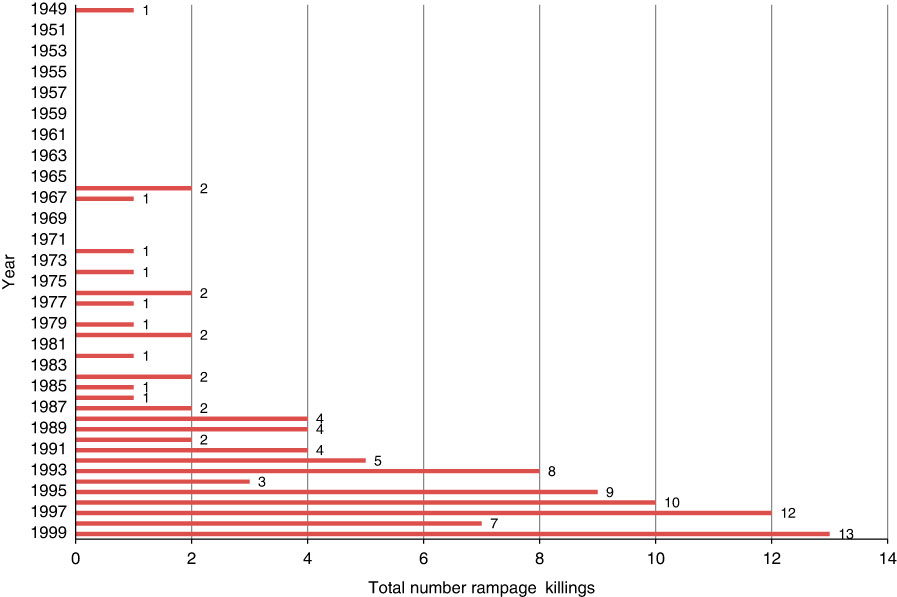
In 2000, Hempel et al’s findings were validated by a detailed New York Times survey of 100 mass killings between 1949 and 1999. Only 10 of the mass killings occurred between 1949 and 1979, whereas 90 of them occurred between 1980 and 1999 (Figure 1). The survey also reported “much evidence of mental illness in its subjects. More than half had histories of serious mental health problems … 48 killers had some kind of formal diagnosis, often schizophrenia.” Among these, 24 had been prescribed psychiatric drugs but “14 had stopped taking them.”Reference Fessenden 18
Rampage killings with multiple victims, at least one of whom died (1949–1999).Reference Fessenden 18

Thus, by the end of the century, the violent consequences of the poorly planned deinstitutionalization of psychiatric patients were evident to everyone. Dr. John Talbott, one of the few American psychiatrists who had warned about releasing hundreds of thousands of patients without providing follow-up treatment for them, had been prophetic when he had earlier written: “With the knowledge that state hospitals required 100 years to achieve their maximum size, the precipitous attempt to move large number of their charges into settings that in fact did not exist must be seen as incompetent at best and criminal at worst.”Reference Talbott 19
Into the 21st Century
Thus, by the beginning of the present century, the relationship between deinstitutionalization, untreated serious mental illness, and violent behavior had been clearly established. A definitive meta-analysis by Fazel et al Reference Fazel, Gulati, Linsell, Geddes and Grann 20 identified 20 studies on violence and psychosis published between 1980 and 2009. Each of the 20 studies showed a positive association, and the authors concluded that “schizophrenia and other psychoses are associated with violence and violent offending, particularly homicide.”Reference Fazel, Gulati, Linsell, Geddes and Grann 20 Another seminal study by Fazel et al Reference Fazel, Wolf, Palm and Lichtenstein 21 examined longitudinal data on violent crime and schizophrenia and related disorders in Sweden over 38 years, from 1972 to 2010. It reported that the rate of violent crime by individuals with these diagnoses not only increased over the 38 years but, most importantly, increased in direct proportion to the decrease of psychiatric hospitalization. Specifically, they “showed that the number of inpatient nights [in psychiatric hospitals] was negatively associated with violence … that is, fewer annual inpatient nights were associated with more violence … perpetrated by those with schizophrenia and related psychoses.”Reference Fazel, Wolf, Palm and Lichtenstein 21 This strongly supported the causal relationship between deinstitutionalization and the increase in violence.
In regard to risk factors for increasing violent behavior among individuals with schizophrenia, multiple studies have shown that substance abuse is an important risk factor.Reference Fazel, Gulati, Linsell, Geddes and Grann 20 , Reference Witt, van Dorn and Fazel 22 However, individuals with schizophrenia and related psychoses have been shown to have increased levels of violent behavior even when substance abuse is not involved.Reference Van Dorn, Volavka and Johnson 23 In an Australian study, individuals with schizophrenia without substance abuse “were more than twice as likely as controls to have a violent conviction.”Reference Short, Thomas, Mullen and Ogloff 24
The present century has produced additional evidence that individuals with serious mental illness are responsible for at least 10% of all homicides. A study in Indiana examined the records of 518 individuals in prison who had been convicted of homicide between 1990 and 2002. Among the 518, 53 (or 10.2%) had been diagnosed with schizophrenia (n=27), bipolar disorder (n=12), or other psychotic disorders not associated with drug abuse (n=14). An additional 42 individuals had been diagnosed with mania or major depressive disorder. It should be emphasized that the study included only those who had been sentenced to prison and did not include those individuals who had committed homicides and were subsequently found to be incompetent to stand trial or not guilty by reason of insanity, and therefore sent to a psychiatric facility instead of prison. Thus, the 10.2% is probably an undercount.Reference Matejkowski, Cullen and Solomon 25
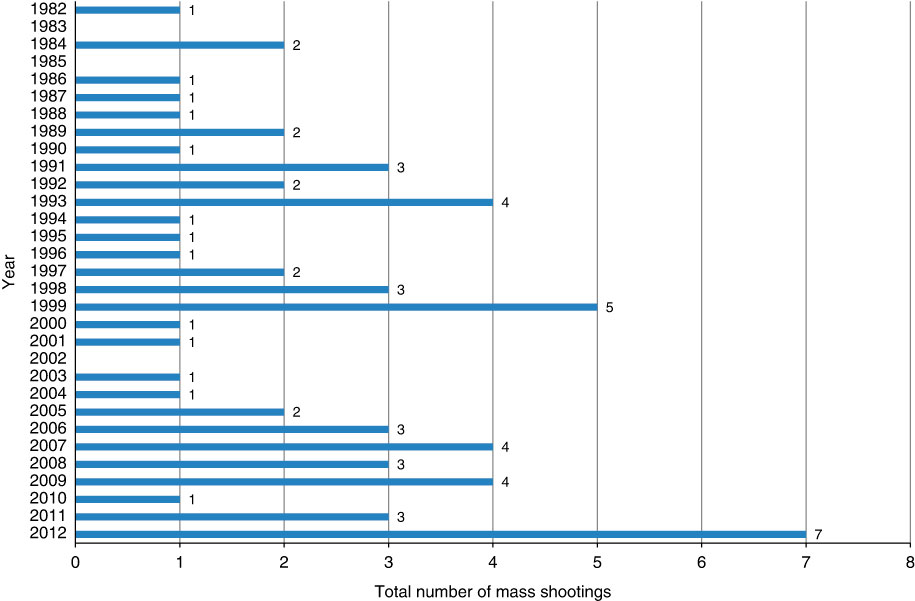
The present century has also produced additional evidence that individuals with serious mental illness are responsible for at least half of the continuing mass killings. A 2012 study suggests that such killings continue to occur regularlyReference Follman, Aronsen and Pan 26 (Figure 2). Virginia Tech, Tucson, Aurora, and Newtown are now synonymous with this issue. But these are merely the mass killings that receive the most public attention. In the 5-year period before the Tucson tragedy, which was highly publicized because a member of Congress was involved, there had been 10 other similar tragedies, in addition to Virginia Tech, involving individuals with serious mental illness who were not being treated. Thus, Jared Loughner in Tucson became a household name after he killed 6 and injured 13, including Congresswoman Giffords, in Tucson. By contrast, Isaac Zamora, who killed 6 and injured 4 in Seattle in 2008, was quickly forgotten.
Mass shootings with >4 deaths (1982–2012), not including the person doing the shooting.Reference Follman, Aronsen and Pan 26

What Is the Answer?
The answer, in a word, is treatment. The deinstitutionalization of individuals from state mental health hospitals was fundamentally a sound idea; the failure of this idea was in how it was carried out. Emptying the hospitals was thus a good idea, but failing to ensure that the individuals leaving the hospital would continue to receive the treatment necessary to keep them from again becoming psychotic has been a disaster.
Many studies have examined the relationship between medication compliance and violent behavior in mentally ill individuals. A 2002 study of 802 adults with serious mental illness reported that those who had been violent were almost twice as likely to have been noncompliant with medications.Reference Swanson, Swartz and Essock 27 A 2006 study of 1011 outpatients with serious mental illness found that “community violence was inversely related to treatment adherence.”Reference Elbogen, van Dorn, Swanson, Swartz and Monahan 28 A 2007 study of 907 individuals with serious mental illness reported that those who were violent were “more likely to deny needing psychiatric treatment.”Reference Elbogen, Mustillo, van Dorn, Swanson and Swartz 29 A 2014 study using the Swedish national database reported that “violent crime fell by 45% in patients receiving antipsychotics.”Reference Fazel, Zetterqvist, Larsson, Långström and Lichtenstein 30 Treatment is especially important during the first episode of psychosis, at which time violent behavior is especially common.Reference Nielssen and Large 31
There are many ways to ensure that individuals with serious mental illness receive treatment. Many patients who are aware of their own illness will accept treatment voluntarily. Others, especially those with anosognosia and are thus unaware of their own illness, will require some form of involuntary treatment. The most effective forms of outpatient involuntary treatment are assisted outpatient treatment (AOT), conditional release, and mental health courts.
Assisted outpatient treatment (AOT)
AOT is a form of outpatient commitment in which mentally ill individuals are told by court order that they can live in the community as long as they follow their treatment plan, but if they do not do so, they can be involuntarily returned to the hospital. It is available in all states except Massachusetts, Connecticut, Maryland, Tennessee, and New Mexico. The criteria for being put on AOT vary somewhat by state, but usually include having had a history of not following treatment plans and becoming dangerous to self or others when not being treated. Examples of AOT are Kendra’s Law in New York and Laura’s Law in California. AOT has been shown to be effective in reducing rehospitalizations, incarcerations, victimizations, episodes of violence, and homelessness.Reference Torrey 32 A study in England claimed that the English equivalent of AOT—called community treatment disorders—was not effective in reducing psychiatric readmissions.Reference Burns, Rugkasa and Molodynski 33 However, this study was seriously flawed in not including the patients most likely to have benefited from community treatment orders, and also insofar as it merely compared one form of mandated treatment against another form of mandated treatment (called Section 17). Thus, the fact that there was no difference in psychiatric rehospitalization was not surprising.
Conditional release
Patients who have been legally committed to a hospital can be released on the condition that they continue to be compliant with medication. Violation of the condition can result in rehospitalization. In most states the hospital director has the authority to do this without asking permission of the courts. Forty states have laws permitting conditional release. In the past, this form of assisted treatment was widely used for both civil and forensic (criminal) cases, but now it is used mostly for the latter.
Until recently, New Hampshire was the leading state using conditional release for civilly committed patients; in 1998, 27% of patients released from the New Hampshire State Hospital were put on conditional release. In a study of the effectiveness of conditional release on medication compliance, 26 severely psychiatrically ill patients were conditionally released from the New Hampshire State Hospital with assessment of various measures for the year prior to hospitalization and for the first 2 years on conditional release. The result was a dramatic decrease in violent behavior from 5.6 episodes in the year prior to hospitalization to 1.1 episodes in the second year on conditional release.Reference O’Keefe, Potenza and Mueser 34
Mental health courts
Mental health courts are courts set up specifically to adjudicate cases in which a person with mental illness has been charged with a crime. Some mental health courts take both misdemeanors and felonies, others only the former. Mental health courts are a form of jail diversion for mentally ill individuals charged with crimes. In most cases, the judge gives the defendant the choice of going to jail or cooperation with an outpatient treatment program, including medication. If the person refuses to follow the treatment plan, he/she can be sent to jail. Mental health courts have been shown to be very effective in keeping people on medication, and in reducing rehospitalizations, incarcerations, and violent behavior. The main limitation of such courts is that a mentally ill person has to have committed a crime in order to be eligible.Reference Lamb and Weinberger 35 , Reference Steadman, Redlich, Callahan, Robbins and Vesselinov 36
Conclusion
In conclusion, the relationship between deinstitutionalization and the increasing episodes of violent behavior by individuals with serious mental illness who are not being treated has been firmly established. Until we address the treatment issue and utilize proven remedies, such as assisted outpatient treatment, conditional release, and mental health courts, we should expect these episodes of violent behavior to continue. Such violence is a major source of stigma against mentally ill individuals, thus affecting all those so affected.
Disclosures
The author has nothing to disclose.