Introduction
When we examine the quality of life for each individual, several specific dimensions need to be considered. Health conditions and quality of family relationships are critical. When the individual in question is married, his/her marital quality is important. When he/she has a job, subjective assessment of that job is important. Social relationships regarding friends, neighbors, colleagues, relatives, etc. may be critical also. Although the quality of life is more than the sum of qualities of these specific areas of one's life, it is still determined to a great extent by the qualities of these sub-areas, including marital and family relationships (Proulx et al., Reference Proulx, Helms and Buehler2007).
In this article we analyze marital and family satisfaction. In particular, we focus on the determinants of satisfaction with marriage and/or family in a cross-cultural setting. Throughout the world, marriage and family represent a large portion of an individual's life, yet what determines the quality of marriage and family life may depend on a particular context of the society in which the individual resides. Our major subject matter for this analysis is people of Asian societies. To understand the role of cultural contexts, Asian societies are best suited because of their vast differences from Western societies in history and culture. Below, we examine satisfaction with marriage and family mostly in Asian societies, along with a couple of non-Asian societies.
Partly due to the influence of Confucianism, which originated in China, most Asian societies are known to emphasize family relationships, particularly intergenerational ones. This includes co-residence between adult children and their elderly parents (Lin et al., Reference Lin, Goldman, Weinstein, Lin, Gorrindo and Seeman2003; Zhang, Reference Zhang2004). The ‘family lines (lineages)’ are deemed something precious that goes above and beyond individual interests, in some extreme cases.
On the other hand, spousal relationships are taken somewhat lightly in most Asian societies. Unlike Western societies where romantic marriages have been the norm, many Asian marriages have resulted from arrangements between two families, primarily motivated by concerns for family lineages/connections and economic benefits for the two families involved. Marriages in Asian societies have been often described as ‘institutions’ rather than ‘companionships’ (Burgess et al., Reference Burgess, Locke and Thomas1971). As an entity mostly for convenience, economic reasons, and the maintenance of family lineages rather than romantic feelings, Asian marriages have been more stable than their Western counterparts (Divorce Magazine, 2010; United Nations, 1982, 1990). In the last couple of decades, however, marriages in many Asian societies have changed substantially. First, more marriages today are based on companionship than previously in many Asian societies (e.g. Fuller and Narasimhan, Reference Fuller and Narasimhan2008). Subsequently, expectations of marital life have changed among married people, particularly married women (Pimentel, Reference Pimentel2000). Rapid increases in the participation of married women in the labor force have added another dimension to marital life (Yu, Reference Yu2009). Gender relationships between husbands and wives have become contentious issues in societies such as Japan, Taiwan, and South Korea (Ochiai and Molony, Reference Ochiai and Molony2008).
One of the serious consequences of spousal conflicts and relatively unfavorable conditions for married women in East Asian societies is extremely low fertility rates (Jones, Reference Jones2007). This is often regarded as a result of role overloads for married women who are more likely than previous generations to be in the labor force. As of 2009, six East Asian societies (Macau, Hong Kong, Singapore, Taiwan, South Korea, and Japan, in the order from the lowest) are listed among the bottom seven out of 223 societies in total fertility rates (Central Intelligence Agency, 2010).
Another issue is the rise in divorce rates among these same societies (e.g. Raymo et al., Reference Raymo, Iwasawa and Bumpass2004, for Japan). Marital satisfaction has been known to be related to marital stability, though the relationship is not necessary dominant (White and Booth, Reference White and Booth1991). Thus, research on marital satisfaction in a cross-cultural context is a timely issue in rapidly changing Asian societies.
Satisfaction with family life in general (rather than marital satisfaction) may not have been a very popular topic for social science researchers. The context of Asian societies, however, warrants a closer examination of this particular concept. As stated above, people in Asian societies pay more attention to intergenerational relationships. Younger generations feel a filial responsibility toward older generations (e.g. parents and grandparents), and often take care of the elderly parents once they become frail and are unable to care for themselves. In turn, older generations feel a very strong responsibility to raise the younger generation (e.g. children) ‘right’. Possibly because parents in these societies often expect their children to be their caregivers when they themselves become old, they invest in their children's education and other areas of human capital to a greater extent than their Western counterparts. Their children's success (both socially and economically) is more critical to their own welfare than it is for their Western counterparts.
For both types of intergenerational relationships, particularly in Asia, women are de facto central figures. Even in the United States, women in their forties and fifties are often called a ‘sandwich generation’ (Zal, Reference Zal1992) who take care of their children and attend their parents and/or parents-in-law. Due to more traditional gender relationships in their societies, Asian women are more burdened with the welfare of their children, parents, parents-in-law, and even grandparents. Even though more married women in some developed societies are entering or remaining in the labor force, their husbands have not changed their traditional attitudes and display highly gendered behavior, thereby causing many married women in Asia to become disgruntled. Low fertility rates and high divorce rates are two phenomena that have surfaced in recent times. When we examine the satisfaction of women toward family life in general, and that of married women in particular, we should see evidence of the pressure they feel.
Although we deal with marital satisfaction and family satisfaction separately, family satisfaction has not been the focus of many studies. Thus, the conceptual argument in this article is primarily about marital satisfaction. Some of the causal mechanisms may be applied to family satisfaction and some may not. One notable variable that affects family satisfaction, but not marital satisfaction, is marital status. The respondent must be married to experience marital satisfaction, but this is not true for family satisfaction. All an individual needs for the latter is family members, regardless of whether or not they reside together.
As for specific determinants of marital satisfaction, several conceptual models have been proposed. Robert Lewis and Graham Spanier (Reference Lewis, Spanier, Wesley, Reuben Hill and Reiss1979), for example, proposed a comprehensive model that utilizes such key variables as social and personal resources, satisfaction with life style, and rewards from spousal interaction. Because the comparative data we use for this article are not specifically designed for family research, many key predictors are missing (e.g. marital communication and psychological/attitudinal variables). Thus, our predictors are largely of a demographic nature, such as age, income, education, employment status, and marital status.
One of the fundamental variables affecting marital satisfaction is the respondent's gender. The marital satisfaction of married women on average is lower than that of their husbands, but this gender gap decreased in the United States from 1980 to 2000 (Amato et al., Reference Amato, Johnson, Booth and Rogers2003). In Asian societies, however, gender is still expected to be very important. Ellen Pimentel (Reference Pimentel2000), for example, shows that in urban China a husband's mean marital satisfaction is higher than that of the wife's, whether measured by ‘closeness’ or ‘disharmony’. Given the level of the burden that women in Asia carry in their family relationships, gender may be more important in family satisfaction. Therefore, we analyze male and female data separately in the analyses presented later.
There has been a well-known debate on the non-linear (U-shaped) relationship between family life-cycle stages and marital satisfaction. It has been found that married couples with children experience lower marital satisfaction. Marital satisfaction is usually higher for couples in later family life cycle stages (Glenn, Reference Glenn1989). Although some scholars claim that it is a cohort or period effect disguised as developmental changes within each couple (Vaillant and Vaillant, Reference Vaillant and Vaillant1993; VanLaningham et al., Reference VanLaningham, Johnson and Amato2001), this U-shaped relationship has been found with many data sets for different time periods in the United States and some Asian countries (Chung et al., forthcoming). In this article, the only variable pertaining to family life-cycle stages is the respondent's age. Thus, we include this variable along with its squared term to capture possible U-shaped relationships between the respondent's age and his/her satisfaction with marriage and/or family.
Past literature based on American marriages tended to downgrade the importance of socioeconomic characteristics as determinants of marital satisfaction. Marriages are based on the affection between the spouses so that economical adversities can be overcome to some extent. As many marriages in Asian societies are still arranged (Madathil and Benshoff, Reference Madathil and Benshoff2008) and family is more ‘institutionalized’, however, these socioeconomic characteristics may be more critical in these societies than in the United States. For instance, one study found that among South Korean couples, economic pressure hurts marital satisfaction through emotional stress and marital conflict, particularly among women (Kwon et al., Reference Kwon, Rueter, Lee, Koh and Ok2003).
Hypotheses
Based on the discussion above, we assembled the following hypotheses:
1. On average, women show lower satisfaction with marriage and family than men.
2. Subjective assessment of male dominance in the society where the respondent lives has negative effects on marriage and family satisfaction among women, but not among men.
3. Age shows U-shaped effects on both marriage and family satisfaction.
4. Given that marriage in some Asian societies is still an economic rather than romantic institution, socioeconomic characteristics of the respondent and his/her family (household income, standard of living, and/or own education) affect marital and/or family satisfaction.
5. There are cross-level interactions on marital and family satisfaction. For example, in ‘male-dominant’ societies, non-traditional behavior of women (e.g. employment) shows a more negative effect on marital/family satisfaction than other societies. The causal structures should be different between societies with large mean incomes and those with small incomes, though the direction and specific predictors involved are not predicted.
Data
Data were taken from the AsiaBarometer Survey, a yearly social survey of people in mostly Asian societies between 2003 and 2008 (Inoguchi et al., Reference Inoguchi, Basanez, Tanaka and Dadabaev2005). Throughout the survey years, data were collected from 32 societies (see Table 1 for the list of them), and in some societies data were collected in multiple years. The Japanese Ministry of Education and Science awarded a grant to the AsiaBarometer Survey project, led by Takashi Inoguchi, during the period from 2005 to 2008. For the present analysis, we combined multiple years of data for each society.
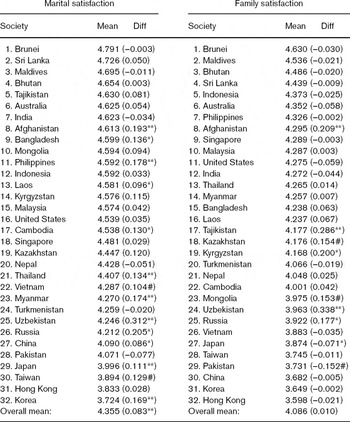
Marital and family satisfaction: mean values and gender differences by society

Note: The gender difference in mean scores is shown in parentheses (male mean − female mean). Positive scores indicate higher means for males.
#p < 0.10, *p < 0.05, **p <0.01.
Analytical procedure
Our dependent variables are satisfaction with one's marriage (if the respondent is married) and satisfaction with one's family. First, we obtained a distribution of mean scores across societies and genders. Treating societies as the unit of analysis (N = 32), we then ran regression analyses with each variable's society-level mean as the dependent variables and other society-level variables as predictors. As our N was small, our interest was more in the sign of each coefficient, rather than statistical significance.
Then we treated individuals as the unit of analysis and ran an Hierarchical Linear Model (HLM) for both dependent variables using individual- and society-level predictors. As we expected the mechanism to determine marital satisfaction and family satisfaction to be different for men and women, we analyzed them separately. We used the HLM to examine the effects of individual-level predictors, society-level predictors, and cross-level interaction effects. Cross-level interaction effects allow us to analyze such questions as whether the effect of household income on marital (family) satisfaction varies depending on the average income of the society where the respondent lives.
Measures
The dependent variables, satisfaction with marriage and satisfaction with family are both measured with a single question. The questions started as: ‘Please tell me how satisfied or dissatisfied you are with the following aspects of your life’, and five response categories were given from: (1) very satisfied to (5) very dissatisfied. One of the items was ‘Marriage [if married] (including de facto married couples)’ and another was ‘family life’. The responses were reverse-coded so that higher scores indicate higher satisfaction. The correlation between these two items (among married respondents only) was fairly strong at 0.527.
Individual-level predictor variables are mostly straight from the questionnaire. Household income was based on the responses to income categories (between seven and 24 of them, depending on society and year). We took the midpoint for each category and an appropriate value for the top category, adjusted to the 2008 value using the consumer price index for each society, converted to US dollars using the 2008 exchange rates, and finally took a natural log. Related to income, the AsiaBarometer Survey included a question on the respondent's subjective standard of living. The question asks: ‘How would you describe your standard of living?’ The five categories are: (1) high, (2) relatively high, (3) average, (4) relatively low, and (5) low. The response was reverse-coded so that higher scores indicate high standards of living.
Questions about education were worded differently for each society. To make various educational categories comparable to each other, we chose the following five categories: (1) no formal education, (2) elementary/junior high/middle school, (3) high school, (4) professional school/technical school, and (5) university/graduate school. The respondent's employment status was measured with a simple dichotomy of whether he/she was employed or not, obtained from a question about the current type of work the respondent had. The number of family members living in the same household and the respondent's age were based on self reports. The respondent's marital status was measured with four dummy variables (married, divorced/separated, widowed, and other) with never married as the reference category. Finally, the respondent's subjective evaluation of ‘male dominance’ in his/her country of residence was based on the response to the question, ‘Do you think that on the whole men and women are treated equally in your country?’ The five response categories included: ‘men (women) are treated much (somewhat) more favorably than women’ and ‘men and women are treated equally’. They were recoded to indicate ‘male dominance’, starting from (5) men much more to (1) women much more.
We also had society-level variables. For society-level analyses, the dependent variables were simply the mean score of satisfaction with marriage/family for each society. Likewise, society-specific mean values were used for log household income, education, and male dominance.
The only genuinely society-level variable was the regime for each society. The 32 societies were categorized into four groups of (former) socialist, familialist, Western, and developing. This typology was broadly based on Hans-Peter Blossfeld and Catherine Hakim's (Reference Blossfeld and Hakim1997) original five categories, which was expanded from Gosta Esping-Aldersen's seminal welfare state typology (Esping-Andersen, Reference Esping-Andersen1990). As we were dealing mostly with Asian societies, we added the category for ‘developing societies’. The grouping was as follows: Western societies (the United States and Australia), familialist societies (Singapore, Japan, Korea, Brunei, Hong Kong, and Taiwan), former or current socialist societies (Russia, Vietnam, China, Kazakhstan, Tajikistan, Turkmenistan, Kyrgyzstan, and Uzbekistan), and developing societies (Malaysia, Indonesia, Philippines, Thailand, India, Pakistan, Afghanistan, Sri Lanka, Myanmar, Cambodia, Laos, Bangladesh, Maldives, Bhutan, Mongolia, and Nepal).
Findings
Table 1 represents mean values of marital satisfaction (for married people only) and family satisfaction for each of the 32 societies.
From Table 1, we learn a couple of interesting patterns. First, rankings of the societies are fairly similar between marital satisfaction and family satisfaction. When we calculated a Pearson correlation coefficient for the 32 pairs of mean values, it was 0.89 (p < 0.001). As marriage is a large part of family, this large correlation is not surprising. This indicates that in societies where people are more (dis)satisfied with marriage, they tend to be more (dis)satisfied with their family life in general.
From Table 1, we can see that the top four societies are identical between the two types of satisfaction (except for their orders), and they are Brunei, Sri Lanka, Maldives, and Bhutan. With the exception of Brunei, a small South Asian country abundant with crude oil, all these societies are relatively underdeveloped and of rural nature, devoid of fast-paced post-industrial lifestyles.
Table 1 also shows that the bottom six societies are identical between these two indicators (again, except for their orders). They are Korea, Hong Kong, Taiwan, Japan, Pakistan, and China. Korea, Hong Kong, Taiwan, and Japan are all small East Asian societies with few natural resources. In these societies, human resources, such as an efficient and productive labor force, and technological advancement make up for insufficient natural resources. China is another East Asian society on the track of rapid economic advancement. All these societies share a certain cultural element called Confucianism. Originating in China, Confucianism emphasizes the welfare of families and kin groups over that of individual group members.
One principle that people in these societies follow is the notion of hierarchy among societal and family members. Two basic factors in determining this hierarchy are age and gender, and seniority by age and gender inequality have been inseparable elements in these societies deeply affected by Confucianism. While not a Confucian country, Pakistan is one of the fundamental Islamic societies included in the sample, along with Afghanistan. Women in these societies are restricted in economic and social aspects of their lives, possibly leading to a lower level of satisfaction with their marriages and family lives.
The numbers shown in parentheses in Table 1 indicate gender differences in their mean values of satisfaction with marriage and family. Positive numbers indicate men are more satisfied than women. In 14 out of the 32 societies, men showed statistically significant, higher means than women in their marital satisfaction. In no societies did women show higher means. When we examined data across the 32 societies together, we also found a gender difference. For family satisfaction, on the other hand, men showed higher means than women in seven societies, whereas the pattern was reverse in two societies. There was no gender difference for the data combined for the 32 societies. Hypothesis 1 regarding gender differences (men in advantage) was strongly supported for marital satisfaction. The support for family satisfaction was weak at best.
It should also be noted also that the four small societies with low mean scores mentioned above are some of the wealthiest in Asia. This is in stark contrast with the top four societies (again, except for Brunei). After all, is it not the case that economic development has been sought after and achieved in some societies for the welfare of societal members? Or is the relatively poor performance in marital/family satisfaction offset by higher standards of living in these societies? We examine this dilemma in more detail in the following sections.
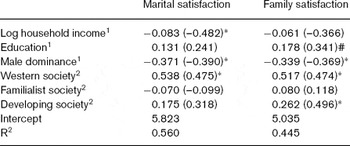
Before analyzing individual-level data, we would like to quickly examine the results from regression analyses treating societies as the unit of analysis and the mean marital/family satisfaction as dependent variables (N = 32). Table 2 shows the results. First, we note that a little difference exists in the fit of the regression models between marital satisfaction and family satisfaction. While R2 is reasonable for marital satisfaction (R2 = 0.560), it is a little smaller for family satisfaction (R2 = 0.445). For marital satisfaction, the mean logged income and the mean value of subjective evaluation of male dominance in each society are negatively related to the mean values for each society. In other words, married people in societies where the mean income is low and people think that society is less male-dominant are more satisfied on average with their marriages. Compared to former or current socialist societies, the mean marital satisfaction level in Western societies (the United States and Australia) is higher on average.
Regression analyses of marital/family satisfaction at the society level (standardized coefficients in parentheses)

Notes:
1 Predictors represent means for each society in the individual data in our sample.
2 The reference category is (former) socialist societies (see Methods section for classification). Choosing different types of societies as the reference group did not alter the findings, including statistical significances.
#p < 0.10, *p < 0.05, **p < 0.01.
The causal relationship is very similar for family satisfaction. The signs for relationships are mostly the same as those for marital satisfaction. The only difference is whether certain predictors attain significance or not. For example, the mean logged household income does not attain statistical significance for family satisfaction, whereas the developing society dummy does. Of course, we cannot interpret these macro-level results as being at work at the individual level, because that would be a classic case of ecological fallacy.
So far we have learned that, at the society level, economic development does not seem to increase the mean values of satisfaction with marriage and/or family for each society. In fact, the mean log household income for the 32 societies in our sample decreases the mean marital satisfaction. Those in developing societies, on average, seem to be more satisfied with their family than those in (former) socialist societies. Does this pattern then hold at the individual level? What are other factors that explain satisfaction with marriage and/or family? Are individual satisfactions affected by the same macro-level variables? Are there any contextual effects (i.e., the effects of individual-level variables depending on the level of macro variables)?
To estimate the effects of both within-society and between-society variables on individual satisfaction without bias, the Hierarchical Linear Model (HLM) has been proposed and extensively used in the last decade. We will examine this multi-level model, including all society-level variables introduced in Table 2 and various individual-level variables (household income, the respondent's age, education, etc.).
This structural model has the following equations as its basic elements:




. . .

Here, Yij represents the Y-value for the ith individual in the jth society. X represents individual-level predictors and W represents society-level predictors. Also, k is the number of individual-level predictors and m is the number of society-level predictors. The simplest possible multi-level model can be expressed as:




. . .

This model assumes no cross-level interaction (contextual effect). In the estimation of β 1, HLM gives us the mean of the estimates for β 1 across societies (in our case, the mean of 32 estimates). Table 3 presents HLM results. Standardized regression coefficients are not available in HLM.
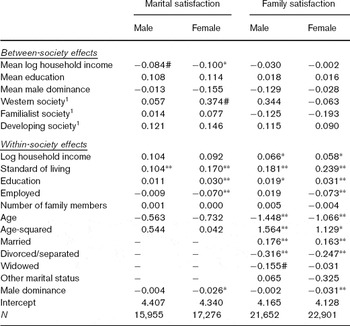
HLM analyses of marital/family satisfaction, between-society and within-society effects

Notes:
The reference category is the (former) socialist society (see Methods section for classification). Choosing different types of societies (familialist for marital satisfaction and developing for family satisfaction) did not alter the findings, including statistical significances.
#p < 0.10, *p < 0.05, **p < 0.01.
As for society-level variables, HLM produced more ‘conservative’ results than those obtained in the macro-level model (Table 2). Still, there are some interesting findings. It seems that the mean income for each society has negative effects on marital satisfaction, if not on family satisfaction. In societies where the mean income is higher, people are less satisfied with their marriage. We need to note that the regime is controlled for, so that the income effects are only within each regime (Western, familialist, socialist, and developing societies). This is in contrast to the effect of household income at the individual level, which seems positive, particularly for family satisfaction (see Table 3, the bottom half). Within each society, those with larger incomes tend to be more satisfied with their family.
Another individual-level variable representing the respondents’ economic status is their assessment of their own standard of living. Its effects are clearly positive, even when we controlled for the logged household income. Given the subjective nature of this ‘standard of living’ variable, its relationship to another variable of subjective nature, ‘satisfaction with marriage (or family)’, might have been expected.
Generally, education has positive effects on marital and family satisfaction. At the individual level, education has positive effects on people's satisfaction with marriage and family (with a possible exception of marriage for men). People in societies where the average educational achievement is higher appear to be more satisfied with their marriage, although these estimates (b = 0.108 and b = 0.114) did not attain statistical significance.
There are more individual-level variables showing statistically significant relationships with marital or family satisfaction. Employment status, for example, shows a very interesting pattern. Whereas it has no effect among men, this variable clearly shows negative effects on women's satisfaction levels with marriage and family. If we consider this negative effect as an embodiment of ‘non-conventional’ status of working women, these negative effects are expected to be stronger in ‘male-dominant’ societies. We later test this conjecture with cross-level interactions. Socioeconomic status of respondents appears to have strong effects on marital and family satisfaction in the 32 societies (Hypothesis 4), which is quite different from previous findings in the Unites States and other European societies.
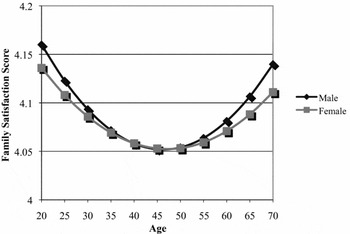
The number of people in the household did not show any relationship with marital or family satisfaction. The respondent's age, as predicted in Hypothesis 3, shows a U-shaped effect on family satisfaction if not on marital satisfaction. In using coefficients for age and age-squared for men and women, we can draw a predicted value for each age as shown in Figure 1. For both men and women, predicted values for their satisfaction with family reach the lowest point around the age of 45 to 50 years (46.3 years old for men and 47.2 years old for women).
The effect of age on family satisfaction by gender: 32 societies’ data combined

Marital status shows mostly predicted effects on family satisfaction. Married individuals show higher and divorced/separated lower levels of satisfaction than their never married counterparts. Whereas widowed men show lower levels of satisfaction with their family lives, widowhood shows no adverse effects for women.
In societies where the mean score of subjective assessment of male dominance is high, people tend to be less satisfied with marriage (women) and family (men), although these relationships did not attain significance. However, at the individual level, women's satisfaction with marriage and family suffers from their belief that their society is dominated by men, which supports Hypothesis 2.
Although some political and economic regime variables seem to have substantive effects on satisfaction with marriage and family, few of them attained statistical significance. Compared to (former) socialist societies (Russia, Vietnam, China, Kazakhstan, Tajikistan, Turkmenistan, Kyrgyzstan, and Uzbekistan), those in Western (the United States and Australia) and developing societies (Malaysia, Indonesia, Philippines, Thailand, India, Pakistan, Afghanistan, Sri Lanka, Myanmar, Cambodia, Laos, Bangladesh, Maldives, Bhutan, Mongolia, and Nepal) seem more satisfied with their marriage and family, on average. The effects of living in familialist societies (Singapore, Japan, Korea, Brunei, Hong Kong, and Taiwan) seem negative for satisfaction with family. This is true for both genders, although the effects were not statistically significant.
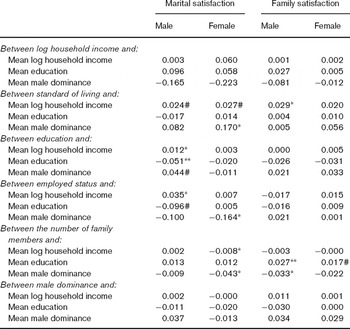
Regarding Hypothesis 5, Table 4 presents HLM results of cross-level interactions between selected variables on the individual and society levels. The main effects of both individual- and society-level variables are omitted from the table. It seems that the effects of the subjective assessment of one's standard of living, education, employment status, and the number of people in the family vary depending on their contexts (society-level variables). Given that the standard of living itself has a positive relationship with satisfaction (Table 3), this interaction indicates that this positive relationship is stronger in societies where the mean income is high (e.g. the United States, Japan, and Australia) than in societies with lower mean incomes. In other words, in poor societies people's satisfaction with marriage and family is affected by their subjective standards of living to a smaller extent. Does this mean that people in ‘rich’ societies are preoccupied in attaining material wealth? It is entirely possible. This relationship is found only for the subjective assessment of their standard of living, and not for their household income.
HLM analyses of marital/family satisfaction: interaction between selected individual- and society-level variables (main effects are not included)

Notes: #p < 0.10, *p < 0.05, **p < 0.01.
It is also interesting that we found an interaction between the subjective evaluation of standard of living and the mean score of subjective assessment of male dominance on women's marital satisfaction. Specifically, the positive effect of standard of living on women's satisfaction with their marriage becomes stronger in more male-dominant societies. In egalitarian societies, the effect of standard of living on women's marital satisfaction is non-existent.
The effect of men's education on their marital satisfaction seems to depend on the context also. While men's education has little, if any, effect on their marital satisfaction (Table 3), this effect appears to be more positive in affluent societies and in societies where the mean educational level is low and people perceive men dominate women. In societies with low mean educational levels, education is a rare commodity and well-educated males may be able to utilize this resource to enhance their married life, helped by the prevalent notion of male dominance.
While the overall effect of men's employment on marital satisfaction is minimum (Table 3), it becomes more positive in affluent societies and in societies where people are not well-educated. The negative effect of married women's employment on their marital satisfaction becomes even stronger in male-dominant societies. This is an interesting interaction which was fully expected due to the ‘deviant status’ of employed wives in these societies.
Although the main effect of the number of family members on women's marital satisfaction is non-existent (Table 3), the effect becomes negative in male-dominant and/or affluent societies. Again, this interaction between family size and male dominance was fully expected from women's heavy domestic roles in male-dominant societies. There is a positive interaction between the number of family members with whom the respondent lives and the mean educational attainment of the society on family satisfaction for both men and women. Finally, men in larger families in male-dominant societies tend to be less satisfied with their family life.
Discussion and conclusion
One of the interesting findings of this article is the systematic cross-cultural variations in the mean values of marital and family satisfaction. Particularly notable is the list of societies where both marital satisfaction and family satisfaction are low on average. Societies such as Korea, Hong Kong, Taiwan, and Japan are all small East Asian societies with few natural resources. Working long hours is the only way to help develop their societies, at the expense of leisure time with spouses and family members. An exception to this pattern is Singapore, where the levels of satisfaction with marriage and family are not particularly low. Marriage is encouraged in that society, and married couples are given priorities to purchase and qualify for government-owned housing units, which are in high demand (The Temasek Review, 2010). This and other policies that favor married couples may keep satisfaction levels with marriage and family relatively high despite their similarities to other small East Asian societies.
At the opposite end to these small, yet developed, societies are Sri Lanka, Maldives, and Bhutan, societies with relatively ‘slow’ paces of life. Bhutan is a particularly interesting case since the government of that country has been promoting GNH (Gross National Happiness), which they officially adopted in November, 2008 (The Centre for Bhutan Studies, 2011). Its government is well aware of the importance of subjective well-being, and it reflects on their high mean values both in marital and family satisfaction.
Gender is a critical factor in marital and family satisfaction. Women's satisfaction with marriage and/or family is often lower, on average, than that of men. This gender difference is particularly apparent in Central Asian/Islamic societies (Uzbekistan, Tajikistan, Kyrgyzstan, Kazakhstan, Afghanistan, and Bangladesh), East-Asian, Confucian societies (Korea, Japan, China, and Taiwan), and Southeast Asian societies (Philippines, Thailand, Myanmar, Cambodia, Laos, and Vietnam). These societies (plus Russia) tend to be low in overall satisfaction scores (Table 2). Conversely, none of the top seven societies in either area of satisfaction shows statistically significant gender differences. Hence, where there is a gender difference in marital and family satisfaction, the overall satisfaction levels tend to be low. Another interpretation may be that wherever people are dissatisfied with marriage and/or family, women are even worse off. In societies where people are relatively satisfied with marriage and/or family, both genders tend to be equally so.
Another interesting finding of this analysis is the effect of women's subjective assessments of male dominance. Those women who think that men dominate women in their societies tend to be less satisfied with marriage and family. The same pattern was found with macro-level data (Table 2). This fact probably indicates that husbands and other male family members in societies with greater male dominance may treat their wives or female family members (mothers, sisters, daughters, etc.) in a non-egalitarian manner.
The plight of women in Asian societies is also seen in cross-level interactions involving employment status and family size. Employed women and women in large families in male-dominant societies tend to have low marital satisfaction. We may be able to interpret this finding as an embodiment of the unhappiness of these women with gendered roles of family caretaking and double burden of family and employment responsibility. Employed women in male-dominant societies may be non-conventional and/or face a greater degree of gender inequality.
On the other hand, the mean male dominance variable interacts with women's subjective standard of living in such a way that women who regard their economic status as high tend to be more satisfied with their marriage in male-dominant societies. Marriages probably have more characteristics of institutions than companionships in ‘traditional’ (i.e. male-dominant) societies, so that marital quality may be more directly affected by the standard of living for women in these societies. ‘We-are-poor-but-we-love-each-other’ type of marriages may not work where marriage is a means to achieving economic stability for women.
This article sheds light on the formation mechanism of marital and family satisfaction from a cross-cultural perspective, and an expansion of this type of analysis to other regions would be informative. Although we have found variations and causes for marital and family satisfaction in mostly Asian societies, similar studies for European, African, and Central/South American societies will complete the picture in this line of research. The HLM makes the analysis relatively manageable. With more comparative data sets becoming available every year, social scientists are now able to tackle the perennial question on the determinants of not only satisfaction with marriage and family, but also general psychological well-being.
About the authors
Yoshinori Kamo is an associate professor of sociology at Louisiana State University and lecturer at Keio University in Tokyo, Japan. His research interests include marriage and family in comparative perspectives (including division of labor, marital satisfaction/stability, living arrangements, etc.), inequality based on race, gender, and class, and aging issues. One of his recent publications is ‘The Aftermath of Hurricane Katrina: Aging Adults’ Psychological Well-being’ in Journal of Family Issues (Tammy Henderson and Karen Roberto as co-authors, 2011).
Makiko Hori is an assistant professor of sociology at Wichita State University, Kansas. She received a Ph.D. from Louisiana State University in 2010 with the dissertation entitled, ‘Gender Differences and Cultural Contexts: Psychological Well-Being in Cross-National Perspective.’ Dr. Hori's research interests include gender, social inequality, race/ethnicities, social psychology, quantitative methods, social demography, work and family, health, childcare, and education. Her recent publications appeared in Population Research and Policy Review, Population and Environment, and Southern Rural Sociology.