The World Health Organization (WHO) defines healthcare-associated infection (HAI) as “an infection occurring in a patient during the process of care in a hospital or other healthcare facility which was not present or incubating at the time of admission” and goes on to state that HAIs represent the most frequent adverse event during care delivery and that no institution or country can claim to have solved the problem thus far.1
Much emphasis has traditionally been placed on the evaluation of HAI transmission within hospitals and brick-and-mortar medical facilities. However, many patients engage the healthcare system outside healthcare buildings. Many patients are transported—whether by ground ambulance or air ambulance—by medical professionals at some point during their interaction with the healthcare system. For example, the US Centers for Disease Control and Prevention reported that there were 14.5 transports to the emergency department per 100 population in the United States in 2017.2
The impact of patient transport on exposures and HAIs has not been well established. To solidify the legitimacy of this topic, a term describing this phenomenon must be introduced to the literature. We propose the term “medical transport–associated infection” (MTAI) to unify previous work on this topic as well as a standardized definition for future research. MTAI is a subset of HAI, defined as any infection acquired as a direct effect of exposure in a medical transport setting. The medical transport setting is defined as any vehicle that is used by medical professionals to transport patients during any time, whether emergency or planned, designated or improvised. Medical transport settings include, but are not limited to, ground ambulance, fixed-wing air ambulance, and helicopter air ambulance. Furthermore, MTAIs can be divided into 2 subgroups: patient MTAIs (P-MTAIs) and healthcare worker MTAIs (HW-MTAIs). A P-MTAI is any infection acquired by the patient as a direct effect of their transport by a medical professional in a medical transport setting. An HW-MTAI is any infection acquired by a healthcare worker as a direct effect of their occupational exposure to a medical transport setting work environment. In our literature review, we focused primarily on P-MTAI.
Contamination of medical transport environments
Gross contamination of the transport environment
Only 2 studies presented data on gross contamination of ambulances. In a 2018 online survey of Australian paramedics, 32.4% of respondents often or always worked in a visibly dirty ambulance and 96.4% found blood contamination on equipment, supplies, and other surfaces in an ambulance at the beginning of a shift >3 times per year.Reference Barr, Holmes, Roiko, Dunn and Lord3 In a 2006 cross-sectional study of ambulance equipment ready for patient use in 6 UK emergency departments, 15% of equipment was grossly contaminated with blood despite being designated ready for patient use, and a further 42% of equipment tested positive for blood with the Kastle-Meyer test, which evaluates blood contamination not seen by the naked eye.Reference Lee, Levy and Walker4
Common bacteria in the transport environment
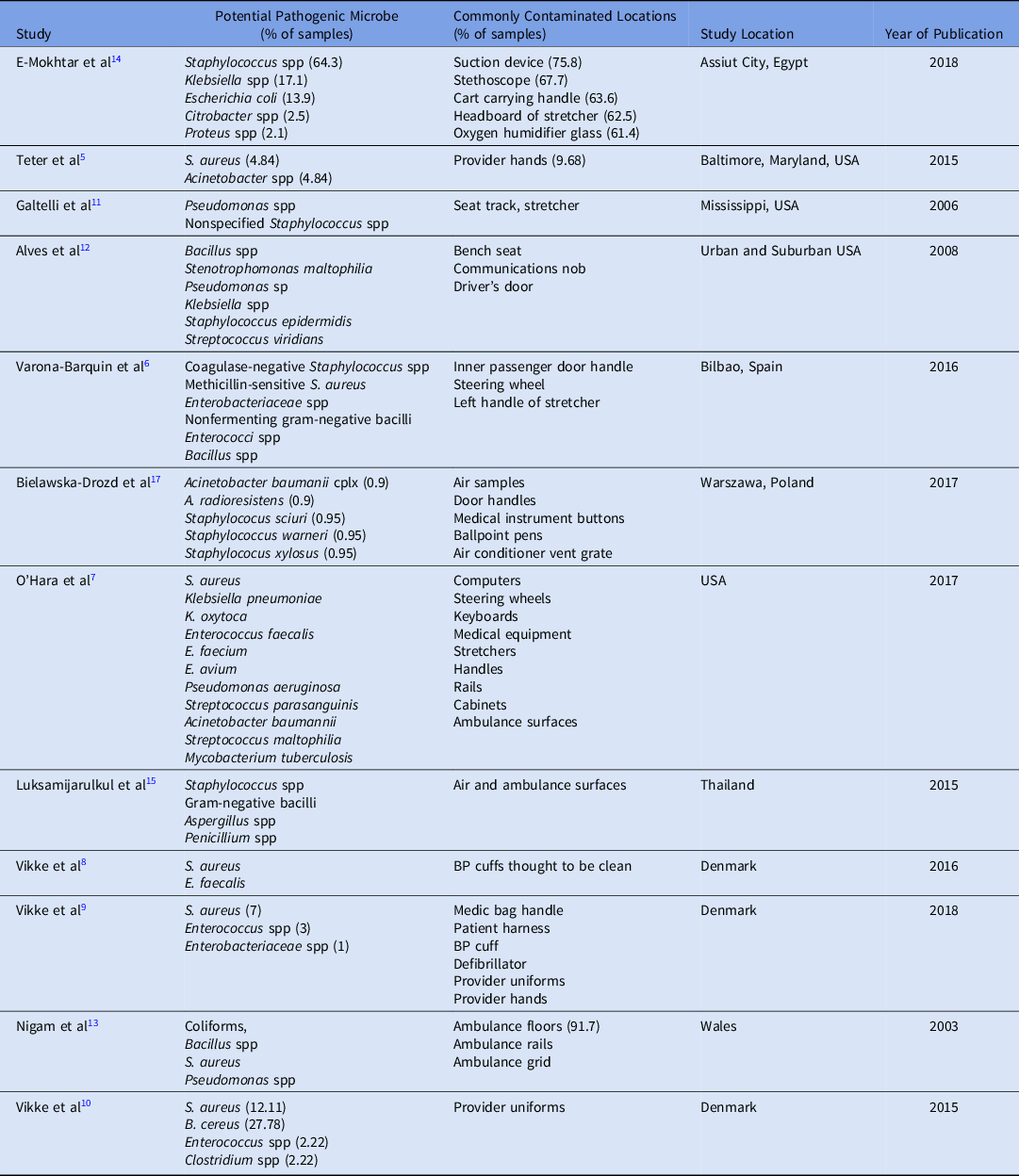
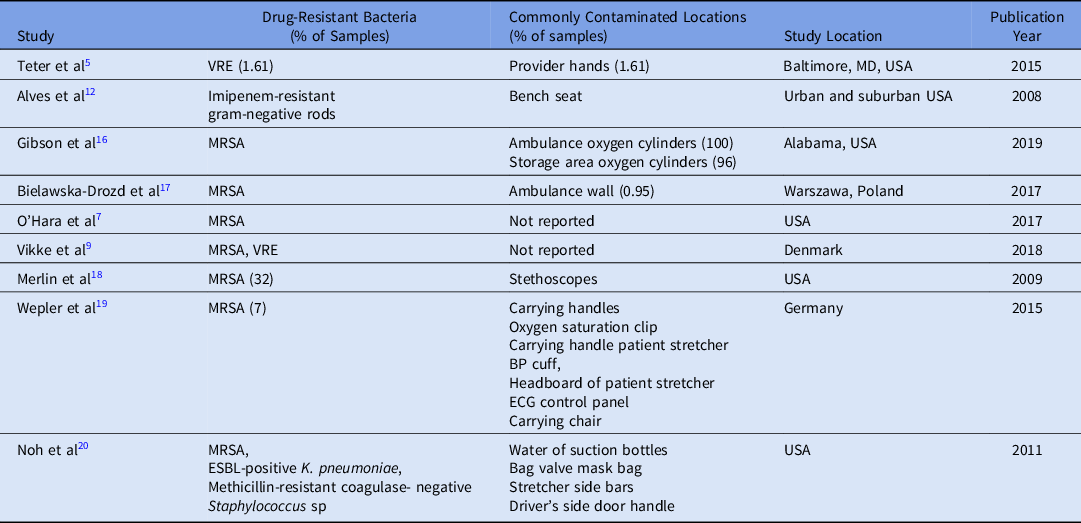
Table 1 presents data from 12 studies that describe the flora encountered in medical transport environments in 7 different countries between 2003 and 2018. Medical transport environments were shown to be contaminated by clinically significant bacteria such as Staphylococcus aureus,Reference Teter, Millin and Bissell5–Reference Vikke and Giebner10 Pseudomonas spp,Reference O’Hara, Reed and Afshinnekoo7,Reference Galtelli, Deschamp and Rogers11–Reference Nigam and Cutter13 Klebsiella spp,Reference O’Hara, Reed and Afshinnekoo7,Reference Alves and Bissell12,Reference El-Mokhtar and Hetta14 Enterococcus spp,Reference Varona-Barquin, Ballesteros-Peña and Lorrio-Palomino6–Reference Vikke and Giebner10 Staphylococcus epidermidis,Reference Alves and Bissell12 and Streptococcus viridians.Reference Alves and Bissell12 The clinically significant fungi Aspergillus was also reported.Reference Luksamijarulkul and Pipitsangjan15 In addition, 9 studies reported on drug-resistant bacteria in the transport environment (Table 2). These studies reported the presence of methicillin-resistant Staphylococcus aureus (MRSA),Reference O’Hara, Reed and Afshinnekoo7,Reference Vikke, Giebner and Kolmos9,Reference Gibson16–Reference Noh, Shin and Kim20 vancomycin-resistant enterococci (VRE),Reference Teter, Millin and Bissell5,Reference Vikke, Giebner and Kolmos9 extended-spectrum β-lactamase (ESBL)–positive Klebsiella pneumoniae,Reference Noh, Shin and Kim20 imipenem-resistant gram-negative rods,Reference Alves and Bissell12 and methicillin-resistant coagulase negative Staphylococcus spp.Reference Noh, Shin and Kim20 Notably, a study of oxygen cylinders in ground ambulances and an off-site oxygen cylinder storage area showed that 100% and 96% of the oxygen cylinders were colonized with MRSA at each site, respectively.Reference Gibson16
Commonly Found Microbes and Contaminated Locations by Study

Note. BP, blood pressure.
Drug-Resistant Bacteria and Commonly Contaminated Locations by Study

Note. BP, blood pressure. ECG, electrocardiogram; MRSA, methicillin-resistant Staphylococcus aureus; VRE, vancomycin-resistant enterococci; ESBL, extended-spectrum β-lactamase.
Commonly studied equipment and ambulance locations
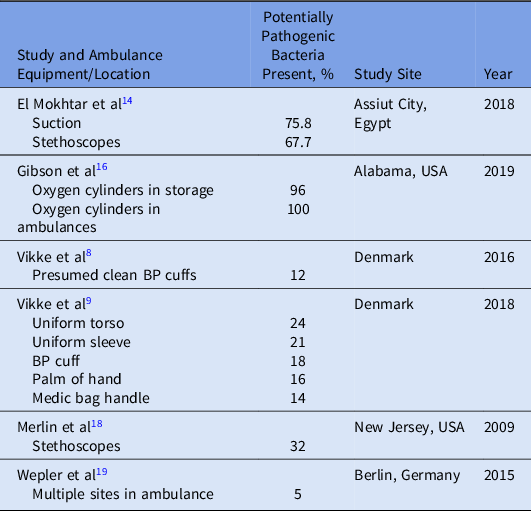
Six studies reported the percentage of swabs that were positive for potentially pathogenic bacteria based on the type of equipment and ambulance location (Table 3). Stethoscopes and blood-pressure cuffs were the most frequently evaluated equipment. Specifically, studies in Egypt and the United States have reported that 67.7% and 32% of samples from stethoscopes were contaminated, respectively.Reference El-Mokhtar and Hetta14,Reference Gibson16 Similarly, 2 separate studies in Denmark conducted in 2016 and 2018 reported that 12% and 18% of blood-pressure cuff samples were contaminated, respectively.Reference Vikke and Giebner8,Reference Vikke, Giebner and Kolmos9 In a 2018 study from Denmark that also evaluated separate parts of EMS provider uniforms, swabs collected from uniform torsos and uniform sleeves were contaminated 24% and 21% of the time, respectively.Reference Vikke, Giebner and Kolmos9
Commonly Contaminated Equipment in the Medical Transport Environment

Contamination and colonization of EMS personnel
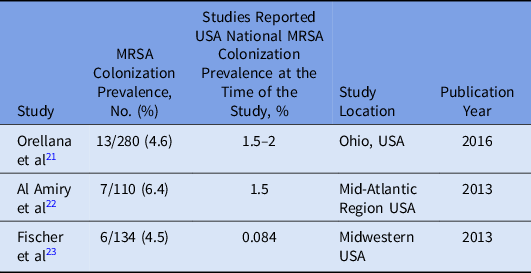
In a 2015 prospective observational study, providers had S. aureus (4.84%), VRE (1.61%), and Acinetobacter spp (4.84%) on their hands before performing hand hygiene.Reference Teter, Millin and Bissell5 Of all organisms, most data pertaining to EMS personnel have been related to MRSA. In 3 studies performed in the United States from 2013 to 2016, EMS personnel had nasal MRSA colonization (Table 4). In a 2016 cross-sectional study of randomly sampled EMS personnel from 84 urban and rural agencies in Ohio, 4.6% of EMS personnel sampled were colonized with MRSA compared to a national MRSA colonization rate at the time of data collection between 1.5% and 2%.Reference Orellana, Hoet and Bell21 A 2013 cross-sectional study of 2 fire departments showed a 6.4% prevalence of nasal MRSA colonization in EMS personnel compared with a 1.5% prevalence among the general population.Reference Al Amiry, Bissell, Maguire and Methicillin-Resistant22 Finally, a 2013 prospective study of out-of-hospital care providers and EMT students revealed a MRSA nasal colonization rate of 4.5% compared with the reported rate for the US population at the time of 0.084%.Reference Miramonti, Rinkle and Iden23
Reported MRSA Colonization of EMS Personnel

Note. MRSA, methicillin-resistant Staphylococcus aureus.
Colonization of transport patients
In a 2004 prospective cohort study of patients hospitalized in a foreign country and repatriated to a hospital in their home country by international air transport on scheduled airlines or ambulance, MRSA, Acinetobacter baumanii, and multidrug-resistant K. pneumoniae colonization were observed in 3%, 2%, and 2% of patients, respectively.Reference Fischer, Veldman, Diefenbach and Schäfer24 In a 2012 retrospective observational study of patients transported via ambulance in Korea, interfacility transport ambulance patients had significantly higher odds of Mycobacterium tuberculosis (ie, TB), MRSA, and VRE colonization than nonambulance patients, and prehospital ambulance patients had significantly higher odds of MRSA and VRE than nonambulance patients.Reference Ro, Shin, Noh and Cho25
Studies evaluating transport personnel infection control practices and beliefs
EMS personnel hygiene perceptions and barriers
Our review included 4 studies that evaluated EMS personnel hygiene perceptions and barriers. In a 2018 online survey of self-reported behaviors and perceptions of Australian paramedics, 98.3% of participants agreed that cleaning an ambulance or shared medical equipment was part of their duties and that 89.4% believed that poor cleanliness increased the risk of transmission of HAI.Reference Barr, Holmes, Roiko, Dunn and Lord3 Among these respondents, 90.1% cited operational pressure or the impression of too much to do in the time allowed between patient cases; 69.3% cited being directed to respond to another patient case rather than perform routine cleaning; and 76.5% cited lack of appropriate cleaning equipment or products as barriers to cleaning.Reference Barr, Holmes, Roiko, Dunn and Lord3
In a 2019 cross-sectional study of self-reported hand hygiene (HH) perceptions and compliance among EMS providers in Denmark, 98% of providers perceived the preventative effect of HH on HAI, 98% believed that HAI influences patient outcomes, and 92% believed that HH is important to their patients, yet only 47% believed that HH was important to their managers.Reference Vikke, Vittinghus and Betzer26 Furthermore, respondents believed that access to supplies at the point of care, support from their managers, simple and clear instructions, and education and training would improve their compliance 94%, 71%, 77%, and 70% of the time, respectively.Reference Vikke, Vittinghus and Betzer26
A 2012 cross-sectional study of the outcomes of a pilot program was conducted to promote HH at a suburban fire department in Florida. The program included brief HH training, installation of hand-rub stations, and posting HH reminder signs. The results showed that forgetfulness (28.9%), difficulty finding water or hand rub (11.6%), belief that wearing gloves was a substitute for HH (8%), and fatigue (2.7%) were barriers to HH.Reference McGuire-Wolfe, Haiduven and Hitchcock27 After the intervention, 24% strongly agreed that installation of alcohol-based hand-rub dispensers and signs led to more frequent HH; 58.8% strongly agreed that the hand-rub dispensers in the rescue vehicle increase the likelihood that they will clean their hands during and after patient care; and 28.1% strongly agreed that the HH signs in the station helped them remember to clean their hands.Reference McGuire-Wolfe, Haiduven and Hitchcock27
In a 2019 qualitative study of both prehospital and interfacility EMS providers in Saudi Arabia, providers washed their hands after patient contact more than before patient contact because they were more concerned about themselves getting sick than transmitting disease to their patients.Reference Khan28 Some providers also reported they do not comply with HH because they believe that their prior history of not getting sick will protect them from getting sick moving forward.Reference Khan28
EMS personnel hand hygiene adherence
In our review, 9 studies reported on hygiene adherence among EMS personnel and five of these studies presented HH findings specifically (Table 5). Overall, the studies demonstrated low adherence to HH before patient contact, ranging between 1.1% and 34%. They also showed that EMS personnel perform HH after patient contact, ranging between 54% and 87.6%.
Results from Observational Studies Evaluating Hand Hygiene (HH) in EMS Providers

Note. NR, not reported.
a Represents HH in the emergency department after dropping patient off.
b Represents arrival in the emergency department wearing gloves.
In a study conducted in suburban Florida, 94% of EMS personnel reported that they consistently practiced HH when returning to the station after a call and after transporting a patient.Reference McGuire-Wolfe, Haiduven and Hitchcock27 Another study conducted in Denmark showed that the median self-reported HH compliance rate was 80%.Reference Vikke, Vittinghus and Betzer26 In contrast, another study showed that 13% always performed HH before every patient contact but 12% never performed HH before contact with patients; 67% performed HH after patient contact every time; and 52% used gloves every time.Reference Bucher, Donovan, Ohman-Strickland and McCoy29 In a 2011 cross-sectional survey of EMS professionals during the 2007–2008 influenza season, 47.9% reported receiving influenza vaccination.Reference Hubble, Zontek and Richards30
EMS personnel disinfection adherence
Among the 34 studies included in this review, 4 studies presented data on EMS personnel adherence to ambulance and equipment disinfection. In a 2014 prospective observational study of EMS providers who transported patients to a large urban emergency department in Las Vegas, Nevada, low disinfection frequencies were reported for common ambulance equipment: 55% for stretchers, 31.6% for backboards, 33.8% for ECG monitors, 36.5% for ECG cables, 4.1% for stethoscopes, and 33.3% for the ambulance.Reference Bledsoe, Sweeney, Berkeley, Cole, Forred and Johnson31 In a 2018 cross-sectional study of EMS providers in Denmark, adherence to guidelines regarding thorough cleaning of the ambulance once per day was 35%, but adherence was 100% for moderate cleaning of the ambulance after every patient course.Reference Vikke, Giebner and Kolmos9
In a 2015 cross-sectional self-reported online survey, 22% of EMS personnel cleaned equipment after every patient contact and their stethoscopes were cleaned 13% of the time.Reference Bucher, Donovan, Ohman-Strickland and McCoy29 In a 2009 prospective, observational cohort study of 50 stethoscopes provided by consecutive EMS providers at an academic emergency department, 32% had no recollection of when they had last cleaned their stethoscope.Reference Merlin, Wong and Pryor18
Studies evaluating P-MTAI outcomes
To date, only 2 studies have described P-MTAI outcomes. First, in a 2013 prospective study of healthcare-associated S. aureus bacteremia (SAB) episodes occurring in adults aged >17 years, 20.8% (n = 23) of peripheral intravenous catheter (PIVC)–associated SABs were from PIVCs inserted by the ambulance service. The PIVC-associated SAB episodes were associated with a 30-day all-cause mortality rate of 26.5%.Reference Stuart, Cameron and Scott32 Second, in a 2011 retrospective cohort study of the raw and uncontrolled nosocomial infection rate among patients treated with prehospital advanced life support, the probability of contracting a nosocomial infection was 3.20% versus 2.28% for patients not treated with advanced life support (odds ratio [OR], 1.42; 95% confidence interval [CI], 1.28–1.57).Reference Alter and Merlin33
Discussion
We conducted a comprehensive literature review of studies that present data on the presence of pathogens in the medical transport environment, the hygiene behaviors and beliefs of EMS providers, and P-MTAI outcomes. Our review led to several important conclusions: (1) potential pathogens are frequently present in the transport environment; (2) EMS providers do not consistently perform hygiene practices such as hand hygiene and equipment decontamination; and (3) there is potential for the transmission of pathogens to patients in the medical transport setting. As a result, we believe that patients can acquire clinically important pathogens during medical transport, and we propose the term medical transport-associated infection (MTAI) to unify all work done in this area moving forward.
The potential for MTAI transmission in the medical transport environment is evident in the frequent presence of gross blood contamination, potential pathogens, and clinically important organisms. These pathogens have been shown to be present throughout the transport environment, on many highly utilized pieces of equipment, and on EMS providers themselves. Notably, there was a high burden of contamination on blood-pressure cuffs and stethoscopes, which are used frequently during most transports. This type of contamination could allow for the transmission of pathogens to a patient and the potential for resultant illness. Furthermore, patients transported via ambulance have often experienced serious trauma that could violate the body’s natural barriers to the outside world. The use of contaminated equipment during these encounters could introduce pathogens.34
Not only do ambulances transport many trauma patients, they also transport some of the sickest patients in the health system. For example, patients transferred to a tertiary-care center from a rural hospital are typically transported in an ambulance or helicopter. Such a patient could be exposed to a pathogen in the ambulance or may transmit pathogens to this environment. These patients could serve as a potential source of contamination for the transport environment, as illustrated by studies showing that certain patients are colonized with antibiotic resistant pathogens.Reference Fischer, Veldman, Diefenbach and Schäfer24,Reference Ro, Shin, Noh and Cho25 EMS providers also have pathogens on their hands and uniforms and are colonized with MRSA at a higher rate than the general population, which could lead to the infection of patients through the transmission of pathogens. The presence of pathogens in the medical transport environment allows patient exposure that can lead to subsequent infections.
Poor hygiene behaviors by EMS personnel may contribute to the presence of pathogens in the medical transport environment. EMS personnel do not consistently perform HH before patient contact; thus, opportunities exist for pathogens on the hands to be transmitted to patients. The studies in this review indicate that time is a limiting factor in proper disinfection after completion of a call, given the need to quickly respond to the next patient.Reference Barr, Holmes, Roiko, Dunn and Lord3 In one study, providers believed that HH is for their protection and not for that of the patient.Reference Khan28 These findings are reinforced in studies demonstrating that EMS providers perform HH less frequently before patient contact than after patient contact.Reference Teter, Millin and Bissell5,Reference Bledsoe, Sweeney, Berkeley, Cole, Forred and Johnson31,Reference Emanuelsson, Karlsson, Castrèn and Lindström35–Reference Ho, Ansari and Page37 Also, some EMS providers see gloves as an alternative to HH, as shown by their consistent use of gloves without HH before patient contact.Reference Vikke, Vittinghus and Giebner36 We must empower EMS professionals to join the efforts of the overall health system to reduce HAIs.
We identified 2 articles that present data on the association between exposure to the medical transport environment and the presence of infection. Thus, the ambulance environment and activities performed during transport can lead to patient harm. More work needs to be done to evaluate whether this rate is significantly higher than for PIVCs placed in other environments.
MTAI outcomes can be difficult to study. In the United States, EMS agencies are surprisingly heterogenous and are regulated on a state level rather than a national level. Specifically, EMS agencies can be operated by a variety of entities including municipalities, hospitals, and private companies. Many EMS systems are integrated with the local fire department, whereas others are purely focused on medical emergencies. Some systems perform only 9-1-1 emergency response; some only conduct interfacility transports; and some perform a combination of these services. Additionally, there is little standardization between medical treatment protocols and procedures because these are usually determined by the medical director and leadership of the individual system. Internationally, there is even more variability in how EMS systems are structured. It is difficult to evaluate MTAI outcomes and their significance in such a varied population.
Controlling for confounding variables is also difficult when studying MTAIs. For example, comparing infection rates between interfacility transport patients and controls is confounded by interfacility transport patients having been exposed to another hospital. As a result, these patients may be more likely to develop infection due to exposures in the hospital and/or have higher acuity of illness—a factor that led to their transport. The issue of confounding is a formidable challenge when studying MTAI outcomes.
Existing data support the potential for disease transmission as a direct result of exposure to the medical transport environment. However, there have been no adequately controlled studies to date that have proven causality.
In the academic realm, understanding of what happens during patient transport is poor. Moving forward, we must better characterize the actions of EMS personnel and their patients within the transport environment. A more complete understanding of which pieces of equipment both patients and EMS personnel contact regularly is needed to determine the most likely sources of disease transmission. We must also design surveillance systems to evaluate whether patients are developing MTAI in real time to enable agencies to perform root-cause analyses to correct any shortcomings that are leading to disease transmission.
The goal of the study of MTAI is to design interventions that reduce preventable patient harm. After further evaluating the medical transport environment and MTAIs, we must design multifaceted interventions to address these issues. These interventions should focus on reducing the presence of pathogens in the medical transport environment as well as improving EMS hygiene practices. For example, products can be devised to make disinfection of the medical transport environment and the equipment within it more efficient. The adoption of more single-use equipment could also be useful in this context. Agencies should encourage EMS personnel to apply the same meticulous infection control behaviors and practices used in the hospital to the medical transport environment. This emphasis must begin during the initial EMS personnel training and onboarding processes and should continue in the professional setting.
Acknowledgments
We would like to thank our colleagues in the Duke Division of Emergency Medicine and the Duke Center for Antimicrobial Stewardship and Infection Prevention for their support. We hope to expand this partnership moving forward to continue to address MTAI.
Financial support
No financial support was provided relevant to this article.
Conflicts of interest
All authors report no conflicts of interest relevant to this article. D.J.A. has received grants from the Agency for Healthcare Research and Quality (AHRQ), the Centers for Disease Control and Prevention (CDC), and the National Institutes of Health (NIH)/National Institute of Allergy and Infectious Diseases (NIAID). D.J.A. has received royalties for authorship from UpToDate Online.