Introduction
There are more than 800 million ha of land under salinity, which causes significant losses to world crop production (Zhu, Reference Zhu2001). Soybean is relatively sensitive to salinity and production has been challenging in various salt affected regions (Phang et al., Reference Phang, Shao and Lam2008; Dantas et al., Reference Dantas, da Silva, Volpato, Barbosa, de Sousa Paula, do Nascimento and de Resende2017). Soybean yield is affected when salinity exceeds 5 dS/m (Ashraf, Reference Ashraf1994). Salinity damages soybean throughout its life cycle by inhibition of seed germination, reduction of plant height, leaf size, biomass, number of nodes and branches, number of pods, seed weight and protein content (Abel and MacKenzie, Reference Abel and MacKenzie1964; Phang et al., Reference Phang, Shao and Lam2008). Use of salt tolerance varieties is considered an effective approach to reduce plant damage from salinity conditions. There is considerable variability among Glycine species (Glycine max, Glycine soja, Glycine tomentella and Glycine argyrea) for salt tolerance (Lenis et al., Reference Lenis, Ellersieck, Blevins, Sleper, Nguyen, Dunn, Lee and Shannon2011), that would be valuable for genetic improvement of cultivated soybean. Within the G. max family, genetic variation was also identified in various populations (Phang et al., Reference Phang, Shao and Lam2008).
Vietnam has a native soybean germplasm which might be related or originated from China (Goldberg, Reference Goldberg2008). Cultivated soybean is grown in 28 out of its 58 provinces, including those in coastal, salt-affected regions. The country is the origin of soybean germplasm in the USDA collection for specific genetic sources of rust resistance and flooding tolerance (Pham et al., Reference Pham, Hill, Miles, Nguyen, Vu, Vuong, VanToai, Nguyen and Hartman2010; Vantoai et al., Reference Vantoai, Thi, Hoa, Thi, Hue, Nguyen, Grover and Atiqur Rahman2010). With a coastline of 3620 km, Vietnam has an estimated 1 million ha of salt-affected land (Lang et al., Reference Lang, Yanagihara and Bui2001). The areas under salt stress are expected to increase significantly due to the rising sea water levels and reduced flow of major rivers throughout the country which is currently affecting crop and aquaculture production (Nguyen et al., Reference Nguyen, Kotera, Sakamoto and Okozawa2008; Konishi, Reference Konishi2011; Nguyen, Reference Nguyen2013). Improvement of salt tolerance in soybean in Vietnam and other saline affected areas is significant for the current and future soybean production.
In this study, we screened a collection of Vietnamese soybean genotypes including popular cultivars and others recently introduced in Northern Vietnam to identify salt tolerant genotypes for current breeding and production. Eighteen genotypes, twelve of which were deposited to National Germplasm Collection of USDA, were evaluated for salt tolerance at 0, 100, 150 and 200 mM NaCl. We found significant variation in salt tolerance in vegetative growth stages among the genotypes and identified a highly salt tolerant soybean accession PI 675847 A (DT2008). Under salinity stress, DT2008 sustained photosynthesis, growth, biomass and seed yield and was able to maintain the lower concentration of Na+ and Cl− in the tissues. Genetic materials identified in this research are specific and valuable for both production and further exploitation in plant breeding for salt tolerance for Vietnam and other regions of the world where salinity is a problem.
Materials and methods
Seeds of 18 soybean genotypes (Table 1) were received from Center for Legumes R&D (LRDC), Field Crops Research Institute and the Agricultural Genetics Institute (AGI). This collection includes eight cultivars that are the most dominant in production for the past 20 years and nine cultivars that were recently introduced. DT2008 and ĐT51 were reported to be drought tolerant (Thu et al., Reference Thu, Nguyen, Thi Hoang, Phuong Thao and Phan Tran2014; Sulieman et al., Reference Sulieman, Van Ha, Nasr Esfahani, Watanabe, Nishiyama, Bao Pham, Van Dong and Phan Tran2015). Williams 82 (Bernard and Cremeens, Reference Bernard and Cremeens1988) was used as a reference genotype for salt sensitivity.
List of soybean genotypes used in the study and their origins

a Field Crops Research Institute (FCRI) and Agricultural Genetics Institute (AGI) are the main soybean developers in Vietnam.
b Crop seasons: Spring – Spr, Summer – Sum, Winter – Win.
Evaluation of salt tolerance was performed using a modified PVC tube method (Lee et al., Reference Lee, Smothers, Dunn, Villagarcia, Shumway, Carter and Shannon2008). There were two sets of experiments. The first set was to evaluate salt tolerance at the vegetative growth stage of 18 varieties using 1.0 l pots (10 cm diameter, Fig. S1) in large trays. Each pot contained coarse sand and was irrigated from the bottom by providing 1 cm deep of Hoagland nutrition solution (pH~6.0) to containing trays. Soybean seeds were placed at 1 cm depth. When plants reached the V2 growth stage (plants having two open trifoliate leaves), salt treatments of 0, 100, 150 and 200 mM NaCl were imposed. Every 3 days, the culture solutions were drained and replaced with a fresh solution. Pots were exposed to the solution for about 30 min to saturate the sand before draining to maintain 1 cm depth in the trays. Electrical conductance of culture solutions was monitored every day and water was added to maintain 1 cm solution and a constant EC, corresponding to given salt treatments. Salt tolerance of the soybean was estimated based on leaf scorch score (where 1.0 = no apparent chlorosis and 5.0 = severe necrosis) as described previously (Lee et al., Reference Lee, Smothers, Dunn, Villagarcia, Shumway, Carter and Shannon2008) and cell membrane stability. When the most sensitive genotype reached a leaf scorch score of 5.0, the third open trifoliate leaves of all genotypes were harvested for a membrane stability assay using the electrolyte conductivity method (http://www.plantstress.com). Twenty cm2 sections of leaves collected from non-stress and salt stress plants were harvested, rinsed and placed in glass tubes containing 20 ml of deionized water. After incubation at 10°C for 24 h, conductance was determined with a conductivity meter. After the initial measurement, the vials were autoclaved for 15 min to release all the electrolytes and the EC was recorded again. Cell membrane stability was calculated as (%) [(1-(T1/T2))/(1-(C1/C2))] × 100, in which T and C refer to the stressed and non-stressed samples, respectively, and the two numbers 1 and 2 refer to the conductance readings before and after autoclaving. The experiments were performed in the greenhouse at Field Crop Research Institute (FCRI) during Summer-Autumn 2016 (the first experiment was performed in June 2016 and repeated in July 2016). Air temperature ranged from 25 to 30°C during the day and 20–25°C during the night. Relative humidity ranged from 70 to 80%. The experiments were conducted in a randomized block design with three replicates.
The best performing variety and two controls, a Vietnamese high yielding soybean variety ĐT26, and Williams 82 were selected from the first 18–;cultivar preliminary screening and used for specific characterization of salt tolerance in the second experiment. The experimental procedures were similar to the above described but with a larger pot size of 1.5 l (Fig. 2). Measurements were taken for seed germination, gas exchange, leaf greenness, leaf scorch score, biomass of roots and shoots and cell membrane stability. Seed germination (germination rate, weight and length of roots and hypocotyls) was recorded 1 week after sowing under predetermined NaCl concentrations of 0, 100, 150 and 200 mM. Gas exchange parameters and photosynthesis rate were surveyed using the CI-340 Hand-Held Photosynthesis System (CID-Bioscience) using the ambient CO2 and natural light conditions of sunny days, measured at 10–11 AM. When the most sensitive genotypes reached a leaf scorch score of 5.0, shoots and roots were harvested for chemical analyses. Analyses of Na+, K+ and Cl− was referred to a standard protocol (Horwitz, Reference Horwitz2003). About 0.25 g of dry, ground tissue from leaves and roots were used to determine Na+ and K+ by means of acid dilution procedure on a hot plate using nitric acid. Resulting samples were diluted to 50 ml and analyzed on Inductively Coupled Plasma. For chloride concentration analyses, ~0.25 g tissues were extracted with 0.5% nitric acid and analyzed by potentiometric titration with silver nitrate.
For the yield test, we grew the three soybean genotypes in trays filled with paddy soil with a lower level of NaCl (~7.5 dS/m) to maintain growth until maturity. To have this desired salt level, various NaCl amounts were pre-mixed with soils and maintained at ~40% soil water holding capacity. Salt level of each mix was determined using an EC meter. The soil mix with an EC reading of ~7.5 dS/m was used for salt treatment. The control treatment had EC readings of about ~2 dS/m. Three soybean genotypes DT2008, ĐT26 and W82 were sown (six plants per row) in each tray to be considered as one replication in a three-replicate experiment (Fig. 5). To maintain salt stress, water was added daily to maintain a constant tray weight and the salt stress was monitored and adjusted using the EC readings. Plants were harvested at maturity and measurements were performed for dry biomass and seed yield. ANOVA was used to compare means of all collected data and multiple mean comparisons were performed with Duncan's multiple range test. All experiments of phenotypic studies were performed two times for consistency.
Results
Effects of salinity on growth, leaf scorch and cell membrane stability of the soybean population
Eighteen soybean genotypes were selected for the study on the basis of their popularity in fields throughout cultivated regions of Northern Vietnam. DT84, ĐT26, ĐT12, DT95, DT2008 and ĐT22 were the most grown soybean cultivars in northern and central regions and account for the majority of the country's soybean production. Twelve of these 18 genotypes have been assigned with PI numbers and deposited with a group of Vietnamese soybean accessions in the US National Plant Germplasm System (https://npgsweb.ars-grin.gov/gringlobal/cooperator.aspx?id=156325). The remaining soybean genotypes were recently introduced in Northern Vietnam, including ĐT51 (introduced in 2011), ĐT30 (2016), D8 (2016) and ĐT31 (2017). These 18 cultivars were recommended for crop production in Vietnam in both spring and winter seasons and some of them can be grown in all three cropping seasons of spring, summer and winter. The average yields were from 1500 to 3000 kg/ha according to the breeders’ communications and variety introduction leaflets (Table 1).
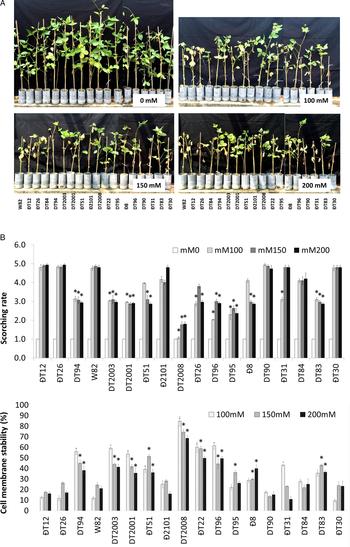
The soybean genotypes were screened for their salt tolerance using a tray system allowing randomization of 18 genotypes in each tray (Fig. S1). All the genotypes germinated well and were healthy in the sand media. Salt stress started when the plants reached the V2 (second open trifoliate leaf) growth stage. After 3 days of salt treatments, the plants under 200 mM started to show symptoms of salt stress including leaf wilting and slower growth. After 1 week of treatment of 200 mM NaCl, there were significant differences in performance of the population in response to salt stress. The most sensitive genotypes ĐT12, ĐT26, W82, DT90 and ĐT30 showed a severe leaf scorch score of 5.0. Variety DT84, the most widely grown cultivar in Vietnam soybean production, was relatively sensitive (Fig. 1a). DT2008 was most tolerant among the tested varieties with a scorch score of about 1.5, which is the lowest among all of the genotypes evaluated. At lower salt concentrations of 150 and 100 mM NaCl, the most sensitive varieties reached a leaf scorch score of 5.0 after ~3 and 5 weeks, respectively. In all NaCl treatments, DT2008 was the most tolerant with a leaf scorch score of less than 2.0. ĐT51, which is drought tolerant (Thu et al., Reference Thu, Nguyen, Thi Hoang, Phuong Thao and Phan Tran2014), showed a relatively tolerant to salt stress.
The soybean collection and their responses to salinity stress. (a) Phenotypic variation in response to NaCl treatments. (b) Leaf scorching scores and cell membrane stability of 18 soybean genotypes under 0, 100, 150 and 200 mM NaCl treatments. Data were taken when the most sensitive genotypes reached the scorching score of 5.0.

The performance of soybean to salt stress was further examined for membrane stability index which measures the relative cation leakage across the membrane due to salt damage. The third fully open trifoliate from all genotypes were harvested when the most sensitive genotypes, usually ĐT12, ĐT26 and W82, reached the scorch score of 5.0. Fig. 1b shows that the membrane stability is highly associated with the leaf scorch score: the varieties with higher scorch score also had lower membrane stability. Among the genotypes, DT94, DT2003, DT2001, ĐT51, DT2008, ĐT22, DT96, DT95, D8 and DT83 were better than the check DT84. W82 was among the most sensitive genotypes. DT2008 performed best in the collection for both indicators at the same stress levels. Correlation analyses for the performance of the soybean genotypes among salt treatments show Pearson correlation coefficients of 0.82–0.96 for both leaf scorch scores and membrane stability index. The result indicates a consistent performance of soybean over a range of NaCl stress levels. The genotypes which performed better at 200 mM NaCl also performed better at both 150 and 100 mM NaCl treatments. These data also show the reliability of the screening methods, and consistency of tolerance of the varieties, in the vegetative growth stages. On average, the coefficient of variation (CV%) of the measurements were about 30–50% indicating a high phenotypic variation in salt tolerance of the soybean lines studied. The results from this initial screening allowed us to further characterize DT2008 for its salt tolerant mechanisms and yield performance under salt stress.
DT2008 maintained better leaf health and photosynthesis under NaCl stress
To investigate the photosynthetic capacity of DT2008, we performed an experiment to compare DT2008 with ĐT26 and W82, which are salt sensitive in the previous experiment, for leaf scorch score, chlorophyll content, photosynthesis and biomass accumulation. ĐT26 was also used as a background of our other experiments to characterize a number of salt tolerance genes in soybean, including AtAVP1, AtSOS1 and AtNHX1 (unpublished) with W82 as the common check for these studies. The soybean genotypes were sown on 1.5L pots filled with washed coarse sand and supplied with Hoagland nutrient solutions. Salt was imposed when plants reach V1 growth stage at concentrations of 0, 100, 150 and 200 mM NaCl. Nutrition and salt stress levels were maintained using the same procedure as the first experiment.
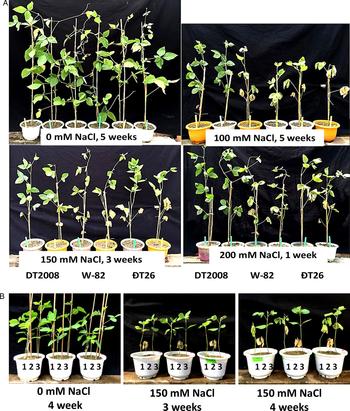
Although salt stress had a significant effect on the chlorophyll content of the soybean leaves, DT2008 was able to maintain the chlorophyll content significantly longer than the ĐT26 and W82 (Fig. 3). In the control non-stress treatment, chlorophyll was maintained at about 200 µM m−2 over the course of the experiment. The loss of chlorophyll increased with higher NaCl concentration treatments. The difference in chlorophyll contents between DT2008 and the controls were observed after the day 28th, 14th and 7th at respective 100, 150 and 200 mM NaCl treatments. At the end of the experiment when the sensitive control plants reached a leaf scorch score of 5.0 (complete wilting), DT2008 was still green with no signs of leaf chlorosis. DT2008 also had a higher photosynthesis rate compared with the two sensitive genotypes after 1, 2, 3 weeks under 200, 150 and 100 mM NaCl treatments, respectively.
Performance of DT2008 and two controls ĐT26 and W82 under salt stress. Three genotypes were grown in (a) separate pots 0, 100, 150 and 200 mM NaCl, and (b) same pot at 150 mM NaCl. For (b), salt treatment (150 mM NaCl) started at V1 stage. Plants were shown as #1 for ĐT26, #2 for W82 and #3 for DT2008.

Chlorophyll content (a) and photosynthesis (b) and average daily dry matter accumulation rate (c) of DT2008, W82 and ĐT26 in exposure to 0, 100, 150, and 200 mM NaCl stress. Gas exchange measurements were taken from 11 AM to 1 PM on sunny days using the C340 unit. Asterisks indicate significant differences between DT2008 compared to the means of other samples of the same experimental group.

After 2–3 weeks of salt treatment, leaf injury increased, chlorophyll concentration decreased and the dry matter accumulation declined sharply. Nevertheless, DT2008 shows higher dry mass accumulation (Fig. 3). Average daily dry biomass accumulation was higher for DT2008 at 100 and 150 mM NaCl, indicating sustained growth, compared with W82 and ĐT26. Root growth was more sensitive to salt stress compared with shoot growth. To generate more uniform stress conditions, a direct comparison was performed by growing three genotypes in the same pots (Fig. 2b). A salt concentration of 150 mM NaCl was applied when plants reached V2 growth stages. Consistent with previous experiments, W82 was the most sensitive and died after 3 weeks of treatment. ĐT26 could not survive longer than 4 weeks of treatment. DT2008, however, showed significantly higher greenness and healthier leaves than the controls even after 4 weeks under salt stress.
After the experiment ended, we kept a set of plants in the 100 mM NaCl treatment to investigate how long DT2008 were able to survive. We observed that they could not survive longer than 7 weeks under this level of stress. Therefore, for evaluation of long-term stress, it is necessary to lower stress level that allows plants to grow and reproduce.
Ion contents of Na+, K+ and Cl− in the soybean roots and leaves
Salt tolerance in crops such as soybean, cowpea and wheat (Triticum aestivum L.) is considered to be primarily related to the ability of plants to limit the accumulation of excess ions (Munns and Tester, Reference Munns and Tester2008). To determine the mechanism of salt tolerance in DT2008, we further analyzed the Na+, K+ and Cl− in roots and leaves. Under NaCl stress, K+ uptake in all three genotypes was reduced sharply, which is consistent with previous reports in soybean (Phang et al., Reference Phang, Shao and Lam2008). We did not find a significant difference in K+ among the three genotypes under salinity stress (Fig. 4). In contrast, Na+ concentrations increased significantly in soybean with the Na+ concentrations being higher in the roots than in the shoots indicating that the soybean plants can limit Na+ transport to the shoots. There were significant differences in Na+ uptake (expressed as root and shoot Na+ concentrations) among the soybean genotypes. DT2008 showed the lowest Na+ uptake by the roots. Compared with both ĐT26 and W82 genotypes, DT2008 had a 24% lower Na+ concentration in the roots and 12% lower in the leaves. The data indicate that DT2008 was more efficient in limiting Na+ uptake rather than limiting Na+ transport to the shoot. Significant differences in Cl− concentrations were found between DT2008 and the two sensitive genotypes ĐT26 and W82. However, these differences in roots (13%) were smaller than in the leaves (38%), indicating that DT2008 efficiently inhibited Cl− transport to the leaves. It is also apparent that Cl− was more associated with the physiological performance of the three genotypes. DT2008 with highest salt tolerance had the lowest level of Cl− in tissues. ĐT26, which was more tolerant than W82, had lower Cl− in the shoot compared with W82, which had highest Cl− in the leaves.
Concentrations of K+, Na+ and Cl− in roots and leaves of DT2008, W82 and ĐT26 in response to NaCl treatments. Asterisks indicate significant differences between DT2008 and the other genotypes within treatment groups.

DT2008 displays yield stability under salt stress
Soybean is relatively sensitive to salt stress and the yield production is reduced significantly even at mild stress. To maintain growth and seed production of the soybean, a mild NaCl stress level was used. This stress level was based on the initial data of the previous experiment in which all genotypes were not able to survive longer than 7 weeks of stress under 100 mM NaCl. Because 5 dS/m NaCl stress was shown to reduce soybean yield more than 50% (Maas, Reference Maas1993), we designed an experiment with two-salt treatments, (1) no addition of NaCl (EC reading of ~2.0 dS/m) and (2) a mild stress (~7.5 dS/m). Salt stress was maintained by monitoring the EC reading every day and an amount of water applied to each tray to adjust the EC. At this mild stress level, the soybean germinated, grew and produced seeds (Fig. 5). The effect of salt stress was noticed at early growth stages with delays in germination, the slower growth rate for all genotypes. At later stages of vegetative growth, the difference in growth was observed and DT2008 performed best among three genotypes (Fig. 5). At harvest, significant differences were found for plant height, biomass, pod numbers and seed weight between DT2008 and the controls (Table S1). DT2008 was able to sustain plant height, biomass, pod number and seed yield under NaCl stress compared with the sensitive genotypes. For comparison, we expressed the difference in relative performance (performance under stress relative to the non-stress data). DT2008 was superior in sustained growth, biomass and seed yield. This data were in agreement with the previous screening which used smaller pots (Fig. 1). In addition, we evaluated germination at 100 mM and found no differences among genotypes for the rate of germination. DT2008 showed slower root and shoot growth in the early vegetative growth stages (data not shown). Slow growth was also observed in the saline soil conditions in this experiment. The slow early growth of DT2008, however, did not affect growth at later stages. DT2008 outperformed ĐT26 and W82 at later stages of growth and development under salt stress (Fig. 5).
Yield of DT2008, W82 and ĐT26 under mild salt stress (7.5 dS/m) conditions. Plants were at 5 weeks (V5) and 10 weeks (R5 seed filling). Different letters indicate significant differences among means of the same experimental group.

Discussion
Genetic variation in soybean tolerance to salinity stress has been identified within Glycine max, and across Glycine species (Phang et al., Reference Phang, Shao and Lam2008; Lenis et al., Reference Lenis, Ellersieck, Blevins, Sleper, Nguyen, Dunn, Lee and Shannon2011; Qi et al., Reference Qi, Li, Xie, Liu, Ni, Shao and Song2014). This genetic variation would be valuable for soybean genetic improvement for salt prone environments. Genetic analyses identified a number of genes/QTL that governs salt tolerance in soybean with promise for using marker assistance selection in breeding programs. Multiple QTLs have been detected in both cultivated and wild species with significant phenotypic variation in salt tolerance. New alleles were detected in various soybean accessions indicating tolerance from different genetic resources (Chen et al., Reference Chen, Cui, Fu, Gai and Yu2008; Tuyen et al., Reference Tuyen, Lal and Xu2010; Qi et al., Reference Qi, Li, Xie, Liu, Ni, Shao and Song2014; Qu et al., Reference Qu, Guan, Qiu and Gilliham2015; Zeng et al., Reference Zeng, Lara, Chen, Luan, Hancock, Korth, Brye, Pereira and Wu2017). However, there is a lack of research on salt tolerance for the Southeast Asia soybean germplasm, a region in which soybean is originated.
In our study, 18 soybean genotypes which include the most popular and recently introduced soybean cultivars in Vietnam for direct application in soybean production in salinity prone regions and use in genetic research and breeding were screened for salt tolerance. The 18 genotypes presented the genetic materials from Vietnam and the Southeast Asia regions including southern China. Twelve soybean genotypes are present in USDA collection and available for research in the USA (Li, Reference Li2017; Peregrine and Nelson, Reference Peregrine and Nelson2017). A number of these lines have been evaluated to identify genotypes with resistance to soybean rust, Phakopsora pachyrhizi Sydow (Pham et al., Reference Pham, Hill, Miles, Nguyen, Vu, Vuong, VanToai, Nguyen and Hartman2010). Other Vietnamese genotypes have been identified for flooding tolerance (Vantoai et al., Reference Vantoai, Thi, Hoa, Thi, Hue, Nguyen, Grover and Atiqur Rahman2010). These limited number of research reports indicate the significance of the Vietnamese soybean germplasm. This study focused on evaluating soybean genotypes to determine if any of these genetic sources could be used in production and breeding for salinity tolerance. Screening the soybean collection for salt tolerance at vegetative growth stages under a range of NaCl concentrations from 0 to 200 mM showed that the reaction of these genotypes was generally consistent over the range of NaCl concentrations (correlation coefficient, r = 0.82~0.96 for both leaf scorch score and membrane stability index). From this preliminary screening, we found that DT2008 was the most salt tolerant genotype with lowest leaf scorch score and highest cell membrane stability.
The early research in soybean suggested that the salt-induced damage is primarily related to both Na+ and Cl− content in the shoot, but Cl− appears more associated with performance of a genotype (Abel and MacKenzie, Reference Abel and MacKenzie1964; Munns and Tester, Reference Munns and Tester2008; Phang et al., Reference Phang, Shao and Lam2008; Tuyen et al., Reference Tuyen, Lal and Xu2010; Lenis et al., Reference Lenis, Ellersieck, Blevins, Sleper, Nguyen, Dunn, Lee and Shannon2011). The exclusion from Na+ and Cl− uptake by limiting ion transport is considered a mechanism of salt tolerance in soybean and the variation has been found in various soybean germplasm sources. Our study is in agreement with these previous reports. Analyses of ion content show that the most tolerant genotype DT2008 was able to inhibit both Na+ and Cl− uptake and transport to root and shoot of the soybean. Analyses of Na+ and Cl− concentration in roots and leaves (Fig. 4) show that DT2008 has the mechanism to control Na+ uptake in the root, and Cl− transport to the shoot.
Among economically important plant species, soybean is considered moderate sensitive to salinity stress. The grain yield is affected at a salinity greater than 5.0 dS/m. Soybean is more salt tolerant than chick pea, corn, flax, peanut, sugar cane and rice, while less tolerant than barley, canola, oat, cotton, rye, sugar beet and wheat (Maas, Reference Maas1993). Plant tolerance to salinity stress is characterized in three general categories: tolerance to osmotic stress, NaCl exclusion and tolerance to high tissue NaCl concentration (Munns and Tester, Reference Munns and Tester2008). Most crop plants are glycophytes which are able to exclude NaCl uptake at low concentration, but they fail to do so when external NaCl concentration is high. In contrast to glycophyte, halophytes can tolerate to high NaCl concentration. For example, Eutrema salsugineum (or previously known as Thellungiella halophila) is native to saline soils and widely used as a halophytic model for salt tolerance research in plants (Amtmann, Reference Amtmann2009). E. salsugineum is closely related to the model species A. thaliana and the agronomically important Brassica species. Due to its halophytic behaviour, Eutrema can accumulate a high concentration of NaCl in the tissues. In our study, DT2008 was able to reduce the uptake and transport of NaCl rather than to tolerate high concentration of tissue NaCl.
DT2008 appears to be tolerant not only to salinity but also to drought stress. It performed superior to the controls with better growth, biomass and nodule development under drought stress (Van Ha et al., Reference Van Ha, Watanabe, Tran, Le, Tanaka, Nguyen, Seki, Van Dong and Phan Tran2015, Reference Van Ha, Le, Nishiyama, Watanabe, Tran, Van Nguyen and Phan Tran2013; Sulieman et al., Reference Sulieman, Van Ha, Nasr Esfahani, Watanabe, Nishiyama, Bao Pham, Van Dong and Phan Tran2015). Since drought and salinity share a part of abscisic acid (ABA) and non-ABA signalling network, therefore, DT2008 may possess the overlapping signalling pathways of drought and salinity response. In fact, transcriptional analyses in DT2008 in reference to W82 using 66 K Genchip assays show that the differential expression in genes encoding osmoprotectant biosynthesis-, detoxification- or cell wall-related proteins, kinases, transcription factors and phosphatase 2C proteins might play important roles in its drought tolerance (Van Ha et al., Reference Van Ha, Watanabe, Tran, Le, Tanaka, Nguyen, Seki, Van Dong and Phan Tran2015). Among Vietnamese soybean germplasm, DT2008 is now considered a soybean model for drought research for both molecular genetics research and breeding (Sulieman et al., Reference Sulieman, Van Ha, Nasr Esfahani, Watanabe, Nishiyama, Bao Pham, Van Dong and Phan Tran2015; Van Ha et al., Reference Van Ha, Watanabe, Tran, Le, Tanaka, Nguyen, Seki, Van Dong and Phan Tran2015, Reference Van Ha, Le, Nishiyama, Watanabe, Tran, Van Nguyen and Phan Tran2013), thus our present research is significant for the use of DT2008 in research and application, both for drought and salinity tolerance in soybean. Recently, the soybean gene GmCLC1 was found to have functioned in Cl− transport from roots to shoots (Wei et al., Reference Wei, Wang, Liu, Yu and Lam2016). Overexpression of GmCLC1 in A. thaliana resulted in reducing the Cl− accumulation in shoots and the transgenic plants showed better growth hence released the negative impact of salt stress on plant growth. Overexpression of GmCLC1 in the hairy roots of soybean sequestered more Cl− in roots and transferred less Cl− to shoots, leading to lower relative electrolyte leakage values in the roots and leaves. Classical genetic analyses showed that Cl− exclusion is controlled by a single gene pair (Abel, Reference Abel1969). Genetic analyses revealed a major quantitative trait locus (QTL) for saline tolerance located on linkage group N (chromosome 3) and several minor QTLs (Lee et al., Reference Lee, Boerma, Villagarcia, Zhou, Carter, Li and Gibbs2004; Guan et al., Reference Guan, Chen, Jiang, Liu, Liu, Tian, Yu, Chang and Qiu2014; Do et al., Reference Do, Vuong, Dunn, Smothers, Patil, Yungbluth, Chen, Scaboo, Xu, Carter and Nguyen2018). With these clues, it will be very interesting to see if those genes/QTL are available and contribute to salt tolerance in DT2008.
In conclusion, this study provides valuable data and identified a resource (DT2008) for future genetic analyses, which can help in elucidating genetic controls for salt tolerance, including reduced Na+ and Cl− uptake and transport. DT2008 was released as an elite cultivar for production in North Vietnam. Therefore, when coupling with salinity and drought tolerance, it would be a valuable germplasm source for future genetic improvement programs to develop improved varieties for yield potential and stress tolerance for the region.
Supplementary material
The supplementary material for this article can be found at https://doi.org/10.1017/S1479262118000266.
Acknowledgements
The authors gratefully acknowledge the support from National Foundation for Science and Technology Development (NAFOSTED, Grant Number 106-NN.03-2014.19) and the International Center for Genetic Engineering and Biotechnology (ICGEB, Grant Number CRP/VNM15-01_EC) to Truyen N. Quach. The authors acknowledge LRDC and AGI for giving the seeds for the study.