Introduction
The development of efficient surveying and monitoring tools is very important for any ecological studies involving pollinators. This allows for both short- and long-term monitoring of pollinators on a given plant or area, comparisons of pollinator populations over different seasons and habitats and assessment of the impacts of agrochemicals on pollinators (Frankie et al., Reference Frankie, Vinson, Thorp, Rizzardi, Tomkins, Newstrom-Lloyd, Kevan and Imperatriz-Fonseca2002). Few methods have been developed to sample the pollinators of cocoa. The earliest method for sampling cocoa-pollinating midges was by cutting the flower pedicel and allowing the flower to drop into alcohol (Cope, Reference Cope1939; Billes, Reference Billes1941). Although this method was critical in identifying cocoa-pollinating midges, Posnette (Reference Posnette1944) indicated that method was inefficient because of the high tendency of the insect escaping before the flower drops into the alcohol.
An improved technique by Posnette (Reference Posnette1944) proved to be relatively efficient. He carefully examined flowers, and those containing insects were enclosed in a specimen tube. The mouth of the tube was slowly brought near the flower then closed spontaneously with a cork, thereby trapping the flower together with the midges. Pooters are sometimes used instead of cork and specimen tubes. Alternatively, the flower may be flicked with the finger and the escaping insect pursued and caught. Most studies on adult midges have basically used these methods to date, despite the difficulty in trapping the insects and the high probability of the target escaping (Posnette, Reference Posnette1944; Saunders, Reference Saunders1959; Kaufmann, Reference Kaufmann1974a, Reference Kaufmannb; Young, Reference Young1982a; Brew, Reference Brew1985).
Sweeping of foliage, flowers and around the cocoa tree trunk with an insect net has occasionally been used (Brew, Reference Brew1985). Other methods include collecting the immature forms (eggs, larvae and pupae) from wet decaying organic matrix, the breeding substrates of midges. This method is, however, limited to the wet season since most of the substrates dry up during the dry season (Saunders, Reference Saunders1959; Winder and Silva, Reference Winder and Silva1972; Brew, Reference Brew1985).
In this work, three sampling methods for cocoa pollinators were used in place of the conventional sampling methods discussed above. The three methods included focal tree observation with a suction pump (motorized aspirator) as capturing apparatus, McPhail traps and ultraviolet-bright painted pan traps (UVPPT). This is the first time a motorized aspirator and UVPPT have been introduced for sampling cocoa pollinators.
The focal patch method has been used extensively in sampling bees both in agro- and wild ecosystems. It basically involves observing or collecting floral visitors to a single flowering plant, group of plants or part of a large flowering plant (Frankie et al., Reference Frankie, Vinson, Thorp, Rizzardi, Tomkins, Newstrom-Lloyd, Kevan and Imperatriz-Fonseca2002; Potts, Reference Potts, Dafni, Kevan and Husband2005).
UVPPT have also been effectively used in sampling bees in tree canopies in the forest and agricultural systems (Potts et al., Reference Potts, Nuttman, Kwapong, Combey and Willmer2006). Sampling cocoa canopy has not been well exploited since ceratopogonid midges were identified as the major pollinators of cocoa. Kaufmann (Reference Kaufmann and Kumar1975), however, observed Lasioglossum sp. (Hymenoptera: Halictidae) foraging in the cocoa canopy and suggested that detailed work on its activity be carried out. The only detailed work on bees on cocoa appears to be that by Young (Reference Young1981) in Costa Rica where he concluded that Trigona jaty Smith (Hymenoptera: Apidae: Meliponinae) was inefficient in pollinating cocoa. The UVPPT and the McPhail trap were introduced in this study to help sample cocoa canopy, where accessibility with the suction pump is limited, for probable cocoa-pollinating bees. The McPhail trap is principally used in fruit fly sampling and was first adopted for studying cocoa pollinators by Young et al. (Reference Young, Erickson and Erickson1988).
This study therefore has sought to develop standardized sampling protocols for surveying and monitoring cocoa pollinators at the trunk and canopy levels.
Materials and methods
Study sites
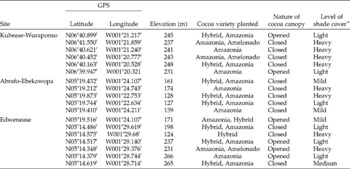
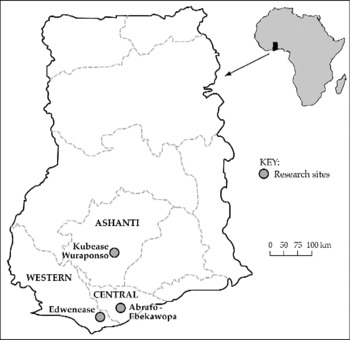
Six farms were selected from each of three cocoa growing areas from three regions in Ghana (Table 1 and Fig. 1). The areas were Kubease-Wuraponso (Ejisu-Juabeng District, Ashanti Region), Abrafo-Ebekawopa (Twifo Heman Lower Denkyira District, Central Region) and Edwenease (Mpohor Wassa East District, Western Region). Each cocoa farm was divided into four quadrants, each quadrant having mean ( ± SD) area of 1.2 ± 0.3 acres (0.48 ± 0.12 ha). Only part (4 acres; 1.6 ha) of relatively large farms was used for the study.
Characteristics of the experimental cocoa farms

+ Four large or six medium-sized shade trees per acre for mild shade (Padi and Owusu, Reference Padi and Owusu1998).
Map of Ghana showing the three research sites.

Preliminary survey of diurnal pollinating activity of cocoa pollinators
The diurnal pollinating activities of cocoa pollinators and the suitability of the three sampling methods were determined from 21 March to 3 April 2007 in two cocoa farms at Kubease–Wuraponso.
Focal patch observation and sampling with motorized aspirator
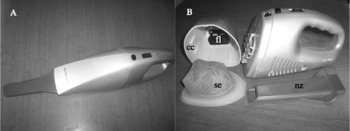
A rechargeable suction pump was supplemented with an external 12 V battery, for prolonged usage. It had a 1.5 × 2.5 × 15 cm removable nozzle through which the insects are sucked into a collection compartment with a fine mesh sieve at the rear and a flap at the anterior to prevent trapped insects from escaping (Plate 1). The flap opens into the collection compartment to allow sucked insects in when the pump is switched on but closes when switched off.
A, suction pump; B, dismantled suction pump: cc, collection compartment; fl, flap; se, sieve; nz, nozzle.

A 1-m section of the trunk of a cocoa tree, 0.3–1.3 m above the soil, with a high number of flowers (10–20) was selected from each of the four plots per farm. A motorized suction pump was used to collect insects that visited the flowers within the marked section for the first 10 min of every hour for 24 h (12.00–24.00 h) for 6 days and 12.00–01.00 h for another 6 days. Flowers were sampled twice within the stipulated 10 min irrespective of the presence of any insect visiting to capture insects that might have entered without being noticed. The nozzle of the pump was quickly covered with the palm to prevent insects that might have been trapped in the nozzle and did not get into the collection compartment. The collection chamber together with the nozzle was separated from the main pump and put into a Perspex cage containing cotton wool soaked in ethyl acetate to kill trapped insects. Inflorescence observation was conducted from positions where most of the flowers were apparent and the collector's shadow would not be cast on the flowers. The experiment was replicated in two cocoa farms and insects caught were stored in 70% ethanol. Insects were later separated to orders (Zahradnik, Reference Zahradnik1999) and subsequently to dipteran families (Scudder and Cannings, Reference Scudder and Cannings2006) for ceratopogonids and cecidomyiids using the respective taxonomic identification keys. The capsids were identified using Afreh-Nuamah's (Reference Afreh-Nuamah1999) insect pests field guide.
UV-bright painted pan traps
UVPPT were made from plastic bowls of 15 cm diameter at the open end, 12 cm at the base and depth of 5 cm by spraying them with three different colours of UV aerosol paint (yellow, blue and white) and sun dried. It must be noted that some smooth bowls do not allow paints to stick easily.
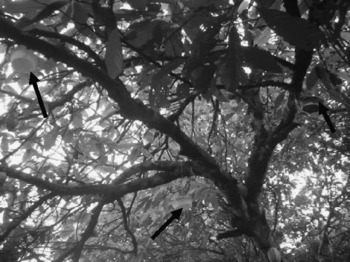
A set of the UVPPT (yellow, blue and white) was filled to three-quarters full with soapy water, to ensure the insects land in the water. The set of UVPPT was hung in the canopy of one cocoa tree randomly selected from each of the four plots (Plate 2). Insects caught in the traps were collected every hour for 24 h for each of the six sampling days and stored, as in focal patch sampling.
UVPPTs arrows hanging in a cocoa canopy

McPhail trap
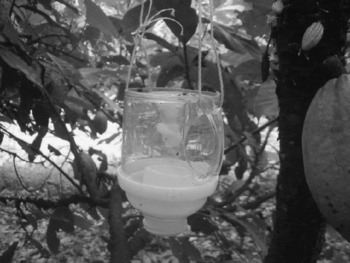
The McPhail trap was made of a top transparent plastic cylindrical chamber of height 7.0 cm and diameter 7.5 cm, and a lower opaque yellow trough of 3.5 cm diameter at the open end (Plate 3).
McPhail trap hanging in a cocoa canopy

Floral oil was distilled from fresh cocoa flowers from Upper Amazonia and hybrid varieties. Fresh flowers were picked directly from cocoa trees between 08.00 and 09.00 h (2–3 h after flowers were fully opened; Swanson et al., Reference Swanson, Carlson and Guiltinan2005) and stored immediately in petroleum ether. Oil was distilled from the flowers using a Soxhlet extraction apparatus, after macerating the flowers with a mortar and pestle. The petroleum ether from which flowers were initially stored was used as the distilling solvent. Distilled oil was diluted with chloroform at 100 parts per million (Young et al., Reference Young, Erickson and Erickson1988).
The distilled floral oil was inoculated into pure cotton balls suspended in the McPhail trap with soapy water in the trough at the base (Young et al., Reference Young, Erickson and Erickson1988). Insects trapped were collected from the trough of the McPhail trap with a fine camel brush every hour for 24 h as in the pan traps. The cotton balls in each trap were then re-inoculated with fresh floral oil on each sampling day.
Monitoring population of cocoa pollinators
After establishing the daily ceratopogonid midge activity peak period, monthly sampling using the three methods was then conducted from April 2007 to April 2008 in all the 18 cocoa farms (six farms from each site).
Focal patch observation and sampling with motorized aspirator
Trees used for this experiment were stratified based on the availability of flowers on the cocoa trees within a plot on each sampling day. On each of the plots, a tree with enough flowers, means ( ± SD) of 17.3 ± 8.73 and 3.86 ± 1.89 flowers during high (February–July) and low (August–December) flowering periods, respectively, within a metre section of the trunk were selected. Thus different cocoa trees, in most cases, were selected for sampling on each plot per month. A 1-m section of the selected tree trunk was marked and flowers were monitored with the motorized suction pump (as detailed in the diurnal experiment above). Ten minutes was spent on each of the four replicate cocoa trees. Based on the results in the diurnal experiment, sampling was confined to between 07.00 and 12.00 h.
UVPPT and McPhail traps
Both traps were set as in the diurnal experiment except that traps were allowed to stay in the cocoa tree canopy for 48 h each month. The same experimental trees were used monthly for the entire 13 month sampling period for the respective UVPPT and McPhail traps.
Data analysis
The active pollination period was determined from simple frequencies of hourly occurrence of the various pollinators using graphs (MS Excel). Number of midges caught per method was normalized by transforming the values to  before analysing. Normality and homogeneity of the data were evaluated by plotting the scatter diagrams of means against variances (Gomez and Gomez, Reference Gomez and Gomez1984). Data were then subjected to ANOVA and means separated by Tukey's test for pairwise comparison at α = 0.05 level, using Minitab release 13.3. All data were back transformed to the original values before plotting of graphs and interpreting the results.
Results
Diurnal pollinating activity of cocoa pollinators
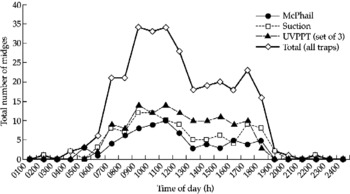
The survey results show that the active pollinating period of cocoa flowers by ceratopogonids spans from 06.00 to 19.00 h, although some were caught with the suction pump between 02.00 and 06.00 h (Fig. 2). Generally, the total number of midges captured with all the trapping methods increased sharply after 06.00 h, peaking at 09.00–11.00 h. Catches thereafter decreased slightly then remained relatively steady until 17.00 h before dropping sharply between 17.00 and 19.00 h. UVPPT catches remained relatively uniform until 17.00 h after peaking at 11.00 h. The suction pump, which actually sampled flower-visiting ceratopogonids, had two peaks – a relatively higher peak occurred before noon (09.00–11.00 h) and a lower peak at dusk (17.00–18.00 h).
Diurnal abundance of cocoa-pollinating midges in two cocoa farms in Ghana.

Abundance of cecidomyiid midges, arguably the second most important pollinators after ceratopogonids (Kaufmann, Reference Kaufmann1973; Young, Reference Young1985), during the day for all the traps followed the pattern observed for ceratopogonid midges. However, higher numbers were caught with the suction pump (scanty for McPhail trap) compared with the complete absence of ceratopogonids during the night sampling.
Monitoring population of cocoa pollinators
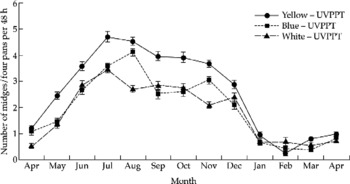
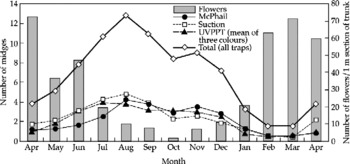
The number of ceratopogonids caught by the yellow UVPPT was significantly higher (P < 0.05) than that by the blue and white UVPPT, with differences between the latter being not significant (Fig. 3). There were no significant differences in number of ceratopogonids for the different colours of the UVPPT at low midge abundance recorded from January to April. There were no significant differences in ceratopogonids abundance recorded by the UVPPT and McPhail traps over the months, except in May–July where significant differences (P < 0.05) were observed (Fig. 4).
Mean ( ± SE) number of midges caught with different colours of UV-bright painted pan traps (UVPPT) from April 2007 to April 2008.

Mean number of midges caught with three sampling methods and flower production in cocoa farms from April 2007 to April 2008.

Over the entire period, the highest mean number of ceratopogonids was caught with the UVPPT (3.11) compared with 2.83 and 2.09 by suction pump and McPhail traps, respectively.
The overall ceratopogonid abundance (total mean from the three sampling methods) and flower production by the cocoa trees over the months are shown in Fig. 4. There was asynchrony between the number of ceratopogonids caught and cocoa flower production. The population of midges increased steadily from April to June, peaking in July–August and then dropped gradually until December. The lowest population was recorded in February and March. However, peak and lowest flower production of cocoa were February–June and August–December, respectively.
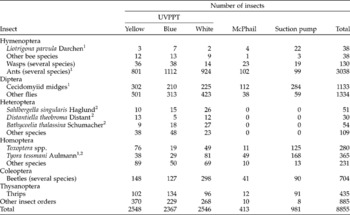
A total of 8855 insects, in addition to ceratopogonids, belonging to 10 orders were trapped by the three sampling methods (Table 2). The insect orders included Diptera (mainly cecidomyiid midges, culicines and fruit flies), Hymenoptera, Orthoptera, Blattodea, Mantodea, Lepidoptera, Coleoptera, Homoptera and Thysanoptera. The rest were Heteroptera including important cocoa pests, capsids (Distantiella theobroma Distant and Sahlbergella singularis Haglund: Miridae) and the pentatomid shield bug Bathycoelia thalassina Schumacher (Table 2). Higher numbers of by-catch insects were recorded in UVPPT than the suction pump and McPhail trap. The two most abundant insects recorded in the study were ants and cecidomyiid midges.
Insects (other than ceratopogonid midges) captured by three sampling methods in cocoa farms

1 Potential cocoa pollinator: all except L. parvula have been found to pollinate cocoa flowers to some extent.
2 Pests of cocoa.
Discussion
All the three methods employed in this study can be concurrently or singularly used to survey and/or monitor cocoa-pollinating midges. The yellow-UVPPT was the most efficient among the three UVPPT and thus can be singularly used for sampling cocoa-pollinating midges. The abundance of midges in yellow pans confirms Potts' (Reference Potts, Dafni, Kevan and Husband2005) assertion that flies are biased towards yellow colour.
The peak midge population and peak flower production asynchrony conform to other reports (Young, Reference Young1982a, Reference Youngb). Flowering intensity, however, appears to influence catches by McPhail and this could explain why the numbers of midges caught by McPhail during the optimal flowering of cocoa between April and August were appreciably lower than that by UVPPT and suction methods. Between August and December when flowering was low, the number of ceratopogonid midges trapped by McPhail was similar to the other two methods. This observation may be attributed to the higher concentration of floral odour produced by the abundant cocoa flowers at the peak period (February–July), masking that by floral oil attractant used in the McPhail. Thus number of midges caught by McPhail was possibly influenced by flower production pattern of cocoa trees rather than seasons highlighted by the studies of Young et al. (Reference Young, Erickson and Erickson1988), where their work was limited to only 6 days each in dry (February) and wet seasons (July), respectively.
Kaufmann (Reference Kaufmann1973) and Murray (Reference Murray and Wood1975) have indicated that cocoa flowers are odourless and nectarless (McGregor, Reference McGregor1976; cited in Brew, Reference Brew1988), but Young (Reference Young1982b) and Young et al. (Reference Young, Schaller and Strand1984) have demonstrated that cocoa flowers produce fragrance and nectar. This study corroborates the findings of Young et al. (Reference Young, Erickson and Erickson1988) that floral oils distilled from cocoa flowers could be used to attract midges. Results from this study also confirm low catches were observed by Young et al. (Reference Young, Erickson and Erickson1988) when the floral oil was used, because the number of midges caught McPhail traps (with floral oil as attractant) here was the least among the three methods, in terms of sampling effort.
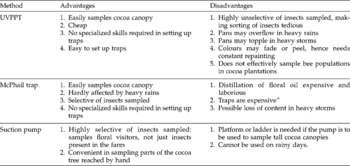
Generally, there were no advantages of sampling using a particular method at low midge abundance. This work did not, therefore, access the diversity of midges caught by the different specimens due to difficulty in getting taxonomists for the identification. For this reason, all the three colours may be used concurrently in future studies until their efficiency in terms of diversity is ascertained. The advantages and disadvantages of the three methods are outlined in Table 3.
Advantages and disadvantages of the three methods used in sampling cocoa pollinators

+ Traps may be improvised from available local plastic materials to reduce cost.
Though UVPPT have been used to efficiently sample bees in agricultural matrix (Potts et al., Reference Potts, Nuttman, Kwapong, Combey and Willmer2006), they appear ineffective in sampling bees in the cocoa agroecosystem. The numbers of bees caught with the UVPPT were extremely low throughout the sampling period. For instance, Apis mellifera L. (Hymenoptera: Apidae: Apinae) (though not a cocoa pollinator) is a frequent visitor to the cocoa farms especially during and a few days after breaking of the harvested cocoa pods, but only nine specimens were caught by UVPPT throughout the sampling period. Similarly, only 12 individuals of Liotrigona parvula Darchen (Hymenoptera: Apidae: Meliponinae) were trapped although a number of them were occasionally seen foraging in the cocoa canopy.
The capturing of most of the L. parvula on the cocoa flowers with the suction pump indicates the possibility of this stingless bee pollinating cocoa flowers. Their efficiency as cocoa pollinators should be investigated, since Young (Reference Young1981) has indicated that T. jaty Smith (Hymenoptera: Apidae: Meliponinae) is ineffective in pollinating cocoa flowers in Costa Rica.
The trapping of a small number of capsids by the UVPPT suggests that with the appropriate colours of UVPPT, these pests may be captured in relatively large numbers. It is hereby recommended that further research should be carried out using an array of different UVPPT colours to establish their efficiency in capturing cocoa capsids for possible management of these pests.
Conclusion
UVPPT, McPhail trap and suction pump can be used singularly or concurrently to survey and/or monitor cocoa-pollinating midges in a cocoa agro-ecosystem. The yellow UVPPT was the most efficient for collecting midges among the three colours (yellow, blue and white) used. The UVPPT generally proved to be the most effective sampling method among the three methods employed, in terms of sampling effort. The appropriate time of the day to sample midges in cocoa flowers using suction pump was from 07.00 to 12.00 h. Both UVPPT and McPhail traps appear ineffective in sampling bees in the cocoa canopy. L. parvula was found visiting cocoa flowers and its role in cocoa pollination should be explored.
Acknowledgements
We thank the Dutch Programme for Cooperation with International Institutions (Netherlands SII) who funded the research through icipe. We are also grateful to the Department of Entomology and Wildlife, University of Cape Coast (UCC), for hosting the project, and Mr Aubyn and Mr Abedu (UCC) for the distillation of floral oils.