INTRODUCTION
Eulimid gastropods exhibit a variety of parasitism (Warén, Reference Warén1984a; Bouchet & Warén, Reference Bouchet and Warén1986; Jangoux, Reference Jangoux and Kinne1990). Some species are completely endoparasitic and have a vermiform body as adults, while the less specialized ectoparasites have the typical shape of caenogastropods and move freely on their host and/or substratum. The parasitic lifestyle of eulimids has resulted in divergent sexual strategies (Warén, Reference Warén1984a, Reference Warénb; Heller, Reference Heller1993), which is one of the important aspects of plasticity in this group. Understanding of their reproductive strategy is of interest from the standpoint of their relationship to attachment mode and life history. Although several strategies are recognized for eulimids (e.g. Lützen, Reference Lützen1972; Gooding & Lützen, Reference Gooding and Lützen1973; Lützen & Nielsen, Reference Lützen and Nielsen1975; Warén, Reference Warén1984a), the ecology of eulimids is too poorly known to understand the advantages of the different strategies.
A large number of eulimid species have pronounced sexual dimorphism expressed as different sizes between sexes. Previous studies have noted that females are larger (e.g. Humphreys & Lützen, Reference Humphreys and Lützen1972; Lützen, Reference Lützen1972; Warén, Reference Warén1980a, Reference Warénb, Reference Warén1984a; Hoskin & Warén, Reference Hoskin and Warén1983; Bouchet & Warén, Reference Bouchet and Warén1986; Warén & Moolenbeek, Reference Warén and Moolenbeek1989; González-Vallejo, Reference González-Vallejo2008) and their shell shape is different (e.g. Lützen & Nielsen, Reference Lützen and Nielsen1975; Warén, Reference Warén1981, Reference Warén1984a, Reference Warén1992; Warén et al., Reference Warén, Norris and Templado1994). The mechanism that induces sexual dimorphism during their growth, however, has not been studied in eulimids.
There have been few studies dealing with the growth and reproductive cycle of eulimids. This is partly because regular sampling of the host animals is often difficult. Morton (Reference Morton1979) studied the growth pattern, reproductive cycle and population dynamics of Parvioris fulvescens (as Mucronalia fulvescens) and P. mortoni (as Balcis ‘shaplandi' = misspelling of shoplandi, subsequently identified as P. mortoni in Warén, Reference Warén1981), both ectoparasites of the asteroid Archaster typicus in coastal waters of Hong Kong. Morton (Reference Morton1979) pointed out that the life cycle of eulimids was poorly studied, and this situation since has not changed much. Several authors have found important ecological aspects of eulimids (e.g. Elder, Reference Elder1979; Fujioka, Reference Fujioka1985; Crossland et al., Reference Crossland, Alford and Collins1991) but our knowledge is not enough to understand the complex life history traits of eulimids.
Hypermastus tokunagai is a eulimid infecting the sand dollar Scaphechinus mirabilis in the coastal waters of Japan (Matsuda et al., Reference Matsuda, Hamano, Yamamoto and Hori2008, Reference Matsuda, Hamano, Hori and Nagasawa2010). This eulimid is usually located on the oral region of the host's test and is able to leave the host and reattach easily. Previously, we examined the growth of H. tokunagai in the western Seto Inland Sea (Matsuda et al., Reference Matsuda, Hamano, Yamamoto and Hori2008), but a clear pattern could not be detected since the number of specimens collected was not sufficient enough for making further inferences. In this study, we investigated the growth and reproductive cycle of H. tokunagai through a study of the host population. Furthermore, using more than 1200 specimens, we examined the change in shell shape of H. tokunagai during the growth with respect to sexual dimorphism.
MATERIALS AND METHODS
Sampling was conducted in the western Seto Inland Sea off Okuni (33°52′N 132°07′E), Yamaguchi Prefecture, Japan, from April 2006 to September 2008. The substratum was composed of fine sand.
Fifty to 70 individuals of Scaphechinus mirabilis were usually collected once or twice a month. When sampling time was limited by bad weather and/or wave was quite high, less than 50 sand dollars were collected. All sand dollars collected were measured for their test diameter and examined for the presence of Hypermastus tokunagai by the naked eye. Specimens of H. tokunagai were removed from the host and placed individually into test tubes. When two or three specimens were found close together on the host, they were regarded as a pair or group, respectively, and the situation was recorded. Water temperature was measured near the bottom when samples were collected. In the laboratory, the shell length (SL) and shell width (SW) of each specimen were measured to the nearest 0.01 mm with a digital microscope (VH-7000, Keyence Inc., Osaka, Japan). Specimens whose apical part or outer lip margin of the shell was damaged were not used for the measurements. The whorl number (WN) was counted for each protoconch and teleoconch.
Gonad development of H. tokunagai was histologically examined. Animals (N = 458) were collected from April 2006 to April 2008. In the laboratory, the tissues were fixed in Bouin's fluid for a day, and the soft parts were transferred to 70% ethanol. The fixed tissues were dehydrated through an ascending ethanol series, embedded in paraffin wax and then sectioned at 5–6 µm thickness. Sections were mounted on slides and stained with haematoxylin and eosin.
Gonad development was classified into one of the following six stages:
Stage 0 (sex-indeterminate stage); a gonia or gametocytes are scattered, and spermatogonia or oogonia line the inner wall of alveoli, but the sex cannot be determined.
Stage I (early development stage); male: the gonadal volume is still small, but spermatogonia have increased in number and developed into spermatid; female: the gonadal volume is still small, but a few gametocytes which can be determined as oocytes are present.
Stage II (late development stage); male: the testis possesses many spermatocytes and spermatid; female: ovary possesses early vitellogenic oocytes, and a few yolk granules began to appear with the initiation of yolk formation.
Stage III (morphologically ripe stage); male: the soft body is filled with testis, the lumen of the seminal vesicle contains spermatozoa; female: the soft body is filled with ovary, and the oocytes contain mature yolk granules.
Stage IV (spawning stage (partially spent stage)); male: the seminal vesicle is less densely packed with spermatozoa, and the acini lumina possess a few sex cells whilst later, the testis becomes a mass of degenerating cells; female: the ripe oocytes are discharged, and there is a general reduction in soft part occupied by genital tissue.
Stage V (recovery stage); male: although the seminal vesicle does not contain spermatozoa, the newly developing testis is seen as a cluster of primordial cells lying above the seminal vesicle; female: the newly developing oogonia appear from the inner wall of the gonad.
Among six stages, five stages excluding sex-indeterminate stage (Stage 0) were categorized as immature group (Stages I and II) and mature group (Stages III–V).
Shell shape was examined for 1286 specimens of H. tokunagai collected from 679 S. mirabilis. The relationship between SL and WN and that between SL and SW were treated with the general equation y = aXb. After sex determination, the measurements of SL and SW were regressed separately for immature males, immature females, mature males and mature females, and the parameters of an equivalent allometric regression log y = log a + b log x were analysed by analysis of covariance to test the equality of regression between sexes and maturity.
RESULTS
Host size
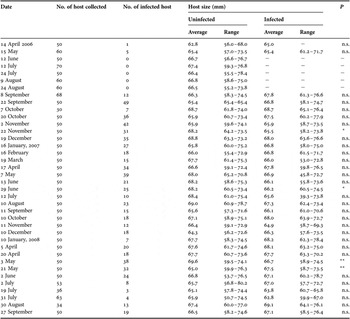
The test diameter of Scaphechinus mirabilis examined varied from 39.3 to 80.2 (mean 66.7) mm (N = 1934), and no clear monthly variation was found (Table 1). The size of infected S. mirabilis was not significantly different from that of uninfected ones (Mann–Whitney U-test, Ps > 0.05), except for individuals collected in four surveys on 22 November 2006 (P < 0.05), 29 June 2007 (P < 0.05) and 3 and 21 May 3 2008 (Ps < 0.01). In the above four surveys, infected S. mirabilis were smaller than the uninfected S. mirabilis but the specimens collected on 21 May 2008 were an exception.
Monthly changes in size (test diameter) of Scaphechinus mirabilis.

n.s., not significant; *P < 0.05; **P < 0.01.
Size structure of Hypermastus tokunagai
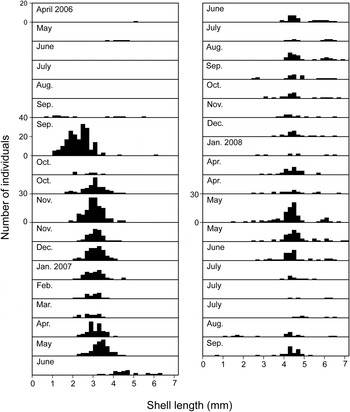
Two distinct size-groups of H. tokunagai (0.7–2.1 and 3.6–5.6 mm SL) were collected in early September 2006, but large-sized individuals almost disappeared thereafter (Figure 1). In late September 2006, individuals that are considered to have grown from the small-sized individuals observed in early September were abundantly observed. They grew thereafter, although the monthly size–frequency distributions (mostly 2.0–4.0 mm SL) did not change between October 2006 and May 2007. In June 2007, however, two distinct size-groups were recognized. Both small (~4.5 mm SL) and large (~6.0 mm SL) individuals remained at nearly the same size-range and were found until August 2008. Small-sized individuals (~2.5 mm SL) were newly collected in low abundance in September 2007. Much smaller individuals (~1.5 mm SL) were collected in May, August and September 2008.
Monthly changes in size–frequency distribution of Hypermastus tokunagai from Scaphechinus mirabilis in the western Seto Inland Sea, Japan, from April 2006 to September 2008.

Maturation of Hypermastus tokunagai
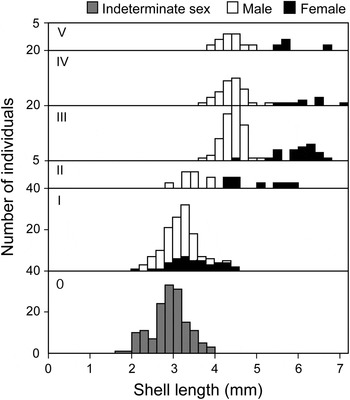
Of the 458 H. tokunagai sectioned, the numbers of individuals of indeterminate sex, males and females were 152, 217 and 89, respectively. No specimens with both ovary and testis were observed. Specimens of indeterminate sex were 1.63–3.95 mm SL, and all the specimens smaller than 2.0 mm SL were included in this stage (Figure 2). Males and females ranged from 2.26–5.22 mm and 2.19–7.05 mm SL, respectively. In sexually recognizable specimens, SL increased in accordance with the progression of gonad development stage from Stage I to Stage III in both sexes (Figure 2). However, no clear differences in SL were detected from Stage III to Stage V. Stage I males and females overlapped in SL, which was, however, significantly different between sexes (Mann–Whitney U-test, P < 0.01). No males and females overlapped in SL at Stages II–V, except for a single specimen of female in Stage III.
Size–frequency distributions of Hypermastus tokunagai in each gonad stage. See text for details of gonad developmental Stages I–V.

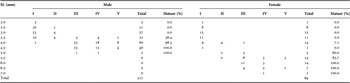
The percentage of specimens classified into each gonad development stage is shown for size-classes separately in Table 2. In males, sexual maturation began at 3.5 mm SL and all individuals over 4.5 mm SL were mature. In females, sexual maturation started at 5.0 mm SL and all individuals over 6.0 mm SL were mature.
Shell length (SL) and sexual maturity (Stages I–V) of male and female Hypermastus tokunagai collected from April 2006 to April 2008. Mature (%) = 100 × (Stages III–V)/total.

Growth and reproductive cycle of Hypermastus tokunagai
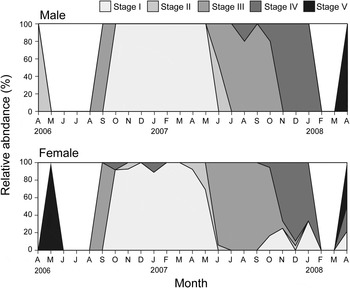
The monthly changes in percentage of different gonad development stages of H. tokunagai were similar for males and females (Figure 3). Stage I individuals were very abundant from October 2006 to May 2007, followed by Stage II individuals in April and June 2007. Stages III and IV specimens predominated from June to October 2007 and from November 2007 to January 2008, respectively. Stage V individuals were recorded in the following April.
Seasonal occurrences in relative abundance of different gonad development stages of Hypermastus tokunagai from April 2006 to April 2008. See text for details of developmental Stages I–V.

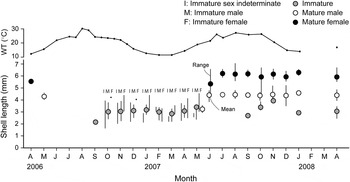
Monthly changes in mean SL of immature and mature groups of H. tokunagai and water temperature are shown in Figure 4. As for months when we surveyed twice a month, the data were combined. Mean SL increased steadily to about 3.0 mm from September to October 2006 (Figure 4). It then stabilized or declined slightly from October 2006 to April 2007. SL increased again in May 2007, but in June 2007, mature males and females appeared and constituted distinct size-groups. Thereafter, these two groups were found until April 2008. Immature individuals were also found from September 2007 to April 2008. Water temperature showed seasonal changes, and the period of the first, steady growth of H. tokunagai immediately after settlement corresponded with the higher water temperature of the early autumn months (Figure 4). Growth was retarded from the mid-autumn to winter months when water temperature remained low. The second notable growth and the appearance of two distinct size-groups occurred in June 2007, when water temperature was 21.4°C.
Seasonal changes in shell length (mean and range) of Hypermastus tokunagai and bottom water temperature from April 2006 to April 2008. Grey-coloured circles indicate mean size of immature specimens. Closed and open circles indicate mean size of mature males and mature females, respectively.

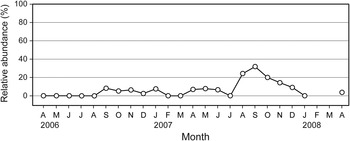
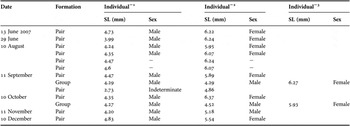
The proportion of paired or grouped individuals of H. tokunagai remained low from April 2006 to June 2007, but increased from August with a peak of 31.8% in September 2007 (Figure 5). The proportion then gradually decreased and reached 0% in January 2008. Examination of the SL in paired or grouped individuals collected from June to December 2007 revealed that most of them were composed of small (~4.5 mm SL) and large specimens (~6.0 mm SL) (Table 3). In addition, among 10 cases in which sex could be determined, 7 were composed of a male and a female, 2 were composed of two males and a female, and the last was composed of two males.
Seasonal occurrences in relative abundance of paired or grouped individuals of Hypermastus tokunagai from April 2006 to April 2008.

Shell length (SL) and sex of paired or grouped Hypermastus tokunagai collected from June to December 2007.

Change in shell shape with growth of Hypermastus tokunagai
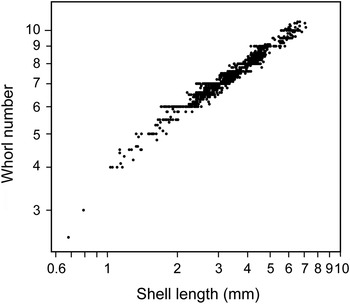
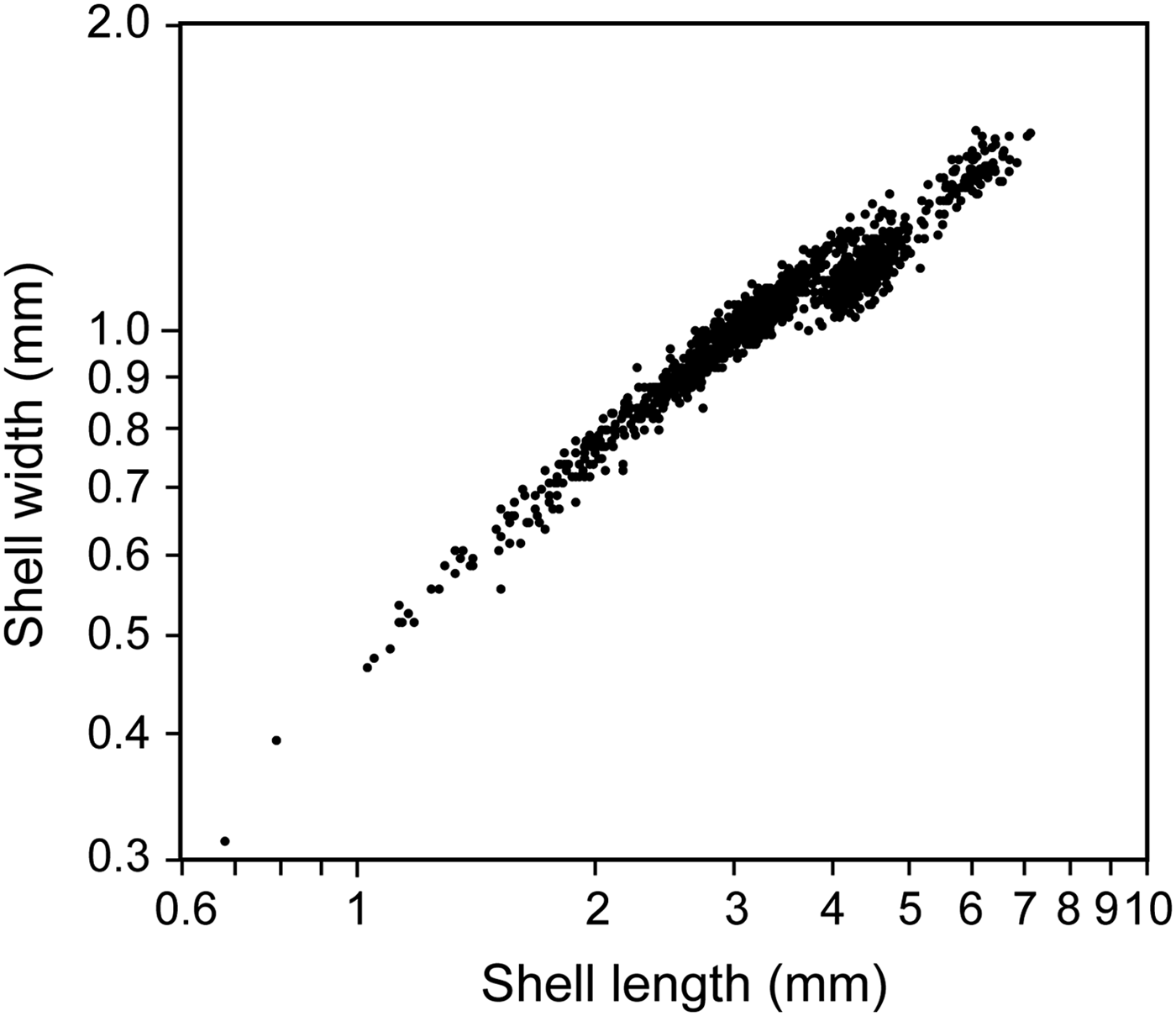
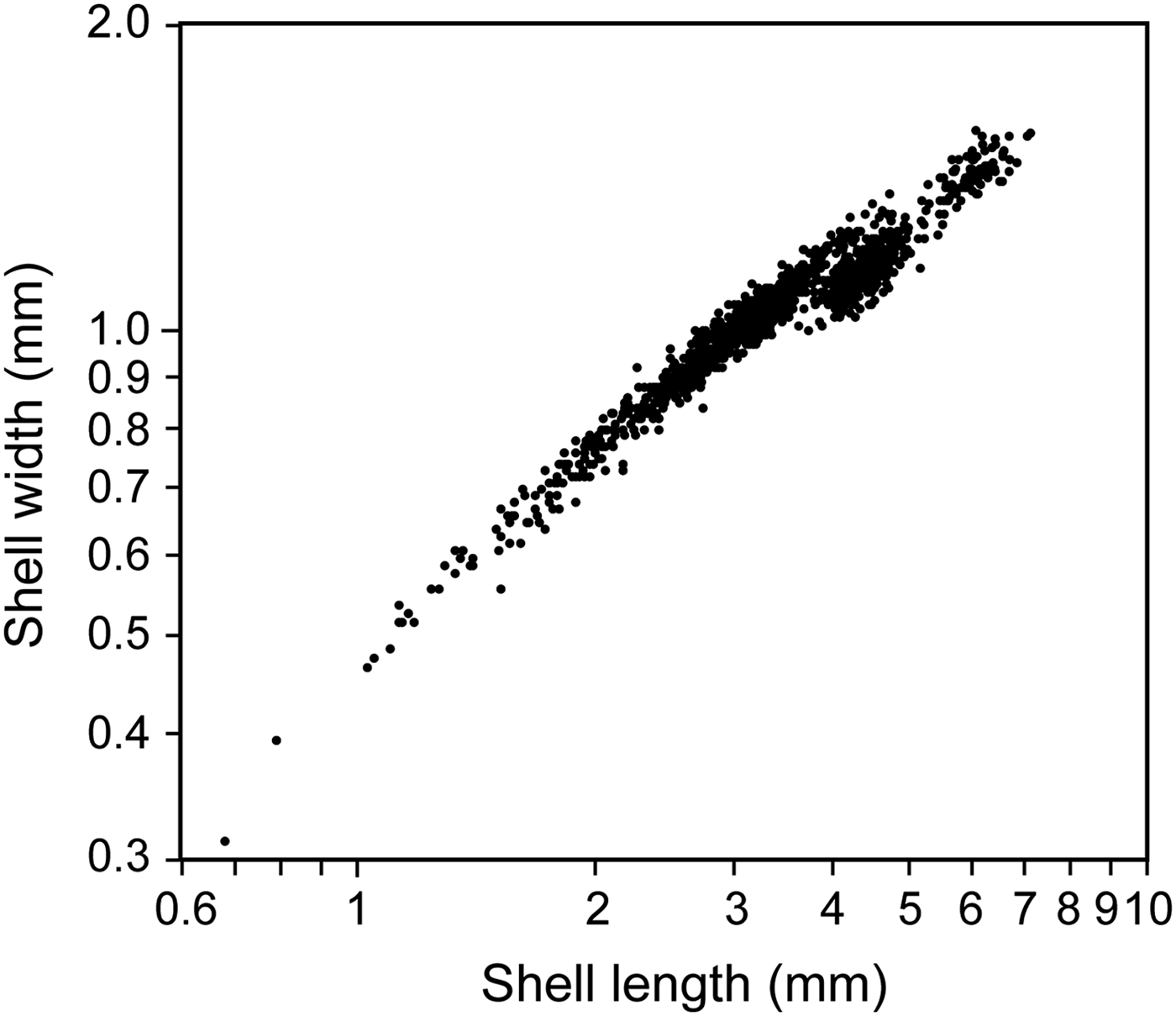
The morphometric regressions between SL and WN (Figure 6) and between SL and SW (Figure 7) showed different patterns. When the data were log-transformed, WN was linearly related to SL (Figure 6). With an increase in SL from 1–2 and 2–3 mm, WN increased from 4–6 (1 whorl per 0.5 mm) and 6–7 (per 1 mm), respectively. Similarly, 7–9 whorls were increased per 1 mm (an increase in SL from 3–4 and 4–5 mm, WN increased from 7–8 and 8–9, respectively). Then, it increased up to 11 in a larger individual (7.17 mm SL). On the other hand, SW was not lineally related to SL (Figure 7). There was a flexion point at 4.0 mm SL, thus growth rates of SL and SW were not constant. Many specimens made a group at around 4.5 mm SL.
Relationship between shell length and whorl number of Hypermastus tokunagai.

Relationship between shell length and shell width of Hypermastus tokunagai.
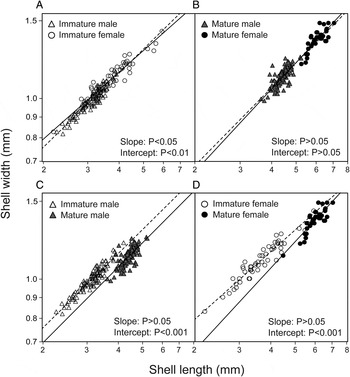
The morphometric regressions between SL and SW were highly significant for immature males, immature females, mature males and mature females (Figure 8A–D, r 2 = 0.57–0.91, Ps < 0.001). The regressions for immature males and females were significantly different (Figure 8A, Slope: P < 0.05; Intercept: P < 0.01), although the values were mostly overlapped in SL from 3–4 mm. The regressions for mature males and females were not significantly different (Figure 8B, Slope: P > 0.05; Intercept: P > 0.05). By contrast, the regressions for immature and mature individuals were significantly different in both males and females (Figure 8C, D, Slope: Ps > 0.05; Intercept: Ps < 0.001).
Relationships between shell length (SL) and shell width (SW) for immature males, immature females, mature males and mature females of Hypermastus tokunagai: (A) relationships between SL and SW of immature males and females. Solid and broken lines are logarithmic regressions for immature females and immature males, respectively; (B) relationships between SL and SW of mature males and females. Solid and broken lines are logarithmic regressions for mature males and mature females, respectively; (C) relationships between SL and SW of immature and mature males. Solid and broken lines are logarithmic regressions for mature males and immature males, respectively; (D) relationships between SL and SW of immature and mature females. Solid and broken lines are logarithmic regressions for mature females and immature females, respectively.

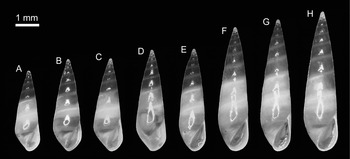
The shells of immature males and females were similar in shape, having slightly angulated body whorl (Figure 9A–D). On the other hand, shells of mature males and females were proportionally slender, and their body whorls were not angulated (Figure 9E–H). No obvious difference in shell shape could be detected between males and females when both immature and mature individuals were combined.
Examples of shell shape of Hypermastus tokunagai: (A, B) immature males, SL = 3.38 mm and SL = 3.87 mm; (C, D) immature females, SL = 3.95 mm and SL = 4.25 mm; (E, F) mature males, SL = 4.27 mm and SL = 5.22 mm; (G, H) mature females, SL = 5.54 mm and SL = 5.89 mm.

DISCUSSION
Growth and reproductive cycle
Hypermastus tokunagai grew markedly on two occasions with respect to its life history (Figure 4). New recruits of H. tokunagai appeared in early autumn, and the first rapid growth occurred immediately after recruitment onto the host. The second period of rapid growth corresponded with maturation. In both cases, individuals grew rapidly within a short time. The growth rate of gastropods is known to vary with season and related conditions, such as nutritional state (feeding behaviour related to environmental factors and biomass of prey animal), water temperature (Hughes, Reference Hughes1986; Uki, Reference Uki, Takashima and Hanyu1989), and reproductive cost (Ekaratne & Crisp, Reference Ekaratne and Crisp1984). As H. tokunagai can obtain energy constantly once it finds a host, nutritional state may not be a major problem. The first steady growth of this species may increase a survival rate after settlement, by firmly attaching to their host. The second period of rapid growth was synchronized with maturation, which shows that reproductive cost does not affect the growth. Water temperature appears to be the most probable factor affecting the growth of H. tokunagai, as suggested for many marine invertebrates (e.g. Ekaratne & Crisp, Reference Ekaratne and Crisp1984; Miyamoto et al., Reference Miyamoto, Ito, Noda and Nakao1995). In temperate marine animals, reproductive activity is regulated by seasonal changing water temperature (Orton, Reference Orton1920). The observed, synchronized growth and maturation of H. tokunagai also occurred within a short period of summer.
This study has revealed that H. tokunagai settles on its host in September and matures in the following June and July. It is thus likely that this species takes 9–10 months to become reproductively active. Although the species did not grow continuously in cold months, such cessation of growth may be advantageous for survival because individuals may save energy for the growth and maturation. In addition, the life span of the sand dollar Echinarachnius parma was reported to be 8 years (Steimie, Reference Steimie1989). The size of Scaphechinus mirabilis we surveyed remained stable throughout the study period and they constantly formed dense beds. The long-life span and population stability of S. mirabilis might be connected with the observed maturation period of H. tokunagai.
It is evident from this study that H. tokunagai has an annual reproductive cycle. A similar annual reproductive cycle with summer spawning (or autumn settlement season) has been suggested for two other eulimids from Japanese waters, Vitreobalcis temnopleuricola (Fujioka, Reference Fujioka1985) and Pelseneeria castanea (Kawai & Nagasawa, Reference Kawai and Nagasawa2006), both known from sea urchins. While H. tokunagai is here considered to recruit to the host in the autumn, small-sized specimens occurred in low abundance in the spring as well. After their reproduction in the summer, mature males and females did not die, and Stage V individuals were collected the following April (Figure 4). Therefore, it is likely that this species can spawn in the spring. However, we do not know whether the same individuals can reproduce again or not. The presence of two spawning seasons is known for Parvioris fulvescens (as Mucronalia fulvescens) and P. mortoni (as Balcis shoplandi) (Morton, Reference Morton1979). In these species, after older females die, young males undergo a sex change to become females, although Warén (Reference Warén1981) did not agree with this theory for P. fulvescens. In some tropical eulimids, spawning is continuous (Warén, Reference Warén1984a), which may be due to the relatively stable environmental conditions, such as water temperature.
Life span
It is evident from Figure 4 that H. tokunagai can live for at least 20 months (from September 2006 to April 2008). In addition, two size-groups (mature males and females) were found until August 2008 (Figure 1). Since newly recruited individuals that appeared in 2007 will take 9–10 months to acquire mature sizes, the large sized individuals which were observed before June are supposed to be parental generation. Thus, the maximum life span (longevity) of H. tokunagai is estimated to be up to nearly two years (21–22 months). This estimate is longer than that of other eulimids, including V. temnopleuricola (10 months: Fujioka, Reference Fujioka1985) which inhabits the same geographical region, Melanella yamazii (6–9 months: Kuramochi, Reference Kuramochi2003), Parvioris fulvescens (as Mucronalia fulvescens) (15 months: Morton, Reference Morton1979) and P. mortoni (as Balcis shoplandi) (15 months: Morton, Reference Morton1979) despite the fact that the maximum SL of these species is almost the same (5–6 mm). While H. tokunagai takes at least 10 months to mature, other eulimid species become sexually active sooner (Morton, Reference Morton1979). The present study area was undertaken in a temperate zone (33°52′N), while Morton's study was in a subtropical zone (~22°N). The retardation in the life cycle of H. tokunagai, shown by the slowed or ceased growth, is thought to be a response to the low temperature in the winter of the temperate region. This may be one of the factors responsible for the longer life span of the species. In addition, as stated above, the host's long-life and population stability may also ensure the longer life span of H. tokunagai. This species is not spatially restricted by the host's spines, and even if it gets detached from the host, it can find and infect the host once again (Matsuda et al., unpublished data). These features may also ensure the longer life span of the species.
Reproductive strategy
In this study, the sexes were found to be separate, indicating that H. tokunagai is a gonochorist. Gonochorism has been reported for some other eulimid species belonging to e.g. Melanella and Peasistilifer (both from holothuroids), as well as Vitreolina (from holothuroids, ophiuroids and echinoids) (Warén, Reference Warén1984a), and is known to occur only in those genera that have a comparatively weak association with the host (i.e. often leaving the host and re-infecting a new host).
Some Hypermastus species, however, are thought to change sex. It was suggested that some individuals of H. obliquistomum develop directly to females, while others pass through a male phase (Warén et al., Reference Warén, Norris and Templado1994) since there are two forms in large females and the more slender of the two has a vestigial penis and a well-developed pallial oviduct. Both H. placentae and H. tenuissimae were suggested to change sex from male to female because large males equivalent to mature females in size were occasionally found (Crossland et al., Reference Crossland, Alford and Collins1991; Warén & Crossland, Reference Warén and Crossland1991). Though overlapping of size distributions of mature males and females were detected in this study (Table 2), no evidence for H. tokunagai changing sex could be obtained.
Two (rarely three) individuals of H. tokunagai were occasionally found in close proximity to one another (shells often touching each other) on the host (Figure 5). The percentage of paired or grouped individuals increased during the reproductive season (August to December) (Figure 5) and the individuals found on the same host animal consisted mainly of pairs of one male and one larger female specimen during the season. This indicates that males and females are solitary before and after the summer, and pairs are formed for mating only. In this study, the number of males was more than twice that of females; however, a female accompanied by more than one male was rarely found. In some eulimids (e.g. Robillardia cernica, Sabinella bonifaciae and S. shaskyi), females are permanently attached to the host, while males can crawl freely (Gooding & Lützen, Reference Gooding and Lützen1973; Bouchet & Warén, Reference Bouchet and Warén1986; Warén, Reference Warén1992). As for H. tokunagai, males may move around and find females to mate with.
The reproductive biology of H. tokunagai parasitic on irregular sea urchins is different from those of other eulimids infecting regular sea urchins. For example, Pelseneeria spp. live in a limited space protected by the host's spines: their body size seems to be limited and they are simultaneous hermaphrodites, where every encounter with other individuals can be an occasion for mating (Warén, Reference Warén1984a). On the other hand, H. tokunagai is not protected by the host's spines and has a slender shell which may be suitable for burrowing itself into the substrate. As suggested above, this species can leave the host and may have numerous occasions to mate with other individuals, which may explain why this species is a gonochorist.
Change in shell shape
Hypermastus tokunagai changes the proportion of SL and SW as it grows. Marine invertebrates are known to have various growth patterns according to the group. The relative growth of gastropods has a turning point, which is associated with their maturation (Takano, Reference Takano1932). Since individuals smaller than 4–5 mm in SL, have rather round-shaped shells (Figure 7), it can be considered that much energy would be required for maturation. In this study, a significant difference was found in the shell variables of immature and mature individuals (Figure 8C, D) which indicate that both males and females change their shell shape when they mature. On the other hand, mature males and females did not differ in shell proportion, though their size differs significantly. It is suggested that female caenogastropods often develop more swollen or larger shells because the pallial gonoduct occupies a larger space than in males (Sasaki, Reference Sasaki2008), and eggs are bulkier than sperm. In H. tokunagai, larger space for reproductive organs in females is thought to be attained by larger shell size, without changing shell proportion from that of males.
Previously, attempts to determine sex from shell morphology were shown to be reliable for Hypermastus placentae (Warén & Crossland, Reference Warén and Crossland1991). Similarly, the sexes of H. colmani were considered to be determined by shell form, shape of the aperture and the size (Warén & Crossland, Reference Warén and Crossland1991). In addition, it is suggested that several Hypermastus species (e.g. H. auritae and H. boschorum) show different shell morphology and this fits with size distribution of the sexes (Warén & Crossland, Reference Warén and Crossland1991). Our study indicated that the size of mature males and females constitute distinct groups though there are overlapping of size distributions between male and female, which indicates that small females may be surpassed by large males (Figure 8). Therefore, it was difficult to judge the sex based on their appearance. At the same time, young specimens of H. tokunagai possess slightly angulated body whorl similar to other eulimids (Bouchet & Warén, Reference Bouchet and Warén1986). This morphological character can be useful for distinguishing immature and mature individuals.
There is a gap at 5–6 mm SL in the relationship between WN and SL (Figure 6) as well as in SW and SL (Figure 7). No individuals of intermediate size, however, were collected during periodical sampling of this study. Eulimid females are typically larger than males but almost no detailed information is available on the mechanisms of sexual size dimorphism for this group. This study has characterized the size dimorphism between sexes of H. tokunagai, and attributes this dimorphism to female acquisition of a larger shell by a rapid growth near maturation.
ACKNOWLEDGEMENTS
We thank Drs Toshihiro Nakai, Susumu Ohtsuka, and Koichiro Kawai of Hiroshima University for comments on an early manuscript. We acknowledge Dr Kazumasa Uematsu of Hiroshima University and Dr Akira Araki of the National Fisheries University for permission for use of equipment. We thank the members of the Laboratory of Aquaculture, Hiroshima University for constructive discussion. We are also grateful to Mr Koichi Miki of the Tana Marine Biological Laboratory, National Fisheries University and the members of the Laboratory of Aquatic Biology, National Fisheries University, for assistance during the fieldwork. Part of this work was supported by a Grant-in-Aid for Japan Society for the Promotion of Science Fellows (22–8067 to H.M.).