Topic nasal sympathomimetic amines, and imidazoline, are thought to be safe in providing relief of the symptoms of nasal congestion, being considered to have only minor side effects, such as reactive hyperaemia and atrophic rhinitis.Reference Bucaretchi, Dragosavac and Vieira1–Reference Thrush5 These drugs, nonetheless, may concentrate rapidly in the plasma if used in very young children, with potential serious side effects, and no real evidence-based data establishing their efficacy in such patients.Reference Bucaretchi, Dragosavac and Vieira1, Reference Eddy and Howell2 We describe here an instance of syncope with severe hypotension and bradycardia associated with the use of oxymetazoline in a toddler.
Case report
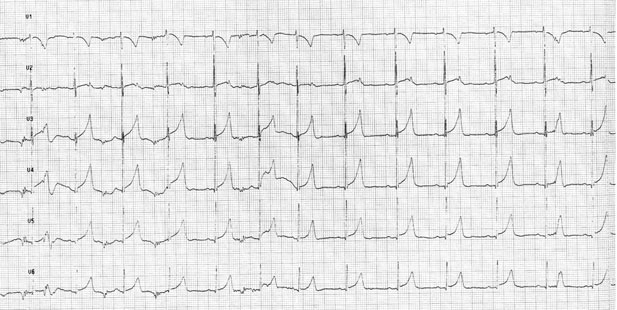
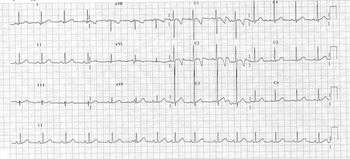
A 23-month-old boy was admitted to our paediatric cardiology unit because of severe hypotension, with systolic pressures of 50 mmHg, and diastolic values being non-detectable, and bradycardia, his heart rate being 60 beats per minute. He was lethargic and pale, without evident signs for sepsis or meningitis at physical examination. The electrocardiogram showed sinus bradycardia without atrioventricular block (Fig. 1). Cross-sectional echocardiography showed moderate left ventricular dysfunction, with an ejection fraction of 45%, but without any structural heart disease. Having established an intravenous line, dopamine and dobutamine were promptly infused, producing a progressive increase in systemic blood pressure and heart rate. Arterial femoral pulses became progressively more appreciable, while the heart rate stabilized at 130 beats per minute in sinus rythm. Within 2 hours, there was a striking normalization of the systolic ventricular function, along with stabilisation of arterial pressure and cardiac rhythm (Fig. 2), allowing for progressive discontinuation of the inotropic support. Examination of blood proved normal, with no signs of infection. Over the following 6 hours, the mental state recovered spontaneously, and his cardio-vascular parameters were normal, permitting his discharge after 48 hours of observation.
The precordial leads of the electrocardiogram taken shortly after admission, and prior to the start of inotropic intravenous support. Sinus bradycardia with high T-waves are recognizable.
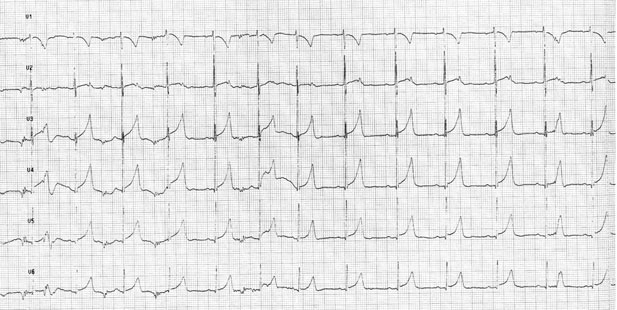
The electrocardiogram 48 hours after recovery, showing normal sinus rhythm.

When asked, the mother explained that, shortly before the onset of symptoms, the child was given a generous amount of inhaled oxymetazoline clorhydrate, at a concentration of 0.05%, to relieve symptoms of rhinorrhea. The patient became lethargic after few minutes and, after 3 hours, she decided to take him to the nearest hospital. She denied administering any medications other than oxymetazoline, and also denied ingestion by the toddler of any other medication.
Discussion
Benzylimidazolines, such as oxymetazoline, are commonly used as topical nasal decongestants, acting as vasoconstrictor by stimulating peripheral alpha2 receptors in the vessels of the nasal mucosa. Hypertension, tachycardia, and generalized peripheral vasoconstrictor are the usual signs of systemic toxicity, but in some patients, toxicity may produce a strong hypotensive-bradycardic reaction due to stimulation of centrally located alpha2 receptors.
Dosing errors, especially in children younger than 2 years, may need hospitalisation and symptomatic treatment, with even instances of death reported in the literature.Reference Bucaretchi, Dragosavac and Vieira1, Reference Eddy and Howell2 Toddlers are at major risk due to the relatively high dose absorbed. Moreover, the extent of dosing has been extrapolated from experience with adults, so at present there are no clear guidelines which may help avoiding toxic levels in small children. Both parents and physicians, therefore, should be aware that uncontrolled administration of benzylimidazolines in children younger than 2 years of age may have serious adverse cardiovascular effects.