Introduction
The global prevalence of dementia is expected to rise from 46.8 million to 131.5 million by 2050. Dementia is generally associated with particularly high care needs, especially in the later stages (Prince et al. Reference Prince, Wimo, Guerchet, Ali, Wu and Prina2015). Therefore, it is not surprising that the prevalence of care-home residents with dementia has increased. For example, it is estimated that more than 80 per cent of care-home residents have memory problems in United Kingdom (UK) (Quince Reference Quince2013) and that around 50 per cent have dementia in the United States of America (USA) (Magaziner et al. Reference Magaziner, German, Zimmerman, Hebel, Burton, Gruber-Baldini, May and Kittner2000). Care homes in the context of this paper are any residential or nursing care provider offering long-term, 24-hour care and personal care to older people. Care homes are coping with more residents with complex or high needs than ever before (British Geriatrics Society 2011). This changing landscape means that there are likely to be more instances of residents experiencing dementia-related behaviours in care homes, which can create challenges for staff.
Emphasis has been placed on minimising the use of restraints (American Nurses Association 2012; Code of Federal Regulations (CFR) 1989; Hughes Reference Hughes2010; Owen and Meyer Reference Owen and Meyer2009). Guidance suggests that restraint should only be used if it is in the person's best interests and to prevent harm (Mental Capacity Act 2005) and that non-pharmacological interventions should be used for behavioural management (National Institute for Health and Clinical Excellence and Social Care Institute for Excellence [2006] 2012). In-line with this move, and as a result of the identification of increased risks, there have been efforts to reduce the use of antipsychotic (sedative) medications for people with dementia in the USA, UK and Australia (Banerjee Reference Banerjee2009; Centers for Medicare and Medicaid Services (CMS) 2014; Peisah and Skladzien Reference Peisah and Skladzien2014; US Food and Drug Administration 2008). The British Psychological Society advocates using non-pharmacological interventions in a stepped care approach to reduce the use of antipsychotic medications (Brechin et al. Reference Brechin, Murphy, James and Codner2013). Other recent approaches to managing dementia-related behaviours in care homes include person-centred care (Brooker Reference Brooker2007; Care Fit for VIPS 2016; Kitwood Reference Kitwood1997); better assessments for residents; environmental changes, and multiple non-pharmacological interventions, such as training programmes for long-term care staff; psycho-social activities; individualised assessment and care planning; exercise; music therapy; and other forms of sensory stimulation (International Psychogeriatric Association 2015).
Neither age nor dementia can be an excuse to deny older people their rights (General Assembly 2015; Kelly and Innes Reference Kelly and Innes2013). There is ongoing work to strengthen the recognition and upholding of the human rights of older people across the globe (Council of Europe 2014; World Human Rights Forum 2014). Many people with dementia in low- and middle-income countries have difficulty meeting even their basic human rights, such as accessing health and social care, due to multiple factors including low literacy levels, poverty, and a lack of transport and local institutions (Mittler Reference Mittler2016; World Health Organization 2015). Access to financial benefits is also an issue in many low- and middle-income countries, with some countries only offering financial benefits to those who have given up their legal capacity (World Health Organization 2015). Provision of and access to long-term care, in particular residential forms of care, may be very restricted in low and middle-income countries. Although there are a growing number of care homes for older people in Asia and Latin America, there is also evidence that the industry is weakly and poorly regulated (Camarano et al. Reference Camarano, Kanos, Leitão e Mello, Carvalho and Camarano2010; Cheung Wong and Leung Reference Cheung Wong and Leung2012; Sasat et al. Reference Sasat, Choowattanapakorn, Pukdeeprom, Lertrat and Arunsaeng2013). This raises a range of issues relating to quality of care, potential abuse and rights violations of older people in these regions, and as dementia is a global phenomenon, the care and treatment of older people with dementia in care settings across the world is likely to be of increasing concern.
This paper examines care practices in relation to the rights to: dignity; independence and autonomy; participation and community integration; safety; personal liberty; giving consent; privacy; personal security; and, importantly, to be free from being subjected to torture or cruel, inhuman, or degrading treatment or punishment.
All people have the right to liberty (Article 5 of the Human Rights Act 1998), however, human rights under certain circumstances can be restricted, occasionally, if there is ‘good cause’. As an example of this, it can become essential to limit the rights of one person to protect the rights of others. The restriction of rights (e.g. liberty) must be necessary and proportionate; the least restrictive option must be used (Equality and Human Rights Commission 2014). Such restrictions should be lawful and, as far as possible, implemented with the consent of the person to be restricted or as a reasonable response to a risk or harm, which could be to the person or to others (Council of Europe 2014).
Care-home staff have a responsibility to keep vulnerable adults in their care safe from harm. However, care-home residents retain the same responsibility for their own lives as people not living in care homes. Residents also have the right to take risks (Department of Health 2010) and live as they would like unless they are restricted by law (CFR 1989; Commission for Social Care Inspection (CSCI) 2007). Trying to ensure residents’ safety whilst maintaining people's rights to freedom to live as they would like and to make choices in a communal setting such as a care home can create tension for the care-home staff balancing these issues (CSCI 2007). A conflict of interest can also exist between running an efficient organisation and maintaining high and humane standards of care (Goffman Reference Goffman1961).
There have been attempts to produce European Charters of Rights (European Commission 2010; German Federal Ministry of Family Affairs, Senior Citizens, Women and Youth and the German Federal Ministry of Health 2007). The German Federal Ministry of Family Affairs, Senior Citizens, Women and Youth and the German Federal Ministry of Health (2007) and others (Owen and Meyer Reference Owen and Meyer2009) have recognised the tension between self-determination, rights and care responsibilities. Residents have the right to be free from chemical or physical restraint (CFR 1989). Care staff have been found to be confused about what constitutes restraint and how to balance people's rights with safety (CSCI 2007). Training to minimise the use of restraint in care homes recognises the balance that has to be made between residents’ independence and their safety (Social Care Institute for Excellence 2014). The Care Quality Commission (CQC) in England is developing a human rights approach, which will extend to their inspections (Equality and Human Rights Commission 2014), so this area of practice will be increasingly something that care-home staff need to be aware of. Additionally, in the USA, there has been a proposal to reform the currently used 1989 Code of Federal Regulations: Requirements for Long Term Care Facilities (CFR 1989), adding multiple aspects on resident safety and individual choice, and including a new section that focuses on the responsibilities of facilities in relation to protecting the rights of their residents (CMS 2015).
Wardhaugh and Wilding (Reference Wardhaugh and Wilding1993) identified how non-standard actions first used in response to one difficult or crisis situation can become established and routine practice, embedded in the setting as an unquestioned usual practice. There is recognised mistrust that actions justified as being used to maintain residents’ safety are actually benefiting staff by reducing work or making tasks easier (CSCI 2007). Wardhaugh and Wilding (Reference Wardhaugh and Wilding1993) also highlighted how corruption of care might emerge when the focus of concern becomes principally oriented on running the organisation efficiently rather than based on concern for the individuals living in the setting. There are also dangers when a restrictive action, deemed necessary for one individual, becomes routine for all individuals in the setting, irrespective of differing need(s) (CSCI 2007; Wardhaugh and Wilding Reference Wardhaugh and Wilding1993).
People with dementia often display behaviours (sometimes termed as behavioural and psychological symptoms of dementia (BPSD)) such as aggression, wandering, persistent calling, agitation and sexual disinhibition. Particularly within a care setting, the impact and risk from these behaviours can be difficult for care-home staff to manage (Backhouse et al. Reference Backhouse, Killett, Penhale, Burns and Gray2014). This paper explores the tensions between keeping residents safe and free from negative impacts while still upholding their human rights and autonomy. We do this through examining the actions care-home staff take as they try to cope with risks or impact arising from dementia-related behaviours.
Methods
This paper draws on data which were generated during a doctoral research project funded by the University of East Anglia. The study explored how dementia-related behaviours were managed in care-home settings. The research was comprised of in-depth ethnographic case studies in four care homes in the East of England. Case studies were conducted in an ethnographic way; for example, the researcher was immersed in each setting for many hours, multiple data were collected in a predominantly unstructured way through participant observation and informal conversations as well as interviews, and these data were interpreted inductively (Hammersley and Atkinson Reference Hammersley and Atkinson2007). Ethnographic case studies were chosen, since both approaches are particularly suitable for studying complex practices in real-life settings in which the researcher has little control, such as within care homes (Hammersley and Atkinson Reference Hammersley and Atkinson2007; Yin Reference Yin2009). There are some limitations of the case study method: due to the consideration of the specific contexts of actions, the studies cannot be replicated; access to field work sites can be difficult; the presence of the researcher can change the data; and the findings can be subjective (Sarantakos Reference Sarantakos2005). In this study, the researcher was at each care home multiple times over several weeks, which could have reduced the Hawthorne Effect. Certainly the staff appeared to become more comfortable with the researcher's presence over time. Additionally, the researcher worked to reduce bias by using a topic guide for interviews and observing in a similar way across case studies. Case studies are suitable to use when there is no satisfactory perspective/s providing a full picture of an issue (Eisenhardt and Graebner Reference Eisenhardt and Graebner2007; Ritchie and Lewis Reference Ritchie and Lewis2003); therefore, although there was some potential for bias, the case study method was employed to gain understanding of how BPSD are managed naturally within the settings in which they usually occur, in this study, care-home settings.
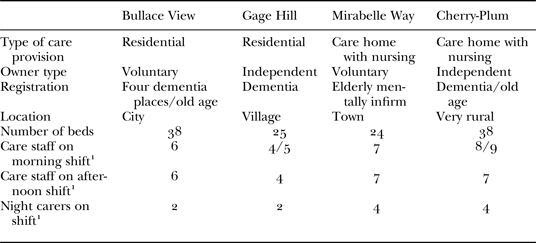
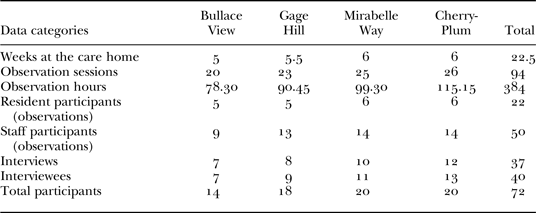
Sampling for the case study care homes was derived from the results of a postal survey to N = 747 care-home managers (response N = 299, 40%), which aimed to determine the behaviours that care-home staff found difficult to manage (Backhouse et al. Reference Backhouse, Killett, Penhale, Burns and Gray2014). The findings from the survey were used to inform purposive sampling. The aim was to recruit care homes which would be potentially data-rich case study sites, so the survey responses were assessed and ordered with the aim of recruiting homes which were most likely to encounter dementia-related behaviours, and use pharmacological and non-pharmacological interventions. To recruit care homes for the case studies, letters were sent to the managers of the homes identified from the survey responses, beginning with those care homes most likely to provide data-rich sites. These managers were contacted in order. The letter was followed up with a telephone call two weeks later to invite the care home to take part in the research. The process continued until four care homes were recruited (two providing qualified nursing care to all residents and two providing residential care only) and data saturation was achieved. In total, ten care-home managers were contacted before four agreed to the participation of their homes (see Table 1). The six homes declining to take part cited that they were not interested in the research (N = 2), they had no manager in place at that time (N = 1), they might be interested in the future (N = 1) and a further two did not provide reasons. The case studies included 384 hours of observations in the shared spaces of the homes and interviews with 40 care-home staff. Table 2 presents a breakdown of the data collected from each care home. To recruit individuals to the research, potential participants were approached face-to-face and informed about the study, each was provided with an information sheet and was given at least 24 hours to decide whether to participate. The sample was purposively selected to maximise insight into managing BPSD and included 22 residents, most of whom displayed dementia-related behaviours, and 50 staff (consenting to observations and/or interviews) from all levels who had close contact with residents with dementia-related behaviours. Out of the individual potential participants approached, one care-home resident, two consultees and four staff members declined outright to participate in the research due to lack of time or interest in the research. However, a clear ‘no’ appeared to be difficult for people to say, with many potential participants evading the issue. The researcher asked each potential individual participant if they would like to participate on two separate occasions before concluding that the individual did not wish to take part. Ethical approval was obtained from the National Social Care Research Ethics Committee (for England and Wales). Since the study included people without the capacity to provide informed consent, the research adhered to guidelines set out in the Mental Capacity Act (2005) and was approved for such purposes.
Characteristics of the four care homes

Note: 1. Includes carers and nurses/seniors on shift, but excludes management, activity, maintenance, office and domestic staff.
Source: Adapted from Backhouse et al. (Reference Backhouse, Killett, Penhale and Gray2016).
Breakdown of data collection by care home

Source: Adapted from Backhouse et al. (Reference Backhouse, Killett, Penhale and Gray2016).
Overt ethnographic observations took place in each care home over four to six weeks until data saturation was achieved. The female researcher (TB), a trained and experienced care worker with a Master's degree in Sociological Research, took on the role of observer as participant (Gold Reference Gold1958), helping with minor tasks in the shared spaces, such as activities, assisted feeding and the tea trolley. Observations focused on usual actions of everyday life undertaken by participants within the shared spaces of the homes. The boundary of the case studies was the management of dementia-related behaviours, a picture of which was built up by the researcher in each home over the duration of the fieldwork. Relationships between the participants and researcher developed throughout the case studies. The participants were aware the researcher had past care work and research experience. Full field notes were written as soon as possible after the observations had taken place, typically within two hours with brief notes taken during the observations only if the researcher was alone. Data were not recorded about non-participants.
Thirty-seven one-off interviews took place with a total of 40 (three being joint interviews) staff including managers, activity workers and care workers. Interviews were conducted within the care homes at a time and place suitable to each participant. For example, some took place during night shifts when staff would have more time, directly after shifts ended, at quiet times and while staff were doing tasks away from residents such as ironing or kitchen work. All interviews took place within empty spaces or rooms at the care homes. The researcher was flexible and worked around the needs of participants; some interviews were ad hoc, interrupted or conducted with joint participants. A topic guide was used and covered areas such as: training, perceptions of behaviours, strategies used, decisions about strategies, medication knowledge and support. Interviews were digitally recorded and transcribed verbatim.
Data from the observations and interviews were anonymised, stored securely and analysed together using the Framework approach (Ritchie and Spencer Reference Ritchie, Spencer, Bryman and Burgess1994). This approach involves becoming familiar with the data, creating a thematic index, refining the index and then applying it to the data, before charting the data into tables by care home and method, and then interpreting the findings. The approach is transparent and allows an audit trail of the process back to the data. Data were analysed manually using tables formulated in Word. All data were indexed to the same a priori and emergent index themes, however, the charting process meant that they could still be isolated by method (interview or observation data) and/or across or between cases (care homes). Separate charts were labelled clearly to show which care home, method and participant the data originated from. Interpretation of the findings took place across and between both method and cases. The analysis was primarily conducted by TB, however, throughout the process the themes, processes and interpretations were discussed, refined and validated with all authors. Analysis of the data generated 97 topics, which were itemised under 12 larger themes to make up the framework. Themes emerging through the analysis included: the impacts of behaviour, risk, surveillance, resident autonomy, and the use of non-pharmacological interventions and person-centred care (the latter two themes are explored elsewhere). Subsequently, the themes were interpreted in three main groups: care-home dynamics; strategies and behaviours (findings from this theme in regard to individualised distraction techniques, and activities and non-pharmacological interventions which could have prevented behaviours occurring are reported elsewhere; Backhouse et al. Reference Backhouse, Killett, Penhale and Gray2016), and issues and tensions. This paper reports connected findings from both the ‘strategies and behaviours’ and ‘issues and tensions’ themes. Pseudonyms are used throughout.
Findings
Risk and impact of dementia-related behaviours
The ‘issues and tensions’ theme repeatedly highlighted instances of risk and impact, while the ‘strategies and behaviours’ theme showed how staff managed these consequences from behaviours, therefore they will both be drawn on to examine this complex issue. We found that in all four care homes it was the consequences of behaviours, not the behaviours themselves, that caused the main challenges for staff. For example, when the behaviour created a risk to the resident themselves, other residents or staff, or impacted on other people, staff considered they would need to intervene.
One example is when residents were walking (or wandering) around the home, which was viewed as an acceptable action unless the resident: went into another resident's bedroom (impacting on others); took another resident's walking frame away from them (putting someone else at risk); was undressed or dirty or at risk of falls (impacting on their own health or dignity), or was attempting to climb the stairs (putting themselves at risk). When behaviour presented a risk to, or adverse impact on, the individual, other residents or staff members, an action by staff would often occur. In this way it was the consequence(s) or issue(s) surrounding the behaviour that led to staff action and not the mere presence of the behaviours themselves.
At all four homes, the risks and impacts created by residents’ behaviours often required care-home staff to act spontaneously in the moment to deal with the developing situation or for staff to devise a plan to act. The observations and interviews found that strategies such as: surveillance, person-centred care, individualised interventions, restrictions, resident placement and forced care were sometimes being used as responses to these situations. Individualised interventions and person-centred care (explored elsewhere) are strategies which would be endorsed by current training and societal values, however, the other strategies observed could be viewed as being more ethically and/or socially questionable and it is these we focus on in this paper through using common illustrative themes.
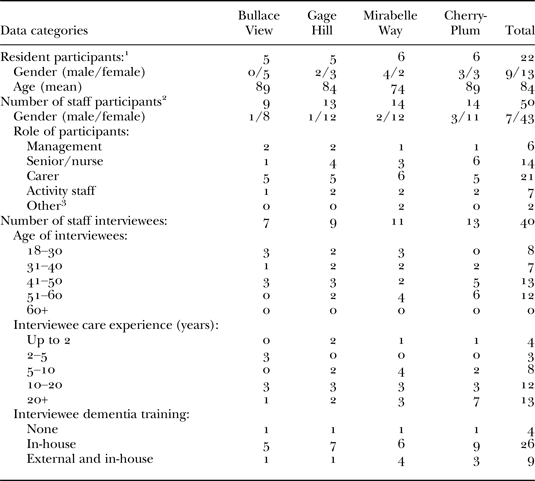
Surveillance, resident placement and restrictions will be explored in turn before examining forced care, which was another action staff resorted to occasionally to manage the risk of pressure ulcers or urine burns and prevent any instances of neglect. It is important to note that while we are using these data to explore this issue, no specific safeguarding issues arose during the fieldwork in any of the study care homes. Table 3 depicts the participant demographics.
Participant demographics by care home

Notes: 1. Residents participating in observations. 2. Staff participating in observations, interviews or both. 3. Domestic and administrator.
Surveillance
Surveillance contributed to the management of risk and impact from dementia-related behaviours in each of the four care homes. Surveillance was both overt and covert, with residents sometimes aware of being watched by staff and other times not. Care-home staff continually monitored residents’ behaviours and passed information on through verbal communication (such as handovers at the end/beginning of each shift, informal chats and through informing senior staff) and documentation (such as care notes, incident reports and behavioural charts) throughout the 24-hour day. Laura talks about the importance of handovers to find out about residents’ behaviours:
If something has happened or for instance, you know, if [resident's name] had been really bad that morning the handover would explain everything obviously that's gone on and also to say maybe you could try this, I tried this it didn't work maybe you could or have you got any other ideas. (Laura, Carer, Mirabelle Way)
Close surveillance of residents behaving in ways that could give rise to difficulties for themselves or others seemed to be essential for staff members to keep updated with relevant information. This allowed them to be aware of any new issues or possible risks and to plan or adapt their approaches if required.
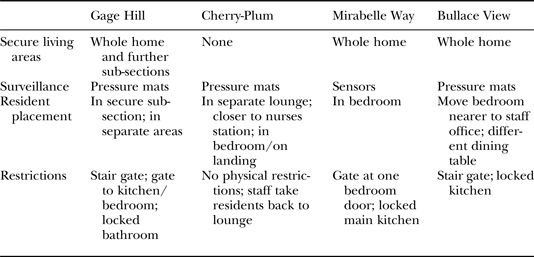
Surveillance and monitoring of residents was heightened with the use of technology. Each care home used either pressure mats (mats on the floor linked to the alarm system in the home which were activated when stood on) or sensors (also connected to the care-home alarm system that was triggered if movement occurred) to assist with the monitoring and surveillance of residents (see Table 4). These sensors or mats, predominantly located in bedrooms, gave staff a chance to pre-empt residents’ actions. The rationale for their use was to safeguard residents, particularly from falls, or to reduce the impact of residents’ behaviour by intercepting them quickly.
Strategies used to manage the consequences of dementia-related behaviours

However, not all residents were monitored with technology, it was used for those who were unsteady or often ‘wandered’ so were posing a potential risk of falling or disturbing others through walking, as Karen explains:
You stand on it [pressure mat] and that will ring the alarm bell so staff can see that it's a priority to get to that room first. Either, so they [residents] don't walk into others’ rooms or they're prone to having a fall and that and they could injure themselves. (Karen, Carer/Activity Worker, Bullace View)
As Karen's excerpt suggests, the pressure mats were an important tool for staff to reduce the risk of falling or to prevent wandering, which could lead to injury, absconding or an incursion into other residents’ private spaces. Pressure mats were placed on the floor near a resident's chair, bed or at the doorway to their bedroom to alert staff when specific residents were on their feet. Pressure mats were used predominantly, although not exclusively, at night. Janice explains:
He'll [Ray] go and get, go in ladies bedrooms … he does tend to always find his way into Phyllis’ strangely enough … He does tend to aim for her room, but sometimes he will come up the corridor as well and we can usually intercept him before he does too much damage (laughs) … ’cause of the wander mat. I like to have it beside the bed because I think then leastwise as soon as he puts a foot on the mat we know he's up. (Janice, Night Carer, Cherry-Plum)
Here Janice clearly illustrates the benefit of the pressure mats to staff, especially at night, since staff can intercept residents before they wake up or disturb other residents.
Cherry-Plum used magic-eye sensor alarms in place of pressure mats. There was one in each resident's bedroom, but they were only switched on for certain residents. Once these residents were in bed the magic eye was turned on, so staff were alerted if the person got out of bed. James explains why they were used for specific individuals here:
It's just people like Ron and Nigel … who are, they are at risk so if they get up then we need to be in here [the resident's bedroom]. (James, Carer, Mirabelle Way)
These modes of surveillance were useful for staff to pre-empt residents’ actions, especially during the night when there was not a large staff presence to monitor residents and when residents walking around could be at risk of falling themselves or could disturb other residents’ sleep.
Risk assessments and documentation were completed when pressure mats were introduced for individual residents. Magic-eye sensors were installed into each bedroom at the time Mirabelle Way was built, therefore, they were already in place and used at the discretion of the staff.
These modes of surveillance may have been reassuring for residents and/or relatives. The surveillance and monitoring of residents appeared to be important to: keep staff members up-to-date about residents’ actions, provide evidence of staff actions and ensure residents’ whereabouts were known.
Resident placement
This section on resident placement covers the positioning, re-positioning and segregation of residents by care-home staff. Residents (mobile and immobile) who were considered to be experiencing behaviours that required monitoring were often placed (taken to a particular room, area or chair) carefully to assist staff to manage the consequences of their behaviours. Residents were sometimes placed in locations closer to staff such as near the nurses’ station during the day (as at Cherry-Plum), or by moving a particular resident into a bedroom nearer to where staff were located at night (as at Bullace View) to enable easier monitoring and so the individual resident would be quicker for staff to get to. Bullace View also moved residents with behaviours that created risks or impacted on others on to other care homes. Flo explains here:
Usually those people will be very aggressive, there are some people during the night they wake, they can't sleep, they'll be disturbing other residents and they'll be having challenging behaviour to the extent that they can just pick their walking stick and (laughs) into a sword. It's very risky, when it's very risky to them and other residents it's no longer safe, then that's when they're moved. (Flo, Night Carer, Bullace View)
Flo states clearly the reasons (risk and impact) residents would be relocated to other care homes. Bullace View was the only home in the study which moved residents on to other homes. It was also the only home which predominantly had residents without dementia.
At two homes (Bullace View and Cherry-Plum), residents needing assistance with feeding or those who may have become agitated were often seated together at mealtimes away from other residents. Since assisted feeding was required for some, the staff members helping at these tables could also monitor residents’ behaviour. At Cherry-Plum some residents were moved into another lounge at mealtimes where those needing assistance with feeding were usually positioned. Dawn offers the explanations why certain residents were moved to this lounge at mealtimes:
It's because she [Dorothy] can aggravate people sometimes because she likes to take [food] off their plate … that's not very nice … Not to those that know what's what … So that's why she's put in there … In the same regard Ray because he aggravates people because he's tap, tap, tap, tap, tap, tap, on the table constantly and they sit there and they're going ‘hhuuhuuuhhuu’ (laughs) and it's jangling their nerves a bit … ’Cause obviously you don't want him aggravating anyone in there [the other lounge] either … Just the same, but because he's there we can watch him a lot easier. (Dawn, Part-time Carer, Cherry-Plum)
This excerpt shows some of the actions which were taken to alleviate the impact of some dementia-related behaviours on other residents.
Residents repeatedly shouting or calling out could have an impact on other people in the homes. Sometimes ‘calling out’ could be stopped by meeting a resident's need(s) or through distraction, but there were residents who frequently offended others or who persistently called out even after staff had tried to alleviate all possible causes. This meant that individual residents were often taken back to their rooms to reduce the impact on others in the setting. Occasionally residents who persistently called out had their bedroom doors shut if others were affected by the noise. For example, Kim states:
She's a prime example, she'll scream for quarter of an hour or so um and especially at this time of night all you can do is close the door. (Kim, Night Carer, Mirabelle Way)
Residents were also sometimes taken out of communal areas or back to their rooms if they were aggressive, if they were perceived to be disruptive or if they were involved in an incident of resident-to-resident conflict. Tracey discusses the issue:
Um, we've got a guy here at the moment who's swearing an awful lot due to his illness and that does affect, because they [the other residents] think that's appalling … But you just have to say to them ‘look he can't help it, he isn't very well, he doesn't know he's doing it’ and they normally brush it off, but like ten minutes later because they've got dementia they say it again (laughs), but in the end you do, kind of, walk them [the resident with the behaviour] away, go and get them a cup of tea and sit somewhere quiet, mm … keep them apart; it's best one person being agitated than say 16 … ’cause then you've got a full riot on your hands (laughs). (Tracey, Carer/Cleaner, Cherry-Plum)
As Tracey explains, staff would also split residents up to reduce resident-to-resident aggression, often removing one resident from the scene if they were aggravating others or putting themselves or others at risk of harm. We observed this to be happening:
A lady was really chatty and laughing a lot all morning, at lunch she started to get cross and aggressive and a staff member took her to her room. This lady cannot walk. (Lunchtime observation, Mirabelle Way)
Often the resident did not have a choice in this. The communal nature of the care-home settings appeared to influence the actions taken by staff.
Cherry-Plum had a male resident usually situated in a wheelchair who would wheel himself about only to be assisted back to the same lounge sometimes repeatedly, as this observation shows:
After lunch Bert left the dining room in his wheelchair, he was brought back two minutes later by a carer; wheeled backwards. A minute later he went out again, he was encouraged and assisted back in by Teresa … he is not deemed safe to leave unattended anywhere except the upstairs landing. He had been found in the carpark twice today and brought back in. Heather asked me to take him up in the lift after tea to prevent any ‘trouble’. (Afternoon observation, Cherry-Plum)
The lack of secure areas at Cherry-Plum meant that staff monitored and positioned Bert frequently to keep him from potential harm, e.g. from traffic in the car park. Staff had the responsibility of keeping Bert safe while completing necessary tasks in other areas of the home. Re-positioning Bert on to the landing could be seen as labour saving for staff, but it also alleviated staff of the worry of him coming to harm. Re-positioning Bert could have been very frustrating for him, removing his choice of where to be and his capacity of freedom of action.
At Bullace View, a home which had dementia and non-dementia residents living together, many staff felt it would be better if residents with dementia were located in a separate wing or unit.
It would be so much easier if they had just given us a dementia unit here … for the residents that are residential, you know, they should be allowed to, you know, have their last quiet days by themselves, undisturbed. (Kate, Assistant Manager, Bullace View)
Similarly Janice, a Night Carer from Cherry-Plum, suggested that residents with behaviours that impact on others should be segregated from those without such behaviours, since she thought ‘that the people that haven't got dementia are at risk of being abused by the people that have got dementia’. This links with actions observed at Mirabelle Way, where occasionally a resident was taken back to their own room to help them get away from the other residents whose behaviour impacted on them in the communal areas of the home.
Restrictions
‘As required’ psychotropic medications were used at times to calm residents from an agitated state, however, this section refers to physical barriers and restraint rather than psychological or chemically based restrictions, and follows on from the restrictions by physical location in the environment. Table 4 shows the physical barriers used at each home. Three of the four care homes were secure with locked doors and sealed gardens (keypad or magnetic locks). Residents were unable to leave these areas unless a staff member helped them. Susan explains the benefits of a secure home:
People want them to be well looked after, secure and safe, prior to having that [the extension and secure area], although all of our external doors were lockable, they were attached to the nurse call system, the buzzers might go off, but that doesn't actually stop someone opening a door and we've had a lot of residents who have managed to get out from time to time and it's horrendous … and to have that element of [security] you just relax a little bit … and for the families to have that peace of mind that, you know we are a secure unit as long as people shut the doors (laughs). (Susan, Manager, Gage Hill)
As Susan states, secure homes offered reassurance to relatives and allowed staff to feel less anxious through keeping residents safe from external risks. They also worked to restrict residents’ movements. Additionally, residents who were allowed out by themselves had to ask staff to let them out. In this way a system to keep some residents safe had an impact on the liberty of all residents due to the restriction on freedom (of movement) at the home regardless of individual need. Paradoxically, within secure areas residents had more freedom and autonomy, since staff could be sure of where they were, so did not have to monitor them so closely. As Susan alludes to, secure areas were not totally infallible, as doors had to be closed behind people in order to maintain the security.
If residents tried to leave the home, but were not able to go out by themselves, it could create difficulties for staff. Staff at all homes would make efforts to take residents out in the garden or out of the home for a walk although this was not always possible or practicable. Mirabelle Way was the only home where the use of Deprivation of Liberty Safeguards (DoLS) authorisations were salient in staff members’ minds. Gill, the manager, explains:
I said ‘that's the fifth time that lady's gone to the front door she needs to be on a deprivation of liberty because we are denying her going out … you realise that the deprivation of liberty order is there to safeguard you as a staff group as well as the individual … certainly when we did um, the DoLS for a lady on [unit name] … it was because she was trying to go out every five minutes and we were stopping her um because she wasn't safe. (Gill, Manager, Mirabelle Way)
Restriction of residents to the care home and employment of the DoLS procedures to keep residents safe is another example of the tension between residents’ rights to liberty and the need for staff to keep residents safe.
Gates were used at three homes. Mirabelle Way used a gate on one resident's bedroom door to prevent other residents going in and scaring the bed/chair-bound occupant rather than to restrict movement of the particular resident. Gage Hill and Bullace View used gates at the top of the stairs to prevent residents falling down them. Vera explains the rationale for restricting residents from the stair area:
The thing is we can't leave them out there [in the non-secure hall area] because if they go upstairs and fall down we don't know, that's why we try not to let them go up the stairs here because you don't know if they're on the floor. (Vera, Carer, Gage Hill)
Staff at all homes, but particularly Mirabelle Way and Gage Hill, were very aware that using restraint should be a last resort and meant that documentation would have to be filled in, such as a care plan, incident form and risk assessment. Staff from Gage Hill, the case study home with the most dementia-related behaviours, talked about the point at which they have to ‘step in’ to a situation and act to restrict someone:
They started grabbing each other and then I'll step in … When they go over that point then that's the time to go, yeah because otherwise they get hurt. (Vera, Carer, Gage Hill)
Sometimes you have to march … one off if they got really, really, you know, where they were lashing out at each other … But then you always have physical restraint in their care plan so it's all written down you see so … would be discussed with the family when they have their six-monthly review. (Pearl, Team Leader, Gage Hill)
Because [a resident] was actually lashing out at the door and she blamed us for her bruises, so me and [another staff member] took one arm each and just marched her away from the door … Stop her hurting herself. (Bernadette, Carer, Gage Hill)
These excerpts clearly show that physical interventions were employed to prevent harm ‘in the moment’ when there was a risk to others or the residents themselves. Often these interventions were in the form of restraint and/or the resident being moved or ‘marched’ away from the scene to a different area of the care home. As the excerpt from Pearl illustrates, relatives were often informed and included in discussions about staff actions. However, staff were also generally aware that restraining residents was not allowed:
We can't make any restraints and if we do use it, which we have done in the past and probably will do in the future even the fact that um, you're holding [resident name's] hands to stop him from hitting somebody or the wall, or from breaking the wall, or kicking the door that is restraint, we then have to fill out an incident form er, to say why [resident's name] might come up with bruises on his wrist tomorrow because we had to restrain him because he was blah, blah. (Hazel, Nurse, Mirabelle Way)
Hazel shows that in some situations of risk, in this case to the resident themselves, restraint is deemed necessary. She also alludes to the documentation required after a restraint has taken place. Generally, staff were aware that their actions had to be justifiable. Through all of these restrictions the tension between protective actions, safeguarding and residents’ liberty is clear.
Forced care
One behaviour creating a potential risk for, or impact on, the resident themselves was refusal of, or resistance to, care. If a resident refused care for any length of time or if they were obviously in need of some assistance with continence, but refused, this could pose a risk to the person themselves such as a public threat to their dignity or a urine burn. These risks, coupled with the duty of care staff had for the residents and the pressures for care-home staff to present residents well as a reflection of the care they provided, would be the principal reasons to make the decision to intervene. Encouragement and/or negotiations with the resident were usually entered into in the first instance to see if the resident could be persuaded to receive care. As Natalie and Christine, senior carers from Cherry-Plum, mention here, often different staff members in the team would attempt to gain resident agreement and provide the care where others had failed:
Natalie: It's normally a change of face sometimes does it.
Christine: Yeah, you can go back five minutes later and they're totally different, can't ya?
Natalie: Mm.
Christine: Yeah.
Natalie: Or somebody else can take over and they're just calm, mm.
Christine describes that leaving the resident and returning a short while later to see if they would agree to the care at that moment was a common way staff got around the issue. Rob also alludes to it here:
I mean it can change so, they can change from being very angry with you, to you walking out of the room and coming back with a cup of tea and they're fine. (Rob, Carer, Bullace View)
However, if attempts to encourage the resident repeatedly failed, as a last resort staff would usually make the decision to step in and provide the bare minimum of care. In some instances forced care would be given. Although staff acted against the wishes of the resident, they did try to make the action as quick and inoffensive to the resident as possible. This excerpt from Gill illustrates this, along with the need to balance resident and staff needs:
If we've got to do something and we know that somebody's perhaps unsettled or agitated then we do the minimum that we need to do and we walk away and then we go back ten minutes later and see how that person is, you know, this is not about, well actually this needs to be done so for whatever reason we're going to do it because that's actually not good for that individual, it may mean they never trust us again, it's certainly not good for the staff, you know, so it's, it's trying to get that balance around you know what's best for the resident … I don't have a problem if … a resident, I don't know, perhaps wearing the wrong clothes or an arms not out. (Gill, Manager, Mirabelle Way)
Gill shows that some tasks are worth resorting to the ‘minimum’ amount of forced care for and others such as ‘the wrong clothes’ are not. She prioritises the trust between the resident and staff members. Elaine explains more about providing necessary care to residents reluctant to receive it:
But you use pillows against their bodies, so that they're buffered, we're buffered and that's only training that [the manager] has shown us … because that is when, that is mostly when dementia people are at their worst, it's they feel embarrassed … we just get on with the task but we know as soon as they're cleaned up and their pants are pulled up like you or I, I suppose um, they're fine … because we have had residents where we do have to buffer, you know we don't like doing it. (Elaine, Carer, Mirabelle Way)
Noticeably, Elaine has an awareness of residents’ reasons for being reluctant to receive care while also being clear about the practical aspects of the ‘task’ to be done. Keeping the resident and staff members safe during this task is also a consideration. Carla discusses the issue further:
It's usually because of personal care, that seems to trigger most people that are prone to, you know be verbally or mildly or viciously … aggressive, but it always seems to be on contact, when you're trying to do something they don't want to do, but it's got to be done because they're wet or they're soiled … soon as you've finished ‘off you go then’ and it's gone, it's like, yeah, they've forgotten it … it's just that moment … you're talking to them, trying to reassure them ‘we're just going to change you, you are alright, make you comfortable if you just sit quietly, it will be done in a minute’ but course they don't understand. (Carla, Senior Carer, Gage Hill)
Carla and Elaine mention that the residents appeared to be ‘fine’ or to forget the incident once the task was completed. The observations also demonstrated this aspect when residents reluctant to accompany staff to receive personal care returned to the shared spaces of the homes more settled. Providing forced care in these instances directly overrides resident autonomy, but could in retrospect be viewed as being in residents’ best interests or an attempt to maintain resident dignity. Staff could also be viewed as neglecting residents if a clear need for assistance with continence was not met. Staff attempts to encourage residents verbally to receive personal care sometimes failed, but show that actions to force the resident to comply are not the first resort for staff members.
Discussion
Drawing on the data from four in-depth ethnographic case studies in care homes, we have examined how impact and risk arising from dementia-related behaviours can be the catalysts for questionable practices to come into use. Many care-home staff attempted to apply individualised or rights-based perspectives, however, in the moment, or due to the nature of the communal setting, staff acted to mitigate consequences of behaviours in ways which affect residents’ human rights. The analysis found that surveillance, resident placement, restrictions and forced care are all practices in which the consequences of dementia-related behaviours are managed by care-home staff and all of these provide examples of the inherent tension between residents’ safety or wellbeing and their liberty or self-determination. Balancing care practices between the safeguarding/need for protection and liberty tension is difficult in communal settings when there is a duty of care for each resident. Care-home staff often act with good intentions, however, a crisis moment or pressing task may mean they temporarily stray into questionable practice. The danger is whether these practices become routinely used for that individual resident or even if they are enacted for all residents regardless of need.
We have drawn on evidence from four case studies in separate care homes, all of which were encountering similar tensions. A limitation of the study is that we have no way of assessing the effect of these practices on the residents experiencing the behaviours or others at the care homes. Additionally, we are not aware of how informed or involved relatives were with many of the situations discussed, as this was not the principal focus of the study. The themes identified provide real-life examples of the widely acknowledged tensions when caring for people with dementia between safety and their human rights. Residents’ right to safety is a high priority generally for care-home staff; however, often in the moment when risks and impact from behaviours need managing, safety becomes the highest priority for staff superseding dignity, choice and person-centred care. This prioritisation of safety over rights-based care may need to be reassessed to maximise the capacity for people with cognitive impairment to maintain their human rights. Recognising these tensions and the complexity of the situations in care homes is important to enable an accurate representation of the reality facing care-home staff (Clough Reference Clough, Stanley, Manthorpe and Penhale1999).
At times, care-home staff can prioritise the need to stop the consequences of individual's behaviours, rather than thinking of the person themselves and the potential effects of actions on them. Our analysis has found some aspects that Wardhaugh and Wilding (Reference Wardhaugh and Wilding1993) identified as part of the corruption of care and likely dehumanisation of residents. For example, organisational efficiency (as well as safety concerns) could be seen to have been placed before the individual resident's needs or human rights when residents were placed in easier-to-monitor areas. However, our data also showed that staff tried more person-centred approaches with residents prior to acting in a way which would impact on their human rights. Care homes or individual staff are not necessarily all good or all bad, since there might be both good and bad practices occurring in one setting. The observations showed countless aspects of good care in the case study care homes, but within this, the difficult situations that we have focused on in this paper meant that some questionable actions occurred. A risk enablement approach (Department of Health et al. 2010) appeared to be difficult to deliver in certain situations, although one home in particular (Mirabelle Way), specialising in the elderly mentally infirm, was more attuned to this approach.
This paper explores a contentious and morally difficult area; the fieldwork it draws on picked up indicators and pointers from the case studies and although there was potential for abuse of residents, the researcher did not come across any safeguarding issues. Nevertheless, many of the strategies used by care-home staff to manage the risks and impacts created by dementia-related behaviours would not be endorsed by best practice guidance. Strategies discussed here such as resident placement or forced care can be perceived by staff as necessary (or in the resident's best interests) in certain situations; however, if socially questionable strategies such as these come to be accepted routine practice, there is a concern that they could lead to, or become, unacceptable abusive strategies especially if viewed as the norm. Prevention of some difficult behaviours may have been possible with higher numbers of staff. Although care-home staff used distraction techniques and encouragement, such as a cup of tea, swapping staff or returning later, as a first-line way to manage some dementia-related behaviours (Backhouse et al. Reference Backhouse, Killett, Penhale and Gray2016), they appeared to be using ‘custodial’ approaches to care (Burns, Hyde and Killett Reference Burns, Hyde and Killett2016). A potential improvement could be to take a more pre-emptive approach in which non-pharmacological interventions are frequently and routinely used to reduce the incidence of behaviours creating risks or impacts.
All new care staff in England receive mandatory safeguarding adults training as part of their induction and as part of the care certificate (CQC 2014; Health Education England, Skills for Care and Skills for Health 2015), and may be aware that they are using what could be understood as negative practices. This has the potential to create uncomfortable inner conflicts for staff who may have limited alternative options or resources to draw on to reduce risk and impact from behaviours. Staff are being left with society's unresolved moral dilemma. The balance of individual freedom with personal risk taking and negative consequences of behaviour on other people is likely to have been present when the person was living in the community, and ‘resolved’ for the community by the person moving out of the community and into a residential setting. The dilemma still remains, however, behind closed doors; it is infrequently spoken about and is found in the internal experiences of both the staff and the residents. That society is leaving care-home staff to deal with this moral dilemma on a daily basis is an important issue.
Regulations for long-term care facilities in the USA may soon have further emphasis placed on residents’ rights (CMS 2015). Additionally, since the CQC in England is developing a human rights approach to their inspections (Equality and Human Rights Commission 2014), care-home staff will increasingly need to act with resident consent or to evidence reasonable responses to risks (Council of Europe 2014). These are positive moves, since abusive practices can develop where principles are not respected, creating ‘risky environments’ (Penhale and Manthorpe Reference Penhale, Manthorpe, Stanley and Manthorpe2004). The recent move to reduce antipsychotic medications for people with dementia (Banerjee Reference Banerjee2009) could also have unintended consequences; less efficacious or sedative effects on residents may mean that socially questionable strategies are relied on more frequently. This is particularly likely if the levels of behaviours that are perceived as difficult to manage increase as a consequence of the diminution of reliance on medication without alternative strategies being developed or available for staff to access and use.
Although strategies to prevent people with dementia experiencing behaviours, and to reduce them escalating, are crucial, it is clear that additional strategies, guidance and training, assisting staff to mitigate risks better and more easily reduce the impact of behaviours in communal settings, when they do occur, is another vital area for attention. The rhetoric to use non-pharmacological interventions as first-line treatments for dementia-related behaviours is a worthwhile campaign. However, it does not address the difficulties arising from the communal nature of care-home settings and the associated difficulties of institutional care for individuals with severe cognitive impairment, many of whom will at times display behaviours that are disturbing to others. There is a need to develop an evidence base for professional practice. This is an area which has generally been ignored by policy and guidance.
Conclusions
This analysis has explored why and how questionable strategies could come to be used within institutional care settings and how the communal nature of these settings can impact on staff actions. This paper contributes to understandings of the upholding of residents’ human rights in care settings: how practices started with good intentions to mitigate the risk or impact from behaviours in communal settings can lead to infringements of individuals’ rights. Care-home staff are working hard to mitigate behaviours and cope with tensions that arise. They appear to be frequently acting to manage the consequences of dementia-related behaviours rather than the behaviours themselves. The risk and impact arising from dementia-related behaviours in care homes can lead to multiple staff actions. The danger is that if these staff strategies become routine actions used to pre-empt behaviours or forestall the consequences of them, or applied to all residents, they could easily lead to regular breaches of human rights or even abusive practices. Our findings have particular relevance for care-home staff who need support and guidance in this area, for service development worldwide and for the global ageing population whose valued human rights may become under threat, if they require long-term care. More work is needed to provide care-home staff with the knowledge, skills and guidance they need to manage the inherent tension between residents’ safety and human rights when mitigating risks or impact from such behaviours, in communal settings, and to enable staff to provide care that is dignified and centred on the human rights of individual residents.
Acknowledgements
We would like to thank the care homes, care-home staff and residents who participated in this study for supporting the researcher to explore this contentious issue, for their candid interviews, and for allowing insight into their living and working situations. This article presents findings from doctoral study funded by the University of East Anglia. The views expressed are those of the authors and not necessarily those of the University of East Anglia. The University of East Anglia played no role (other than the provision of resources) in the design, execution, analysis and interpretation of the data or writing of the study. This study was reviewed and given a favourable opinion by the Social Care Research Ethics Committee (reference number 11-IEC08-0028). All participants consented individually to take part in the study. In line with the Mental Capacity Act (2005), personal consultees were identified and contacted to provide advice about the participation of residents without sufficient mental capacity to consent to their involvement in observational phases of the study. All authors contributed to the design of the study, analysis and interpretation of the findings. TB conducted the fieldwork. TB and BP conceptualised the manuscript, TB wrote the first draft of the manuscript, and all authors reviewed and contributed to the writing of the manuscript and approved the final version. The authors do not have any conflicts of interest.