

Background
Bone metastases are a common site of distant spread of disease from many solid cancers, particularly the common malignancies of lung, breast, and prostate cancer, and occur in as many as 70 percent of patients during the course of their illness (Reference Mundy1). Many patients will receive radiation therapy for palliation of oligometastatic disease. However, 20–30 percent of patients will have refractory pain. Pain medications or more aggressive medical therapies are often required in order to control persistent pain, and side effects may significantly diminish the quality of life. In some of these patients, percutaneous treatments such as microwave and radiofrequency ablation may be another alternative, but these procedures carry risks of bleeding and infection, as well as the risk of associated pathologic fracture. Additionally, percutaneous techniques may be poorly suited to the ablation of larger lesions.
Magnetic resonance-guided focused ultrasound (MRgFUS), also known as high-intensity focused ultrasound, or HIFU, is a powerful new noninvasive technique for thermal ablation of focal lesions. This innovative technology has received approvals from international regulatory bodies for a wide range of indications, including uterine fibroids, essential tremor, and bone metastases. Several early clinical studies over recent decades have demonstrated that MRgFUS treatment significantly improves pain scores and can markedly reduce usage of pain medication in patients with osseous metastatic disease (Reference Catane, Beck and Inbar2–Reference Thacker, Callstrom and Curry10). Importantly, MRgFUS appears to be effective even in patients who have failed prior palliative radiation therapy. Although the cost-effectiveness of MRgFUS has been determined for other indications, such as uterine fibroid ablation, it has not been assessed for palliation of bone metastases.
Methods
Model Overview
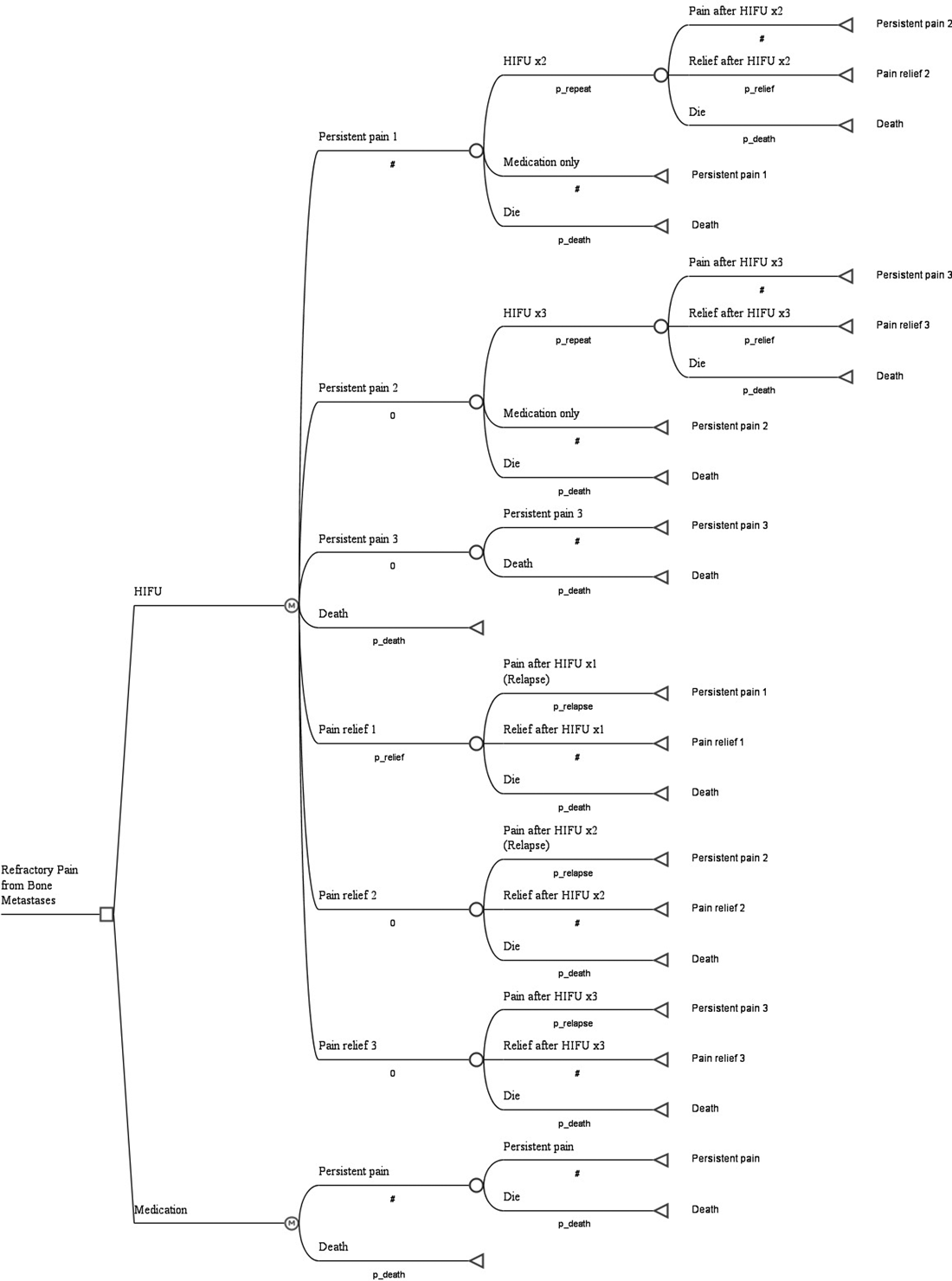
We constructed a Markov state transition model using TreeAge Pro software (TreeAge Software, Inc., Williamstown, MA, USA) to model costs, outcomes, and the cost-effectiveness of a treatment strategy using MRgFUS (ExAblate2000, Insightec, Haifa, Israel) for palliative treatment of patients with refractory pain following initial radiotherapy for painful bone metastases, compared with a treatment strategy using pain medication alone: “Medication Only” (Figure 1). Percutaneous approaches, such as radiofrequency ablation, were not included in the model, as percutaneous interventions are only rarely used to treat bone metastases at the authors’ institutions because of the technical difficulties involved in treating relatively larger metastatic lesions. The health states in the model were defined based on response or a lack of response to the MRgFUS treatment, with transitions across health states occurring at 1-month intervals. This time interval was chosen because it is a standard clinical follow-up time point after ablation and a typical interval for clinical re-evaluation of ongoing pain. Each health state was associated with a different utility (quality-adjusted life-year or QALY) and an economic cost. The model simulated patient transitions through different health states. Following treatment, patients could have symptom relief with pain reduction, no treatment response with persistent levels of pain, or die from their disease. In the base case, 50 percent of those who failed initial MRgFUS therapy were assumed to receive a subsequent repeat treatment. Patients could have up to a total of three MRgFUS treatments for persistent symptoms. Symptoms could recur at any point until death. Patients initiated in the model were assumed to have osseous metastatic disease targetable by MRgFUS. The population of interest is heterogeneous and outcomes can vary by disease subtype; however, for the purposes of this model, it was assumed that approximately 80 percent of the cohort would have died over the 24-month time horizon, similar to prior studies (Reference Konski11). In the base-case analyses, we estimated total costs (in 2018 dollars), QALYs, and cost-per-QALY gained from a payer perspective. Because of the limits in functional status for patients with metastatic disease, we did not include lost productivity costs in our model.
Decision tree outlining possible outcomes for this study of patients with refractory pain from bone metastases managed with MRgFUS or Medication Only.

Treatment of Bone Metastases
Palliation of painful bone metastases can be challenging for clinicians. Across all therapeutic approaches, including radiotherapy, medications, MRgFUS, and percutaneous ablations, some patients may experience complete relief, whereas some may continue to have lingering symptoms requiring continued pain medication use at a minimum, if not additional rounds of intervention. There are limited available data regarding treatment patterns of patients managed with MRgFUS versus percutaneous interventions for osseous metastatic disease. Therefore, we made several assumptions for our base-case model. We assumed that patients would pursue MRgFUS therapy no more than three times, because in routine clinical practice, referring clinicians are generally unwilling to refer patients for treatment more than three times, as patients typically do not experience benefit after a third treatment. We also assumed that if patients pursued a Pain Medication Only approach to manage their pain, then they would be relying predominantly on opioid medications and would potentially develop tolerance requiring increasing doses of these medications over time. We did not include additional costs in the Medication Only arm based on local expert opinion, because the use of additional medications, procedures, and visits would most likely not be significantly different between the two arms.
Model Parameters and Data Sources
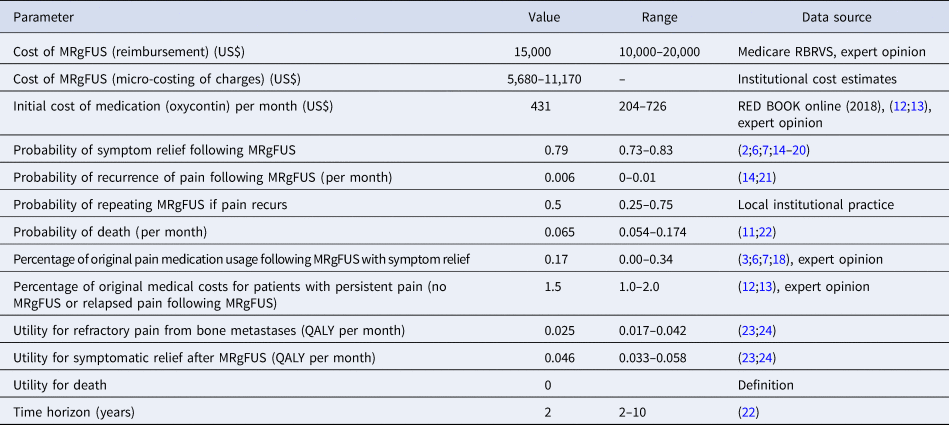
Model transition state probabilities, costs (in 2018 US$), and effectiveness data (QALYs) were derived from a systematic search of the available literature, local expert opinion, and reimbursement patterns at two U.S. tertiary academic medical centers actively performing MRgFUS (Table 1). For the literature search, the PubMed electronic database was queried in April 2018 and in April 2020 with the following terms (“mrgfus” or “HIFU” or “focused ultrasound”) AND (“bone” or “bone metastases” or “bone metastasis”) (Reference Anzidei, Napoli and Sacconi14–Reference Papatheofanis, Williams and Chang21;Reference Konski, James and Hartsell23–Reference Chow, Hoskin and Mitera25). The search terms were developed by the authors in consensus. No time limitation was imposed on the search criteria. The literature searches and initial study screenings were performed by MDB. Study titles and abstracts were screened for relevance. Non-English and duplicate studies were removed. The task of identifying required inputs from the reviewed papers was divided among all authors who shared in the process of screening titles and abstracts, reading full texts, and completing data extraction prior to group discussions.
Model parameters, base-case values, ranges, and data sources

Note: Numbers in the data source column correspond to references.
Base-case model transition state probabilities and utilities, and the possible range of these parameters, were determined in consensus, informed by clinical expertise in treating patients with MRgFUS at two tertiary academic medical centers in the United States (CA). Expert opinions were solicited through discussions with two physicians engaged in performing the MRgFUS treatment at these two institutions. An initial estimate and range of parameters were established in consensus based on the authors’ review of the literature, and the experts performing the MRgFUS treatments at the two institutions were asked whether or not these parameters were consistent with their experiences.
Treatment Efficacy
We estimated the proportions of patients who would respond to treatment with MRgFUS from available published studies and local expert opinion at two centers routinely performing MRgFUS for palliation of bone metastases. Due to a lack of data on recurrence rates following palliation of bone metastases with MRgFUS after successful treatment, we made the assumption that in the setting of treatment relief, the rate of recurrence was more likely driven by the underlying disease, and therefore, we used recurrence rates following palliation of bone metastases with radiotherapy as a proxy. We standardized the recurrence rates to the 1-month transition intervals of our model and assumed that the risk of recurrence was constant until death. In the base case, probabilities of symptom relief with each strategy were assumed to be the same regardless of patients' prior responses.
Medical Care Costs
Costs (in 2018 US$) associated with MRgFUS of bone metastases are dominated by direct medical costs of treatment. Medical care costs include the costs of the procedure and the costs of medication. Patients can have continued pain medication costs if (i) they do not have the MRgFUS procedure, (ii) they have the procedure but have persistent symptoms, or (iii) if they have a successful MRgFUS procedure with some residual pain. Potential screening costs for the MRgFUS procedure overlap with those for standard-of-care imaging procedures and were, therefore, not specifically included as part of this analysis.
Procedure costs for MRgFUS were obtained from reimbursement data at the above-referenced two tertiary academic medical centers, where MRgFUS is routinely performed with the InSightec ExAblate device. These reimbursement data were used for the base case. An additional cost analysis was performed in which the composite costs of an MRgFUS procedure at these two institutions were estimated based on the costs of staff time (radiologist, anesthesiologist, technologist, and nurse); room time (MRI room, preoperative room, and recovery room); equipment time (ventilator and MRgFUS machine); and consumables (treatment kit, degassed water, gadolinium contrast agent, and anesthesia equipment such as intravenous tubing and intubation supplies). This costing approach was used to potentially expand the range of MRgFUS costs for the probabilistic sensitivity analysis (PSA).
Medication costs for pain palliation therapy were obtained from RED BOOK Online®. At both academic medical centers noted above, oxycontin is one of the most frequently prescribed pain medications for painful bone metastases and is representative of many pain medication regimens for pain from bone metastases, so this was chosen as the reference medication. We assumed that patients classified as having symptom relief would probably have a small amount of residual pain, and therefore, included the costs of a smaller amount of pain medication, even for those deemed as responders to the MRgFUS treatment. The estimation of the percentage of residual pain was made based on the literature review and informed by local clinical expertise in following these patients over time.
Health-Related Quality of Life
Because of a lack of MRgFUS-specific quality-of-life utility values for patients with painful bone metastases refractory to radiotherapy treated with MRgFUS, health utilities for the states of persistent pain following MRgFUS or response to MRgFUS were estimated from prior economic analyses of persistent pain in the literature evaluating radiation therapy for bone metastases (Reference Konski, James and Hartsell23;Reference Kim, Rajagopalan, Beriwal, Huq and Smith24).
Discount Rate
All costs and QALYs were discounted to the beginning of the model period using a 3 percent annual discount rate, according to guidance from the Second Panel on Cost-Effectiveness in Health and Medicine (Reference Sanders, Neumann and Basu26).
Analyses
Base-Case Analyses
We calculated the accumulated total costs and QALYs from the initial decision to receive MRgFUS or proceed with Medication Only over a 2-year time horizon, when it was estimated that approximately 80 percent of the initial cohort of patients with stage four metastatic disease may have died, similar to prior work (Reference Konski11). We then calculated the incremental cost-per-QALY gained for the MRgFUS treatment strategy compared with the Medication Only strategy. The cost-effectiveness threshold was set at $100,000/QALY.
Sensitivity Analyses
To better understand uncertainty in the base-case analysis, we performed one-way sensitivity analyses by varying key model parameters one at a time through plausible ranges and examining the effects on the incremental cost-effectiveness ratios. For each sensitivity analysis, we determined whether or not the incremental cost-effectiveness ratio for MRgFUS met our established cost-effectiveness threshold of $100,000/QALY. In addition to creating a tornado diagram with all key parameter inputs, we specifically varied the cost of MRgFUS, the amount of pain relief following MRgFUS, and the percentage of patients repeating MRgFUS. We also varied the time horizon as survival estimates for patients can vary considerably by cancer type (Reference Svensson, Christiansen, Ulrichsen, Rørth and Sørensen22).
To determine the effect of combined uncertainty, a PSA was conducted in which all costs, utilities, and probabilities in the market were varied. The Markov model was rerun for 5,000 iterations and the percentage of iterations that met the stated cost-effectiveness threshold of $100,000/QALY was determined. Given the limited data inputs for the model, triangular distributions were used, based on the ranges established in Table 1. To better understand the impact of the choice of the cost-effectiveness threshold, the PSA was repeated in an identical fashion with the cost-effectiveness threshold set at $50,000/QALY.
Results
Base-Case Results
In the base-case analysis, the MRgFUS treatment strategy incurred $18,985 in costs over the 2-year time horizon, compared with $7,121 in the Medication Only strategy, a difference of approximately $11,863 (Supplementary Table 1). The MRgFUS treatment strategy also accumulated additional 0.22 discounted QALYs over the time horizon (0.50 for MRgFUS compared with 0.28 for Medication Only). Therefore, the incremental cost effectiveness ratio (ICER) of the MRgFUS treatment strategy was $54,160/QALY, making MRgFUS the preferred treatment strategy based on the $100,000/QALY threshold.
One-Way Sensitivity Analyses
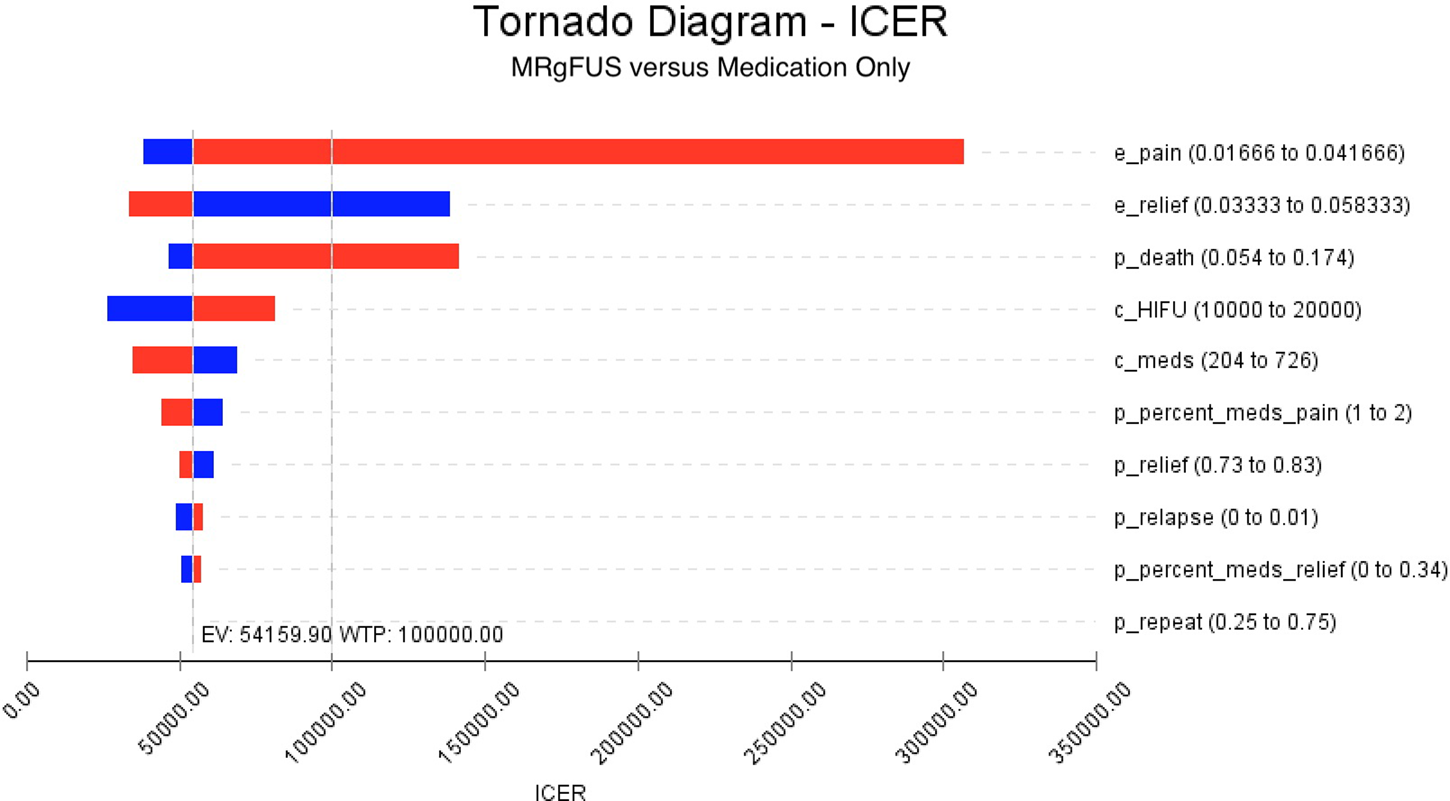
Model parameters were varied across plausible ranges and the strategies that would be cost-effective at the $100,000/QALY cost-effectiveness threshold were identified. Model parameters were most sensitive to the QALYs associated with persistent pain or pain relief following MRgFUS (Figure 2). For example, the crossover point at which Medication Only would instead become the preferred strategy was $23,341 per treatment, compared with the $15,000 used in the initial model input based on reimbursement data at two U.S. institutions. Micro-costing estimates demonstrated that MRgFUS costs at each institution were well below this estimated crossover point and the value used in the base-case analysis, with a micro-costing estimate for MRgFUS of approximately $5,680 at institution one and $11,170 at institution two (Supplementary Table 2).
Tornado diagram showing the relative contributions of each model parameter to the incremental cost-effectiveness ratio (ICER) across the range of estimated plausible values (e_pain: utility of ongoing pain; e_relief: utility of pain relief; p_death: probability of death related to underlying illness; c_HIFU: cost of MRgFUS treatment; c_meds: baseline cost of pain medication; p_percent_meds_pain: factor increase in pain medication usage with ongoing pain; p_relief: probability of relief following MRgFUS treatment; p_relapse: probability of recurrent pain after initial symptom relief following MRgFUS; p_percent_meds_relief: factor decrease in pain medication usage following MRgFUS; p_repeat: probability of patient repeating treatment following relapsed pain).

If, in the base case, the costs of background medication for patients with relief of MRgFUS are increased from 17 to 34 percent of baseline pain medication usage, the ICER increases from $54,160/QALY to $57,469/QALY. The results of the model were also analyzed with regard to the percentage of patients electing to repeat MRgFUS for persistent or relapsed pain. In the base-case analysis, it was assumed that approximately 50 percent of patients failing MRgFUS would elect to repeat the treatment each time. If that is increased to 90 percent, the ICER decreases to $54,064/QALY.
Finally, in the base case, the time horizon was set at 2 years. If the time horizon increases to 5 years, the ICER decreases to $40,587/QALY, and if the horizon extends to 10 years, the ICER decreases to $39,666/QALY.
Probabilistic Sensitivity Analysis
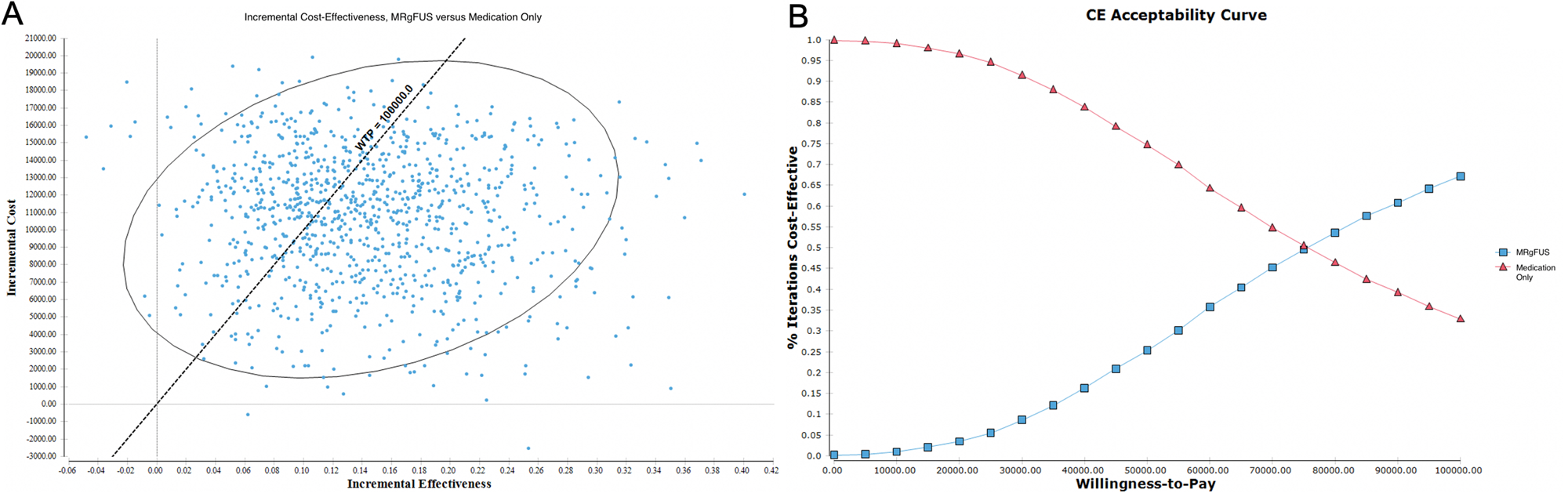
A scatter plot of the results of the PSA analysis is shown in Figure 3a. Sixty-seven percent of the model iterations demonstrated that the MRgFUS treatment strategy would be preferred to Medication Only. The cost-effectiveness acceptability curve is shown in Figure 3b, demonstrating the probability of the MRgFUS strategy being cost-effective given different thresholds. In comparison, at a threshold of $50,000/QALY, only 25 percent of the model iterations favor the MRgFUS treatment strategy.
(a) Scatter plot of distribution of results of PSA relative to the $100,000/QALY cost-effectiveness threshold. (b) Acceptability curve from the PSA comparing the two treatment strategies.

Discussion
To our knowledge, this is the first study exploring the cost-effectiveness of MRgFUS compared with other regimens of care for management of bone metastases. Our base-case and sensitivity analyses demonstrated that MRgFUS was a preferred treatment strategy across a range of transition state probabilities, costs, and QALYs. Our model appears to be most sensitive to changes in the utilities associated with persistent pain, pain relief, and the death rate (Figure 2). MRgFUS remained the preferred treatment throughout the range of plausible costs of pain medications examined in this model in one-way analyses. The cost of medication, probabilities of pain relief, relapsed pain, and likelihood of a repeat treatment had a relatively small effect on the calculated ICER. Our base case estimated a 79 percent rate of successful MRgFUS treatment; however, MRgFUS remained a cost-effective strategy across a range of treatment efficacy estimates.
The PSA provides moderate confidence in the results of our base-case analysis, with 67 percent of the model iterations supporting the conclusion that an MRgFUS treatment strategy would be preferred to Medication Only. Prior work has suggested that technologies with a 40 percent certainty of cost-effectiveness tend to be recommended, whereas those below the threshold are not recommended (Reference Adalsteinsson and Toumi27). Of note, if the cost-effectiveness threshold is set at $50,000/QALY, only 25 percent of iterations favored the MRgFUS treatment strategy, limiting the generalizability of our findings and indicating the importance of regional guidelines around cost-effectiveness thresholds in evaluating the two treatment strategies considered in the current study (Reference Neumann, Cohen and Med28).
Many patients with painful bone metastases will be referred for radiation therapy as a first option. However, the 20–30 percent of patients with persistent pain, as well as patients who have contraindications to radiation therapy, have limited options including pain medication, percutaneous intervention, or MRgFUS. Pain medication alone is often unsatisfactory as patients may develop increasing tolerance to opioid medications. Alternatively, percutaneous approaches may also be limited, as it may be difficult to achieve satisfactory ablation with such methods. MRgFUS is a completely noninvasive, safe, and effective alternative, with a favorable side-effect profile (Reference Hurwitz, Ghanouni and Kanaev6). Focused ultrasound primarily works by destroying nerves within the periosteal layer, although it may also help provide local tumor control. The results of our study also show that it is cost-effective in this setting as well.
In general, although the technology of focused ultrasound holds considerable promise for a wide range of indications, the rate of studies developing the technology has far outpaced efforts to compare the relative cost and effectiveness of MRgFUS to existing technologies. Aside from several earlier studies regarding the cost-effectiveness of MRgFUS for uterine fibroids and two studies of MRgFUS for neurological indications, there is a paucity of published cost-effectiveness studies regarding this technology (Reference Ravikumar, Parker and Hornbeck29–Reference Kumar, Bhati, Ravikumar, Ghanouni, Stein and Halpern34). Promoting this type of technology assessment work is critical, both for helping to define the real-world value of this technology in specific clinical situations and for providing additional data for public and private health payers that may help increase access to this technology to those unable to access these treatments for cost-related reasons. Although MRgFUS for bone metastases is increasingly covered by private insurance companies, the current study provides further evidence for ongoing coverage expansion for certain patients.
Our model has several important limitations. We did not account for treatment eligibility with regard to the site of metastasis, which limits the applicability of our results. Our estimations of the probability of symptom relief and relapsed pain were limited by the number of MRgFUS-specific trials for bone metastases with varying lengths of follow-up across trials. We also lacked sufficient MRgFUS-specific quality-of-life data and instead relied on the health state utilities following palliation of bone metastases with radiation therapy as surrogate utilities. It is possible that MRgFUS-specific data may yield important differences in the utility states of responders to MRgFUS, emphasizing the need for more research in this area going forward. Finally, our model does not account for lost productivity costs, the costs of additional office/ED visits for patients managed with Medication Only, and additional diagnostic tests for patients with Medication Only as we expected these to be diminutive in comparison with the costs of the MRgFUS procedure and the costs of medication. Additionally, as major procedure-related complications following MRgFUS are exceedingly rare, these were not estimated within our model as well.
Our study represents the first cost-effectiveness analysis to evaluate MRgFUS for bone metastases in the United States. Our findings suggest that MRgFUS is within the range of accepted criteria for cost-effectiveness, across a range of plausible model parameter inputs. Further studies of cost-effectiveness of MRgFUS for bone metastases would benefit from the availability of more procedure-specific quality-of-life data and larger, longer-term studies that can better estimate overall efficacy.
Supplementary material
The supplementary material for this article can be found at https://doi.org/10.1017/S0266462320001907.
Acknowledgments
This investigation was supported by an AUR GE Radiology Research Academic Fellowship Award.
Conflict of Interest
MDB received the AUR GE Radiology Research Academic Fellowship, which is partially funded by GE, which is a technology partner of one device maker of MRgFUS technology (Insightec, Ltd.).