Heart failure affects nearly 35,000 children in the United States of America, and it is estimated that >15,000 paediatric heart failure-related hospitalisations occur per year.Reference Hsu and Pearson 1 , Reference Rossano 2 Common causes include critical CHD following surgical repair of the heart, genetically triggered cardiomyopathies, and acquired disease such as myocarditis. Surgical advancements and improved medical management have resulted in improved survival; however, patients are often required to abide by physical activity restrictions, medications, and chronic long-term follow-up, which can impair their health-related quality of life. Health-related quality-of-life measurement provides a comprehensive description of an individual’s health, and may result in the identification of physical, functional, and psychosocial dysfunction.Reference Ware 3 – Reference Drotar 5 Health-related quality of life is a critical component for the evaluation of long-term outcomes of chronic conditions and disease-specific therapies.Reference Ware 3 – Reference Drotar 5 In addition, heart failure severity may impact health-related quality of life, and developmental changes in children have made adoption of a universal system for grading heart failure severity in children difficult. Use of the modified American Heart Association Heart Failure Staging for paediatric heart failure was promoted in the 2014 International Society for Heart and Lung Transplant Guidelines for the Management of Paediatric Heart Failure.Reference Yancy, Jessup and Bozkurt 6 , Reference Kirk, Dipchand and Rosenthal 7 Studies regarding such long-term outcomes focusing on health-related quality of life in children with heart failure are limited.
At present, little data exist with regard to health-related quality of life in children with heart failure.Reference Menteer, Beas and Chang 8 , Reference Friess, Marino and Cassedy 9 The purpose of this study was to compare the self-reported and parent proxy-reported health-related quality of life in children with heart failure with that of the healthy paediatric population, children with other chronic conditions, and children with cardiovascular disease. In addition, we report potential modifiers of health-related quality of life in the paediatric heart failure population, including ejection fraction, physical activity restriction, presence of pacemaker or implantable cardioverter-defibrillator, and American Heart Association stage of heart failure.
Materials and methods
Study design
This was a prospective cross-sectional study with patients enrolled from a tertiary-care paediatric cardiology centre and was conducted in accordance with the Texas Children’s Hospital Baylor College of Medicine Institutional Review Board.
Patient population
Participants (n=73) attended the Texas Children’s Hospital Cardiomyopathy clinic for treatment between 1 October 2009 and 31 July 2010. Patients included had a diagnosis of cardiomyopathy and heart failure requiring medical therapy: an ACE inhibitor and/or β-blocker. Patients were excluded if they were diagnosed with developmental disability, listed for heart transplantation, maintained on inotrope infusion, had an implanted ventricular assist device, or non-cardiac conditions that might be expected to affect health-related quality of life. All patients underwent heart failure staging as per the 2014 International Society for Heart and Lung Transplant Guidelines for the Management of Paediatric Heart Failure following study enrolment as follows: (1) Stage B in patients with heart disease and no past or current cardiovascular symptoms and (2) Stage C in patients with heart disease and past or current cardiovascular symptoms.Reference Yancy, Jessup and Bozkurt 6
The sample of healthy children was derived from the standardised pediatric quality-of-life questionnaire (PedsQL) healthy children database.Reference Varni, Burwinkle and Seid 10 , Reference Varni, Seid and Kurtin 11 The healthy children sample was derived from the PedsQL 4.0 initial field test (n=730) and the State Children’s Health Insurance Program evaluation (n=8836).Reference Varni, Burwinkle and Seid 10 , Reference Varni, Seid and Kurtin 11 Median age was 9.79 with a standard deviation of 3.15. Healthy children were assessed in physicians’ offices during well-child checks at the Children’s Hospital and Health Centre, San Diego, in the initial field test, and via mail surveys in the State Children’s Health Insurance Program evaluation.
The children with chronic conditions sample was derived from previously published reports by Varni et alReference Varni, Limbers and Burwinkle 12 The asthma (n=162) sample was derived from the PedsQL 3.0 Asthma Module field test.Reference Varni, Burwinkle and Rappoff 13 Children with asthma were assessed at the University of Kansas Medical Centre and at a summer camp sponsored by the American Lung Association. These children had a mean age of 9.58 and standard deviation of 1.65. The end-stage renal disease (n=96) sample was derived from families and patients with renal transplant (n=45), patients receiving haemodialysis (n=32), and patients receiving peritoneal dialysis (n=19), assessed at the Baylor College of Medicine/Texas Children’s Hospital, Houston, Texas, or Children’s Mercy Hospital and Clinics, Kansas City, Missouri.Reference Goldstein, Graham, Burwinkle, Warady, Farrah and Varni 14 The mean and standard deviation for age was 13.54±3.77 for these patients.
The children with cardiovascular disease sample was derived from previously published reports by Uzark et al.Reference Uzark 15 The cardiovascular disease sample (n=347) was derived from families and patients recruited from the paediatric cardiology clinic at Cincinnati Children’s Hospital Medical Centre. All the patients had a diagnosis of heart disease, and, if operated, were >6 months past the surgical intervention. The mean and standard deviation for age was 9.7±4.8.
Measures
To assess health-related quality of life, patients and parents completed the PedsQL 4.0 and the PedsQL 3.0 Cardiac Module.Reference Varni, Burwinkle and Seid 10 , Reference Varni, Seid and Kurtin 11 , Reference Uzark 15
PedsQL 4.0
The PedsQL 4.0 has been used in a variety of paediatric populations creating a large normative database of health-related quality of life in ethnically diverse healthy children and children with chronic conditions – for example, asthma, end-stage renal disease, and CHD – which allows for comparison.Reference Varni, Burwinkle and Seid 10 – Reference Uzark 15 The PedsQL is reliable and valid in children who are healthy, ethnically diverse, or diagnosed with acute and chronic disease.Reference Varni, Burwinkle and Seid 10 – Reference Uzark 15 It is composed of 23 items that gauge function in the following four areas: physical (eight-items), emotional (five-items), social (five-items), and school (five-items). Patients report the degree of their function using a 5-point Likert scale ranging from 0 to 4. These responses are reverse scored and linearly transformed to a 0 to 100 scale, with a higher score indicating higher quality of life.
The Psychosocial Health Summary score is a computed mean of the emotional, social, and school functioning sub-scales of the PedsQL. The physical functioning scale is the same as the Physical Summary score. In addition, the computed mean of the Emotional, Social, School functioning, and Physical scales are used to generate a Total Summary score. PedsQL scales are composed of parallel child self-report and parent-proxy report formats.
PedsQL 3.0 Cardiac Module
The PedsQL 3.0 Cardiac Module is a reliable and valid, disease-specific module that includes items specific to heart disease.Reference Uzark 15 It includes the following five scales; symptoms (seven items), perceived physical appearance (three items), treatment anxiety (four items), cognitive problems (five items), and communication (three items). The module uses the same format as the PedsQL.
Data collection
Demographic data including age, sex, race, and cardiac diagnosis were collected from all the patients. Clinical data including physical activity restriction, presence of a pacemaker or implantable cardioverter-defibrillator, and echocardiographic parameters including ejection fraction were collected and evaluated as predictor variables.
Analyses
Descriptive statistics were generated for demographic, clinical variables, and self-reported and parent-proxy-reported measures. Pearson’s product moment correlations were used in determining the correlation between child self-reported PedsQL scores and parent-proxy reports.
To compare self-reported and parent-proxy-reported scores in children with heart failure with those in the healthy children database, two sample t-tests were used.Reference Varni, Burwinkle and Seid 10 , Reference Varni, Seid and Kurtin 11 Similarly, self-reported and parent-proxy-reported scores in children with heart failure were compared with children with chronic conditions.Reference Varni, Limbers and Burwinkle 12 – Reference Goldstein, Graham, Burwinkle, Warady, Farrah and Varni 14 In addition, t-tests were used to compare self-reported and parent-proxy-reported scores in children with heart failure with those previously reported in children with cardiovascular disease;Reference Uzark 15 two sample t-tests were used to compare self-reported and parent-proxy-reported scores between children with stage B and stage C heart failure. Similarly, self-reported and parent-proxy-reported scores in children with stage C heart failure were compared with those previously reported in children with cardiovascular disease.Reference Uzark 15
To assess for modifiers of health-related quality of life, two sample t-tests were performed to evaluate the relationship between scores with respect to gender, ethnicity, physical activity restriction, and presence of a pacemaker or implantable cardioverter-defibrillator. Pearson’s product moment correlations were computed to assess the relationship between scores and continuous variables, including demographics such as age and ventricular function. An analysis of variance (F-test) was used to determine whether the variances were equal or unequal, and then appropriate statistics were used based on those results. All multiple comparisons were adjusted using a Bonferroni correction. All the statistical analyses were performed using SAS 9.2 (SAS Institute, Cary, North Carolina, United States of America).
Results
Patient and family characteristics
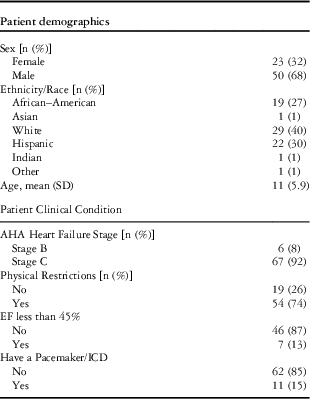
A total of 63 families, including 73 children, were identified. Patient demographic and clinical conditions are summarised in Table 1. Primary diagnoses of the patients were anomalous left coronary artery arising from the pulmonary artery (n=2) with resultant dilated cardiomyopathy phenotype, isolated dilated cardiomyopathy (n=15), hypertrophic cardiomyopathy (n=30), left ventricular aneurysm (n=1), left ventricular non-compaction (n=18), and myocarditis (n=7). Patients with left ventricular non-compaction included those with normal ventricular dimensions and systolic function (n=5), dilated phenotype (n=5), systolic ventricular dysfunction EF<55% (n=7), and arrhythmia (n=1).
Patient and family characteristics.

AHA=American Heart Association; EF=ejection fraction; ICD=implanted cardioverter-defibrillator
Comparison of health-related quality of life between parents and children
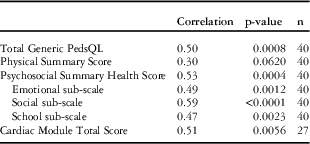
Table 2 shows a moderate correlation with the Generic PedsQL Total score, Psychosocial Health Summary score, and Cardiac Module Total score; however, the Physical Health Summary scores reported by parent-proxy were higher than those self-reported, resulting in only a mild correlation.
Patient/parent-proxy correlations in PedsQL scores.

Comparison of health-related quality-of-life scores between children with heart failure and healthy children
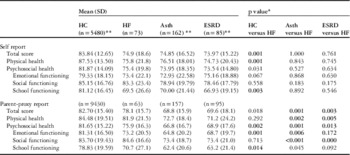
PedsQL scores for children with heart failure were significantly lower compared with healthy children for Total, Physical Health Summary, and School functioning scores (Table 3). Parents perceived no difference in Physical Health Summary scores between these groups, but reported significantly lower values compared with healthy children for Psychosocial Health Summary, Emotional functioning, and School functioning scores (Table 3).
Mean PedsQL Scores for children with HF, healthy children, and children with chronic conditions.

HC=healthy children; HF=heart failure; Asth=asthma; ESRD=end-stage renal disease; SD=standard deviation
* Two-sample t-tests were performed between patient groups using a Bonferroni correction for three comparisons. Bolded values indicated statistically significant values (p<0.017)
** Comparison group data for HC, Asth, and ESRDReference Varni, Burwinkle and Seid 10 – Reference Uzark 15
Comparison of health-related quality-of-life scores between children with heart failure and chronic conditions
PedsQL scores comparing children with heart failure and children with chronic conditions are listed in Table 3. There were no significant differences between self-reported scores of children with heart failure and those with Asthma. There were significantly higher scores for Total, Physical Health Summary, Psychosocial Health Summary, Emotional functioning, and Social functioning in parent-proxy-reported scores of children with heart failure compared with those with Asthma. There were no significant differences between self-reported scores of children with heart failure and those with end-stage renal disease. There were significantly higher scores for Total, Physical Health Summary, Psychosocial Health Summary, and Social functioning in parent-proxy-reported scores of children with heart failure compared with those with end-stage renal disease.
Comparison of health-related quality-of-life scores by heart failure classification
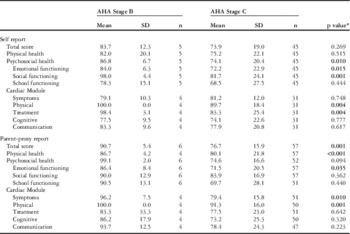
PedsQL 4.0 Generic Core Scale and 3.0 Cardiac Module scores are reported by the American Heart Association heart failure stage classification in Table 4. By self-report, children with Stage C heart failure reported significantly lower Psychosocial Health Summary scores, 3.0 Cardiac Module Physical scores, and 3.0 Cardiac Module Treatment scores compared with those in Stage B. By Parent-proxy, those with Stage C heart failure reported significantly lower health-related quality-of-life scores for Total score, Physical Health Summary, Emotional functioning, 3.0 Cardiac Module Symptoms, and 3.0 Cardiac Module Physical scores compared with those with Stage B.

Comparison of health-related quality-of-life scores between children with heart failure and children with cardiovascular disease
Given the limited Stage B population, comparison of PedsQL 4.0 Module scores between Stage C heart failure patients and children with cardiovascular disease is displayed in Figure 1. Cardiovascular disease was classified as detailed in Figure 1. Health-related quality-of-life scores from the American Heart Association Stage C patients were significantly lower compared with those with mild Cardiovascular Disease on all parental-proxy measures (p<0.013) and on Total and Physical Health Summary Scale (p=0.011; p=0.001) by self-report (Figs 1a and b). Similarly, Stage C patients and parents reported no significant differences in all health-related quality-of-life measures compared with that seen in children with surgically treated cardiovascular disease and severe cardiovascular disease
( a ) Mean PedsQL Scores by Self-Report for Children with AHA Stage C HF compared with Children with Cardiovascular Disease. Cardiovascular disease (CVD) includes the following: (1) Mild including disease requiring no therapy or effectively treated non-operatively (catheter therapy), (2) Moderate including those requiring no therapy or surgically corrected (curative), (3) CVD requiring surgical correction (⩾1 procedure) with significant residua or need for additional surgery, and (4) Complex or severe CVD including uncorrectable or palliated, includes single ventricle;Reference White-Koning, Arnaud and Dickinson 28 Two-sample t-tests were performed between patient groups using a Bonferroni correction for four comparisons with a statistically significant p value <0.0125. Health-related quality of life (HRQOL) scores for Stage C patients are significantly lower than those with mild CVD for Total (p=0.011) and Physical Health Summary Scales (p=0.001). Stage C patients reported no significant differences in all HRQOL measures compared with children with moderate CVD, surgically treated CVD, and severe CVD. ( b ) Mean PedsQL Scores by Parent-Proxy for Children with AHA Stage C HF compared with Children with Cardiovascular Disease. HRQOL scores for Stage C patients are significantly lower than all HRQOL measures of those with mild CVD (p<0.0125). Stage C parents reported no significant differences in all HRQOL measures compared with children with moderate CVD, surgically treated CVD, and severe CVD.

Modifiers of health-related quality-of-life scores
Effects of age, gender, ethnicity, ventricular function, physical activity restriction, and presence of a pacemaker or implanted cardioverter-defibrillator on PedQL 4.0 Generic Core Scales scores were evaluated.
There was no significant difference in PedsQL 4.0 Generic Core Scales scores with regard to age, gender, or ethnicity. With regard to ventricular function measurements, children with moderate-to-severe dysfunction (EF<45%) had significantly lower Parent-proxy PedsQL scores for Total (65.5±13.8 versus 79.1±16.4, p=0.040), Psychosocial Health Summary Scale (59.6±14.2 versus 77.6±16.7, p=0.017), School functioning (48.6±35.9 versus 74.4±26, p=0.040), and Cardiac 3.0 Module Symptoms (62.4 ±21.2 versus 81.4 ±15.1, p=0.012). No significant differences were noted in the PedsQL 4.0 Core Scale scores by self-report with regard to EF<45%.
When evaluating physical activity restriction, there was no significant difference in PedsQL scores by self-report with the exception of Cardiac 3.0 Module Treatment and Communication scores. The 3.0 Cardiac Module Treatment (83.1±25.8 versus 96.2±5.5, p=0.030) scores were significantly lower in the restricted group, whereas the Communication (81.3±18 versus 61.6±24, p=0.040) scores were significantly higher in the physical restriction group compared with the non-restricted group. Parent-proxy PedsQL scores were significantly lower for Total score (74.4±16 versus 86.5±11.5, p=0.004), Physical Health Summary Scale (77.6±22.1 versus 92.1±16.6, p=0.013), Psychosocial Health Summary Scale (72.9±17.1 versus 82.9±11.5, p=0.033), Cardiac 3.0 Module Physical (89.2±17.7 versus 98.4±4.5, p=0.005), and Cardiac 3.0 Module Cognitive (68.8±26.8 versus 85.6±15.6, p=0.006) for the physical restriction group.
Presence of a pacemaker or implanted cardioverter-defibrillator was associated with significantly decreased self-reported PedsQL scores for Total (64.6±22.8 versus 77.8±16.4, p=0.037), Physical Health Summary (61.1±23.5 versus 80.0±19.7, p=0.010), and Emotional functioning (56.1±28.2 versus 78.3±17.6, p=0.002). When correcting for HF stage, self-reported PedsQL scores were significantly lower in the pacemaker or implanted cardioverter-defibrillator population for Physical Health (61.1±23.5 versus 79.7±19.9, p=0.014) and Emotional Functioning (56.1±28.2 versus 77.5±18.6, p=0.006).
Discussion
Heart failure is increasingly recognised as a problem in the paediatric population; however, the long-term effects of heart failure in this population are only starting to be recognised. Our study adds to the increasing literature supporting the significant impairments on health-related quality of life in this population.
Although unique in the paediatric heart failure population, both self-reports and parental-proxy reports provide distinct perspectives on how heart failure impacts the quality of life in this population. Children with heart failure perceived more physical impairment of health-related quality of life than their parents. This suggests that parents may underestimate the significant physical functional impairments of heart failure in children. Our reports of impaired health-related quality of life in children with heart failure are similar to those previously reported in the adult heart failure population.Reference Lesman-Leegte, Jaarsma and Coyne 16 , Reference Evangelista, Dracup and Moser 17 Adults with heart failure report lower physical functioning, psychological status, and health-related quality of life when compared with healthy peers.Reference Evangelista, Dracup and Moser 17 – Reference Moser, Doering and Chung 19 In contrast with the adult heart failure literature, children with heart failure often only present with physical activity impairments in advanced stages, and thus parents may underappreciate the heart failure effects on health-related quality of life in the physical functioning of their children.
When children with heart failure are compared with various other populations, it is evident that they have significant impairment in health-related quality of life. Children with heart failure report significantly lower total health-related quality of life than healthy children. In addition, children with heart failure report impaired health-related quality of life similar to children with chronic conditions such as asthma and end-stage renal disease. Interestingly, parents perceived children with heart failure to have health-related quality of life significantly better than children with asthma and end-stage renal disease. Thus, parents appear to underestimate the effects of heart failure on health-related quality of life in children. Wong et alReference Wong, Hawkins and Jhund 20 reported in the CHARM study the striking differences between young patients with heart failure and how health-related quality of life is more significantly impaired in this population, yet few clinical and radiological signs of heart failure were present. Although children with heart failure may lack external signs or symptoms of a chronic condition as seen in children requiring chronic dialysis, they too have significantly impaired health-related quality of life.
Children with heart failure appear to have impaired health-related quality of life similar to children with moderate cardiovascular disease, and this impairment seems to be incremental with increasing American Heart Association stage of heart failure. We reported children with heart failure having health-related quality of life similar to children with at least moderate cardiovascular disease, and this appears to be dependent on the stage of heart failure. Children with stage C heart failure were noted to have impaired health-related quality of life similar to children with surgically treated cardiovascular disease and complex cardiovascular disease including uncorrectable or palliated CHD including single ventricle anatomy. Health-related quality of life in adult heart failure patients is noted to decrease with increasing severity of American Heart Association heart failure stage.Reference Azevedo, Bettencourt and Alvelos 21 Uzark et alReference Uzark, Jones and Slusher 22 report incremental health-related quality of life impairment in children with increasing severity of cardiovascular disease. We report similar findings in children with heart failure and incremental health-related quality of life impairment with increasing severity of heart failure stage. It must be noted that even in adults living with heart failure without symptoms (Stage B), health-related quality of life is noted to be impaired.Reference Azevedo, Bettencourt and Alvelos 21 Freiss et alReference Friess, Marino and Cassedy 9 recently reported similar findings with noted impaired health-related quality of life in children with a family history of cardiomyopathy (Stage A). Thus, presence of symptoms in patients with heart failure is not required to have detrimental effects on health-related quality of life.
Several modifiers of health-related quality of life in children have been reported in the literature, including severity of cardiovascular disease, severity of CHD, presence of a pacemaker or implantable cardioverter-defibrillator, and exercise restriction.Reference Uzark 15 , Reference Lesman-Leegte, Jaarsma and Coyne 16 , Reference Marino, Tomlinson and Wernovsky 23 , Reference Knowles, Day and Wade 24 In children with heart failure, we evaluated for such modifiers of health-related quality of life. We found no effects of age or ethnicity with respect to health-related quality of life. We did identify a greater parental perceived impairment in health-related quality of life in children with heart failure and moderate-to-severe left ventricular dysfunction (EF<45%). In a report of children with severe CHD cardiac interventions, school absence and regular medications were independently associated with reduced health-related quality of life.Reference Knowles, Day and Wade 24 Similarly, in children with heart failure clinic visits and hospitalisations associated with school absence, cardiac medications are common and may affect health-related quality of life. Moreover, cardiac interventions, such as the use of a pacemaker or cardioverter-defibrillator, may be required in children with heart failure. In our study, children with heart failure with a pacemaker or cardioverter-defibrillator reported impaired health-related quality of life in Total score, Physical Health, and Emotional functioning. Czosek et alReference Czosek, Bonney and Cassedy 25 reported similar impaired health-related quality of life in children with an implanted cardioverter-defibrillator independent of cardiac disease severity. Similarly, our study found impaired health-related quality of life in children with a pacemaker or implanted cardioverter-defibrillator independent of heart failure stage. Exercise restriction in children with CHD has been reported to be associated with impaired psychosocial health-related quality of life.Reference Knowles, Day and Wade 24 Our study showed lower self-reported 3.0 Cardiac module health-related quality-of-life scores in children with heart failure and physical activity restrictions treated with cardiac medications. Interestingly, children with heart failure and physical activity restriction reported higher 3.0 Cardiac Module communication scores, which may be a reflection of such children being educated extensively regarding physical activity restriction and being more adept at communicating this with others. Although children in our study reported limited differences in health-related quality of life in the exercise-restricted group, parents perceived significant impairment in quality of life. Such differences between child self-perception and parental-perception have been well reported in children with chronic illnesses.Reference Buyan, Turkmen and Bilge 26 – Reference White-Koning, Arnaud and Dickinson 28
We acknowledge several limitations to our study, including the study population representing only a portion of children with heart failure in our institution. As such, a potential selection bias exists and external validity of these findings should be interpreted with this in mind. Although this is the largest prospective study evaluating health-related quality of life in children with heart failure reported to date, the relatively limited patient number restricted sub-analysis within patient groups. In addition, differences in age and racial composition varied between the heart failure population and several of the comparison groups. Although all patients had a primary diagnosis of heart failure, the duration of time living with a diagnosis of heart failure and its effects on health-related quality of life were not evaluated in this study.
In conclusion, health-related quality of life is significantly impaired in children living with heart failure. Parental perceptions appear to underestimate the health-related quality of life impairments in this population. Children with heart failure reported health-related quality of life impairment similar to those of children with chronic conditions – for example,. asthma and end-stage renal disease. In addition, children with heart failure appear to have incremental impairment of health-related quality of life with advancing stage of heart failure as reported in the adult heart failure literature. Modifiers of perceived health-related quality of life, such as the presence of a pacemaker or cardioverter-defibrillator systems, and exercise restriction can aid in further identifying children with increasing severity of impairment. These findings identify the negative effects of heart failure in children and the limitations of parental perception of these effects on quality of life. Health-related quality of life has been used as an outcome metric in the adult population with heart failure and it has been linked to increased mortality. Similarly, health-related quality of life can serve in identifying at-risk children with heart failure and aid in both targeting future paediatric heart failure management and serve as an outcome metric.
Acknowledgements
None.
Financial Support
This research received no specific grant from any funding agency, commercial, or not-for-profit sectors.
Conflicts of Interest
None.
Ethical Standards
The authors assert that all procedures contributing to this work comply with the ethical standards of the relevant national guidelines on human experimentation and with the Helsinki Declaration of 1975, as revised in 2008, and has been approved by the Baylor College of Medicine and Cincinnati Children’s Hospital institutional review boards.