Implications
Supplementing a yeast-derived product (Celmanax; Church & Dwight Co., Inc.; Princeton, NJ, USA) during the initial 38 days in the feedlot tended to improve average daily gain (ADG) by 7% and feed efficiency by 5% in beef steers. Beginning Celmanax supplementation during a preceding 30-day post-weaning preconditioning period did not result in additional benefits to feedlot performance, although incidence of respiratory disease during preconditioning was eliminated in Celmanax-supplemented steers. Hence, results from this experiment suggest Celmanax supplementation as a nutritional strategy to improve preconditioning health and initial feedlot performance of beef cattle.
Introduction
Feedlot receiving is one of the most critical phases of the beef production cycle, comprising of the initial 4 to 6 weeks in the feedlot when cattle experience inflammatory and acute-phase responses known to impair their immunocompetence and productivity (Cooke, Reference Cooke2017). These innate immunity responses are elicited by several stress-related stimuli, including endotoxemia caused by death of rumen microbes due to nutrient deprivation during road-transport to feedyards, as well as major environmental and dietary changes after feedlot entry (Marques et al., Reference Marques, Cooke, Francisco and Bohnert2012). Hence, nutritional efforts to enhance cattle health are warranted to optimize animal productivity and welfare in feedlot systems (Duff and Galyean, Reference Duff and Galyean2007).
Supplementing cattle with yeast-derived products, such as yeast cultures and extracts, has been shown to enhance immune function during feedlot receiving (Cole et al., Reference Cole, Purdy and Hutcheson1992; Brown and Nagaraja, Reference Brown and Nagaraja2009). Ponce et al. (Reference Ponce, Schutz, Elrod, Anele and Galyean2012) supplemented heifers during a 35-day feedlot receiving period with a commercial source of yeast culture + enzymatically hydrolyzed yeast products (Celmanax). These authors reported greater ADG, dry matter (DM) intake and reduced morbidity in supplemented v. non-supplemented heifers, and associated these outcomes to innate immunomodulatory properties of Celmanax components such as β-glucans and mannan-oligosaccharide (Nocek et al., Reference Nocek, Holt and Oppy2011). However, Ponce et al. (Reference Ponce, Schutz, Elrod, Anele and Galyean2012) did not evaluate immune and physiological responses to elucidate the biological benefits of Celmanax supplementation. Moreover, Ponce et al. (Reference Ponce, Schutz, Elrod, Anele and Galyean2012) began supplementation 1 day after feedlot arrival, which is after the critical period of stress caused nutrient deprivation during road transport (Marques et al., Reference Marques, Cooke, Francisco and Bohnert2012). Hence, we hypothesized that beginning Celmanax supplementation to beef cattle before transport, such as within a 30-day post-weaning preconditioning period (Pritchard and Mendez, Reference Pritchard and Mendez1990), would further increase cattle health and performance during feedlot receiving. To test this hypothesis, this experiment evaluated Celmanax supplementation starting during preconditioning or at feedlot entry on performance, health and physiological responses of beef steers during both preconditioning (30 days) and feedlot receiving (38 days) periods.
Material and methods
This experiment was conducted at the Oregon State University – Eastern Oregon Agricultural Research Center (Burns station) from September to November 2016. All animals utilized herein originated from the Eastern Oregon Agricultural Research Center (Burns station) research herd, born during the 2016 calving season, and managed equally from birth until the beginning of the experiment. All animals were cared for in accordance with acceptable practices and experimental protocols reviewed and approved by the Oregon State University, Institutional Animal Care and Use Committee (no. 4862). The experimental period was divided into a preconditioning (days 4 to 30) and feedlot receiving phase (days 31 to 69).
Animals and treatments
Eighty-four Angus×Hereford steers were utilized in this experiment (weaning BW=245±2 kg; weaning age=186±2 days). At weaning (day 0), steers were vaccinated against Clostridium and Mannheimia haemolytica (One Shot Ultra 7; Zoetis, Florham Park, NJ, USA), infectious bovine rhinotracheitis virus, bovine viral diarrhea complex, parainfluenza3, and bovine respiratory syncytial virus (Bovi-Shield Gold 5; Zoetis), and were administered an anthelmintic (Dectomax; Zoetis). From days 0 to 3, steers were maintained in a single meadow foxtail pasture and fed grass-alfalfa hay for ad libitum consumption. This interval (days 0 to 3) served as a transition period between weaning and experimental procedures to alleviate behavioral distresses caused by maternal separation (Weary et al., Reference Weary, Jasper and Hötzel2008). On day 4, steers were allocated according to weaning BW and age to a 21-pen drylot (7×15 m with 7-m linear space of concrete feedbunk; 4 steers/pen); a manner in which all pens had equivalent average BW and age. Pens were randomly assigned to receive one of three treatments: (1) no Celmanax supplementation during the experiment (n=7 pens), (2) supplementation with Celmanax (14 g/steer daily) from days 14 to 69 (n=7 pens) or (3) supplementation with Celmanax (14 g/steer daily) from days 31 to 69 (n=7 pens). Celmanax inclusion rate was based on Ponce et al. (Reference Ponce, Schutz, Elrod, Anele and Galyean2012), and according to manufacturer’s recommendation (Church & Dwight Co., Inc.). Celmanax consists of the liquid medium used to grow strains of Saccharomyces cerevisiae; hence composed of dead cell walls, the medium, and an undetermined number of live yeast cells. Enzymatically hydrolyzed S. cerevisiae cell wall and its metabolites, including mannan-oligosaccharide and β-glucan components are added to the liquid medium, which is then dried on a grain-based carrier (by proprietary processes; Church & Dwight Co., Inc.).
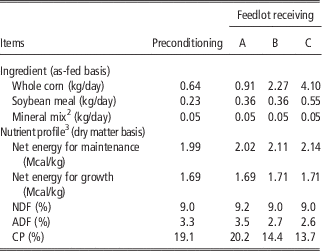
Steers had free-choice access to grass-alfalfa hay and water throughout the preconditioning phase (days 4 to 30), and received a corn-based concentrate (Table 1) beginning on day 14. Celmanax was mixed daily with the concentrate. The interval from days 4 to 13 served as transition period for steers to adapt to drylot pens and feedbunks before the beginning of concentrate feeding and treatment administration. Within each pen, hay and concentrate were offered (0800 h) separately in different sections of the feedbunk. On day 18, steers were re-vaccinated against Clostridium (Ultrabac 8; Zoetis), infectious bovine rhinotracheitis virus, bovine viral diarrhea complex, parainfluenza3 and bovine respiratory syncytial virus, following the manufacturer’s recommendation for revaccination against these pathogens (Zoetis).
Ingredient composition (as-fed basis; kg/day) of concentrate offered during preconditioning (days 4 to 30) and feedlot receiving (days 31 to 69) phasesFootnote 1

1 Preconditioning concentrate was offered from days 14 to 30. During feedlot receiving, A=days 31 to 36; B=days 37 to 44; and C=days 45 to 69. Steers had free-choice access to grass-alfalfa hay throughout the experimental period (day 4 to 69). Hay and concentrate were offered separately, in different sections of the feedbunk.
2 Cattleman’s Choice (Performix Nutrition Systems, Nampa, ID, USA) containing 14% Ca, 10% P, 16% NaCl, 1.5% Mg, 3200 mg/kg of Cu, 65 mg/kg of I, 900 mg/kg of Mn, 140 mg/kg of Se, 6,000 mg/kg of Zn, 136,000 IU/kg of vitamin A, 13 000 IU/kg of vitamin D3 and 50 IU/kg of vitamin E.
3 Based on nutritional profile of each ingredient, which were analyzed via wet chemistry procedures by a commercial laboratory (Dairy One Forage Laboratory, Ithaca, NY, USA). Calculations for net energy for maintenance and growth were calculated with the equations proposed by the National Research Council (2000).
On day 30, all steers were commingled and transported at the same time and in the same double-deck commercial livestock trailer (Legend 50’ cattle liner; Barrett LLC., Purcell, OK, USA) for 1500 km. During transport, the driver stopped every 6 h to rest for 60 min, but cattle remained in the truck at all times, and total transport time was 24 h. Minimum, maximum and average environmental temperatures during transport were −5°C, 18°C and 11°C, respectively, whereas average humidity was 54% and no precipitation was observed. Transportation length and distance were selected to simulate the stress of a long-haul that beef cattle originated from western or southeastern US cow-calf operations are exposed to when transferred to feedlots in the midwestern USA (Cooke et al., Reference Cooke and Arthington2013). Upon arrival (day 31), steers returned to their original pens for a 38-day feedlot receiving (days 31 to 69). During this phase, steers also had free-choice access to grass-alfalfa hay and water, received a corn-based concentrate (Table 1) at 0800 h separately from the hay, with Celmanax being mixed daily with the concentrate.
Sampling
Samples of hay and concentrate ingredients were collected weekly, pooled across all weeks, and analyzed for nutrient content by a commercial laboratory (Dairy One Forage Laboratory, Ithaca, NY, USA). All samples were analyzed by wet chemistry procedures for concentrations of CP (method 984.13; Association of Official Analytical Chemists (AOAC), 2006), ADF (method 973.18 modified for use in an Ankom 200 fiber analyzer, Ankom Technology Corp., Fairport, NY, USA; AOAC, 2006) and NDF (Van Soest et al., Reference Van Soest, Robertson and Lewis1991; modified for use in an Ankom 200 fiber analyzer). Calculations for net energy for maintenance and gain were calculated with the equations proposed by the National Research Council (2000). Hay nutritional profile was (DM basis) 36.1% NDF, 29.3% ADF, 1.47 Mcal/kg of net energy for maintenance, 0.90 Mcal/kg of net energy for gain and 20.5% CP. Nutrient profile of concentrate offered during preconditioning and feedlot receiving phases are described in Table 1.
Steer shrunk BW was recorded on days 4 70, after 16 h of water and feed withdrawal. Steer shrunk BW was also recorded on day 31 immediately after unloading from the livestock trailer. Full BW was recorded on days 14, 30 and 45. Values from days 14 and 45 were used to monitor steer growth during the experimental period, and values from day 30 used to evaluate BW shrink during transport. Shrunk BW was not recorded again on day 14, when treatment administration began, to prevent distress on recently-weaned steers (Marques et al., Reference Marques, Cooke, Francisco and Bohnert2012) and hinder the objectives of this experiment. Hence, shrunk BW values obtained on days 4 and 31 were used to calculate preconditioning ADG, whereas shrunk BW obtained on days 31 and 70 were used to calculate feedlot receiving ADG. Concentrate, hay, and total DM intake were evaluated daily from days 14 to 69 from each pen by collecting and weighing offered and non-consumed. All samples were dried for 96 h at 50°C in forced-air ovens for DM calculation. Hay, concentrate and total daily DM intake of each pen were divided by the number of steers within each pen, and expressed as kg per steer/day. Total BW gain and DM intake of each pen from days 31 to 69 were used to calculate feed efficiency during feedlot receiving.
Steers were observed daily (0800 to 1000 h and 1600 to 1800 h) from days 0 to 69 for sickness, particularly bovine respiratory disease (BRD; as described by Berry et al., Reference Berry, Confer, Krehbiel, Gill, Smith and Montelongo2004) and bloat (as described by Meyer and Bartley, Reference Meyer and Bartley1972). Cattle received (intramuscularly) 0.1 ml/kg of BW of Hexasol LA Solution (Norbrook® Inc., Overland Park, KS, USA) when BRD signs were observed, or 60 ml (oral drench, mixed with 500 ml of water) of Therabloat (Zoetis) when bloat was detected.
Blood samples were collected on days 14, 30, 31, 33, 35, 40, 45, 54 and 69 (0700 h), before hay and concentrate feeding. Samples were collected via jugular venipuncture into commercial blood collection tubes (Vacutainer, 10 ml; Becton Dickinson, Franklin Lakes, NJ, USA) containing no additive or containing freeze-dried sodium heparin for serum and plasma collection, respectively. After collection, all blood samples were placed immediately on ice, centrifuged (2500×g for 30 min; 4°C) for plasma or serum harvest, and stored at −80°C on the same day of collection. Serum samples collected from days 14 to 54 were analyzed for non-esterified fatty acids (NEFA; colorimetric kit HR Series NEFA – 2; Wako Pure Chemical Industries Ltd, Richmond, VA, USA). Plasma samples collected from day 14 to 54 were analyzed for cortisol (Immulite 1000; Siemens Medical Solutions Diagnostics, Los Angeles, CA, USA) and haptoglobin (Cooke and Arthington, Reference Cooke, Guarnieri Filho, Cappellozza and Bohnert2013). Plasma samples collected on days 14, 30, 54 and 69 were analyzed for IGF-I (Immulite 1000). The intra- and interassay CV were, respectively, 1.7% and 6.8% for NEFA, and 3.0% and 4.5% for haptoglobin. Plasma IGF-I and cortisol were analyzed within single assays, and the intra-assay CV were, respectively, 2.7% and 1.4%.
Statistical analysis
Pen was considered the experimental unit for all analyses. Results from the preconditioning phase were analyzed by comparing pens that received (CELM) or not (CONPC) Celmanax during preconditioning. Results from the feedlot receiving phase were analyzed by comparing pens that received Celmanax from days 14 to 69 (CELPREC), days 31 to 69 (CELRECV) or no Celmanax supplementation during the experiment (CON). In addition, treatment effects during feedlot receiving were compared using pre-planned single-df orthogonal contrasts (CELPREC and CELRECV v. CON; CELPREC v. CELRECV).
Quantitative data were analyzed using the MIXED procedure of SAS (SAS Institute Inc., Cary, NC, USA), binary data were analyzed using the GLIMMIX procedure of SAS (SAS Institute Inc.), and Satterthwaite approximation to determine the denominator df for tests of fixed effects. All data were analyzed using pen(treatment) and steer(pen) as random variables, but for DM intake and feed efficiency that used pen(treatment) as random variable. Model statement for BW, ADG, BW shrink, feed efficiency, and morbidity and mortality rates within each phase contained the effects of treatment. Model statement for DM intake, cumulative BRD incidence and blood variables contained the effects of treatment, day and the resultant interaction, in addition to results from day 14 as independent covariate for blood variables only. The specified term for the repeated statements was day, with pen(treatment) as subject for DM intake and steer(pen) as subject for blood variables and cumulative BRD incidence. The covariance structure used was first-order autoregressive, which provided the smallest Akaike information criterion and hence the best fit for all variables analyzed. All results are reported as least square means, but for blood variables that are reported as covariately adjusted least square means. Significance was set at P⩽0.05 and tendencies were determined if P>0.05 and ⩽0.10. Results are reported according to main effects if no interactions were significant, or according to the highest-order interaction detected.
Results
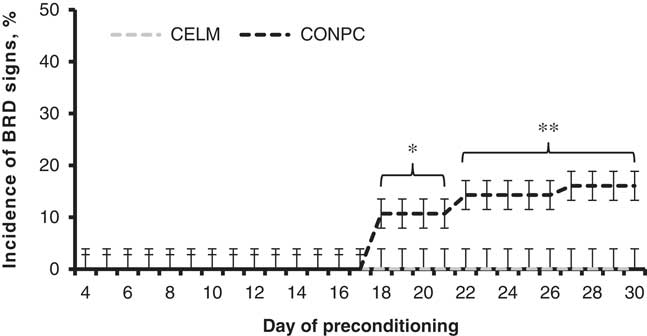
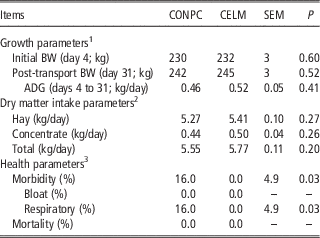
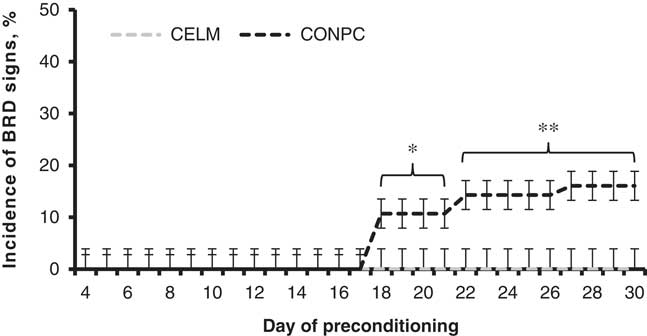
During the preconditioning phase, no treatment differences were detected (P⩾0.20) for shrunk BW, ADG and DM intake parameters (Table 2). Likewise, full BW did not differ (P=0.62) between treatments on day 14, indicating that BW was similar in CONPC and CELM steers at the beginning of treatment administration (261 v. 263 kg, respectively; SEM=3.6). No differences were also detected for BW shrink from days 30 to 31 (9.48% v. 9.30% for CONPC and CELM steers, respectively; SEM=0.45). Incidence of BRD during the preconditioning phase was less (P=0.03) in CELM steers compared with CONPC steers (Table 2), whereas bloat symptoms were not observed. It is important to note that all cases of BRD signs during preconditioning were observed from day 18 to 30 (treatment×day interaction, P<0.01; Figure 1), after treatments began to be administered.
Incidence of bovine respiratory disease (BRD) signs, according to Berry et al. (Reference Berry, Confer, Krehbiel, Gill, Smith and Montelongo2004), during the preconditioning phase (days 4 to 30) in steers receiving a concentrate containing (CELM; n=7 pens) or not (CONPC; n=14 pens) 14 g/steer daily of Celmanax (Church & Dwight Co., Inc., Princeton, NJ, USA) from days 14 to 30. A treatment×day interaction was detected (P<0.01). Within day; * P=0.03, ** P<0.01.
Performance and health parameters during the preconditioning phase (days 4 to 30) in steers receiving a concentrate containing (CELM; n=7 pens) or not (CONPC; n=14 pens) 14 g/steer daily of Celmanax (Church & Dwight Co., Inc., Princeton, NJ, USA) from days 14 to 30

ADG=average daily gain.
1 Steer shrunk BW was recorded after 16 h of water and feed withdrawal on day 4 (initial BW), and after road transport (1500 km for 24 h) on day 31.
2 Feed intake was recorded daily from days 14 to 30 by measuring offer and refusals from each pen. Results were divided by the number of steers within each pen, and are expressed as kg per steer/day.
3 Steers were observed daily (days 4 to 69) for bloat (according to Meyer and Bartley, Reference Meyer and Bartley1972) and bovine respiratory disease (according to Berry et al. Reference Berry, Confer, Krehbiel, Gill, Smith and Montelongo2004) signs.
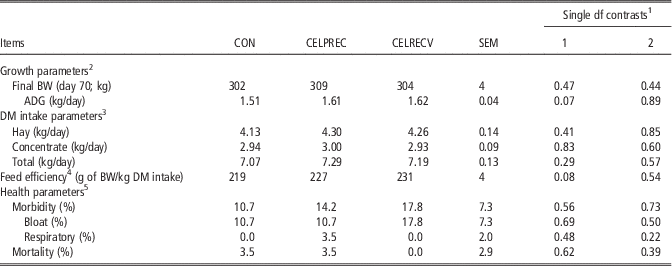
During the feedlot receiving phase, ADG tended (P=0.07) to be greater in CELPREC and CELRECV v. CON steers, and was similar (P=0.89) between CELPREC and CELRECV steers (Table 3). No treatment differences were detected (P⩾0.29) for DM intake parameters (Table 3). Therefore, feed efficiency also tended (P=0.08) to be greater in CELPREC and CELRECV v. CON steers, and was similar (P=0.54) between CELPREC and CELRECV steers (Table 3). Treatment differences detected for ADG, however, were not sufficient to impact (P⩾0.27) steer full BW on day 45 (281, 276 and 280 kg for CELPREC, CELRECV and CON, respectively; SEM=4) and final receiving shrunk BW (Table 3).
Performance and health parameters during the feedlot receiving phase (days 31 to 69) in steers receiving 14 g/day of Celmanax (Church & Dwight Co., Inc., Princeton, NJ, USA) during preconditioning and feedlot receiving (days 14 to 69; CELPREC; n=7 pens), during feedlot receiving only (days 31 to 69; CELRECV; n=7 pens), or not receiving Celmanax during the experiment (days 4 to 69; CON; n=7 pens)Footnote 1 , Footnote 2

DM=dry matter; ADG=average daily gain.
1 Single-df orthogonal contrasts: 1=CON v. CELPREC and CELRECV, and 2=CELPREC v. CELRECV.
2 Steer shrunk BW was recorded after road transport (1500 km for 24 h) on day 31, and after 16 h of water and feed withdrawal on day 70 (final BW).
3 Feed intake was recorded daily from days 31 to 69 by measuring offer and refusals from each pen. Results were divided by the number of steers within each pen, and are expressed as kg per steer/day.
4 Calculated according to total DM intake and BW gain of each pen.
5 Steers were observed daily (days 4 to 69) for bloat (according to Meyer and Bartley, Reference Meyer and Bartley1972) and bovine respiratory disease (according to Berry et al., Reference Berry, Confer, Krehbiel, Gill, Smith and Montelongo2004) signs.
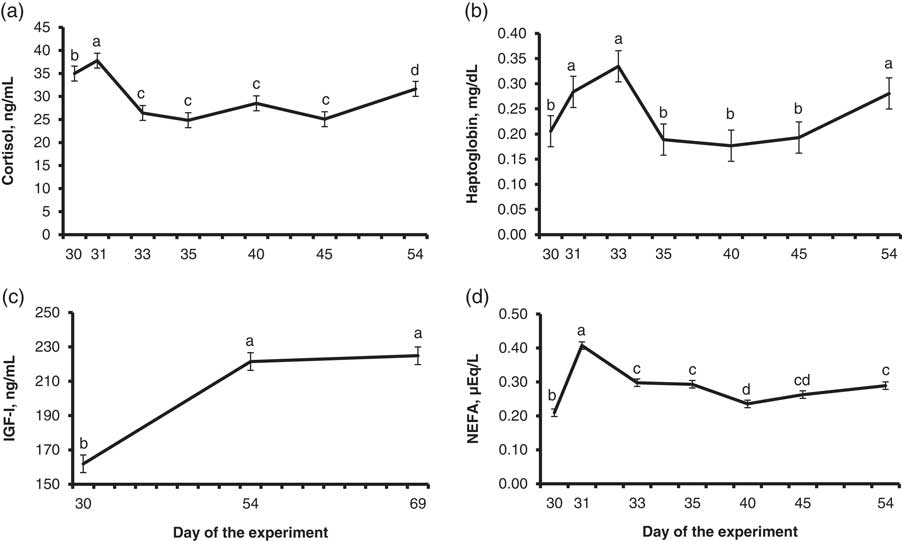
No treatment effects were detected (P⩾0.22) for morbidity and mortality parameters (Table 3) during the feedlot receiving phase. No treatment differences were also detected (P⩾0.27) for concentrations of plasma cortisol, plasma haptoglobin, plasma IGF-I, and serum NEFA (Table 4). Day effects, however, were detected (P<0.01) for plasma and serum variables (Figure 2).
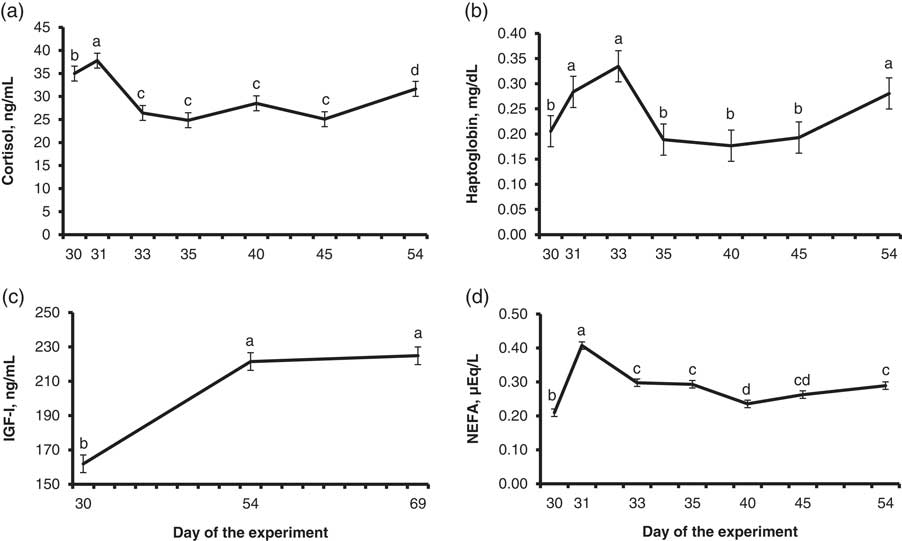
Concentrations of plasma cortisol (a), plasma haptoglobin (b), plasma IGF-I (c), and serum non-esterified fatty acids (NEFA) (d) during the experiment. On day 30, steers were loaded into a livestock trailer and transported for 1500 km (24 h), and assigned to a 38-day feedlot receiving (days 31 to 69). Day effects were detected for all variables (P<0.01). a,b,c,dWithin variable, days with different letters differ (P<0.05).
Concentrations of plasma cortisol, plasma haptoglobin, plasma IGF-I and serum non-esterified fatty acids (NEFA) in steers receiving 14 g/day of Celmanax (Church & Dwight Co., Inc., Princeton, NJ, USA) during preconditioning and feedlot receiving (days 14 to 69; CELPREC; n=7 pens), during feedlot receiving only (days 31 to 69; CELRECV; n=7 pens), or not receiving Celmanax during the experiment (days 4 to 69; CON; n=7 pens)Footnote 1

1 Blood samples were collected on days 14, 30, 31, 33, 35, 40, 45, 54 and 69. Serum samples collected from days 14 to 54 were analyzed for NEFA concentrations. Plasma samples collected from days 30 to 54 were analyzed for cortisol and haptoglobin concentrations. Plasma samples collected on days 14, 30, 54 and 69 were analyzed for IGF-I concentrations. Results from day 14 were used as independent covariate within each respective analysis; hence, values reported are covariately adjusted least square means.
2 Single-df orthogonal contrasts: 1=CON v. CELPREC and CELRECV, and 2=CELPREC v. CELRECV.
Discussion
Results from the preconditioning phase indicate that Celmanax supplementation failed to improve steer preconditioning performance (Table 2), differing from studies reporting increased ADG in Celmanax-supplemented livestock (Ponce et al., Reference Ponce, Schutz, Elrod, Anele and Galyean2012; Nde et al., Reference Nde, Verla, Michael and Ahmed2014). Treatment administration during preconditioning started concurrently with concentrate feeding on day 14, and Ponce et al. (Reference Ponce, Schutz, Elrod, Anele and Galyean2012) reported that ADG was greater in Celmanax-supplemented v. non-supplemented heifers 14 days after supplementation began. Thus, similar preconditioning performance between CELM and CONPC steers should not be attributed to insufficient length of treatment administration. Alternatively, increased ADG of Celmanax-supplemented ruminants has been associated with increased DM intake (Ponce et al., Reference Ponce, Schutz, Elrod, Anele and Galyean2012; Nde et al., Reference Nde, Verla, Michael and Ahmed2014). Supplementing S. cerevisiae-derived products to cattle may improve ruminal fiber degradation and microbial protein synthesis (Miller-Webster et al., Reference Miller-Webster, Hoover, Holt and Nocek2002; Salinas-Chavira et al., Reference Salinas-Chavira, Arzola, González-Vizcarra, Manríquez-Núñez, Montaño-Gómez, Navarrete-Reyes, Raymundo and Zinn2015; Salinas-Chavira et al., Reference Salinas-Chavira, Montano, Torrentera and Zinn2017), which in turn regulate DM intake in ruminants (Allen, Reference Allen1996). Accordingly, Ponce et al. (Reference Ponce, Schutz, Elrod, Anele and Galyean2012) reported greater concentrate intake, but similar hay intake and overall feed efficiency, in Celmanax-supplemented compared with non-supplemented heifers during feedlot receiving. However, Ponce et al. (Reference Ponce, Schutz, Elrod, Anele and Galyean2012) offered hay and concentrate for ad libitum consumption. In the present experiment, the concentrate was limit-fed, which may have hindered a potential increase in concentrate DM intake in CELM steers during preconditioning, contributing to the similar preconditioning ADG between treatments.
Treatment differences in BRD incidence during the preconditioning phase (Table 2; Figure 1) indicate that supplementing Celmanax eliminated, or at least contributed to the lack of BRD occurrence typically observed in recently-weaned cattle (Taylor et al., Reference Taylor, Fulton, Lehenbauer, Step and Confer2010; Ponce et al., Reference Ponce, Schutz, Elrod, Anele and Galyean2012). Although the effects of yeast products on cattle immunity are not clearly established, yeast components such as β-glucan are positively associated with proliferation and responsiveness of T-cells to antigens or cytokines (Nocek et al., Reference Nocek, Holt and Oppy2011). Mannan-oligosaccharide acts as a high-affinity ligand offering competitive binding site options for gram-negative bacteria, which enhance humoral immunity against these pathogens through presentation of the attenuated antigens to immune cells (Ballou, Reference Ballou1970). Accordingly, Franklin et al. (Reference Franklin, Newman, Newman and Meek2005) supplemented non-lactating dairy cows with mannan-oligosaccharide and observed enhancement of humoral immune response of cows to rotavirus. Moreover, Celmanax supplementation reduced clinical mastitis in lactating dairy cows (Proudfoot et al., Reference Proudfoot, Nocek and von Keyserlingk2009) and nematode egg count in growing sheep (Nde et al., Reference Nde, Verla, Michael and Ahmed2014). Nevertheless, treatment differences in BRD incidence were not sufficient to affect steers preconditioning performance, although BRD incidence impairs ADG in beef cattle (Snowder et al., Reference Snowder, Van Vleck, Cundiff and Bennett2006; Schneider et al., Reference Schneider, Tait, Busby and Reecy2009).
During the feedlot receiving phase, trends detected for performance traits (Table 3) are in accordance with previous research reporting improved ADG in receiving cattle supplemented Celmanax (Ponce et al., Reference Ponce, Schutz, Elrod, Anele and Galyean2012). Given the similar DM intake among treatments (Table 3), likely due to limited-fed concentrate as previously discussed, Celmanax supplementation enhanced nutrient utilization during feedlot receiving as evidenced by statistical trends on receiving feed efficiency. Such outcome may be attributed to improved rumen fermentation in Celmanax-supplemented cattle (Miller-Webster et al., Reference Miller-Webster, Hoover, Holt and Nocek2002; Nocek et al., Reference Nocek, Holt and Oppy2011), although ruminal parameters were not evaluated herein. Differing from our hypothesis, however, beginning Celmanax supplementation before feedlot entry did not result in additional benefits compared with supplementation during feedlot receiving only, based on the similar ADG between CELPREC and CELRECV steers. Perhaps Celmanax supplementation only improved rumen fermentation and tended to increase feed efficiency in receiving diets with elevated concentrate inclusion, whereas forage:concentrate ratio (DM basis) across treatments was 92 : 8 during preconditioning and 59 : 41 during feedlot receiving phase (Table 2). Moreover, benefits of Celmanax supplementation on feedlot receiving ADG and feed efficiency should not be associated with preconditioning BRD incidence (Snowder et al., Reference Snowder, Van Vleck, Cundiff and Bennett2006; Schneider et al., Reference Schneider, Tait, Busby and Reecy2009), given that CELRECV steers did not receive Celmanax during the preconditioning phase.
Morbidity during the feedlot receiving phase, particularly BRD incidence, was not as prevalent compared with values from research conducted at commercial receiving yards (Snowder et al., Reference Snowder, Van Vleck, Cundiff and Bennett2006; Marques et al., Reference Marques, Cooke, Rodrigues, Cappellozza, Larson, Moriel and Bohnert2016), which may have hindered proper assessment of receiving morbidity and contributed to the lack of treatment effects in these variables (Table 3). Although steers were subjected to the stress of transportation (Arthington et al., Reference Arthington, Qiu, Cooke, Vendramini, Araujo, Chase and Coleman2008; Cooke et al., Reference Cooke and Arthington2013), they returned to the same facility with the same pen members, and were not exposed to calves from other sources in a novel environment (Step et al., Reference Step, Krehbiel, DePra, Cranston, Fulton, Kirkpatrick, Gill, Payton, Montelongo and Confer2008). Furthermore, steers were preconditioned for 30 days, which is known to lessen feedlot receiving morbidity (Pritchard and Mendez, Reference Pritchard and Mendez1990; Duff and Galyean, Reference Duff and Galyean2007). Ponce et al. (Reference Ponce, Schutz, Elrod, Anele and Galyean2012) also reported that morbidity rates were less than expected in their study, despite reduced BRD incidence in Celmanax-supplemented v. non-supplemented heifers. Hence, research is still warranted to verify the health benefits of Celmanax supplementation to receiving cattle exposed to scenarios with elevated morbidity rate (Duff and Galyean, Reference Duff and Galyean2007).
The lack of treatment effects on plasma and serum variables (Table 4) indicate that Celmanax supplementation beginning at preconditioning or feedlot receiving did not modulate the physiological and acute-phase responses evaluated herein. Nonetheless, day effects reported for these variables (Figure 2) corroborate that steers were exposed to the stress and nutritional challenges associated with feedlot entry. Plasma cortisol and haptoglobin concentrations transiently increased across all treatments after transport, validating that steers experienced a neuroendocrine and subsequent acute-phase protein response elicited by transport and feedlot entry (Cooke, Reference Cooke2017). Serum NEFA concentrations also transiently increased across all treatments after transport, which can be associated with water and nutrient deprivation during transport and the cortisol-induced lipolysis (Marques et al., Reference Marques, Cooke, Francisco and Bohnert2012). Plasma IGF-I concentrations increased across all treatments during feedlot receiving, mainly due to increased nutrient intake (Table 1) and growth (Table 3) during this phase (Elsasser et al., Reference Elsasser, Rumsey and Hammond1989). Hence, the benefits of Celmanax supplementation on receiving ADG and feed efficiency were not associated with lessened cortisol and acute-phase responses elicited by transport and feedlot entry; although both responses influence DM intake, nutrient utilization, and growth in beef cattle (Cooke, Reference Cooke2017). Likewise, increased receiving ADG in Celmanax-supplemented steers was not reflected by plasma IGF-I concentrations, which is associated positively with cattle growth rates (Bishop et al., Reference Bishop, Simmen, Simmen and Davis1989; Ellenberger et al., Reference Ellenberger, Johnson, Carstens, Hossner, Holland, Nett and Nockels1989; Elsasser et al., Reference Elsasser, Rumsey and Hammond1989). Collectively, plasma and serum variables evaluated herein failed to elucidate biological mechanisms by which Celmanax may benefit performance of receiving cattle. Perhaps Celmanax supplementation improved cattle ADG and feed efficiency herein without substantial impacts on systemic inflammatory, metabolic and responses.
Conclusions
Supplementing Celmanax during feedlot receiving tended to improve ADG by 7% and feed efficiency by 5% in beef steers, despite similar DM intake likely due to limited-fed concentrate. Beginning Celmanax supplementation during a preceding 30-day preconditioning did not result in additional benefits to feedlot receiving ADG and feed efficiency, although BRD incidence during preconditioning was eliminated in Celmanax-supplemented steers. Hence, additional research is warranted to investigate the effects of Celmanax supplementation to transported beef cattle, including ad libitum intake of concentrate during feedlot receiving, with cattle exposed to high-stress scenarios where morbidity and mortality are traditionally greater as observed herein. Nonetheless, results from this experiment suggest Celmanax supplementation as a nutritional strategy to improve preconditioning health and receiving performance of beef cattle.
Acknowledgments
Financial support for this research was provided by Church & Dwight Co., Inc. (Princeton, NJ, USA). Dr Reinaldo Cooke is also affiliated as permanent professor to the Programa de Pós-Graduação em Zootecnia / São Paulo State University (UNESP), School of Veterinary Medicine and Animal Science, Botucatu 18168-000, Brazil.