Introduction
Polycystic ovary syndrome (PCOS) is an endocrine disorder characterized by reproductive dysfunction and abnormal glucose metabolism (Cox et al., Reference Cox, Edwards, Rodriguez Paris, Aflatounian, Ledger, Gilchrist, Padmanabhan, Handelsman and Walters2020). PCOS, which features persistent anovulation, androgen excess and insulin resistance (IR), contributes to menstrual disorders in women of reproductive age (Goodman et al., Reference Goodman, Cobin, Futterweit, Glueck, Legro and Carmina2015; Azziz, Reference Azziz2018). Inflammatory cytokines, the immune system and adipose tissue participate in IR, which is a chronic nonspecific inflammation and mediated by innate immunity (Olefsky and Glass, Reference Olefsky and Glass2010; Winer et al., Reference Winer, Luck, Tsai and Winer2016; Patel, Reference Patel2018). IR not only involves many classic targets in the regulation of insulin and glucose metabolism, such as liver and fat, but also exists in nonclassical organ, such as ovary (Kim et al., Reference Kim, Jeong, Kim, Kim, Chae and Chae2010). Overall, 5% of PCOS obese patients and 35% of non-obese patients have different degrees of IR. IR is not only considered as a significant biochemical feature of PCOS disease, but also an important pathophysiological basis of PCOS disease (Goodarzi and Korenman, Reference Goodarzi and Korenman2003). Moreover, PCOS has been verified to cause lipid accumulation in the liver (Petta et al., Reference Petta, Ciresi, Bianco, Geraci, Boemi, Galvano, Magliozzo, Merlino, Craxì and Giordano2017).
GPR120, belonging to the class A-rhodopsin receptor family of the G-protein family, has low homology with other members of the FFA receptor family and is expressed in most tissues of species such as human, rat and fish (Sawzdargo et al., Reference Sawzdargo, George, Nguyen, Xu, Kolakowski and O’Dowd1997; Katsuma et al., Reference Katsuma, Hatae, Yano, Ruike, Kimura, Hirasawa and Tsujimoto2005). Accumulating reports have provided evidence that GPR120, which is involved in the regulation of glucose and lipid metabolism, and IR (Marzuillo et al., Reference Marzuillo, Grandone, Perrone and Miraglia Del Giudice2015; Song et al., Reference Song, Yang, Zhou, Wei and Peng2017), is a potential target for the treatment of obesity and diabetes (Oh et al., Reference Oh, Walenta, Akiyama, Lagakos, Lackey, Pessentheiner, Sasik, Hah, Chi, Cox, Powels, Di Salvo, Sinz, Watkins, Armando, Chung, Evans, Quehenberger and Mcnelis2014; Zhang and Leung, Reference Zhang and Leung2014). A review revealed that the activation of GPR120 could suppress inflammation, improve IR, as well as affect lipid and glucose metabolism in the liver (Zhang and Leung, Reference Zhang and Leung2014). However, the role of GPR120 in PCOS still remains unclear. The study was designed to investigate whether GPR120 is implicated in the pathomechanism of PCOS.
Method
Animals
Sixty specific pathogen-free (SPF) female Sprague Dawley rats (aged 6–8 weeks, weighing 160–200 g) were purchased from Shanghai SLAC Laboratory Animal Co., Ltd (Shanghai, China). The PCOS rat model was established by subcutaneous injection of DHEA (60 mg/kg/d) dissolved into 0.2 ml sesame oil for 15 days. PCOS model rats were randomly divided into model group (n = 10) and model + GPR120 group (n = 10) while the normal rats were randomly divided into control group (n = 10) and GPR120 group (n = 10). Normal rats were subcutaneously injected with 0.2 ml sesame oil. In the model + GPR120 group, the rats were administrated intraperitoneally (i.p.) with GPR120 agonist TUG-891 (weight/9.1 × 6.3). In the model group, rats were injected i.p. with the same amount of normal saline once a day for 15 days. The study was approved by the ethical committee of Affiliated Maternity and Child Health Care Hospital of Nantong University.
RT-qPCR
Total RNA was extracted using TRIzol reagent (Sigma) and reverse-transcribed into a cDNA template using a reverse transcription kit (TaKaRa, Japan). RT-qPCR was performed using cDNA as templates with the Applied Biosystems™ SYBR™ reagent (ThermoFisher Scientific). The relative GPR120 mRNA levels were calculated using the 2−ΔΔCt method.
Western blot
Proteins collected from ovarian and liver tissues were lysed with RIPA buffer and quantified using a bicinchoninic acid (BCA) protein assay kit (Thermo Fisher Scientific Inc.). These were then subjected to sodium dodecyl sulfate-polyacrylamide gel electrophoresis; the proteins were transferred onto poly(vinylidene fluoride) (PVDF) membranes. After blocking with 5% skimmed milk powder, the membranes were incubated with primary antibody against GPR120 (ab263964) or glyceraldehyde-3-phosphate dehydrogenase (GAPDH) (ab181602) at 4°C overnight. The following day, secondary antibody (ab7090, abcam, England) was added and the membranes were incubated at room temperature for 2 h. ECL reagent (Sigma-Aldrich) was used to develop colour and protein bands were analyzed using ImageJ software.
Detection of blood glucose
The levels of fasting blood glucose (FBG) in each group were detected using the hexokinase method. The levels of fasting insulin in serum (FINS) were detected using an enzyme-linked immunosorbent assay kit according to the manufacturer’s guidelines (Beijing Haying Institute of Biotechnology, Beijing, China).
Detection of testosterone, estradiol, luteinizing hormone and follicle-stimulating hormone
Collected blood was placed at 4°C for 3 h and then centrifuged at 4500 r/min for 15 min at 4°C. After collecting the serum, the operation was conducted strictly in accordance with the manufacturer’s instructions. The content of testosterone (T), estradiol (E2), luteinizing hormone (LH) and follicle-stimulating hormone (FSH) in the serum was detected using the corresponding kits (Elabscience Biotechnology Co. Ltd, Wuhan, China).
Haematoxylin and eosin staining
After fixation with 4% paraformaldehyde for 48 h, the ovaries and livers of rats in each group were dehydrated and embedded in paraffin. The thickness of sections was 4 μm, and the ovarian and liver tissues were stained with haematoxylin and eosin (H&E). The pathological changes in ovarian tissues were observed under a light microscope.
The detection of serum lipid metabolism
Serum total cholesterol (TC), triglyceride (TG), low-density lipoprotein cholesterol (LDL-C), and high-density lipoprotein cholesterol (HDL-C) levels in rats in each group were detected by enzymatic colorimetry. Subsequently, TC, HDL-C, LDL-C and TG levels were measured using the corresponding kits (TC, cat. no. 439074; HDL-C, cat. no. 384041; LDL-C, cat. no. 372984; TG, cat. no. 442499; Roche, Shanghai).
Oil red staining
Here, 5–10 µm frozen tissue sections of liver were prepared and then washed using distilled water. The sections were stained using oil red diluent that was prepared with 6 ml oil red saturated liquid and 4 ml distilled water, in addition the nucleus was stained with Mayer’s haematoxylin. Finally, the number of positive cells was counted with the application of a light microscope.
Statistical analysis
Data were expressed as mean ± standard deviation (SD), and the GraphPad Prism 8 software was used for statistical analysis. Comparison between the two groups was performed using Student’s t-test. One-way analysis of variance (ANOVA) was used to compare between multiple groups, followed by Tukey’s test. A P-value < 0.05 was considered to be statistically significant.
Results
GPR120 levels were decreased in the plasma, liver and ovary of PCOS rat model
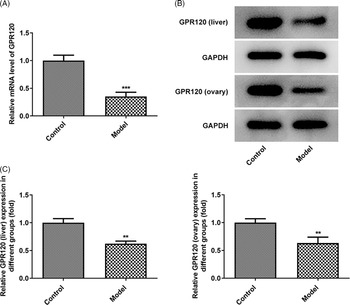
The mRNA expression of GPR120 was significantly decreased in the serum of PCOS rats compared with the control (Figure 1A). As Figure 1(B) depicts, the protein level of GPR120 was also downregulated in liver and ovary tissues of PCOS rats.
GPR120 levels were decreased in the plasma, liver and ovary of PCOS rat model. (A) GPR120 mRNA levels in the serum of PCOS rats were detected using RT-qPCR. (B) Protein levels of GPR120 in liver and ovary of PCOS rats were detected using western blot. (C) The relative levels of GPR120 in liver and ovary. Data are shown as mean ± standard deviation (SD). n = 10. **P < 0.01, ***P < 0.001 vs control group.

GPR120 agonist regulates the body weight in the PCOS rat model
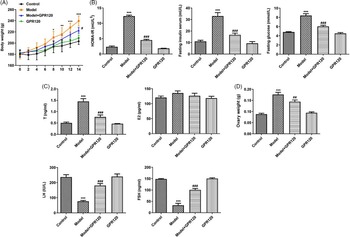
The weight of rats in different groups was recorded every 2 days. Compared with the model group, the weight of PCOS rats was markedly decreased following GPR120 agonist treatment. In addition, GPR120 agonist treatment also increased the weight of PCOS rats in the control group (Figure 2A). The above-mentioned results revealed that the GPR120 agonist regulated the body weight in the PCOS rat model.
GPR120 agonist regulated the weight and insulin resistance of PCOS rat model. (A) Changes in body weight after GPR120 agonist administration. (B) HOMA-IR, fasting insulin and fasting glucose levels. (C) Levels of testosterone (T), estradiol (E2), luteinizing hormone (LH) and follicle-stimulating hormone (FSH). (D) Weight of the ovary. Data are presented as mean ± standard deviation (SD). n = 10. *P < 0.05, **P < 0.01, ***P < 0.001 vs control. # P < 0.05, ## P < 0.01, ### P < 0.001 vs model + GPR120.

GPR120 agonist reduced insulin resistance in PCOS rat model
Insulin resistance refers to a series of physiological and pathological changes in which the metabolism and transport of glucose in the body is lower than the normal physiological level under the regulation of insulin. Moreover, the weakened response of the target organ cells to insulin resulted in the decreased absorption and utilization efficiency of glucose in the body (Moghetti, Reference Moghetti2016). Previous studies have testified that IR plays a vital role in PCOS (Polak et al., Reference Polak, Czyzyk, Simoncini and Meczekalski2017; Wiweko et al., Reference Wiweko, Indra, Susanto, Natadisastra and Hestiantoro2018). Therefore, we further experimented to explore whether a GPR120 agonist could exert effects on IR in the PCOS rats. As Figure 2(B) displays, fasting glucose, fasting insulin and HOMA-IR increased markedly in PCOS rats compared with the control. However, GPR120 agonist administration exhibited suppressive effects on these groups, evidenced by the decreased fasting glucose, fasting insulin and HOMA-IR in the model + GPR120 group (Figure 2B).
GPR120 agonist improved ovarian function in PCOS rat model
The ovary function of PCOS rats was evaluated through the detection of T, E2, LH and FSH. It is noted that, compared with the control group, the levels of T, E2 and LH were substantially increased, while FSH levels were decreased in the model group; these levels were then reversed by GPR120 agonist treatment (Figure 2C). Additionally, the ovary weight of PCOS rats was higher than that in the control group (Figure 2D). However, in contrast with the model group, the weight of PCOS rats with GPR120 agonist administration was slightly less. Furthermore, there was no significant difference between the control and GPR120 groups.
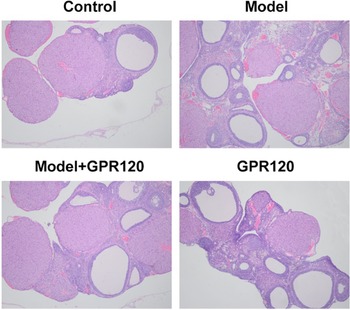
To investigate whether administration of a GPR120 agonist could improve the ovary of PCOS rats, H&E staining was performed to detect ovary tissues. In the control group, follicles at all levels could be seen everywhere and the structure was normal, and without lesions. In the model group, there were a large number of cystic dilated follicles in which oocytes or radiating crowns disappeared, interstitial cells proliferated and the number of ovarian granulosa cell layers decreased. In contrast, GPR120 agonist treatment decreased the number of cystic follicles. In addition, mature follicles with cumulus and various follicles were also present in PCOS rats after GPR120 agonist treatment (Figure 3).
GPR120 agonist improved ovarian function in PCOS rat model. The ovary pathology was detected using haematoxylin and eosin staining. Magnification: ×40.

GPR 120 agonist regulates lipid metabolism in the liver of PCOS rat model
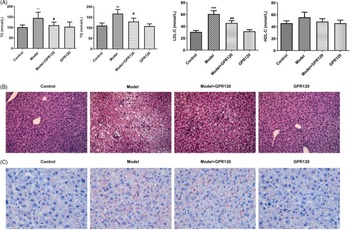
As Figure 4(A) depicts, the levels of TC, TG, HDL-C and LDL-C increased markedly in the model group compared with the control. Nevertheless, it was noted that the GPR120 agonist downregulated the levels of TC, TG, HDL-C and LDL-C, revealing that the GPR120 agonist exhibited inhibitory effects on these rats.
GPR120 agonist regulates the lipid metabolism in the liver of PCOS rat model. (A) Blood lipid levels. (B) Pathological changes of liver tissues were evaluated using haematoxylin and eosin staining. Magnification: ×200. (C) Lipid accumulation in liver tissues was detected using oil red staining. Magnification: ×400. Data are shown as mean ± standard deviation (SD). n = 10. **P < 0.01, ***P < 0.001 vs control. ## P < 0.01 vs model + GPR120. TC, total cholesterol; TG, triglyceride; LDL-C, low-density lipoprotein cholesterol; HDL-C, high-density lipoprotein cholesterol.

Additionally, results from H&E staining demonstrated that the hepatocyte cords were arranged radially and neatly without obvious inflammatory cell infiltration in the control (Figure 4B). However, in the model group, hepatocyte cord arrangement was disordered, bullae steatosis was obvious, collagenous fibres in portal area had proliferated and extended into lobules, and many inflammatory cells had infiltrated. It was also found that hepatocyte steatosis was significantly reduced in GPR120 agonist-treated PCOS rats with scattered inflammatory cells, in contrast with the model group. Lipid formation in the liver was observed using oil red staining. As shown in Figure 4(C), there was a large quantity of lipid formation in PCOS rats, which was then improved by GPR120 agonist administration. We also observed that there was no obvious difference between the control group and the GPR120 group.
Discussion
PCOS is a highly heterogeneous endocrine disorder common in women of childbearing age, and patients living with PCOS feature obvious IR (Fruzzetti et al., Reference Fruzzetti, Perini, Russo, Bucci and Gadducci2017). In the present study, we found that GPR120 levels were downregulated in the plasma, liver and ovary of the PCOS model. In addition, the GPR120 agonist regulated lipid metabolism in the liver and the weight of PCOS rats. What is more, the GPR120 agonist was confirmed to inhibit the levels of IR in the PCOS rat model, but improve the ovarian function.
Previous studies have shown that the functional loss of GPR120, which is activated by receptors of long-chain fatty acids, is closely related to many metabolic diseases (Cox et al., Reference Cox, Chu, Chelliah, Debenham, Eagen, Lan, Lombardo, London, Plotkin, Shah, Sun, Vaccaro, Venkatraman, Suzuki, Wang, Ashley, Crespo, Madeira and Leung2017; Zhang and Macielag, Reference Zhang and Macielag2020). GPR120 has been also reported to regulate lipid and/or glucose metabolism (Zhang and Macielag, Reference Zhang and Macielag2020). We administrated PCOS rats with GPR120 agonist and found decreased IR and lipid formation in the liver, suggesting that GPR120 played a protective role in PCOS. Indeed, the GPR120 agonist markedly reduced testosterone, but significantly elevated LH and FSH levels, which suggested that GPR120 directly or indirectly affected the levels of these hormones and improved ovary pathology of PCOS rats. This indicated that GPR120 altered the synthesis and/or secretion of gonadotropic hormones to play a role in affecting gonadal function.
In summary, the present study revealed that a GPR120 agonist improved IR and serum lipid levels, affected gonadal function, as well as ameliorated liver and ovary pathology. These results demonstrated that GPR120 could be a potential target for PCOS therapy. Understanding the action mechanisms of GPR120 in PCOS will open new windows for the further investigation of pathogenic mechanisms in PCOS and the development of potential therapeutic strategies against PCOS.
Acknowledgements
Not applicable.
Authors’ contributions
All authors have made substantial contributions to the conception and design of the study, performed the experiments, interpreted the data and drafted and revised the manuscript for important intellectual content and confirm the authenticity of the raw data. All authors have read and approved the final manuscript.
Funding support
The study was supported by Nantong Science and Technology Project (MS12019003); Nantong University Clinical Medicine Project (2019JQ014), and the Nantong Health and Family Planning Commission Science Project (WKZL2018074).
Availability of data and materials
The datasets used and/or analyzed during the current study are available from the corresponding author on reasonable request.
Ethics approval and consent to participate
Not applicable.
Consent for publication
Not applicable.
Competing interests
None declared.