


1. Introduction
Degree achievement sentences describe events that involve a change in values on a scale (Hay et al. Reference Hay, Kennedy, Levin, Matthews and Strolovitch1999, Kennedy & Levin Reference Kennedy, Levin and Kennedy2008, Piñón Reference Piñón and Kennedy2008, Rothstein Reference Rothstein, Dölling, Heyde-Zybatow and Schäfer2008a). They either specify a change of state in a particular direction (e.g., widen, harden, dim, cool), or a motion in a particular direction (e.g., descend, rise, fall) (Levin & Rappaport Hovav Reference Levin and Malka Rappapport1995: 172–173).Footnote 2 An example is given in (1).
(1) The soup cooled.
They differ from regular achievement sentences, where the change events described are not a change in values on a scale, but instead are a change from a situation in which α holds to a situation in which ¬α holds (Rothstein Reference Rothstein, Dölling, Heyde-Zybatow and Schäfer2008a: 193). One special characteristic of degree achievement sentences is that they can be either telic or atelic (Dowty Reference Dowty1979: 88; Abusch Reference Abusch1985; Levin & Rappaport Hovav Reference Levin and Malka Rappapport1995; Hay et al. Reference Hay, Kennedy, Levin, Matthews and Strolovitch1999; Rothstein Reference Rothstein, Dölling, Heyde-Zybatow and Schäfer2008a). In English, they may appear with a for temporal adverbial or an in temporal adverbial; the former are atelic while the latter are telic.
- (2)
(a) The soup cooled for hours.
(b) The soup cooled in half an hour. (Rothstein Reference Rothstein, Dölling, Heyde-Zybatow and Schäfer2008a: 191)
One issue in the analysis of degree achievements is whether or not what are called degree achievements are in fact achievements or, more specifically, whether or not they have properties of achievements, in addition to properties of activities and accomplishments (Hay et al. Reference Hay, Kennedy, Levin, Matthews and Strolovitch1999, Kearns Reference Kearns2007, Rothstein Reference Rothstein, Dölling, Heyde-Zybatow and Schäfer2008a). In this paper, we provide support for the claim that degree achievements are lexically specified as achievements (Kearns Reference Kearns2007, Rothstein Reference Rothstein, Dölling, Heyde-Zybatow and Schäfer2008a, contra Hay et al. Reference Hay, Kennedy, Levin, Matthews and Strolovitch1999). Our evidence comes from a close study of the verbal prefix meN- in Malay and its aspectual effect on degree achievement sentences.Footnote 3 The variety of Malay investigated in this paper is Standard Formal Malay used in Malaysia. We argue that meN-'s aspectual effect on degree achievement sentences can receive a natural account under an approach to degree achievements where they are lexically specified as achievements, but is difficult to explain if they are not.
Despite extensive study, the status of the verbal prefix meN- has remained controversial. The difficulty with the analysis of meN- has to do with the fact that its semantic contribution is difficult to detect, especially in transitive sentences and in some intransitive sentences (see Soh & Nomoto Reference Soh and Hiroki2009). For example, there does not appear to be any meaning difference between the transitive sentences in (3).
- (3)
(a) Saya sudah baca buku itu.
1sg perf read book that
‘I have read that book.’
(b) Saya sudah mem-baca buku itu.
1sg perf meN-read book that
‘I have read that book.’
Some Malay speakers have noted that transitive meN- sentences like (3b) above describe events that are more ‘in progress’ than sentences like (3a), without meN- (Soh & Nomoto Reference Soh and Hiroki2009). However, not all speakers share this intuition. Another difficulty with the analysis of meN- is a prescriptive rule that requires that meN- be used in the formal variety. This leads to some reports in the literature that sentences without meN- are unacceptable in Formal Malay. While we recognize the existence of such a prescriptive rule, we want to emphasize that both the meN- and the bare verbal forms occur in the written as well as the spoken form of the formal variety (see Soh & Nomoto Reference Soh and Hiroki2009).
Most previous work on meN- has focused on the use of meN- in transitive sentences, with less attention on the use of meN- in intransitive sentences. Although meN- is often assumed to be an active voice marker (e.g., Chung Reference Chung and Li1976, Nomoto & Shoho Reference Nomoto, Shoho, Kawaguchi, Takagaki, Tomimori and Tsuruga2007, Son & Cole Reference Son and Cole2008), it has also been analyzed as an agentive marker (e.g., Gil Reference Gil, Wouk and Ross2002), a transitive marker (e.g., Chung Reference Chung and Li1976, Cole & Hermon Reference Cole and Hermon1998), a Case assigner (Guilfoyle, Hung & Travis Reference Guilfoyle and Hung1992) or a Case recipient (Voskuil Reference Voskuil and Reesink1993), an anti-passive marker (Fortin, in press) and a subject agreement marker (e.g., Cole et al. Reference Cole, Hermon and Yanti2008). In Soh & Nomoto (Reference Soh and Hiroki2011), focusing in particular on the use of meN- in intransitive sentences, we claim that meN- (in both transitive and intransitive sentences) is associated with the existence of an external argument, which need not be an agent.
In the present paper, we focus on the occurrence of meN- in degree achievement sentences. We show that the presence of meN- constrains the interpretation of degree achievement predicates so that they can only have an atelic interpretation. This effect is not found in non-degree achievement sentences. These findings lead us to a refinement of the analysis of the verbal prefix meN- in Malay. Assuming that meN- is a v (light verb) (Aldridge Reference Aldridge2008; Nomoto Reference Nomoto2008, Reference Nomoto, Nomoto, Ahmad and Ridhwan2011; Sato Reference Sato2012), we propose that it merges with a verbal projection (VP) that describes eventualities with stages, in the sense of Landman (Reference Landman1992, Reference Landman2008). This requirement explains meN-'s apparent effect on telicity in degree achievement sentences, and the absence of such an effect in non-degree achievement sentences. It also accounts for the restricted distribution of meN- in stative sentences (Soh & Nomoto Reference Soh and Hiroki2009). Our proposal predicts that the occurrence of meN- should also be restricted in regular (non-degree) achievement sentences. We show that this prediction is borne out. While our analysis suggests certain parallels between the verbal prefix meN- and the English progressive in their aspectual properties, we argue that meN- is not a progressive marker. Rather, the similarities with the progressive are due to the subcategorization requirement of meN-, which has the effect of making event stages more prominent than sentences without meN-. Noting the parallel between meN- and English do with respect to their aspectual restrictions, we argue in support of the treatment of meN- as v, rather than Voice (Cole et al. Reference Cole, Hermon and Yanti2008).
This paper is organized as follows: In Section 2, we present the aspectual effect of meN- in degree achievement and non-degree achievement sentences. The discussion focuses on degree achievement sentences specifying directed motion. This is because these sentences may contain bare verbal forms, as well as the meN- verbal forms, allowing the aspectual effect of meN- to be established. In Section 3, we present our account for the effect. In Section 4, we consider degree achievement sentences specifying a change of state in a particular direction, which is usually formed by the prefix meN- and an adjective root. We show that they pattern similarly to degree achivements specifying directed motion in their essentials, but with a difference. We offer an account for the difference between these two types of degree achievements. In Section 5, we consider predictions of our analysis regarding the occurrence of meN- in sentences of different situation types, and show that they are borne out. In Section 6, we discuss implications of our analysis for the treatment of degree achievements and for whether or not meN- is a progressive aspect marker. We also consider how the current analysis relates to previous work on meN-, in particular on analyses of meN- as v versus Voice. The conclusions are given in Section 7.
2. The problem
2.1 Degree achievement sentences specifying directed motion in Malay
Degree achievement sentences in Malay specifying a motion in a particular direction may be expressed by verbs such as turun ‘fall’ and naik ‘rise’. An example with the verb turun is given in (4).
(4) Harga minyak turun.
price oil fell
‘The oil price fell.’
The counterpart of the for/in test of telicity in Malay is the selama/dalam test. A selama phrase is compatible only with an atelic predicate while a dalam phrase is compatible only with a telic predicate. This is shown in (5) and (6).
- (5)
(a) Dia berlari selama 10 minit.
3sg run for 10 minute
‘S/he ran for 10 minutes.’
(b) *Dia berlari dalam masa 10 minit.Footnote 4
3sg run in time 10 minute
The predicate in (5) is atelic, and a selama phrase is compatible with it, but a dalam phrase is not.
- (6)
(a) *Dia berlari 100 meter selama 10 minit.
3sg run 100 meter for 10 minute
(b) Dia berlari 100 meter dalam masa 10 minit.
3sg run 100 meter in time 10 minute
‘S/he ran 100 meters in 10 minutes.’
On the other hand, the predicate in (6) is telic. A selama phrase is not compatible with it, but a dalam phrase is. Note that as with the English for/in test of telicity, the results of the selama/dalam test are not absolute, in that the sentence with an incompatible test phrase may be an acceptable sentence, but not with the intended interpretation (Borik Reference Borik2006: 23). The acceptability judgments indicated here with the test phrase are for the intended readings.
As shown in (7), degree achievements may appear with a selama phrase or a dalam phrase, indicating that they may be either telic or atelic.
- (7)
(a) Harga minyak turun selama tiga hari.
price oil fall for three day
‘The oil price fell for three days.’
(b) Harga minyak turun dalam tiga hari.
price oil fall in three day
‘The oil price fell in three days.’
Degree achievement sentences expressing directed motion in Malay thus pattern like ones in English in exhibiting both telic and atelic interpretive possibilities.
2.2 MeN- in directed motion degree achievement sentences
Interestingly, the presence of the verbal prefix meN- in degree achievement sentences expressing directed motion has an effect such that these sentences can only receive atelic interpretations, but not telic ones. This is shown in (8), where the degree achievement sentence with meN- is compatible with a selama phrase, but not with a dalam phrase.
- (8)
(a) Harga minyak men-[t]urun selama tiga hari.Footnote 5
price oil meN-fall for three day
‘The oil price was falling for three days.’
(b) *Harga minyak men-[t]urun dalam tiga hari. (compare (7b))
price oil meN-fall in three day
Further support for meN-'s effect comes from another test of telicity, which involves whether the sentence may appear in a frame of the form take x time to. The Malay counterpart of this frame is mengambil masa x untuk. The frame is restricted to telic predicates as shown in (9).
- (9)
(a) *Dia (hanya) meng-ambil masa 10 minit untuk berlari.Footnote 6
3sg only meN-take time 10 minute to run
(b) Dia (hanya) meng-ambil masa 10 minit untuk berlari 100 meter.
3sg only meN-take time 10 minute to run 100 meter
‘S/he only took 10 minutes to run 100 meters.’
Degree achievements with meN- are atelic as they cannot appear with the mengambil masa x untuk ‘take x time to’ frame as shown in (10a). This is in contrast to degree achievement sentences without meN-, an example given in (10b), which may appear with the relevant frame.
- (10)
(a) *Harga minyak meng-ambil masa tiga bulan untuk men-[t]urun.
price oil meN-take time three month to meN-fall
(b) Harga minyak meng-ambil masa tiga bulan untuk turun.
price oil meN-take time three month to fall
‘The oil price took three months to fall.’
Additional support for the claim that degree achievements with meN- are atelic comes from native speakers' intuition about the contrast in interpretation between (11a) and (11b).
- (11)
(a) Harga minyak turun.
price oil fall
‘The price of oil fell.’
(b) Harga minyak men-[t]urun.
price oil meN-fall
‘The price of oil was falling.’
While (11a) implies a fall in oil price from x to y, (11b) implies a fall with stages, e.g., from x to y to z.
2.3 MeN- in non-degree achievement sentences and degree achievement sentences with a measure phrase
Unlike degree achievement sentences, the presence of meN- in non-degree achievement sentences does not make the predicates atelic, as evidenced by their compatibility with a dalam phrase, shown in (12b).
- (12)
(a) Dia tanam tiga batang pokok dalam masa satu jam.
3sg plant three clf tree in time one hour
‘S/he planted three trees in an hour.’
(b) Dia men-[t]anam tiga batang pokok dalam masa satu jam.
3sg meN-plant three clf tree in time one hour
‘S/he planted three trees in an hour.’
This is in contrast to degree achievement sentences, where the presence of meN- is incompatible with a dalam phrase:
- (13)
Degree achievement sentences with a measure phrase pattern like non-degree achievement sentences. The prefix meN- may appear even though the sentence receives a telic interpretation.
- (14)
(a) Harga minyak turun dua dolar dalam tiga hari.
price oil fall two dollar in three day
‘The oil price fell two dollars in three days.’
(b) Harga minyak men-[t]urun dua dolar dalam tiga hari.Footnote 7
price oil meN-fall two dollar in three day
‘The oil price fell two dollars in three days.’
The pattern above suggests that meN-'s telicity effect is not a general one, but rather one that is restricted to degree achievement sentences, in particular ones without a measure phrase.
3. The proposal
In this section, we present an account of meN-'s effect on the telicity of degree achievement sentences and the lack of such an effect in non-degree achievement sentences and degree achievement sentences with a measure phrase. Our account relies on Rothstein's treatment of degree achievements, which makes use of the notion of ‘atomic events’ or minimal events, as well as Landman's (Reference Landman1992, Reference Landman2008) notion of event stages. These two notions will be reviewed in Section 3.1 below.
3.1 Assumptions
3.1.1 Rothstein's (Reference Rothstein, Dölling, Heyde-Zybatow and Schäfer2008a, Reference Rothsteinb) analysis of degree achievements
According to Rothstein, degree achievements may describe an event that consists of a single ‘atomic event’ or an event that consists of a sum of multiple ‘atomic events’. An event that consists of a single atomic event is a minimal event, while an event that consists of a sum of multiple atomic events is a non-minimal event. The distinction between a minimal and a non-minimal event is schematically represented in (15), where the symbol □ signals an atomic event and the bold rectangle signals a single event.
- (15)
(a) A minimal event

(b) A non-minimal event


Thus, fall may describe an event that consists of a minimal falling event (= minimal event) or an event that consists of multiple occurrences of minimal falling events, with each fall a development of a previous one (= non-minimal event). In Rothstein's system, non-minimal events are derived from minimal ones by the application of the semantic operation ‘S-summing’ (which stands for singular-summing), defined in (16). The operation sums two temporally overlapping events and forms a new single event (Rothstein Reference Rothstein, Dölling, Heyde-Zybatow and Schäfer2008a, Reference Rothsteinb).
(16) S-sum V (= the S-sum operation in the verbal domain)
∀e,e′: P(e) ∧ P(e′) ∧ R(e,e′): S-sum(e,e′) → P(S(e⊔e′))
For any two events e and e′ in the denotation P which stand in the R relation, S-sumV applied to e and e′ yields a singular event formed out of the sum of e and e′ and which is also in the denotation P.
R denotes a temporal overlap relation between the two events.
(Rothstein Reference Rothstein2008b: 46)
Rothstein develops an account of the telic/atelic distinction in terms of atomicity, where telic predicates denote sets of atomic events. ‘A predicate P is telic if it has as part of its lexical content the information about what counts as one instance of P, in other words if the invidividual countable units of P are given independent of context, and if we can count, independent of context, how many individuals there are in P’ (Rothstein Reference Rothstein, Dölling, Heyde-Zybatow and Schäfer2008a: 189). With telic predicates, information on what counts as one instance of P can be fully given by the meaning of the verb (e.g., arrive), or provided by the verb in combination with other materials within the verb phrase (e.g., run a mile). The former predicates are naturally atomic.
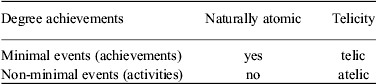
Given this, the predicate fall that describes a minimal event is telic because it is naturally atomic, with a clearly defined beginning and end point as given by the meaning of the verb. The predicate fall that describes a non-minimal event is atelic because what counts as one instance of a non-minimal falling event is not given by the meaning of the predicate that has undergone the S-summing operation. Thus, ‘degree achievements’ are achievements with respect to their minimal event interpretations (telic), and activities with respect to their non-minimal event interpretations (atelic), as summarized in (17).
(17) The relation between two interpretations of degree achievements and telicity
3.1.2 Landman's (Reference Landman1992, Reference Landman2008) notion of event stages
In addition to Rothstein's (Reference Rothstein, Dölling, Heyde-Zybatow and Schäfer2008a, Reference Rothsteinb) analysis of degree achievements, our account also relies on Fred Landman's notion of event stages. According to Landman (Reference Landman1992), a stage of an event is a special kind of part of that event:
An event is a stage of another event if the second can be regarded as a more developed version of the first, that is, if we can point at it and say “It's the same event in a further stage of development.” Thus, not every part of e at an interval is a stage of e; to be a stage, a part has to be big enough and share enough with e so that we can call it a less developed version of e. (Landman Reference Landman1992: 23)
The relation ‘stage of’ (≼e) is defined as in (18):
(18) Stages (= cross-temporal subevents) (Landman Reference Landman2008: 116)
≼e: = λe 2λe 1.e 1 ⊑ e 2 ∧ e 1 ~ e 2
An event e 1 is a stage of another event e 2 iff e 1 is a part of e 2 and the two events are cross-temporally identical (represented by ~ above). Cross-temporal identity is concerned with what one counts as the same event in a particular context for expressing how often something happened. To illustrate with an example from Landman (Reference Landman2008: 114) of a person who ran from 2 to 3 pm one day, this person's running activity from 2:00 to 2:15 and his running activity from 2:45 to 3:00 are part of his running activity from 2 to 3 pm. Though these three running activities have different running times, they do not count as different runnings because they are considered part of the same running event. Thus, events that are cross-temporally identical may have different running times, but are considered the same event. Landman (Reference Landman2008) develops the notion of ‘stages’ further, making a distinction between the stage-of relation and the i-stage-of relation, with the former defined segmentally and the latter incrementally. i-stages are event parts with the same initial point, and they are cross-temporally identical. Thus in the running example above, the person's running activity from 2:00 to 2:15 and from 2:00 to 2:30 are i-stages of his running activity from 2:00 to 3:00. In this paper, we adopt the conception of stages where e is a stage of e′ if e′ is a development of e and we use the term ‘stages’ to refer to ‘i-stages’.
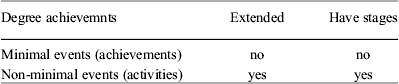
As Rothstein (Reference Rothstein, Dölling, Heyde-Zybatow and Schäfer2008a) notes, eventualities that have stages are inherently extended in time. Achievements do not have stages (Rothstein Reference Rothstein, Dölling, Heyde-Zybatow and Schäfer2008a). This is because achievements are events of instantaneous change from α to ¬α, and thus consist of two instants, the last instant at which α holds and the first instant at which ¬α holds. They are not extended because there is no interval intervening between their initial and final instants and are thus not naturally divisible into stages. On the other hand, activities, which are extended in time, have stages (Landman Reference Landman1992). Given this, the two conceptions of degree achievements have the properties summarized in (19).
(19) Degree achievements, extended events and the stage property
3.2 Explaining meN-'s apparent effect on telicity
Assuming that meN- is v (Aldridge Reference Aldridge2008; Nomoto Reference Nomoto2008, Reference Nomoto, Nomoto, Ahmad and Ridhwan2011; Sato Reference Sato2012), we propose that it requires the verbal projection it merges with (VP) to denote a set of eventualities with stages, in the sense of Landman (Reference Landman1992, Reference Landman2008). This constraint on the semantics for meN- is given in (20).Footnote 8
(20) Stage requirement of meN-
*[vPmeN- [VP[−stages] ]]
Following Rothstein (Reference Rothstein, Dölling, Heyde-Zybatow and Schäfer2008a, Reference Rothsteinb), we assume that turun ‘fall’ in Malay may describe an event that consists of a minimal falling event (= minimal event) or an event that consists of multiple occurrences of minimal falling events, with each fall a development of a previous one (= non-minimal event). Because the minimal event of a degree achievement is an achievement, which is without stages, and the non-minimal event of a degree achievement is an activity, which has stages, meN- is compatible only with the non-minimal event interpretation of the degree achievement sentence. The non-minimal event interpretation of degree achievements is atelic. This explains why degree achievement sentences with meN- are incompatible with a dalam ‘in’ phrase, as shown in (21b).
- (21)
Under our analysis, meN- does not have an effect on the telicity of the predicate. The effect on telicity is only apparent, due to meN-'s requirement that it merge with a verbal projection describing an eventuality with stages. In degree achievements, only the non-minimal event interpretation of the sentence can be characterized as having stages. Because degree achievements describing non-minimal events are atelic, meN- gives the appearance that it affects the telicity of the sentence. Our analysis is summarized in (22).
(22) Summary

4. Degree achievement sentences specifying a change of state in Malay
Unlike degree achievements specifying directed motion, degree achievements specifying a change of state in a particular direction are usually formed in Malay with the prefixation of meN- to gradable adjectives, as in kuning ‘yellow’ > meng-[k]uning ‘becoming yellow’, besar ‘big’ > mem-besar ‘becoming big’ and kering ‘dry’ > meng-[k]ering ‘becoming dry’ (Soh & Nomoto Reference Soh and Hiroki2009). An example with kuning ‘yellow’ is given below.Footnote 9
- (23)
(a) Kertas ini kuning.
paper this yellow
‘This piece of paper is yellow.’
(b) Kertas ini meng-[k]uning.
paper this meN-yellow
‘This piece of paper is yellowing.’
Without the prefix meN-, the sentence expresses a state, rather than an event. This contrast in the aspectual classification of the sentences with and without meN- is evidenced by their ability to appear with the adverb perlahan-lahan ‘slowly’. The sentence containing the bare adjective may not appear with the adverb perlahan-lahan, while the one with meN- may.Footnote 10
- (24)
(a) (*)Daun-daun yang awalnya hijau perlahan-lahan kuning.
leaf.pl rel earlier green slowly yellow
(b) Daun-daun yang awalnya hijau perlahan-lahan meng-[k]uning.
leaf.pl rel earlier green slowly meN-yellow
‘Leaves that were green earlier are slowly yellowing.’
Degree achievements specifying a change of state formed with the prefix meN- pattern like ones specifying directed motion with the prefix meN- in their ability to appear with a selama ‘for’ phrase as shown below.
- (25)
(a) Daun meng-[k]uning selama tiga hari.
leaf meN-yellow for three day
‘The leaves were yellowing for three days.’
(b) Sungai itu meng-[k]ering selama satu bulan.
river that meN-dry for one month
‘The river was drying up for a month.’
However, unlike degree achievement sentences specifying directed motion, degree achievement sentences with the prefix meN- that specify a change of state in a particular direction appear more readily with a dalam ‘in’ phrase (Tham Reference Tham2010).
- (26)
(a) Daun meng-[k]uning dalam tempoh tiga hari.
leaf meN-yellow in period three day
‘The leaves turned yellow in three days.’
(b) Sungai itu meng-[k]ering dalam masa satu bulan.
river that meN-dry in time one month
‘The river turned dry in a month.’
Although it is true that change of state degree achievements allow a telic interpretation more readily than directed motion degree achievements, we suggest that the atelic reading remains the core meaning associated with these degree achievements. Consider more closely the interpretation of these sentences using the example in (27).
(27) Bibir-nya mem-biru dalam masa 30 minit.
lip-3sg meN-blue in time 30 minute
‘His lips started to turn/turned blue in 30 minutes.’
Speakers accept the sentence with the interpretation that the process of the lips changing to blue starts within 30 minutes and is likely to continue after 30 minutes. Although it is possible that the change is completed within 30 minutes, this is not necessary. That a prominent reading associated with the sentence is an atelic one is further supported by the contrast in (28) below between mem-biru ‘meN-blue’ and menjadi biru ‘become blue’; the latter is telic (see Abusch (Reference Abusch1985: 62) for discussion on the counterparts of these predicates in English).
- (28)
(a) Bibir-nya meng-ambil masa satu jam untuk mem-biru.
lip-3sg meN-take time one hour to meN-blue
‘His lips took an hour to turn blue/to start to turn blue’
(b) Bibir-nya meng-ambil masa satu jam untuk men-jadi biru.
lip-3sg meN-take time one hour to meN-become blue
‘His lips took an hour to become blue.’
Assuming that the lip color went from red to purple and then to blue, sentence (28a) is an accurate description of a situation where the lips were purple at the end of the hour, while (28b) is not. Thus, in (28a) at the end of the hour, the lips need only to have started the process of turning to blue, while in (28b) the lips must have finished the process.
Why do these two types of degree achievements differ in their ability to appear in test sentences sensitive to telicity if both of them are atelic? We suggest that the difference is related to how degree achievements specifying a change of state are derived (see Tham Reference Tham2010).Footnote 11 We propose the following structure for degree achievements involving a change of state in a particular direction using membiru ‘meN- + blue’ as an example:
(29) [vP meN- [VP V [AP biru]]]
We suggest that there are two possible derivations for membiru as a degree achievement shown in (30).
- (30)
(a) [vP meN- [VP [V-A biru] [AP <biru>]]]
(b) [vP meN- [VP [V <jadi>] [AP biru]]]
In (30a), the adjective raises to V. In (30b), the adjective remains in its base merged position with a null jadi ‘become’ occupying the V position (see Richards Reference Richards2010). This null jadi is semantically identical to the jadi in (28b). The structure in (30a) exhibits properties comparable to directed motion degree achievements. The VP in (30a) is a degree achievement that denotes a set of instantaneous changes, where the entity undergoing the change is assigned a value on a color scale that is higher than the original value assigned, assuming that the higher value more closely approximates the color blue. S-summing may apply to yield an activity. The prefix meN- is compatible only with the activity interpretation, which has stage properties. The structure in (30b) is the one associated with the telic interpretation of membiru. The difference between directed motion degree achievements and change of state degree achievements lies in the absence of the comparable structure in (30b) for directed motion degree achievements. The example in (31a) below is unacceptable. Correspondingly, neither the structure in (31b) with an overt jadi nor the structure in (31c) with a null jadi is available. The unavailability of (31b) and (31c) is due to the fact that jadi ‘become’, whether overt or null, does not take a VP complement.Footnote 12
- (31)
(a) *Harga minyak men-jadi turun.
price oil meN-become fall
(b) [vP meN- [VP [V jadi] [VP turun]]]
(c) [vP meN- [VP [V <jadi>] [VP turun]]]
The absence of either structure accounts for the lack of a telic interpretation in directed motion degree achievements with meN-.
5. Predictions and explantions
Our analysis predicts that meN- may occur in sentences that describe activities and accomplishments, and may not occur in sentences that describe states and (non-degree) regular achievements. This is because activities and accomplishments have stages while states and regular achievements do not. The predictions are summarized in (32).
(32) Predictions with respect to the occurrence of meN- in other situation types

In the rest of this section, we will show that these predictions are borne out.
5.1 MeN- in activity and accomplishment sentences
It is easy to see that the predictions regarding the presence of meN- in sentences that describe activities and accomplishments are borne out. Most meN- sentences are of these two types. Examples are given in (33).
- (33)
(a) Aminah sedang me-nyanyi.
Aminah currently meN-sing
‘Aminah is singing now.’
(b) Dia telah men-[t]anam tiga batang pokok.
3sg perf meN-plant three clf tree
‘S/he planted three trees.’
Activities have stages. A singing event e may have a subevent e′ which is itself a singing event but a less developed stage of e. Thus, the VP of (33a), shown below, denotes eventualities with stages, and hence can occur with meN-.
(34) [vP [v meN-] [VP[+stages] nyanyi]] (activity)
An accomplishment event consists of an activity part and a result part (Dowty Reference Dowty1979). For example, the event described by the accomplishment sentence in (33b), involving his planting of three trees, consists of the planting activity and the result of three trees having been planted. Since activities have stages, accomplishments, which contain them, also have stages. Thus, the VP in (33b), shown below, denotes eventualities with stages, enabling it to occur with meN-.
(35) [vP [v meN-] [VP[+stages] tanam tiga batang pokok]] (accomplishment)
Note that meN- does not have a direct effect on telicity as it may occur in a sentence with a telic interpretation, as in (36).
(36) Dia men-[t]anam tiga batang pokok dalam masa satu jam. (= (12b))
3sg meN-plant three clf tree in time one hour
‘S/he planted three trees in an hour.’
The fact that meN-'s apparent effect on telicity is found only in degree achievement sentences, but not in non-degree achievement sentences and degree achievement sentences with a measure phrase, suggests that meN- does not change the predicate's stage property to fit the stage requirement, but rather it selects only for predicates with stages. Because degree achievements may denote minimal events ([–stages]) or non-minimal events ([+stages]), the selection of predicates with stages gives the illusion that meN- affects telicity since degree achievement predicates that are [–stages] are telic, while degree achievement predicates that are [+stages] are atelic.
5.2 MeN- in stative sentences
The prediction that meN- should be absent in sentences that describe states is also borne out. In Soh & Nomoto (Reference Soh and Hiroki2009), we argue that the prefix meN- cannot occur in stative sentences. Examples showing that meN- does not appear in stative sentences are given below.
- (37)
(a) Mereka suka masakan Jepun.
3pl like cuisine Japan
‘They like Japanese cuisine.’
(b) *Mereka meny-[s]uka masakan Jepun.
3pl meN-like cuisine Japan
- (38)
(a) Ali hormat cikgu-nya.
Ali respect teacher-3sg
‘Ali respects his/her teacher.’
(b) *Ali meng-hormat cikgu-nya.
Ali meN-respect teacher-3sg
There are, however, two classes of apparent counter-examples to this generalization, namely (i) ‘stative’ meN- verbs with the applicative suffix -i and (ii) mental ‘state’ verbs. Examples are given in (39) and (40), respectively.
- (39)
(a) Mereka meny-[s]uka-i masakan Jepun.
3pl meN-like-i cuisine Japan
‘They like Japanese cuisine.’
(b) Ali meng-hormat-i cikgu-nya.
Ali meN-respect-i teacher-3sg
‘Ali respects his/her teacher.’
- (40)
(a) Mereka meng-anggap dia orang yang tidak boleh di-harap.
3pl meN-consider 3sg person rel not can pass-hope
‘They considered him/her to be a person who cannot be depended on.’
(b) Dari tadi dia men-duga bahawa perkara itu akan berlaku.
from just.now 3sg meN-suspect that incident that will happen
‘S/he has suspected that the incident will happen since just now.’
Although these sentences appear to be descriptions of states and are acceptable with meN-, we argue in Soh & Nomoto (Reference Soh and Hiroki2009) that they are in fact descriptions of events rather than states, on the basis of several tests that distinguish events from states.Footnote 13 For example, one of the tests involves the adverb perlahan-lahan ‘slowly’, which may appear in eventive but not stative sentences. The test applied below indicates that the sentence with the meN- -i ‘stative’ verbal form is eventive, unlike the sentence with a bare stative verb.
- (41)
(a) Ali belajar meny-[s]uka-i sekolah baru-nya perlahan-lahan.
Ali learn meN-like-i school new-3sg slowly
‘Ali is learning to like his new school slowly.’
(b) *Ali belajar suka sekolah baru-nya perlahan-lahan.
Ali learn like school new-3sg slowly
The same test shows that the sentence with the mental ‘state’ verb prefixed with meN- is eventive, in contrast to the sentence with a bare mental ‘state’ verb.
- (42)
(a) Perlahan-lahan dia meng-anggap/*anggap teori itu
slowly 3sg meN-consider/consider theory that
berkemungkinan tidak betul.
probably not correct
‘S/he gradually started to think that the theory may be wrong.’
(b) Perlahan-lahan mereka meny-[s]angka/*sangka mereka di-pedaya
slowly 3pl meN-think/think 3pl pass-cheat
oleh-nya.
by-3sg
‘They gradually started to suspect that they had been cheated by him/her.’
Given this and other tests, we conclude that the presence of meN- in these two classes of sentences does not present a problem for the generalization that meN- does not appear in stative sentences.
The restricted distribution of meN- in stative sentences provides support for our current analysis. States do not have stages (Landman Reference Landman1992, Reference Landman2008; Rothstein Reference Rothstein, Dölling, Heyde-Zybatow and Schäfer2008a). This is because states are homogeneous down to instants. A state cannot be a stage of another state because the second state cannot be regarded as a more developed version of the first, as it is not qualitatively different from the first (Rothstein Reference Rothstein, Dölling, Heyde-Zybatow and Schäfer2008a). Thus, the VP in (37b) above, for example, lacks stages, and hence cannot occur with meN-, unless the VP presents a durative event, when the same verb bears the suffix -i, as in (37a). Their structures are as follows:
- (43)
(a) *[vP [v meN-] [VP[−stages] suka masakan Jepun]] (state)
(b) [vP [v meN-] [VP[+stages] suka-i masakan Jepun]] (activity)
For the class of mental ‘state’ verbs such as anggap ‘consider’ and sangka ‘think’, we assume the existence of a null suffix parallel to the suffix -i, whose presence is associated with activities. The presence of this suffix is licensed by meN-.Footnote 14MeN- may merge with these verb phrases because they describe activities, which have stages.
5.3 MeN- in regular achievement sentences
In this section, we show that, as our analysis predicts, the prefix meN- is also restricted in sentences that describe regular achievements (i.e., non-degree achievements). Achievement verbs in Malay include sampai ‘arrive’, mula ‘begin’, sedar ‘realize’, tahu ‘know/find out’ and mati ‘die’. These verbs can be modified by point adverbs such as pada pukul 8.15 pagi ‘at 8:15 am’, as shown in (44).Footnote 15
- (44)
(a) Bas sampai pada pukul 8.15 pagi.
bus arrive at o'clock 8:15 morning
‘The bus arrived at 8:15 am.’
(b) Kelas biasanya mula pada pukul 8.15 pagi.
class usually begin at o'clock 8:15 morning
‘Classes usually start at 8:15 am.’
(c) Mereka sedar bahawa mereka telah tertipu pada pukul 8.15
3pl realize that they perf cheated at o'clock 8:15
pagi.
morning
‘They realized that they were cheated at 8:15 am.’
(d) Mereka tahu hal itu pada pukul 8.15 pagi.
3pl find.out matter that at o'clock 8:15 morning
‘They found out about the matter at 8:15 am.’
(e) Ali mati pada pukul 8.15 pagi.
Ali die at o'clock 8:15 morning
‘Ali died at 8:15 am.’
Also as expected, these achievement verbs may not appear with a selama ‘for’ phrase, with the temporal phrase specifying the duration of the events, given that the situations described are instantaneous.Footnote 16
- (45)
(a) *Bas sampai selama 5 minit.
bus arrive for 5 minute
(b) *Kelas biasanya mula selama 5 minit.
class usually start for 5 minute
(c) *Mereka sedar bahawa mereka telah tertipu selama 5 minit.
3pl realize that 3pl perf cheated for 5 minute
(d) *Mereka tahu hal itu semalam selama 5 minit.
3pl find.out matter that yesterday for 5 minute
(e) *Ali mati selama 5 minit.
Ali die for 5 minute
These achievement verbs may not bear the prefix meN-, as shown in (46).
- (46)
(a) *Bas meny-[s]ampai pada pukul 8.15 pagi.
bus meN-arrive at o'clock 8:15 morning
(b) *Kelas biasanya me-mula pada pukul 8.15 pagi.
class usually meN-begin at o'clock 8:15 morning
(c) *Mereka meny-[s]edar bahawa mereka telah tertipu pada pukul
3pl meN-realize that 3pl perf cheated at o'clock
8.15 pagi.
8:15 morning
(d) *Mereka men-[t]ahu/meng-[k]e-tahu hal itu pada pukul 8.15
3pl meN-find.out/meN-find.out matter that at o'clock 8:15
pagi.Footnote 17
morning
(e) *Ali me-mati pada pukul 8.15 pagi.
Ali meN-die at o'clock 8:15 morning
However, some of these verbs may appear with meN- when the verb also bears the suffix -i, with what appears to be the same meaning as the bare forms.
- (47)
(a) Mereka tahu (akan)/meng-[k]e-tahu-i hal itu semalam.
3pl find.out about/meN-find.out-i matter that yesterday
‘They found out about the matter yesterday.’
(b) Mereka sedar/meny-[s]edar-i bahawa mereka telah tertipu.
3pl realize/meN-realize-i that 3pl perf cheated
‘They realized that they were cheated.’
The existence of such sentences appears to present a problem for our generalization that meN- does not appear in sentences that describe regular achievements. However, we argue that the sentences with the meN- -i verbal forms describe situations that hold at extended intervals and have stages and hence do not describe achievements. Although the sentences with tahu ‘find out’ and mengetahui ‘meN- + find out + -i’ are both acceptable in (48), with most speakers preferring the (b) sentence over the (a) sentence, they differ in the period that the duration phrase describes. The duration in (48a) with the bare verb denotes the period before the occurrence of the event of finding out or learning about the matter while the duration in (48b), with the verb prefixed with meN- and suffixed with -i, denotes the period of the learning process.
- (48)
(a) ?Mereka (meng-)ambil masa satu hari untuk tahu hal itu.
3pl meN-take time one day to find.out matter that
‘It took a day before they learned about the matter.’
(b) Mereka (meng-)ambil masa satu hari untuk meng-[k]e-tahu-i
3pl meN-take time one day to meN-find.out-i
hal itu.
matter that
‘They took a day to learn about the matter (fully).’
The same is true of the sentences containing sedar ‘realize’ and menyedari ‘meN- + realize + -i’ in (49). There is a preference for (49b) over (49a) for most speakers. The duration in (49a) denotes the period before the occurrence of the event of becoming aware, while the duration in (49b) denotes the period of becoming (fully) aware.
- (49)
(a) ?Mereka meng-ambil masa satu hari untuk sedar bahawa
3pl meN-take time one day to realize that
mereka telah tertipu.
3pl perf cheated
‘It took a day before they realized that they were cheated.’
(b) Mereka meng-ambil masa satu hari untuk meny-[s]edar-i bahawa
3pl meN-take time one day to meN-realize-i that
mereka telah tertipu.
3pl perf cheated
‘They took a day to realize (fully) that they were cheated.’
That the sentences with the meN- -i form describe extended situations with stages receives further support from the contrast in (50).
- (50)
(a) Sedikit demi sedikit, mereka ?tahu/meng-[k]e-tahu-i hal itu.
bit by bit 3pl find.out/meN-find.out-i matter that
‘Bit by bit, they found out about the matter.’
(b) Sedikit demi sedikit, mereka ?sedar/meny-[s]edar-i bahawa
bit by bit 3pl realize/meN-realize-i that
mereka telah tertipu.
3pl perf cheated
‘Bit by bit, they came to realize that they had been cheated.’
The sentences with the bare form describe instantaneous situations and are odd with sedikit demi sedikit ‘bit by bit’. This is in contrast to the sentences with the meN- -i form, which describe durative situations with stages, and are thus acceptable with sedikit demi sedikit.
Other potential problems for our generalization that meN- does not appear in achievement sentences come from sentences with kenal ‘know, recognize’, jadi ‘become’ and dapat ‘get’. Consider first the verb kenal, which can be used in contexts like those in (51). As indicated, the form with meN- is unacceptable in the uses in (51a) and (51b), but not in (51c).
- (51)
(a) Semua orang kenal/*meng-[k]enal dia di kampung itu.
all person know/meN-know 3sg in village that
‘Everyone knows him in the village.’
(b) Saya tidak kenal/*meng-[k]enal dia setelah dia pakai make-up.
1sg not recognize/meN-know 3sg after 3sg wear make-up
‘I did not recognize her after she wore make-up.’
(c) Ketika itu, kalau Ali tidak kenal/meng-[k]enal erti
time that if Ali not know/meN-know meaning
sabar, dia sudah di-tikam oleh orang itu.
patience 3sg already pass-knife by person that
‘At that time, if Ali hadn't discovered/learned about the meaning of patience, he would have been knifed by the person.’
Thus, the use of mengenal in (51c) appears to present a problem, as there does not appear to be any meaning difference between kenal and mengenal that is easily detectable. However, there is reason to suggest that the situation described by the sentence with kenal differs from the one described by the sentence with mengenal. The former is instantaneous, while the latter is extended and has stages. This is evidenced by a contrast in their ability to be modified by sedikit demi sedikit ‘bit by bit’, as shown in (52).
(52) Sedikit demi sedikit, dia ?kenal/meng-[k]enal erti sabar.
bit by bit 3sg know/meN-know meaning patience
‘Bit by bit, s/he learned about the meaning of patience.’
Further support for this difference comes from a contrast in interpretation between the meN- form and the bare form in the mengambil masa x untuk ‘take x time to’ frame. With the bare form, the sentence in (53a) describes a situation in which there was a long period at the end of which Ali (abruptly) learned about the meaning of patience. With the meN- form, the sentence in (53b) describes a situation where the learning of the meaning of patience was gradual.
- (53)
(a) Ali meng-ambil masa yang lama untuk kenal erti sabar.
Ali meN-take time rel long to know meaning patience
‘Ali took a long time to discover the meaning of patience.’
(b) Ali meng-ambil masa yang lama untuk meng-[k]enal erti
Ali meN-take time rel long to meN-know meaning
sabar.
patience
‘Ali took a long time to learn about the meaning of patience.’
Thus, cases of kenal ‘know, recognize’ with the prefix meN- do not present a problem for our generalization because such cases do not describe achievements, which are instantaneous.
Next, we consider the verb jadi ‘become’, which may appear with or without meN-, as in (54).
(54) Kulit-nya jadi/men-jadi berminyak.
skin-3sg become/meN-become oily
‘His/her skin became oily.’
Despite the fact that the meaning difference between jadi and menjadi is not easy to detect in (54), there is a difference between them. As shown in (55), jadi is odd with the adverb beransur-ansur ‘gradually’, while menjadi is not.
- (55)
(a) ?Kulit-nya jadi berminyak beransur-ansur.
skin-3sg become oily gradually
(b) Kulit-nya men-jadi berminyak beransur-ansur.
skin-3sg meN-become oily gradually
‘His/her skin gradually became oily.’
This suggests that the sentence containing the meN- form of jadi describes a durative situation, and hence does not describe an achievement.
The third apparently problematic case involves dapat ‘get’. Dapat ‘get’ can be used as an auxiliary verb or a main verb. In its use as an auxiliary verb, only the bare form is acceptable, while the meN- form is not, as shown in (56) and (57).
- (56)
(a) Saya dapat (mem-)beli tiket itu.
1sg get meN-buy ticket that
‘I got (managed) to buy the ticket.’
(b) *Saya men-dapat (mem-)beli tiket itu.
1sg meN-get meN-buy ticket that
- (57)
(a) Tiket itu dapat di-beli.
ticket that get pass-buy
‘The ticket got bought.’
(b) *Tiket itu men-dapat di-beli.
ticket thet meN-get pass-buy
The inability of the prefix meN- to appear with an auxiliary dapat in (56) and (57) is not surprising as an auxiliary dapat is a raising verbal category, and is not associated with an external argument. Given that meN- is associated with an external argument (Soh & Nomoto Reference Soh and Hiroki2011), it is incompatible with an auxiliary dapat.
When dapat is used as a main verb, as in (58), the situation is similar to jadi ‘become’, where it is difficult to detect any meaning difference between the bare form and the meN- form.
- (58)
(a) Saya dapat markah yang tinggi.
1sg get mark rel high
‘I got high marks.’
(b) Saya men-dapat markah yang tinggi.
1sg meN-get mark rel high
‘I got high marks.’
However, there are contexts where one can detect a difference between these two forms. When appearing in contexts that force a durative interpretation, with the use of semakin ‘more and more’, or the mengambil masa x ‘take x time to’ frame, the bare form dapat is less acceptable than the meN- form, as shown in (59) and (60).Footnote 18
- (59)
(a) ?Kegiatan memancing semakin dapat sambutan menggalakkan.
activity fishing more.and.more get reception encouraging
(b) Kegiatan memancing semakin men-dapat sambutan
activity fishing more.and.more meN-get reception
menggalakkan.
encouraging
‘Fishing more and more is getting encouraging reception.’
- (60)
(a) ?Dia meng-ambil masa yang lama untuk dapat markah yang
3sg meN-take time rel long to get mark rel
tinggi.
high
(b) Dia meng-ambil masa yang lama untuk men-dapat markah yang
3sg meN-take time rel long to meN-get mark rel
tinggi.
high
‘He took a long time to get high marks.’
Additional support for the claim that there are no achievement sentences with meN- comes from the contrast between dengar ‘hear’ and its meN- counterpart mendengar. A sentence containing dengar as in (61) can be used to describe an event of hearing but can also be used to describe an event of acquiring some knowledge through a third party via one's sense of hearing. With the former reading, the speaker must be within earshot of the people who were quarrelling. This is not required with the latter reading.
(61) Saya dengar mereka bergaduh petang tadi.
1sg hear 3pl quarrel afternoon this.past
Reading 1: ‘I heard them quarrelling this afternoon.’
Reading 2: ‘I heard that they quarrelled this afternoon.’
When the sentence contains mendengar, as in (62), reading 2 is unavailable, and the only reading available is reading 1. Thus, the speaker must be within earshot of the people who were quarrelling.
(62) Saya men-dengar mereka bergaduh petang tadi.
1sg meN-hear 3pl quarrel afternoon this.past
Reading 1: ‘I heard them quarrelling this afternoon.’
Reading 1 is associated with an activity while reading 2 is associated with an achievement. The fact that reading 2 is unavailable in the presence of meN- further supports the claim that meN- is not compatible with an achievement sentence.
The restricted distribution of meN- in regular achievement sentences supports our analysis. As noted earlier, achievements do not have stages (Rothstein Reference Rothstein, Dölling, Heyde-Zybatow and Schäfer2008a). This is because they are events of instantaneous change from α to ¬α, and thus consist of two instants, the last instant at which α holds and the first instant at which ¬α holds. Thus, the VP in (46c) above, sedar bahawa mereka telah tertipu ‘realize that they were cheated’, for example, cannot occur with meN-, unless the verb bears the suffix -i, as in (47b) above. As we have seen earlier, sentences with meN- -i verbal forms describe extended events rather than instantaneous ones. The contrast between sentences with meN- + sedar ‘realize’ and sentences with meN- + sedar ‘realize’ + -i is shown in (63).
- (63)
(a) *[vP [v meN-] [VP[−stages] sedar bahawa …]] (achievement)
(b) [vP [v meN-] [VP[+stages] sedar-i bahawa …]] (accomplishment)
The VP containing the verb kenal ‘know, recognize’ can describe either an achievement or an accomplishment situation. It cannot occur with meN- when the VP containing it describes an achievement situation as in (51a–b) (kenal dia ‘know/recognize him’). However, when the relevant VP can be interpreted as describing an accomplishment or an achievement situation as in (51c) (kenal erti sabar ‘discover/learn the meaning of patience’), meN- may occur with such VP with an accomplishment interpretation. The contrast between sentences with meN- + kenal ‘know/recognize’ and sentences with meN- + kenal ‘know/recognize’ + -i is shown in (64).
- (64)
(a) *[vP [v meN-] [VP[−stages] kenal dia]] (achievement)
(b) [vP [v meN-] [VP[+stages] kenal erti sabar]] (accomplishment)
Similarly, the VP containing the verb dengar ‘hear’ may describe either an activity (i.e., the experiencing of an event through one's sense of hearing) or an achievement (i.e., the acquisition of some knowledge through one's sense of hearing). MeN- can only appear with the VP describing an activity, which has stages, and thus a mendengar sentence can only be interpreted as expressing an auditory experience, as shown in (65).
- (65)
(a) [vP [v meN-] [VP[+stages] dengar mereka bergaduh …]] (activity)
(b) *[vP [v meN-] [VP[−stages] dengar mereka bergaduh …]] (achievement)
With jadi/menjadi ‘become’ and dapat/mendapat ‘get’, we assume that there is a null suffix -i (as in the cases involving mental ‘state’ verbs). This suffix provides a durative interpretation to the sentence and the presence of the null suffix -i is tied to the presence of the prefix meN-.
6. Implications
6.1 Degree achievements
Our analysis has implications for the treatment of degree achievements. One issue in the analysis of degree achievements is whether or not what are called degree achievements are in fact achievements. More specifically, the question includes a consideration of whether degree achievements have properties of achievements, in addition to properties of activities and accomplishments (Hay et al. Reference Hay, Kennedy, Levin, Matthews and Strolovitch1999, Kearns Reference Kearns2007, Rothstein Reference Rothstein, Dölling, Heyde-Zybatow and Schäfer2008a). For example, Rothstein (Reference Rothstein, Dölling, Heyde-Zybatow and Schäfer2008a) proposes that degree achievements are lexically specified as achievements (telic). The operation of S-summing derives the activity interpretation (atelic), and the accomplishment reading (telic) is due to context/implicature (see also Kearns Reference Kearns2007). On the other hand, Hay et al. (Reference Hay, Kennedy, Levin, Matthews and Strolovitch1999) propose that degree achievement predicates introduce a measure of the amount to which an argument of the verb changes with respect to the gradable property introduced by the adjectival base. The formal properties of the difference value determine the predicate's telicity. The predicate is telic when the difference value identifies a bound on the measure of change in the argument affected by the event, and atelic when the measure of change is unbounded. According to Hay et al. (Reference Hay, Kennedy, Levin, Matthews and Strolovitch1999), the difference value may be provided by explicit linguistic materials, as in (66a), or inferred through a process of conversational implicature, as in (66b).
- (66)
(a) They widened the road five meters.
(b) The tailor lengthened my pants.
That the identification of the difference value in examples like (66b) arises through conversational implicature is evidenced by the fact that the implicature that the change is bounded can be cancelled, as shown in (67).
- (67)
(a) The tailor lengthened my pants, but not completely.
(b) I straightened the rope, but not completely.
Thus, degree achievement/directed motion predicates where the difference value is not explicitly provided can be said to denote activities (atelic), with the accomplishment reading (telic) derived from a conversational implicature. Degree achievements are thus not considered achievements.
Our analysis provides support for treating degree achievements as achievements, in addition to activities and accomplishments. This is because our analysis crucially assumes the existence of achievements in degree achievements. It is difficult to extend an analysis such as Hay et al.'s (Reference Hay, Kennedy, Levin, Matthews and Strolovitch1999) to explain meN-'s apparent effect on telicity in degree achievement sentences. The presence of meN- affects degree achievement sentences in such a way that they may not receive telic interpretations, as shown in (7) and (8) above, repeated here in (68).Footnote 19
- (68)
Under Hay et al.'s (Reference Hay, Kennedy, Levin, Matthews and Strolovitch1999) analysis, the telic reading of (68a) arises because a bounded measure of change is inferred by conversational implicature. The unavailability of a telic reading in (68b) thus indicates that the same inference is impossible when meN- is present, and it is most plausible to assume that the prefix meN- cancels the relevant implicature. Hay et al. (Reference Hay, Kennedy, Levin, Matthews and Strolovitch1999) argue that the for-adverbial in (69c) does exactly this. According to their analysis, (69a) is most informative on a telic interpretation, and thus a bounded difference value arises through a process of conversational implicature, enabling the predicate to occur with the in adverbial in (69b).
- (69)
(a) The soup cooled.
(b) The soup cooled in an hour.
(c) The soup cooled for an hour.
The example in (69c) is acceptable because the for adverbial cancels the conversational implicature that gives rise to a telic interpretation.
However, analyzing meN- similarly to the for adverbial is undesirable. This is because it leaves unexplained why meN- may appear in regular accomplishment sentences with a telic interpretation as shown in (36) above, repeated below, but not in achievement sentences.
(70) Dia men-[t]anam tiga batang pokok dalam masa satu jam. (= (36))
3sg meN-plant three clf tree in time one hour
‘S/he planted three trees in an hour.’
MeN- cannot be said to cancel the telicity implicature here as the predicate remains telic.
6.2 Progressives
Our analysis raises questions about the extent to which meN- may be a progressive marker. In Landman (Reference Landman1992, Reference Landman2008), the semantics of the progressive makes reference to event stages. According to Landman (Reference Landman2008: 126), ‘[t]he progressive maps a set of events P onto the set of all events that are stages of some event in P with a further modal constraint’ which concerns the cross-temporal identity among events (recall Section 3.1.2 above). Because states and achievements do not have stages, they do not occur in the progressive (Rothstein Reference Rothstein, Dölling, Heyde-Zybatow and Schäfer2008a). Given that meN- has restricted distribution in stative sentences (Soh & Nomoto Reference Soh and Hiroki2009), and is similarly restricted in achievement sentences, could meN- be a progressive marker? This question is raised in Soh & Nomoto (Reference Soh and Hiroki2009) in connection with the restricted distribution of meN- in stative sentences. However, it is left open whether the similar restriction is due to meN- being a progressive aspect marker or meN- sharing a component of meaning with the progressive that makes them both incompatible with stative sentences. We argue below that meN- is not a progressive aspect marker on the basis of its (lack of) effect on the completion entailment with accomplishments, and its interaction with temporal adverbials. We suggest that the similarities with the progressive are due to the subcategorization requirement of meN- that has the effect of making event stages more prominent in sentences with meN- compared to ones without.
An accomplishment sentence in the perfective viewpoint aspect (marked by the aspectual auxiliaries telah or sudah), as in (71a), entails the completion of the event described by the sentence. This is evidenced by the fact that the sentence cannot be followed by another sentence that denies the event's completion as. shown in (71b).Footnote 20
- (71)
(a) Siti telah/sudah tulis huruf ‘G’.
Siti perf write letter G
‘Siti wrote the letter G.’
(b) #Tadi Siti telah/sudah tulis huruf ‘G’. Semasa dia
just.now Siti perf write letter G when 3sg
men-[t]ulis, tiba-tiba ada orang telefon. Jadi huruf ‘G’
meN-write suddenly exist person phone as.a.result letter G
itu belum siap lagi.
that not.yet complete still
‘#Siti wrote the letter G just now. While she was writing, suddenly someone phoned. As a result, the letter G was not yet completed.’
The presence of the prefix meN- in accomplishment sentences does not affect the completion entailment as shown below:
(72) #Tadi Siti telah/sudah men-[t]ulis huruf ‘G’. Semasa dia
just.now Siti perf meN-write letter G when 3sg
men-[t]ulis, tiba-tiba ada orang telefon. Jadi huruf ‘G’ itu
meN-write suddenly exist person phone as.a.result letter G that
belum siap lagi.
not.yet complete still
‘#Siti wrote the letter G just now. While she was writing, suddenly someone phoned. As a result, the letter G was not yet completed.’Footnote 21
This is in contrast to the preverbal aspectual auxiliary sedang, which is standardly considered a progressive aspect marker (Mashudi Reference Mashudi1981: 36; Imran Reference Imran Ho1993: 14; Liaw Reference Liaw1999: 93). No completion entailment is observed in accomplishments with sedang.
(73) Tadi Siti sedang tulis/men-[t]ulis huruf ‘G’. Semasa dia
just.now Siti prog write/meN-write letter G when 3sg
men-[t]ulis, tiba-tiba ada orang telefon. Jadi huruf ‘G’ itu
meN-write suddenly exist person phone as.a.result letter G that
belum siap lagi.
not.yet complete still
‘Siti was writing the letter G just now. While she was writing, suddenly someone phoned. As a result, the letter G was not yet completed.’
The contrast between sedang and meN- in their effect on completion entailment suggests that meN- is not a progressive aspect marker.
Turning to the interaction between meN- and temporal adverbials, according to de Swart (Reference de Swart1998) and Thompson (Reference Thompson2006), a progressive sentence in English is incompatible with an in adverbial when the latter takes scope over the progressive operator (but see Dowty Reference Dowty1979: 346–347). Thus, the sentence in (74) cannot have the reading represented in (74a) below. This is because progressives describe states (Vlach Reference Vlach, Tedeschi and Zaenen1981, Moens & Steedman Reference Moens and Steedman1988, Kamp & Reyle Reference Kamp and Reyle1993inter alia), which are atelic, whereas an in adverbial is compatible only with a telic predicate. The sentence in (74) is well-formed when the progressive takes scope over the in adverbial, as shown in (74b).
(74) Susan was writing a book in a month.
(a) *[in a month [PROG [Susan write a book]]]
(b) [PROG [in a month [Susan write a book]]]
This configuration states that Susan was in the middle of writing a book, which was to be completed within a one month period.
A sentence with sedang in Malay patterns similarly with progressives in English in that only the interpretation in which sedang takes scope over the dalam ‘in’ adverbial is well-formed, as shown in (75). The dalam adverbial cannot take scope over sedang. The sentence can be used to describe a situation in which Siti was in the middle of a three-kilometer run, which was to be completed within 30 minutes.
(75) (Ketika itu,) Siti sedang berlari tiga kilometer dalam masa 30
at.time that Siti sedang run three kilometer in time 30
minit.
Minute
(a) *[in 30 minutes [PROG [Siti run three kilometers]]]
(b) [PROG [in 30 minutes [Siti run three kilometers]]]
‘(At that time,) Siti was running three kilometers in 30 minutes.’
The prefix meN- is unlike sedang in that it does not prevent the dalam adverbial to take matrix scope, as shown in (76a). In fact, meN- is not scope-bearing, as (76b) illustrates.
(76) Dia men-[t]anam 100 pokok dalam masa se-jam.
3sg meN-plant 100 tree in time one-hour
(a) [in an hour [s/he meN-plant 100 trees]]
‘In an hour, s/he planted 100 trees.’
(b) *[meN- [in an hour [s/he plant 100 trees]]]
The above considerations suggest that it is sedang rather than meN- that seems to indicate the progressive aspect in Malay. Given this, we suggest that the similarities between meN- and the English progressive lie in the fact that both require the situations described to be ones with stages. One question that remains is how our analysis may explain why some speakers have the intuition that meN- sentences like (3b) above describe events that are more ‘in progress’ than sentences without meN- like (3a), given that the predicate describe events with stages in both sentences. The examples are repeated below.
- (77)
We suggest that the appearance of meN- makes event stages more prominent. This is because a VP not introduced by meN- may be either [+stages] or [–stages], while a VP introduced by meN- must be [+stages]. Thus, in cases where an event may be described by a predicate with or without meN-, namely one with [+stages], the decision to use the meN- form may signal a desire by the speaker to highlight the stage property of the event. This focus on the internal structure of the event gives rise to the sense that the event described is ‘in progress’, much like the progressive does.Footnote 22
6.3 Voice, v, and aspect
How does the present analysis relate to previous proposals on meN-? One widely assumed analysis of meN- is that it is an active voice marker (e.g., Chung Reference Chung and Li1976, Nomoto & Shoho Reference Nomoto, Shoho, Kawaguchi, Takagaki, Tomimori and Tsuruga2007, Son & Cole Reference Son and Cole2008), and that it heads either a vP (Aldridge Reference Aldridge2008; Nomoto Reference Nomoto2008, Reference Nomoto, Nomoto, Ahmad and Ridhwan2011; Sato Reference Sato2012) or VoiceP (Cole et al. Reference Cole, Hermon and Yanti2008). In Soh & Nomoto (Reference Soh and Hiroki2011), we argue that meN- is associated with the existence of an external argument, which need not be an agent. The analysis provides support for the treatment of meN- as heading a vP or VoiceP, to the extent that these projections are associated with an external argument. We should note that although VoiceP is intended to be associated with grammatical voice (Kratzer Reference Kratzer, Rooryck and Zaring1996), the projection is motivated on the basis of evidence related to the introduction of an external argument, rather than on evidence related to grammatical voice distinction (see Baltin Reference Baltin2012). Given that v also introduces an external argument, it has been unclear whether vP and VoiceP are notational variants of each other, or whether they both exist.Footnote 23 Thus, the fact that there is evidence that meN- occupies v or Voice does not necessarily suggest that it is a grammatical voice marker.Footnote 24
We have assumed, following previous work, that meN- is a v head. One question that arises is how the status of meN- as v relates to the aspectual restrictions we have proposed for meN-. We believe that the aspectual effect of meN- is parallel to that found in English do in pseudo-cleft constructions (what x did was VP) (Dowty Reference Dowty1979: 55; Landman Reference Landman2008) and do so reduction (Dowty Reference Dowty1979: 112–123; Baltin Reference Baltin2012).Footnote 25 These connections may not be apparent at first glance. This is because pseudo-clefts and do so reduction are generally suggested to be sensitive to the stative/non-stative distinction, even though in many cases, the evidence involves the contrast between states and activities/accomplishments (Lakoff Reference Lakoff1970: 121; Ross Reference Ross, Davidson and Harman1972; Dowty Reference Dowty1979: 55, 60, 184; Baker Reference Baker1984; Zucchi Reference Zucchi and Rothstein1998; but see Parsons Reference Parsons1990).Footnote 26
- (78)
(a) *What John did was know the answer.
(b) What John did was run.
(c) What John did was build a house.(Dowty Reference Dowty1979: 55)
- (79)
(a) *Bill knows something, but John doesn't do so. (Binder Reference Binder1971: 123)
(b) Bill runs to the store everyday, but John doesn't do so. (Binder Reference Binder1971: 124)
(c) John built a garage next to his cabin. Max did so too.
Achievements seem to vary with respect to their compatibility with pseudo-clefts and do so reductions. Although some typical achievements are acceptable in pseudo-clefts and do so reductions, others are not.
- (80)
(a) What Max did was arrive at midnight. (Hallman Reference Hallman, Schmeiser, Chand, Kelleher and Rodriguez2004: 315 ex. (40a))
(b) What John did was realize his mistake.
(c) What John did was notice the mark.
(d) *What John did was get a kiss.
(e) ??What John did was die yesterday.
(f) ??What John did was recognize him.
- (81)
(a) Max arrived at midnight and Mary did so, too. (Hallman Reference Hallman, Schmeiser, Chand, Kelleher and Rodriguez2004: 315 ex.(39a))
(b) Bill realized his mistakes. Max did so too.
(c) Bill noticed the mark. Max did so too.
(d) *Bill got a kiss. Max did so too.
(e) ??Bill died yesterday. Max did so too.
(f) ??Bill recognized him. Max did so too.
It may be tempting to attribute the relevance of agentivity in the felicity of pseudo-clefts and do so reduction (e.g., Haddican Reference Haddican2007). However, it has been shown that agentivity is not at issue (Ross Reference Ross, Davidson and Harman1972: 106; Dowty Reference Dowty1979). Examples below are from Dowty (Reference Dowty1979: 164):
- (82)
(a) What the rock did was roll down the hill.
(b) The maple leaves have turned brown, but the oak leaves haven't done so yet.
One intuition that has been suggested to be relevant for do so reduction is one of subject participation in the event described (Binder Reference Binder1971). In Dowty (Reference Dowty1979: 118), the notion of ‘control’ is noted to be relevant for do so reduction and pseudo-clefts. While it is beyond the scope of the present paper to pin down the relevant factor, the parallel with Malay meN- suggests stage property to be a relevant factor, and that intuition about the level of subject participation or ‘control’ may be a side effect of the stage requirement. Events that have stages take place in time and require continuous input of energy (see Comrie Reference Comrie1976: 49; Smith Reference Smith1999: 485–486) or continuous withdrawal of energy. Events with stages may thus give rise to the intuition that the subject is more involved or has more control over the situation, than events without stages.
To the extent that the connection between meN- and do can be maintained, our analysis supports the treatment of meN- as heading a vP rather than a VoiceP. Do in do so has typically been analyzed as occupying v rather than Voice (Stroik Reference Stroik2001, Hallman Reference Hallman, Schmeiser, Chand, Kelleher and Rodriguez2004, Haddican Reference Haddican2007). The similar aspectual effect exhibited by meN- suggests that it too occupies v (Aldridge Reference Aldridge2008; Nomoto Reference Nomoto2008, Reference Nomoto, Nomoto, Ahmad and Ridhwan2011; Sato Reference Sato2012; contra Cole et al. Reference Cole, Hermon and Yanti2008).Footnote 27
7. Conclusions
To summarize, we propose that meN- merges with a verbal projection that describes eventualities with stages, in the sense of Landman (Reference Landman1992, Reference Landman2008), and argue in support of the treatment of meN- as a v head, rather than a Voice head or a marker of progressive aspect. The aspectual requirement that the events have stages explains meN-'s apparent effect on telicity in regular degree achievement sentences, and the absence of such an effect in non-degree achievement sentences and degree achievement sentences with a measure phrase. It also accounts for meN-'s restricted distribution in stative sentences, as well as in (non-degree) achievement sentences. The analysis implies that degree achievements are lexically specified as achievements (Rothstein Reference Rothstein, Dölling, Heyde-Zybatow and Schäfer2008a, contra Hay et al. Reference Hay, Kennedy, Levin, Matthews and Strolovitch1999).


