As we write, the world is still in the grips of a financial crisis. Germany was one of the first countries to bail out a bank in July 2007. Then, in September 2007, the United Kingdom (UK) witnessed a run on a building society, Northern Rock, and the subsequent widespread nationalization of its banking sector. In the United States, the crisis led to a number of collapses among financial institutions, most famously Bear Stearns and Lehman Brothers, and the bail out of the insurance group, AIG, all in 2008.
The causes of the financial crisis continue to be debated (US Senate 2011). Some fault private organizations (i.e., banks), others blame public organizations (i.e., regulators and public policies) and/or point to capitalist societies' preoccupation with homeownership. Others have focused on the way in which different “varieties of capitalism” have reacted differently to the crisis (Blyth Reference Blyth, Breznitz and Zysmanforthcoming, Hall and Soskice Reference Hall, Soskice, Hall and Soskice2001).
Now, governments are responding to the ongoing global financial crisis with various regulatory reforms. Changes in the international (Basel III), European, and national regulatory frameworks are being implemented to address diagnosed weaknesses. In Germany, no major institutional rearrangements occurred as many feared that such reform might threaten the Bundesbank's independence. In the UK, regulatory reform moves toward a “twin peak” model of regulation that places key responsibility on the Prudential Regulation Authority, established within the Bank of England, and the Financial Conduct Authority, responsible for financial businesses' conduct vis-à-vis customers. In the United States, the Dodd-Frank Wall Street Reform and Consumer Protection Act passed in July 2010 set up a “Financial Stability Oversight Council” consisting of various regulatory bodies and chaired by the Treasury Secretary, as a “resolution authority” to liquidate failing institutions; placed limitations on proprietary trading (the “Volcker Rule”); and created a “Consumer Financial Protection Bureau, an independent unit located within the Federal Reserve. Both the UK and the United States therefore moved toward strengthening the institutional role of their central banks within financial regulation.
The ongoing crisis and implementation of reforms have been accompanied by an interpretive cacophony that makes it difficult to understand what happened, who is responsible, and how such a crisis might be avoided in the future. This article clarifies the debate on the causes and proposed solutions to the financial crisis in Germany, the UK, and United States. The article uses cultural theory (CT) developed by Mary Douglas, Aaron Wildavksy, and others (Douglas Reference Douglas1992; Thompson, Ellis, and Wildavsky Reference Thompson, Ellis and Wildavsky1990) to classify, chart, and compare argumentation patterns reflected in newspaper reporting on the crisis to assess several hypotheses. One of these hypotheses is about the trajectory of financial reform, another hypothesis is central to comparative political economy studies, and finally, three additional hypotheses, although taken from CT itself, are central to comparative studies of politics and political change more generally.
First, with respect to the trajectory of financial reform, various scholars (e.g., Hacker and Pierson Reference Hacker and Pierson2010, Chapter 10; Streeck Reference Streeck2010) suggest that the strength of business interests and the dependency of politics on financial interests in Western democracies is likely to lead to a return to advocacy of “light touch” regulation in the financial sector. The following analysis indicates that this is not the case, at least in terms of public argumentation: calls for “more” regulation outweigh those demanding “less” regulation or advocating caution in imposing additional regulation.
Second, this article investigates whether distinct national regulatory styles are noticeable, or whether regulatory proposals for the financial sector display some similarity, or even convergence over time, in type of reforms proposed. The “varieties of capitalism” literature has noted how differences within the organization of the economy as well as in the linkages between state and economy have distinct impacts on the way economies develop (Hall and Soskice Reference Hall, Soskice, Hall and Soskice2001). As “discursive institutionalists” would argue (Schmidt Reference Schmidt2010), these relational differences also have distinct impacts on the way risks are perceived and how economic ideas (or “paradigms”) are considered. Studies in regulation have similarly considered the importance of “national” logics (Kagan Reference Kagan2007, Swedlow et al. Reference Swedlow, Kall, Zhou, Hammitt and Wiener2009, Vogel Reference Vogel2003, Wiener Reference Wiener2003). Germany, the UK, and the United States are usually considered to be different in these ways, yet the analysis of the observed patterns across the three societies indicates that the same kind of reform arguments are dominant in all of them.
Third, the research assesses three hypotheses derived from CT (Douglas Reference Douglas1992; Thompson, Ellis, and Wildavsky Reference Thompson, Ellis and Wildavsky1990). One hypothesis is that the definition of problems and solutions in any political area will reflect the influence of no more than four types of culture (see, e.g., Swedlow Reference Swedlow2011a, this issue). A second hypothesis, common to some variants of CT, is that all four types will necessarily be present (see, e.g., Verweij, Luan, and Nowacki Reference Verweij, Luan and Nowacki2011, this issue). Both of these hypotheses are validated for all three countries. With respect to change, CT hypothesizes that crises are predicated on cultural surprises: crises arise when a cultural way of conducting political or social life exhibits failures or severe shortcomings (see, e.g., Swedlow Reference Swedlow2011a, Reference Swedlow2011b, this issue). Again, as hypothesized, the three jurisdictions exhibit an ongoing and heightened degree of contestation between worldviews that use the crises to gain reforms that reflect their typical definition of problems and solutions. Currently, it appears that those who blame private actors and demand increased regulation are winning the debate.
Through a lens informed by CT, studying argumentation allows us to investigate the extent and direction of public attention. In brief, CT derives four cultural types from two dimensions of social relations, group and grid, which are in continuous contention with each other. The dimension of group measures the extent to which individuals are incorporated into a group or collective; grid measures the extent to which political and social prescriptions constrain individuals. The two dimensions produce four cultural types: hierarchs (high group/high grid), individualists (low group/low grid), egalitarians (high group, low grid), and fatalists (low group/high grid). Each of these cultural types, or worldviews, is characterized by different interpretations about the state of the world and underlying cause-effect relationships. This difference leads to contrasting understandings of policy problems and advocacy of competing policy solutions. Self-interest is embedded in particular worldviews (Wildavsky Reference Wildavsky1987), and any institutional settlement needs to be understood as a (temporary) expression of dominance of a single (or coalition of) dominant worldview(s). Therefore, if policy making is regarded as a process involving pork barreling, rent seeking, or other kinds of strategic maneuvering, actors still need to legitimize their position and win their case through appeals in the media (Hood and Jackson Reference Hood and Jackson1991). Argumentation about financial regulation, therefore, provides one indicator about the trajectory of contestation concerning how markets should be controlled. Indeed, how markets are regulated is fundamentally about views regarding the autonomy of the individual, the benevolence (or otherwise) of state intervention, and the belief in the “invisible hand” of the markets.
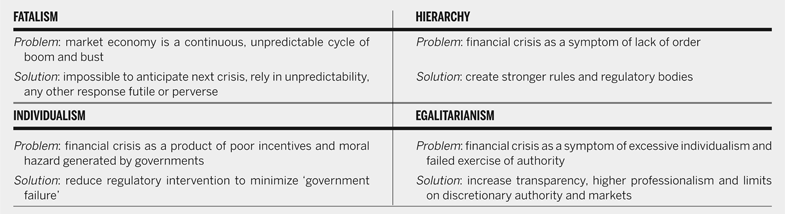
Table 1 summarizes a CT-driven classification of different argumentation patterns (also Hindmoor Reference Hindmoor2010). In brief, hierarchical arguments suggest that the appropriate response to the financial crisis is to move “high grid” and “high group,” emphasizing the importance of prescriptive mandatory rules and the strengthening of regulatory professionalism. Individualist claims argue that the financial crisis is a result of regulation and government interventionism, suggesting that “real markets” will reduce perverse incentives and thereby improve stability. Egalitarian arguments emphazise that the financial crisis is inherently about the limits of authority and markets. These arguments stress the need to counter private self-interest and information asymmetries through providing tighter consumer-facing transparency and increasing emphasis on making regulation “accountable” through people rather than rules. Finally, fatalists argue that capitalism is inevitably about boom and bust and unexpected events. Therefore, any attempt at “securing the future” is doomed, in the sense of any activity triggering inevitable unintended consequences. Alternative fatalist arguments advocate a “lottery-type” approach of regulation that is based on “contrived randomness” (Hood Reference Hood1998), according to this view, as any other strategy is likely to invite gaming.
Four Cultural Worldviews and Their Responses to the Financial Crisis

METHODOLOGY
The analysis of argumentation involved the extraction of claims that demanded particular types of regulatory action, and coding these claims according to their cultural bias (see Lodge Reference Lodge2011; Lodge, Wegrich, and McElroy Reference Lodge, Wegrich and McElroy2010), a form of “cultural auditing” (Swedlow Reference Swedlow2002). Information was entered into a database that includes claims (“the regulator lacks enforcement powers”), the actor making the claim (“Joe Bloggs”), date, and media source (thereby broadly reflecting other media analysis exercises; e.g., Chong and Druckman Reference Chong and Druckman2007). This strategy allows for a comparison of individual and organizational arguments and a comparison across news sources. British and American newspaper stories were taken from Nexis news, using the search words regulation and financial crisis (or, in German, Finanzkrise and Aufsicht). The analysis includes highly respected newspapers, the New York Times, the Washington Post, The Guardian, and The Times; future analysis will include the Wall Street Journal and the Financial Times. Neither of the two most respected German newspapers (Frankfurter Allgemeine Zeitung (FAZ) and Süddeutsche Zeitung) are on Nexis. Only the FAZ facilitated affordable access. In general, given the prominent standing of these newspapers, it can be confidently expected that all major sides of the argument are present. In terms of articles, the US search generated 1,925 claims (extracted from 1,871 stories); the UK search, 714 claims (extracted from 917 stories); and German search, 319 claims (extracted from 435 stories).
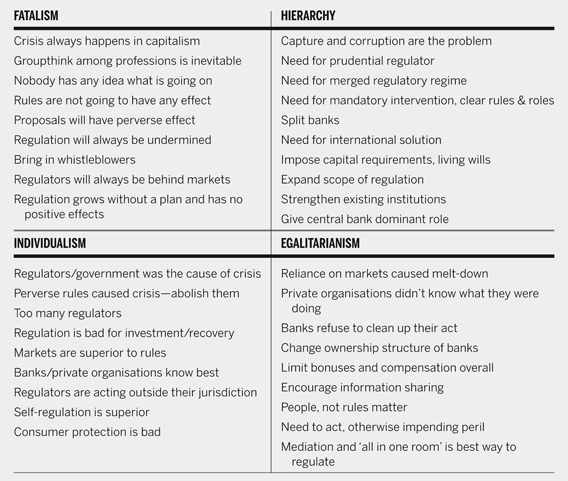
Manual coding was used because mechanical extraction seemed problematic given that CT is not about key words, but rather about identifying justifications. Extraction and coding followed a double-blind sampling method to check on intercoder reliability (0.75). The coding frame emerged in an interactive pattern that followed earlier attempts at classifying regulatory approaches within the CT framework (Hood Reference Hood1998; Lodge Reference Lodge2011; Lodge et al. Reference Lodge, Wegrich and McElroy2010) and the specifics of the financial crisis. As indicated in table 1, claims were coded according to their implied grid/group characteristics. The following analysis concentrates on aggregate “pure type” claims rather than on hybrids or actor-specific patterns. Table 2 provides an overview of claims and how they were allocated to particular cultural worldviews. The remainder of the article presents the aggregate picture of argumentation patterns over the course of the financial crisis from late 2006 to 15 March 2011. It concentrates on “national” claims by domestic actors.
CT Coding Frame Regarding the Financial Crisis

FINDINGS
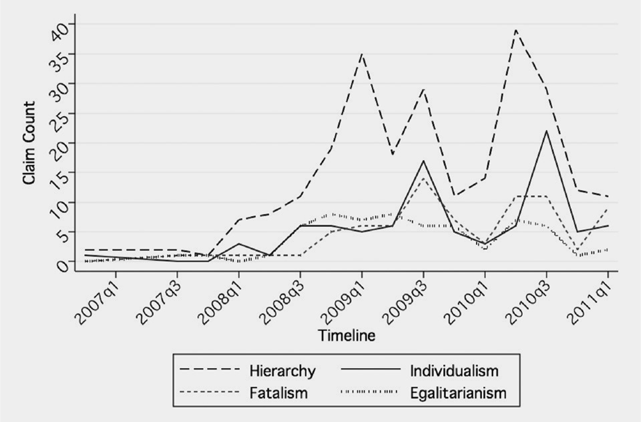
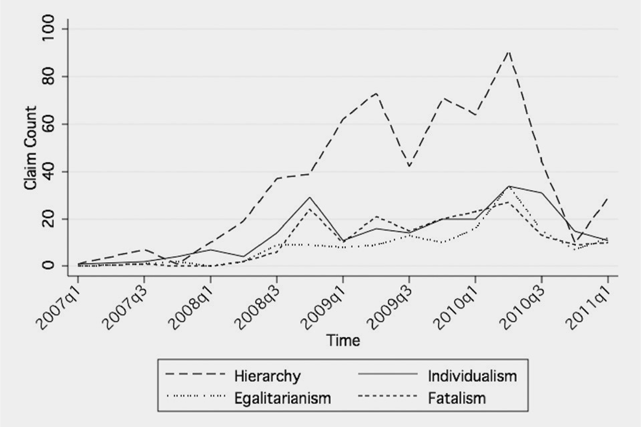
Figures 1–3 provide a graphic overview of the argumentation patterns across the three countries. This section briefly considers each national pattern before exploring comparative insights.
Claim Distribution: Germany

Claim Distribution: United Kingdom

Claim Distribution: United States

An election-induced overall decline in argumentation is evident in the German case, as political debate moved to more tractable issues, such as tax rates, health policy, and labour market reforms. A delayed rise in hierarchical arguments is noticeable as the financial crisis primarily involved publicly owned Landesbanken. The then opposition FDP (Liberals) made largely individualist-type arguments regarding their control. Individualist claims vanish post-September 2009. This trend can be linked to the FDP's entry into government where they were not allocated the finance portfolio. The spike in interest in late 2010 is largely about debates whether or not the Bundesbank should be responsible for financial regulation, or whether such a role would undermine its autonomy. These debates, however, concentrated on the role of the central bank in regulation and the potential for political interference rather than on the relationship between state and market. Therefore, they cannot be interpreted as a back-to-business-as-usual pattern. The overall decline in attention and argumentation toward the end of the period is due to the decision not to seek any regulatory institutional change.
The UK pattern points to a rise in attention in the fourth quarter of 2007 that coincides with the collapse of Northern Rock, the building society. What is also noticeable is an increase in overall contestation of the demand for more control (as expressed in the dominance of hierarchical-type claims throughout the period). Opposition to tougher control (as expressed through individualist and fatalist claims) gained increased prominence, especially in the wake of government proposals for increased regulation (as evident in the delayed spike towards late 2010). The decline in argumentation in late 2009 and early 2010 is due to the UK election in early 2010 when financial regulation was not a campaign theme: the overall state of public finances, the future of public services, and social and labour policies took priority. As legislation was being considered after the 2010 election, a marked growth occurred in opposition to regulatory reform; however, this increase merely establishes a renewed diversification of argumentation, not a return to previously dominant views of an individualist “light touch” kind. Indeed, “more” regulation type views of a hierarchical and egalitarian type continue to outweigh those of an individualist or fatalist kind.
The US patterns point to a growing dominance of hierarchical claims over time, although this dominance only asserts itself after Barack Obama's election as president. It declines after the passing of the Dodd-Frank Act (which explains the peak in mid-2010). The continued Republican opposition is evident in the ongoing prominence of individualist and fatalist argumentation patterns. If we assume that fatalist and individualist claims represent concerted opposition to ‘hierarchical’ regulatory change, then the opposition to regulatory change remains at a lower level (with the exception of the fourth quarter of 2010) than the proregulatory change coalition that one expects to exist between proponents of egalitarian-type and hierarchical-type arguments.
As noted, the analysis focuses on aggregates rather than subclaims and/or individual participants in the debate. Nevertheless, the claim distribution provides insights into the extent and direction of argumentation regarding financial regulation, and it allows for the assessment of the hypotheses considered at the outset. The continued state of heightened contestation in argumentation does not confirm a return to a world dominated by mostly individualist arguments that would indicate light touch business-friendly regulatory advocacy. Instead, the continued dominance of hierarchical claims over other claims—and of hierarchical and egalitarian claims over individualist-fatalist claims—further suggests a continued dominance of those who argue in favor of more regulation over those who argue for less regulation. In terms of distinct national styles, no real differences exist. Hierarchy predominates across all three societies, with Germany being somewhat more individualist (which can be accounted for by the status of Landesbanken as public entities). The analysis also validates several CT hypotheses, namely that the four worldviews are able to cover key claims, that they are all present, and that they are in a state of continued contestation over the causes and potential solutions to the future of financial regulation. The financial crisis most certainly represents a “surprise” to established assumptions regarding regulation and financial markets. This surprise element is evident in the rise of argumentation, and its diversification over time, across the three countries. However, how this surprise of financial meltdown is understood and what to do about it remains a matter of contestation between the different worldviews. Although the financial crisis has not led to the marked decline or disappearance of any particular worldview, it is apparent that hierarchical arguments in favor of more regulation are more prevalent than arguments opposing more regulation.
CONCLUSION
This article showed how CT can be used to audit argumentation patterns in the media. Studies in other domains have pointed to similar patterns (Lodge Reference Lodge2011), while the attempt to code arguments regarding regulation to advance the agenda regarding doctrinal argumentation set out by Christopher Hood's utilization of CT (Hood Reference Hood1998). Future analysis will focus on the argumentation patterns by particular actors and continued differentiation according to different claims within worldviews.
CT provides a unique theory-driven way to capture debates among different worldviews regarding distinct policy problems and solutions. Of course, there are many limitations with this method; nevertheless, CT advances our understanding of the kind of coalitions that form within the public domain. This brief analysis finds support for hypotheses that are central to CT, namely that all worldviews are present and that these offer distinct arguments regarding diagnosed problems and advocated solutions. In addition, contestation emerges in response to a crisis, or surprise when established patterns of dominance are found wanting. Different CT-related arguments have their own ways of blaming particular other worldviews' institutional preferences for the financial meltdown of the late 2000s. At least, in terms of argumentation, across the three countries individuals who blame private actors and therefore demand more oversight have gained the upper hand.
What does this analysis tell us about regulatory change? For readers who view the immediate regulatory responses described in the introduction as a triumph for business and government interests favoring a return to light touch regulation, this analysis offers the somewhat troubling insight that significant demands for more oversight have not led to significantly more oversight. For others, the analysis in this article may support the more reassuring view that heightened public attention and continued contestation among different viewpoints means that the future is not one of inevitably “captured” financial regulation.