INTRODUCTION
Parasite transmission strategies should be subject to strong selection and involve multiple factors associated with both the host and the parasite. Parasite fitness is largely dependent upon contacting and infecting a susceptible host. Hence, heterogeneity in infection should be driven not only by differences in host exposure and susceptibility, but also by parasite choice for certain types of hosts that optimize fitness. One of the most commonly reported forms of heterogeneity is male-biased infection, which is generally attributed to sex-specific differences in exposure (e.g., due to behaviour and diet) and susceptibility (e.g., immune competence and physiology) (Poulin, Reference Poulin1996; Zuk and McKean, Reference Zuk and McKean1996; Schalk and Forbes, Reference Schalk and Forbes1997; but see Krasnov et al. Reference Krasnov, Bordes, Khokhlova and Morand2012; Kiffner et al. Reference Kiffner, Stanko, Morand, Khokhlova, Shenbrot, Laudisoit, Leirs, Hawlena and Krasnov2013). Biased infections could in turn give rise to aggregation in the abundance and distribution of parasites in natural host populations (Shaw and Dobson, Reference Shaw and Dobson1995; Wilson et al. Reference Wilson, Bjornstad, Dobson, Merler, Poglayen, Randolf, Read, Skorping, Hudson, Rizzoli, Grenfell, Heesterbeek and Dobson2002), with variability among conspecific hosts often attributed to differential exposure and/or susceptibility to parasites. While previous research has given us valuable insight into how host ecology and physiology contribute to parasite prevalence and distribution, the role of parasite preference for specific types of hosts and its potential to generate heterogeneity in infection remains poorly understood.
Host body size can be an important ecological factor influencing the abundance of ectoparasites (Grutter and Poulin, Reference Grutter and Poulin1998). Body size is often indicative of relative fitness among conspecifics, while physiological differences (such as those related to immunocompetence) are often mediated by sex, whether due to hormones or other sexually selected traits (Hamilton and Zuk, Reference Hamilton and Zuk1982; Folstad and Karter, Reference Folstad and Karter1992; Honěk, Reference Honěk1993). Thus, body size and sex are candidate factors for explaining heterogeneities in infection. Christe et al. (Reference Christe, Glaizot, Evanno, Bruyndonckx, Devevey, Yannic, Patthey, Maeder, Vogel and Arlettaz2007) found that parasitic mites of bats tended to prefer female hosts to males; this bias was attributed to sex-specific differences in host roosting and dispersal behaviour (also see Lajeunesse et al. Reference Lajeunesse, Forbes and Smith2004). Likewise, Gilburn et al. (Reference Gilburn, Stewart and Edward2009) showed both a male- and size-biased infection by parasitic mites of seaweed fly hosts, attributing the phenomenon to differences in conspecific host ecology.
Symbiotic arthropods can acquire a host relatively passively, via vertical and/or horizontal transmission from one host to another, or by engaging in active seeking, which is common among mites and ticks (Daralova et al. Reference Daralova, Hoi and Schleicher1997; Dallas and Foré, Reference Dallas and Foré2013). The mite Macrocheles muscaedomesticae is commonly found in ephemeral habitats of rotting organic matter or in agricultural settings (Axtell, Reference Axtell1963; Jalil and Rodriguez, Reference Jalil and Rodriguez1970). While it has a cosmopolitan distribution, it is a poor disperser and commonly uses dipteran hosts to escape non-suitable or deteriorating habitats (Rodrigueiro and Prado, Reference Rodrigueiro and Prado2004). This study focuses on a natural association between M. muscaedomesticae and Drosophila hydei. The relationship between mite and fly is historically considered phoretic; however, M. muscaedomesticae also feed on the eggs and larvae of their hosts (Axtell, Reference Axtell1961, Reference Axtell1963). It is also suspected that M. muscaedomesticae opportunistically feed on host body fluids during attachment (Krantz, Reference Krantz1988, personal observations). The mites induce a melanization response when attached to the flies, an immune response that involves the enzyme phenoloxidase, which is costly for the host to produce (Beresford and Sutcliffe, Reference Beresford and Sutcliffe2009; Gonzalez-Santoyo and Cordoba-Aguilar, Reference Gonzalez-Santoyo and Cordoba-Aguilar2012). The mites also cause a reduction in host flight performance (Luong et al. Reference Luong, Penoni, Horn and Polak2015). In a similar system involving the mite Macrocheles subbadius, the mite has been shown to be parasitic on Drosophila nigrospiracula (Polak, Reference Polak1996). Herein, we treat M. muscaedomesticae as a facultative parasite of Drosophila.
Numerous field surveys have reported higher mite loads among female flies (Wade and Rodriguez, Reference Wade and Rodriguez1961; Rodrigueiro and Prado, Reference Rodrigueiro and Prado2004). However, given that female flies are typically larger than male flies (Brandt and Andrade, Reference Brandt and Andrade2007), mite choice may be driven by a preference for hosts with larger body size, and not host sex. In this study, we tested the hypothesis that active mite choice for different types of hosts can generate heterogeneity in infection. In particular, we examine the role of host sex and body size in mite choice while separating out their confounding effects, and controlling for differences arising from variation in host exposure and susceptibility. We performed pairwise choice-tests whereby mites were offered a choice between two different host types. The parasite choice hypothesis predicts that mites will preferentially infect female hosts, presumably because associating with larger hosts results in optimal fitness (Sivinski and Dodson, Reference Sivinski and Dodson1992; Christe et al. Reference Christe, Glaizot, Evanno, Bruyndonckx, Devevey, Yannic, Patthey, Maeder, Vogel and Arlettaz2007; Campbell et al. Reference Campbell, Klompen and Crist2013). Specifically, we predicted that mites would: (i) preferentially infect female hosts over male hosts when body size was not accounted for; (ii) but show no preference when males and females are similar in size; and (iii) actively choose larger hosts when we control for variation in host sex.
MATERIALS AND METHODS
Study system
The mite M. muscaedomesticae (Acari: Macrochelidae) is found in association with various fly species, depending upon host availability, which include (but are likely not limited to): stable flies, Stomoxys calcitrans (Williams and Rogers, Reference Williams and Rogers1976), members of the genus Drosophila (Krantz 1998), and house flies, Musca domestica (Jalil and Rodriguez, Reference Jalil and Rodriguez1970). Mite prevalence and intensity of infection also varies spatiotemporally with some evidence of preference for female flies (Axtell, Reference Axtell1964; Rodrigueiro and Prado, Reference Rodrigueiro and Prado2004). We collected D. hydei (~100 per sex) from residential compost bins in Edmonton, Alberta, Canada in September 2013 (approx. coordinates: 53·527815°N, 113·483924°W) and cultured them on standard agar–molasses–yeast-based fly media at standard laboratory light and temperature conditions (12 h light, 25 °C: 12 h dark, 24 °C). M. muscaedomesticae were harvested from the infected flies collected in the field and reared on artificial media consisting of wheat bran, wood shavings and bacteriophagic nematodes that served as a source of food for the mites. Mites were maintained in 4 L tubs in a separate incubator under similar conditions (12 h light, 25 °C: 12 h dark, 23 °C).
Infection chambers
Infection chambers consisted of a 200 µL pipette tip reduced to half the length by cutting off the narrow end. Both open ends were stoppered with cotton, leaving approximately 1·5 cm of length available to flies and mites during trials. The diameter of the pipette tip at the widest point was approximately 4 mm. These modified chambers severely restricted the movement of the flies, allowing us to control for differences in attachment success arising from heterogeneity in behaviourally-mediated host resistance or encounter probabilities. In a similar macrochelid mite M. subbadius, differential susceptibility of the host is based primarily on variation in behavioural resistance to the mites (Luong et al. Reference Luong, Heath and Polak2007). Any resulting variation in infection is therefore due primarily to mite choice, and not differences in host susceptibility or exposure. Body mass was used as a proxy for body size. Flies were weighed (Denver Instruments SI-215D) under light anaesthesia with CO2 and allowed to recover in individual agar vials for 1 h before trials began. For each infection trial, a single mature female M. muscaedomesticae was placed inside the pipette tip with two adult D. hydei. The flies were transferred directly from the agar vials into the pipette tip without the use of anaesthesia (with one exception, see below). The order in which flies were placed into the chambers was randomized. Each infection chamber was maintained for 16–18 h at 25 °C and then examined and scored for choice, defined as a mite having been found attached to a fly host at the time of inspection.
Choice tests
Four separate experiments were conducted to test for either sex- or size-biased infection by M. muscaedomesticae. In the first experiment MFr (n = 31), each mite was allowed to choose between randomly paired male and female flies. Fly body weight was not recorded in this group, but females were visibly larger than males in all trials. In a second choice test, experiment MFm (n = 50), mites were allowed to choose between one male and one female fly that were similar in size. For this experiment, flies within 0·05 mg of each other were considered the same size. By size matching the flies and controlling for variation in body size, we explicitly tested for infection bias due to host sex. In experiments MM (n = 25) and FF (n = 115), respectively, male and female flies were paired with a fly of the same sex, but of disparate body size. For the FF assays, females differed by either approximately two standard deviations in body weight (0·09–0·18 mg; hereafter referred to as group ‘FFa’, n = 65) or four standard deviations (0·21–0·30 mg; group ‘FFb’, n = 50). Once the flies were weighed, we applied a minute clip (<2% wing area) to the tip of either the left or right wing to differentiate between the ‘smaller’ and ‘larger’ fly. Wings were clipped while flies were under light anaesthesia (see above), alternating between the left and right wings between trials.
Due to low attachment rates (5 out of 20 pairwise trials) results from experiment MM were not analysed. For all other experiments, data were analysed separately using the R statistical program (R Core Team, 2015). We used the chi-squared goodness-of-fit test to determine whether mites showed a preference for one type of host to another. Generalized linear models were used to test for differences in mean body weight between groups (where applicable), and to test for overall differences in response amongst groups FFa and FFb. A factor was retained if the model comparison showed increased deviance in the reduced model without the variable (P ⩽ 0·05, χ 2 statistic). The same method was employed to test the fit of the polynomial function used to describe the relationship between mite choice and fly body weight.
RESULTS
Experiment MFr
In this experiment, individual mites were simultaneously exposed to two adult flies, the male and female flies indiscriminately selected from the laboratory culture. Of the 31 assays, 22 mites attached to a fly (71·0% made a choice). Of these, 17 mites chose female flies and 5 chose male flies. There was a significant female-biased attachment (χ 2 = 6·55, P = 0·01, Fig. 1). Body weight was not measured in this experiment, but female flies were visibly larger in every trial.
Proportion of mites attaching to flies in the paired choice tests. A single female M. muscaedomesticae mite was simultaneously presented with a male and a female adult D. hydei. In experiment MF(r), flies were randomly paired with respect to body size; in the MF(m) experiment, flies were sized-matched within 0·05 mg. White bars represent male flies and hatched bars represent female flies. Sample sizes indicate the total number of mites that attached to a fly (i.e. made a choice). Error bars represent ± 1 standard error.

Experiment MFm
For the size-matched assays (n = 50), a single mite was allowed to choose between the male and female flies of similar body weight. Mean body weight was not statistically different (coef. est. = −0·003, P = 0·95) between females (2·057 ± 0·204 mg) and males (2·054 ± 0·205 mg). The overall attachment rate was again fairly high at 74% (37 of 50). However, the choice-test yielded no clear preference for either male or female flies (χ 2 = 0·24, P = 0·62). Mites chose males in 17 of the trials and females in 20 of the trials. In contrast to the results of experiment MFr, when male and female flies were size matched, the mites did not exhibit a preference for either sex (Fig. 1).
Experiment FF
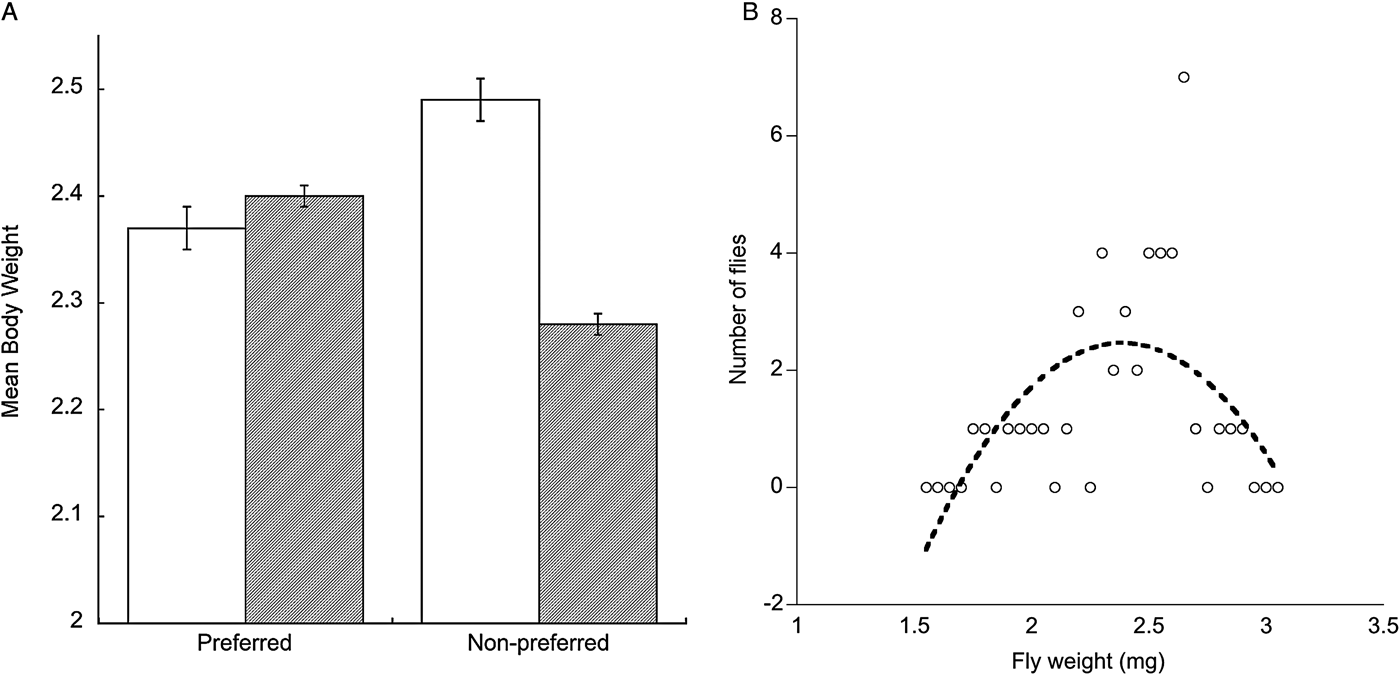
Since the outcome of the choice tests differed between flies in the FFa and FFb group (P = 0·04), the two weight groups were analysed separately. In the FFa group (n = 115), the difference in body weight between the two female flies in this experiment ranged from 0·09 to 0·18 mg. Of the 45 mites that made a choice (69·2% attachment rate), 29 selected the larger fly and 15 selected the smaller fly. This size-biased attachment was statistically significant (χ 2 = 4·45, P = 0·03, Fig. 2). The preferred flies were similar in body weight regardless of whether they were designated as the ‘smaller’ or ‘larger’ fly in a given trial (post hoc Tukey's HSD test, P = 0·99, Fig. 3A). Across the entire range of fly body weight in this study, the mites generally preferred attaching to flies of intermediate body size (mean = 2·39 mg, χ 2 = 25·1, P = 0·0004, Fig. 3B). In the trials with mites exhibiting a preference for the larger fly, the mean weight of the non-preferred (i.e. smaller) flies was 2·28 mg (mean body weight for all flies was 2·34 mg); in the trials where the smaller fly was chosen, the non-preferred (i.e. larger) weight was on average 2·49 mg (mean for all flies was 2·43 mg). This difference in mean body weight among the non-preferred flies was marginally significant (post hoc Tukey's HSD test, P = 0·06).
Proportion of mites attaching in the female–female choice tests. In each trial, a mite was provided access to two female flies of differing body sizes. In group FF(a), the difference in body weight between the smaller female and the larger female was 0·9–0·20 mg. In group FF(b), the differences in body weight ranged from 0·21 to 0·30 mg. White bars represent smaller flies and hatched bars represent larger flies. Sample sizes indicate the total number of mites that attached to a fly (i.e. made a choice). Error bars represent ± 1 standard error.

Body weight of flies in the FF(a) experiments. (A) Mean body weight of the preferred flies; white bars represent the trials in which the mites selected smaller flies and hatched bars represent the trials in which mites selected larger flies. Error bars represent ± 1 standard error. (B) The number of flies infected by mites in relation to fly body weight.

For the FFb trials, the difference in body weight between the smaller and larger flies varied between 0·21 and 0·30 mg. Out of the 50 trials conducted, 26 (52%) of the mites attached to a fly. Mites chose the larger fly in 12 of the trials and the smaller in 14 of the trials. There was no statistically significant preference for hosts based on size in this group (χ 2 = 0·15, P = 0·69).
DISCUSSION
As predicted, the ectoparasitic mite M. muscaedomesticae preferentially infected female over male D. hydei hosts when size was not accounted for. However, the apparent sex-biased infection disappeared when we controlled for the effect of body size. In the FFa experiment in which only female flies were presented with the pairwise choice-tests, mites preferentially attached to the larger fly. Interestingly, across the size distribution of hosts in this study, mites preferentially selected flies of intermediate size. The overall sex-biased infection appears to be driven by host body size and not host sex per se. Active mite choice for certain types of hosts can therefore play a potentially important role in generating heterogeneity in infection even in the absence of variation in host exposure and/or susceptibility. The precise mechanism by which mites are selecting and discriminating between hosts is not known and requires further investigation. Studies on entomophilic nematodes and mites have shown that cuticular hydrocarbons, semiochemicals and other olfactory cues play an important role in locating and discriminating between alternative hosts (Soroker et al. Reference Soroker, Nelson, Bahar, Reneh, Yablonski and Palevsky2003; Niogret et al. Reference Niogret, Lumaret and Bertrand2006; Krishnan et al. Reference Krishnan, Muralidharan, Sharma and Borges2010).
Grossman and Smith (Reference Grossman and Smith2008) investigated host preference in the phoretic mite Poecilochirus (Mesostigamata: Parasitidae) using similar pairwise choice tests involving the burying beetle Nicrophorus (Coeloptera: Silphidae). Their results showed that the mites preferentially selected larger beetles, with mite load positively correlated with host size. Since the beetles were wild-caught and they did not control for differences in host susceptibility, it is difficult to interpret the results as mite choice or size-related differences in susceptibility. Harrison et al. (Reference Harrison, Camazine, Marden, Kirkton, Rozo and Yang2001) did account for the confounding effects of host body size and sex in wood mice (Apodemus sylvaticus) infected with ticks (Ixodes ricinus), but they did not consider the role of active parasite choice in generating the size-biased infections. Valera et al. (Reference Valera, Hoi, Daralova and Kristofik2004) showed that haemotophagous flies (Carnus hemapterus) parasitizing the European bee-eater (Merops apiaster) nestlings were more likely to be found on larger hosts. Interestingly, they found that as the disparity in host size increased the preference for larger hosts became more pronounced (also see Zhang, Reference Zhang1991).
The M. muscaedomesticae mites in our study tended to choose the larger fly in a given pairwise choice-test. In the few trials where the smaller female was chosen instead, the mean body weight of the preferred fly was comparable with that of flies in trials where the larger female was selected. This can be explained by the overall shift in the grand mean from 2·34 mg for flies in trials where larger flies were preferred to 2·43 mg for trials in which smaller flies were selected. Hence, mites preferentially attached to flies of intermediate size given the distribution of fly body weight in this study.
Mite choice for hosts of intermediate size may be the result of a selection ‘tug-of-war’ between the fitness benefits and costs of preferentially infecting larger hosts. Larger hosts may be actively preferred by parasites and/or phorionts because they provide larger ‘habitat islands’, better access to nutritional resources, more refugia to escape host defences or greater dispersal potential (Rózsa, Reference Rózsa1997; Valera et al. Reference Valera, Hoi, Daralova and Kristofik2004; Grossman and Smith, Reference Grossman and Smith2008). For non-volant species, such as mites that inhabit widely disperse ephemeral habitats, the ability to locate new habitats is entirely dependent on the host (Krantz, Reference Krantz1988; Campbell et al. Reference Campbell, Klompen and Crist2013). Sivinski and Dodson (Reference Sivinski and Dodson1992) found that in tephritid flies, an increase in body size was often accompanied by differences in wing morphology that enabled either faster or longer-distance flight. As such, size-related differences in host dispersal capability are likely to impact host preference. Among several species of Drosophila, females have been shown to be better dispersers than males (Iliadi et al. Reference Iliadi, Iliadi, Rashkovetsky, Girin, Nevo and Korol2002; but see Johnston and Templeton, Reference Johnston, Templeton, Barker and Starmer1982). More studies are needed to evaluate the relationship between host size and dispersal capability in this system. By contrast, flies on the upper end of the size spectrum may be easier targets for predators (Boake, Reference Boake1989). By associating with larger hosts, parasites may be subject to an increased risk of mortality. Similarly, mites may be at a greater risk for dislodgement or injury if the host makes frequent contacts with conspecifics (Boake, Reference Boake1989).
This preference for medium-sized hosts is analogous to the prey selection strategies of predators. Numerous studies have shown that predators tend to consume intermediate-sized prey in greater proportion than expected given the relative abundance of the prey (Pastorok, Reference Pastorok1981; Allan et al. Reference Allan, Flecker and McClintock1987; Roger et al. Reference Roger, Coderre and Boivin2000). Differences in the handling time between small and large prey items may influence the relative profitability of different prey size classes. The rate of capture success may decrease as prey size increases because larger prey mount better defence and/or escape responses. Larger prey may also increase the risk of injury or mortality to predators (Pastorok, Reference Pastorok1981; Sabelis, Reference Sabelis and Crawley1992). These constraints on prey selection parallel the limitations of host selection by phoretic and parasitic mites.
Mite preference for intermediate-sized hosts may result in parasite-mediated disruptive selection, which could serve to maintain genetic variation in body size within the host population. Generally, parasite-mediated disruptive selection has been documented in populations of Daphnia, where exposure to a yeast parasite resulted in a rapid increase in host genetic diversity (Duffy et al. Reference Duffy, Brassil, Hall, Tessier, Cáceres and Conner2008). Given that Drosophila fecundity is positively correlated with female body size (Robertson, Reference Robertson1957; Lefranc and Bundgaard, Reference Lefranc and Bundgaard2000), parasites may impose sufficient selection pressure on the host to shift the population away from its fitness optimum.
In conclusion, M. muscaedomesticae preference for D. hydei hosts is influenced by host body size and not sex per se. Size-biased attachment resulted from mites actively choosing hosts of intermediate size, generating heterogeneities in infection even in the absence of differential host exposure and susceptibility. More studies are needed to identify the fitness gains and losses for parasites that display active choice for certain types of hosts, as well as the potential evolutionary consequences for hosts in response to parasitism. In natural populations, differential host exposure and susceptibility are likely operating simultaneously alongside active mite choice to generate heterogeneity in infection. Dye and Hasibeder (Reference Dye and Hasibeder1986) suggest that preference for certain types of hosts increases both the infection and transmission rate of parasites. Our study sheds light on the often overlooked role of mite choice and perhaps more generally, adaptive parasite choice in disease ecology.
ACKNOWLEDGEMENTS
We thank H. Proctor and A. Shostak for providing helpful feedback on an earlier version of this manuscript and also thank to S. Orlofske for her comments and suggestions on the later drafts.
FINANCIAL SUPPORT
The project was funded by a NSERC Discovery grant to LTL (grant number 435245).