FOCUS POINTS
• QOL is gravely impaired in patients with OCD especially in the presence of comorbid conditions.
• Individual and group psychotherapy and medications are all successful in improving QOL in OCD, although not to community norm levels.
• QOL needs to be included as an essential measure of treatment outcome in addition to symptom severity and functioning.
Introduction
Obsessive-compulsive disorder (OCD) is an anxiety disorder characterized by recurrent obsessions and/or compulsions that cause high levels of distress, consume considerable amounts of time, and significantly impair important aspects of functioning.1 As it is currently the fourth most prevalent psychiatric diagnosis,Reference Karno, Golding, Sorenson and Burnam2 OCD has been recognized for its chronic and disabling course. Indeed, it ranks as the 10th leading cause of disability worldwide.3 According to an Epidemiologic Catchment Area (ECA) program study, the lifetime prevalence of OCD is 1.7% in the United States,Reference Karno, Golding, Sorenson and Burnam2 with prevalence rates of 3.1% and 3.5% in Canadian and Swiss studies, respectively.Reference Stein, Forde, Anderson and Walkder4, Reference Angst, Gamma and Endrass5 Extensive research has been conducted on OCD, but only in recent years, however, has quality of life (QOL) grown to become an increasingly important aspect of patient assessment and treatment in mental health care,Reference IsHak, Greenberg and Balayan6 both in general, and specifically in OCD.
The World Health Organization (WHO) defines quality of life (QOL) as the “individuals’ perception of their position in life in the context of the culture and value systems in which they live and in relation to their goals, expectations, standards and concerns.”7 Quality of life is further identified as one's satisfaction with health, and with occupational, social, and other activities according to self-report.Reference IsHak, Greenberg and Balayan6 The operational definition of QOL has been translated into the most frequently cited QOL measures in the literature, which include the Medical Outcomes Study Short Form-36 (SF-36)Reference Ware8, Reference Orley, Saxena and Herrman9; the World Health Organization Quality of Life Assessment (WHOQOL-100),10 and its brief form, the World Health Organization Quality of Life Assessment–Abbreviated Version (WHOQOL-BREF)11; and the Quality of Life Enjoyment and Satisfaction Questionnaire (Q-LES-Q).Reference Endicott, Nee, Harrison and Blumenthal12 Detailed information regarding these measures can be obtained from our review on QOL and depression that was published in an earlier issue of this journal.Reference IsHak, Greenberg and Balayan6 As argued in that review, QOL can be considered the ultimate indicator that treatments have succeeded. Thus, as we have examined for depression, it is equally important to further investigate the relationship between QOL and OCD.
Accordingly, this article provides an in-depth review of QOL in OCD and addresses three main questions: (1) What is the impact of OCD on QOL, especially when compared to other disorders? (2) How do comorbid conditions affect QOL in OCD? (3) How does the treatment of OCD symptoms impact QOL?
Methods of Literature Search
Data sources
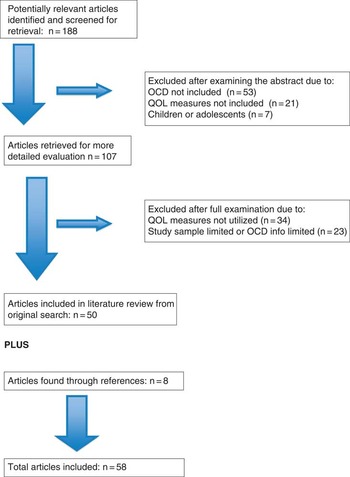
A systematic literature search was conducted using the MEDLINE, PUBMED, and PsycINFO databases from 1980 to 2011. We used the following keywords: “obsessive compulsive disorder” OR “OCD” AND “quality of life” OR “QOL.” The initial search yielded 188 articles. The reference list of identified papers and previous reviews was manually reviewed for additional studies.
Study selection criteria
Three of the authors in this article reviewed the 188 studies independently using the following inclusion criteria: (1) Articles in English or with an available published English translation; (2) publication in a peer-reviewed journal; (3) studies evaluating adult humans; (4) studies, of any design, which focused on OCD; and (5) studies that used at least one QOL measure. These measures included those most frequently cited, as listed above: SF-36,Reference Ware8, Reference McHorney, Ware and Raczek13 WHOQOL,Reference Orley, Saxena and Herrman9, 14, Reference Saxena and Orley15 and the Q-LES-Q.11 Exclusion criteria consisted of review articles and research articles that did not employ QOL measurement, and those from animal models. The reviewers conducted a focused review using the full-text articles of studies that met the above criteria. Additional articles were then selected using references from these articles. The reviewers then reached a consensus on the studies to include in this review.
Data Extraction and Yield
The study selection process yielded 58 articles meeting the aforementioned selection criteria. Research methodology and key findings were derived from the full text and tables within the selected studies.
The search process and results are outlined in Figure 1.
Search process for quality of life studies in OCD.

Results
What is the impact of OCD on QOL?
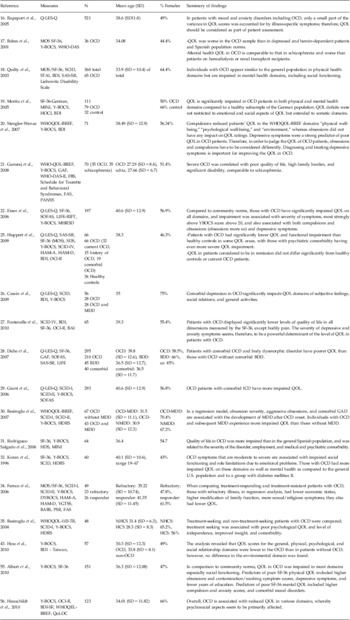
The impact of OCD on QOL has been investigated through numerous studies, as depicted in Table 1, which shows that patients suffering from OCD experience grave impairments in QOL.
The impact of OCD on quality of life
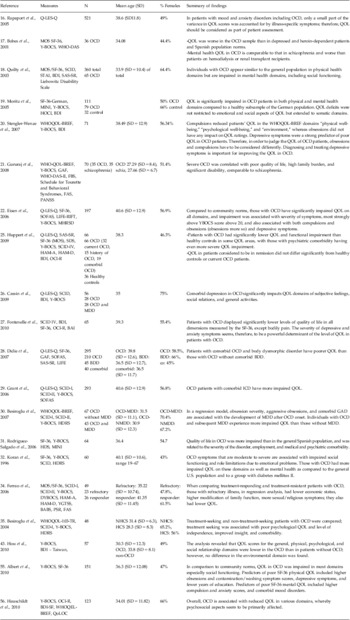
Abbreviations: BABS (Brown Assessment of Beliefs Scale), BAI (Beck Anxiety Inventory), BDI (Beck Depression Inventory), CGI (Clinical Global Improvement), DYBOCS (Dimensional Y-BOCS), FAS (Family Accommodation Scale), FBS (Family Burden Schedule), GAD (Generalized Anxiety Disorder), GAF (Global Assessment of Functioning), HAM-A (Hamilton Anxiety Rating Scale), HAM-D (Hamilton Depression Rating Scale), HDRS (Hamilton Depression Rating Scale), HOCI (Hamburg Obsessive-Compulsive Inventory), LIFE-RIFT (Range of Impaired Functioning Toll), MHRSD (Modified Hamilton Rating Scale of Depression), MINI (Mini International Neuropsychiatry Interview), PANSS (Positive and Negative Symptom Scale), PSR (Psychiatric State Rating), SAS (Social Adjustment Scale), SCID (Structured Clinical Interview for DSM-IV), SDS (Sheehan Disability Scale), SOFAS (Social and Occupational Functioning Assessment Scale), STAI (State-Trait Anxiety Inventory, WHO-DAS (Disability Assessment Scale), Y-BOCS (Yale-Brown Obsessive Compulsive Scale), YGTSS (Yale Global Tic Severity Scale).
The literature reveals that when compared with community norms and with other psychiatric and medical disorders, QOL in OCD patients is significantly impaired. In fact, QOL impairment in OCD was shown to be higher than QOL impairment in panic disorder,Reference Rapaport, Clary, Fayyad and Endicott16 social phobia,Reference Rapaport, Clary, Fayyad and Endicott16 heroin dependence,Reference Bobes, Gonzalez and Bascaran17 and in patients on hemodialysisReference Bobes, Gonzalez and Bascaran17 and kidney transplant recipients.Reference Bobes, Gonzalez and Bascaran17 With regard to disorders that are known to severely impair QOL such as schizophrenia and depressive disorders, QOL impairment in OCD was comparable.Reference Rapaport, Clary, Fayyad and Endicott16, Reference Quilty, Van Ameringen, Mancini, Oakman and Farvolden18
Of note, OCD patients exhibit variations in the QOL domains that are affected. The studies we reviewed suggest that QOL deficits in OCD are more pronounced on the social, emotional, and mental domains of QOL measures, whereas the physical domain, although impaired, is typically less affected. For instance, Bobes etal.Reference Bobes, Gonzalez and Bascaran17 compared QOL of outpatients with OCD to the population norms using the SF-36. The QOL domains most significantly impaired were first social functioning, then role limitations due to emotional impairment (role–emotional), mental health, general health, and vitality. However, physical functioning, role limitations due to physical impairments (role–physical), and bodily pain were not significantly different, nor were the physical health summary measures. A similar investigation by Moritz etal.Reference Moritz, Rufer and Fricke19 compared QOL of OCD patients to QOL in a healthy sample of the population. The authors found that z-scores for QOL in OCD patients were 2–4 standard deviations lower than the z-scores for the healthy subsample. Again, the domains most affected in OCD participants were social functioning, mental health, vitality, and role limitations due to emotional problems (scores were below the 25th percentile of the normative sample).
Although research supports the notion that QOL deficits largely encompass social and emotional domains, studies also show that QOL impairments due to OCD can also extend to include the somatic domain.Reference Moritz, Rufer and Fricke19 In Moritz etal.,Reference Moritz, Rufer and Fricke19 OCD patients had lower SF-36 scores on physical functioning, role–physical, and bodily pain. Impairment in physical subscales was also noted to be more obvious in those patients with compulsions and those patients with long illness duration.Reference Moritz, Rufer and Fricke19 Further research is needed to examine the extent of physical impairments in chronic OCD patients and those who experience compulsions.
In order to fully understand how OCD impairs QOL, it is important to examine the impact of symptom severity and/or the predominance of obsessions or compulsions. Namely, is there a differential effect between obsessions and compulsions on QOL? While symptom severity has been shown to be associated with poor QOL in OCD, the evidence has been mixed as to whether compulsions or obsessions differed regarding their effects on QOL. Stengler-Wenze etal.Reference Stengler-Wenze, Kroll, Riedel-Heller, Matschinger and Angermeyer20 showed that Yale Brown Obsessive Compulsive Scale (YBOCS) compulsion severity was associated with QOL impairment on WHOQOL-BREF on three subscales, whereas obsession severity did not show this same association with QOL impairment. Similarly, Moritz etal.Reference Moritz, Rufer and Fricke19 showed that though the severity and the number of both obsessions and compulsions were significantly related to several SF-36 QOL subscales, there was a stronger association with compulsions. In contrast, Gururaj etal.Reference Gururaj, Math, Reddy and Chandrashekar21 showed that YBOCS total symptom severity and obsession severity were significantly associated with QOL impairment, whereas compulsion severity did not show this association. Likewise, Eisen etal.Reference Eisen, Mancebo and Pinto22 showed that OCD obsessional and compulsive symptom severity were each significantly correlated with QOL, but there were stronger associations with regard to obsessions in seven Q-LES-Q categories. Because of the lack of consensus among researchers, additional studies are needed in order to better understand the differential effects of obsessions and compulsions on QOL, as these might influence the management of OCD symptoms.
Overall, evidence shows that QOL is greatly impaired in OCD, especially when compared with community norms or with other psychiatric and medical disorders. Other factors may influence QOL, however, and since QOL is the ultimate measure of treatment success, it is important to examine their effects. A key factor influencing QOL is comorbidity.
How do comorbid conditions affect QOL in OCD?
Generally, patients with OCD tend to have comorbid conditions. Surveys have indicated that at least 50% of OCD patients have at least one other psychiatric disorder, most commonly another anxiety disorder.Reference Markarian, Larson and Aldea23 Approximately one-third met diagnostic criteria for major depression disorder, over one-third suffered from depressed mood, and over one-third suffered from anxiety symptoms.Reference Moritz, Meier, Hand, Schick and Jahn24 Research shows that among patients with OCD, those with comorbidities had greater QOL impairment and demonstrated the poorest QOL when compared to those with OCD alone or with OCD in remission as measured by the Q-LES-Q.Reference Moritz, Meier, Hand, Schick and Jahn24, Reference Huppert, Simpson, Nissenson, Liebowitz and Foa25 Some common comorbid conditions include major depression,Reference Moritz, Rufer and Fricke19, Reference Cassin, Richter, Zhang and Rector26, Reference Fontenelle, Fontenelle and Borges27 body dysmorphic disorder,Reference Didie, Pinto and Mancebo28 and impulse control disorders,Reference Grant, Mancebo, Pinto, Eisen and Rasmussen29 all of which have significant negative impact on QOL.
In order to verify that the additional QOL impairment can be attributed to a corresponding comorbid condition, Gururaj etal.Reference Gururaj, Math, Reddy and Chandrashekar21 ran a study and found that social and family QOL items on the WHOQOL-BREF had statistically significant correlations with anxiety and depression as well as with OCD symptoms. These correlations, however, dissolved after controlling for depressive symptom severity using the Beck Depression Inventory (BDI) score, which strongly suggests that comorbid illnesses (in this case depression) can be associated with increased QOL impairment. Besiroglu etal.Reference Besiroglu, Uguz, Saglam, Agargun and Cilli30 came to a similar conclusion when they found that in individuals suffering from OCD and subsequent major depressive disorder (MDD), the severity of depressive symptoms contributed more to the impairment of QOL than the severity of OCD symptoms.
The effects of medical comorbidity have been investigated as well. For instance, studies by Rodriguez-Salgado etal.Reference Rodriguez-Salgado, Dolengevich-Segal and Arrojo-Romero31 and Koran etal.Reference Koran, Thienemann and Davenport32 revealed that OCD patients with comorbid medical conditions exhibited poorer QOL on the SF-36 than those without.
Overall, evidence shows that comorbid conditions, particularly depression, are major contributing factors in QOL impairment in OCD. Given the substantial impact of comorbid conditions, treatment strategies should aim to achieve remission in these conditions.
How does the treatment of OCD symptoms impact QOL?
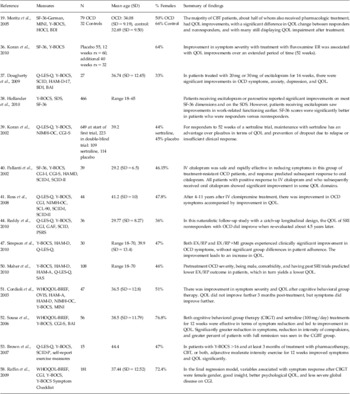
Current treatment recommendations of OCD include pharmacotherapy with selective serotonin reuptake inhibitors (SSRI) or clomipramine, cognitive-behavioral therapy (CBT), and combination therapy.Reference Greist, Bandelow and Hollander33–Reference Besiroglu, Cilli and Askin35 Generally, OCD treatment leads to QOL improvement. The findings of the impact of treatment on QOL in OCD are depicted in Table 2.
The impact of treatment on QOL in OCD

Abbreviations: BABS (Brown Assessment for Beliefs Scale), BAI (Beck Anxiety Inventory), BDI (Beck Depression Inventory), BDI-SF (Beck Depression Inventory Short Form), CGI (Clinical Global Improvement), GAF (Global Assessment of Functioning), HAM-A (Hamilton Anxiety Rating Scale), HAM-D (Hamilton Depression Rating Scale), HOCI (Hamburg Obsessive-Compulsive Inventory), OCI-R (Obsessive Compulsory Inventory – Revised), MINI (Mini International Neuropsychiatry Interview), NIMH-OC (NIMH Global Obsessive-Compulsive Scale), OVIS (Overvalued Ideas Scale), PSRS (Psychiatric Status Rating Scale), QoLOC (Quality of Life in Obsessive Compulsive Disorder), SCID (Structured Clinical Interview for DSM-IV), SCL-90 (Symptom Checklist 90), SAS (Social Adjustment Scale), SDS (Sheehan Disability Scale), SRI (Serotonin-Reuptake Inhibitor), Y-BOCS (Yale-Brown Obsessive Compulsive Scale).
Pharmacotherapy
The FDA-approved medications for the treatment of OCD include clomipramine, fluoxetine, fluvoxamine, paroxetine, and sertraline. However, other SSRIs and serotonin-norepinephrine reuptake inhibitors (SNRIs) have been studied and shown to be effective in OCD treatment.
Similarly, QOL has also been shown to improve in treatment studies using oral fluvoxamine,Reference Koran, Bormberg and Hornfeldt36 escitalopram,Reference Dougherty, Jameson and Decersbach37, Reference Hollander, Stein, Fineberg, Marteau and Legault38 paroxetine,Reference Hollander, Stein, Fineberg, Marteau and Legault38 sertraline,Reference Koran, Hackett, Rubin, Wolkow and Robinson39 IV citalopram,Reference Pallanti, Quercioli and Koran40 and clomipramine.Reference Ross, Fallon, Petkova, Feinstein and Liebowitz41, Reference Fallon, Liebowitz and Campeas42 Overall, these studies seem to indicate that QOL improvement is gradual and is maintained/improved by continued pharmacotherapy. For instance, fluvoxamine ER's impact on QOL was seen in 52 weeks, but not after 12 weeks. Of the participants who achieved symptom remission according to Y-BOCS scores at week 12, those who had a 52-week follow-up achieved significantly higher psychological QOL on multiple domains than those participants who did not experience remission. Thus, symptom relief seems to be correlated to subsequent significant improvements in QOL.Reference Koran, Bormberg and Hornfeldt36 Of note, research has also shown that some patients do not experience an improved QOL even with improvement in OCD symptoms due to medication. This suggests that there are factors beyond OCD symptom severity that affect QOL.Reference Hou, Yen, Huang, Wang and Yeh43
The advantages of continual pharmacotherapy were suggested by Koran etal.Reference Koran, Hackett, Rubin, Wolkow and Robinson39 in a 54-week sertraline trial. Longitudinal studies of OCD showed QOL improvements in SSRI nonresponders over extended treatment time, although it remains unclear whether this is secondary to the continued efforts to treat or the natural course of the illness.Reference Reddy, Alur, Mandjunath, Kandavel and Math44, Reference Shetti, Reddy and Kandavel45 However, adverse side effects from pharmacological treatments must be taken into account with prolonged treatment times, as adverse effects can have a negative effect on QOL.Reference Hou, Yen, Huang, Wang and Yeh43 When adverse effects present a barrier to treatment adherence, frequent discussions should occur with the patient to encourage continued treatment after careful consideration of the risks and benefits.
Psychotherapy
Exposure and response prevention (EX/RP),Reference Lindsay, Crino and Andrews46 one of the most efficacious interventions for OCD, is currently the first-line treatment for this disease. When adhered to, EX/RP is highly effective, yet patients often fail to reach this level of effectiveness, as they often drop out or do not fully implement the recommended procedures. Simpson etal.Reference Simpson, Zuckoff and Maher47 examined whether motivational interviewing (MI), a tool proven to show patient adherence in other disorders, could be added to EX/RP to effectively improve patient adherence. MI is a client-centered, goal-oriented method designed to motivate patients to change. The study revealed that though both the EX/RP and EX/RP+MI groups showed significant improvement in symptom reduction and QOL, there were no significant differences in improvement between the groups, especially with regard to patient adherence. On the other hand, two other studies suggest otherwise,Reference Maltby and Tolin48, Reference Merlo, Storch and Lehmkuhl49 showing that readiness interventions utilizing MI yielded more adherence rates in adults who previously refused EX/RP. Furthermore it was shown that three sessions of MI appeared to accelerate treatment progress in pediatric OCD. Maher etal.Reference Maher, Huppert and Chen50 showed that greater comorbidity, greater number of past SSRI trials, and lower baseline QOL predicted poorer EX/RP treatment adherence. Although the individual effects of these inhibitors were small, their collective effect is significant, suggesting that multimodular strategies may improve EX/RP outcomes.
Other treatment options, such as individual and group CBT, have been shown to have a positive impact on QOL in OCD.Reference Moritz, Rufer and Fricke19, Reference Cordioli, Heidt and Bochi51 In a CBT comparison to SSRIs,Reference Sousa, Isolan, Oliveira, Manfro and Cordioli52 patients showed improvement in the four domains of the WHOQOL-BREF QOL, without significant difference between the two groups. Other interventions such as exercise have demonstrated effectiveness in reduction of OCD symptoms and in improving QOL.Reference Brown, Abrantes and Strong53
Discussion
Obsessive-compulsive disorder can be a relentless mental illness as it plagues patients with undesired thoughts and impulses. The anxiety and discomfort from not submitting to these intrusive obsessions can lead to great anguish for the patient, especially when they hinder patients from accomplishing their occupational, social, and recreational aspirations. As treatments continue to progress for OCD, mental healthcare providers find that symptom relief is just the beginning of the pathway toward remission and patient satisfaction. Patients’ quality of life of must also improve for them to truly resume an unburdened life in which they can enjoy work, love, and play.
As the various studies we reviewed have shown, there are several steps in the process to restoring the QOL when diagnosing and treating OCD. Ideally, the provider should be aware, from the initial contact with the patient, of predictors that highlight those patients who are at risk for poorer QOL in order to better prepare for the treatment plan. The literature does shed some light to the predictors of QOL in OCD patients. For instance, low social support was indicative of a low QOL.Reference Hou, Yen, Huang, Wang and Yeh43 Patients with OCD features such as hoarding were found to have lower QOL than non-hoarders.Reference Saxena, Ayers and Maidment54 Fewer years of education, higher HAM-D scores, higher YBOCS scores, and higher scores on the contamination/washing symptom dimension predicted poorer scores on the physical component of the SF-36.Reference Albert, Maina, Bogetto, Chiarie and Mataix-Cols55 Likewise, higher YBOCS compulsion scores, the presence of a comorbid mood disorder, and higher anxiety scores predicted poorer scores on the mental health component of the SF-36. By identifying these predictors of QOL and treating patients using a multidimensional approach, physicians can tailor their treatment to the individual needs of their patients.Reference Hauschildt, Jelinek, Randjbar, Hottenrott and Moritz56–Reference Raffin, Fachel, Ferrao, de Souza and Cordioli58
In order to better understand the effects of OCD treatment on QOL, standardized measurements (such as the ones listed earlier) should be taken prior to starting treatment and then monitored throughout the course of the treatment, whether the treatment plan includes pharmacotherapy, psychotherapy, or a combination of the two. The studies we reviewed documented benefits from both types of therapies with regard to symptom reduction and QOL improvement.
With regard to pharmacotherapy, antidepressant treatments (such as citalopramReference Pallanti, Quercioli and Koran40 and escitalopramReference Dougherty, Jameson and Decersbach37, Reference Hollander, Stein, Fineberg, Marteau and Legault38) have been shown to improve QOL. Further research should continue to investigate how the timing and duration of these treatments promote the intended improvement of QOL. For example, fluvoxamine initially showed little or no QOL improvement in studies that checked after 12 weeks of treatment, but when followed over a longer course of 40–52 weeks, mental health and role emotional problems showed improvement.Reference Koran, Bormberg and Hornfeldt36 This suggests that QOL improvements can take time, with the various aspects of QOL improving over different timelines. Likewise, QOL must be monitored over an extended period of time beyond symptom improvement. For instance, sertraline was found to be effective at 52 weeks in improving the QOL of patients, and continued administration of sertraline was advantageous in the maintenance of improved QOL.Reference Koran, Hackett, Rubin, Wolkow and Robinson39 Additional research should continue to determine the length of pharmacotherapy treatment time necessary for QOL improvement, as these findings could prove beneficial to keep patients on treatment past mere symptom reduction and toward truly regaining satisfaction with their health.
Similarly, psychotherapeutic treatments have proven effective for QOL enhancement. For instance, cognitive behavioral group therapy (CBGT) was shown to improve QOL in the short-term and keep QOL stable thereafter. Group therapy, especially when leading to long-lasting QOL stability, can be cost-effective for the patient when compared to individual therapy. But financial concerns aside, both group and individual psychotherapies have shown benefits on par with pharmacotherapy in alleviating disease burden and in improving QOL. CBT and EX/RP can dramatically impact a patient's understanding of OCD and help the patient learn how to maneuver around the obstacles that the obsessions and compulsions create. More research attention should also focus on the specific aspects of psychotherapy most beneficial to gaining improved QOL. Saxena etal.Reference Saxena, Ayers and Maidment54 showed that interventions are optimally administered when using a multidisciplinary approach, wherein the treatment of OCD could address the three dimensions of the illness: symptom severity, functional impairment, and quality of life. For example, the study suggests that OCD patient treatment should be augmented by targeting the patient's individual problems (e.g., victimization, safety, employment, and finances) to reach better appreciated results. Along with patient-specific treatment plans, research suggests that motivational interviewing can be key to strengthening patient adherence through the arduous exercises implemented during therapy in order to ultimately overcome the obsessions and compulsions.
Just as the current published evidence clearly shows that QOL is impaired in individuals suffering from OCD, studies also demonstrate how QOL is further affected by the presence of psychiatric or medical comorbidities.Reference Bobes, Gonzalez and Bascaran17–Reference Moritz, Rufer and Fricke19 Comorbid disorders with OCD, including major depressive disorder, body dysmorphic disorder, and impulse control disorders, show a larger impairment in QOL than OCD alone.Reference Gururaj, Math, Reddy and Chandrashekar21, Reference Eisen, Mancebo and Pinto22, Reference Moritz, Meier, Hand, Schick and Jahn24, Reference Besiroglu, Uguz, Saglam, Agargun and Cilli30, Reference Koran, Thienemann and Davenport32 Specifically when dealing with comorbid major depression, the subscales of psychological health and social relations are the most adversely affected. In order to achieve a substantial impact on functioning and QOL, treatment strategies should aim to improve comorbid conditions along with OCD.Reference Gururaj, Math, Reddy and Chandrashekar21, Reference Cordioli, Heidt and Bochi51
While this review article has surveyed the impact of OCD on QOL, as well as the numerous ways that treatments can better patient QOL and satisfaction, it is important to note that our studies need to be viewed in light of several study limitations. First, studies were limited by sample size,Reference Didie, Pinto and Mancebo28, Reference Rodriguez-Salgado, Dolengevich-Segal and Arrojo-Romero31, Reference Koran, Thienemann and Davenport32, Reference Dougherty, Jameson and Decersbach37, Reference Koran, Hackett, Rubin, Wolkow and Robinson39, Reference Pallanti, Quercioli and Koran40, Reference Reddy, Alur, Mandjunath, Kandavel and Math44, Reference Sousa, Isolan, Oliveira, Manfro and Cordioli52 by significant dropout amounts,Reference Koran, Hackett, Rubin, Wolkow and Robinson39 and by having information about depressive symptoms that was gathered cross-sectionally.Reference Besiroglu, Uguz, Saglam, Agargun and Cilli30 Also, variable findings indicate the need for further research in order to definitively ascertain several factors, including the effects of OCD on physical impairment and the difference in the impacts of compulsions versus obsessions. And again, the role of comorbid depressive and anxiety symptoms as well as the efficacy of motivational interviewing on patient adherence should be more thoroughly investigated to better help healthcare providers develop treatment courses.
Further research that utilizes larger samples is needed. This research should examine the effects of demographic and clinical factors such as gender, age, symptom severity, and symptom types. Other facets of QOL and OCD that should be examined include longer follow-up after treatment, cost-effectiveness of different treatments, and comparing findings with different QOL measures. It may even be necessary to develop a tool specifically designed to measure quality of life in OCD in order to to pick up on the specific difficulties that this population experiences.Reference Fontenelle, Fontenelle and Borges27 Randomized, controlled, large-sample studies need to be designed with three outcome measures: QOL, functioning, and OCD symptom severity. A new methodology of assessing the burden of illness that incorporates the above three outcomes has been studied in depression [Individual Burden of Illness Index for Depression (IBI-D)], and a similar tool could be designed for OCD.Reference IsHak, Greenberg and Saah59 Interventional research to improve QOL in OCD is also needed. Initial evidence shows the utility of the following interventions in other psychiatric disorders: exercise,Reference Larun, Nordheim, Ekeland, Hagen and Heian60 nutrition,Reference Ruano, Henriquez and Bes-Rastrollo61 future-directed therapy,Reference Vilhauer, Young and Kealoha62 meditation,Reference Nyklicek and Kuijpers63 massage,Reference Hamre, Witt and Glockmann64 music,Reference Maratos, Gold, Wang and Crawford65 and humor.Reference Strean66 Such interventional research could contribute to the notion that the ultimate success of treatment lies not only in the complete remission of symptoms, but also in the overall improvement in QOL.
Conclusion
Quality of life in OCD patients is significantly impaired compared to that in the general population and to that in other psychiatric and medical disorders. OCD appears to hamper patients’ ability to enjoy life just as strongly as other severe mental illnesses, such as major depression and schizophrenia. It is also largely affected by psychiatric and medical comorbidity, and at times, the additional weight of these comorbid symptoms (especially with regard to depression) is even more disruptive to QOL than the OCD symptoms alone. However, QOL in OCD has been shown to improve with medications and with individual and/or group CBT psychotherapy. Efforts should be made to encourage treatment compliance and adherence, often by implementing motivational interviewing, so that patients can finally enjoy life free from these disabling and demoralizing symptoms. Clinicians and researchers will need to include QOL measurement in research studies and in clinical settings, both at baseline and during follow-up in the treatment course, in order to assess treatment effectiveness and to monitor patients’ progress toward the ultimate goal of full recovery from OCD.
Disclosures
Dr. IsHak has received research support from NARSAD (quality of life in major depression) and Pfizer (ziprasidone monotherapy for major depression). None of the other authors has anything to disclose.