Introduction
It is widely acknowledged that effective processing and management of emotional information, both in the intra-personal domain (perception and regulation of emotions in oneself) and in the inter-personal domain (perception and management of other people’s emotions), is critical for adaptive functioning. In recent years, individual differences in the functionality of these processes and their neurobiological underpinnings have been extensively studied, primarily because deficits are characteristic of several neuropsychiatric disorders (for reviews, see Chida & Hamer, Reference Chida and Hamer2008; Kohler, Hoffman, Eastman, Healey, & Moberg, Reference Kohler, Hoffman, Eastman, Healey and Moberg2011; Kohler, Walker, Martin, Healy, & Moberg, Reference Kohler, Walker, Martin, Healy and Moberg2010). Understanding genetic factors that affect monoamine neurotransmitters flux in prefrontal cortex may help to further specify the complex neurobiological processes that underlie emotion processing. But to date, research has failed to provide a clear picture of the genetic factors contributing to the specific facets of emotional competency.
A large body of evidence supports the role of the monoaminergic system in modulating central cognitive and emotional processes in the prefrontal cortex (Homberg & Lesch, Reference Homberg and Lesch2011; Seamans & Yang, Reference Seamans and Yang2004; Starr, Fox, Harris, Deary, & Whalley, Reference Starr, Fox, Harris, Deary and Whalley2007; Tunbridge, Harrison, & Weinberger, Reference Tunbridge, Harrison and Weinberger2006).
One key genetic variation modulating cognitive and emotional processes is the Val158Met single nucleotide polymorphism of the gene coding for the Catechol-O-methyltransferase (COMT) enzyme (Mier, Kirsch, & Meyer-Lindenberg, Reference Mier, Kirsch and Meyer-Lindenberg2009). A common functional polymorphism at codon 158 in the gene on chromosome 22q11 results in a substitution of valine (Val) by methionine (Met) in the peptide sequence (Val158Met), that affects the thermostability of the enzyme and leads to a 3–4 times lower enzymatic activity in Met carriers (Chen et al., Reference Chen, Lipska, Halim, Ma, Matsumoto, Melhem and Weinberger2004; Lachman et al., Reference Lachman, Papolos, Saito, Yu, Szumlanski and Weinshilboum1996). In the nervous system, COMT is one of several enzymes that degrade catecholamines, such as dopamine, epinephrine, and norepinephrine. Due to the important role for dopamine catabolism in the frontal cortex and in line with evidence of superior executive functioning and prefrontal efficacy in Met carriers (e.g., Bruder et al., Reference Bruder, Keilp, Xu, Shikman, Schori, Gorman and Gilliam2005; de Frias et al., Reference Frias, Annerbrink, Westberg, Eriksson, Adolfsson and Nilsson2004; Diaz-Asper et al., Reference Diaz-Asper, Goldberg, Kolachana, Straub, Egan and Weinberger2008; Goldberg et al., Reference Goldberg, Egan, Gscheidle, Coppola, Weickert, Kolachana and Weinberger2003), COMT may be relevant for moderating frontal cortical involvement in top-down emotion regulation (Canli, Ferri, & Duman, Reference Canli, Ferri and Duman2009). Notably, dopaminergic activity may be more generally associated with self-regulation (Declerck, Boone, & De Brabander, Reference Declerck, Boone and De Brabander2006), and several empirical findings have supported these notions by showing the Met allele to be linked with various behavioral indicators of effective intra-personal emotion regulation in experimental settings (Amstadter et al., Reference Amstadter, Daughters, Macpherson, Reynolds, Danielson, Wang and Lejuez2012; Grossmann et al., Reference Grossmann, Johnson, Vaish, Hughes, Quinque, Stoneking and Friederici2011; Poletti et al., Reference Poletti, Radaelli, Cavallaro, Bosia, Lorenzi, Pirovano and Benedetti2013). For instance, parents judged their infants as recovering quicker and better from distress when they carried one or two Met-alleles as compared to infants who were homozygous for the Val-allele, who were rated as recovering most poorly (Grossmann et al., Reference Grossmann, Johnson, Vaish, Hughes, Quinque, Stoneking and Friederici2011). Met/Met homozygotes were less likely to quit a frustrating task than Val-allele carriers, which was interpreted as more effective emotion regulation in a study in adolescents (Amstadter et al., Reference Amstadter, Daughters, Macpherson, Reynolds, Danielson, Wang and Lejuez2012). In a sample of schizophrenia patients, Met/Met homozygotes showed enhanced activation in brain areas related to cognitive control of emotion and lower ratings of distress during an emotional task as compared to Val/Val participants (Poletti et al., Reference Poletti, Radaelli, Cavallaro, Bosia, Lorenzi, Pirovano and Benedetti2013). However, studies using performance-based measures of inter-personal emotion perception yielded mixed findings (for a review, see Antypa, Drago, & Serretti, Reference Antypa, Drago and Serretti2013). Weiss et al. (Reference Weiss, Stadelmann, Kohler, Brensinger, Nolan, Oberacher and Marksteiner2007) found better and faster performance in recognizing negative facial expressions such as anger and sadness in healthy male and female participants homozygous for the Val allele. Similarly, healthy male Val carriers were more likely to remember aversive information (but not neutral) compared to Met homozygous males (Naudts, Azevedo, David, van Heeringen, & Gibbs, Reference Naudts, Azevedo, David, van Heeringen and Gibbs2012). On the contrary, Montag et al. (Reference Montag, Buckholtz, Hartmann, Merz, Burk, Hennig and Reuter2008) showed markedly greater startle responses in Met allele homozygotes during the unpleasant picture condition, whereas Soeiro-de-Souza et al. (Reference Soeiro-de-Souza, Bio, David, Rodrigues dos Santos, Kerr, Gattaz and Moreno2012) found no differences in facial recognition scores between genotype groups in healthy volunteers, but impaired performance in bipolar patients carrying the Met allele. Taken together, behavioral studies examining the influence of the COMT polymorphism on emotional information processing showed inconsistent results, with small effect sizes, especially in comparison to neuroimaging studies that have examined the role of the Val158Met polymorphism on neurocognitive function using emotional processing tasks (Antypa et al., Reference Antypa, Drago and Serretti2013). Of interest, in a meta-analysis of neuroimaging studies, the authors suggest a pleiotropic effect of the COMT polymorphism on cognitive and emotional processing in the prefrontal cortex. Val allele carriers showed increased activation in the prefrontal cortex, but impaired performance during cognitive tasks, whereas Met allele carriers had increased activations but impaired performance during emotional processing paradigms (Mier et al., Reference Mier, Kirsch and Meyer-Lindenberg2009).
Another key genetic variation regulating mood and emotional processes is the serotonin transporter linked promoter region (5-HTTLPR) polymorphism. The short (s) allele is associated with reduced transcriptional efficiency and significant decreases in serotonin reuptake compared to the long (l) allele (Caspi et al., Reference Caspi, Sugden, Moffitt, Taylor, Craig, Harrington and Poulton2003; Hu et al., Reference Hu, Oroszi, Chun, Smith, Goldman and Schuckit2005). Despite evidence that the short allele of the 5-HTTLPR genotype may be a genetic susceptibility locus for depression and anxiety-related disorders (Pezawas et al., Reference Pezawas, Meyer-Lindenberg, Drabant, Verchinski, Munoz, Kolachana and Weinberger2005; Sen, Burmeister, & Ghosh, Reference Sen, Burmeister and Ghosh2004), there are only a few findings specifically showing deficits in the regulation of emotions in s-allele carriers. One study examining more basic processes related to top-down processing of emotion showed that these were less effective in participants homozygous for the s-allele (Jonassen et al., Reference Jonassen, Foss Haug, Endestad, Bentsen, Grimholt and Landro2013). Top-down processing of emotional information may play a role for effective emotion regulation, but may also be important for the perception of emotions in oneself and / or in other people by helping to better distinguish self from other in the presence of social-emotional information (Decety & Sommerville, Reference Decety and Sommerville2003; Declerck et al., Reference Declerck, Boone and De Brabander2006). Experimental evidence that was interpreted as difficulty of s/s homozygotes in differentiating between their own distress and that of others (Gyurak et al., Reference Gyurak, Haase, Sze, Goodkind, Coppola, Lane and Miller2013) may be in line with these considerations. Another study showed that men (but not women) with the s/s genotype of 5-HTTLPR or with lower enzyme activity related to the MAOA-EcoRV (1460T 1 C, rs1137070) genotype had lower scores on a composite measure of intra-personal emotional behaviors, particularly the attention to one’s own feelings (Kim, Kang, Namkoong, & Song, Reference Kim, Kang, Namkoong and Song2011). In contrast, Kano et al. (Reference Kano, Mizuno, Kawano, Aoki, Kanazawa and Fukudo2012) found that healthy individuals homozygous for the long allele had higher scores than those carrying at least one short allele of the 5-HTTLPR polymorphism on one subscale of the Toronto Alexithymia Scale, namely the subscale: difficulty identifying feelings, which is conceptually close to the perception of one’s own emotions scale of the present study. In the inter-personal domain, there is evidence for a link between the s-allele and better emotion recognition abilities, at least as far as negative emotions are concerned (Antypa, Cerit, Kruijt, Verhoeven, & Van der Does, Reference Antypa, Cerit, Kruijt, Verhoeven and Van der Does2011; Defrancesco et al., Reference Defrancesco, Niederstätter, Parson, Oberacher, Hinterhuber, Canazei and Marksteiner2011).
In contrast to most previous studies which used performance-based measures (especially studies on individual differences in inter-personal emotion perception), the present study aims to introduce new aspects into the research on genetic influences on emotional competency by focusing on the self-estimated effectiveness of the individual’s emotion perception and emotion regulation in everyday life. This is important because performance tests capture what individuals are theoretically capable of doing (given best possible conditions, high motivation, and so on), but individuals may only use this capacity to a certain extent when behaving in actual emotional situations (Freudenthaler, Neubauer, & Haller, Reference Freudenthaler, Neubauer and Haller2008; Gohm, Reference Gohm2004; Mikolajczak, Nelis, Hansenne, & Quoidback, Reference Mikolajczak, Nelis, Hansenne and Quoidbach2008). The effectiveness of an individual’s actual behavior in everyday life, however, should be most important for adaptive outcomes and is supposed to be best measured by self-report scales (Freudenthaler & Papousek, Reference Freudenthaler and Papousek2013). Another advantage of the methods applied in the present study was that several specific facets of emotional competency, especially both intra-personal and inter-personal facets, could be examined in the same sample and using the same assessment methods. Particularly intra-personal emotion-related processes are generally difficult to assess by performance-based measures.
Thus, the purpose of the current study was to explore a possible association between the 5-HTTLPR and the COMT polymorphisms and specific measures of the self-estimated effectiveness of an individual’s emotion perception and regulation in the intra- and inter-personal domains. We used a well-established psychometric measure for the assessment of emotion perception and regulation in the intra- and inter-personal domain, which has been successfully used in recent studies of our laboratory (Freudenthaler & Neubauer, Reference Freudenthaler and Neubauer2005; Papousek, Freudenthaler, & Schulter, Reference Papousek, Freudenthaler and Schulter2008, Reference Papousek, Freudenthaler and Schulter2011; Papousek et al., Reference Papousek, Ruch, Freudenthaler, Kogler, Lang and Schulter2009; Weiss et al., Reference Weiss, Schulter, Freudenthaler, Hofer, Pichler and Papousek2012).
Methods
Participants
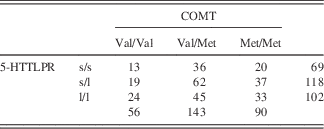
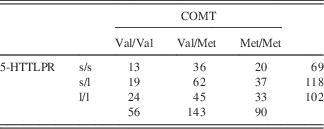
A total of 289 healthy female students aged 18 to 59 years (M=22.8; SD=4.6; median age 22 years) were recruited from a larger screening sample (n=624). All participants were Caucasian and native German speakers recruited at the local university. The students received course credit for their participation. They completed a screening questionnaire concerning demographic data and general information. Participants were excluded when they reported about suffering from any neuropsychiatric disease or were using psychoactive drugs. Buccal swabs were taken to genotype all participants for the 5-HTTLPR and COMT Met158Val polymorphisms. Table 1 shows the distribution of COMT and 5-HTTLPR genotypes. The study was performed in accordance with the 1964 Declaration of Helsinki and was approved by the Ethics Committee of the University of Graz. After complete description of the study, all subjects provided written informed consent.
Distribution of COMT and 5-HTTLPR genotypes
Psychometric Measures
Self-report Emotional Ability Scale (SEAS)
The SEAS (Freudenthaler & Neubauer, Reference Freudenthaler and Neubauer2005; see also Papousek et al., Reference Papousek, Freudenthaler and Schulter2008, Reference Papousek, Ruch, Freudenthaler, Kogler, Lang and Schulter2009, Reference Papousek, Freudenthaler and Schulter2011; Weiss et al., Reference Weiss, Schulter, Freudenthaler, Hofer, Pichler and Papousek2012) includes two subscales for the assessment of emotion perception and regulation in the intra-personal domain and two subscales for the assessment of emotion perception and regulation in the inter-personal domain, respectively: Perception of one’s own emotions (9 items, e.g., “It often takes a while for me to recognize my true feelings”, “When I am facing a tough task that I absolutely don’t want to fail at, I can easily estimate my fear of it”, Cronbach’s alpha in the present study α=.78), Regulation of one’s own emotions (6 items, e.g., “When I am scared of something I can barely do anything against it”, “It’s easy for me to get over a disappointing experience”, α=.77), Perception of the emotions of others (11 items, e.g., “I can tell immediately if a friend is worrying about something”, “Even in strangers I have no trouble recognizing insincere expressions of emotion”, α=.80), and Regulation of the emotions of others (11 items, e.g., “I can influence the mood of others very well”, “I have great trouble cheering up an acquaintance who has lost a person close to them”, α=.75). The items are rated on a six-point Likert scale (1–6). Lower scores on the SEAS scales indicate less effective emotion perception or regulation.
Genotyping
DNA extraction
DNA was extracted from individual saliva swabs using a modified Chelex method. 1.25 mL of a solution containing 5% Chelex (Biorad, Hercules, CA) and 200 µg/mL Proteinase K (Roche, Mannheim, Germany) were added to the saliva swab placed in a 1.5-mL microcentrifuge tube. The solution was incubated at 55°C for 30 min, vortexed, incubated at 90°C for 8 min, and finally centrifuged at 13,000×g for 5 min.
Genotyping of 5-HTTLPR
Polymerase chain reaction (PCR) amplification followed the protocol published by Hu et al. (Reference Hu, Lipsky, Zhu, Akhtar, Taubman, Greenberg and Goldman2006) with modifications. It was conducted on an ABI GeneAmp PCR system 9700 (LT, Applied Biosystems/Life Technologies, Paisely, UK) thermal cycler with a total reaction volume of 10 µL containing 5 µL of TaqMan Universal PCR Master Mix (LT), 2.5 µg of non-acetylated bovine serum albumin (Sigma-Aldrich, St. Louis, MO), 4% (v/v) dimethyl sulfoxide (both Sigma-Aldrich), 100 nM primer HTTLPR_F: GCAACCTCCCAGCAACTCCCTGTA, 100 nM primer HTTLPR_R: GAGGTGCAGGGGGATGCTGGAA (both Microsynth, Balgach, Switzerland), and 2 µL sample DNA. The thermal cycling protocol suggested an initial denaturation step at 95°C for 10 min, 40 cycles of 96°C for 15 s and 62.5°C for 90s, and a final extension step at 62.5°C for 30 min. Laser induced fluorescence capillary electrophoretic separation of the PCR products was performed on an ABI Prism 3100 Genetic Analyzer (LT) using POP6, 36 cm capillary arrays, and default instrument settings. Before electrophoresis, 2 µL of PCR product were heat-denatured in 20 µL of deionized formamide. Amplicon-length determination was based on the GeneScan-500 LIZ internal size standard (LT). Raw data were recorded and analyzed with the ABI Prism 3100 Genetic Analyzer data collection (v 1.1) and the Genotyper (v 3.6 NT) softwares (both LT).
Genotyping of COMT Val158Met (rs4680)
For the molecular genetic analysis of the human COMT Val158Met polymorphism the high resolution melting (HRM) curve profiles of short PCR amplicons were analyzed. In a pre-study, by this approach 99.5% concordant genotype inferences were obtained for a set of 189 samples with known rs4680 genotype. Due to an additional sequence variant (Y) in the amplicon, a single sample was attributed erroneously the A/A (Met/Met) instead of the actual G/A (Val/Met) rs4680 genotype.
PCR amplification and subsequent HRM analysis were conducted in a homogeneous assay format on a Rotor-Gene Q real-time PCR cycler (Qiagen, Hilden, Germany). The amplification cocktail had a total volume of 20 µL and consisted of 1× Type-it HRM PCR master mix (Qiagen), 250 nM primer COMT-F-44 (5′-CCGACTGTGCCGCCATCAC-3′), 250 nM primer COMT-R+27 (5′-GTCAGGCATGCACACCTTGTCCTTCA-3′, both Microsynth, Balgach, Switzerland; Oberacher et al., Reference Oberacher, Pitterl, Niederstätter, Weiss, Stadelmann, Marksteiner and Parson2006), 5 µg of non-acetylated bovine serum albumin, and 2 µL of DNA extract.
The cycler protocol used for amplification comprised an initial denaturation step at 95°C for 5 min followed by 40 cycles of 95°C for 15s and 68°C for 45s. The final extension step (68°C) was extended by 10 min. To identify samples featuring exceptionally low or high template molecule concentrations and/or aberrant amplification plots, PCR kinetics was determined by the on-line recording of the signal emitted by the bound double-stranded DNA specific EvaGreen fluorescent dye. Following amplification, the PCR products (71 bp) were subjected to a temperature ramp from 68°C to 95°C (0.1°C increments) without any prior manipulations. EvaGreen fluorescence was continuously recorded to monitor DNA strand dissociation kinetics. For the automated COMT Val158Met genotype calling from the HRM data of unknown samples, the Rotor-Gene Screen-Clust HRM software (v 1.10.1.2, Qiagen; Reja et al., Reference Reja, Kwok, Stone, Yang, Missel, Menzel and Bassam2010) was run in the supervised analysis mode. The dissociation curves obtained for a set of samples with known COMT Val158Met genotypes were used as controls for the underlying linear discriminant analysis.
Statistical Analysis
The relationships between the genotypes and the self-estimated effectiveness of emotion perception and regulation were assessed using four two-way analyses of variance, using the COMT genotype and the 5-HTTLPR genotype as between-subjects factors, and intra-personal perception, intra-personal regulation, inter-personal perception, and inter-personal regulation as the dependent variables, respectively. The effects of the two genotypes were simultaneously analyzed in one analysis to be able to test the effect of the COMT genotype independently of the 5-HTTLPR genotype and vice versa A two-tailed significance level of p <.05 was used for all analyses.
Results
Intra-personal Domain
The analyses of variance yielded a significant main effect of COMT genotype on emotion regulation (F 2,280=4.0; p=.02; η p²=.027; perception F 2,280=0.1; p=.91) and a significant main effect of 5-HTTLPR genotype on emotion perception (F 2,280=3.2; p=.04; η p²=.022; regulation F 2,280=0.2; p=.98). There were no detectable interaction effects between the COMT and 5-HTTLPR genotypes (perception: F 4,280=1.8; p=.13; regulation: F 4,280=0.6; p=.65). Means and standard deviations for the main effects of COMT and 5-HTTLPR are shown in Table 2. Participants in the COMT Val/Val group had the lowest scores on emotion regulation as compared to participants carrying one or two Met alleles. Scores on intra-personal emotion perception were lowest in the 5-HTTLPR s/s group, and highest in the s/l group.
Effects of COMT and 5-HTTLPR on the self-estimated effectiveness of emotion perception and regulation in the intra-personal domain

Note. Means (SDs). The effect of COMT is significant for emotion regulation (p=.02). The effect of 5-HTTLPR is significant for emotion perception (p=.04).
Inter-personal Domain
Neither the COMT nor the 5-HTTLPR genotype showed a statistically significant effect on inter-personal emotion perception (F 2,280=0.3; p=.71; F 2,280=0.2; p=.83) or regulation (F 2,280=0.6; p=.54; F 2,280=0.1; p=.87) (interaction: perception F 4,280=0.3; p=.86; regulation F 4,280=1.4; p=.24).
The four SEAS scales were only modestly inter-correlated (Table 3). Correlations with age were r=.15 (p=.01; intra-personal perception), r=.08 (p=.20; intra-personal regulation), r=.05 (p=.45; inter-personal perception), and r=-.04 (p=.54; inter-personal regulation).
Inter-correlations among SEAS scales

Note. Pearson correlations. All correlations p<.05, except intra-personal regulation - inter-personal perception.
Discussion
The present study showed an influence of the COMT genotype on the self-estimated effectiveness of emotion regulation and an influence of the 5-HTTLPR genotype on the self-estimated effectiveness of emotion perception in oneself. By contrast, no associations were found between the genotypes and emotion perception and regulation in the inter-personal domain.
Although the statistical effects of the genetic variants are only small in the current study, one has to keep in mind that specific genetic variants typically only account for very small amounts of variance in psychological traits. Even when all variants for which evidence suggests an effect are aggregated, the total variance explained typically does not exceed a few percent (DeYoung & Clark, Reference DeYoung and Clark2012). The most obvious cause for the small statistical effects is that many genes contribute to the production of a given psychological trait, so that the variation in any single contributing gene will necessarily produce only a very small effect. Additional explanations include epigenetic effects, epistasis, and gene-environment interactions (DeYoung & Clark, Reference DeYoung and Clark2012).
Influence of 5-HTTLPR - Polymorphism and COMT Val158Met - Polymorphism on Emotion Regulation and Perception in the Intra-personal Domain
Participants’ reports of effective emotion regulation in everyday life were associated with the COMT Met-allele, with participants homozygous for the Val-allele showing the lowest scores on this scale. This finding is in line with the importance of dopamine for executive functioning and putatively related top-down processes that are important not only in the cognitive domain but also in emotion regulation (Canli et al., Reference Canli, Ferri and Duman2009). Also in accordance with the present result, findings of several experimental studies showed associations of the Met allele with higher scores on behavioral variables that may be interpreted as indicators of effective emotion regulation (Amstadter et al., Reference Amstadter, Daughters, Macpherson, Reynolds, Danielson, Wang and Lejuez2012; Grossmann et al., Reference Grossmann, Johnson, Vaish, Hughes, Quinque, Stoneking and Friederici2011; Poletti et al., Reference Poletti, Radaelli, Cavallaro, Bosia, Lorenzi, Pirovano and Benedetti2013).
On the other hand, the association of the Met-allele with more effective emotion regulation may seem at odds with reports of higher anxiety and emotionality (Ducci & Goldman, Reference Ducci and Goldman2008; Enoch, Schuckit, Johnson, & Goldman Reference Enoch, Schuckit, Johnson and Goldman2003; Zubieta et al., Reference Zubieta, Heitzeg, Smith, Bueller, Xu, Xu and Goldman2003) as well as increased reactivity in limbic regions in response to negative stimuli (Drabant et al., Reference Drabant, Hariri, Meyer-Lindenberg, Munoz, Mattay, Kolachana and Weinberger2006; Smolka et al., Reference Smolka, Buhler, Schumann, Klein, Hu, Moayer and Heinz2007) in Met carriers. However, emotional responsivity and emotion regulation can be relatively independent processes (e.g., Key, Campbell, Bacon, & Gerin, Reference Key, Campbell, Bacon and Gerin2008).
Given the broad evidence of a 5-HTTLPR effect on the propensity to anxiety and depression (Karg, Burmeister, Shedden, & Sen, Reference Karg, Burmeister, Shedden and Sen2011; Minelli, Bonvicini, Scassellati, Sartori, & Gennarelli, Reference Minelli, Bonvicini, Scassellati, Sartori and Gennarelli2011), it may seem surprising that there was no effect of the 5-HTTLPR polymorphism on emotion regulation. One possible explanation for the null effect is that the 5-HTTLPR polymorphism may be related to heightened sensitivity to negative emotional cues rather than to emotion regulation processes as such. Neuroscientific findings indicated heightened amygdala activation in response to laboratory stimuli (Murphy et al., Reference Murphy, Norbury, Godlewska, Cowen, Mannie, Harmer and Munafò2013) as well as a propensity to experience withdrawal oriented affect in response to negative emotion cues in the environment (Papousek, Reiser, et al., Reference Papousek, Reiser, Schulter, Fink, Holmes, Niederstätter and Weiss2013) in s/s homozygotes (who are also more prone to anxiety and depression) than in l-carriers.
The association of the serotonin-related 5-HTTLPR genotype with emotion perception of the individual’s own emotions appears to be more complex. Both homozygous groups rated their intra-personal emotion perception less effective than participants in the heterozygous s/l group. The very sparse literature on potential serotonergic effects on the perception of emotions in oneself revealed variegated findings. Some authors suggested that the short allele may be linked with greater emotional reactivity and difficulties in identifying one’s own feelings (Bamonti et al., Reference Bamonti, Heisel, Topciu, Franus, Talbot and Duberstein2010; Gyurak et al., Reference Gyurak, Haase, Sze, Goodkind, Coppola, Lane and Miller2013; Kim et al., Reference Kim, Kang, Namkoong and Song2011). On the other hand, Kano et al. (Reference Kano, Mizuno, Kawano, Aoki, Kanazawa and Fukudo2012) found that homozygosity for the long allele of the 5-HTTLPR polymorphism was associated with higher scores on one subscale of the Toronto Alexithymia Scale, namely the subscale: difficulty identifying feelings. However, one has to keep in mind that several methodological and conceptional issues limit the comparison of these studies. All studies seeking to elucidate the relationship between serotonin levels or serotonin-related genes and emotional competency used different measurements such as empathic/emotional responding in socially embedded contexts (Gyurak et al., Reference Gyurak, Haase, Sze, Goodkind, Coppola, Lane and Miller2013), or self-report scales such as the Trait Meta Mood Scale (Kim et al., Reference Kim, Kang, Namkoong and Song2011) or the Toronto Alexithymia Scale (Kano et al., Reference Kano, Mizuno, Kawano, Aoki, Kanazawa and Fukudo2012). Furthermore, inconsistent findings may result from sample heterogeneities. Previous studies have shown considerable variations in the distribution of the 5-HTTLPR alleles among men and women (Brummet et al., Reference Brummett, Boyle, Siegler, Kuhn, Ashley-Koch, Jonassaint and Williams2008; Mizuno et al., Reference Mizuno, Aoki, Shimada, Inoue, Nakaya, Takahashi and Fukudo2006; Stoltenberg & Vandever, Reference Stoltenberg and Vandever2010) as well as cultures (Chiao & Blizinsky Reference Chiao and Blizinsky2010; Hennings, Zill, & Rief, Reference Hennings, Zill and Rief2009). Therefore, more research is needed to extrapolate the relationship between the serotonin transporter polymorphism and emotion perception in the intra-personal domain.
Influence of 5-HTTLPR - Polymorphism and COMT Val158Met - Polymorphism on Emotion Regulation and Perception in the Inter-personal Domain
In contrast to emotion perception and regulation in the intra-personal domain, the present study showed no influences of the COMT and 5-HTTLPR genotypes on the self-rated effectiveness of the perception and regulation of emotions in other people. In studies using performance tests of emotion recognition, associations with COMT and 5-HTTLPR were moderated by the type or valence of emotions (e.g., Antypa et al., Reference Antypa, Cerit, Kruijt, Verhoeven and Van der Does2011; Defrancesco et al., Reference Defrancesco, Niederstätter, Parson, Oberacher, Hinterhuber, Canazei and Marksteiner2011; Weiss et al., Reference Weiss, Stadelmann, Kohler, Brensinger, Nolan, Oberacher and Marksteiner2007). The emotion perception scale applied in the present study does not differentiate between different types of emotion. A further important difference compared to performance measures of emotion recognition ability is that, in most ability tests, cognitive reasoning in terms of Theory of Mind plays some role, whereas the applied measure of emotion perception may relate to a more global susceptibility to the emotions of others, encompassing processes that are more automatic and emotional in nature (Freudenthaler & Papousek, Reference Freudenthaler and Papousek2013; Qualter, Barlow, & Stylianou, Reference Qualter, Barlow and Stylianou2011). For instance, higher scores on the used inter-personal emotion perception scale were related to more pronounced cardiac responses to incoming social-emotional information indicating enhanced attention and heightened perceptual processing as well as to an EEG indicator of heightened susceptibility to social-emotional perceptual input (Papousek, Weiss, et al., Reference Papousek, Weiss, Reiser, Schulter, Freudenthaler and Lackner2013). Moreover, self-reported tendencies to effectively perceive the emotions of others were shown to moderate the impact of experimental contagion, which is an automatic process with little cognitive contribution (Papousek et al., Reference Papousek, Freudenthaler and Schulter2008, Reference Papousek, Freudenthaler and Schulter2011).
A limitation of the current study is that the sample was all female with a high level of education and all Caucasian, which may raise the issue of generalizability of the findings and points to the need for replication. We decided to use a female-only sample for the present study because several studies in the psychometric research tradition reported sex-differences in emotion perception and regulation with women showing higher scores in the inter-personal domain (e.g., Brackett & Mayer, Reference Brackett and Mayer2003; Dawda & Hart, Reference Dawda and Hart2000; Day & Carroll, Reference Day and Carroll2004; Freudenthaler, Neubauer, & Haller, Reference Freudenthaler, Neubauer and Haller2008; Saklofske, Austin, & Minski, Reference Saklofske, Austin and Minski2003), whereas men scored higher on measures in the intra-personal domain, especially on emotion regulation (e.g., Bar-On, Brown, Kircaldy, & Thomé, Reference Bar-On, Brown, Kircaldy and Thomé2000; Dawda & Hart, Reference Dawda and Hart2000; Extremera, Durán, & Rey, Reference Extremera, Durán and Rey2007; Freudenthaler, Neubauer, & Haller, Reference Freudenthaler, Neubauer and Haller2008; Mikolajczak, Luminet, Leroy, & Roy, Reference Mikolajczak, Luminet, Leroy and Roy2007). Additionally, sex differences in the genetic architecture of many human traits, psychiatric phenotypes, and brain functions are well addressed in the literature, and accumulating evidence showed that COMT and 5-HTTLPR have markedly sexually dimorphic effects on brain function and brain dysfunction in psychiatric disorders (Brummett et al., Reference Brummett, Boyle, Siegler, Kuhn, Ashley-Koch, Jonassaint and Williams2008; Stoltenberg & Vandever, Reference Stoltenberg and Vandever2010; for a review, see Harrison & Tunbridge, Reference Harrison and Tunbridge2008).
Another limitation of the study is that the used self-report scales are quite but certainly not entirely specific with regard to the assessment of emotion perception and regulation. For instance, the used intra-personal emotion regulation scale does not allow to capture emotion regulation completely independently from emotional reactivity (which is generally a difficult task): An EEG study showed that the intra-personal emotion regulation scale captures mainly variance related to the recovery from emotional arousal but also interacts with inter-personal emotion perception in determining the reactivity to a social-emotional stimulus (Papousek et al., Reference Papousek, Freudenthaler and Schulter2011).
In conclusion, the results of the present study indicate that, in healthy adult women, genetic variants of the COMT and 5-HTTLPR genes are differentially associated with specific measures of the self-estimated effectiveness of an individual’s emotion perception and regulation in the intra-personal domain. Participants’ reports of effective emotion regulation in everyday life were associated with the COMT Met-allele, emphasizing the importance of dopamine for executive functioning such as top-down processes that are important not only in the cognitive domain but also in emotion regulation. On the other hand, self-estimated effectiveness of emotion perception of the individual’s own emotions was related to the 5-HTTLPR with best performance for participants in the heterozygous s/l group. More wide-ranging conclusions should be made with caution until the findings are confirmed in independent studies. Additionally, further studies are warranted, especially in clinical populations such as schizophrenia and depression, to clarify the complex neurobiological processes that underlie emotion processing impairments in such psychopathologies.
Acknowledgments
Conflicts of Interest and Source of Funding: none