Medicare is one of the largest social programs in the world. Did organized industry favor Medicare's passage in 1965? If it did, this would represent powerful evidence in favor of the theory that social programs typically require cross-class alliances to pass, such as alliances between business and labor. However, in a previous article in this journal, I argued that answering questions about political actors’ preferences—such as whether organized industry favored Medicare's passage—can be surprisingly difficult due to the “problem of preferences”; that is, political actors might misrepresent their true policy preferences for many reasons.Footnote 1 For example, when their ideal proposals are not politically feasible, political actors may wish to bolster support for a more politically viable alternative to a disliked proposal—even if they do not truly support this alternative to the status quo.Footnote 2 To better understand political actors’ true policy preferences, I argued, scholars should trace how those actors’ expressed preferences change as a function of their strategic context—just as scholars seeking to understand the impact of any other variable trace the effects of changes in it.
I illustrated this argument in the case of Medicare's passage. With evidence from eight historical archives, original interviews, and previously sealed Congressional hearings, my article showed that a broad spectrum of business organizations and allies—including House Ways and Means Committee Chairman Wilbur Mills, Ranking Member John Byrnes, the U.S. Chamber of Commerce and its state equivalents, and the National Association of Manufacturers (NAM)—shifted their expressed positions on Medicare as their strategic contexts changed. Most importantly, after the decisive 1964 election gave Democrats large majorities in Congress, it was clear Medicare would pass in some form. As a result, many businesses and business organizations that had expressed complete opposition to Medicare in any form just months before turned on a dime and expressed sympathy for the proposal in early 1965, focusing their energies on arguing for modifications or more palatable alternatives to insuring the aged.Footnote 3 I likewise traced how key business-friendly politicians John Byrnes and Wilbur Mills changed their expressed preferences and legislative strategies after the 1964 election and as they dealt with different audiences, offering a clear picture that neither perceived business interests as favoring the Medicare plan that passed. The correct conclusion to draw from the evidence, I argued, was that “key business groups and their allies did not truly favor the [Medicare] program” that Congress passed to the status quo.Footnote 4
As an example of how political actors’ preferences might be misunderstood if one did not attend to the problem of preferences, I also considered how a 2006 essay by Peter Swenson interpreted some of this evidence.Footnote 5 In this 2006 essay, Swenson noted that some business allies supported some Medicare-like proposals in 1965. Swenson therefore concluded that Medicare was “hardly a victory of labor and liberals over big business” and instead passed due to a “cross-class” alliance between business and traditional liberal forces.Footnote 6 However, I showed that the very same business-aligned politicians and organizations that Swenson argued had entered into a cross-class alliance to pass Medicare had in fact expressed total opposition to Medicare when its passage was less assured just prior to the November 1964 election. It is implausible that business's true policy preferences or interests shifted radically enough over the course of these few months. Moreover, much other evidence I presented was likewise consistent with business and its allies primarily seeking to limit the unacceptability of whatever Medicare program would pass, not truly preferring Medicare's passage. Thus, I argued, Swenson's essay came to the incorrect conclusion that business favored Medicare's passage to the status quo because it failed to attend to the problem of preferences when interpreting business behavior in 1965.Footnote 7 This helped demonstrate my broader argument that scholars must attend to the problem of preferences when seeking to understand whose political preferences are really being satisfied when laws change.
I appreciate the editors of SAPD inviting me to comment on Swenson's new article, “Misrepresented Interests,” which seeks to further critique the view that organized industry did not favor Medicare's passage.Footnote 8 Swenson's article claims to locate “extensive evidence” of “enormous division within business” about Medicare and “a great deal of support from large and powerful corporations” for it. However, careful readers of Swenson's article will be disappointed that there is little such evidence his article adduces. In this article, I provide a closer inspection of the empirical evidence Swenson's article draws on and argue that this evidence does little to prove its claims. I also provide a broader discussion of how to ascertain business's interests and political preferences.
First, Swenson's article again neglects the problem of preferences—failing to consider the strategic context from which its evidence was drawn. For example, when business groups made statements to Congress asking for specific changes to the Medicare bill, Swenson's article interprets their failure to express opposition to the overall bill as implicit support or indifference to it. However, the historical record shows that just months before, when the political environment was less favorable to Medicare, many of these same individuals openly opposed the very concept of Medicare.
Swenson's article also reads far too much into the other limited evidence it does present. For example, the article implies that because some businesspeople who had favored Nixon over Kennedy in 1960 then favored LBJ over Goldwater in 1964, they must have been attracted to LBJ's Medicare proposal—even though Kennedy favored Medicare, too, and even though none of the sources that Swenson's article cites name Medicare as a reason for these shifts. Nearly all of the evidence Swenson's article presents suffers from similar fatal shortcomings upon closer inspection. For example, in support of “enormous division” within business, Swenson's article cites secondary work that relies on unsourced anecdotes that in fact suggest such division was atypical. In all, then, there is little in Swenson's article that should change conventional wisdom about Medicare as largely not supported by business.
Swenson also argues that “facts about economic interests” (p. 3, emphasis in original; all parenthetical page references in the text are citing Swenson, “Misrepresented Interests”) should be regarded as more reliable than facts about political actors’ revealed policy preferences, given the difficulty in ascertaining actors’ true policy preferences. However, as I discuss, it is often even more difficult to understand what is in actors’ economic interests—as exemplified by the fact that it remains unclear, and would be extremely difficult to definitively determine, whether Medicare was in large business's interest or not.
In the pages that follow, I will summarize Swenson's article's claims and the flaws in them, and then conclude with a broader discussion of the broader theoretical and methodological issues at hand.
SWENSON'S CLAIMS
Swenson: The NAM's position is uninformative about broader business sentiment
Swenson's article implies that the core of my 2012 article's case rested on demonstrating the NAM's opposition to Medicare, implying that my 2012 article therefore provides little evidentiary value because the NAM was unrepresentative of broader business sentiment. However, Swenson's article neglects to mention that the reason my 2012 article considered the NAM as one of several cases was because Swenson had previously held up an NAM official's statements about Medicare as key evidence that Medicare was business-supported. Indeed, a statement by an NAM official constituted the core of Swenson's own previous argument about business support for Medicare.
In particular, in a 2006 essay, Swenson discussed a letter a NAM official sent to Ways and Means Committee Ranking Member Republican John Byrnes. The letter deemed Byrnes's “Bettercare” proposal worthy of “strong[] support by industry.”Footnote 9 Swenson notes that Byrnes distributed this NAM “letter of approval” to fellow Republicans on the Ways and Means Committee.Footnote 10 Swenson interprets these events as indicating that business preferred Byrnes's proposal to the status quo and that Byrnes was taking steps to “assure[] himself and then fellow Republicans that what they were doing was good for business.” Byrnes's NAM-approved “Bettercare” proposal was incorporated into the final Medicare bill, meaning a business-supported proposal was present in the final act. Swenson therefore concluded that Medicare was “hardly a victory of labor and liberals over big business” and instead represented a “cross-class” alliance.Footnote 11
My 2012 article pointed out two issues with this reasoning.Footnote 12 First, everyone at the time understood that Byrnes's proposal was intended as a less unpalatable “substitute” for the Johnson administration's proposal, not as the addition that Wilbur Mills made it (to Byrnes's surprise). That the NAM supported Byrnes's efforts to offer an alternative to President Lyndon Johnson's Medicare plan does not indicate that the NAM truly preferred this alternative to the status quo, only that it preferred this alternative to Medicare. Second, the NAM likely did not prefer it to the status quo, as the NAM explicitly opposed any form of medical care for the aged whatsoever before the 1964 election necessitated Medicare opponents offer an alternative (see Table 2 in my 2012 article).Footnote 13
Swenson's latest article implies that my demonstration of this second point about the flaws in Swenson's evidence about the NAM's preferences in fact constituted the core of my own case that business opposed Medicare, implying that I mistook the NAM to be representative of business at large. My article in fact considered a wide array of evidence and not only evidence from the NAM. Ironically, however, Swenson's own previous essay does regard an NAM representative's “letter of approval” for “Bettercare” as the key smoking gun indicative of business support for Medicare in general.Footnote 14 As a result, if we accept Swenson's latest article's claim that NAM officials’ views were in fact uninformative about broader business sentiment, one of the few slender reeds supporting Swenson's own case that business favored Medicare—an NAM official's support for Byrnes's “Bettercare”—collapses.
Swenson: That twenty-two state Chambers of Commerce did not sign onto a letter from the Council of State Chambers of Commerce opposing Medicare supports the presence of “enormous division within business.”
Swenson is right to point out that the Chamber of Commerce was regarded as more representative of broader business sentiment than the NAM and engaged in extensive efforts to ensure that its stances reflected the will of its members.Footnote 15 Moreover, Swenson does not dispute the clear historical record that the national Chamber of Commerce and a majority of State Chambers of Commerce opposed Medicare. However, he notes that twenty-two state Chambers of Commerce did not sign on to a statement the Council of State Chambers of Commerce made to Congress opposing Medicare (p. 10). Swenson implies that their absence suggests the presence of division among state Chambers of Commerce.
Those hoping Swenson's article will make good on its promise to provide “extensive evidence” of “enormous division within business” with this example, however, will be disappointed to learn that Swenson's article does not document any such division or support among even one of these twenty-two state chambers. Moreover, other evidence shows that many of these twenty-two state chambers clearly opposed Medicare: For example, cursory searches of newspapers and the Congressional record reveal that within the three years prior to Medicare's passage, state chambers or their spokespeople in California,Footnote 16 Illinois,Footnote 17 and LouisianaFootnote 18 voiced opposition to Medicare, including during the very same Congressional hearings where Swenson erroneously claims that their voices were absent.Footnote 19 (State chambers also did not appear to exist at the time in Nevada, New Hampshire, Oregon, Rhode Island, and Vermont.Footnote 20) Why some clearly opposed state chambers did not sign onto the council's letter to Congress we do not know. However, the clear opposition of several of these missing state chambers shows that states chambers’ nonappearance among the signatories does not indicate that they supported or were indifferent to Medicare. As a result, the council's letter hardly provides “extensive evidence” of “enormous division” among them.
Swenson: Business Week ran an editorial favoring Medicare.
Vogel's Fluctuating Fortunes cites a Business Week editorial that supported Medicare.Footnote 21 Swenson's essay seizes upon this find, but it is difficult to know what to conclude about business sentiment more broadly from the opinions of the one individual who presumably wrote this editorial, Business Week editor Elliott V. Bell. Swenson asserts that Bell's editorials were a “bellwether of business sentiment” (p. 6). However, Swenson's article offers no support for its claim that one individual's opinions would reliably inform us about broader business sentiment, despite also rejecting that the opinions of a majority of state Chambers of Commerce are informative about it.Footnote 22
Moreover, a look at other business-friendly publications does not confirm Swenson's suspicion that business publications were leading a chorus of support for Medicare. For example, Fortune ran a detailed article by Harold B. Meyers in May 1963 entitled “‘Medicare,’ the Cure That Could Cause a Setback”Footnote 23 that criticized many of the proposed features of Medicare that were later passed into law, arguing for a means-tested, privately administered system with no taxes on employers. Likewise, the Wall Street Journal’s editorial page expressed concern about Medicare on multiple occasions.Footnote 24
Swenson: Business supported LBJ's election in 1964 more strongly than they supported Kennedy's election in 1960.
It is unclear what we should conclude about business support for Medicare from this. Of the many reasons given for business's stronger support for LBJ than for Kennedy in the secondary sources Swenson's article cites, LBJ's support of Medicare is never mentioned. Nor is there any reason to think it would be: Kennedy also supported Medicare.
The sources Swenson's article cites do, however, offer many reasons beyond Medicare why businesspeople who did not support Kennedy in 1960 might have supported Johnson in 1964 or acted kindly toward him as president. For example, Johnson was the clear favorite headed into the 1964 election; businesses understood there was “an excellent outlook for an overwhelming Johnson victory.”Footnote 25 It is well known that businesses often donate to politicians likely to win reelection even if they do not support all their policies in order to gain access to and influence with them.Footnote 26 In addition, Johnson pursued many other pro-business policies. As another example, Vogel indicates that the clearest explanation for the change in attitudes of many business executives toward LBJ was their support for the Johnson tax cut of 1964.Footnote 27 Likewise, the article in Fortune that Swenson cites—penned by the same Medicare skeptic Harold B. Meyers referenced above—indicates that many businesspeople supported Johnson because of his efforts to reduce federal spending, a sentiment that hardly indicates business support for welfare state expansion. That article likewise makes no mention of Medicare.Footnote 28 As a final example, one of the other sources Swenson cites, a book by legendary journalists Evans and Novak, argues that businesspeople's not unreasonable fear of a destabilizing Goldwater presidency is what led some of them to support Johnson.Footnote 29
More broadly, Swenson's essay seems to imply that business's stronger support for LBJ's election than Kennedy's implies that business must have favored all of LBJ's proposed policies, including Medicare. This is obviously not the case.Footnote 30
Swenson: John Byrnes said Medicare would benefit GM.
In 1967, an oral historian asked Congressman John Byrnes whether he thought “the attitude of larger corporations in particular” was “particularly hostile to the Medicare bill.” The historian named General Motors (GM) as an example—a natural company for Byrnes to speak to given that Byrnes represented eastern Wisconsin. Seeming to refer to GM specifically,Footnote 31 Byrnes replied that GM was not “particularly hostile” to Medicare, although he thought they “had a rather more moderate attitude” than others. Next, Byrnes says that this may have been because Medicare “would have relieved” GM of retiree health costs, a comment Swenson appears to regard as a smoking gun for business support for Medicare.Footnote 32
Byrnes's full remarks are less supportive of Swenson's article's argument, however. In the same breath as the words Swenson's article quotes, Byrnes also says that “it wasn't particularly relieving” GM and that GM thought “they weren't going to gain anything” from Medicare because they thought unions would bargain for another benefit to be put in its place—sentiments of equivocation Swenson neglects to mention.Footnote 33 Byrnes thus appears to say GM was unique in being nearly indifferent toward Medicare and that it did not see clear net benefits to its passage. Byrnes also does not characterize GM as being particularly persuaded by Swenson's logic about being relieved of their retiree health obligations. Byrnes's interview is thus another example where a closer look at Swenson's article's evidence in fact undermines its case.Footnote 34
Finally, as a reminder, the broader question at issue is whether business indifference or support for Medicare was a necessary condition for its passage. Not only do Byrnes's comments fail to demonstrate that business support or indifference existed to any significant degree, they fail to show that the relevant politicians perceived any such support or indifference: Democrats, not Republicans like Byrnes, were responsible for passing Medicare, and so it is their perceptions of business, not Republicans’, that are theoretically relevant. That one Republican who opposed Medicare saw one large business as possibly indifferent is hardly a smoking gun that the Democrats who passed Medicare—and who had favored it since long before Swenson argues that business interests shifted—did so because they did not perceive business as opposed. Swenson's article offers no evidence that the congressional Democrats responsible for Medicare's passage perceived business indifference or support, much less that they finally passed Medicare in 1965 because they came to have this perception in the mid-1960s—unlikely given that Democrats had been trying to pass the proposal since long before Swenson's article argues that a business interest shift occurred.
Swenson: Medicare was in large corporations’ interest.
Swenson's article seeks to sidestep the mountain of troubling empirical evidence for its argument by arguing that, instead of attending to it, “above all, facts about economic interests are needed to help sort out the tricky inferential problems involved in preference attribution” (p. 3). However, with respect to the narrow question of Medicare, the article fails to engage in a thorough accounting of these interests—in particular, it neglects to consider whether the benefits of Medicare would have exceeded the costs to big businesses in additional taxes. Although Swenson's article notes some of the benefits that might have accrued to some businesses from socializing their retiree health burdens, it never seriously considers what the costs of Medicare's new taxes would have been, a necessary precondition for making a credible claim that the benefits would have exceeded the costs. Swenson argues that the benefits from Medicare to business grew over time as retiree populations swelled, but as Americans lived longer, the costs of supporting the Medicare program in taxes would have risen over time, too.
In support of the notion that Medicare's benefits would have exceeded its costs, Swenson cites letters and memoranda from the United Automobile Workers (UAW) and Blue Cross Blue Shield that argue the Big 3 automakers would benefit from Medicare's passage (p. 8). The UAW and Blue Cross Blue Shield's opinions say little about whether automakers agreed with their analysis of the situation. Given that the UAW was a strong supporter of Medicare, it is also hard to regard the UAW's analysis of employers’ finances as objective. Likewise, Blue Cross Blue Shield stood to gain considerably from some versions of Medicare under consideration at the time, which would have administered the program through them.
It is also hard to square the evidence we do have with the notion that a business interest shift in favor of Medicare is what led to its passage in 1965. In particular, the very short time that had elapsed between when business-affiliated groups nearly unanimously opposed Medicare in late 1964 and when many changed their tune in early 1965 makes it implausible that a large “interest shift” was responsible for their changing tune in early 1965; there were no dramatic changes in economic conditions in just those few months. Swenson's article argues that business interests were shifting in favor of Medicare during this time. It may or may not be that a Medicare proposal would have been less problematic for business in 1965 than in 1955; but any such gradual changes in economic conditions cannot account for why so many business organizations and their allies changed their new attitude about Medicare in the months just before and after the November 1964 election.
As a more general theoretical matter, considering Swenson's argument that “above all, facts about economic interests are needed to help sort out the tricky inferential problems involved in preference attribution” (p. 3, emphasis in original), there clearly can be value in trying to understand what is in political actors’ economic interest. However, third parties’ true interests are often difficult to ascertain; entire subfields of economics are devoted to understanding the long-run, general equilibrium effects of government policy on firms, which often fail to reach clear answers.
As an example of this difficulty, consider Swenson's article's argument that Medicare would have advantaged large businesses in particular by socializing their retiree health obligations, a burden their small business competitors had typically not taken on. It is plausible that large businesses would have benefited from retiree health plans being socialized, but it is also plausible that this would have damaged them. Suppose large businesses were uniquely positioned to offer retiree health programs because they could pool risk across a large base of retirees in a way small businesses could not, allowing them to offer a benefit that would attract workers from small business competitors in the tight labor market of the mid-1960s. Medicare might plausibly remove this advantage, undermining large business's ability to compete with small businesses in the labor market. The point of this example is not to make a strong claim in either direction, but simply that it is rarely straightforward to ascertain facts about actors’ economic interests—and that it may well be much more difficult than ascertaining facts about their revealed preferences, despite the problem of preferences.
Whether scholars’ judgments about interest groups’ economic interests should be placed “above” determinations about their revealed preferences as a general matter, as Swenson's article argues, is thus not obvious and will depend on the details of the case.Footnote 35 For example, in the case of Medicare, the historical evidence that Swenson, myself, and others have presented is very limited on the question of interests: it is unclear, and will probably always be unclear, whether Medicare's benefits to large businesses were even positive and whether, even if they were positive, they were large enough to exceed the costs. By contrast, the evidence is relatively clear on the question of business's revealed preferences: Businesses almost universally were not seeking to support Medicare's passage.
Swenson: Some business groups gave statements about Medicare to Congress that did not explicitly oppose Medicare.
During Congressional hearings in 1965, when all expected Medicare would pass in some form, several business groups gave statements to Congress that did not explicitly oppose Medicare—instead expressing no position in their remarks—but instead asked for specific provisions of the proposal to be changed. The NAM, however, remained explicitly opposed to Medicare in its testimony to Congress. Swenson infers from this difference in approach that those whose testimony focused on opposing specific provisions must have disagreed with the NAM's opposition to Medicare overall (pp. 13–14).
This reasoning suffers from two flaws. First, it again fails to attend to the problem of preferences by failing to consider how strategic context might have influenced these actors’ expressed preferences. In particular, in making this point Swenson's article again examines only testimony and expressed preferences from a time when a Medicare bill was assured to pass. But why would savvy businesses waste their limited time before Congress and risk damaging relationships with supportive members of Congress by expressing opposition to a proposal that was guaranteed to pass regardless of what they said? Even those strongly opposed to Medicare might reasonably conclude that they would make better use of their time before Congress by arguing for modifications that would reduce the bill's negative impacts rather than engaging in the fool's errand of arguing against the bill as a whole. Tracing how the very business actors Swenson names changed their stated preferences over time is consistent with this alternative interpretation.Footnote 36 My previous article likewise showed that several other organizations and individuals who gave statements like these asking for modifications had indicated total opposition to Medicare just months earlier, in 1964, when Medicare was less assured to pass.Footnote 37 This shows that asking for revisions to a proposal does not in fact indicate that one favors it to the status quo.
Second, to state the obvious, when political actors do not state their preferences about a proposal overall, one cannot simply infer that they support or are indifferent to the proposal. For example, Swenson singles out the California State Chamber of Commerce's letter to the Senate Finance Committee that focused on expressing opposition to just one provision and does not state a position on the overall bill. Swenson's article interprets this letter as indicating that the California Chamber was indifferent to or supported the overall bill. But we know that the California Chamber had opposed Medicare altogether not long before.Footnote 38
Swenson: Secondary sources claim business executives supported Medicare.
This is an exaggeration. First, Swenson's article cites three secondary sources—Epstein's Corporation in American Politics, Vogel's Fluctuating Fortunes, and a history of Medicare by Social Security historian Peter Corning—as indicating that the views on Medicare of rank-and-file businesses differed from the views of the NAM and Chamber of Commerce.Footnote 39 None of these secondary works cite sources. And none of them claim that support for Medicare was widespread or even common among rank-and-file businesses. For example, Epstein's book merely says that opposition to Medicare and support for right-to-work laws were “cited as examples” by some “corporate managers” as reasons they did not agree with the NAM and chamber on every issue, but no sense of magnitude is given.Footnote 40 If Epstein's statements about Medicare and right-to-work should lead us to accept Medicare as business-supported, it should also lead us to accept right-to-work laws as business-opposed, a dubious conclusion indicative of flawed reasoning. Unless Swenson seeks to disprove the straw man claim that not one person affiliated with business supported Medicare, these secondary works indicate little.Footnote 41
Next, Swenson's essay notes that a book published in 1964 about the Kennedy administration's relations with business did not mention Medicare (p. 6). Swenson's essay argues that this suggests business might have been indifferent toward Medicare. Again, as earlier, absence of evidence does not constitute much evidence.Footnote 42
Last, Swenson's essay cites an article in the Harvard Business Review from Harvard Business School Professor Theodore Levitt as indicating that some big business executives supported LBJ's social welfare programs (p. 7). That article, too, cites no sources and gives no sense of scale. It is also not about Medicare. Moreover, the editors of the Harvard Business Review even appeared to find Levitt's claim so non-obvious that they inserted a special inset in the magazine describing his thesis as “controversial” and noting that many readers might disagree with it.Footnote 43
Not only do these secondary sources fail to provide the endorsement of Swenson's thesis that he claims, other secondary sources explicitly contradict it. For example, in a different article published the following year, Levitt described Medicare in a list of programs he refers to as programs “business … fought.”Footnote 44 Likewise, McQuaid includes Medicare in a list of income support programs he calls a “real Waterloo” for “organized business.”Footnote 45 It is not the case that secondary literature describes Medicare as business-supported.
Swenson: Surveys seem to indicate rank-and-file business support for Medicare or at least indifference toward it
Swenson cites two contemporaneous surveys:
• Swenson cites (on p. 7) a Chamber of Commerce survey of local chambers reproduced in Donald Hall's Cooperative Lobbying.Footnote 46 The survey question reproduced does not ask whether respondents supported or opposed Medicare, but asked them merely to indicate whether various issues were of major, minor, or no interest. The results do not seem to indicate that these chambers were indifferent toward Medicare. Indeed, only 131 of 400 responses indicated that Medicare was of no interest; slightly more, 134 of 400, actually indicated that repeal of 14(b) (of Taft-Hartley) was of no interest, regarded as one of the most salient issues to business at the time. At times, Swenson's article scales back the claim that business supported Medicare's passage to merely that business was indifferent; the survey it cites here in fact indicates that most businesses were not indifferent.
• In my 2012 article, I cited a document the NAM prepared that indicated there was “strong opposition” to Medicare among respondents to a survey the NAM conducted of “American industry in eleven states of the northeastern United States.”Footnote 47 Swenson points to a second page of this document, which I did not originally examine, that lists percentages under a heading reading “% of Business Opposition” with Medicare listed as “36%.” However, it is not clear from the document what this number means; presumably the NAM would not describe this number as indicating “strong opposition” to Medicare among the sample if it implied that the remaining 64 percent of respondents supported Medicare. It is thus difficult to know what to conclude from this document. As in other areas, Swenson assumes that in this gap in the historical record there lies support for his argument; but, in light of the vague second page of this document, it is more appropriate to conclude this document tells us little that is definitive.
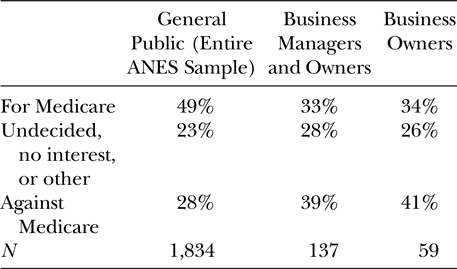
My prior critique of Swenson's 2006 essay was focused on how organized business's public statements might be misinterpreted, so I did not dwell on surveys of everyday businesspeople. As best I can tell neither Swenson's arguments nor mine turn on the opinions of everyday businesspeople. However, as Swenson's article dwells on surveys of such opinion, here I consider a more reliable source for it that is readily available. The 1964 American National Election Studies (ANES) Time Series Study asked respondents for their views on Medicare and for their occupations. Table 1 breaks out opinion among the general ANES sample, among those who identify as business owners and managers, and among only business owners. It shows that business owners were 15 percentage points less likely to support Medicare than the general public. Among the general public, supporters of Medicare outnumbered opponents by nearly two to one; among business people, opponents outnumbered supporters. This difference is statistically significant.Footnote 48
ANES 1964 Time Series Study

Notes. Collapses those who say they have made up their mind and those who say they have not (there are few in the latter category). Percentages may not total to 100 due to rounding.
These patterns are hardly indicative of a “cross-class alliance realignment … in favor of … Medicare.”Footnote 49 One cannot conclude anything about the opinions of executives of large businesses from these data, of course; but what these data does show is that there was not support for Medicare among everyday businesspeople whose sentiments might have been missed in sources that tend to record elite opinion, such as the Congressional record.
DISCUSSION
In conclusion, I will dwell on two lessons from our exchange.
First, substantively, Medicare represents a problematic case for theories of welfare state expansion that argue cross-class alliances between business and other forces like labor are important for such expansions to occur. Medicare is one of the largest social programs in the world, making its passage particularly important for satisfactory theories of welfare state expansion to explain. In a previous analysis of Medicare's passage, Swenson argued that Medicare's case strongly confirmed this theory, arguing that it only passed because of a “cross-class realignment of interests in favor of something like Medicare” and that “a decisive constituency” in passing it “was also big business.”Footnote 50 Swenson himself seems to have realized this analysis was in error, as his recent article at times revises this claim to be that “if there was a class war over Medicare, most on the capitalist side were non-combatants.” But even this weaker thesis Swenson's article struggles to persuasively support. Although Swenson's article promises to document “extensive evidence” of “enormous division within business” over Medicare, it offers no such evidence.
Characterizing the positions of a group as large and diverse as business is never easy, but Swenson's article offers us no reason to suspect that business's hostility to Medicare was anything but widespread. The only evidence Swenson offers that businesses were indifferent is Byrnes's comment that one business—GM—may have been indifferent, unlike other businesses. The only evidence Swenson's article offers that businesses supported Medicare comes from uncited anecdotes in secondary sources that refer to a few scattered business players. This evidence may disprove the straw man that every single businessperson opposed Medicare. It falls far short of indicating that the presence of meaningful business support or indifference.
More broadly, the historical evidence also fails to support the key mechanism in Swenson's theoretical argument, that businesses would favor Medicare's passage because it would reduce their retiree obligations. Swenson has produced essentially no evidence that this consideration was important to businesspeople at the time, save for the UAW's argument that it should have been important to business—even as John Byrnes explicitly indicated that GM did not see this consideration as particularly important. Swenson's article also does not present its own calculations of whether the savings to businesses would have exceeded their new costs in taxes. Nor did it present any evidence that the relevant politicians thought businesses would later realize that Medicare was in their interests after it passed.
Second, flaws in Swenson's empirical analysis also underscore the methodological perils of failing to explicitly account for the problem of preferences when seeking to understand whose political preferences are influencing political outcomes. First, as reviewed earlier and in my prior article on this topic, Medicare's passage shows how strategic context can influence how political actors represent their preferences. Just as we would never mistake contemporary politicians’ statements of support for a policy as indicative of their true policy preferences, neither should we mistake historical political actors’ statements about their policy preferences as accurately reflecting their genuine views. Medicare's passage offers a vivid example of this dynamic at work, given that important political actors dramatically changed their tunes within just months—changes that were too large and rapid for changes in their actual preferences or interests to explain, but that the changing political context produced by the 1964 election can readily explain. My earlier article provides many examples of this dynamic at work by examining evidence from both right before and right after the election. Swenson's latest article again focuses nearly exclusively on evidence from after the election. But, as I have written, to account for the influence of strategic context on actors’ expressed preferences, such as that introduced by an election, scholars must trace how actors’ expressed preferences vary as a function of changes in this context—just as scholars seeking to understand the impact of any other variable must trace the effects of changes in it.Footnote 51
Swenson's article also suggests additional cautions about how to accurately ascertain political actors’ preferences. First, Swenson's article assumes actors’ expressions of their preferences must be exhaustive—assuming, for example, that when individuals argue for changes to a bill and do not state their position on the bill, that must mean that they support it or are indifferent to it. Examples clearly contradict this logic. Swenson's article also relies on unsourced anecdotes in secondary sources for much of his argument; as I showed above, Medicare's case also illustrates the danger this poses.
Acknowledging that the problem of preferences presents “tricky” challenges, Swenson's article proposes an alternative, to analyze facts about economic interests instead. In some cases, such as in the case of steel tariffs, whether various actors would be economic winners or losers from a proposal may be relatively clear to both scholars and historical actors themselves. However, in many cases, the long-run, general equilibrium impact of a government policy on a firm is often very difficult for ascertain—even for the firm in question, let alone for scholars decades later. Medicare represents an example of this difficulty: Swenson's article offers one rationale for why Medicare might have benefited large businesses, but it is also plausible that it could have undermined their interests by the same rationale. Swenson's analysis also fails to provide an estimate of the costs of the proposal to determine whether the benefits exceeded them, perhaps because such costs would also be extremely difficult to estimate. As tricky as the problem of preferences is, in many cases it is eminently more feasible to ascertain political actors’ revealed preferences over policies than it is to reliably impute which policies would have benefited them most.
Medicare is such a case. Turning to the historical record to better understand business's own perceptions of its interests, a holistic read of Medicare's passage as a case does not offer support for the presence of appreciable business support for the program—and little for the view that business entered into a “cross-class alliance”Footnote 52 to help pass it.