More than a hundred years ago, Thorstein Veblen (Veblen, Reference Veblen1899) recognized that one of the goals that individuals pursue via their consumption choices is to signal their social status to others. Veblen suggested that individuals signal status by engaging in expensive leisure activities, or by purchasing luxury products. Such behavior, directed at the ostentatious display of wealth is referred to as “conspicuous consumption”. More recently, consumer psychologists have revisited this idea (e.g., Griskevicius et al., Reference Griskevicius, Tybur, Sundie, Cialdini, Miller and Kenrick2007), and provided a similar rationale, now complemented with insights from evolutionary biology. They suggest that engaging in lavish wealth displays, although wasteful, may be a manifestation of an evolutionary advantageous mechanism to signal one’s genetic quality. Signaling genetic quality is a central tool in the service of gaining social status and of successful mate attraction.
In line with these ideas, we predict that experiences that trigger mate attraction goals (Study 1: Exposure to others in bathing outfit) or status display goals (Study 2: Experiencing a vicarious victory of one’s favorite sports team) will increase people’s interest in luxury products. However, we demonstrate that is only the case for some individuals, who are predictably more responsive to those experiences than others. These individual differences in responsiveness to status-relevant experiences are grounded in a biological mechanism, more specifically prenatal exposure to testosterone.
Luxury consumption and status signaling
For a long time, biologists were puzzled by the costliness and the wastefulness of certain behavioral, anatomical, and physiological characteristics in animals, such as the peacock’s tail. Zahavi’s handicap principle (Zahavi, Reference Zahavi1975) provided a solution. These wasteful features, although they reduce survival chances (i.e., energy spent on these features cannot be spent on survival-related activities), might provide a wider evolutionary benefit, particularly in the context of sexual selection. Adaptive mate selection, in the service of producing healthy and strong offspring, involves a preference for partners of high genetic quality and physical health (Miller, Reference Miller2000; Miller & Todd, Reference Miller and Todd1998). Individuals cannot directly observe these underlying qualities, also referred to as “fitness”, in others, but they can recognize features that correlate with them (Zahavi & Zahavi, Reference Zahavi and Zahavi1997). Those features are called fitness indicators. To be diagnostic about underlying genetic quality, fitness indicators should be costly (in terms of producing a survival risk, or of investments of time or energy). Costly features are difficult to copy by individuals with a lower quality genetic make-up, and are therefore an honest signal of that quality: costly fitness indicators reduce survival chances, and therefore lower quality individuals cannot afford to carry them. For example, only healthy peacocks, with a good metabolism and which are free from disease are capable of sporting a heavy, highly visible tail and to survive until reaching reproductive age. This mechanism is called “costly signaling”.
Once certain features become reliable fitness indicators, recognized by other individuals, having those features improves one’s social status (i.e., the position in the social hierarchy). Social status reflects the capacity of an individual to impose costs on other individuals, and to dispense benefits to allies and mates (Boone, Reference Boone1998). The display of costly features advertises these capacities and determines ones position in the social ranking. From that perspective, status hierarchies represent social agreements, and exist to facilitate social interaction and to avoid costs of repeated, costly, contest competition (Maynard Smith & Price, Reference Maynard Smith and Price1973). In as far as costly signals are valued and recognized by others in the group as representing social status, they become status symbols. Achieving a higher social status implies a number of benefits, in terms of mate attraction, access to resources and alliance partners, and benefits to health and survival (Cummins, Reference Cummins2005; von Rueden, Gurven, & Kaplan, Reference von Rueden, Gurven and Kaplan2011). As a result, individuals are motivated to establish a high status position by showing off status symbols.
Recently, consumer psychologists have suggested that people’s interest in expensive luxury goods might be a current cultural manifestation of this mechanism in humans (Drèze & Nunes, Reference Drèze and Nunes2009; Griskevicius et al., Reference Griskevicius, Tybur, Sundie, Cialdini, Miller and Kenrick2007; Haselton, Mortezaie, Pillsworth, Bleske-Rechek, & Frederick, Reference Haselton, Mortezaie, Pillsworth, Bleske-Rechek and Frederick2007; Mandel, Petrova, & Cialdini, Reference Mandel, Petrova and Cialdini2006). In other words, people are interested in the acquisition and display of luxury goods, despite the fact that these do not have particular functional benefits, but because they are costly signals, whose acquisition and display produces status benefits. For example, individuals who experienced a lack of social power (Rucker & Galinsky, Reference Rucker and Galinsky2008), or who fantasize about future successes (Mandel et al., Reference Mandel, Petrova and Cialdini2006) had an increased desire for luxury goods, in an attempt to attain a higher status, or to signal status, respectively. Owning and displaying luxury goods does affect perceptions of wealth and status, and can lead to a number of social benefits. For example, in a series of studies, individuals displaying luxury goods were considered superior job candidates and deserving of a higher salary, their requests were more likely to be met with compliance, and they were treated more favorable by others, for example by receiving larger offers in a dictator game (Nelissen & Meijers, Reference Nelissen and Meijers2011).
The above reasoning suggests that desire for luxury consumption goods is triggered in settings in which social status is relevant. This is the case when individuals experience a threat to their social status position (Rucker & Galinsky, Reference Rucker and Galinsky2008) or when social status can be instrumental to reach one’s current goals. Because of the central role of status signaling in the context of mate attraction, as recognized by the costly signaling hypotheses, status concerns and the interest in luxury goods are triggered when a mate attraction goal is activated (Janssens et al., Reference Janssens, Pandelaere, van den Bergh, Millet, Lens and Roe2011; Lens, Driesmans, Pandelaere, & Janssens, Reference Lens, Driesmans, Pandelaere and Janssens2012).
In this paper, we test the hypothesis that status relevant experiences increase individual’s interest in luxury goods, in two settings. Additionally, we predict that contextual triggers of status display goals should not affect all individuals to the same extent.
Who wants to signal status?
Previous research has established that there are individual differences between people regarding their inclination to display social status. Some of these differences seem to be grounded in biological mechanisms (Miller, Tybur, & Jordan, Reference Miller, Tybur and Jordan2007; Stenstrom, Saad, Nepomuceno, & Mendenhall, Reference Stenstrom, Saad, Nepomuceno and Mendenhall2011). Notably, individual differences in testosterone levels seem to co-vary with competitive, dominant, and aggressive behavior (Archer, Reference Archer2006; Mazur & Booth, Reference Mazur and Booth1998). It seems that the role of testosterone in human social behavior is best understood in terms of the search for, and maintenance of, social status (Eisenegger, Haushofer, & Fehr, Reference Eisenegger, Haushofer and Fehr2011). Interestingly, previous research has identified a physiological measure (the ratio of the length of the index and ring finger, 2D:4D) that reflects differences in prenatal exposure to testosterone (Manning, Scutt, Wilson, & Lewis-Jones, Reference Manning, Scutt, Wilson and Lewis-Jones1998). Smaller 2D:4D (a shorter index finger, relative to the ring finger) is associated with increased testosterone exposure, both for males and females (Brown, Hines, Fane, & Breedlove, Reference Brown, Hines, Fane and Breedlove2002). A smaller 2D:4D is related to more competitive and dominant behavior later in life (Manning, Reference Manning2002; Ryckmans, Millet, & Warlop, Reference Ryckmans, Millet and Warlop2015; van der Meij, Almela, Buunk, Dubbs, & Salvador, Reference van der Meij, Almela, Buunk, Dubbs and Salvador2012) and to reproductive success in males, but not females (Manning et al., Reference Manning, Barley, Walton, Lewis-Jones, Trivers, Singh and Szwed2000). Even though previous research has documented a reliable gender difference in 2D:4D - on average, females have a higher 2D:4D ratio – studies have shown that the relationship between 2D:4D and competitive and dominant behavior exists for both genders, as expressed, for example, in athletic prowess (Hönekopp & Schuster, Reference Hönekopp and Schuster2010). In conclusion, to some extent, inter-individual variations in interest in social status are grounded in biological differences, and these differences can be observed by measuring 2D:4D.
Various studies have found that individual differences in 2D:4D are only expressed in behavior when triggered by status-relevant experiences, such as when one’s status is threatened, or in situations of high or lower power (Millet & Dewitte, Reference Millet and Dewitte2008; Ronay & von Hippel, Reference Ronay and von Hippel2010; Ryckmans et al., Reference Ryckmans, Millet and Warlop2015). Therefore, we predict that, if low 2D:4D individuals are more responsive to status-relevant cues (Josephs, Newman, Brown, & Beer, Reference Josephs, Newman, Brown and Beer2003), then differences in 2D:4D should moderate the effect of status-relevant experiences on individuals’ interest in signaling social status and luxury consumption. For low 2D:4D individuals, but not for high 2D:4D individuals, status relevant experiences will trigger an interest in luxury goods.
Hypotheses and current studies
We tested the hypothesis that status relevant experiences increase individuals’ interest in luxury goods, for low 2D:4D individuals, but not for high 2D:4D individuals, in two contexts. On the one hand, as mentioned earlier, social status concerns are relevant in situations in which a mate attraction goal is activated (Janssens et al., Reference Janssens, Pandelaere, van den Bergh, Millet, Lens and Roe2011; Lens et al., Reference Lens, Driesmans, Pandelaere and Janssens2012). Therefore, we chose to conduct a field study nearby a popular beach in a metropolitan area in the summertime, when the beach is frequented by a large number of sunbathers. Mere visual exposure to members of the opposite sex (in person or on photographs) triggers mate attraction goals, status considerations and status-oriented behavior (Roney, Reference Roney2003). We assumed that the same should occur for those about to arrive at the beach, when anticipating exposure to people of theirs and the opposite gender in bathing outfit. Goal activation and selection of action is essentially forward-looking, and determined by possible acts and outcomes in the future (Seligman, Railton, Baumeister, & Sripada, Reference Seligman, Railton, Baumeister and Sripada2013). Therefore we assume that for individuals on their way to the beach, mate attraction goals will be more likely to be activated than for those who are leaving the beach. The prospects and goals for the ones leaving will be likely of a very different type, related to what they were about to do next, and therefore the individuals in that group could be considered making up a control condition. We predicted that anticipated exposure to scarcely clothed others, for those on the way to the beach, would increase interest in luxury products, but only so for those with a low 2D:4D.
On the other hand, the outcome of a competitive confrontation is directly relevant to one’s status position in a group (Maynard Smith & Price, Reference Maynard Smith and Price1973). In the context of sports contests in humans, research has demonstrated how much these direct confrontations bear on individual status concerns: winning increases testosterone levels, whereas losing decreases those levels (Booth, Shelley, Mazur, Tharp, & Kittok, Reference Booth, Shelley, Mazur, Tharp and Kittok1989; Mazur & Lamb, Reference Mazur and Lamb1980; Oliveira, Gouveia, & Oliveira, Reference Oliveira, Gouveia and Oliveira2009). Interestingly, the vicarious experience of winning or losing have the same effect: after watching a sports game, testosterone levels increase in fans of the winning team, but decrease in fans of the losing team (Bernhardt, Dabbs Jr, Fielden, & Lutter, Reference Bernhardt, Dabbs, Fielden and Lutter1998; but see van der Meij, Almela, Hidalgo et al., Reference van der Meij, Almela, Buunk, Dubbs and Salvador2012). In our second study, participants vicariously experienced a victory of their favorite football team, by watching a compilation of images of a victorious game against their main rivals. We predicted that this status-relevant experience would lead to an increased interest in luxury products, but only so for low 2D:4D individuals.
STUDY 1
Method
Participants and procedure
We randomly approached 51 individuals on their way to (N = 19), or leaving (N = 32), a popular beach, located in the vicinity of a large size cosmopolitan city. Their age varied from 15 to 47 (M = 26, SD = 10.9), 29 were male and 22 were female. We asked them whether they were willing to participate in a short study involving a computerized visual display task in exchange for a cold non-alcoholic drink. As explained above, we rely on the assumption that the anticipated exposure to others in bathing outfit would activate a mate attraction goal (Roney, Reference Roney2003). The control condition was made up of participants who were leaving the beach, who presumably were preoccupied with other issues related to what they were about to do next. People who agreed to participate were seated in front of a portable computer in a park where pine trees provided shadow. The park connects a residential area with the beach. Participants first completed a visual display task in which their interest in luxury products was measured. After they finished the task we photographed their right hand to calculate the 2D:4D ratio for each participant.
Materials
Luxury products recognition task
An activated goal leads to a perceptual “readiness” to recognize those items that may help the individual to achieve that goal (Bruner, Reference Bruner1957). We argued above that luxury goods can be considered instrumental in the context of an activated mate attraction goal. Therefore, we can (approximately) measure individuals’ interest in acquiring luxury products with a “luxury products recognition task” (Janssens et al., Reference Janssens, Pandelaere, van den Bergh, Millet, Lens and Roe2011).
Participants were asked to look at ten displays. Each display contained five different products. One of them was a luxury product, and four were functional products. Each display remained on the screen for one second. After being exposed to the display, participants were asked to write down the objects they had recognized. Luxury products included an SUV car, a Breitling watch, a smartphone, a diamond, and an expensive perfume, among others. Functional products included a pen, a hammer, or fruit. After seeing the display, participants were given sufficient time to write down which objects they had recognized. They were asked to recall general product categories (not specific brand names) and the task was unaided. We counted the total number of products participants recognized, and the number of luxury products. Then we divided the number of luxury products participants recognized by the total number of objects. This proportion of luxury products that participants recognized was used as an index for participants’ “interest in luxury goods” and constituted our dependent measure.
Digit ratio
Participants were asked to put their right hand white sheet of paper on the table in front of them, as flat as possible, with the palm up. We made a digital photograph from the ventral surface of the right hand from a position perpendicular above the hand. After data were collected, we measured the length of the index finger (2D) and the ring finger (4D) of each participant. We did so using tps suite morphometric software (http://life.bio.sunysb.edu/morph/). After importing the pictures of participants’ hand in the software, we placed landmarks on the ventral proximal crease of the digits and on the finger tip and measured the distance between those landmarks in pixels. We measured from the most proximal crease when there was a band of creases at the base of the digit. Then we divided the length of the second digit by the length of the fourth digit to obtain the 2D:4D ratio for each participant. Measures of two independent raters (r = .98) were averaged and used for data analyses).
Results
Much previous research on status seeking either included males only or focused on gender differences, even though, as mentioned earlier, other studies demonstrated similar effects in males and females in terms of status signaling (Brown et al., Reference Brown, Hines, Fane and Breedlove2002; Josephs, Sellers, Newman, & Mehta, Reference Josephs, Sellers, Newman and Mehta2006). Therefore we included gender in our analyses. In our sample, we did not find a difference in 2D:4D between males and females (t(49) = –1.27, p = .209).
We used moderation analysis based on Ordinary least squares (OLS) regression equations, as developed by Hayes (Reference Hayes2013), to test the effect of 2D:4D, anticipated visit to the beach (coded as: anticipated visit to the beach = 1, control = 0), and gender (coded as: female = 1, male = 0) on the proportion of luxury goods recognized. None of the main effects were significant (for 2D:4D: β = –0.61, SE = 0.37, t(43) = –1.65, p = .107; for anticipated visit to the beach: β = –0.002, SE = 0.02, t(43) = –0.11, p = .914; for gender: β = 0.03, SE = 0.02, t(43) = 1.10, p = .279). We did find two significant 2-way interactions.
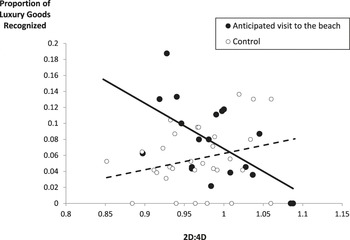
First, we discuss the interaction that addresses the crucial test of our hypothesis: we found an interaction effect of anticipated visit to the beach and 2D:4D (β = 0.97, SE = 0.41, t(43) = –2.34, p = .024) on the proportion of luxury goods recognized, see Figure 1. To explore this interaction in more detail, we tested simple slopes at values one standard deviation above and below the mean of 2D:4D (Aiken & West, Reference Aiken and West1991). The conditional effect of the anticipated visit to the beach on the proportion of luxury products recognized was significant for those with a low 2D:4D (β = 0.07, SE = 0.02, t(47) = 3.84, p < .001), but not for those with a high 2D:4D (β = –0.01, SE = 0.02, t(47) = –0.88, p = .383). For participants with a low 2D:4D, a larger proportion of the products that they recognized were luxury products when they on their way to the beach, compared to those leaving the beach. No such effect was found for those with a high 2D:4D.
The effect of anticipated visit to the beach and 2D:4D on the relative number of luxury products recognized. The full line is the trend line for the “anticipated visit to the beach” condition, the dotted line is the trend line for the control condition.

Second, we found an interaction between anticipated visit to the beach and gender (β = –0.08, SE = 0.03, t(43) = –2.87, p = .006). For males, there was no (main) effect of anticipated visit to the beach on the proportion of luxury products recognized (β = –0.02, SE = 0.02, t(47) = –1.08, p = .284; M = .092, SD = .05 for those on their way to the beach, and M = .076, SD = .04, for those leaving the beach). For females, we found a marginally significant (main) effect (β = –0.03, SE = 0.02, t(47) = –1.95, p = .057). Women recognized more luxury goods when going towards the beach (M = .058, SD = .04), compared to when they were leaving the beach (M = .026, SD = .02). The 3-way interaction was not significant (β = –0.242, SE = 0.54, t(43) = –0.45, p = .656).
Discussion
Consistent with our hypothesis, we found that an anticipated visit to the beach leads to a larger interest in luxury goods, but only for low 2D:4D participants. In as far as this anticipated visit to the beach activates mate attraction goals, this study provides preliminary evidence for the idea that 2D:4D represents individual differences in responsiveness to status-relevant experiences. However, besides a number of limitations of this study, mentioned in the general discussion, the field setting of this study made it subject to the possibility of selection effects, and allowed limited control over other variables. Therefore, in Study 2, we moved to a lab setting, that should assure a tighter control over extraneous variables that might have influenced participants’ behavior.
We also found an interaction effect between anticipated visit to the beach and gender. We found that females were more likely to recognize luxury products when on their way to the beach, as compared to leaving the beach. Based on our theoretical account, we do not have an explanation for this effect. However, these results are consistent with previous studies that found that when mating goals are activated, women pay more attention to luxury products (Lens et al., Reference Lens, Driesmans, Pandelaere and Janssens2012). We will further address this issue in the general discussion.
STUDY 2
In this study, we replicated the design of Study 1. Besides the benefits of additional control by running this study in a lab setting, it had a second objective. We wanted to test the robustness of our findings by studying the effect of a different status-relevant experience: a vicarious victory of one’s favorite sports team over its main rival.
Method
Participants, materials, and procedure
We invited 54 university students to participate in a lab experiment (28 males and 26 females). They received 9€ to complete a number of studies. Our participants were seated in front of a computer in a semi-closed cubicle and we provided them with a set of headphones. Those in the vicarious victory condition (34 participants) watched two videos on a victory of participants’ favorite football team. Both videos related to a football match that had been played 4 days earlier between Fútbol Club Barcelona (FCB) and Real Madrid (RM). These teams are the two top contenders and main rivals in the Spanish football league. The first video was developed by a Catalan TV station, intended to create anticipation, excitement and suspense before the game. The second video, produced by the same TV station, showed images of RM fans expressing their confidence about winning the game prior to the match. This video intended to increase the sense of rivalry and competition (Madrigal & Dalakas, Reference Madrigal, Dalakas, Haugtvedt, Herr and Kardes2008). Then followed a section with images from the actual game, edited with dramatic music, showing FCB’s victory and including the goals scored and the celebrations of players and fans. Participants were pre-screened to be supporters of FC Barcelona. This experience was hypothesized to provide an experience of social dominance (Bernhardt et al., Reference Bernhardt, Dabbs, Fielden and Lutter1998).
In the control condition, participants did not see any video (20 participants). Then participants in both conditions completed the luxury product recognition task, identical to the one we used in Study 1. Afterwards, we photographed their right hand using the same procedure as in Study 1 to establish each participant’s 2D:4D ratio (r between raters = .97).
Results
As in Study 1, we did not find a significantly different 2D:4D for males and females (t(52) = 0.93, p = .357). We computed the same index for the proportion of luxury products recognized as in Study 1, dividing the number of luxury products participants recognized by the total number of recognized objects. We used moderation analysis based on Ordinary least squares (OLS) regression equations, to test the effects of 2D:4D, experiencing a vicarious victory (vicarious victory = 1, control = 0), and gender (coded as: female = 1, male = 0) on proportion of luxury goods recognized.
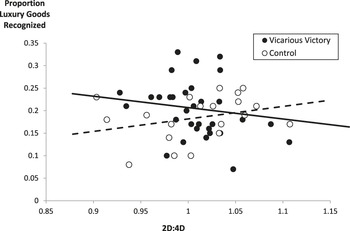
We did not find a main effect of 2D:4D (β = –0.07, SE = 0.18, t(46) = –0.41, p = .686), vicarious victory (β = 0.02, SE = 0.02, t(46) = 1.08, p = .285), nor gender (β = –0.01, SE = 0.02, t(46) = 0.91, p = .369) on the proportion of luxury goods recognized. When analyzing our focal effect, we found, in line with our predictions, an interaction effect of 2D:4D and vicarious victory (β = –0.71, SE = 0.35, t(46) = –2.05, p = .047). This effect is illustrated in Figure 2. No other two way interaction effects were significant (vicarious victory and gender: p = .774; 2D:4D and gender: p = .868).
The effect of Vicarious Victory and 2D:4D on the relative number of luxury products recognized. The full line is the trend line for the “Vicarious Victory” condition, the dotted line is the trend line for the control condition.

To explore this interaction effect of 2D:4D and vicarious victory in more detail, we tested simple slopes at values one standard deviation above and below the mean of 2D:4D (Aiken & West, Reference Aiken and West1991). The conditional effect of experiencing a vicarious victory on the number of luxury products recognized was significant for those with a low 2D:4D (β = 0.046, SE = 0.023, t(51) = 2.00, p = .050). For these participants, those who experienced a vicarious victory, the proportion of luxury goods they recognized was larger than for those in the control condition, see Figure 2. For those with a high 2D:4D, there was no conditional effect of the vicarious victory on the proportion of luxury products recognized (β = –0.01, SE = 0.02, t(51) = –0.52, p = .603).
Additionally, and unexpectedly, we found a three way interaction effect of vicarious victory, 2D:4D, and gender (β = –1.53, SE = 0.71, t(46) = –2.15, p = .037). To further explore this effect, we decomposed the analysis by gender. For males, we did not find a vicarious victory by 2D:4D interaction effect on proportion of luxury goods recognized (β = 0.02, SE = 0.41, t(24) = 0.05, p = .961), nor a main effect of 2D:4D (β = –0.12, SE = 0.34, t(24) = –0.34, p = .737) or vicarious victory (β = –0.01, SE = 0.42, t(24) = –0.02, p = .986). For females, neither the main effect of 2D:4D (β = 0.04, SE = 0.28, t(23) = 0.14, p = .894), nor vicarious victory (β = 0.03, SE = 0.02, t(23) = 1.60, p = .123) was significant, but the interaction effect between both was significant (β = –1.51, SE = 0.54, t(23) = –2.79, p = .011). The conditional effect of experiencing a vicarious victory on the number of luxury products recognized was significant for those with a low 2D:4D (β = 0.09, SE = 0.03, t(23) = 3.12, p = .005). For these participants, those who experienced a vicarious victory, the proportion of luxury good they recognized was larger than for those in the control condition. For those with a high 2D:4D, there was no conditional effect of the vicarious victory on the proportion of luxury products recognized (β = –0.03, SE = 0.03, t(23) = –0.87, p = .395).
Discussion
We found that experiencing a vicarious victory leads to a larger interest in luxury goods, but only for low 2D:4D participants. Again, this result supports the suggestion that 2D:4D represents individual differences in responsiveness to status-relevant experiences. In this study, this effect was found exclusively in females, but not in males. Previous research on the effects of 2D:4D has mostly focused on males, even though later findings suggests that this individual difference variable is predictive of status signaling behavior for females as well (Hönekopp & Schuster, Reference Hönekopp and Schuster2010). We did not make any gender specific predictions. Therefore, this is a very intriguing result. More research is required before any firm statements can be made regarding the meaning of this particular result, but it seems to be consistent with recent developments suggest that social competition within females may be more prominent than was assumed earlier, especially in social mammals (e.g., Stockley & Campbell, Reference Stockley and Campbell2013).
This paper intended to provide insight into why, and under which conditions, individuals engage in wasteful acts, such as luxury consumption. We studied whether individual differences, grounded in a biological mechanism (i.e., 2D:4D, a proxy for exposure to prenatal androgens) moderates the effect of status-relevant experiences on individuals’ interest in luxury consumer products. The results of two studies provide support to the suggestion of Millet (2010), that the effect of prenatal exposure to androgens is only expressed in status seeking or status behavior in certain contexts. That is, there exist stable differences between individuals in their inclination to display social status, but this inclination will only become active, when triggered by an experience that highlights the relevance of displaying one’s social status (Millet & Dewitte, Reference Millet and Dewitte2008; Ronay & von Hippel, Reference Ronay and von Hippel2010; Ryckmans et al., Reference Ryckmans, Millet and Warlop2015; van den Bergh & Dewitte, Reference van den Bergh and Dewitte2006). In the control conditions of our studies, we did not find a difference in participants’ interest in luxury goods between high and low 2D:4D participants. However, when exposed to a status-relevant experience, low 2D:4D participants became more attentive to luxury goods in their environment. In other words, it seems that 2D:4D represents individual differences in responsiveness to status-relevant experiences.
Interestingly, in both studies, we found interaction effects including gender. In Study 1, the effect of the status-relevant experience was significant for females, but not for males. This effect for females is consistent with the previous finding that when mating goals are activated, women pay more attention to luxury products (Lens et al., Reference Lens, Driesmans, Pandelaere and Janssens2012). Since we did find an overall interaction effect of 2D:4D and the status-relevant experience across genders, this finding does not seem particularly problematic. In Study 2, however, we found the predicted interaction effect of 2D:4d and the status relevant experience for females, but not for males. Previous research on the effects of 2D:4D has mostly focused on males, even though later findings suggests that this individual difference variable is predictive of status signaling behavior for females as well (Hönekopp & Schuster, Reference Hönekopp and Schuster2010). In fact, recent views emphasize that social competition within females may be more prominent than was assumed earlier, especially in social mammals (e.g., Stockley & Campbell, Reference Stockley and Campbell2013). Within that context, our findings add support for the view that 2D:4D is a relevant individual difference variable in explaining behavior for females as well. The lack of an effect for males is puzzling at this point, and demanding of future research attention.
From a marketing perspective, in the context of the promotion of luxury products, the most practical insights probably do not pertain to the moderating role of 2D:4D, but rather to the manipulations used in both studies. We attempted to test our hypothesis in naturally occurring settings (i.e., a visit to the beach), or by getting as close as possible to such settings in a lab environment (i.e., videos depicting scenes that one is familiar too) in order to test whether in such settings, status-relevant experiences can affect participants’ interest in luxury goods, despite being embedded in a context in which a wide range of factors could influence participants’ capacity to recognize luxury goods. The fact that we find effects of these status-relevant experiences suggests that such experiences have a substantial impact on consumers in real life, and that the contexts that provide such experiences, such as sports events, might be interesting environments for the promotion of luxury goods.
The goal of this paper was modest: we wanted to provide preliminary evidence for the idea that individual differences in 2D:4D are expressed only when triggered by status-relevant experiences. We opted to test this idea in naturally occurring settings (exposure to others on the beach, and fans observing a victory of their favorite sports team), rather than favoring strict methodological control. In this sense, we consider this paper a call for additional research in this issue, rather than providing conclusive evidence. We believe that the consistent results over both studies provide a certain degree of confidence in the conclusions, even though it is important to recognize that both studies suffered from a number of methodological issues. First, we relied on the assumption that the manipulations produced a mate attraction goal or a status display goal, in Study 1 and 2, respectively. The effect that they had on the participants’ performance on the luxury product recognition task suggests that that manipulation was successful. Still, it is necessary for future research to explore this effect in more controlled settings, using manipulations that have been shown to reliably activate a status display goal.
Second, related to the previous issue, we cannot exclude the possibility that our manipulations activated additional concepts (beyond a status display goal) that might have been responsible for the effects that we found. For example, in the first study, going towards the beach versus leaving the beach may have produced a difference in terms of an approach or an avoidance mindset being activated. An approach mindset might favor the recognition of glamorous products rather than utilitarian ones. It is more difficult to provide a rationale for why that should only be the case for low 2D:4D participants, but nonetheless it is possible that our manipulation activated alternative goals or mindsets that may have been responsible for the results that we obtained. Additional future research in more controlled setting could mend this.
Third, both studied resulted in a similar pattern of results, in terms of the interaction effect of 2D:4D and status-relevant experience on people’s interest in luxury goods. This consistency provides a certain degree of confidence in the effect, but it is true that both studies relied on small sample sizes. Studies on larger samples should provide additional support for these results. Additionally, future research might attempt to extend these findings in the direction of other types of behavior that have been identified as “costly signals”, such as the engagement in risk-seeking activities (Stenstrom et al., Reference Stenstrom, Saad, Nepomuceno and Mendenhall2011) or extravagant behavior (Bellezza, Gino, & Keinan, Reference Bellezza, Gino and Keinan2014).