Introduction
After nearly three decades of civil war and fatal conflict, Cambodia's political situation has stabilized since the 1990s (Van de Put & Eisenbruch, Reference Van de Put, Eisenbruch and de Jong2002). However, Cambodia is still one of the poorest, least developed countries in Asia facing many challenges including poor standards of health and education, rural exodus, rapid urbanization and political instability (Dubois et al. Reference Dubois, Tonglet, Hoyois, Sunbaunat, Roussaux and Hauff2004; UN Development Programme, 2015).
Studies investigating Cambodian mental health morbidity consistently reported elevated rates of depression, anxiety, post-traumatic stress disorder (PTSD) and other mental disorders (de Jong et al. Reference de Jong, Komproe and Van Ommeren2003; Dubois et al. Reference Dubois, Tonglet, Hoyois, Sunbaunat, Roussaux and Hauff2004; Mollica et al. Reference Mollica, Brooks, Tor, Lopes-Cardozo and Silove2014). The most comprehensive study to date reported 53.4% of the Cambodian population suffering from a common psychiatric disorder, with anxiety and PTSD being the most frequent (40.0% and 28.4%, respectively) (de Jong et al. Reference de Jong, Komproe and Van Ommeren2003). In contrast, a 2009 report stated that mental health services are extremely scarce and that there were only 18 psychiatric beds available for the entire country (i.e. for around 14.5 million people) (Deva et al. Reference Deva, D'Souza and Sundram2009). In addition, mental health professionals and appropriate training programmes are needed (Deva et al. Reference Deva, D'Souza and Sundram2009).
Thus, although peace and some political stability have returned to Cambodia, there are urgent mental health care needs including a large demand for individualized psychiatric services and effective mental health treatments (Dubois et al. Reference Dubois, Tonglet, Hoyois, Sunbaunat, Roussaux and Hauff2004; Deva et al. Reference Deva, D'Souza and Sundram2009; Jegannathan et al. Reference Jegannathan, Kullgren and Deva2015).
The present study originated as part of a large developmental programme (‘Mekong Project’) (Bumke & Sodemann, Reference Bumke and Sodemann2014) which was funded by the German Federal Ministry for Economic Cooperation and Development as well as Terre des Hommes (Germany) and coordinated by Trauma-Aid (Germany). The programme aims at establishing independent psychotherapeutic services via systematic training of local health professionals and offering free-of-charge psychological help to traumatized civilians.
Resource-oriented trauma therapy combined with eye movement desensitization and reprocessing (EMDR) resource installation (in short, ROTATE) is a form of manualized trauma therapy that has been developed by psychodynamically oriented clinicians and researchers (Wöller et al. Reference Wöller, Leichsenring, Leweke and Kruse2012; Wöller & Mattheß, Reference Wöller and Mattheß2016).
The approach mainly aims at establishing a secure therapeutic relationship and strengthening resilience and coping capacities by activating positive personal resources. Despite including EMDR elements, it does not involve any form of trauma confrontation. ROTATE includes a variety of imaginative resource-activating methods that can be found in treatment manuals of psychodynamic therapy for PTSD (Reddemann, Reference Reddemann2011; Wöller et al. Reference Wöller, Leichsenring, Leweke and Kruse2012) as well as resource development and installation (RDI), a resource-activating EMDR technique (Korn & Leeds, Reference Korn and Leeds2002). ROTATE is especially suitable for clients with complex trauma conditions, i.e. PTSD, co-morbid conditions and impaired functioning. It adheres to the following two main principles:
-
(1) A psychodynamic relationship orientation. Psychodynamic therapy operates on a supportive–expressive continuum of interventions (Luborsky, Reference Luborsky1984). Supportive interventions especially aim at fostering a secure therapeutic alliance, which itself may be regarded as a prerequisite to strengthen psychosocial abilities (‘ego functions’) that are temporarily not available to a patient, e.g. due to acute stress (traumatic events). The use of more supportive or more interpretive (insight-enhancing) interventions depends on a patient's needs. The more severely disturbed a patient is, or the more acute his or her problem is, the more supportive and less interpretive interventions are required and vice versa (Luborsky, Reference Luborsky1984; Wallerstein, Reference Wallerstein1989). Regarding ROTATE, there was a clear focus on the supportive side of this continuum.
-
(2) Resource orientation is the second major element of ROTATE. From a psychodynamic perspective, activation of internal resources means enhancing a patient's mastering and coping competencies and can be understood as a process of restoring the ability to activate positive internalized object relationships (Bellak et al. Reference Bellak, Hurvich and Gediman1973; Kernberg, Reference Kernberg1976). Practically, this can be achieved by evoking memories of positive relationship experiences or by stimulating fantasies of positive experiences (Wöller et al. Reference Wöller, Leichsenring, Leweke and Kruse2012).
ROTATE has multiple advantages:
-
(a) The approach takes into account the complex nature of trauma, e.g. in victims of man-made disasters and genocide. Instead of solely focusing on PTSD symptoms, it considers the mental co-morbidities typically found in these clients, notably depression and anxiety.
-
(b) ROTATE can be safely applied even to complex trauma conditions; no major side-effects have been observed so far.
-
(c) The approach is especially suitable for clients from non-Western countries as traditional healing resources and metaphors can be integrated in an overall framework of resource activation. Additionally, as it is not solely language based and also focuses on somatic aspects and bodily reactions, it can be viewed as more culturally independent than other psychotherapies.
-
(d) The basic elements of the approach can easily be taught to professionals and paraprofessionals in the field. This aspect is of major importance to ensure a broad dissemination of the approach's basic elements among the vast number of traumatized clients in severely affected non-Western regions.
-
(e) ROTATE can be combined with traditional trauma confrontative techniques, if necessary (Wöller et al. Reference Wöller, Leichsenring, Leweke and Kruse2012). In this context, it serves as a preparatory stabilization phase for confrontative techniques to be safely applied. However, in the current study no confrontation was used.
The effectiveness of psychodynamically based resource-oriented approaches has been documented in (non-randomized) controlled studies with patients suffering from complex trauma (Sachsse et al. Reference Sachsse, Vogel and Leichsenring2006; Lampe et al. Reference Lampe, Hofmann, Gast, Reddemann and Schüßler2014) and refugees from former Yugoslavia (Kruse et al. Reference Kruse, Joksimovic, Cavka, Woller and Schmitz2009). More specifically, the effectiveness of ROTATE has been shown in a large sample of Tsunami survivors with complex trauma and PTSD in Aceh/Indonesia (Bumke & Sodemann, Reference Bumke and Sodemann2010). However, a study using a randomized controlled trial (RCT) design was still missing. Thus, we set up an RCT in Cambodia, comparing the effects of five sessions of ROTATE with a waiting-list control (WLC) group in adult traumatized patients. One publication from this trial already exists in the form of a Letter to the editor (Steinert et al. Reference Steinert, Bumke, Hollekamp, Larisch, Leichsenring, Mattheß, Sisokhom, Sodemann, Stingl, Thearom, Vojtová, Wöller and Kruse2016). The Letter reports data on improvement in Harvard Trauma Questionnaire (HTQ) mean scores. However, several other outcomes that have not yet been published were assessed. These findings will be presented in the following.
Aims
The present study aimed at testing the efficacy of ROTATE regarding remission from PTSD, symptoms of anxiety and depression as well as impaired functioning.
Method
Study design and implementation
This RCT was carried out in cooperation with the Royal University of Phnom Penh (RUPP). It was located in Phnom Penh City and the nearby Kandal Province. Participants were recruited from May 2012 to June 2014. All age-eligible clients (age ⩾18 years) seeking help from one of the professionals of the ‘Mekong Project’ were screened for probable PTSD using the PTSD Checklist-Civilian Version (PCL-C) (Blanchard et al. Reference Blanchard, Jones-Alexander, Buckley and Forneris1996). Patients screening positively (PCL-C ⩾44) were asked if they were interested to take part in a treatment study. Patients signalling interest were informed about the aims and the design of the study. All included patients provided informed consent and were informed that participation was voluntary, data were evaluated anonymously, and that they were free to withdraw their consent at any time without any disadvantages. The described ‘training-cum-therapy programme’ adhered to the strictest ethical standards. The Department of Psychology of RUPP deemed this to be in full compliance with local ethical standards for research. The RCT was carried out as an integral part of an Official Development Assistance (ODA) project (project no. 2010.1572.6, ‘Mekong Project’). The study protocol is available on request from the first author (C.S.).
Inclusion and exclusion criteria
For inclusion, a PCL-C score ⩾44 was required. We allowed inclusion of patients with co-morbid mental health problems except for psychosis, organic brain disorder, cognitive impairment, dementia, acute suicidality, acute need for treatment, and severe impairments. Other exclusion criteria were ongoing therapy or therapy within the last 2 years and severe communication difficulties. Therapy was free of charge. All patients on the waiting list were offered treatment after the end of the waiting period (5 weeks).
Assessments
As mentioned above, initial screening was performed by use of the PCL-C (Blanchard et al. Reference Blanchard, Jones-Alexander, Buckley and Forneris1996). It assesses the 17 symptoms required for assignment of a PTSD diagnosis according to the Diagnostic and Statistical Manual of Mental Disorders, 4th edition (DSM-IV). A cut-off score of 44 provides the highest level of diagnostic efficiency (0.90) (Blanchard et al. Reference Blanchard, Jones-Alexander, Buckley and Forneris1996).
For testing the efficacy of ROTATE, the Indochinese versions of the HTQ (Mollica et al. Reference Mollica, Caspi-Yavin, Bollini, Truong, Tor and Lavelle1992) and the Hopkins Symptom Checklist-25 (HSCL-25) (Mollica et al. Reference Mollica, Wyshak, de Marneffe, Khuon and Lavelle1987) were used. Symptoms were measured before and after the intervention, or before and after 5 weeks of waiting. Assessments were performed via personal interviews by an investigator who was blind to treatment allocation.
Results on the following outcomes will be reported:
-
(1) Remission rates: the PTSD scale of the HTQ includes 16 items reflecting the DSM-IV criteria for PTSD. PTSD status is calculated by use of a DSM-IV algorithm (Mollica et al. Reference Mollica, McInnes, Sarajlic, Lavelle, Sarajlic and Massagli1999). PTSD is diagnosed when a patient scores 3 or 4 on (i) at least one of the four re-experiencing symptoms (criterion B), (ii) at least three of the seven avoidance and numbing symptoms (criterion C), and (iii) at least two of the five arousal symptoms (criterion D). Criterion A (exposure to a traumatic event) was met by all the participants, according to the ‘traumatic events’ section of the HTQ. Patients no longer fulfilling these criteria are regarded as remitted.
-
(2) Self-perception of functioning (SPF), as measured with the 24-item SPF score of the HTQ.
-
(3) Symptoms of depression and anxiety assessed with the HSCL-25.
-
(4) Depression and emotional distress status: cut-off scores on the HSCL-25 can be used to determine whether a patient is ‘checklist positive’ for major depression, respectively emotional distress (mean scores ⩾1.75) (Mollica et al. Reference Mollica, Wyshak, de Marneffe, Khuon and Lavelle1987).
All instruments have been validated for the Cambodian population (Mollica et al. Reference Mollica, Wyshak, de Marneffe, Khuon and Lavelle1987, Reference Mollica, Caspi-Yavin, Bollini, Truong, Tor and Lavelle1992; Silove et al. Reference Silove, Manicavasagar, Mollica, Thai, Khiek, Lavelle and Tor2007; Hinton et al. Reference Hinton, Kredlow, Pich, Bui and Hofmann2013). They also show very good psychometric properties and have been used among several cultural groups (Kleijn et al. Reference Kleijn, Hovens and Rodenburg2001; Dubois et al. Reference Dubois, Tonglet, Hoyois, Sunbaunat, Roussaux and Hauff2004; Sonis et al. Reference Sonis, Gibson, de Jong, Field, Hean and Komproe2009; Mollica et al. Reference Mollica, Brooks, Tor, Lopes-Cardozo and Silove2014). Internal consistency (Cronbach's α) at baseline of the PCL-C, HTQ and HSCL-25 in our sample was 0.89, 0.94 and 0.91, respectively.
Randomization
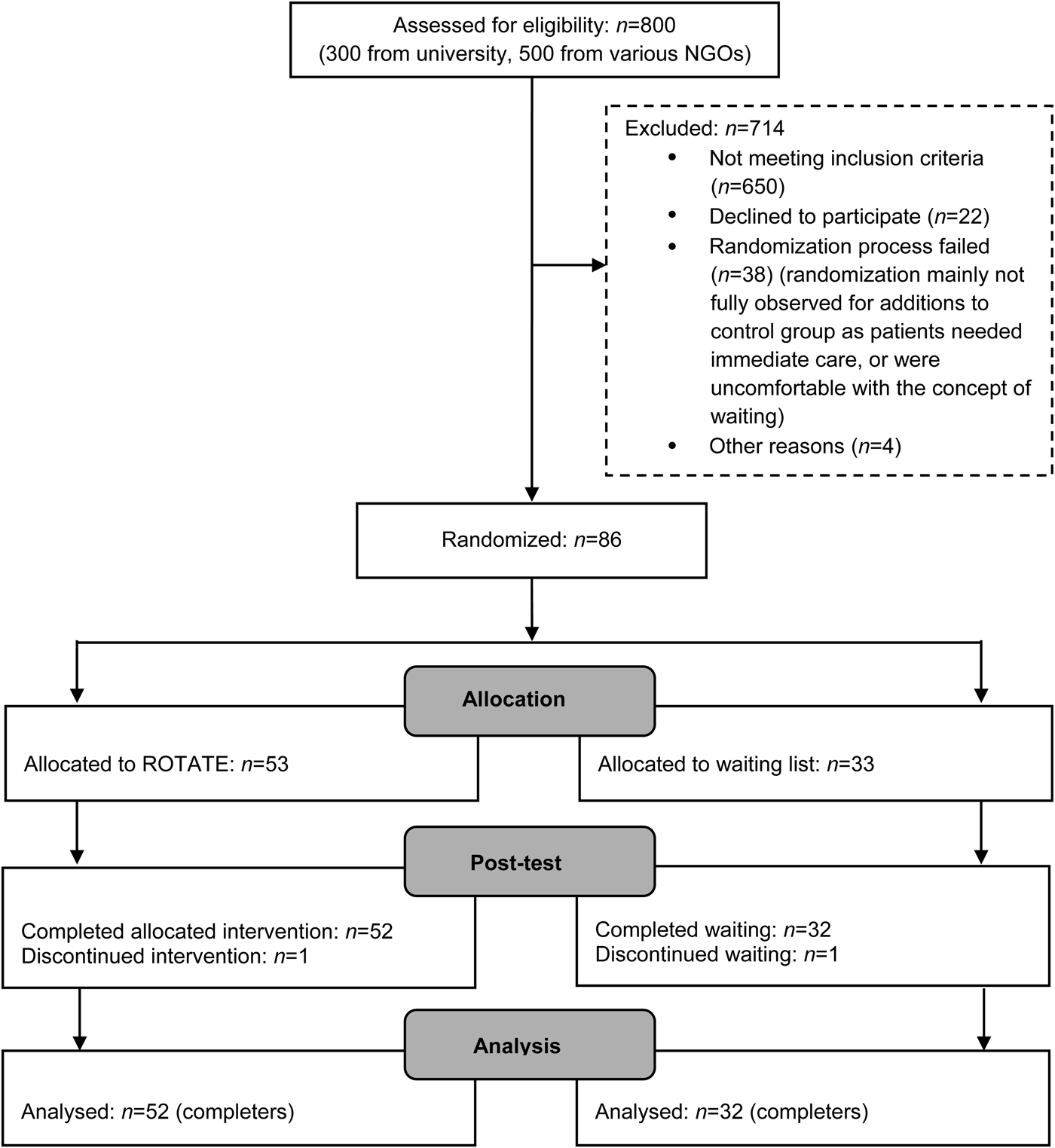
Patients eligible for inclusion were randomized to ROTATE (n = 53) or to a WLC group (n = 33) via simple randomization using a computer-generated list of random numbers. Sealed envelopes containing assignments were prepared by one of the investigators. The allocation sequence was concealed until assignment to interventions via a preparatory session conducted by the therapists. After choosing an envelope, patients were informed that they received treatment either immediately or after waiting. The concept of randomization, especially to a waiting list, was very difficult or even perceived as a threat by some of the Cambodian clients. Thus, randomization failed in 38 patients leading to an unbalanced allocation ratio (1.6:1) with an over-representation of patients randomized to treatment.
Intervention
Patients in the intervention group received 5 h of ROTATE provided in weekly sessions. ROTATE is a manualized treatment. The manual can be accessed online (Wöller & Mattheß, Reference Wöller and Mattheß2016). ROTATE includes the following treatment elements:
-
(1) Providing information about the disorder and the treatment.
-
(2) Establishing a sense of safety and control, e.g. via explaining that nothing will be done during therapy without explicit consent of the patient. The therapist presents him- or herself as a security-providing object thereby allowing for internalization of security-providing functions.
-
(3) Taking an antiregressive and resource-oriented therapeutic stance by strengthening the adult (observing) ego of the patient. For this purpose the therapist uses an active intervention style, which motivates patients to actively cooperate and abandon passive healing expectations. The therapist explores and fosters the coping strategies already successfully used by the patient to deal with negative emotional states.
-
(4) Focusing on resource activation to enhance emotion regulation, i.e. all kinds of positive memories, thoughts, or fantasies are regarded and used as internal resources to enhance emotion regulation.
-
(5) Applying specific imaginative techniques to help patients distance themselves from overwhelming traumatic emotions and intrusions. For this purpose, interventions such as the ‘container technique’ (see Appendix 1 for a verbatim example) are used to deliberately activate the defence mechanism of (affect-) isolation (Freud, Reference Freud1936). This technique includes imagining a container to put all disturbing traumatic material into and is used to cope with traumatic ‘flashbacks’.
-
(6) Teaching patients so-called ‘grounding techniques’ that help them to manage dissociative crises by staying in the here and now. The therapist guides the patient in reorienting him- or herself by directing attention toward external stimuli or toward rational thinking (reality testing according, for example, to Bellak et al. Reference Bellak, Hurvich and Gediman1973).
-
(7) RDI, an EMDR technique aimed at systematically developing and anchoring resources using alternating bilateral stimulation (Korn & Leeds, Reference Korn and Leeds2002). Hereby, the focus is on increasing the affective intensity within a selected positive memory network and fostering associations to other positive networks. The increase of positive emotions is supposed to help the patient gain access to more ego-strengthening material and to reinforce his or her ability to access affective, cognitive and behavioural coping skills when confronted with stress-related stimuli at a later point in time (Korn & Leeds, Reference Korn and Leeds2002). Important aspects of transference and countertransference are considered throughout the treatment (e.g. perpetrator or rescuer transferences) and dealt with if necessary, e.g. by reminding the patient that s/he has full control over therapy or by repairing disruptions in the therapeutic relationship that are the result of transference phenomena.
ROTATE was delivered by six local therapists. All have a master's degree in psychology from RUPP and completed a 3-year course in trauma therapy led by an experienced therapist as part of the ‘Mekong Project’. If patients had consented, treatment sessions were videotaped. Adherence was informally checked by an investigator after the end of the study. Treatments were in accordance with the ROTATE concept.
Statistical analyses
The power analysis was based on the primary outcome (HTQ mean scores) (Steinert et al. Reference Steinert, Bumke, Hollekamp, Larisch, Leichsenring, Mattheß, Sisokhom, Sodemann, Stingl, Thearom, Vojtová, Wöller and Kruse2016). According to previous meta-analyses (Sherman, Reference Sherman1998; Bradley et al. Reference Bradley, Greene, Russ, Dutra and Westen2005; Bisson & Andrew, Reference Bisson and Andrew2007), psychotherapeutic treatments (including EMDR) yielded medium to large effect sizes (between 0.52 and 1.51) compared with WLC or usual-care controls, depending on study populations and applied outcomes. Based on these findings, we chose a conservative effect size expecting ROTATE to be superior to waiting with a between-group effect size of at least d = 0.65 which is between a medium (0.50) and a large (0.80) effect size. This hypothesis took an uncertainty into account as it was not clear whether the treatment would work in this setting. To detect a difference of d = 0.65 with a power of 0.80 at α = 0.05, using a two-sided test, 2 × 40 patients are required (Cohen, Reference Cohen1988). We anticipated a drop-out rate of about 10–15%, and aimed at compensating for drop-outs by including some more patients. Due to problems with the randomization process, as noted above, our final sample exceeded the targeted number in the treatment group (n = 53) and was lower in the WLC group (n = 33), yielding a harmonic mean of 40.7 (Cohen, Reference Cohen1988, p. 42). The trial stopped when the necessary sample size to achieve a power of 0.80 was reached.
Only one patient dropped out of each group during the course of treatment. Therefore, only completer analyses were performed (n = 84). All data were analysed using SPSS version 20.0 (USA). Categorical data were analysed by means of binary logistic regression models, and continuous data by general linear regression models. Post-treatment categories (e.g. remission yes/no) and post-treatment means of the respective measures served as dependent variables, while baseline scores of the respective continuous measures and type of group (treatment v. waiting) were entered as predictors. Based on these results, baseline adjusted odds ratios (ORs) and baseline-adjusted post-treatment means were computed. From the latter we then calculated baseline-adjusted Cohen's d values. Adjusted ORs were additionally transformed into baseline-adjusted numbers needed to treat (NNT). The NNT is the number of patients who need to be treated to achieve one additional successful outcome. The ideal NNT is 1; the higher the NNTs, the less effective the treatment (Kraemer & Kupfer, Reference Kraemer and Kupfer2006). The α-level was Bonferroni adjusted for multiple comparisons (α = 0.01 = 0.05/5: PTSD remission, anxiety, depression, emotional distress and self-perception of functioning).
Results
Participants
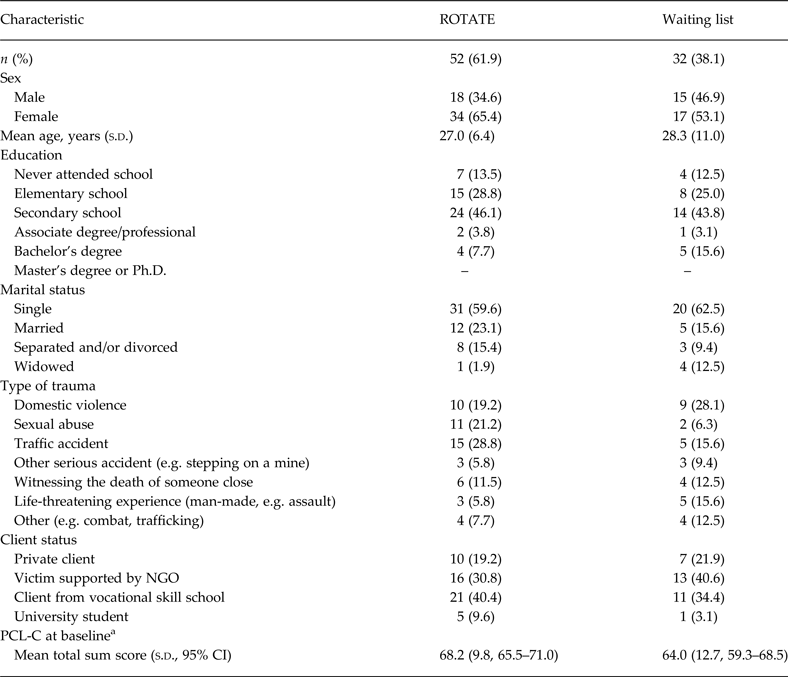
A total of 800 potential patients were assessed for eligibility. Of these, 86 patients met all selection criteria and were correctly randomized to treatment arms (see flowchart; Fig. 1). Baseline characteristics can be found in Table 1.
Flowchart of study participants. NGO, Non-governmental organization; ROTATE, Resource-oriented trauma therapy combined with eye movement desensitization and reprocessing (EMDR) resource installation.

Sociodemographic characteristics of the treatment (ROTATE) and the waiting list sample (analysed completers, n = 84)

Data are given as number of participants (percentage) unless otherwise indicated.
ROTATE, Resource-oriented trauma therapy combined with eye movement desensitization and reprocessing (EMDR) resource installation; s.d., standard deviation; NGO, non-governmental organization; PCL-C, PTSD Checklist-Civilian Version; CI, confidence interval.
a Scores on the PCL-C range from 17 to 85, with higher scores indicating greater pathology; a cut-off score of ⩾44 was used for study inclusion.
Treatment outcome
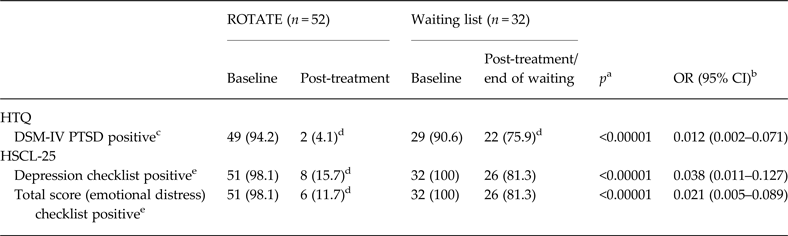
PTSD remission rates were 95.9% for patients in ROTATE and 24.1% for patients in the WLC condition (based on HTQ DSM-IV PTSD algorithm). Remission from co-morbid depression (84.3% v. 18.7%) and emotional distress (88.3% v. 18.7%) was of similar size. Baseline-adjusted effect sizes were large for all assessed binary outcomes, i.e. rates of PTSD (OR 0.012), depression (OR 0.038) and emotional distress (OR 0.021) (p < 0.00001, Table 2). The corresponding NNTs were 1.09, 1.25 and 1.15, respectively.
Outcomes of ROTATE v. waiting list (binary outcomes)

Data are given as number of participants (percentage) unless otherwise indicated.
ROTATE, Resource-oriented trauma therapy combined with eye movement desensitization and reprocessing (EMDR) resource installation; OR, odds ratio; CI, confidence interval; HTQ, Harvard Trauma Questionnaire; DSM-IV, Diagnostic and Statistical Manual of Mental Disorders, 4th edition; PTSD, post-traumatic stress disorder; HSCL-25, Hopkins Symptom Checklist.
a p Value based on baseline-adjusted values determined by logistic regression; Bonferroni-corrected α = 0.01 (0.05/5); see Statistical analyses.
b ORs based on baseline-adjusted values determined by logistic regression.
c DSM-IV PTSD based on DSM-IV algorithm (see Assessments section).
d Based on patients that were ‘positive’ at baseline (e.g. HTQ: 2/49 = 0.041 = 4.1%).
e Threshold score based on a cut-off on the HSCL-25 (⩾1.75).
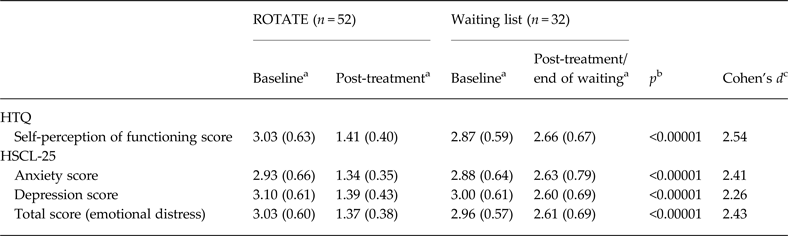
Pairwise comparisons of post-therapy data via linear-effects regression models revealed significant differences in favour of ROTATE for self-perceived functioning [baseline-adjusted post-treatment means on HTQ-SPF: 1.39, 95% confidence interval (CI) 1.25–1.53 (ROTATE), 2.68, 95% CI 2.50–2.86 (WLC), p < 0.00001, d = 2.54] as well as HSCL total score [baseline-adjusted means post-treatment: 1.37, 95% CI 1.22–1.51 (ROTATE), 2.62, 95% CI 2.43–2.80 (WLC), p < 0.00001, d = 2.43], HSCL anxiety score [baseline-adjusted means post-treatment: 1.34, 95% CI 1.19–1.49 (ROTATE), 2.64, 95% CI 2.44–2.83 (WLC), p < 0.00001, d = 2.41) and HSCL depression score [baseline-adjusted means post-treatment: 1.39, 95% CI 1.24–1.54 (ROTATE), 2.60, 95% CI 2.41–2.79 (WLC), p < 0.00001, d = 2.26; see Table 3 for raw scores of all scales].
Outcomes of ROTATE v. waiting list (continuous outcomes)

Data are given as raw mean (standard deviation).
ROTATE, Resource-oriented trauma therapy combined with eye movement desensitization and reprocessing (EMDR) resource installation; HTQ, Harvard Trauma Questionnaire; HSCL-25, Hopkins Symptom Checklist; ANCOVA, analysis of covariance.
a For baseline-adjusted means the reader is referred to the main text (see Results).
b p Value based on baseline-adjusted post-treatment means determined by ANCOVA; Bonferroni-corrected α = 0.01 (0.05/5) (see Statistical analyses).
c Cohen's d (between-groups) calculated from baseline-adjusted post-treatment means (ANCOVA).
Within-group effect sizes (Cohen's d) were also large for ROTATE on all continuous outcomes (HTQ-SPF mean score: d = 2.57; HSCL-25 depression, anxiety and total score: d = 2.41, 2.80 and 2.77, respectively), while they were small to moderate in the WLC group (HTQ-SPF mean score: d = 0.36; HSCL-25 depression, anxiety and total score: d = 0.39, 0.66 and 0.61, respectively). No adverse events or harms were reported.
Discussion
To the best of our knowledge, this is one of only a very few RCTs investigating a psychotherapeutic intervention for the treatment of PTSD in a post-conflict setting. Furthermore, it is the first RCT testing the efficacy of ROTATE. Our main finding was that a treatment focusing on a secure patient–therapist relationship, stabilizing techniques and activating patients’ own resources significantly contributed to remission from PTSD as well as reducing symptoms of depression, anxiety and impaired functioning. Effect sizes in the treatment group were large while they were small to moderate in the WLC group. Additionally, our results suggest that ROTATE might be associated with fewer dropouts than confrontational treatments probably due to fewer problems with affect tolerance.
The efficacy of trauma-focused psychotherapeutic treatments that include trauma confrontation is well established (Bisson & Andrew, Reference Bisson and Andrew2007); however, there remain uncertainties regarding the efficacy of other forms of psychological treatments for PTSD, especially those not focusing on traumatic memories (Bisson & Andrew, Reference Bisson and Andrew2007). Taking into account that this RCT would be carried out in a low-developed, post-conflict setting with insufficient mental health care and often insecure psychosocial and material life situations, we regarded the use of a confrontational trauma treatment as difficult and decided to investigate whether a non-confrontational form of trauma therapy would also have beneficial effects – although there is evidence that trauma confrontation is efficacious and feasible in similar settings (Neuner et al. Reference Neuner, Onyut, Ertl, Odenwald, Schauer and Elbert2008; Ertl et al. Reference Ertl, Pfeiffer, Schauer, Elbert and Neuner2011). Our results corroborate earlier findings by showing that effective trauma therapy does not necessarily require trauma exposure to significantly reduce psychological symptoms, a notion that is supported by a recent RCT by Markowitz et al. (Reference Markowitz, Petkova, Neria, Van Meter, Zhao, Hembree, Lovell, Biyanova and Marshall2015). The authors compared interpersonal therapy (IPT), a non-exposure-based psychotherapy against prolonged exposure (PE; the current ‘gold standard’ in PTSD treatments) and showed that IPT was non-inferior to PE.
Whether Western diagnostic concepts of mental disorders, as recorded for example in the DSM, are universally valid and whether these disorders should be targeted on site by Western forms of psychotherapy have been the focus of debate (Summerfield, Reference Summerfield2008; Silove, Reference Silove2012). This is especially true for the concept of PTSD (von Peter, Reference von Peter2008). More specifically with regard to Cambodian people, it has been pointed out that symptoms of anxiety and PTSD are perceived and interpreted differently by Cambodian compared with Western patients (Hinton & Otto, Reference Hinton and Otto2006). For example, Cambodian patients seem to focus more strongly on somatic symptoms, including a particular worry about a ‘weak heart’ (Hinton & Otto, Reference Hinton and Otto2006, p. 251), especially during acute anxiety. The perception of a ‘weak heart’ can cause catastrophic thoughts about life-threatening consequences which themselves foster further somatization (Hinton & Otto, Reference Hinton and Otto2006). It may be a limitation of our study that we did not systematically investigate these aspects, especially as we received informal feedback from the local therapists and researchers (of whom most were Cambodian) stating that patients’ symptoms were partly different from the ones tapped in the diagnostic evaluation which was based on DSM-IV diagnostic criteria.
However, another finding of this study was that, due to its focus on stabilizing and fostering resources in order to cope with anxiety and accompanying physical symptoms, ROTATE turned out to be well suited for Cambodian clients. Additionally, it related well to prevailing attitudes of illness and traditional beliefs about healing (e.g. mindfulness strategies as applied in Buddhism) (Otto & Hinton, Reference Otto and Hinton2006).
The strengths of our study include that it was conducted on site by local psychologists who all had received extensive training in ROTATE. Consequently no language barriers between therapists and patients existed and no interpreters had to be used. Also, as therapists and patients had similar cultural backgrounds, culture-specific interpretations of symptoms could naturally be taken into account, a factor that has been identified as vital in the therapeutic work with Cambodian patients (Hinton & Otto, Reference Hinton and Otto2006). Additionally, our study adheres to most of the recommendations on mental health and psychosocial support in humanitarian settings that were published by Tol et al. (Reference Tol, Barbui, Galappatti, Silove, Betancourt, Souza, Golaz and van Ommeren2011, p. 1581). In accordance with these recommendations, we applied rigorous methods and broadened outcomes beyond PTSD and internalizing symptoms by also including functional impairment. The importance of including measures of functioning in trials of psychotherapy has also been stressed recently by Tolin et al. (Reference Tolin, McKay, Forman, Klonsky and Thombs2015) in the context of updating the criteria for empirically supported treatments. Additionally, as a main part of this project, local psychologists were trained in ROTATE, which is expected to facilitate patient access to an empirically supported treatment in a country struggling with insufficient mental health care. As local practitioners and researchers were involved in conducting the study, an exchange between science and practice may also have been fostered. Thus, following Tol et al. (Reference Tol, Barbui, Galappatti, Silove, Betancourt, Souza, Golaz and van Ommeren2011, p. 1588) this RCT provides an example for the ‘systematic integration of rigorous monitoring and assessment procedures in humanitarian programmes’. Finally, broad inclusion criteria heighten generalizability of the findings.
Limitations of the present study include: (a) the lack of a follow-up period; (b) the incomplete knowledge regarding adherence and competence as videotapes of recorded sessions have not been systematically evaluated; (c) a problem with randomization leading to an imbalanced allocation ratio; and (d) a lack of data regarding substance use.
Similar to previous studies comparing PTSD treatments with a WLC (e.g. Ertl et al. Reference Ertl, Pfeiffer, Schauer, Elbert and Neuner2011) we found that patients on the waiting list somewhat improved during the waiting period with pre–post effect sizes varying between 0.36 and 0.66, i.e. in the small to medium range. Furthermore, the remission rate from probable PTSD was as high as 24.1% in the WLC group. These findings are in accordance with a meta-analysis by Devilly & McFarlane (Reference Devilly and McFarlane2009) who found a pre–post effect of g = 0.336 on PTSD symptoms for patients on a waiting list. Regarding our sample, we can only speculate as to what caused this decline in symptoms. A spontaneous recovery seems unlikely due to the short waiting period and the rather chronic nature of PTSD in clinical populations (Steinert et al. Reference Steinert, Hofmann, Leichsenring and Kruse2015). We rather think that – as all patients were offered treatment after waiting and as the waiting period was comparably short – the expectancy of receiving help soon might have already had a beneficial effect; the same might be true for the diagnostic interview.
Interestingly, recent research suggested that WLC groups may be regarded as a nocebo condition as the response rate of WLC groups in depression was found to be significantly lower compared with no-treatment conditions (Furukawa et al. Reference Furukawa, Noma, Caldwell, Honyashiki, Shinohara, Imai, Chen, Hunot and Churchill2014). However, these results were not robust when controlling for publication bias and they may be specific with regard to depressed patients. Independent of the question whether a WLC group represents a nocebo condition or not, testing a treatment against a WLC group is not a very strict test and may overestimate treatment effects. The rather small effect sizes associated with WLC groups can be relatively easily surpassed by a condition that includes some active ingredients. For this reason, such a comparison only seems to be appropriate under specific conditions, for example as a first test of a new treatment (e.g. Cloitre et al. Reference Cloitre, Koenen, Cohen and Han2002) or under fairly new conditions (as in the present study). As large differences between treatment and WLC groups can be expected, only relatively small sample sizes are required and the study costs can be kept comparably low.
Taken together, the results of this trial are preliminary but promising. Conducting an RCT in a developing country is challenging as scientific infrastructures have not yet been fully established. Also, transferring a Western form of psychotherapy and a Western research paradigm to a country with a culturally different background can conflict with local attitudes and induce uncertainties among patients, as can be seen with regard to randomization problems in our study. On the other hand, we showed that the implementation of an RCT was possible and that this specific form of trauma therapy was well accepted by both therapists and patients. Additionally, as this form of therapy is also teachable to paraprofessionals it is a promising future approach towards enhanced care for patients with PTSD in post-conflict settings. Further research, preferably including a follow-up period of reasonable length, to examine the stability of effects resulting from this rather brief intervention is required to corroborate the results.
Acknowledgements
The authors thank all involved patients for their participation in the study. The therapists responsible for treating the clients and hence substantially contributing to this study were: Mr Plaktin Om, M.A., Ms Samchet Serey, M.A., Ms Sotheary Yim, M.A., Mr Bunna Phoeun, M.A., Ms Nary Thuon, M.A. and Mr Nil Ean, M.A.
This study was carried out in the framework and as an integral part of an ODA project (project no. 2010.1572.6, Program for Trauma Treatment in Thailand, Burma, Cambodia and Indonesia, ‘Mekong Project’) and was financially supported by the BMZ (German Federal Ministry for Economic Cooperation and Development) and the German branch of EMDR-Europe [EMDR International Association (EMDRIA-Germany)]. It was coordinated by Trauma-Aid Germany and locally implemented in cooperation with the Department of Psychology of RUPP.
The funders of this study had no role in study design, data collection, data analysis, data interpretation, or writing the report.
Declaration of Interest
None.
Appendix 1
‘Container technique’
This exercise gives the client control over traumatic material. It is helpful to consciously dissociate, at least for a period of time. To be able to do so often is a prerequisite to be able to go on with the work.
-
– Please imagine a container that can be locked or think of such.
-
– Look at it closely: What size?, … Material?, … Colour?, … How to close the door?, … Noises?, … How to lock it?, … Which kind of lock(s)?
-
– If you look at your container: is it absolutely safe? If not, change it until it is. (Check material, solid walls, strong locks, …)
-
– Put whatever you want to lock up into a box, take it to your container, open the door and put it inside.
-
– Then close the door and decide where to leave the key.
-
– Then bring your container to a place where you can reach it when you wish to, but not too close by.
If it's difficult to put the experiences into the container it helps to materialize them. E.g.:
-
– Affects (e.g. extreme fear or body sensations as pain): give it a form/Gestalt and shrink it to a very small size until it fits into a box.
-
– Thoughts: write it down on a paper with unreadable special ink, put it into an envelope and then into the container.
-
– Pictures: handle as a photo, maybe shrink it, let the colour fade out, put an-other paper in front of it and then put it into an envelope.
-
– Inner films: handle as a video, if necessary use the remote control to take charge of colour, sound, etc. Turn off the TV and take the videocassette to the container.
-
– Sounds: handle as if on a CD or sound cassette, turn off the volume, fast rewind and take it to the container.
-
– Smells: e.g. take them into a bottle, close it.
-
– Taste: give it form and colour, shrink it and store it in a glass.
Check if everything is gone. If there is something left, put it away into the container like you did before.
The client locks traumatic material in and decides if and when s/he wants to take ‘pieces’ out to look at them.